HAL Id: hal-01603718
https://hal.archives-ouvertes.fr/hal-01603718
Submitted on 6 Jun 2020HAL is a multi-disciplinary open access archive for the deposit and dissemination of sci-entific research documents, whether they are pub-lished or not. The documents may come from teaching and research institutions in France or abroad, or from public or private research centers.
L’archive ouverte pluridisciplinaire HAL, est destinée au dépôt et à la diffusion de documents scientifiques de niveau recherche, publiés ou non, émanant des établissements d’enseignement et de recherche français ou étrangers, des laboratoires publics ou privés.
Liming against forest decline
Claude Nys, Arnaud Legout, Anne Jambois, . Département Efpa, . Asirpa
(analyse Socio-économique Des Impacts de la Recherche Publique
Agronomique)
To cite this version:
Claude Nys, Arnaud Legout, Anne Jambois, . Département Efpa, . Asirpa (analyse Socio-économique Des Impacts de la Recherche Publique Agronomique). Liming against forest decline. [Technical Report] auto-saisine. 2013, 10 p. �hal-01603718�
ASIRPA
Socio‐economic analysis of the diversity of Impacts of Public Research for AgricultureLiming against forest decline
June 2013 Revised on July 2014 Claude Nys Arnaud Legout Anne Jambois Case study performed for the Forest, Grassland and Freshwater Ecology department of INRA With methodological support from ASIRPA team
This case study shows how INRA, thanks to its expertise and knowledge acquired through a wide network of experimental test sites, today provides an accurate overview of the issues to be considered when nutrition dysfunctions or forest decline are detected in forest ecosystems (yellowing needles or leaves, diminished leafing, drying shoots, etc.).
Context
In the 1980s, many cases of forest decline were observed in the Vosges region (Eastern France). This phenomenon was found to be the result of a high vulnerability of this area due to a combination of acid rain induced by atmospheric pollution (sulphur and nitrogen) with a high density of conifers on acidic and nutrient‐ poor soil. Under these conditions, these soils lose their ability to store cations (Ca2+, Mg2+, K+) and release
aluminum, resulting in nutritional deficiencies for plants and deterioration in the quality of surface water. The impact on the flora and fauna of forests and streams are significant: changes in biodiversity (e.g. increase of nitrophilous species), regression of populations of land snails, aquatic invertebrates and certain fish species (e.g. trout). Impacts on human health are also possible (increased risk of water poisoning). Since the 1980s, deposition rates of sulphur on terrestrial ecosystems have strongly decreased in Europe but nitrogen deposition has either remained stable. Consequently, soil and stream water acidification recovery has been slow or has not yet been observed at many monitoring sites. Furthermore, the increasing demand for bio‐ energy encourages intensified forest practices such as shorter rotations and whole‐tree harvesting which may slow or cancel the recovery. Finally, climate change and any subsequent extreme events submit the forests to additional regular stress. These climatic events (water stress, drought) increase the risk of triggering forest dieback when trees are already stressed by nutritional deficiencies.
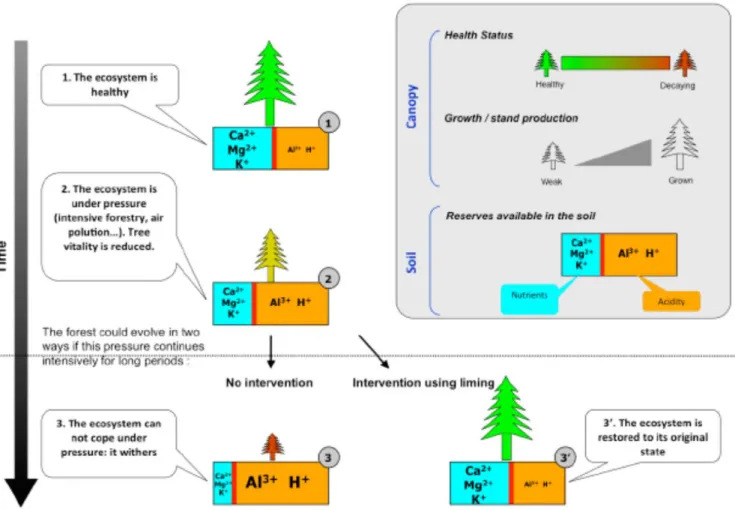
Figure 1. Possible evolution scenarios for a low mineral fertility forest ecosystem faced with external pressures such as
3
Moreover, in the 1950’s, following sharp decline in agricultural land use, conifers were planted in heavily fertilized soils. The chemical imbalance in these soils (high levels of nitrogen) put forest ecosystems even further at risk. In order to definitively solve problems of decline and instability, and in order to restore the quality of water and soil in degraded forest areas, it is necessary to address the causes of soil acidification and the consequences:
⇒ To treat the causes : Air pollution is a major source of acidity. Policies reducing pollutant releases should be encouraged. In addition, intensive forest management should be avoided in forests already showing symptoms of nutrition deficiency or high acidification of water and soil. A more efficient way of managing nutrient reserves in soil needs to be adapted.
⇒ To treat the consequences : Providing appropriate mineral elements helps to combat soil acidity. This practice of liming is aimed at improving the physical or physicochemical properties of soil for proper functioning. We differentiate treatment by liming from fertilization which aim is to increase production. A supply of nitrogen can stimulate tree growth but also increase the need for cations – which can further worsen the state of decline in trees already deficient in calcium and magnesium.
Inputs and productive configuration
In the 1960s at the forestry station in Nancy, the first studies on forest soil fertility focused primarily on the relationship between mineral soil fertility and forest production. Between the 1960s and the 1990s, over 60 fertilization tests using nitrogen (N), phosphorus (P) and calcium (Ca) were conducted on experimental sites, designed and maintained for long term monitoring. These tests produced a huge amount of data on the growth of trees and nutritional imbalances in soils and allowed scientists to rapidly respond to the issue of acid rain. The combination of these tests with additional tests on restoration of soil fertility formed the “Amendment Network”. All data characterizing the different plots and trials from the 1980s to present day are referenced in a common database. During the same period, research on soil fertility evolved into a global study to examine the functionality of the forest ecosystems: maintaining mineral soil fertility is the basis for a sustainable system. This involves maintaining a balance of inflows and outflows inherent in the ecosystem. To do this, experimental sites, highly equipped and dedicated to the long term study of biogeochemical cycles were installed and monitored. Parameter measurements and sample collection are done in situ every 28 days at these “high resolution” sites to establish namely the input‐output balance of minerals and improve the understanding of nutrient cycling in forest. Most of these sites are now part of the Environmental Research Observatory SOERE F‐Ore‐T. All data collected through this amendment network and study sites is used to supply a software program called ‘REGESOL’ in order to calculate the quantitative liming needs to restore normal functioning of the forest ecosystem.
Research outputs
INRA has developed a complete expertise on soil and nutritional diagnosis. Determining specific needs to be treated by liming begins by analyzing the state of health of the tree population:
Visual observation of the health of the trees:
Observing the tree crowns can help detect a poor state of health. The most common symptoms are yellowing needles and leaves, decreased leafing, small leaves, drying out of young shoots… However, these observations alone are not sufficient to determine the causes of wilting (illness, poor nutrition.) but they can aid in anticipating such a decline.
Foliar diagnosis and mineral reserves in soils:
Foliar diagnostics provide information about the population’s nutritional state which affects biomass growth. They are based on the analysis of content levels of N, P, K, Ca and Mg in needles or leaves collected at the end of the growing season from branches in the upper third portion of the crown of dominant trees most representative in the stand of trees. These measured concentrations are compared to standard levels established for each species to determine whether the deficiency threshold has been reached or if the stand is at a critical stage (i.e. when mature stand growth has reached 90% of maximum growth) or if on the contrary, the stand is in optimal nutritional condition. Analyzing soil samples is then used to determine stocks of bioavailable nutrients necessary for plants and soil structure. These stocks are calculated from slices of soil taken at the root level (0‐70 cm) and then compared to functional standards established for the biogeochemical cycles of nutrients in the ecosystem (recycling, loss, ...). From this analysis, using the software program REGESOL, researchers are able to define the quantitative needs by liming for each forest plot and for each soil type to restore normal functioning of the forest ecosystem. From 1995, INRA developed REGESOL software with the support of the Ministry of Agriculture and the French National Office for Forests (ONF). REGESOL, pending registration at the APP (Agency Protection Program), is now used to estimate nutrient requirements for several species (Spruce, Pine, Douglas, Oak, Beech ...) on soils ranging from acidic to saturated soils. Simulations can be run to give an advice on forest restoration, dynamic forestry and/or in support to Wood Energy forestry where material exports are high. For several years, the BEF research unit of EFPA in Nancy has responded to the demand of forest managers for additional specific plot level diagnoses that are needed when nutritional deficiencies and bad stand health conditions are detected. These diagnoses are done at the massif scale. Expertise has enabled INRA to provide forest managers and local authorities with the results of soil and nutritional diagnoses (soil type, pH, nutrient contents and pools of N, C, K, P, Mg, Ca, Cu, Na, Mn, Zn, B, etc). Maps are also established, indicating potential risks and signaling any need of calcium (CaO), magnesium (MgO), potassium (K2O), and phosphorus (P2O5) oxides. These maps provide a tool for
simplified decision making with a color code to quickly identify plots deficient in each of these elements.
Knowledge flow and intermediaries
INRA provides expertise on the diagnosis. The implementation of liming (soil analysis, treatment) is done by the private sector (notably Gessofor company). The maps and reports provided by INRA and Gessofor company allow managers and forest owners to decide whether or not to lime in order to restore the proper functioning of the ecosystem. The cost of treatment (spraying by helicopter) is on average 500 €/ha.
Liming is a simple and natural treatment: a combination of non toxic calcium and magnesium carbonate, usually in the form of crushed rock and therefore completely natural. It is added to the ground (usually only once), sometimes with potassium if needed. Liming is made by specialized companies to meet the requirements of the concerned client. Long‐term post amendment monitoring (> 20 years) of the soil composition is systematically performed by INRA.
Scientific publications and dissemination
Belkacem, S., Nys, C. (1997). Effects of liming and gypsum regimes on chemical characteristics of an acid forest soil and its leachates. Annales des Sciences Forestières, 54 (2), 169‐180. Bonneau, M., Landmann, G., Nys, C. (1990). Fertilisation of declining conifer stands in the Vosges and in the French Ardennes. Water Air and Soil Pollution, 54, 577‐594. Bonneau, M., Landmann, G., Ranger, J., Dreyer, E., Nys, C. (1995). Fertilization of declining conifers in the Vosges and the Ardennes: effects on soil, nutrient cycling, and tree health, growth and physiology. Dans G. Landmann, M. Bonneau, Forest decline and atmospheric deposition effects in the French mountains (p. n.p.). Berlin, DEU : Springer.
5
Bonneau, M., Nys, C. (1992). Nitrogen cycle in a spruce stand in the French Ardennes with high nitrogen pollution. Dans A. Teller (Editeur), P. Mathy (Editeur), J.N.R. Jeffers (Editeur), Responses of Forest ecosystems to environmental changes (p. 669‐672). London, GBR : Elsevier.
Larrieu, L., Nys, C., Jabiol, B. (2006). Prise en compte de la fragilité chimique des sols forestiers dans les conseils de gestion. Illustration pour une sapinière‐hêtraie montagnarde sur roche acide (Vallée d’Aure, Hautes‐Pyrénées). Revue Forestière Française, 53 (6), 532‐548. DOI : 10.4267/2042/8021 Legout A., Dambrine E., Pollier B., Guerold F., Poswa A., van der Heijden G., Bolou Bi E., Angeli N., Nys C. (2011). La pratique de l’amendement en vue de la restauration de la qualité des sols et des eaux acidifiées. Plaquettes réalisées en partenariat avec le Conseil Général des Vosges et l’Agence de l’eau Rhin‐Meuse. pp 11. Legout A., Walter C., Nys C. (2008). Spatial variability of nutrient stocks in the humus and soils of a forest massif (Fougères, France). Annals of Forest Science. 65 : 108‐118. Marçais, B., Wargo, P.M. (2000). Impact of liming on the abundance and vigor of Armillaria rhizomorphs in Allegheny hardwoods stands. Canadian Journal of Forest Research, 30, 1‐11. Nys C., Collet R., Legout A. (2010). Dossier d’expertise : carte de fertilité chimique et calcul des besoins en nutriments des hêtraies de la Voge en vue d’un amendement. Rapports individuels de 6 pages transmis à 13 communes de la Voge.
Nys, C., Bonneau, M., Picard, J.F. (2000). Amendements et fertilisants associés : remèdes pour une meilleure fertilité chimique des sols forestiers. Forêt Privée, 43 (252), 51‐61.
Picard, J.F., Becker, M., Nys, C., Dupouey, J.L. (1999). Evolution à moyen terme de la croissance radiale de l'épicéa et du hêtre en relation avec la fertilisation/amendement : analyse dendroécologique. Revue Forestière Française (2), 197‐218. Ranger, J., Mohamed, A.D., Gelhaye, D. (1995). Effet d'un amendement calco‐magnésien associé ou non à une fertilisation, sur le cycle biogéochimique des éléments nutritifs dans une plantation d'épicéa commun (Picea abies Karst) dépérissante dans les Vosges. Annales des Sciences Forestières, 51 (1), 455‐475. Ranger, J., Robert, M., Bonnaud, P., Nys, C. (1990). Les minéraux‐test, une approche expérimentale in situ de l'altération biologique et du fonctionnement des écosystèmes forestiers. Effets de types de sols et des essences feuillues et résineuses. Annales des Sciences Forestières, 47, 529‐550 Renaud J. P., Picard J. F., Richter C., Legout A., Nys C. (2009). Calcium and magnesium amendments and ecological functioning ‐ overview of experiments conducted in Eastern France ‐ Vosges massif and Ardennes. Revue Forestière Française. 61 (3) : 283‐300.
Van der Heijden G., Legout A., Nicolas M., Ulrich E., Johnson D.W., Dambrine, E. (2011). Long‐term sustainability of forest ecosystems on sandstone in the Vosges Mountains (France) facing atmospheric deposition and silvicultural change. Forest Ecology and
7
Impacts 1
Since 2010, diagnoses have been made in France on ca. 30,000 ha, mainly public forests owned by local municipalities and located in the Vosges area. Approximately 50% of such analysis led to advised treatment by liming. Only 2,000 hectares of beech have been treated to date. Other proposals of liming are in process, waiting for budgets by their concerned municipalities.
Environmental impact :
Expertise and liming operations permitted to restore the capacity of soils to neutralize acids and replenish nutrient pool. The effects are long lasting, and permit over the long term: ⇒ To increase the pH levels and saturation of the first soil horizons in first time. After a several years period, for certain soil types such as granitic soils, pH is increased in depth. ⇒ To improve the water quality of surface water and therefore improve aquatic biodiversity in streams. The chemical quality of streams is improved immediately after treatment by liming. In addition, liming of the soil also improves the chemical quality over the long term. Ecological functioning of forest streams is based largely on leaf decomposition that then serves to feed a multitude of organisms. In acidic streams, leaf decomposition is dramatically reduced and this impacts the entire food chain. Soil liming improves the decomposition of litter benefiting all living organisms in streams. Fish, such as trout, often repopulate streams after liming.
⇒ To promote the activity of soil organisms and thus the decomposition of forest litter. The presence of earthworms in the soil appears to increase with soil liming, allowing for better circulation of mineral elements in the ecosystem.
⇒ To improve specific biodiversity of fauna and flora. Indicator species appear in more fertile environments without the disappearance of acidophilic species.
⇒ To improve the health of trees. The frequency of yellowing trees is reduced and the percentage of defoliation decreases after liming. Leaf chemical composition progressively reaches optimal values. It appears that treated trees would better withstand climate disruptions (drought, storm, etc.). Studies are in progress to test this hypothesis. Health impact : In the Vosges massif communes, some water pipes are still made of lead. The lead concentration in drinking water is even higher when the water is acidic and remains for long periods in these pipes. Reduction in the acidity of water lessens the risk of waterborne lead poisoning. In addition, acidification may also lead to the emergence of toxic forms of aluminum in water sources. Economic impact
:
Liming allows to restore the deficient state of health of forests and to promote satisfactory tree growth. Results from experimental plots show recovering up to 20% yield losses for situations of nutritional deficiency, and more than 50% in case of proven severe deficiency. Liming therefore avoids a significant economic loss. In addition, a visible dying or declining forest has a negative impact on recreational activities.
Impacts 2
The beneficial effects of the amendment are gradually being acknowledged by forest managers, local authorities and environmental groups, as applications expertise are developed in other regions: Massif Central, Alsace, Brittany, etc. Expertise can be made now on most French forest species.
9
Impact vector
Dimension of impact Importance (/5)Economic 2/5 Used on 2000 ha. Long lasting effects: forests are back to a normal productivity (recovering between 20% to 50% yield losses).
Effects on SME’s and recreational activities in the region.
Environmental 4/5 Maintenance of ecosystems. Restoring sanitary state of trees: limiting pathologies, increased resistance to processionary caterpillars …
Protection of water quality. In comparison with systematic fertilization (Germany), forest liming prevents unbalanced nutrition and eutrophication
Forest liming may also increase forest’s resistance to the effects of droughts
Sanitary 2/5 The acidification of surface waters facilitates dissolution of lead in pipes carrying water for human consumption, which can trigger lead poisoning. Forest liming prevents this acidification.
Data sources:
This report has been drawn based on bibliographic desk research and some semi‐directive interviews conducted with INRA researchers and stakeholders involved in this innovation process (French National Office for Forestry‐ONF, the firm Gessofor, …).