HAL Id: hal-02127908
https://hal.archives-ouvertes.fr/hal-02127908
Submitted on 13 May 2019HAL is a multi-disciplinary open access
archive for the deposit and dissemination of sci-entific research documents, whether they are pub-lished or not. The documents may come from teaching and research institutions in France or abroad, or from public or private research centers.
L’archive ouverte pluridisciplinaire HAL, est destinée au dépôt et à la diffusion de documents scientifiques de niveau recherche, publiés ou non, émanant des établissements d’enseignement et de recherche français ou étrangers, des laboratoires publics ou privés.
Ménières syndrome: a daily pattern of changes in
hearing in the affected ear
Vernon Thornton
To cite this version:
Vernon Thornton. Ménières syndrome: a daily pattern of changes in hearing in the affected ear. [Research Report] None. 2019. �hal-02127908�
Ménières syndrome: a daily pattern of changes in hearing in the affected ear.
Summary
A simple test of hearing in the affected ear of a sufferer of Ménière's disease (me) has shown the following: a regular daily pattern of changes in hearing; the existence of three daily peaks of improvement in hearing; and that these peaks occurred about two hours after each of three daily meals. In one test, after skipping breakfast, the corresponding peak was absent. It is proposed that these changes in hearing were the result of raised blood insulin and sugar levels following a meal. This caused increased blood flow in the tiny blood vessels in the inner ear and improved the energy supply to vital ion-pumping epithelial cells.
The context
The first symptom's of what turned out to be Ménière's syndrome appeared while on a walking holiday in Cyprus, in 2002, with three severe vertigo episodes within a week. During the following months, severe vertigo was experienced at irregular intervals and the weeks between were troubled with periods of giddiness lasting days. The spells of vertigo and giddiness were accompanied by tinnitus and a sensation of 'fullness' in the right ear. The hearing loss in the right ear became evident – when using the telephone, for example. An audiogram confirmed the characteristic pattern of hearing loss, with the low tones being particularly affected. The left ear was normal. After about four years, tinnitus, which had come and gone with the periods of vertigo and giddiness, became a permanent companion, although varying in 'volume'.
In 2009, observations on several occasions led to the suspicion that the hearing level in the right, affected ear changed during the day. Old scientific reflexes took over and I decided to check out what was happening. Using the rudimentary hearing test that will be described, hearing was tested during the course of a normal day. Hearing clearly changed, so the observations were continued for the rest of the week, giving the results described below.
A comment on the guinea-pig: in good general health, aged 64 and 70kg, normal weight, at the time of the tests. No medication was taken during the week of observation, nor had any been taken for several months before that. However, cinnarizine (Stugeron) had been found to be helpful in dealing with dizziness and vertigo, and from such experiences it was known that one 15 mg tablet was effective within about 45 minutes. Some weeks after the time when the present observations were made, the opportunity arose to check the effect of cinnarizine on hearing and these results have been included.
The method
Given the limited means, it was necessary to set up a very simple hearing test. The 'laboratory' was a room with closed doors, double-glazed windows and low ambient noise in the
neighbourhood. The sound source was a ticking clock. During the test, hearing by the normal left ear was blocked with a finger on the tragus. The right, malfunctioning ear was held side on to and at a level with the clock. Stopping the right ear with a finger during the test blocked out the ticking sound completely, as one would expect if only that ear was hearing the ticking during the test. The principle of the test was to find the distance from the clock at which the ticks could just be heard. Two movements were made to determine the final estimate of distance from the clock. First a position was taken where the ticks could be clearly heard and then a position further away from the clock was found where the ticks could only just be heard. To correct for any entrainment taking place, the null position was checked by stepping further away so that for a moment the ticking could
not be heard, and then returning until the ticking could just be heard once more.
Finding the null point was inconvenienced by two problems: there was a tendency for the sounds to fade in and out over a period of seconds while standing still at the null point; and hearing faint ticks with a tinnitus-affected ear required patience. Despite this, a second measurement made after a short time out of earshot of the clock was identical to the first. This was also the case if, for example, loud music was played in the intervening period.
Other attempts were made to undermine what turned out to be the robustness of the method. Measurements of the null point were not different if the guinea pig crouched low for several minutes, and moving between crouching and standing did not change the loudness of the ticks. Head position, chin up or chin down, did not have any effect. The Valsava manoeuvre had no effect on hearing sensitivity, but the sound of the ticks became tinnier while pressure was maintained. Vigorous cycle rides of 30 minutes between two tests did not have any detectable effect on the results.
Consistent with the sophistication of the method, distance from the clock to the null point was measured by counting the number of (20 cm) floor tiles between the two points. Sometimes a half-tile estimate seemed justified, but no attempt was made to over-refine. There were occasions when hearing in the right ear was so dull that the ear was practically up against the clock.
The data have been presented with no modification whatsoever; (although there might be a case for allowing for the effects of the inverse-square law). There were occasional prolonged gaps in some of the daily records that demonstrate that the guinea pig had Free Will.
Results
The hearing tests were performed during the week 4 – 10 May, 2009. The results for the most complete day of recording are indicated in the following Figure 1.
Figure 1
As explained, the measure of hearing is simply '5 tiles' from the clock (for example). The three red arrows indicate 'feeding time'. The two blue bars are measurements taken the following morning, not the morning of the test.
The results for each of the seven days recorded indicated the presence of peaks of improvement in hearing, Figure 1 being the sharpest example. It seemed clear that the peaks followed each meal and since the morning peak was consistently the most clearly defined, it was decided to test the effect of skipping breakfast.
Figure 2
The result of skipping breakfast.
The level of hearing throughout this day was duller than in the previous example and illustrates the fog through which it a challenge to discern what is going on. Because of these day-to-day changes, it was impossible to create the ideal conditions for one-variable experiments, alas. Has skipping breakfast resulted in the disappearance of the first peak? Maybe; that is all that can be said. In all, 171 measurements were made over the seven days. They are presented together in Figure 3. To simplify the presentation, the results of all seven days were placed in hourly groups and averaged.
Figure 3
The data of a week of observations presented as a representative day.
The hearing test was used in two other ways: to look for an effect of the drug cinnarizine; and to check for changes in hearing over a longer period of time.
First a word about dizziness, sometimes leading to vertigo, which is a manifestation of Ménière's syndrome. Cinnarizine, a treatment for motion-sickness, had proved in the past to be useful for treating giddiness, and prevented the development of vertigo if taken in time. The opportunity to check for an effect of cinnarizine on hearing arose, some while after the above measurements were taken, on the 13 May. Dizziness was felt just after 3 pm and began quickly to worsen; it was decided to take a cinnarizine tablet and to start hearing measurements. Cinnarizine was taken at 3.30 pm and hearing measurements were continued thereafter.
Figure 4
The effect of the cinnarizine was detected after about thirty minutes: sweating stopped and the sensation of giddiness began to fade. Did cinnarizine improve hearing in the damaged ear? Again, a resounding: maybe. Hearing obviously improved, but it could be argued that the earlier results showed that hearing improves anyway in the evening. On the other hand, my experience with dizziness and vertigo is that if it had continued, hearing would have remained blocked for many hours. So cinnarizine has had some effect, direct or indirect, on hearing. The blue bars are measurements made the following morning, and the improvement had disappeared. I resisted the temptation to test for an effect of cinnarizine at other times than as a treatment for giddiness. Just to complicate the interpretation, it should be pointed out that cinnarizine is not an agent with a
specific, clearly-defined action.
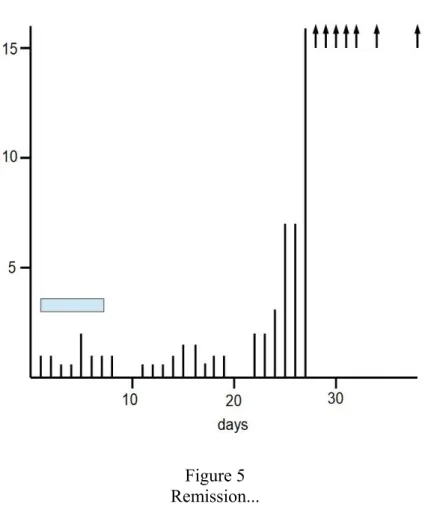
As I mentioned earlier, the general level of hearing in the diseased ear varied from day to day. To check this effect over a longer period, one early-morning reading was taken each day over a period of 37 days. The result was a surprise.
Figure 5 Remission...
The blue bar indicates the week of testing reported above. The level of 16 on the hearing scale is the maximum that can be measured using the method that I have described. The results are self-explanatory. The damaged ear returned to, as far as I could tell, normal function. Without insight into the mechanisms at work, it would be a waste of time speculating on the cause of the
improvement. All I note is that the change took place over the course of roughly a week. Discussion
I am not in a position to discuss the physiology of the inner ear, and what may be the
pathological processes operating in Ménière's disease, except in a very general way; nor do the data allow over-interpretation. The key result is the detection of the relatively rapid changes in hearing in
the damaged ear during the course of the day. The existence of three peaks of improvement seems pretty clear. A simple explanation springs to mind: hearing improves after a meal in a way that suggests that raised blood glucose and insulin levels resulting from a meal stimulate blood flow in the tiny blood vessels of the inner ear. Normal function of the inner ear, involving an ion-pumping epithelium, is highly energy-dependant, so restriction of blood flow would be particularly
damaging. If the cause of ear pathology in Ménière's syndrome is damage to the blood vessels, then any agent that improves blood flow and at the same time improves energy supply, would have beneficial effects. These results therefore reinforce the idea that the blood supply to the inner ear is of crucial importance in this pathology. What remains inexplicable about Ménière's disease is the apparently haphazard coming and going of the blood supply restriction (if that is indeed the final common cause) over the longer term. It's an interesting problem.
As I am updating this account (2019), I will point out that the story does not have a happy ending, at least as far as my ear is concerned. Eventually the right ear packed up altogether, taking its symptoms with it (hooray for me though!). It looks as though the ups and downs that have been recorded here represent blips on a downward curve marking some kind of slow (years) degenerative change in the inner ear. My suggestion is the following: if the degenerative changes leading to deafness (and loss of other functions) are gradual, the brain has the capacity to adapt to the misinformation that it is getting from the damaged ear. If on the other hand the degenerative changes are accentuated by periodic crises, the brain fails to orchestrate information about where the head is in space and the symptoms of the disease classified as Ménière's syndrome is the result. One part of the mystery, therefore, is the cause of these crises.
Vernon Thornton 21/02/2019