HAL Id: hal-01167335
https://hal.archives-ouvertes.fr/hal-01167335
Submitted on 24 Jun 2015
HAL is a multi-disciplinary open access
archive for the deposit and dissemination of
sci-entific research documents, whether they are
pub-lished or not. The documents may come from
teaching and research institutions in France or
abroad, or from public or private research centers.
L’archive ouverte pluridisciplinaire HAL, est
destinée au dépôt et à la diffusion de documents
scientifiques de niveau recherche, publiés ou non,
émanant des établissements d’enseignement et de
recherche français ou étrangers, des laboratoires
publics ou privés.
Copyright
Analysis of virtualization as a solution to VR-system
sharing
Jean-Marie Normand, Aurélien Milliat, Marc Christie, Fabien Picarougne,
Guillaume Moreau
To cite this version:
Jean-Marie Normand, Aurélien Milliat, Marc Christie, Fabien Picarougne, Guillaume Moreau.
Analy-sis of virtualization as a solution to VR-system sharing. International Conference on Artificial Reality
and Telexistence, Dec 2013, Tokyo, Japan. �hal-01167335�
Analysis of virtualization as a solution to VR-system sharing
Jean-Marie Normand∗
CERMA, Ecole Centrale de Nantes
Aur ´elien Milliat† LINA/CLART ´E
Marc Christie‡ IRISA, University of Rennes 1
Fabien Picarougne§ LINA, University of Nantes
Guillaume Moreau¶ CERMA, Ecole Centrale de Nantes
ABSTRACT
Immersive Virtual Reality (VR) systems offer vast opportunities in terms of scientific research as well as in terms of industrial appli-cations. However their construction and maintenance costs remain an issue. It is therefore essential to find means to easily and safely share VR equipments among multiple users in order to reduce such costs, as well as democratize their use.
In this paper, we analyze the interest of virtualization techniques to administrate, maintain and share complex VR systems among multiple users with heterogeneous needs in software, drivers, op-erating systems and peripherals. Despite the general idea that vir-tualization techniques strongly impact performance, we show that these technologies can be a viable solution with a careful selection of virtualization tools and graphics hardware.
Index Terms: I.3.7 [Computer Graphics]: Three-Dimensional Graphics and Realism—Virtual Reality D.4.3 [Operating Systems]: File Systems Management—Distributed file systems
1 SHARINGVRSYSTEMS
Although VR systems are becoming more and more popular, their cost remain high thus preventing small companies or research groups to use them. As a consequence, these systems should be shared among different users to at least cover construction, soft-ware and hardsoft-ware maintenance and operator-related costs. In turn, this raises issues on how to effectively maintain multiple configura-tions for different users and how to efficiently switch between such configurations. A configuration here refers to a set of software, li-censes, drivers, operating system, peripherals, etc. representing the environment of a specific user in a VR system.
In this article we show that recent virtualization technologies are efficient enough to be used as a viable solution to the problem of sharing VR systems and that they offer benefits in terms of automation of management and maintenance operations.
In the task of sharing a VR system, a good degree of flexibility is necessary to switch between configurations. Currently, flexibility can be enforced by using one of the following techniques: 1) HDD switching, that consists in preparing a user configuration as a set of hard-drives and physically installing them in the host machine(s) of the VR system whenever needed; 2) Multiboot that consists of in-stalling different configurations on the VR system machine(s) and selecting one during the boot process; and 3) Deployment of virtual hard drives images that consists of creating hard-drive images files corresponding to each user configuration that can be deployed (i.e. copied) onto the VR system via network communication. These
∗e-mail:[email protected] †e-mail:[email protected] ‡e-mail: [email protected]
§e-mail:[email protected] ¶e-mail:[email protected]
techniques are relatively easy to implement, offer sufficient level of data privacy and ensure optimal performance by directly running on the hardware of VR system host machine(s). However, some draw-backs remain, either on the necessity of physical HDD switching, on the copying of hard drive images, and in all cases in the difficulty to maintain and administrate such solutions.
2 VIRTUALIZATION FORVRSYSTEMS SHARING
An alternative to classical sharing techniques relies on the use of virtualizationtechnologies. To the best of our knowledge, virtu-alization has not yet been employed for VR systems although it presents interesting benefits.
Virtualization is a technology that aims at abstracting the physi-cal hardware of a host machine by using a virtual machine monitor (also known as a hypervisor). The hypervisor, a minimalist OS, handles access to the physical resources of the hardware across dif-ferent guest operating systems (also called Virtual Machines - VMs) running on the host. In the context of VR systems, each VM will correspond to a user configuration (i.e. OS, software, drivers, 3D data, etc.). The VMs are totally isolated from the hardware of the host machine and as a consequence have no direct access to the CPUs, GPUs or I/O functionalities. In practice, the hypervisor acts as a controller between the hardware and the VM, and can emulate peripherals or provide means to offer a controlled direct access to hardware components to ensure performance.
Virtualization has the potential to offer a flexible solution for sharing a VR system by simplifying maintenance operations and providing automated features such as batch administration (update, etc.), or copying a configuration in background. This technology also allows for testing or preparing configurations, i.e. creating new VMs, outside of the VR system thus optimizing its uptime. But due to the complexity of VR setups, virtualization has not been evaluated in the context of VR sharing so far.
3 PERFORMANCE EVALUATION
In order to evaluate the efficiency of virtualizing a VR system, we compare results obtained from a native vs. a virtualized mode. The native mode corresponds to a classical installation on which bench-marking applications are directly executed. In the latter mode, a hypervisor controls a virtualized operating system (i.e. a VM) on which the benchmarking applications are executed. Tests were run on a HP Z800 computer with the following components: CPU Intel Xeon [email protected] GHz; 3.7 GB RAM DDR3@1333 MHz; HDD Seagate 500 GB@7200 rpm and with two GPU configurations: #1 NVIDIA Quadro FX 3800 and #2 ATI FirePro V8800. In the vir-tualized mode, we selected the Xen [1] hypervisor, which offers at the date of this publication, better performances and best hardware compatibility.
3.1 Hardware performance
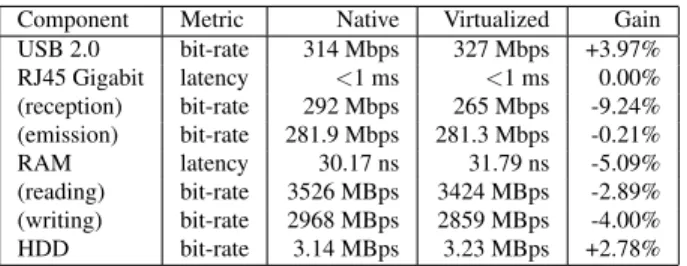
We first focus on individually evaluating performance of hardware components classically involved in VR setups (USB, networking, RAM, VR peripherals and 3D graphics). Table1summarizes the performance measured in native vs. virtualized modes.
Component Metric Native Virtualized Gain USB 2.0 bit-rate 314 Mbps 327 Mbps +3.97% RJ45 Gigabit latency <1 ms <1 ms 0.00% (reception) bit-rate 292 Mbps 265 Mbps -9.24% (emission) bit-rate 281.9 Mbps 281.3 Mbps -0.21% RAM latency 30.17 ns 31.79 ns -5.09% (reading) bit-rate 3526 MBps 3424 MBps -2.89% (writing) bit-rate 2968 MBps 2859 MBps -4.00% HDD bit-rate 3.14 MBps 3.23 MBps +2.78%
Table 1: Average performance (over 10 runs) of the main compo-nents involved in a VR system. Gain for virtualized mode is ex-pressed in percentage.
While some differences appear in the RAM latency and Giga-bit reception, at the practical level the impact is negligible since the benchmark tools (PassMark Advanced Memory Test, PassMark Advanced Network Test) perform successive copies of large mem-ory chunks, or network packets, situations rarely encountered in practice in VR applications. Moreover, in practice, VR peripherals using network communication (cf. Section3.2) did not suffer from noticeable performance degradation.
3.2 Graphics performance
This second study focuses on graphics capacities: dual display, stereoscopy, synchronization and on graphics performance in ren-dering complex 3D scenes. Table2compares graphic chipsets (ATI vs. NVIDIA), the Mono or Stereo display as well as the DirectX9 (DX9), DirectX11 (DX11) or OpenGL drivers. The benchmarking applications mentioned in the table are: Heaven: Unigine Heaven Benchmark 4.0, Valley: Unigine Valley Benchmark 4.0, and Fur-mark: Geeks3D Furmark v1.9.2. ATI cards have not been tested in stereo due to driver incompatibilities between native and virtualized modes. Applications were run in fullscreen mode at the resolution of 1650 × 1050 with 8× anti aliasing activated.
Configuration Native Virt. Gain NVIDIA,Mono, Valley, DX11 338 348 -2,87% NVIDIA,Mono,Heaven, DX11 229 222 3,15% NVIDIA,Mono, Valley, OpenGL 276 282 -2,13% NVIDIA,Mono, Heaven, OpenGL 189 187 1,07% NVIDIA,Mono, Valley, DX9 376 381 -1,31% NVIDIA,Mono, Heaven, DX11 278 274 1,46% NVIDIA,Mono, Furmark, OpenGL 303 311 -2,57% NVIDIA, Stereo, Heaven, DX11 172 169 1,78% NVIDIA, Stereo, Valley, DX9 312 288 8,33% ATI, Mono, Valley, DX11 1088 1098 -0,91% ATI, Mono, Heaven, DX11 395 398 -0,75% ATI, Mono, Furmark, OpenGL 1966 1967 -0,05% ATI, Mono, Valley, OpenGL 495 498 -0,60% ATI, Mono, Heaven, OpenGL 292 294 -0,68% ATI, Mono, Valley, DX9 1338 1355 -1,25% ATI, Mono, Heaven, DX9 901 900 0,11%
Table 2: Comparison of graphical performance between native and virtualized 3D applications on 3D benchmarks in units of the bench-mark. Gain for virtualized mode is expressed in percentage.
Differences between monoscopic and stereoscopic modes are limited to a few percent (maximum loss of−2.87%), with however an unexpected gain of 8.33% in the favour of virtualization on the NVIDIA stereo benchmark with DX9. Cases where the virtualized mode was found more efficient is probably due to re-ordering of operations done by the hypervisor. The very clear outcome of these
tests is that purely graphics performance are comparable in virtual-ized and native modes.
Table3highlights performance in VR contexts that are measured in frames per second using Fraps software. Two VR applications have been tested: Improov v1.0 based on Virtools 5.0.0.14 with VRPack 2.6 connected via DTrack to an ART motion capture sys-tem, and Unity 4.1.3 using Middle VR v.1.2.1.
Configuration Native Virt. Gain ATI, side by side, Unity 106,10 58,29 -82,01% ATI, master, mono, sync, Improov 43,57 34,78 -25,26% ATI, slave, mono, sync, Improov 43,58 34,74 -25,46% NVIDIA, master, mono, Improov 19,77 19,75 -0,06% NVIDIA, master, stereo, Improov 20,50 21,06 2,66% NVIDIA, slave, mono, Improov 19,78 19,70 -0,43% NVIDIA, slave, stereo, Improov 20,46 19,82 -3,24% NVIDIA, stereo, Unity 168,85 154,15 -9,53%
Table 3: Comparison of graphical performance between native and virtualized VR applications in frames per second and percentage in gain of virtualized applications wrt. native applications.
In a VR context, results demonstrate close to equivalent per-formance for NVIDIA cards on the two VR applications (with a peak loss of 10% for Unity in stereo). Further investigations are necessary to understand the important performance impact suffered by ATI cards (from 25 to 80%), possibly due to a combination of drivers, hypervisor and virtualized operating system.
Together with these results, compatibility tests have been per-formed on classical peripherals used in VR: ART tracker (us-ing DTrack1, DTrack2, TrackPack and DTrack2 with TrackPack) connected via RJ45, Virtuose arm 6D35-45 connected via RJ45, 6D mouse from 3D Connexion (USB) and MOTU Audio 3.6.7.0 (Firewire) soundcard. In all cases the peripherals displayed the same behaviour in native and virtualized modes demonstrating an unnoticeable impact of virtualization technologies on these periph-erals as well as connection types.
The virtualized solution has been successfully tested on two 4-sided CAVE systems, and has raised significant interest from the maintainers and operators in charge of these platforms.
4 DISCUSSION
Easily sharing and maintaining complex VR setups appear in the short-term future as mandatory steps to offer multiple users with specific needs (companies, laboratories, individuals) a better access to VR technologies, as well as to absorb the costs of such high-end systems. In this paper we showed that, among other techniques, virtualization is an interesting solution for VR system sharing. In-deed, as well as offering close to native performance, both in terms of graphics and of hardware components, this technology present some benefits: backing up a user configuration, batch administra-tion to manipulate user VMs, configuring and testing user config-urations outside of the VR room thus increasing availability of the VR room.
Nevertheless, setting up a virtualization solution requires evalu-ating a chain of hardware and software compatibilities, which can be a time-consuming task. However, the very fast evolution of hard-ware in the direction of better support of virtualization technologies opens great perspectives in simplifying this task.
REFERENCES
[1] P. Barham, B. Dragovic, K. Fraser, S. Hand, T. Harris, A. Ho, R. Neuge-bauer, I. Pratt, and A. Warfield. Xen and the art of virtualization. SIGOPS Oper. Syst. Rev., 37(5):164–177, Oct. 2003.1