HAL Id: hal-00717332
https://hal.archives-ouvertes.fr/hal-00717332
Submitted on 12 Jul 2012
HAL is a multi-disciplinary open access
archive for the deposit and dissemination of
sci-entific research documents, whether they are
pub-lished or not. The documents may come from
teaching and research institutions in France or
abroad, or from public or private research centers.
L’archive ouverte pluridisciplinaire HAL, est
destinée au dépôt et à la diffusion de documents
scientifiques de niveau recherche, publiés ou non,
émanant des établissements d’enseignement et de
recherche français ou étrangers, des laboratoires
publics ou privés.
Automatic synthesis of TTA processor networks from
RVC-CAL dataflow programs
Jani Boutellier, Olli Silven, Mickaël Raulet
To cite this version:
Jani Boutellier, Olli Silven, Mickaël Raulet. Automatic synthesis of TTA processor networks from
RVC-CAL dataflow programs. Signal Processing Systems (SiPS), 2011 IEEE Workshop on, Oct 2011,
Beyrouth, Lebanon. pp.25 -30, �10.1109/SiPS.2011.6088944�. �hal-00717332�
AUTOMATIC SYNTHESIS OF TTA PROCESSOR NETWORKS FROM RVC-CAL
DATAFLOW PROGRAMS
J. Boutellier, O. Silv´en
Computer Science and Engineering Laboratory
Department of Electrical and Information Engineering
FI-90014 University of Oulu
M. Raulet
INSA Rennes
IETR
FR-35708 Rennes Cedex 7
ABSTRACT
The RVC-CAL dataflow language has recently become stan-dardized through its use as the official language of Recon-figurable Video Coding (RVC), a recent standard by MPEG. The tools developed for RVC-CAL have enabled the transfor-mation of RVC-CAL dataflow programs into C language and VHDL (among others), enabling implementations for instruc-tion processors and HDL synthesis.
This paper introduces new tools that enable synthesizing RVC-CAL dataflow programs automatically into application specific processor networks. Each processor in the network performs the functionality of one RVC-CAL actor. The pro-cessors are of the Transport Triggered Architecture (TTA) type, for which a complete codesign toolset exists. The ex-isting tools enable customizing the processors according to the requirements of individual dataflow actors.
The functionality of the toolchain has been demonstrated by synthesizing an MPEG-4 Simple Profile video decoder to an FPGA. The decoder is realized into 21 processors that de-code QCIF resolution video at 20 frames per second with a 50MHz FPGA clock frequency.
Index Terms— data flow computing, design automation, multiprocessor interconnection
1. INTRODUCTION
Signal processing systems constantly need more and more processing performance as their complexity increases. To tackle the increasing program complexity, algorithm design-ers have looked for new ways to express the programs in a less error-prone and more portable fashion than traditional imper-ative languages can offer. At the same time, processing hard-ware designers try to come up with processing platforms that offer better processing performance, scalability and energy-efficiency.
On the software side, a major step into this direction has been the CAL dataflow language [1]. A more restricted ver-sion of the CAL language, named RVC-CAL, has been stan-dardized and used to specify the algorithms and functions re-quired by the Reconfigurable Video Coding standard, which
embodies the recent trends of software modularity, portability and concurrency [2].
Dataflow programs written in RVC-CAL can be compiled into implementation languages with the Open RVC-CAL Compiler (Orcc) that has several backends: C, C++, LLVM assembly and VHDL [3], which enable the algorithms speci-fied in RVC-CAL to be executed on instruction processors or dedicated integrated circuits.
This paper presents a design flow that allows a designer of signal processing systems to write a program in the RVC-CAL dataflow language and automatically generate a multi-processor implementation out of it. In addition to describ-ing the algorithm in RVC-CAL, the designer is responsible for building the processors that are used in the system. The processor design is based on the TCE toolset, which has a graphical user interface and allows the designer to assemble processors without any HDL design skills. The design flow presented in this paper creates VHDL hardware descriptions as a final output and thus enables direct synthesis on FPGA boards. The functionality of the design flow is demonstrated with an MPEG-4 Simple Profile (SP) video decoder that is written in RVC-CAL.
2. BACKGROUND
Before going into the details of our design flow, the RVC-CAL language and the used processor technology are ex-plained.
2.1. The RVC-CAL Language
RVC-CAL is a dataflow language. Dataflow languages are popular in signal processing system design, as they allow the designer to abstract the signal processing system to logical entities that interact with each other. It is up to the designer to decide how to partition the signal processing system into different dataflow entities, which are called actors.
A dataflow actor reads data from its inputs, performs some data processing and finally outputs the results. In RVC-CAL actors communicate with each other over FIFO buffers. The
set of actors interconnected with FIFOs is called an RVC-CAL network. The data is wrapped inside tokens and each FIFO carries tokens of a specified size. Internally, actors work like finite state machines (FSMs) that contain states, state transitions and internal variables.
Conditional execution is the most important feature of RVC-CAL when it is compared to traditional dataflow lan-guages: for example, Synchronous Data Flow (SDF) [4] does not allow conditional execution.
2.2. Transport Triggered Architecture Processors Transport Triggered Architecture processors resemble Very Long Instruction Word processors (VLIW) in the sense that they fetch and execute multiple instructions each clock cy-cle. A major difference, however, is that TTA processors have only one instruction: move, which simply transfers data from an input location to an output. For example, one move in-struction can initiate a data transfer from the output of an add function unit (FU) to one of the inputs of a mul function unit. In [5] it is stated that direct programming of the data transports reduces the register file traffic when compared to VLIWs, but on the other hand makes the compiler design quite challenging, as it is the compiler that schedules the data transports and makes sure that conflicts are avoided. As the compiler does so many decisions at design time, the run-time system is simplified and hence there are savings on the processor gate count and energy consumption.
The design of custom TTA processors has become easy and accessible to everyone through the open source TTA Codesign Environment (TCE) toolset [6, 7]. The TCE toolset offers a graphical user interface for custom processor, func-tion unit and instrucfunc-tion design. The TCE toolset has a compiler which is based on LLVM1and contains a processor
simulator and profiler. TCE also provides a possibility to realize the processors into VHDL files and memory images, which enable easy FPGA synthesis.
2.3. Related Work
There has been prior work similar to that presented in this paper. Park, Oh and Ha [8] list several multiprocessor sys-tem design methods that use various dataflow models as in-put. The difference of our work compared to the ones listed in the article is that our toolchain is the first one that supports the RVC-CAL language, and uses TTA processors.
In [9], a design flow is described for synthesizing hetero-geneous multiprocessor systems out of CAL programs. The difference to our work is that the methodology in [9] does not target a specific platform, but remains on a more abstract level. In contrast, our work targets TTA processor networks and presents all necessary tools down to the level of FPGA synthesis.
1http://www.llvm.org/
Processor Specification
TTA Processor Designer (ProDe) ADF Proces-sor Description Processor in VHDL CAL Network Network Description Actor C code CAL Actors Orcc TTA Backend TTA FIFO Function Units
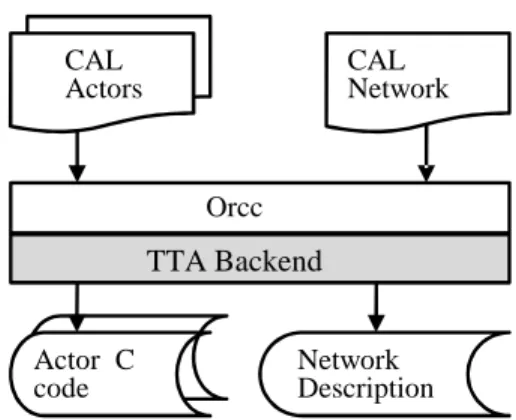
Fig. 1. Production of the (abstract) processor network de-scription and the actors’ C code.
3. PROPOSED SOLUTION
In this paper we propose a design flow that enables a signal processing system designer to write a program in the RVC-CAL language, and automatically produce an FPGA-ready multiprocessor system out of it.
The design flow requires three different inputs from the designer: 1) the actors, 2) the actor interconnection network, and 3) the processors. The actors are source code files written in the RVC-CAL language. An example of an actor is In-verse Discrete Cosine Transform (IDCT) that reads 8 tokens and produces 8 tokens of data. The actor interconnection net-work is an XML file that describes the connections between actors. Finally, the user needs to provide a processor speci-fication for each RVC-CAL actor in the system. Thus, if the signal processing system consists of 15 RVC-CAL actors, the designer has to provide a total of 15 processors to the design flow. These processors can be identical or heterogeneous.
The actor files (written in RVC-CAL) and the actor net-work description file (written in XML) are processed by the Orcc compiler2. For our purpose, Orcc produces a C language
file out of each RVC-CAL actor, as well as a network descrip-tion file that is in a special format required by our design flow. This part of the design flow is depicted in Figure 1.
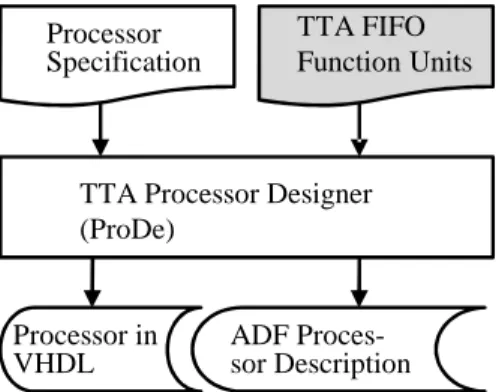
The processors are designed with the TCE (TTA Codesign Environment) toolset. The designer can create the processors with a graphical user interface without writing any hardware descriptions by hand. For each processor, the TCE toolset produces an Architecture Definition File (ADF) and a set of VHDL files. The ADF file is used by the TCE compiler to compile the C code of each actor into TTA machine language and produce memory images for the FPGA implementation. This part of the design flow is depicted in Figure 2.
To enable the design flow presented in this paper, some software tools and components had to be designed for Orcc and TCE. For inter-processor communication, special TTA
Processor Specification
TTA Processor Designer (ProDe) ADF Proces-sor Description Processor in VHDL CAL Network
Tool for generating the interconnect between processors Network Description Actor C code Interconnect in VHDL CAL Actors Orcc TTA Backend TTA FIFO Function Units
Fig. 2. The processor design in our design flow.
FIFO functional units had to be designed to enable the pro-cessors to communicate over hardware FIFOs (see Figure 2). For Orcc, a special TTA backend had to written (see Figure 1). The TTA backend produces C code that is specially meant for TTAs that contain FIFO function units. The network de-scription produced by the TTA backend is processed by the TTANetGentool (Figure 3) that generates the interconnect be-tween the TTA processors. Next, these components and tools are described in detail.
3.1. The TTA FIFO Function Units
The special function units (FUs) for accessing external FIFO memories were designed to enable inter-processor commu-nication with minimal overhead. The ”FIFO read” TTA FU implements three instructions: status (returns number of to-kens in the FIFO), read (reads a token) and peek (shows the value of the next token in the FIFO). The ”FIFO write” TTA function unit, on the other hand, has just status and write in-structions.
The instructions were implemented in C++ for the pro-cessor simulator ttasim and in VHDL for FPGA implemen-tations. The latencies of these new functions units range be-tween 1 and 3 clock cycles depending on the instruction.
3.2. The TTA Backend for Orcc
The backends of the Orcc compiler are easy to customize, as they are specified with StringTemplate (http://www.stringtem-plate.org/) files that can be modified with any text editor. To make each actor directly multiprocessing-capable, the Orcc C language backend was modified such that it produces actors that access FIFOs with their special instructions that were introduced in Subsection 3.1.
Each FIFO connection of an actor is given an index num-ber which directly invokes a TTA function unit that is con-nected to the respective hardware FIFO. Thus, if a processor executes actor A, and actor A has 5 input ports, the processor has 5 separate function units that are directly connected to 5 different FIFOs. HDL Synthesis Network Description Interconnect in VHDL Processor in VHDL Proc. Me-mory Images TTANetGen
Fig. 3. Production of the interconnection network HDL de-scription.
It is also worth mentioning that using C code as an inter-mediate language between Orcc and TCE is not mandatory. Actually Orcc is capable of directly producing LLVM assem-bly [10], which is already an intermediate language of TCE. Using LLVM assembly as a bridge between Orcc and LLVM is a natural direction of future work.
3.3. Generating the Interconnect Between Processors In general, the complexity of actors in an RVC-CAL network can vary considerably from actor to actor. As each RVC-CAL actor is running on a separate TTA processor, it is not sensible to reserve the same amount of program memory, data mem-ory or computational resources (such as multipliers) for each processor.
The TTA Processor Designer (ProDe) software produces instruction and data memory images for each processor. The sizes of these memory images are analyzed by our TTANet-Gen software, which produces VHDL envelopes for each memory unit and processor, so that the processors with their private memories are encapsulated into single entities at the top level design file.
Finally, TTANetGen generates the top-level VHDL file for the whole system. In the first phase, the output of Orcc is analyzed to generate an internal representation of the actor network. In the second stage this internal representation is written to a top-level VHDL file that has each FIFO and each processor as a separate entity. This part of the design flow is depicted in Figure 3.
4. DESIGN FLOW
In this section we describe the use of the design flow that is described in this paper.
We assume that in the very beginning the user has only an abstract idea of the program that she or he wishes to
imple-dcraddr proces-sor iquant processor iap processor is processor idct2d processor address processor buffer processor add proces-sor inter-polation processor dcrec proces-sor broad-cast proces-sor merger proces-sor mvrec proces-sor mvseq proces-sor broad-cast proces-sor dcsplit proces-sor blkexp proces-sor serialize proces-sor source proces-sor parser proces-sor display proces-sor
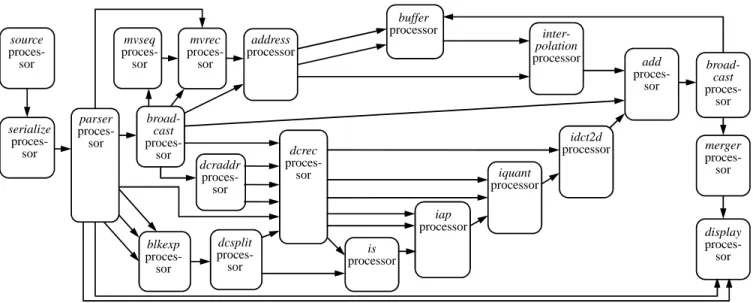
Fig. 4. The TTA processor network that has been synthesized from the MPEG-4 SP RVC-CAL dataflow program. The arrows between the processors are FIFO buffers.
Fig. 5. The TTA processor that executes the serialize actor. The processor has 2 transport buses, 2 general register files (RF) with sizes of 12 slots each. STREAM IN and STREAM OUT are the special FIFO function units.
ment with the design flow. The very first task the user needs to do, is to split his program into logical entities. The division of the application into entities is a very important part, because it will later on affect the maximum attainable performance, as well as the resource consumption on the target device.
After the partitioning of the abstract program the user needs to write the functionality of the individual parts as RVC-CAL actors, and draw data connections between the actors where ever they need to communicate. The Orcc compiler exists as a plugin to the Eclipse3 development
en-vironment and offers a text editor that assists in writing of RVC-CAL. Finally, the user can use the Orcc compiler to produce the C code implementations and interconnection in-formation of the actor network. This phase was depicted in Figure 1.
As it is quite hard to predict the computational resource requirements of individual actors, it is recommended that the user designs one low-performance processor that he uses as the initial execution entity for each actor. This processor must be designed such that it fills the minimum needs of every ac-tor, but does not offer superfluous resources.
Next, the user provides the C code implementations of the actors together with the processor description (ADF) to the TCE compiler, which produces binary files for each actor. Having the actor binaries, the user can now profile the per-formance of actors on the initial processor. If necessary, the user can create more powerful custom processors for actors that need more performance. One of the most important ways to improve TTA processor performance is adding more trans-port buses. Each transtrans-port bus in the processor can perform one data move each clock cycle.
As shown in Figure 2, the user produces the VHDL and ADF description of the processor. As the processor network generally forms a sort of a pipeline, it is desirable that all pro-cessors have an identical latency in the final implementation. Profiling can easily be performed with the cycle-accurate TTA simulator proxim that belongs to the TCE toolset.
After the user has customized the processors and reached the performance requirements, she or he can use the TCE processor generator to produce VHDL implementations of each processor. The VHDL description of the interconnect between processors, on the other hand, is produced by our TTANetGen. By default, the design flow offers a special sourceactor that can be used to input processing data to the network from a dedicated on-chip memory. If the user wishes to use another kind of a data source, he must at this stage design it. Likewise, the default data output is the display, which enables directing the computation results to FPGA general output pins (such as LEDs). For the actual synthesis, the user can use his favourite design environment. However, the interfaces to on-chip memories (required by FIFOs, and processor memories) have been designed only Altera devices in mind.
3www.eclipse.org
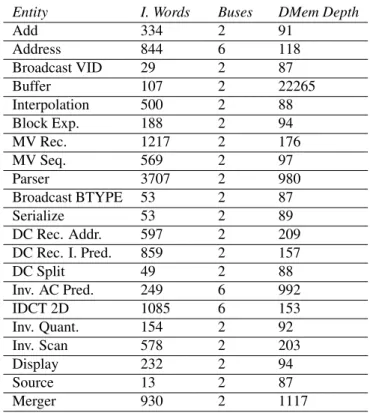
Table 1. Instruction memory and data memory requirements of actors.
Entity I. Words Buses DMem Depth
Add 334 2 91 Address 844 6 118 Broadcast VID 29 2 87 Buffer 107 2 22265 Interpolation 500 2 88 Block Exp. 188 2 94 MV Rec. 1217 2 176 MV Seq. 569 2 97 Parser 3707 2 980 Broadcast BTYPE 53 2 87 Serialize 53 2 89 DC Rec. Addr. 597 2 209 DC Rec. I. Pred. 859 2 157 DC Split 49 2 88 Inv. AC Pred. 249 6 992 IDCT 2D 1085 6 153 Inv. Quant. 154 2 92 Inv. Scan 578 2 203 Display 232 2 94 Source 13 2 87 Merger 930 2 1117 5. EXPERIMENTS
To demonstrate the functionality of our design flow, we took the RVC-CAL program describing an MPEG-4 Simple Pro-file decoder and synthesized it using our design flow as a multi-TTA processor network. The total number of generated processors was 21.
The synthesis results were transferred to the Altera Cy-clone IV EP4CE115F29C7 FPGA. We used a video stream of QCIF resolution as test data to verify the correct operation of the network. The decoding result was compared against a checksum that had been computed for each frame on a work-station beforehand.
All of the memories and video bitstream fit on the FPGA on-chip resources (EP4CE115 has 432 kB of on-chip RAM), when the maximum video resolution was limited to QCIF. Higher video resolutions would make the size of the predic-tion buffer explode and would require resorting to off-chip memory, which was not done at this stage.
Table 1 shows the resources consumed by each processor for the MPEG-4 SP decoder. The most notable figures are the instruction memory usage of the parser and the data memory usage of buffer. Parser is by far the most complex actor in the network and it requires almost 4000 instruction words in a two-bus TTA processor. The buffer actor, on the other hand, is very simple, but its large data memory contains the prediction buffer.
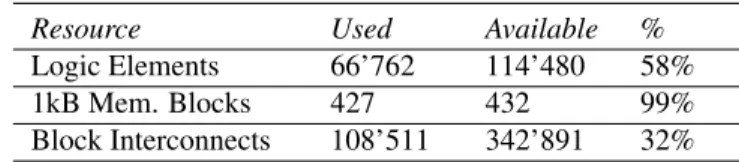
Table 2. Total resource usage.
Resource Used Available % Logic Elements 66’762 114’480 58% 1kB Mem. Blocks 427 432 99% Block Interconnects 108’511 342’891 32%
Table 3. Performance Unit Clock Cycles Intra frame 2’904’000 Pred. frame 29’300 Intra macrob. 2’633’000 Pred. macrob. 26’600
Most of the processor instances in the network are identi-cal. As the tools that form the basis of the toolchain, TCE and Orcc, allow creating heterogeneous processors, this was done for some actors that required more than an average amount of resources. The processors that required more performance can be seen in Table 1: they have more than 2 transport buses. On the contrary, Figure 5 shows a tiny TTA processor that was used to execute the code of the serialize actor.
Table 3 shows the number of clock cycles consumed by intra frames and predicted frames, which was well-balanced due to the possibility to tune the performance of each proces-sor. It was detected that the main limiting factor in the sys-tem performance was in the backend that generates code for TTAs. The TTA processors could compute much faster, but the automatically generated code still had some unnecessary computations at this stage. Improving this is a clear direction for future work.
Regarding the FPGA resource usage (see Table 2), the ex-ample application fit well to the FPGA board. The TTA fea-ture of instruction word compression helped alleviate need of scarce on-chip memory resources. Through instruction word compression, it was possible to save on the usage of memory blocks with the expense of logic element usage.
6. CONCLUSION
In this paper we have presented a design flow that enables au-tomatic synthesis of RVC-CAL actor networks to application specific transport-triggered processor networks. The func-tionality of the toolchain has been demonstrated by applying it to an RVC-CAL network, which defines an MPEG-4 SP video decoder. The performance of the resulting implementa-tion was 20 frames per second on a 50 MHz FPGA and QCIF video resolution.
7. ACKNOWLEDGEMENTS
The authors would like to thank Pekka J¨a¨askel¨ainen and Otto Esko for technical help related to TTAs.
8. REFERENCES
[1] J. Eker and J. Janneck, “CAL language report,” Tech. Rep. UCB/ERL M03/48, UC Berkeley, 2003.
[2] M. Mattavelli, I. Amer, and M. Raulet, “The Reconfig-urable Video Coding standard,” IEEE Signal Processing Magazine, vol. 27, no. 3, pp. 159–167, May 2010. [3] Nicolas Siret, Matthieu Wipliez, Jean-Franc¸ois Nezan,
and Aimad Rhatay, “Hardware code generation from dataflow programs,” in Proceedings of the 2010 Con-ference on Design & Architectures for Signal & Image Processing, 2010, pp. 113–120.
[4] E.A. Lee and D.G. Messerschmitt, “Synchronous data flow,” Proceedings of the IEEE, vol. 75, no. 9, pp. 1235– 1245, Sept. 1987.
[5] H. Corporaal, Microprocessor Architectures: From VLIW to TTA, John Wiley & Sons, Inc., New York, NY, USA, 1997.
[6] P. J¨a¨askel¨ainen, V. Guzma, A. Cilio, and J. Takala, “Codesign toolset for application-specific instruction-set processors,” in Proc. SPIE Multimedia on Mobile Devices, San Jose, CA, January 2007, pp. 65070X–1 – 65070X–11.
[7] O. Esko, P. J¨a¨askel¨ainen, P. Huerta, C.S. de La Lama, J. Takala, and J.I. Martinez, “Customized exposed dat-apath soft-core design flow with compiler support,” in International Conference on Field Programmable Logic and Applications, 2010, pp. 217–222.
[8] Hae woo Park, Hyunok Oh, and Soonhoi Ha, “Multi-processor SoC design methods and tools,” IEEE Signal Processing Magazine, vol. 26, no. 6, pp. 72 –79, novem-ber 2009.
[9] C. Lucarz, G. Roquier, and M. Mattavelli, “High level design space exploration of RVC codec specifications for multi-core heterogeneous platforms,” in Conference on Design and Architectures for Signal and Image Pro-cessing, oct. 2010, pp. 191–198.
[10] J. Gorin, M. Wipliez, F. Prˆeteux, and M. Raulet, “LLVM-based and scalable MPEG-RVC decoder,” Journal of Real-Time Image Processing, vol. 6, pp. 59– 70, 2011, 10.1007/s11554-010-0169-2.