HAL Id: hal-02944908
https://hal.inria.fr/hal-02944908
Submitted on 22 Sep 2020
HAL is a multi-disciplinary open access
archive for the deposit and dissemination of
sci-entific research documents, whether they are
pub-lished or not. The documents may come from
teaching and research institutions in France or
L’archive ouverte pluridisciplinaire HAL, est
destinée au dépôt et à la diffusion de documents
scientifiques de niveau recherche, publiés ou non,
émanant des établissements d’enseignement et de
recherche français ou étrangers, des laboratoires
Cryptanalysis Results on Spook: Bringing Full-round
Shadow-512 to the Light
Patrick Derbez, Paul Huynh, Virginie Lallemand, María Naya-Plasencia, Léo
Perrin, André Schrottenloher
To cite this version:
Patrick Derbez, Paul Huynh, Virginie Lallemand, María Naya-Plasencia, Léo Perrin, et al..
Cryptanal-ysis Results on Spook: Bringing Full-round Shadow-512 to the Light. CRYPTO 2020 - 40th Annual
International Cryptology Conference, Aug 2020, Santa Barbara / Virtual, United States. pp.359–388,
�10.1007/978-3-030-56877-1_13�. �hal-02944908�
Cryptanalysis Results on Spook
Bringing Full-round Shadow-512 to the Light
Patrick Derbez1, Paul Huynh2, Virginie Lallemand2, Mar´ıa Naya-Plasencia3,
L´eo Perrin3, Andr´e Schrottenloher3
1
Univ Rennes, CNRS, IRISA, France [email protected]
2 Universit´e de Lorraine, CNRS, Inria, LORIA, F-54000 Nancy, France
3 Inria, Paris, France [email protected]
Abstract. Spook [BBB+19] is one of the 32 candidates that has made it
to the second round of the NIST Lightweight Cryptography Standardiza-tion process, and is particularly interesting since it proposes differential side channel resistance. In this paper, we present practical distinguish-ers of the full 6-step vdistinguish-ersion of the underlying permutations of Spook, namely Shadow-512 and Shadow-384, solving challenges proposed by the designers on the permutation. We also propose practical forgeries with 4-step Shadow for the S1P mode of operation in the nonce misuse sce-nario, which is allowed by the CIML2 security game considered by the authors. All the results presented in this paper have been implemented. Keywords: dedicated cryptanalysis, differential attacks, implemented attacks, Spook, round constants, lightweight primitives, distinguisher, forgery.
1
Introduction
The number of applications running on interconnected resource-constrained de-vices increased exponentially during the last decade, bringing new challenges to both the community and the industry. Sensor networks, Internet-of-Things, smart cards and healthcare are a few examples which handle sensitive data that should be protected.
These new platforms have their own specific sets of requirements, in partic-ular in terms of implementation efficiency. As common cryptographic primitives were not designed to satisfy these specific use cases, they can be ill-suited in these contexts. A staggering number of algorithms has been proposed to fulfill such requirements, such as PRESENT [BKL+07] (low gate count in hardware),
PRINCE [BCG+12] (low latency in hardware), Midori [BBI+15] (low power
con-sumption), or LEA [HLK+14] (low ROM and cycle count on micro-controllers).
Such primitives have been nicknamed lightweight. Because the corresponding de-vices can often be expected to be physically interacted with by an attacker, an
c
○ IACR 2020. This article is the final version submitted by the authors to the IACR and to Springer-Verlag on June 8th, 2020.
algorithm easing side channel resistance has a significant advantage. Hence many recent proposals were designed to be naturally resistant against side-channel at-tacks or, at least, protectable at low cost. For instance, the authenticated encryp-tion (AE) scheme Pyjamask [GJK+19] was designed with a minimal number of
non-linear gates to allow efficient masked implementations while the AE scheme ISAP [DEM+17] is resistant to differential power analysis, a powerful type of
attack where the adversary try to deduce information about the secret key from power consumption.
This need for lightweight cryptographic primitives led the American Na-tional Institute of Standards and Technology (NIST) to initiate the Lightweight Cryptography Project, aiming at the standardization of hash functions and au-thenticated encryption algorithms suitable for constrained devices. It received 57 algorithm proposals in February 2019 and accepted 56 of them. In August 2019, 32 primitives were announced as the 2nd round candidates.
In this paper we study Spook, an Authenticated Encryption scheme with Associated Data (AEAD) which is among those 2nd round candidates. It was designed to achieve both resistance against side-channel analysis and low-energy implementations and is particularly interesting as it aims at providing strong integrity guarantees even in the presence of nonce misuse and leakage. AEAD is provided using three sub-components: the Sponge One-Pass mode of operation (S1P), the tweakable block cipher Clyde-128 and the permutation Shadow. Both Clyde and Shadow are based on simple extensions of the LS-design framework first introduced by the designers of the lightweight block ciphers Robin and Fantomas [GLSV15]. This strategy leads to efficient bitslicing and side-channel resistant implementations on a wide range of platforms. To further simplify the implementation, the permutation uses the round function of the tweakable block cipher as a sub-routine, effectively combining 3 or 4 parallel instances of a round-reduced cipher using a simple linear layer to construct a 384- or 512-bit permutation.
Motivation and contributions. In Section 4.3 of the specification document of Spook [BBB+19], the designers explicitly point out that an important
require-ment for the permutation in the S1P mode of operation is that it provides collision resistance with respect to the 255 bits that generate the tag and they say:
“Hence, a more specific requirement is to prevent truncated differentials with probability larger than 2128 for those 255 bits. A conservative heuristic for this
purpose is to require that no differential characteristic has probability better than 2−385, which happens after twelve rounds (six steps).”
In this paper we show that this heuristic is not conservative, providing prac-tical truncated distinguishers on Shadow, the inner permutation of Spook. We exhibit non-random behavior for up to the full version of Shadow-512. More-over, the same technique would also distinguish Shadow-512 extended by 2 more rounds at the end. More precisely, we exhibit two particular subspaces 𝐸 and 𝐹
of co-dimension 128 and an efficient algorithm which returns pairs of messages (𝑚, 𝑚′) such that 𝑚
⊕𝑚′
∈ 𝐸 and Shadow-512(𝑚)⊕Shadow-512(𝑚′)
∈ 𝐹 . This implies in particular a practical collision on 128 bits of the output. This prob-lem is a particular instance of the so-called limited birthday probprob-lem, which was first introduced by Gilbert and Peyrin when looking for known key distingushers against the AES [GP10]. As a permutation can be seen as a block cipher with a known key, it is natural to borrow distinguishers from this field. While the complexity of a generic algorithm performing this task is around 264 because of
the birthday bound (see [IPS13] for more details), our un-optimized implemen-tations of our distinguishers run in at most a few minutes on a regular desktop computer.
We also provide similar distinguishers targeting up to 10 (out of 12) rounds of Shadow-384, the small version of Shadow. Note that, as for Shadow-512, adding 2 more rounds at the end of the permutation would not increase its security as there would exist a similar distinguisher on the last 12 rounds (a 2-round shifted version of the proposed permutation).
As other several sponge-based lightweight algorithms1, the authors purpose-fully relied on a permutation for which distinguishers could exist as this allows to use fewer permutation rounds (Spook designers pointed out for instance that 12 rounds were not enough to have 512 bits of security with respect to linear distin-guishers) and thus an increase in the speed of data processing. Nevertheless, our distinguishers seem to prove that the behavior of Shadow is not compatible with the requirements given by the authors on the permutation for the S1P mode of operation.
The next important question is whether these distinguishers are a threat to Spook itself, as the impact is a priori not clear. For Spook, we are able to leverage the results we obtained to produce practical existential forgeries for the S1P mode of operation when Shadow-512 is reduced to 8 rounds out of 12 in the nonce misuse scenario, which is allowed by the CIML2 security game considered by the authors [BPPS17].
Distinguishers on both Shadow-512 and Shadow-384 along with the forg-eries on 8-step Spook have been implemented and verified against the reference implementation provided by the designers.
Paper Organization. In Section2we describe Shadow and introduce some crypt-analysis techniques. Then in Section3we make some observations on the struc-ture of the permutation that will play a crucial role in our cryptanalysis. Finally, in Sections 4 and 5 we present the results of our analysis of both versions of Shadow, including a distinguisher on the full Shadow-512, as well as forgeries against Spook when Shadow-512 is reduced to 8 rounds.
All the analyses presented in this paper are practical and have been imple-mented and tested. Their source code is available at:
https://who.paris.inria.fr/Leo.Perrin/code/spook/index.html
1
Our results have been acknowledged and discussed by the designers of Spook in [BBB+20].
2
Preliminaries
The specific mode of operation we target will be described in the relevant section. Here, we present the Shadow family of permutations and recall the definition of differential distinguishers.
2.1 Specification of Shadow-384 and Shadow-512
The Spook algorithm is based on a permutation named Shadow that exists in two flavors: Shadow-384 and Shadow-512, where Shadow-512 is the one used in the primary candidate to the NIST Lightweight competition. In both cases, the internal state is seen as a collection of 𝑚 two-dimensional arrays (or bundles) each of dimensions 32× 4: as depicted in Figure 1, 𝑚 = 4 for Shadow-512 and 𝑚 = 3 for Shadow-384. The permutations have a Substitution Permutation Network (SPN) structure based on a 4-bit S-box layer and two distinct linear layers, each being used every second round.
· · · · · · · · · · · · · · · · · · · · · · · · · · · · · · · · · · · · · · · · · · · · · · · · bundle 3 bundle 2 bundle 1 bundle 0 · · · · · · · · · · · · ℓ = 32 m = 4 s = 4 bundle row bundle column · · · · · · · · · · · · · · · · · · · · · · · · · · · · · · · · · · · · · · · · · · · · · bundle 1bundle 2 bundle 0 · · · · · · · · · · · · ℓ = 32 m = 3 s = 4 bundle row bundle column
Fig. 1: State Organization of Shadow-512 (left) and of Shadow-384 (right).
The full versions of the permutations iterate 6 steps. As represented in Fig-ure2, one step is made of two rounds, denoted round A and round B, interleaved with round constant additions. Shadow-384 and Shadow-512 only differ in the definition of the 𝐷 layer.
Round Afirst applies a non-linear layer made by the application on each bundle column of the 4-bit S-box recalled in Table1. It then applies the so-called L-box which calls the 𝐿′transformation to the first two and last two rows of each
bundle. If we denote by (𝑥, 𝑦) the input and by (𝑎, 𝑏) the output the definition of 𝐿′ is given by: (𝑎, 𝑏) = 𝐿′(𝑥, 𝑦) =(︂circ(0xec045008) · 𝑥 𝑇 ⊕ circ(0x36000f60) · 𝑦𝑇 circ(0x1b0007b0)· 𝑥𝑇 ⊕ circ(0xec045008) · 𝑦𝑇 )︂
where circ(𝐴) stands for a circulant matrix whose first line is a row vector given by the binary decomposition of 𝐴.
· · · · · · · · · · · · S S S S S · · · · · · · · · · · · S S S S S · · · · · · · · · · · · S S S S S · · · · · · · · · · · · S S S S S S-box L L L L L L L L L L L L L-box Round A · · · · · · · · · · · · S S S S S · · · · · · · · · · · · S S S S S · · · · · · · · · · · · S S S S S · · · · · · · · · · · · S S S S S S-box D-box Round B c 1 Step · · · · · · · · · · · · · · · · · · · · · · · · · · · · · · · · · · · · · · · · · · · · · · · · D AC(2i) AC(2i + 1) c’
Fig. 2: Description of one step of Shadow-512.
Table 1: 4-bit S-box used in Shadow.
x 0 1 2 3 4 5 6 7 8 9 a b c d e f
S(x) 0 8 1 f 2 a 7 9 4 d 5 6 e 3 b c
Round Bstarts with the same S-layer as round A but uses a different linear layer, denoted 𝐷. The purpose of 𝐷 is to provide diffusion between the 𝑚 bundles of the state: as depicted in Figure 2, it takes as input one bit of each bundle. It modifies them with the application of a near-MDS matrix (which previously appeared in the design of the ciphers Midori [BBI+15] and Mantis [BJK+16] for
instance), respectively: 𝐷(𝑎, 𝑏, 𝑐, 𝑑) = ⎛ ⎜ ⎜ ⎝ 0 1 1 1 1 0 1 1 1 1 0 1 1 1 1 0 ⎞ ⎟ ⎟ ⎠× ⎛ ⎜ ⎜ ⎝ 𝑎 𝑏 𝑐 𝑑 ⎞ ⎟ ⎟ ⎠
for Shadow-512 while for Shadow-384 we use: 𝐷(𝑎, 𝑏, 𝑐) = ⎛ ⎝ 1 1 1 1 0 1 1 1 0 ⎞ ⎠× ⎛ ⎝ 𝑎 𝑏 𝑐 ⎞ ⎠.
The round constants used in the permutation correspond to the internal state of a 4-bit LFSR. They are recalled in Table 2. At the end of every round (for rounds from 0 to 11), the 4-bit constant is XORed at 4 different positions, one time in each bundle: in bundle 𝑏 (for 𝑏 = 0, 1, 2, 3), the constant is XORed to the column number 𝑏. Without loss of generality, we hereafter position bit number 0 on the right of the state in our figures.
2.2 Differential Distinguishers
As indicated in the Spook specification, the black box security analysis of the mode of operation that is used in Spook (S1P) relies on the assumption that
Table 2: Round constants used in Shadow. Note that the LSB is on the left.
Round Constant Round Constant Round Constant Round Constant
0 (1,0,0,0) 1 (0,1,0,0) 2 (0,0,1,0) 3 (0,0,0,1)
4 (1,1,0,0) 5 (0,1,1,0) 6 (0,0,1,1) 7 (1,1,0,1)
8 (1,0,1,0) 9 (0,1,0,1) 10 (1,1,1,0) 11 (0,1,1,1)
the permutations are random. In this paper we challenge this assumption by exhibiting distinguishers for the permutations – that is, algorithms that unveil a non-random behavior.
Our distinguishers use the notion of differential, a technique that was intro-duced by Biham and Shamir in [BS91]. The idea is to find a couple of XOR differences (𝛿, 𝛥) such that if two messages differ from 𝛿 then with high proba-bility their output difference after encryption is equal to 𝛥.
This idea was later extended by Knudsen in 1994 to define truncated differ-entials [Knu95], a variant in which only a portion of the difference is fixed (while the remaining part is undetermined). This technique is illustrated in Figure 5
for instance, where we introduce a distinguisher that ends with a difference of the form (*, *, *, 0) before the last 𝐷 operation: the ’*’ symbol indicates that the difference between the messages is not determined over the first three bundles, while the ’0’ symbol indicates that the two messages are identical on the last bundle (128 bits).
3
Structural Observations
In this section we present the general properties we found that we will later exploit in our analysis. While our distinguisher is a truncated differential one, our method for finding right pairs does not rely on a high probability differential trail (whose very existence is disproved by the authors’ wide trail argument). Instead, we exploit the similarity between the functions applied in parallel on each bundle. To better describe them, we introduce the notion of Super S-box (as it applies to Shadow) and we study the propagation of the following type of properties through the step function. Note that we next provide the details for Shadow-512 but that similar results apply to Shadow-384.
Definition 1 (𝑖-identical state). We call 𝑖-identical an internal state of Shadow in which𝑖 bundles are equal.
3.1 Super S-box
Given the fact that in every step only the 𝐷 layer is mixing the bundles together, it is possible to rewrite Shadow as an SPN using four 128-bit Super S-boxes (each
operating on one bundle) interleaved with a linear permutation 𝐷 operating on the full state. If 𝑎, 𝑏, 𝑐 and 𝑑 are the 128-bit bundles, this linear permutation is represented as follows: 𝐷(𝑎, 𝑏, 𝑐, 𝑑) = ⎛ ⎜ ⎜ ⎝ 0 𝐼 𝐼 𝐼 𝐼 0 𝐼 𝐼 𝐼 𝐼 0 𝐼 𝐼 𝐼 𝐼 0 ⎞ ⎟ ⎟ ⎠× ⎛ ⎜ ⎜ ⎝ 𝑎 𝑏 𝑐 𝑑 ⎞ ⎟ ⎟ ⎠ .
𝐷 is an involution with branching number 4 (over 128-bit words) and it verifies that∀𝑎 ∈ F128
2 , 𝐷(𝑎, 𝑎, 𝑎, 0) = (0, 0, 0, 𝑎).
We denote by 𝜎𝑗 for 𝑗 ∈ {0, 1, 2, 3} the four parallel Super S-boxes of the
cipher. They correspond to the first four operations of the step, namely: the S-layer and the linear operation 𝐿 of round A, the constant addition (that is done on a different position for each Super S-box), and the S-layer of round B.
In the following, we show that even though the four bundles of a state go through different Super S-boxes it might be possible to have a Shadow state with four equal bundles that is transformed into a Shadow state of the same form at the output of a full step.
3.2 4-Identical States
In the discussion below we follow the evolution of the 4-identical property through a step and show the required conditions for it to remain in the end. This evolution is also summarized in Figure3.
Probability of Maintaining the 4-Identical Property through a Step. We start from a 4-identical state 𝑋 that we write 𝑋 = (𝑥, 𝑥, 𝑥, 𝑥). Each bundle 𝑥 is made of 32 columns: 𝑥 = (𝑥31, 𝑥30,
· · · , 𝑥1, 𝑥0).
– Application of the Super S-boxes.The step starts with one non-linear layer followed by the 𝐿 layer, applied in parallel (that is, independently) on each of the 4 bundles. Since these transformations are identical for each bundle the 4-identical property is followed with probability one up to this point and so we have 𝐿∘ 𝑆(𝑋) = (𝑦, 𝑦, 𝑦, 𝑦) with 𝑦 = 𝐿 ∘ 𝑆(𝑥). We next have the addition of the first round constant on column 𝑗 of bundle 𝑗 for 𝑗 ∈ {0, 1, 2, 3}, that we will call 𝐴𝐶, and finally we apply another S-box layer. By denoting the round constant by2 𝑐, we obtain the following values for 𝑆∘ 𝐴𝐶(2𝑖) ∘ 𝐿 ∘ 𝑆(𝑋):
𝐵0: 𝑆(𝑦31) · · · 𝑆(𝑦4) 𝑆(𝑦3) 𝑆(𝑦2) 𝑆(𝑦1) 𝑆(𝑦0⊕ 𝑐)
𝐵1: 𝑆(𝑦31) · · · 𝑆(𝑦4) 𝑆(𝑦3) 𝑆(𝑦2) 𝑆(𝑦1⊕ 𝑐) 𝑆(𝑦0)
𝐵2: 𝑆(𝑦31) · · · 𝑆(𝑦4) 𝑆(𝑦3) 𝑆(𝑦2⊕ 𝑐) 𝑆(𝑦1) 𝑆(𝑦0)
𝐵3: 𝑆(𝑦31) · · · 𝑆(𝑦4) 𝑆(𝑦3⊕ 𝑐) 𝑆(𝑦2) 𝑆(𝑦1) 𝑆(𝑦0)
where 𝐵𝑖 is bundle 𝑖. At this stage, the 4 bundles stop being 4-identical but
differ on the value of their 4 first columns.
2
30 28 26 24 22 20 18 16 14 12 10 8 6 4 2 0 30 28 26 24 22 20 18 16 14 12 10 8 6 4 2 0 D 30 28 26 24 22 20 18 16 14 12 10 8 6 4 2 0 +c' S 30 28 26 24 22 20 18 16 14 12 10 8 6 4 2 0 30 28 26 24 22 20 18 16 14 12 10 8 6 4 2 0 D 30 28 26 24 22 20 18 16 14 12 10 8 6 4 2 0 +c' S 30 28 26 24 22 20 18 16 14 12 10 8 6 4 2 0 30 28 26 24 22 20 18 16 14 12 10 8 6 4 2 0 D 30 28 26 24 22 20 18 16 14 12 10 8 6 4 2 0 +c' S 30 28 26 24 22 20 18 16 14 12 10 8 6 4 2 0 30 28 26 24 22 20 18 16 14 12 10 8 6 4 2 0 D 30 28 26 24 22 20 18 16 14 12 10 8 6 4 2 0 +c' S
y0 + c y1 + c y2 + c y3 + c S(y0 + c) S(y1 + c) S(y2 + c) S(y3 + c)
30 28 26 24 22 20 18 16 14 12 10 8 6 4 2 0 30 28 26 24 22 20 18 16 14 12 10 8 6 4 2 0 L 30 28 26 24 22 20 18 16 14 12 10 8 6 4 2 0 +c S = = = 30 28 26 24 22 20 18 16 14 12 10 8 6 4 2 0 30 28 26 24 22 20 18 16 14 12 10 8 6 4 2 0 L 30 28 26 24 22 20 18 16 14 12 10 8 6 4 2 0 +c S = = = 30 28 26 24 22 20 18 16 14 12 10 8 6 4 2 0 30 28 26 24 22 20 18 16 14 12 10 8 6 4 2 0 L 30 28 26 24 22 20 18 16 14 12 10 8 6 4 2 0 +c S = = = 30 28 26 24 22 20 18 16 14 12 10 8 6 4 2 0 30 28 26 24 22 20 18 16 14 12 10 8 6 4 2 0 L 30 28 26 24 22 20 18 16 14 12 10 8 6 4 2 0 +c S = = = 30 28 26 24 22 20 18 16 14 12 10 8 6 4 2 0 30 28 26 24 22 20 18 16 14 12 10 8 6 4 2 0 = 30 28 26 24 22 20 18 16 14 12 10 8 6 4 2 0 30 28 26 24 22 20 18 16 14 12 10 8 6 4 2 0 = 30 28 26 24 22 20 18 16 14 12 10 8 6 4 2 0 30 28 26 24 22 20 18 16 14 12 10 8 6 4 2 0 = 30 28 26 24 22 20 18 16 14 12 10 8 6 4 2 0 30 28 26 24 22 20 18 16 14 12 10 8 6 4 2 0 = and S(y0)+ c’=S(y0 + c)
S(y0)+ c’
and S(y1)+ c’=S(y1 + c)
S(y1)+ c’
and S(y2)+ c’=S(y2 + c)
S(y2)+ c’
and S(y3)+ c’=S(y3 + c) S(y3)+ c’
Fig. 3: Evolution of two rounds with a starting 4-identical state, where the four bundles are equal in the beginning.
– D-box and second round constant addition. The 𝐷 layer mixes
to-gether the 4 bundles by XORing 3 of them toto-gether to form one output bundle, as described in Section2.1. In the above representation of the state, it operates columnwise by replacing each column element with the XOR of the 3 others. The last operation is the addition of the second round constant, that we denote 𝑐′, at the same positions as before (column 𝑗 of
𝐴𝐶(2𝑖 + 1)∘ 𝐷 ∘ 𝑆 ∘ 𝐴𝐶(2𝑖) ∘ 𝐿 ∘ 𝑆(𝑋) is the following:
𝐵0: 𝑆(𝑦31) · · · 𝑆(𝑦4) 𝑆(𝑦3⊕ 𝑐) 𝑆(𝑦2⊕ 𝑐) 𝑆(𝑦1⊕ 𝑐) 𝑆(𝑦0)⊕ 𝑐′
𝐵1: 𝑆(𝑦31) · · · 𝑆(𝑦4) 𝑆(𝑦3⊕ 𝑐) 𝑆(𝑦2⊕ 𝑐) 𝑆(𝑦1)⊕ 𝑐′ 𝑆(𝑦0⊕ 𝑐)
𝐵2: 𝑆(𝑦31) · · · 𝑆(𝑦4) 𝑆(𝑦3⊕ 𝑐) 𝑆(𝑦2)⊕ 𝑐′ 𝑆(𝑦1⊕ 𝑐) 𝑆(𝑦0⊕ 𝑐)
𝐵3: 𝑆(𝑦31) · · · 𝑆(𝑦4) 𝑆(𝑦3)⊕ 𝑐′ 𝑆(𝑦2⊕ 𝑐) 𝑆(𝑦1⊕ 𝑐) 𝑆(𝑦0⊕ 𝑐)
To ensure a 4-identical state at this point, the following 4 equations need to be satisfied: ⎧ ⎪ ⎪ ⎪ ⎨ ⎪ ⎪ ⎪ ⎩ 𝑆(𝑦3 ⊕ 𝑐) = 𝑆(𝑦3) ⊕ 𝑐′ 𝑆(𝑦2 ⊕ 𝑐) = 𝑆(𝑦2) ⊕ 𝑐′ 𝑆(𝑦1 ⊕ 𝑐) = 𝑆(𝑦1) ⊕ 𝑐′ 𝑆(𝑦0 ⊕ 𝑐) = 𝑆(𝑦0) ⊕ 𝑐′ .
Depending on the values of 𝑐 and 𝑐′ – that vary with the index of the step –
these 4 equations are either never verified or can be verified with a rather high probability. In fact, their number of solutions corresponds to the probability of the transition from a difference of 𝑐 to a difference of 𝑐′through the S-box 𝑆. We
computed the corresponding probabilities for all the steps and report the results in Table3. Note that we experimentally verified these values.
Table 3: Probability that an output of step 𝑠 of Shadow is 4-identical knowing that the input is.
𝑠 0 1 2 3 4 5
Probability 0 0 0 2−12 2−8 0
3.3 3-Identical States
A similar reasoning applies to states for which only 3 (out of 4) bundles are equal. In this case, we have one fewer S-box transition to constrain, and then the probabilities of Table3increase to the ones provided in Table4.
Table 4: Probability that an output of step 𝑠 of Shadow is 3-identical knowing that the input is.
𝑠 0 1 2 3 4 5
Probability 0 0 0 2−9 2−6 0
We detail the equations leading to the probabilities of Table4in AppendixA. These probabilities do not depend on the choice of the positions of the 3 input
bundles that are identical. Instead, they are valid as soon as the 3 positions are the same in the input and in the output.
3.4 2-Identical States
We can follow a similar reasoning to obtain the probability of keeping a 2-identical state. We obtain two equations to solve, and the probabilities become the ones given in Table 3. Again, the position of the 2 identical bundles does not impact these probabilities but it has to be the same in the input and in the output.
Table 5: Probability that an output of step 𝑠 of Shadow is 2-identical knowing that the input is.
𝑠 0 1 2 3 4 5
Probability 0 0 0 2−6 2−4 0
4
A Distinguisher Against Full Shadow-512 (and More)
In this section, we present a practical distinguisher which allows us to exhibit pairs (𝑥, 𝑥′) of 512-bit inputs of the Shadow-512 permutation such that
𝑥⊕ 𝑥′ = (
*, *, *, 0) and 𝜋(𝑥) ⊕ 𝜋(𝑥′) = 𝐷(0, 0, 0,
*) , (1)
for the full version and such that 𝑥⊕ 𝑥′ = (
*, *, *, 0) and 𝜋(𝑥) ⊕ 𝜋(𝑥′) = 𝐷(
*, *, *, 0) , (2)
for a “round-extended” version of Shadow-512 using 7 steps rather than 6. In other words, we efficiently solve a limited-birthday problem.
As proved by Iwamoto et al. [IPS13], generating such pairs for a random permutation would require roughly 264 queries. However, we can produce pairs
satisfying Property (1) for full Shadow-512 using about 215 calls to said
permu-tation. The exact same technique finds pairs satisfying Property (2) for 7-step Shadow-512. The corresponding procedures are described in Section4.2.
These distinguishers hinge on two properties: the propagation of 3-identical states which we described in Section3.3, and a probability 1 truncated differen-tial explained in Section 4.1. The latter can be used directly as a distinguisher for 10-round Shadow-512.
𝜎0 𝜎1 𝜎2 𝜎3 𝐷 𝜎0 𝜎1 𝜎2 𝜎3 𝐷 𝜎0 𝜎1 𝜎2 𝜎3 𝐷 𝜎0 𝜎1 𝜎2 𝜎3 𝐷 𝜎0 𝜎1 𝜎2 𝜎3 𝐷 * * * 0 * * * 0 0 0 0 * 0 0 0 𝛼 𝛼 𝛼 𝛼 0 𝛽 𝛽 𝛽 0 0 0 0 𝛽 0 0 0 𝛾 𝛾 𝛾 𝛾 0 * * * 0 1 step 𝑝 = 1 𝑝 = 1 Start
Fig. 4: A 5-step distinguisher against the 512-bit permutation Shadow.
4.1 A 5-Step Truncated Differential Property
We start by devising a distinguisher of Shadow-512 reduced to 5 steps out of 6. The truncated trail we use is summarized in Figure4. Starting from the middle, we can easily construct pairs of states such that their difference propagates with probability 1 over 2 forward and 2 backward steps.
All propagations are of probability 1, the only place where we would a priori have to pay for the cost of a transition is for the three Super S-box level transi-tions 𝛼 𝛽 in step 2. However, the high similarity between the Super S-boxes provides us with a simple way to obtain three such pairs of 128-bit blocks. Building pairs of bundles that follow the same differential for different Super S-boxes. Recall that the only difference between two Super S-boxes lies in the constant addition operation that is done right after the 𝐿 linear layer. The 4-bit constant 𝑐 is added to the input of only one S-box of the second non-linear layer, and the index of this S-box depends on the Super S-box index.
Thanks to this limited difference between the Super S-boxes, we can easily build an input difference 𝛼 so that the output difference of the S-box does not depend on its index. More precisely, this difference 𝛼 should be chosen so that it does not diffuse to the last 4 columns of the bundle. This simple fact is formalized in the following lemma:
Lemma 1. If𝑥∈ F128
2 and𝛼∈ F1282 are such that(𝐿∘𝑆)(𝑥)⊕(𝐿∘𝑆)(𝑥⊕𝛼) = 𝛽
and if 𝛽 is set to 0 on the 4 S-boxes that can receive the round constant 𝑐, then the value of𝜎𝑏(𝑥)⊕ 𝜎𝑏(𝑥⊕ 𝛼) does not depend on the bundle index 𝑏.
Proof. We denote by 𝑦 and 𝑦⊕ 𝛽 the respective values of (𝐿 ∘ 𝑆)(𝑥) and (𝐿 ∘ 𝑆)(𝑥⊕ 𝛼). By expanding these into the column notation we get:
𝑦 = 𝑦31 · · · 𝑦4 𝑦3 𝑦2 𝑦1 𝑦0 𝑦⊕ 𝛽 = 𝑦31 ⊕ 𝛽31 · · · 𝑦4 ⊕ 𝛽4 𝑦3 𝑦2 𝑦1 𝑦0
Let us first look at 𝜎0. We have that
𝜎0(𝑥) = 𝑆(𝑦31) · · · 𝑆(𝑦4) 𝑆(𝑦3) 𝑆(𝑦2) 𝑆(𝑦1) 𝑆(𝑦0⊕ 𝑐)
𝜎0(𝑥⊕ 𝛼) = 𝑆(𝑦31⊕ 𝛽31) · · · 𝑆(𝑦4⊕ 𝛽4) 𝑆(𝑦3) 𝑆(𝑦2) 𝑆(𝑦1) 𝑆(𝑦0⊕ 𝑐)
so summing these equations yields
𝜎0(𝑥)⊕ 𝜎0(𝑥⊕ 𝛼) = 𝛾31 · · · 𝛾4 0 0 0 0
Without loss of generality, let us now consider 𝜎1. We have
𝜎1(𝑥) = 𝑆(𝑦31) · · · 𝑆(𝑦4) 𝑆(𝑦3) 𝑆(𝑦2) 𝑆(𝑦1⊕ 𝑐) 𝑆(𝑦0)
𝜎1(𝑥⊕ 𝛼) = 𝑆(𝑦31⊕ 𝛽31) · · · 𝑆(𝑦4⊕ 𝛽4) 𝑆(𝑦3) 𝑆(𝑦2) 𝑆(𝑦1⊕ 𝑐) 𝑆(𝑦0)
As we can see we have the exact same pairs of values, and thus the same output differences, unless we look at one of the first 4-bit nibbles. However, in this case, the values in 𝜎1(𝑥) and 𝜎1(𝑥⊕ 𝛼) are identical to one another, meaning that
their difference is equal to 0 as well.
This concludes the proof since the two differences are equal. ⊓⊔ To put it differently, this lemma allows us to build pairs of messages that follow the same differential trail over one step whatever the index of the Super S-box.
Our distinguisher for 5 steps of Shadow-512 thus works by following the process described in Algorithm 1. As depicted in Figure 4, the choice of the difference 𝛽 ensures that the same transition is followed for the 3 first Super S-boxes of step 2. The differential pattern then propagates as expected with probability 1 through steps 1 then 0 (backward), and 3 then 4 (forward).
We have verified experimentally that this distinguisher works as predicted. The differences in the output of the Super S-box layer of step 5 (denoted by * in Figure 4) are a priori different from one another, meaning that this approach cannot cover more rounds. Fortunately, we can use the property studied in Section3.3to our advantage, as explained below.
4.2 A Distinguisher for 6- and 7-Step Shadow
Using the truncated trail discussed in Section 4.1 with the observation in Sec-tion3.3, we can build a distinguisher on 6 steps of Shadow, i.e. on the full per-mutation. It would naturally extend to a distinguisher on 7 steps if we defined such a “round-extended” variant of Shadow. This distinguisher is summarized in Figure5.
Algorithm 1 A distinguisher for 5-step Shadow.
1. Choose 𝛽 ∈ F1282 such that it is set to 0 on the 4 S-boxes of lowest weight
2. Choose a random 𝑦 ∈ F128
2 and a random 𝑧 ∈ F1282
3. Compute 𝑥 = 𝜎−10 (𝑦) and 𝑥 + 𝛼 = 𝜎
−1
0 (𝑦 + 𝛽),
4. Set the two states at step 2 to be
𝑋2= (𝑥, 𝑥, 𝑥, 𝑧) and 𝑋2′ = (𝑥 + 𝛼, 𝑥 + 𝛼, 𝑥 + 𝛼, 𝑧) .
5. Invert step 1 and step 0 on 𝑋2 and 𝑋2′ to obtain a pair of states (𝑋0, 𝑋0′) such
that 𝜋(𝑋0) ⊕ 𝜋(𝑋0′) = 𝐷(*, *, *, 0). 𝜎0 𝜎1 𝜎2 𝜎3 𝐷 Step 0 𝜎0 𝜎1 𝜎2 𝜎3 𝐷 Step 1 𝜎0 𝜎1 𝜎2 𝜎3 𝐷 Step 2 𝜎0 𝜎1 𝜎2 𝜎3 𝐷 Step 3 𝜎0 𝜎1 𝜎2 𝜎3 𝐷 Step 4 𝜎0 𝜎1 𝜎2 𝜎3 𝐷 Step 5 𝜎0 𝜎1 𝜎2 𝜎3 𝐷 Step 6 * * * 0 * * * 0 0 0 0 * 0 0 0 𝛼 𝛼 𝛼 𝛼 0 𝛽 𝛽 𝛽 0 0 0 0 𝛽 0 0 0 𝛾 𝛾 𝛾 𝛾 0 𝛿 𝛿 𝛿 0 0 0 0 𝛿 0 0 0 * * * * 0 * * * 0 By construction 𝑝 = 2−9 𝑝 = 2−7.245 𝑝 = 1 𝑝 = 1 Start
Fig. 5: A 7-step distinguisher against the 512-bit permutation Shadow.
Structure of the distinguisher. Our distinguisher works as follows.
– We first focus on the input of step 2 and build a pair of messages that differ by (𝛼, 𝛼, 𝛼, 0). This difference automatically sets the input difference of step 0 to be equal to 0 on the third bundle. Our choice of the two messages must
also ensure that their difference at the end of step 2 is equal to (0, 0, 0, 𝛽) and that the two output messages are 3-identical (the 3-identical property is depicted by the thick rectangle in Figure5.).
– In step 3, we want to keep the 3-identical property in order to ease the following step. As we established before (see Table4), this event has a prob-ability equal to 2−9. The input difference at the end of step 3 is then equal
to (𝛾, 𝛾, 𝛾, 0).
– We next aim for a difference equal to (𝛿, 𝛿, 𝛿, 0) at the output of the Super S-boxes of step 4, an event whose probability we later prove to be 2−7.245.
When this condition is fulfilled we obtain a difference equal to (0, 0, 0, 𝛿) at the output of step 4, which automatically leads to the required difference of the form (*, *, *, 0) at the end of step 5.
Let us now show how we can efficiently find two states that verify the condi-tions at the input and the output of Step 3.
Suppose that there is an 𝑥∈ F128
2 such that the following holds during step 2
for some 128-bit values 𝛼, 𝛽, 𝜖 and 𝜖′:
⎧ ⎪ ⎨ ⎪ ⎩ 𝜎0(𝑥) + 𝜎0(𝑥 + 𝛼) = 𝛽 𝜎1(𝑥 + 𝜖) + 𝜎1(𝑥 + 𝜖 + 𝛼) = 𝛽 𝜎2(𝑥 + 𝜖′) + 𝜎2(𝑥 + 𝜖′+ 𝛼) = 𝛽 , (3)
these constraints corresponding to the differential trail at step 2 that is used in Figure 5. Such an 𝑥 would allow us to run the 5-round distinguisher described in Section4.1. However, as we explained, the property would not extend beyond the fifth step. To achieve this, we add another set of constraints:
{︃ (𝐴𝐶∘ 𝐷)(︀𝜎0(𝑥), 𝜎1(𝑥 + 𝜖), 𝜎2(𝑥 + 𝜖′), 𝑧 )︀ = (𝑦, 𝑦, 𝑦, 𝑧′) (𝐴𝐶∘ 𝐷)(︀𝜎0(𝑥 + 𝛼), 𝜎1(𝑥 + 𝛼 + 𝜖), 𝜎2(𝑥 + 𝛼 + 𝜖′), 𝑧)︀ = (𝑦, 𝑦, 𝑦, 𝑧′+ 𝛽) . (4) In other words, we impose that each state we consider is 3-identical.
In this case, the difference between the states has to be equal to (0, 0, 0, 𝛽) at the input of step 3. Furthermore, each state is 3-identical. This property is carried over to the next step with some probability. Should this happen, we would have at the input of step 4 that the difference between the states is equal to (0, 0, 0, 𝛾) for some 𝛾∈ F128
2 , and that each state is 3-identical.
Finding Solutions for Properties (3) and (4). It turns out that a specific prob-ability 1 truncated differential pattern allows us to trivially find solutions satis-fying both Property (3) and Property (4).
Indeed, we remark that:
1. the impact of the constant additions both within the Super S-box layers and outside it (after the 𝐷 layer) is limited to the S-boxes with indices in {0, 1, 2, 3} (i.e. the 4 of lowest weight) within each Super S-box, and 2. the bits with indices 22 and 23 in each of the 4 input words of a Super S-box
Using the reference implementation, we can indeed see that 𝐿(0, 𝑒22) = (1b880510, 6c06f000)
𝐿(𝑒22, 0) = (36037800, 1b880510)
𝐿(0, 𝑒23) = (37100a20, d80de000)
𝐿(𝑒23, 0) = (6c06f000, 37100a20) ,
where the 4 bits of lowest weight in each output are always equal to 0. We then define the vector space∇ ⊂ (F4
2)32as
∇ = {𝑎 × 𝑒22+ 𝑏× 𝑒23, 𝑎∈ F42, 𝑏∈ F 4 2} ,
where the multiplications are done in the finite field F4
2. As a consequence of our
observations, we have the following lemma. Lemma 2. Let 𝑥∈ (F4
2)32 be a 128-bit vector and let 𝛼 ∈ ∇ be a difference.
Then for all steps and all bundle index𝑖, we have that 𝜎𝑖(𝑥) + 𝜎𝑖(𝑥 + 𝛼) = (*, *, ..., *, 0, 0, 0, 0) .
As evidenced by our experimental results (see below), this approach is effi-cient, and with the cost of computing 1 Super-Sbox we can obtain about 216
internal states that verify the condition of step 2.
Description of the Full Distinguisher. Algorithm 2 details our distinguisher. Using the techniques described so far, we are able to find input differences that satisfy the truncated trail and are 3-identical where needed (see Figure5) from the beginning of step 0 to the end of step 2. Let us now see what happens in the remaining steps.
Algorithm 2 Our 7-step distinguisher against Shadow.
Output: A pair (𝑥, 𝑦, 𝑧, 𝑡), (𝑥′, 𝑦′, 𝑧′, 𝑡) such that 𝜋(𝑥, 𝑦, 𝑧, 𝑡) ⊕ 𝜋(𝑥′, 𝑦′, 𝑧′, 𝑡) =
(*, *, *, 0) with probability at least 2−16.245 after 7-step Shadow-512.
1. Select a difference 𝜖 ∈ ∇.
2. Select a state (𝑦2, 𝑦2, 𝑦2, 𝑧2) that will be a state after step 2.
3. Invert step 2 on (𝑦2, 𝑦2, 𝑦2, 𝑧2), obtaining (𝑥1, 𝑦1, 𝑧1, 𝑡1).
4. Invert step 1 on (𝑥1, 𝑦1, 𝑧1, 𝑡1) and (𝑥1⊕ 𝜖, 𝑦1⊕ 𝜖, 𝑧1⊕ 𝜖, 𝑡1), obtaining (𝑥0, 𝑦0, 𝑧0, 𝑡0)
and (𝑥0, 𝑦0, 𝑧0, 𝑡′0).
5. Invert step 0, obtaining a pair of Shadow-512 states with a zero-difference in the last bundle.
6. Return this pair of state. With high probability (≥ 2−16.24), it satisfies the
Step 3. We start from two messages that are built such that at the end of step 2 they are 3-identical, and we want that the two messages are again 3-identical at the end of step 3. With a reasoning similar to the one given in Section3.3, we obtain 6 equations to solve, while in fact only 3 are independent (the 3 equations obtained for the second message are the same as the 3 obtained for the first message since they only differ on the last bundle), and as detailed in Table4 the probability is equal to 2−9 since this is step number 3.
Step 4. Our objective is to obtain a difference of the form (0, 0, 0, 𝛿) for any non-zero 𝛿 in F128
2 at the beginning of step 5 (see Figure5). In order for this
to happen, we need to have a difference equal to (𝛿, 𝛿, 𝛿, 0) at the end of step 4. To estimate the probability of this event, let us write the corresponding equations. We denote the two messages after the application of 𝑆 and 𝐿 of step 4 by (𝑦, 𝑦, 𝑦, 𝑤) and (𝑦′, 𝑦′, 𝑦′, 𝑤) respectively. Since the input of step
4 is 3-identical, 𝑦𝑖 = 𝑦′𝑖 for all 𝑖 > 3. The expression of the last 4 column
values at the end of step 4 (i.e. after applying 𝐷 and 𝐴𝐶) is then as follows for (𝑦, 𝑦, 𝑦, 𝑤)
𝑆(𝑤3 ⊕ 𝑐) 𝑆(𝑦2 ) ⊕ 𝑆(𝑦2 ⊕ 𝑐) ⊕ 𝑆(𝑤2 ) 𝑆(𝑦1 ) ⊕ 𝑆(𝑦1 ⊕ 𝑐) ⊕ 𝑆(𝑤1 ) 𝑆(𝑤0 ) ⊕ 𝑐′
𝑆(𝑤3 ⊕ 𝑐) 𝑆(𝑦2 ) ⊕ 𝑆(𝑦2 ⊕ 𝑐) ⊕ 𝑆(𝑤2 ) 𝑆(𝑤1 ) ⊕ 𝑐′ 𝑆(𝑦0 ) ⊕ 𝑆(𝑦0 ⊕ 𝑐) ⊕ 𝑆(𝑤0 ) 𝑆(𝑤3 ⊕ 𝑐) 𝑆(𝑤2 ) ⊕ 𝑐′ 𝑆(𝑦1 ) ⊕ 𝑆(𝑦1 ⊕ 𝑐) ⊕ 𝑆(𝑤1 ) 𝑆(𝑦0 ) ⊕ 𝑆(𝑦0 ⊕ 𝑐) ⊕ 𝑆(𝑤0 ) 𝑆(𝑦3 ) ⊕ 𝑐′ 𝑆(𝑦2 ⊕ 𝑐) 𝑆(𝑦1 ⊕ 𝑐) 𝑆(𝑦0 ⊕ 𝑐)
and as follows for (𝑦′, 𝑦′, 𝑦′, 𝑤):
𝑆(𝑤3 ⊕ 𝑐) 𝑆(𝑦′2 ) ⊕ 𝑆(𝑦′2 ⊕ 𝑐) ⊕ 𝑆(𝑤2 ) 𝑆(𝑦′1 ) ⊕ 𝑆(𝑦′1 ⊕ 𝑐) ⊕ 𝑆(𝑤1 ) 𝑆(𝑤0 ) ⊕ 𝑐′
𝑆(𝑤3 ⊕ 𝑐) 𝑆(𝑦′2 ) ⊕ 𝑆(𝑦′2 ⊕ 𝑐) ⊕ 𝑆(𝑤2 ) 𝑆(𝑤1 ) ⊕ 𝑐′ 𝑆(𝑦′0 ) ⊕ 𝑆(𝑦′0 ⊕ 𝑐) ⊕ 𝑆(𝑤0 ) 𝑆(𝑤3 ⊕ 𝑐) 𝑆(𝑤2 ) ⊕ 𝑐′ 𝑆(𝑦′1 ) ⊕ 𝑆(𝑦′1 ⊕ 𝑐) ⊕ 𝑆(𝑤1 ) 𝑆(𝑦′0 ) ⊕ 𝑆(𝑦′0 ⊕ 𝑐) ⊕ 𝑆(𝑤0 ) 𝑆(𝑦′3 ) ⊕ 𝑐′ 𝑆(𝑦′2 ⊕ 𝑐) 𝑆(𝑦′1 ⊕ 𝑐) 𝑆(𝑦′0 ⊕ 𝑐)
In order for the sum of these two states to be equal to (0, 0, 0, 𝛿) (for any non-zero 𝛿), the following relations have to be satisfied:
𝑆(𝑦′2)⊕ 𝑆(𝑦′2⊕ 𝑐) = 𝑆(𝑦2) ⊕ 𝑆(𝑦2 ⊕ 𝑐) 𝑆(𝑦′1)⊕ 𝑆(𝑦′1 ⊕ 𝑐) = 𝑆(𝑦1 )⊕ 𝑆(𝑦1 ⊕ 𝑐) 𝑆(𝑦′0)⊕ 𝑆(𝑦′0⊕ 𝑐) = 𝑆(𝑦0) ⊕ 𝑆(𝑦0 ⊕ 𝑐) .
Since we are looking at step 4, the constant 𝑐 is equal to 0𝑥5 and then each equality has a probability equal to 2−2.415 to be verified (assuming that the
value of 𝑦 and 𝑦′ are independent).
Step 5. This last step is passed with probability one, so in the end we observe an output difference equal to (*, *, *, 0) with a probability at least equal to (2−2.415)3
× 2−9= 2−16.245.
Step 6. One additional round can be added with probability one, since by in-verting 𝐷 we would find a difference equal to 0 in the last bundle with the same probability of 2−16.245.
Experimental Results. Experiments showed that the probability of the distin-guisher is slightly higher than what we expected, since in fact the previously detailed trail is not the only one that leads to the required output difference (see Appendix B for a description of another valid trail). By running Algorithm2
for 222 times, we obtained 124 successful pairs, a probability close to 2−15. Our
unoptimized C++ implementation found all these pairs in less than 30 seconds on a desktop computer. Below is an example for 7 steps.
𝑥1 𝑥2
9c7fbdf0 4a9a3523 90bd4f15 33e12e8f 5554509d 5ea7c50d db9fd14e 8cd31faf 5f0785c3 14ce1b1f b9a7f521 336e44ba fcf630fb 82cafa8e abf5b881 e5534b79
b4764864 aaabc55e 2b65df83 33e12e8f 30d8625c 6d513db3 9024c477 8cd31faf 89fb6758 5d19b594 e69ccd64 336e44ba 4f3d62a5 3e530b8b f7ccf2b7 e5534b79
𝑥1⊕ 𝑥2 𝜋(𝑥1) ⊕ 𝜋(𝑥2)
2809f594 e031f07d bbd89096 00000000 658c32c1 33f6f8be 4bbb1539 00000000 d6fce29b 49d7ae8b 5f3b3845 00000000 b3cb525e bc99f105 5c394a36 00000000
39e368a5 03e51caf f2d7ae55 00000000 2668956a b1720999 00c93f81 00000000 4aed9270 2b317fb5 6f1a183b 00000000 d902b8fd 5c7db7c2 2ef09921 00000000
4.3 A Distinguisher for 6-step Shadow-384
In this section we show how to build a similar distinguisher on 6 steps of the 384-bit variant of Shadow shifted by one round (i.e. which works for steps from 1 to 6 but for no steps from 0 to 5 because of the round constants). As explained in the preliminaries, Shadow-384 is defined as a 3LS-design, and the 𝐷 layer acts on three 128-bit bundles 𝑎, 𝑏, 𝑐 as follows:
𝐷(𝑎, 𝑏, 𝑐) = ⎛ ⎝ 𝐼 𝐼 𝐼 𝐼 0 𝐼 𝐼 𝐼 0 ⎞ ⎠× ⎛ ⎝ 𝑎 𝑏 𝑐 ⎞ ⎠
Interestingly, propagating identical states remains possible with this layer, more specifically for states in which the last 2 bundles are equal. Using this property, one can exhibit pairs (𝑥, 𝑥′) such that 𝑥⊕ 𝑥′ = (0,*, *) at step 1 and
𝜋(𝑥)⊕ 𝜋(𝑥′) = 𝐷(0,
*, *) at the end of step 6. Note that in this case, we cannot cover step 0. Hence this is not a distinguisher on the full version of Shadow-384 for which we can cover only 5 steps. However, it shows that adding 1 more step at the end does not increase the security of Shadow-384. The distinguisher is summarized in Figure6.
As previously described in Section4.2, by picking an 𝛼 in the vector space ∇ = {𝑎×𝑒22+𝑏×𝑒23, 𝑎∈ F42, 𝑏∈ F42} we can easily find two states (𝑥1, 𝑦1, 𝑦1+𝜖)
and (𝑥1, 𝑦1+𝛼, 𝑦1+𝜖+𝛼) as inputs to step 2 that satisfy the following properties
at input of step 3: {︃ 𝜎1(𝑦1) + 𝜎1(𝑦1+ 𝛼) = 𝛽 𝜎2(𝑦1+ 𝜖) + 𝜎2(𝑦1+ 𝜖 + 𝛼) = 𝛽 , (5) and {︃ (𝐴𝐶∘ 𝐷)(︀𝑥1, 𝜎1(𝑦1), 𝜎2(𝑦1+ 𝜖) )︀ = (𝑥2, 𝑦2, 𝑦2) (𝐴𝐶∘ 𝐷)(︀𝑥1, 𝜎1(𝑦1+ 𝛼), 𝜎2(𝑦1+ 𝛼 + 𝜖))︀ = (𝑥2, 𝑦2+ 𝛽, 𝑦2+ 𝛽) . (6)
𝜎0 𝜎1 𝜎2 Step 0Step 0Step 0 𝐷 𝜎0 𝜎1 𝜎2 𝐷 Step 1 𝜎0 𝜎1 𝜎2 𝐷 Step 2 𝜎0 𝜎1 𝜎2 𝐷 Step 3 𝜎0 𝜎1 𝜎2 𝐷 Step 4 𝜎0 𝜎1 𝜎2 𝐷 Step 5 𝜎0 𝜎1 𝜎2 𝐷 Step 6 * * * * * * 0 * * 0 𝛼 𝛼 0 𝛼 𝛼 0 𝛽 𝛽 0 𝛽 𝛽 0 𝛾 𝛾 0 𝛾 𝛾 0 𝛿 𝛿 0 𝛿 𝛿 0 * * 0 * * 0 * * By construction 𝑝 = 2−12 𝑝 = 2−8 𝑝 = 2−4.83 𝑝 = 1 𝑝 = 1 Start
Fig. 6: A (1-step shifted) 6-step distinguisher for Shadow-384. The thick rectan-gles depict 2-identical states.
By inverting step 1, we obtain a difference (0,*, *) with probability 1.
Now at step 3, the input difference equals (0, 𝛽, 𝛽) and the last two bundles of each state are identical. With probability 2−12 and 2−8 respectively, the
2-identical states are preserved through step 3 and 4. Using the same notations as in Section3.2, these probabilities are explained below.
Starting from a 2-identical state 𝑋 = (𝑥, 𝑦, 𝑦), let (𝑤, 𝑧, 𝑧) = 𝐿∘ 𝑆(𝑋) with 𝑤 = 𝐿∘ 𝑆(𝑥) and 𝑧 = 𝐿 ∘ 𝑆(𝑦). The first round constant 𝑐 is then added on column 𝑗 of bundle 𝑗 for 𝑗 ∈ {0, 1, 2}, and another S-box layer is applied, and we obtain the following:
𝑆∘ 𝐴𝐶(2𝑖) ∘ 𝐿 ∘ 𝑆(𝑋) = [︂ · · · 𝑆(𝑤𝑖) · · · 𝑆(𝑤2) 𝑆(𝑤1) 𝑆(𝑤0⊕ 𝑐) · · · 𝑆(𝑧𝑖) · · · 𝑆(𝑧2) 𝑆(𝑧1⊕ 𝑐) 𝑆(𝑧0) · · · 𝑆(𝑧𝑖) · · · 𝑆(𝑧2⊕ 𝑐) 𝑆(𝑧1) 𝑆(𝑧0) ]︂ . At this stage, the last 2 bundles of each state differ only on the value of their second and third columns. After the 𝐷 layer and the addition of the second round
constant 𝑐′at column 𝑗 of bundle 𝑗 for 𝑗
∈ {0, 1, 2}) as before, the expression of the bundles of 𝐴𝐶(2𝑖 + 1)∘ 𝐷 ∘ 𝑆 ∘ 𝐴𝐶(2𝑖) ∘ 𝐿 ∘ 𝑆(𝑋) becomes:
· · · 𝑆(𝑤𝑖) · · · 𝑆(𝑤2) ⊕ 𝑆(𝑧2) ⊕ 𝑆(𝑧2⊕ 𝑐) 𝑆(𝑤1) ⊕ 𝑆(𝑧1⊕ 𝑐) ⊕ 𝑆(𝑧1) 𝑆(𝑤0⊕ 𝑐) ⊕ 𝑐′
· · · 𝑆(𝑤𝑖) ⊕ 𝑆(𝑧𝑖) · · · 𝑆(𝑤2) ⊕ 𝑆(𝑧2⊕ 𝑐) 𝑆(𝑤1) ⊕ 𝑆(𝑧1) ⊕ 𝑐′ 𝑆(𝑤0⊕ 𝑐) ⊕ 𝑆(𝑧0)
· · · 𝑆(𝑤𝑖) ⊕ 𝑆(𝑧𝑖) · · · 𝑆(𝑤2) ⊕ 𝑆(𝑧2) ⊕ 𝑐′ 𝑆(𝑤1) ⊕ 𝑆(𝑧1⊕ 𝑐) 𝑆(𝑤0⊕ 𝑐) ⊕ 𝑆(𝑧0).
Thus, to ensure a 2-identical state, the following 2 equations need to be satisfied: 𝑆(𝑧2
⊕ 𝑐) = 𝑆(𝑧2)
⊕ 𝑐′, 𝑆(𝑧1
⊕ 𝑐) = 𝑆(𝑧1)
⊕ 𝑐′ .
We can then compute the probability of following each step of the truncated pattern in Figure6starting from the end of step 2:
Step 3: each equation is satisfied with probability 2−3 for one state, thus 2−12
in total for the two states.
Step 4: the probability for one state becomes 2−2, meaning 2−8 in total.
Step 5: the 2-identical property cannot be carried through because of the round constants. However, one can obtain a difference in the form (0,*, *) between the two states with probability 2−4.83, as explained below.
By inverting the 𝐷 layer of step 6, we should then observe a difference equal to 0 in the first bundle with a probability equal to (2−2.415)2
× 2−8
× 2−12= 2−24.83.
Let us now compute the probability of going through step 5. If we denote (𝑤, 𝑧, 𝑧) and (𝑤, 𝑧′, 𝑧′) the two states after the application of 𝑆 and 𝐿 in step
5, then the expression of the column values at the end of that step for (𝑤, 𝑧, 𝑧) becomes
· · · 𝑆(𝑤𝑖) · · · 𝑆(𝑤2) ⊕ 𝑆(𝑧2) ⊕ 𝑆(𝑧2⊕ 𝑐) 𝑆(𝑤1) ⊕ 𝑆(𝑧1⊕ 𝑐) ⊕ 𝑆(𝑧1) 𝑆(𝑤0⊕ 𝑐) ⊕ 𝑐′
· · · 𝑆(𝑤𝑖) ⊕ 𝑆(𝑧𝑖) · · · 𝑆(𝑤2) ⊕ 𝑆(𝑧2⊕ 𝑐) 𝑆(𝑤1) ⊕ 𝑆(𝑧1) ⊕ 𝑐′ 𝑆(𝑤0⊕ 𝑐) ⊕ 𝑆(𝑧0)
· · · 𝑆(𝑤𝑖) ⊕ 𝑆(𝑧𝑖) · · · 𝑆(𝑤2) ⊕ 𝑆(𝑧2) ⊕ 𝑐′ 𝑆(𝑤1) ⊕ 𝑆(𝑧1⊕ 𝑐) 𝑆(𝑤0⊕ 𝑐) ⊕ 𝑆(𝑧0)
and it takes the following value for (𝑤, 𝑧′, 𝑧′)
· · · 𝑆(𝑤𝑖 ) · · · 𝑆(𝑤2 ) ⊕ 𝑆(𝑧′2 ) ⊕ 𝑆(𝑧′2 ⊕ 𝑐) 𝑆(𝑤1 ) ⊕ 𝑆(𝑧′1 ⊕ 𝑐) ⊕ 𝑆(𝑧′1 ) 𝑆(𝑤0 ⊕ 𝑐) ⊕ 𝑐′ · · · 𝑆(𝑤𝑖 ) ⊕ 𝑆(𝑧′𝑖 ) · · · 𝑆(𝑤2 ) ⊕ 𝑆(𝑧′2 ⊕ 𝑐) 𝑆(𝑤1 ) ⊕ 𝑆(𝑧′1 ) ⊕ 𝑐′ 𝑆(𝑤0 ⊕ 𝑐) ⊕ 𝑆(𝑧′0 ) · · · 𝑆(𝑤𝑖 ) ⊕ 𝑆(𝑧′𝑖 ) · · · 𝑆(𝑤2 ) ⊕ 𝑆(𝑧′2 ) ⊕ 𝑐′ 𝑆(𝑤1 ) ⊕ 𝑆(𝑧′1 ⊕ 𝑐) 𝑆(𝑤0 ⊕ 𝑐) ⊕ 𝑆(𝑧′0 )
For the first bundles to be equal for both states the following relations have to be satisfied: 𝑆(𝑧′2)⊕ 𝑆(𝑧′2⊕ 𝑐) = 𝑆(𝑧2) ⊕ 𝑆(𝑧2 ⊕ 𝑐) 𝑆(𝑧′1)⊕ 𝑆(𝑧′1 ⊕ 𝑐) = 𝑆(𝑧1 )⊕ 𝑆(𝑧1 ⊕ 𝑐) , which occurs with probability 2−2.415for each relation.
Experimental Results. Experiments showed that the probability of the distin-guisher is very close to what we expected. By testing 230 pairs, we obtained
31 successes, a probability close to 2−25. Our unoptimized C++ implementation
took less than 70 minutes on a desktop computer to find these pairs, i.e. about 2 minutes per pair on average. Below is an example.
𝑥1 𝑥2 62544d56 60b9af6e bd3ddabf 019d0421 569ad0d3 e543b03f 5f8ba283 087f4892 f7b632d8 116bb908 eef0b58d 97dc955a 62544d56 48d12ffc bb391a7d 019d0421 5efa911b cb4ff1e5 5f8ba283 265b098a ffd272c0 116bb908 e0d8f55f 9790d5da 𝑥1⊕ 𝑥2 𝜋(𝑥1) ⊕ 𝜋(𝑥2) 00000000 28688092 0604c0c2 00000000 086041c8 2e0c41da 00000000 2e244118 08644018 00000000 0e2840d2 004c4080 00000000 d7ddf0cd 87ed7095 00000000 c4e25bec df225a5c 00000000 d3d67ba2 9416fab2 00000000 1cff6fdd 9cf7ed09
Difference with 7 Rounds. The main difference with our 7-round distinguisher on Shadow-512 is our inability to cover step 0, and it stems from 𝐷. The middle rounds of the attack cannot be moved, as they depend on our ability to cancel out the constants and maintain 2-identical states. In the 7-round attack, rounds alternate between 3 and 1 active Super S-box (bundle). The inverse step 1 takes in input a difference 𝛼, 𝛼, 𝛼, 0 and the inverse application of 𝐷 gives a difference 0, 0, 0, 𝛼. But since this difference is active in only one bundle, we can traverse one more round and have a difference active in only three bundles. Here, we used a different path, with two active bundles at each round. The inverse step 1 takes as input a difference 0, 𝛼, 𝛼, the inverse of 𝐷 maps to a difference 0, 𝛼, 𝛼, but after the inverse Super S-box, we obtain two unknown differences, and we cannot traverse round 0.
5
Forgeries with 4-step Shadow in the Nonce Misuse
Setting
In this section, we show how to use the properties exploited in the distinguishers to create existential forgeries for the S1P mode of operation [BBB+19], in the
single user setting, when used with 4-step Shadow (out of 6) shifted of two steps (starting at step 2 instead of 0). Hence, our attack targets the “aggressive parameters” specified in [BBB+19, Section 5].
One interesting feature of Spook is that it provides strong integrity guaran-tees in the presence of nonce misuse and leakage, which are formalized as CIML2 in the unbounded leakage model [BPPS17]. In our attack, we do not require leak-age and instead exploit the nonce control. More specifically, we require the same nonce to be used three times. Our attack then creates two different messages with the same authentication tag. In particular, we are able to build collisions on the underlying hash function, which allows us to build the forgeries.
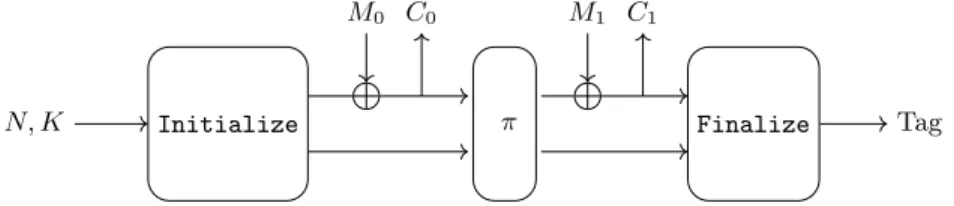
Attack Outline. S1P is a sponge-based mode of authenticated encryption with associated data represented in Figure7, that uses Shadow as its underlying per-mutation. It has a rate of size 256 bits and a capacity of size 256 bits. If we number the bundles of Shadow as in the reference implementation, bundles 0 and 1 are the rate part and bundles 2 and 3 are the capacity part.
For the sake of simplicity, we consider a version of the S1P mode of opera-tion without associated data, and we only consider two-block messages 𝑀0, 𝑀1.
This situation is depicted on Figure 7, where 𝜋 is the Shadow permutation, Initialize is a procedure combining 𝜋 and the Clyde block cipher, that pro-duces a 512-bit state from a nonce 𝑁 and the secret key 𝐾, and Finalize is a procedure that, on input a 512-bit state, produces a 128-bit authentication tag.
𝑁, 𝐾 Initialize Initialize Initialize 𝑀0 𝐶0 𝜋 𝜋 𝜋 𝑀1 𝐶1 Finalize Finalize Finalize Tag
Fig. 7: S1P mode in our attack setting
Our goal is to output two plaintexts (𝑀0, 𝑀1), (𝑀0′, 𝑀1′) and a nonce 𝑁 that
yield the same authentication tag. In order to do that, we obtain a collision on the internal state before Finalize. This means that any pair (𝑀0, 𝑀1, 𝑥2, ..., 𝑥ℓ),
(𝑀′
0, 𝑀1′, 𝑥2, ..., 𝑥ℓ) of messages built by appending the same blocks to our
col-liding pair would also yield the same tag provided that the nonce is reused. We can find (𝑀0, 𝑀1) and (𝑀0′, 𝑀1′) thanks to the following algorithm, that we will
prove later.
Let 𝜋 be the Shadow permutation restricted to rounds 2 to 5. Informally, the first queries allow us to find the difference between the states before 𝜋, the second ones to figure out the difference after 𝜋, and the third to cancel it out. The whole attack is presented in details in Algorithm4. Before describing it, we present its main subroutine whose success probability is given by the following lemma.
Algorithm 3 Algorithm to generate candidate pairs for our 4-step property.
Output: two pairs of (𝑥1, 𝑦1), (𝑥′1, 𝑦
′
1) such that 𝜋(𝑥1, 𝑦1, 𝑎, 𝑏) ⊕ 𝜋(𝑥′1, 𝑦
′
1, 𝑎, 𝑏) =
(*, *, 0, 0) with probability 𝑝.
1. Select a random 128-bit bundle 𝑤2.
2. Invert step 2 on (𝑤2, 𝑤2, 0, 0), obtaining (𝑥1, 𝑦1, *, *)
3. Return (𝑥1, 𝑦1), (𝑥1⊕ 𝜖, 𝑦1⊕ 𝜖) where 𝜖 ∈ ∇ (a difference that intervenes only in
columns 22 and 23 of a bundle).
Lemma 3. Let(*, *, 𝑎, 𝑏) be a Shadow state. Then Algorithm3produces 4 bun-dles (𝑥1, 𝑦1), (𝑥′1, 𝑦1′) such that 𝜋(𝑥1, 𝑦1, 𝑎, 𝑏)⊕ 𝜋(𝑥′1, 𝑦1′, 𝑎, 𝑏) = (*, *, 0, 0) with a
In a nutshell, this property allows us to find a collision on the capacity part of the state after having applied 𝜋. Since we can control the differences in the rate before and after 𝜋, we then obtain a collision on the full 512-bit state. This is summarized in Algorithm4. Notice that each plaintext and ciphertext “block” is comprised of two rate bundles.
Algorithm 4 Collision attack on the S1P mode, with nonce reuse, and using 4-step Shadow.
1. Encrypt an arbitrary two-block (4-bundle) message, e.g. (0, 0), (0, 0), and obtain
ciphertexts (𝑑0, 𝑑1), (𝑑2, 𝑑3). Let 𝑥1, 𝑦1, 𝑎, 𝑏 be the 4-bundle state after Initialize
(immediately before step 1). Then 𝑑0, 𝑑1= 𝑥1, 𝑦1.
2. Use Algorithm 3 to obtain two pairs of rate bundles (𝑥′1, 𝑦
′ 1), (𝑥 ′′ 1, 𝑦 ′′ 1) such that 𝜋(𝑥′1, 𝑦1′, 𝑎, 𝑏) ⊕ 𝜋(𝑥′′1, 𝑦1′′, 𝑎, 𝑏) = (*, *, 0, 0) with probability 𝑝.
3. Encrypt (with the same nonce) (𝑥1⊕ 𝑥′1, 𝑦1⊕ 𝑦′1), (0, 0) and obtain (𝑐
′ 0, 𝑐 ′ 1), (𝑐 ′ 2, 𝑐 ′ 3).
Then (𝑐′2, 𝑐′3) is the value of the rate after the application of 𝜋 on (𝑥′1, 𝑦1′, 𝑎, 𝑏).
4. Encrypt (with the same nonce) (𝑥1⊕𝑥′′1, 𝑦1⊕𝑦1′′), (0, 0) and obtain (𝑐
′′ 0, 𝑐 ′′ 1), (𝑐 ′′ 2, 𝑐 ′′ 3). Then (𝑐′′2, 𝑐 ′′
3) is the value of the rate after the application of 𝜋 on (𝑥
′′ 1, 𝑦
′′
1, 𝑎, 𝑏).
5. Output the two 4-bundle plaintexts: (𝑥1⊕ 𝑥′1, 𝑦1⊕ 𝑦1′), (𝑐2′, 𝑐′3) and (𝑥1⊕ 𝑥′′1, 𝑦1⊕
𝑦1′′), (𝑐 ′′ 2, 𝑐
′′
3) and the nonce 𝑁 that was used. Then these plaintexts, encrypted with
this nonce, yield the same internal state before the Finalize procedure, and the
same tag, with probability 𝑝 ≃ 2−24.83.
4-step Path. We will now prove Lemma3. We are interested in pairs of 2-identical states for Shadow, where the first two bundles are equal. The following lemma stems immediately from the results in Table5 (as both states in the pair must remain 2-identical, we take the squared probabilities).
Lemma 4. Let 𝑡1, 𝑡2 be a pair of 2-identical states with difference (𝛼, 𝛼, 0, 0).
Then after a step of Shadow, they remain 2-identical with probability2−12at step
3, 2−8 at step 4 and 0 otherwise.
Using these probabilities, we can investigate Lemma3.
Proof (of Lemma3).We follow the convention of indexing bundles depending on the step that immediately precedes, i.e. 𝑤2is a bundle after step 2. The pattern
used in this proof is summarized in Figure8.
We consider Shadow reduced to steps 2 to 5. We start with an input state (*, *, 𝑎1, 𝑏1). We select a random bundle 𝑤2 and invert step 2 on (𝑤2, 𝑤2, 0, 0).
We denote by (𝑥1, 𝑦1,*, *) the state obtained after this inversion.
Now we consider the “mixed” state (𝑥1, 𝑦1, 𝑎1, 𝑏1) passing through step 2.
Applying the super-sboxes, 𝐷 and adding the second round constant we obtain the state: (𝜎2(𝑎1)⊕ 𝜎3(𝑏1)⊕ 𝑤2, 𝜎2(𝑎1)⊕ 𝜎3(𝑏1)⊕ 𝑤2,*, *) which is 2-identical.
We also consider the state (𝑥1⊕ 𝜖, 𝑦1⊕ 𝜖, 𝑎1, 𝑏1), where 𝜖 belongs to the set∇
shown in our analysis from the previous section, the difference does not interact with the part of the state dealing with the round constant. Hence, the state after step 2 is also 2-identical and it has the same bundles in the capacity part.
We now have a pair of 2-identical states (𝑥2, 𝑥2, 𝑎2, 𝑏2) and (𝑦2, 𝑦2, 𝑎2, 𝑏2) in
the output of step 2. It is mapped to a pair of 2-identical states (𝑥3, 𝑥3, 𝑎3, 𝑏3)
and (𝑦3, 𝑦3, 𝑎3, 𝑏3) through step 3 with probability 2−12 and similarly through
step 4 with probability 2−8.
Before step 5, we have a 2-identical pair (𝑥4, 𝑥4, 𝑎4, 𝑏4), (𝑦4, 𝑦4, 𝑎4, 𝑏4). Our
goal is to obtain a zero-difference in the capacity part. By an analysis analogous to the one of Shadow-384, this happens with a probability approximately equal to 2−4.83. We then have a total probability of 1
⏟ ⏞ Step 2 × 2−12 ⏟ ⏞ Step 3 × 2−8 ⏟ ⏞ Step 4 × 2−4.83 ⏟ ⏞ Step 5 . ⊓⊔ 𝑥1 𝑦1 𝑎1 𝑏1 𝑥1⊕ 𝜖 𝑦1⊕ 𝜖 𝑎1 𝑏1 Step 2: prob. 1 𝑥2 𝑥2 𝑎2 𝑏2 𝑦2 𝑦2 𝑎2 𝑏2 Step 3: prob. 2−12 𝑥3 𝑥3 𝑎3 𝑏3 𝑦3 𝑦3 𝑎3 𝑏3 Step 4: prob. 2−8 𝑥4 𝑥4 𝑎4 𝑏4 𝑦4 𝑦4 𝑎4 𝑏4 Step 5: prob. 2−4.83 * * 𝑎5 𝑏5 * * 𝑎5 𝑏5
Fig. 8: 4-step path
Experimental Results. Lemmas 3 and 4 have been verified independently. Fur-thermore, we have fully implemented the attack against S1P itself. Using the reference implementation of S1P (but taking out the two first steps) we obtained the following example for a zero-key and a zero-nonce.
𝑚1= aaf2fbf5334fdfc6c1ee182f593cc6e1 a5ebc70be994a1bc8b980410a3dae96a e93257859683265f20552e381b15c621 eb3257859783265f23552e381b15c621 𝑚2= aaf2bbf5334fdfc6c1ee182f593cc6e1 a5eb870be994a1bc8b980410a3dae96a 2f160415c118c8c174200434e93c2e83 2d160415c018c8c177200434e93c2e83 𝑐1= 75235998b09dcbe55a97db04e29622e4 4e73577cdacccc3520d6d6b03b5f2f51 00000000000000000000000000000000 00000000000000000000000000000000 c6461d8861f434500882ac5dc3490ce1 𝑐2= 75231998b09dcbe55a97db04e29622e4 4e73177cdacccc3520d6d6b03b5f2f51 00000000000000000000000000000000 00000000000000000000000000000000 c6461d8861f434500882ac5dc3490ce1
After 230 trials, we obtained 41 successful collisions, with an experimental
probability of success of 2−24.64 which backs the theoretical 2−24.83. In
prac-tice, our un-optimized C++ implementation needs about 15 minutes to find one collision.
Possible Extensions. Although using similar properties as the previous distin-guishers (keeping 2-identical states with a cancellation of constants, using a difference in ∇), our attack suffers from the fact that we cannot control the input in the capacity part. This is the main reason why we cannot consider the steps before step 2, contrary to our distinguisher on full Shadow-512.
As a trivial extension, we remark that we can extend our reduced-step Shadow by one round (i.e. half a step) at the end of our 4-step path, since this round does not traverse 𝐷; but it falls outside the scope of the actual primitive. We could attack rounds 4 to 13 of Shadow-512 instead of rounds 0 to 12.
Furthermore, the differences that we obtain at the input of step 2 are very sparse, since they belong to the space∇. As the complexity of our attack is of the order of 225, and the generic complexity is of 2128for a collision on the capacity,
it might be possible to extend the attack 1 round at the beginning Shadow, but this seems far from trivial and would require advanced message modification techniques.
6
Conclusion
In this paper we have shown some new cryptanalysis results on the second round candidate of the lightweight NIST competition Spook based on the limited birth-day problem. We can distinguish 5-step Shadow-512 from a random permutation using only 2 queries. If we exploit the round constants, we are able to distinguish the full (6-step) Shadow-512, and we could even distinguish 7 steps if the num-ber of rounds was increased (and regardless of the round constant values chosen for this step). Regarding Shadow-384, we are able to efficiently distinguish the 6-step permutation if its round constants are shifted, and a round-reduced 5-step version otherwise.
Using similar ideas we could build collisions on the underlying hash function for a 4-step version of the permutation, which means we can build forgeries for the S1P mode with nonce misuse, which is allowed by the CIML2 security game considered by the authors [BPPS17].
All the analyses presented are practical and have been implemented and verified. The corresponding source code is publicly available.
An interesting extension of this work would be to reach 5-step forgeries: as we presented, extending it one round is easy, but one more round for reaching 5-steps might be possible using some advanced message modification techniques. In any case, 6-steps do seem out of reach with our current techniques.
New criterion. Our analysis provides a new simple criterion for choosing the round constants in LS-designs: besides trying to avoid invariant subspaces
at-tacks, they should be introduced in such a way that their effect in the internal symmetries cannot be canceled out.
Possible tweaks for Shadow. Though our findings do not represent a threat on the full-round authenticated encryption primitive, it is possible to tweak the permutation to counter the low complexity distinguisher and improve the security margin of Spook.
The first tweak we would suggest is to use denser constants. This change would not affect the 5-step distinguishers, but would counter the 6-step ones and the 4-step forgeries. Another option that might have the same effect as using less sparse constants is to only use one round constant per step instead of two as it is the case now. This would prevent us from canceling them out inside a step in order to build identical bundle states. This option could be more interesting than denser constants due to implementation reasons.
A second option is to change the 𝐷 matrix in order to break the symmetry properties between the bundles. This approach was favored by the authors of Spook. After our results, they proposed a new version, Spook v2 [BBB+20], in
which they replace the matrix 𝐷 by an efficient MDS matrix (they also modify the round constants of Shadow for more efficiency). Thus, the attacks presented in this paper are a priori inapplicable to Spook v2.
Acknowledgments. The authors would like to thank the designers of Spook for many helpful discussions and useful comments. Part of this work was done dur-ing the symmetric cryptography seminars of FrisiaCrypt 2019 and Dagstuhl 2020 (Seminar 20041). This project has received funding from the European Research Council (ERC) under the European Union’s Horizon 2020 research and innova-tion programme (grant agreement no. 714294 - acronym QUASYModo) and has been partly funded by the ANR under grant Decrypt ANR-18-CE39-0007.
References
BBB+19. Davide Bellizia, Francesco Berti, Olivier Bronchain, Ga¨etan Cassiers,
S´ebastien Duval, Chun Guo, Gregor Leander, Ga¨etan Leurent, Itamar
Levi, Charles Momin, Olivier Pereira, Thomas Peters, Fran¸cois-Xavier
Standaert, and Friedrich Wiemer. Spook: Sponge-based leakage-resilient authenticated encryption with a masked tweakable block cipher. Submission
to the NIST Lightweight Cryptography project. Available online https:
//csrc.nist.gov/CSRC/media/Projects/lightweight-cryptography/ documents/round-2/spec-doc-rnd2/Spook-spec-round2.pdf., 2019.
BBB+20. Davide Bellizia, Francesco Berti, Olivier Bronchain, Ga¨etan Cassiers,
S´ebastien Duval, Chun Guo, Gregor Leander, Ga¨etan Leurent, Itamar Levi,
Charles Momin, Olivier Pereira, Thomas Peters, Fran¸cois-Xavier Standaert,
and Friedrich Wiemer. Spook: Sponge-based leakage-resistant
authenti-cated encryption with a masked tweakable block cipher. IACR Trans.
Symmetric Cryptol., Special Issue on Designs for the NIST Lightweight
Standardisation Process, 2020. Available online at https://www.spook.
BBdS+19. Christof Beierle, Alex Biryukov, Luan Cardoso dos Santos, Johann
Großsch¨adl, L´eo Perrin, Aleksei Udovenko, Vesselin Velichkov, and Qingju
Wang. Schwaemm and Esch: lightweight authenticated encryption and hashing using the Sparkle permutation family. Submission to the 2nd round of the NIST lightweight process., 2019.
BBI+15. Subhadeep Banik, Andrey Bogdanov, Takanori Isobe, Kyoji Shibutani,
Harunaga Hiwatari, Toru Akishita, and Francesco Regazzoni. Midori: A block cipher for low energy. In Tetsu Iwata and Jung Hee Cheon, edi-tors, ASIACRYPT 2015, Part II, volume 9453 of LNCS, pages 411–436. Springer, Heidelberg, November / December 2015.
BCG+12. Julia Borghoff, Anne Canteaut, Tim G¨uneysu, Elif Bilge Kavun, Miroslav
Kneˇzevi´c, Lars R. Knudsen, Gregor Leander, Ventzislav Nikov, Christof
Paar, Christian Rechberger, Peter Rombouts, Søren S. Thomsen, and Tolga
Yal¸cin. PRINCE - A low-latency block cipher for pervasive computing
ap-plications - extended abstract. In Xiaoyun Wang and Kazue Sako, editors, ASIACRYPT 2012, volume 7658 of LNCS, pages 208–225. Springer, Hei-delberg, December 2012.
BDP+16. Guido Bertoni, Joan Daemen, Micha¨el Peeters, Gilles Van Assche, and
Ronny Van Keer. CAESAR submission: Ketje v2. Submission to the CAE-SAR Competition, 2016.
BJK+16. Christof Beierle, J´er´emy Jean, Stefan K¨olbl, Gregor Leander, Amir Moradi,
Thomas Peyrin, Yu Sasaki, Pascal Sasdrich, and Siang Meng Sim. The SKINNY family of block ciphers and its low-latency variant MANTIS. In Matthew Robshaw and Jonathan Katz, editors, CRYPTO 2016, Part II, volume 9815 of LNCS, pages 123–153. Springer, Heidelberg, August 2016.
BKL+07. Andrey Bogdanov, Lars R. Knudsen, Gregor Leander, Christof Paar, Axel
Poschmann, Matthew J. B. Robshaw, Yannick Seurin, and C. Vikkelsoe. PRESENT: An ultra-lightweight block cipher. In Pascal Paillier and Ingrid Verbauwhede, editors, CHES 2007, volume 4727 of LNCS, pages 450–466. Springer, Heidelberg, September 2007.
BPPS17. Francesco Berti, Olivier Pereira, Thomas Peters, and Fran¸cois-Xavier
Stan-daert. On leakage-resilient authenticated encryption with decryption leak-ages. IACR Trans. Symm. Cryptol., 2017(3):271–293, 2017.
BS91. Eli Biham and Adi Shamir. Differential cryptanalysis of DES-like
cryptosys-tems. In Alfred J. Menezes and Scott A. Vanstone, editors, CRYPTO’90, volume 537 of LNCS, pages 2–21. Springer, Heidelberg, August 1991.
DEM+17. Christoph Dobraunig, Maria Eichlseder, Stefan Mangard, Florian Mendel,
and Thomas Unterluggauer. ISAP - towards side-channel secure authenti-cated encryption. IACR Trans. Symmetric Cryptol., 2017(1):80–105, 2017. DEMS16. Christoph Dobraunig, Maria Eichlseder, Florian Mendel, and Martin
Schl¨affer. Ascon v1. 2. Submission to the CAESAR Competition, 2016.
GJK+19. Dahmun Goudarzi, J´er´emy Jean, Stefan K¨olbl, Thomas Peyrin, Matthieu
Rivain, Yu Sasaki, and Siang Meng Sim. Pyjamask. Submission to
the NIST Lightweight Cryptography project. Available online https:
//csrc.nist.gov/CSRC/media/Projects/lightweight-cryptography/ documents/round-2/spec-doc-rnd2/pyjamask-spec-round2.pdf., 2019.
GLSV15. Vincent Grosso, Ga¨etan Leurent, Fran¸cois-Xavier Standaert, and Kerem
Varici. LS-designs: Bitslice encryption for efficient masked software imple-mentations. In Carlos Cid and Christian Rechberger, editors, FSE 2014, volume 8540 of LNCS, pages 18–37. Springer, Heidelberg, March 2015.