Bringing physics to life at the submesoscale
The MIT Faculty has made this article openly available. Please sharehow this access benefits you. Your story matters.
Citation Lévy, Marina et al. “Bringing Physics to Life at the Submesoscale.” Geophysical Research Letters 39.14 (2012).
As Published http://dx.doi.org/10.1029/2012gl052756
Publisher American Geophysical Union (AGU)
Version Author's final manuscript
Citable link http://hdl.handle.net/1721.1/75746
Terms of Use Creative Commons Attribution-Noncommercial-Share Alike 3.0 Detailed Terms http://creativecommons.org/licenses/by-nc-sa/3.0/
Bringing physics to life at the submesoscale
1 2 3
Marina Lévy1*, Raffaele Ferrari2, Peter J.S. Franks3, Adrian P. Martin4, Pascal Rivière5
4 5 6
(1) LOCEAN-IPSL, CNRS/UPMC/IRD/MNHN, Paris, France
7
(2) Massachusetts Institute of Technology, Cambridge, USA
8
(3) Scripps Institution of Oceanography, UCSD, La Jolla, USA
9
(4) National Oceanography Centre, Southampton, SO14 3ZH, UK
10
(5) LEMAR-IUEM, CNRS/IRD/UBO, Plouzané, France
11
* Corresponding author, [email protected]
12 13
Draft, resubmitted version for GRL “Frontier Article”, June 2012
14
15 16
Abstract
16 17
A common dynamical paradigm is that turbulence in the upper ocean is dominated by three
18
classes of motion: mesoscale geostrophic eddies, internal waves and microscale
three-19
dimensional turbulence. Close to the ocean surface, however, a fourth class of turbulent
20
motion is important: submesoscale frontal dynamics. These have a horizontal scale of
O(1-21
10) km, a vertical scale of O(100) m, and a time scale of O(1) day. Here we review the
22
physical-chemical-biological dynamics of submesoscale features, and discuss strategies for
23
sampling them. Submesoscale fronts arise dynamically through nonlinear instabilities of the
24
mesoscale currents. They are ephemeral, lasting only a few days after they are formed. Strong
25
submesoscale vertical velocities can drive episodic nutrient pulses to the euphotic zone, and
26
subduct organic carbon into the ocean’s interior. The reduction of vertical mixing at
27
submesoscale fronts can locally increase the mean time that photosynthetic organisms
28
spend in the well-lit euphotic layer and promote primary production. Horizontal stirring
29
can create intense patchiness in planktonic species. Submesoscale dynamics therefore can
30
change not only primary and export production, but also the structure and the functioning of
31
the planktonic ecosystem. Because of their short time and space scales, sampling of
32
submesoscale features requires new technologies and approaches. This paper presents a
33
critical overview of current knowledge to focus attention and hopefully interest on the
34
pressing scientific questions concerning these dynamics.
35 36 37
1- Introduction
37
The ocean’s storage of carbon and ability to regulate atmospheric carbon dioxide is
38
crucially dependent on primary production, the creation of organic matter from inorganic
39
nutrients and carbon through photosynthesis. The transport of limiting nutrients to the sunlit
40
surface ocean (the euphotic zone) plays a central role in controlling primary production. It
41
has been argued that turbulent eddy motions are an important vehicle for this transport
42
(Falkowski et al., 1991; Flierl and Davis, 1993; Oschlies and Garcon, 1998; Mahadevan and
43
Archer, 2000; Martin and Richards, 2001; Levy et al., 2001; Williams and Follows, 2003).
44
Although the subject of some debate (Oschlies, 2002; McGillicuddy et al., 2003; Martin and
45
Pondaven, 2003) it has been claimed that in some regions of the ocean as much as half of the
46
nitrate supply may be driven by eddy-induced vertical motions (McGillicuddy et al., 1998).
47
The other essential ingredient for photosynthesis is light. Turbulent motions modulate the
48
availability of light by moving phytoplankton through the euphotic zone (Sverdrup, 1953;
49
Lévy et al., 1998; Taylor and Ferrari, 2011a). The nutrient and light environments that
50
regulate global primary production, the export of fixed carbon to depth and ultimately the
51
efficiency of the ocean’s biological carbon storage, are thus intimately intertwined with these
52
turbulent motions.
53
Until a few years ago, the dynamical paradigm was that turbulence in the upper ocean is
54
dominated by three classes of motion: mesoscale geostrophic eddies, internal waves and
55
microscale three-dimensional turbulence. Geostrophic eddies are generated through
56
barotropic and baroclinic instabilities of the mean currents at mesoscales of O(10-100) km
57
and dominate the eddy kinetic energy of the ocean. The mesoscale eddies twist and fold
58
tracer filaments resulting in a cascade of tracer variance to smaller scales, while they
59
interact and pair resulting in a cascade of energy to larger scales. Internal waves,
60
generated by surface winds and tidal forcing at scales O(0.1-10) km, interact and drive
a transfer of energy toward smaller spatial scales. Microscale turbulence at scales O(0.01)
62
km and less arises from three-dimensional instabilities driven by air-sea fluxes in the
63
turbulent boundary layers and from breaking internal gravity waves in the interior. The
64
absence of an energy cascade to smaller scales separates mesoscale turbulence from
65
internal waves and microscale turbulence that transfer energy to molecular dissipation
66
scales.
67
There is a rich literature on the impact of these three phenomena on biological dynamics
68
in the ocean. Geostrophic eddies can regulate both the lateral (e.g., Williams and Follows,
69
1998; Oschlies, 2002; Lévy, 2003; Ferrari et al., 2008; Lehahn et al., 2011; Chelton et al.,
70
2011) and vertical (e.g., McGillicuddy et al., 1998; Uz et al., 2001; Cipollini et al., 2001;
71
Martin and Richards, 2001; McGillicuddy et al., 2007) transport of biomass and nutrients.
72
Internal waves affect production by periodically heaving biomass into the euphotic zone (e.g.,
73
Holloway and Denman, 1989). Microscale turbulence maintains well-mixed biomass and
74
nutrients within the turbulent surface boundary layer as well as driving nutrient fluxes into
75
the mixed layer (e.g., Lewis et al. 1986) and particulate and dissolved organic carbon out of it
76
(e.g., Ruiz et al., 2004).
77
Recent observations and numerical simulations, however, suggest that close to the ocean
78
surface a fourth class of turbulent motion is important: submesoscale frontal dynamics (e.g.
79
Thomas et al., 2008; Ferrari, 2011). Submesoscale fronts arise at scales just smaller than the
80
mesoscale: a horizontal scale of O(1-10) km, i.e., less than the first baroclinic deformation
81
radius; a vertical scale of O(100) m, i.e., thinner than the main thermocline; and a time scale
82
of O(1) day. Submesoscale fronts arise dynamically through advective interactions
83
involving mesoscale currents (and thus are distinct from inertial-gravity waves on
84
comparable spatial scales). They are, importantly, influenced by Earth’s rotation and
85
by density stratification (unlike microscale turbulence). Most importantly, submesoscale
fronts are distinct from the filaments generated by mesoscale stirring, because they are
87
characterized by density jumps and sharp velocity jets. Mesoscale stirring is inefficient
88
at transferring potential (density filaments) and kinetic (narrow jets) energy to scales
89
below the first deformation radius. Frontogenesis at the ocean surface (and other
90
boundaries) breaks this constraint and results in a transfer of energy from the
91
mesoscale to fronts and then all the way to dissipation through secondary frontal
92
instabilities, as we discuss below. From the perspective of this review, the emergence of
93
submesoscale fronts is particularly important because they can regulate the exchange of
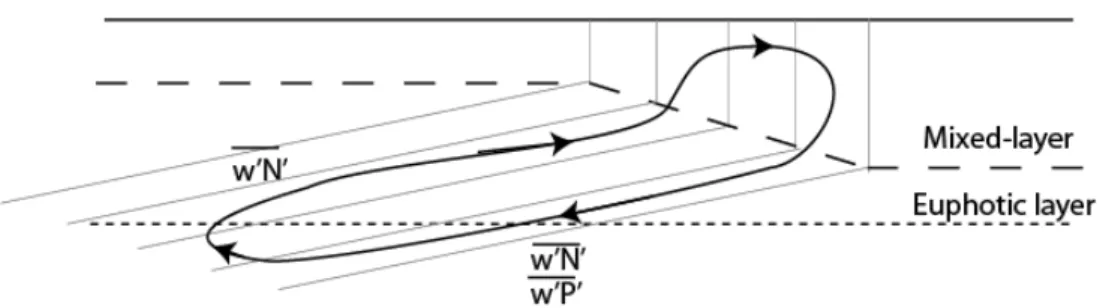
94
properties between the turbulent boundary layer and the ocean interior.
95
The relative contribution of the various turbulent motions to the evolution of a tracer is
96
best illustrated in terms of the Reynolds-averaged equation – the equation describing the
97
dynamics of the long-time average of the tracer. For illustrative purposes, let us consider the
98
concentration of nutrient N averaged over a time/spatial scale larger than the mesoscale field.
99
The average evolves according to:
100 € ∂tN + u .∇N mean = −∇H⋅ u' N mesoscale '−∂zw' N' submesoscale + ∂z
(
kz∂zN)
microscale + B(N) bio log y (1) 101where overbars indicate averages and primes denote eddy fluctuations over this
spatio-102
temporal scale. For clarity, we have separated the microscale Reynolds fluxes, which are
103
associated with irreversible mixing of water masses, and the mesoscale and
104
submesoscale Reynolds fluxes, which represent advective transport of material
105
properties along density surfaces without irreversible mixing. The horizontal advective
106
Reynolds fluxes are dominated by mesoscale eddies (Ledwell et al., 1998). The vertical
107
advective Reynolds fluxes are dominated by mesoscale eddies in the ocean interior away
108
from boundaries, but there is growing evidence that in the upper few hundred meters of the
oceans they are dominated by submesoscale circulations at fronts (e.g., Capet et al., 2008;
110
Klein and Lapeyre, 2009); evidence of the more active role of submesoscales in the
111
vertical Reynolds flux is presented in section 3.3. The effect of microscale turbulence often
112
referred to as vertical mixing, is particularly strong in the turbulent boundary layers, where it
113
keeps tracers and momentum well mixed. In this equation it is parameterized as a vertical
114
diffusivity term, with kz the vertical diffusion coefficient. Finally, B(N) denotes all biological 115
processes affecting the concentration of N. Typically, for nitrate B(N) includes uptake by
116
phytoplankton and production through nitrification. An equation similar to Eq. (1) holds for
117
phytoplankton, except that the “biology” term accounts for phytoplankton growth minus
118
losses such as death and respiration.
119
The potential role of the submesoscale has only recently been recognized; thus, compared
120
to the other terms in the above equation little is known about its magnitude, distribution and
121
contribution to vertical and horizontal fluxes. This paper presents a critical overview of
122
current knowledge to focus attention and hopefully interest on the pressing scientific
123
questions concerning these dynamics.
124
The paper is organized into 6 parts. Section 2 reviews the main characteristics of
125
submesoscale dynamics. Section 3 examines how these dynamics are likely to affect the
126
nutrient and phytoplankton budget of the euphotic layer. Section 4 focuses on the impact of
127
submesoscale dynamics on the structure and spatial distributions of the planktonic ecosystem.
128
Section 5 discusses the observational difficulties associated with investigating submesoscale
129
heterogeneities. Finally, section 6 comprises the Conclusions.
130
131 132
2- Submesoscale dynamics
133
Stirring by large-scale ocean currents and mesoscale eddies creates a convoluted web of
134
filaments of all oceanic tracers, including temperature, salinity, nutrients and phytoplankton.
135
However, only close to the ocean surface does the filamentation of hydrographic properties
136
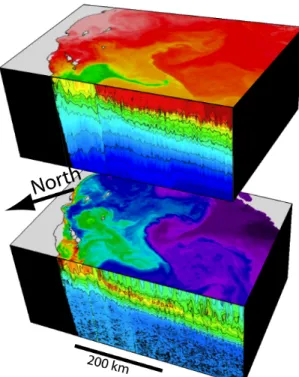
evolve into sharp density fronts with associated strong submesoscale circulations (Fig.1). The
137
theory of frontogenesis at the ocean surface is well understood and the interested reader
138
is referred to the many excellent in-depth reviews (e.g., Hoskins, 1982; Thomas et al.,
139
2008; Klein and Lapeyre, 2009). Here we offer a heuristic argument to explain why
140
submesoscale fronts are generated preferentially at the ocean surface. Note that fronts
141
can also be generated at the ocean bottom, but our focus is on the impact of fronts on
142
ocean productivity in the upper ocean.
143
At the mesoscale, i.e., scales larger than the first deformation radius of O(10-100)
144
km (Chelton et al., 1998), the pressure gradients associated with horizontal density fronts are
145
balanced by the Coriolis acceleration due to Earth’s rotation: the so-called “geostrophic
146
balance”. The degree of geostrophic balance is quantified in terms of the Rossby number
147
Ro=U/fL, where U is the characteristic velocity at a front, L is the frontal width and f is the 148
Coriolis parameter: geostrophic balance holds if Ro<<1. In the ocean interior, density
149
surfaces are very flat with a steepness smaller than O(Ro). Whenever the mesoscale or
150
large-scale velocity field is locally convergent and acts to compress and steepen density
151
surfaces, an overturning circulation develops that promptly brings the surfaces back
152
toward the horizontal (reducing their steepness) and restores the geostrophic balance
153
(increasing L). Hence submesoscale motions with Ro=O(1) do not arise spontaneously in
154
the ocean’s interior. A convergent velocity field, however, compresses passive tracers
155
that have no feedback on the dynamics. Indeed mesoscale turbulence in the ocean
156
interior continuously generates sharp tracer filaments, a process referred to as a
forward cascade of enstrophy and tracer variance (Charney, 1971). It is only density
158
surfaces that remain smooth (Lapeyre et al., 2006; Klein et al., 2008).
159
The situation is quite different at the ocean surface. In regions of flow convergence
160
where density surfaces are brought together, the overturning circulation, that in the
161
interior slumps surfaces back to the horizontal, becomes purely horizontal at the
162
surface because water cannot cross the air-sea interface. The horizontal circulation acts
163
to further accelerate the convergence of density surfaces resulting in frontogenesis – the
164
formation of sharp density fronts in a time of a few days (Hoskins and Bretherton,
165
1972; Spall, 1995). As the fronts form, the slope of the density surfaces increases (the
166
slope is further increased by microstructure turbulence in the surface mixed layer
167
which mixes away any vertical stratification) and Ro becomes O(1). The increase in Ro
168
results in strong ageostrophic submesoscale circulations that drive a forward energy
169
cascade and excite local microstructure turbulence (Molemaker and McWilliams, 2010;
170
Taylor and Ferrari, 2010). The increase in slope is accompanied by the development of
171
intense upwelling and downwelling on the warm and cold sides of the front respectively:
172
the ratio of vertical to horizontal velocities scales with the slope of density surfaces and
173
it is therefore much larger at fronts. In the ocean interior, with frontal aspect ratios of
174
O(10-4 - 10-3) and horizontal velocities of O(0.1) m/s, the vertical velocities reach O(10-5-10-4)
175
m s-1 or O(1-10) m d-1. Near the surface the vertical velocities reach O(10-3) m s-1 or O(100)
176
m d-1 (Mahadevan and Tandon, 2006; Legal et al., 2007; Klein and Lapeyre, 2009). These
177
large vertical velocities extend from just below the surface down to a few hundred meters and
178
drive a rapid exchange of properties between the turbulent boundary layer and the permanent
179
thermocline (Fig.2a).
180
Submesoscale fronts are ephemeral and typically last only a few days after they are
181
formed. This is either because the flow convergence ceases as currents and mesoscale eddies
evolve, or because the fronts become unstable. During frontolysis (frontal decay) the vertical
183
velocity and the associated exchange of properties with the ocean interior progressively
184
decrease. The shutdown is particularly rapid and extreme when frontolysis is associated with
185
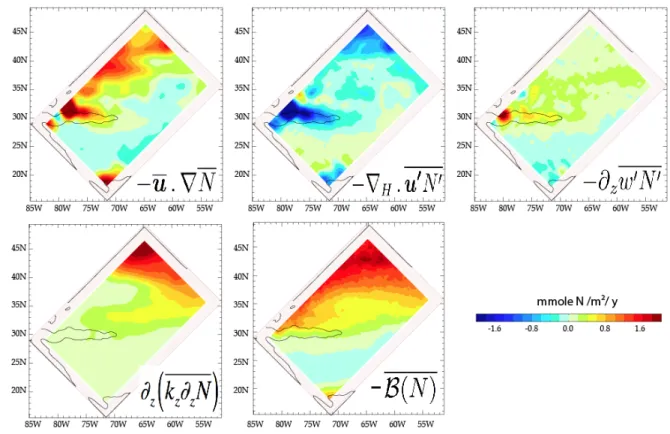
frontal instabilities (Boccaletti et al., 2007; Capet et al., 2008; Thomas and Ferrari, 2008),
186
sometimes taking just a few hours. There is a rapidly growing literature on the details of how
187
such instabilities develop. In the first stage, light waters flow over dense waters in what is
188
called symmetric instability, a process that has recently been observed at the Kuroshio
189
(D’Asaro et al., 2011) and Gulf Stream fronts (Thomas and Joyce, 2010). Later, meanders
190
and eddies develop along the front and slumping accelerates as a result of baroclinic
191
instability (Fox-Kemper et al, 2008). Other forms of instability have also been reported when
192
the lateral shear at the front is particularly intense (McWilliams, 2010). Regardless of the
193
details of specific processes, the instabilities typically result in restratification and
194
suppression of vertical mixing within the turbulent boundary layer (i.e. a strong decrease of
195
kz in Eq. 1).
196
Thomas (2005) points out that frontolysis can be arrested by winds. If the winds blow in
197
the same direction as the frontal current, they act to steepen the front and prevent further
198
slumping by frontal instabilities. In such situations turbulent mixing is enhanced at fronts,
199
rather than being reduced, and no restratification takes place (e.g., Franks and Walstad,
200
1997). If the winds blow in the opposite direction of the frontal current they act to slump the
201
front, further accelerating restratification by frontal instabilities.
202
In summary, one expects frontogenesis whenever large-scale currents or mesoscale eddies
203
converge to bring together different water masses. During this phase strong vertical velocities
204
develop which promote exchange of properties between the surface ocean and the permanent
205
thermocline. Once the convergent flow weakens, frontolysis effectively suppresses turbulent
206
mixing at the front except when winds blow in the direction of the frontal current.
3- Response of phytoplankton to submesoscale dynamics
208
The response of phytoplankton to submesoscale dynamics will typically depend on
209
what factor exerts the main control over phytoplankton growth, light or nutrients. In
210
case of nutrient limitation, the contribution of the submesoscale is mostly through the
211
supply of nutrients into the nutrient starved euphotic layer. However, some of the most
212
productive regions are in the high latitudes, where spring blooms are light limited. In
213
the case of light limitation, the impact of submesoscales is mostly to modulate the
214
strength of vertical mixing and thus the light exposure of phytoplankton. Moreover, in
215
both cases, submesoscale processes will export phytoplankton out of the surface layer.
216
These mechanisms, how they combine and their potential impact on large scale fluxes,
217
are presented in this section.
218
3.1 Response to submesoscale vertical transport
219
Over much of the ocean, phytoplankton growth is constrained by the availability of
220
nutrients, which are abundant beneath the euphotic zone. The upward component of the
221
submesoscale vertical circulation enhances the nutrient flux into the euphotic layer,
222
stimulating phytoplankton growth (Fig. 2a) (Mahadevan and Archer, 2000; Levy et al., 2001;
223
Allen et al., 2005; Lapeyre and Klein, 2006b; Nagai et al., 2008; Johnson et al., 2010;
224
Pidcock et al., 2010). Submesoscale upwelling can also drive deep phytoplankton biomass
225
upward, alleviating light limitation of growth (Lévy et al., 2001). The downward branch,
226
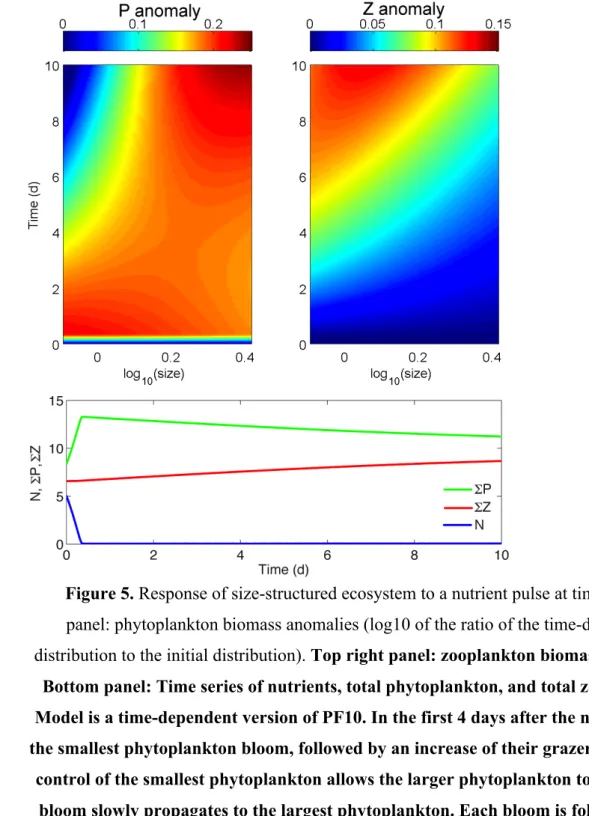
however, has a negative impact on primary production by subducting phytoplankton, together
227
with other organic matter, out of the euphotic zone (Fig. 2a) (Kadko et al., 1991; Fielding et
228
al., 2001; Levy et al., 2001; Niewiadomska et al., 2008; Thomas and Joyce, 2010). This
229
subduction acts as a physical carbon pump and modifies the properties of intermediate mode
230
waters (Karleskind et al., 2011a,b). Submesoscale vertical motions will occur in all regions,
not just those that are nutrient limited. Purely from a perspective of vertical transport,
232
therefore, the net biogeochemical effect of submesoscale dynamics may vary with region,
233
representing a changing balance of the two antagonistic effects (Lathuilière et al., 2010). The
234
strength of the submesoscale vertical advection also varies in space and time depending in
235
part on the intensity of the eddy activity, and can be enhanced by winds through the
236
generation of inertial motions (Franks and Walstad, 1997) that interact with the submesoscale
237
frontogenetic dynamics (Lévy et al., 2009).
238
Much of our knowledge on this topic comes from models. For example, simulations
239
suggest that submesoscale turbulence increases phytoplankton abundance in the open ocean
240
(Lévy et al., 2001, Oschlies, 2002, McGillicuddy et al., 2003) but decreases it in eastern
241
boundary upwelling regions (Lathuilière et al., 2011). Some studies also suggest that in
242
regions where nutrients are plentiful, such as the subpolar North Atlantic or eastern boundary
243
upwelling systems, submesoscale vertical circulations could cause a loss of nutrients from the
244
euphotic layer (Lévy et al., 2000; Oschlies, 2002, McGillicuddy et al., 2003, Gruber et al.,
245
2011). More generally, the regional net flux of nutrients due to submesoscale vertical
246
advection depends on the often strongly localized distribution of enhanced vertical circulation
247
and the rate of removal of upwelled nutrients from the upwelling regions by horizontal
248
advection (Martin et al., 2002; Martin et al., 2003; Pasquero et al., 2005). Typically,
249
capturing the full strength of submesoscale vertical movements requires horizontal model
250
resolution of the order of one tenth of the internal Rossby radius of deformation. This would
251
require a resolution of O(1) km at mid-latitudes, though this depends on the mixed-layer
252
depth. Studies with a coarser resolution will not fully capture the vertical circulation.
253
There are only a few observational studies to complement these model results: the
254
balance between upwelling and subduction of nutrients, phytoplankton and other organic
255
material is inherently difficult to assess purely from observations, let alone quantifying how
this balance varies with the intensity of submesoscale turbulence. The magnitude of
257
submesoscale turbulence can be evaluated from mean properties such as eddy kinetic energy
258
or descriptors such as the Lyapunov exponent of the flow. This approach to quantifying the
259
link between the vertical transport of nutrients and the strength of the submesoscale flow was
260
applied by Rossi et al. (2008) and Gruber et al. (2011) in eastern boundary upwelling regions
261
and by Calil and Richards (2010) in the oligotrophic open ocean. These studies report a
262
positive correlation between productivity and eddy kinetic energy derived from altimetry in
263
the open ocean, but the opposite relationship for eastern boundary upwelling regions.
264
Although it is too early to discern any clear pattern, these results are at least consistent with
265
the modelling studies described earlier.
266
Submesoscale upwelling of nutrients to the surface also depends on how deep the
267
submesoscale vertical velocities extend into the water column. The strength of the
268
submesoscale vertical circulation is typically maximal at the base of the mixed layer. In
269
situations of nutrient limitation, the largest vertical gradient of dissolved nutrients, the
270
nutricline, is found at the base of the euphotic layer. The mixed layer is often shallower than
271
the nutricline. In this case submesoscale upwelling will not be effective in mixing nutrients
272
into the euphotic zone. A few studies have suggested that significant submesoscale vertical
273
velocities can, in some circumstances, penetrate deeper than the mixed layer, potentially
274
reaching the nutricline (Capet et al., 2008; Lévy et al., 2010). In contrast to the submesoscale,
275
the mesoscale vertical circulation is maximal at the zero crossing of the first baroclinic mode,
276
which is often found deeper in the water column (~500-1000 m).
277
The time scales associated with upwelling will also determine its influence on primary
278
production: the delivery of nutrients by mesoscale eddies may be more efficient than
279
submesoscale motions for biological growth (McGillicuddy et al., 2007). Though the vertical
280
velocities associated with mesoscale eddies are much smaller than the submesoscale ones due
to the different Ro of the two regimes, the residence time of nutrients in the euphotic layer is
282
longer for mesoscale eddies than for submesoscale fronts, potentially allowing for more
283
complete uptake of the upwelled nutrients. Submesoscale fronts bring nutrients so rapidly in
284
and out of the euphotic layer that it is unclear whether phytoplankton can fully utilize them.
285
Indeed, typically, the time scale of nutrient supply at the surface by submesoscale
286
vertical velocities is of the order of 0(1-10) day, which corresponds to the time scale of
287
nutrient uptake by phytoplankton. Our current — rather incomplete — view of how the
288
relationship between submesoscale and mesoscale vertical velocities varies with depth and
289
time is a topic that clearly requires further research.
290
Finally, in terms of carbon, how the air-sea CO2 exchange is affected by submesoscale
291
vertical transport is not straightforward. For instance, there are compensating effects of the
292
small-scale upwelling of nutrients and cold temperatures, which tend to decrease oceanic
293
pCO2, and the upwelling of dissolved inorganic carbon (DIC), which tends to increase it
294
(Mahadevan et al., 2004; Mahadevan et al., 2011). The leading term of this balance depends
295
on the relative vertical gradients of DIC (and alkalinity), nitrate and temperature. In the
296
Northeast Atlantic, large submesoscale surface pCO2 gradients have been observed, but
297
attributed to stirring by mesoscale eddies rather than to vertical advection associated with
298
submesoscale circulations (Resplandy et al., 2009).
299
3.2 Response to reduced vertical mixing at submesoscale fronts
300
When light is the main factor limiting phytoplankton production, such as in large parts of
301
the Southern Ocean or at high latitudes prior to the spring bloom, the reduction of vertical
302
mixing induced by submesoscale dynamics can locally increase the mean time that
303
photosynthetic organisms spend in the well-lit euphotic layer and promote primary
304
production. This can be rationalized by the reduction of kz in Eq. 1, with the consequence
of limiting phytoplankton excursions out of the euphotic layer (Fig. 2b). Models suggest
306
that this reduction of vertical mixing can either result in a reduction in the mixed-layer depth
307
(Lévy et al., 1998) or in a reduction of mixing intensity within the mixed-layer (Taylor and
308
Ferrari, 2011a,b). This may lead to the beginning of a bloom prior to seasonal stratification,
309
and has been reported in the North Atlantic by Townsend et al. (1994) and Joyce et al.
310
(2009), as well as in the Adriatic by Santoleri et al. (2003). Model studies of this
311
phenomenon in the Mediterranean Sea (Lévy et al., 1999, 2000) suggest that it only modifies
312
the annual mean budget of phytoplankton production in the absence of strong seasonality.
313
Otherwise, the main effect seems to be restricted to the earlier onset of the bloom (Lévy et al.,
314
2005; Taylor and Ferrari, 2011a,b). The importance of this process over large-scale,
light-315
limited regions (such as in the Southern Ocean) remains to be assessed.
316
3.3 Response to large-scale changes of the circulation induced by submesoscale
317
dynamics
318
The effects on nutrients of local mesoscale and submesoscale perturbations of the
319
velocities do not cancel out when averaged over a regional scale. This is due to the non-linear
320
nature of advection. Mathematically, this local effect is associated with the Reynolds terms
321
(see Eq. 1). However, a complete picture of the impact of submesoscale turbulence on
322
nutrients has to account not only for the local Reynolds fluxes but also for how the
323
distribution of the large-scale circulation and nutrient fields (and hence the mean advection
324
and vertical diffusion) are modified by submesoscale phenomena. For instance, the feedback
325
of the submesoscale motions on the mean circulation may influence the position and strength
326
of western boundary currents, and through the thermal wind balance, the global equilibration
327
of the thermocline and nutricline (Lévy et al., 2010). In this sense there is an effect that is
328
non-local in space and time, and can be thought of as the remote effect of the submesoscale
329
dynamics. To demonstrate this impact it is necessary to run model experiments long enough
to allow the model mean state to equilibrate in the presence of submesoscale dynamics.
331
Clearly there is a practical issue of the computational demands associated with this. One
332
example, however, is provided by the model study of Levy et al. (2012). Here, phytoplankton
333
abundance at equilibrium was found to be less in the submesoscale-resolving (1/54°) model
334
than in the model without submesoscale processes. This result arises from the different
large-335
scale distributions of the nutricline depth and mixed-layer depth in the two model equilibria.
336
An attempt to quantify the contribution of submesoscales to the annual nitrate balance in
337
the euphotic layer at mid-latitudes is presented here in the context of the Lévy et al. (2012)
338
model. A seasonally varying double-gyre is simulated, representative of an idealized sector of
339
the Northwest Atlantic or Pacific. A strong surface jet, the model’s equivalent of the Gulf
340
Stream or Kuroshio, flows eastward at ~30°N (Fig. 3a). The instability of this jet generates
341
intense mesoscale turbulence which is maximum in the vicinity of the jet but can be found
342
throughout the region 20-40°N. The submesoscale circulation can be seen in the form of
343
submesoscale jets (Fig. 3a), accompanied by intense upwellings and downwellings on
344
either sides of the jets (Fig. 3b). The nutrient concentration at the surface is
345
characterized by a large-scale gradient, characteristic of the North Atlantic, and
346
distorted by mesoscale stirring (Fig. 3c). The long model spin-up (50 years) allows the
347
annual mean position of the jet, as well as the thermocline and nutricline depths to reach
348
equilibrium, integrating the feedback of submesoscale processes on large-scale quantities.
349
The model domain is large enough to encompass different biological regimes: an
350
oligotrophic regime in the subtropical gyre (from ~20-30°N) where winter nitrate
351
concentrations are less (Fig. 3c), a strong spring bloom in the subpolar gyre north of ~40°N
352
and a mid-latitude regime with a moderate bloom between 30-40°N in the inter-gyre region.
353
This north-south gradient in productivity is reflected by the structure of the biological term
354
B(N) (Fig. 4). 355
At equilibrium, an annual integration of all the terms in equation (1) implies that ∂tN is
356
zero and thus the biological term B(N) is exactly balanced by the sum of the four physical
357
terms. After integration over the euphotic depth, this leads to:
358 € [−u .∇N remote − ∇H⋅ u' N mesoscale(local ) '− ∂ zw' N' submesoscale(local ) +∂ z
(
kz∂zN)
remote ]dzdt z =0 Zeupho∫
1year∫
= B(N) bio log y dzdt z =0 Zeupho∫
1year∫
(2) 359The remote effect of submesoscales enters this equation through the mean advection and the
360
vertical mixing terms. This is because submesoscale dynamics influence the mean currents,
361
the mixed-layer depth and the mean distribution of nutrients. The local effects enter the
362
equation through the horizontal and vertical Reynolds fluxes. Here, the separation
363
between mean and eddy fields was done with a space filter with a cut-off scale of O(100)
364
km. Thus the Reynolds terms potentially contain the contribution of both the mesoscale
365
and the submesoscale. However, spectra of horizontal and vertical nitrate flux vs.
366
wavenumber k show that the horizontal flux spectrum (slope of ~k-2) is steeper than the
367
vertical flux spectrum (slope of ~k-1) and implies that the integral over wavenumbers is
368
dominated by the largest scales (small wavenumbers) in the case of the horizontal flux,
369
but it is strongly affected by the smallest scales (large wave numbers) in the case of the
370
vertical flux. The overall vertical tracer flux is thus strongly affected by the
371
submesoscale fronts.
372
The contribution of the different terms in Eq. 2 to the annual balance of nutrient supply to
373
the euphotic layer varies regionally (Fig. 4), as does the relative importance of the local
374
(Reynolds) and remote (mean) submesoscale contributions. Vertical mixing dominates the
375
balance in the regions where the mixed layer gets deeper than the euphotic depth over the
376
seasonal cycle. This is the case north of 40°N and in the eastern sector. In these regions the
377
local submesoscale term is negligible. In contrast, in the intergyre region (30-40°N), the
mean and mesoscale advection terms are larger than vertical mixing and tend to oppose each
379
other. In this region the local submesoscale term has a magnitude comparable to the other
380
advective terms and is always positive. Thus, in this region local submesoscale advection is
381
efficiently supplying nitrate to the euphotic layer; this supply makes a substantial contribution
382
to the overall balance.
383
4- Ecosystem response to submesoscale dynamics
384
All the submesoscale dynamics described previously have the potential to change not
385
only the primary and export production, but also the structure and the functioning of the
386
planktonic ecosystem. Strong submesoscale vertical velocities can drive episodic nutrient
387
pulses into the euphotic zone, while horizontal stirring can create intense patchiness in
388
planktonic species. These processes have been investigated with both models and data.
389
Many field studies have observed systematic changes in phytoplankton community
390
structure across trophic gradients: the fraction of total biomass contributed by the smallest
391
cells decreases strongly with increasing biomass (e.g., Yentsch and Phinney, 1989; Chisholm,
392
1992; Ciotti et al., 2002; Li, 2002; Irigoien et al., 2004; Uitz et al., 2006). Biomass is
393
typically added in successively larger size classes as the total biomass increases, while
394
smaller size classes remain relatively unchanged (Landry, 2002).
395
These large-scale patterns are also seen in ecosystem responses to the episodic addition of
396
limiting nutrients. Cavender-Bares et al. (2001) measured size-abundance spectra of
397
phytoplankton in mesocosms of Sargasso Sea water enriched with NO3 and PO4 and found
398
that waves of enhanced biomass propagated from small to large sizes over 5 days. Similar
399
analyses inside iron-fertilized patches during IronEx II showed peaks and troughs of particle
400
abundance propagating toward the larger sizes of the size spectrum over 8 days with large
401
pennate diatoms dominating the increase in phytoplankton biomass (e.g., Coale et al., 1996;
Landry et al., 2000). This ecosystem response to enrichment is an emergent property driven
403
by the size-dependencies of fundamental biological rates such as growth, production and
404
grazing (e.g., Rassoulzadegan and Sheldon, 1986; Fuchs and Franks, 2010; Poulin and
405
Franks, 2010). Pulses of biomass propagating to larger size classes after a nutrient injection
406
reflect changing balances of growth and predation with size and time. These imbalances can
407
lead to disproportionate growth of larger phytoplankton and efficient food chains fueling
408
pelagic fish production (e.g., Moloney and Field, 1991). They can also lead to episodic
409
particle fluxes and locally enhanced carbon sequestration (e.g., Guidi et al., 2007). It is thus
410
critical to measure and understand the size-dependencies of phytoplankton growth and
411
microzooplankton grazing rates in submesoscale features where such pulses may be focused.
412
The changes in the size structure of the planktonic community driven by nutrient pulses
413
will lead to local patches of distinct species abundances. Such patches will become stirred
414
and distorted by the mesoscale and submesoscale horizontal velocity fields (Martin et al.,
415
2001). By combining multisatellite data, notably high-resolution ocean-colour maps of
416
dominant phytoplankton types and altimetry-derived Lagrangian diagnostics of the surface
417
transport, d’Ovidio et al. (2010) demonstrated that the phytoplankton landscape is organized
418
into submesoscale patches, often dominated by a particular phytoplankton group, separated
419
by physical fronts induced by horizontal stirring. These physical fronts effectively delimit
420
ephemeral ecological niches by encircling water masses of similar history and whose
421
lifetimes are comparable to the timescale of the biological response (a few weeks). This
422
submesoscale structuring of the plankton community is a direct consequence of horizontal
423
stirring by the turbulent circulation.
424 425
4.1 Size-dependent ecosystem response to a nutrient pulse
427
To explore the size-dependent community response to a nutrient pulse, we used the
428
Poulin and Franks (2010) (hereafter PF10) size-structured ecosystem model, which allows for
429
an arbitrary number of different size classes of phytoplankton P and zooplankton Z (typically
430
>500 size classes of each). The model is similar to the Fuchs and Franks (2010)
size-431
structured model: it is based on a simple NPZ model structure, but includes potential
size-432
dependence of all biological processes (growth, grazing, assimilation efficiency, etc.). The
433
results shown here were obtained with a herbivore-only model.
434
The PF10 model was initialized at steady state with a total nutrient concentration
435
(phytoplankton+zooplankton+dissolved nutrients) of 10 mmolN m-3 and given a nutrient
436
pulse of 5 mmolN m-3 over 1 day (Fig. 5). There was an immediate growth response across
437
all phytoplankton size classes. Over the days following the initial response, the smallest
438
phytoplankton showed the largest increase in biomass, followed by an increase in the biomass
439
of their grazers. The increase of the grazers led to eventual net decreases in the smallest
440
phytoplankton. This grazer-induced decrease in the smallest phytoplankton decreased
441
their competitive ability, allowing growth of the larger phytoplankton. Over the next 10
442
days (and longer), a pulse of high biomass propagated from the smallest phytoplankton
443
toward the largest. The duration of the biomass pulse depends on the phytoplankton growth
444
and zooplankton grazing rates; the pulse propagates more slowly and is of longer duration as
445
it reaches the larger (slower-growing) phytoplankton. The phytoplanktonic biomass pulse
446
in a given size class is ultimately terminated by a subsequent biomass increase of the
447
herbivores. These results suggest that in a Lagrangian sense, nutrient pulses to the
448
euphotic zone should lead to a patchy, distinct, and evolving planktonic community
449
structure compared to surrounding waters. The resonance between the time scales of
450
submesoscale-driven nutrient injections (O(1) day, e.g., D’Asaro et al., 2011) and
phytoplankton and protist grazer growth rates (O(1) d-1) are expected to lead to
452
significant modification of the planktonic community and its dynamics in the vicinity of
453
submesoscale features.
454
4.2 Spatial diversity driven by submesoscale nutrient pump
455
The PF10 model is presently too computer intensive to run at full resolution in a 3D
456
submesoscale-resolving model. To investigate the effects of submesoscale dynamics on
457
spatial patterns of phytoplankton diversity, a reduced NPPZD
(nutrient-phytoplankton-458
phytoplankton-zooplankton-detritus) model was run with a SQG (surface quasi-geostrophic)
459
physical model (Perruche et al., 2011). In this model the phytoplankton community
460
comprises two size classes of phytoplankton (P1 and P2), representing nano and micro 461
phytoplankton respectively, using the Moloney and Field (1991) parameterization of growth
462
rates. In particular, because of competitive exclusion there is no region of the parameter space
463
(total nutrient Co vs. irradiance I) in which P1 and P2 can coexist at equilibrium (Fig. 6c). 464
When coupled to the SQG model, the local perturbations of nutrients by physical
465
processes nevertheless allow the coexistence of the two phytoplankton types (Fig. 6ab): P2 466
dominates in the long thin filaments between eddies formed by the straining of the
467
concentration fields; P1 dominates inside eddies, but is also found in the filaments. Both the 468
coexistence and shifts in the balance of this coexistence over short length scales can be
469
explained by considering the response time scales of the system (Fig. 6c). The similarity
470
between the short time scales associated with strong submesoscale vertical nutrient injections
471
and the ecosystem response time scale (given along the red line, Fig. 6c) favours dominance
472
by the largest phytoplankton size class. On the other hand, the longer time scales associated
473
with eddies with low rates of vertical nutrient injection favor the smallest phytoplankton
474
class. The potential resonances between different components of the plankton and different
scales of physical forcing lead to strong spatial and temporal heterogeneities in community
476
structure and dynamics.
477
These nascent modelling studies underscore the importance of resolving submesoscale
478
features in models and in sampling. Biological processes such as growth, grazing,
479
aggregation and predation are all expected to be enhanced in submesoscale upwellings.
480
Nutrient pulses are able to propagate through the trophic web, driving strong changes in
481
community structure. The spatial and temporal heterogeneity of nutrient pulses, combined
482
with horizontal stirring, alters the competitive balance among different phytoplankton
483
species. We thus expect to see strong spatial and temporal gradients in planktonic community
484
structure forced by submesoscale physical dynamics. Furthermore, Cotté et al. (2011) and
485
Tew-Kai et al. (2009) have recently shown that the effects of submesoscale dynamics extend
486
through the food web to affect the top predators’ foraging behaviour. Thus, the combined
487
effects of submesoscale features, even though a relatively small fraction of the total area, may
488
be disproportionately important to biological dynamics.
489
5- Observational considerations
490
A major obstacle to testing current predictions from theories and models is the difficulty
491
of adequately sampling the submesoscale. As mentioned above, the phenomena of interest are
492
both ephemeral and localized, taking just a few days to wax and wane and only being of
O(1-493
10) km in width despite being up to hundreds of kilometers in length. A major aspect of the
494
observational challenge, therefore, is one common to the purely physical study of the
495
submesoscale: the need to be able to survey a region at sufficiently high temporal and spatial
496
resolution.
497
Gliders (e.g., SPRAY spray.ucsd.edu/pub/rel/index.php, Slocum
498
www.webbresearch.com/slocumglider.aspx, Seaglider
www.irobot.com/gi/maritime/1KA_Seaglider) are fast becoming the platform of choice in a
500
wide range of oceanographic applications. Typically a glider can cover 1 km horizontally in
501
an hour with an ascent angle of around one in five. Steeper angles of ascent are possible but
502
with the consequence of slower horizontal progress. Even for larger submesoscale features of
503
O(10) km width a glider would require half a day for one transect. The slow speed also means
504
that the strong directional currents associated with many of the submesoscale features of
505
interest have the potential to displace the glider significantly over even one transect.
506
A more traditional alternative is a ship-towed undulating device, such as the SeaSoar
507
(Pidcock, 2011) or Triaxus (D’Asaro et al., 2011) platforms. These allow sampling typically
508
10-20 times faster than a glider, permitting much better time resolution of the evolution of
509
submesoscale features. Furthermore, the physical connection to the ship allows the use of
510
sensors whose power demands would significantly curtail the range of a glider. The costs of
511
and demands on research vessels mean that such studies are nevertheless limited in duration
512
relative to gliders, which can continue to sample a region for months even during the winter
513
period.
514
The relevant submesoscale timescales for a study impose other constraints on a study of
515
their biogeochemistry. An obvious intention might be to record biogeochemical processes
516
such as primary production and export of carbon over an annual cycle at a resolution
517
sufficient to allow the contribution of the submesoscale to be assessed. Given the fleeting
518
existence of any specific submesoscale feature this annual budget may best be addressed
519
using Eulerian sampling, building up a statistical picture of the cumulative effect of
520
submesoscale processes at a fixed location. The problem then arises of how temporal signals
521
in biogeochemistry can be disentangled from simple advection of spatial variability through
522
the site. Having a collection of moorings spaced at distances sufficient to resolve
523
submesoscale spatial variability might be one approach. The spatial coverage would also be
required to separate out the regional change in time associated with biological processes such
525
as nutrient uptake, population growth and sedimentation. This approach to studying the
526
underlying physical processes of the submesoscale is to be tried, for example, by the UK
527
OSMOSIS program, with the moorings augmented by gliders.
528
If study of the dynamics associated with a specific submesoscale feature is of interest then
529
a Lagrangian approach is required, as the mesoscale circulation may advect any feature tens
530
of kilometers in just one day. For example, D’Asaro et al. (2011) used a neutrally buoyant
531
float to mark a submesoscale front in the Japan Sea. They used this as a moving reference
532
point for repeated Triaxus surveys of the physical characteristics. A similar observational
533
strategy, augmented with fluorescence and backscattering measurements, was followed
534
during the 2008 North Atlantic spring bloom experiment (Fennel et al., 2011; Alkire et al.,
535
2012; D’Asaro, pers. comm.). A major program of the US Office of Naval Research targeting
536
the physics of the submesoscale will also use a Lagrangian approach. Two recent
537
developments that show considerable potential for Lagrangian studies involve the use of
538
multiple drifters. The Autonomous Underwater Explorer (http://jaffeweb.ucsd.edu/node/81)
539
is a very compact (2 L) float with active buoyancy control that can carry multiple
540
biogeochemical sensors and can be deployed in groups, collecting information on spatial
541
variability through triangulation by means of acoustic communication links as they disperse.
542
A similar idea lies behind the Wire Walker (Rainville and Pinkel, 2001; Pinkel et al., 2011)
543
which maintains a float at the surface but uses wave power to constantly yo-yo a sensor
544
package beneath it. Deploying a number of these would provide a high-frequency and
545
irregularly spaced but 3D map of biogeochemical and physical processes. These vehicles can
546
collect complete vertical profiles through 250 m of water with less than 10 minutes between
547
profiles; the time scales are shorter if the profiling depth is decreased.
Current satellite altimeters do not resolve the submesoscale, but do provide information
549
on the mesoscale field which can be used to diagnose where submesoscale fronts (d’Ovidio et
550
al., 2004; 2009; Lehahn et al., 2007; Deprès et al. 2011) and submesoscale vertical transport
551
(Legall et al., 2007; Isern-Fontanet et al., 2008) should occur. The Indo-German LOHAFEX
552
iron fertilization experiment (March 2009) and French KEOPS2 natural fertilization
553
experiment in the Southern Ocean (Nov 2011) used an innovative sampling strategy based on
554
this concept, with real-time identification of transport structures from the analysis of
multi-555
satellite altimetry data and surface buoy release. This approach is aimed at identifying
556
environments naturally isolated by the structure of the surface circulation, where it becomes
557
possible to study the time evolution of biophysical processes in a Lagrangian sense. More
558
generally, the use of altimetry should soon become common practice to adjust sampling
559
strategy at sea in real time (for instance, with repeated sections across submesoscale fronts, as
560
in Legall et al., 2007) according to the position of the frontal structures that can be forecast
561
with such data. In the near future, development of wide-swath altimetry by both the NASA
562
SWOT and ESA Wavemill programs would take the spatial resolution of geostrophic currents
563
to a few km, which should significantly improve our ability to identify in real time where
564
submesoscale fronts may be generated.
565
Colour satellites have long provided information on phytoplankton distributions at a
566
resolution capable of resolving the submesoscale (e.g., Gower et al., 1980), though such
567
information is often discarded by averaging the data into weekly or monthly composites.
568
Recent developments using satellites to study the biogeochemistry of the submesoscale in
569
more detail include nitrate estimates (Goes et al., 2004) and algorithms to probe community
570
composition by using the array of frequencies on multi-spectral sensors to fuller extent (e.g.,
571
Alvain et al., 2005; Uitz et al., 2009). One concern with the former is that the nitrate
572
algorithm is based on sea-surface temperature and chlorophyll measurements, so it could be
argued that it is not an independent measurement. It would additionally need to be
574
ascertained whether the empirical relationship underpinning it holds at the submesoscale
575
where biogeochemistry will often be far out of equilibrium. There is also the question of
576
whether, to obtain an acceptable signal to noise ratio, it would be necessary to spatially
577
average the signal up to scales that would preclude the submesoscale from being
578
resolved accurately. Nevertheless, if it proves possible to allay such concerns, the approach
579
is an appealing one as it potentially allows a much more thorough mapping of the surface
580
nitrate field than could be achieved by any ship or glider survey at a resolution which should
581
capture much of the submesoscale variability.
582
Returning to in situ observations, it has long been a problem that very few
583
biogeochemical properties can be accurately measured using compact autonomous sensors. It
584
is only recently that ultraviolet-based sensors capable of robust measurements of nitrate with
585
a sensitivity suitable for open ocean biogeochemistry have been developed (Pidcock et al.,
586
2010; Johnson et al., 2010). The most exciting development for submesoscale studies,
587
perhaps, is the emergence of lab-on-chip technology; the ability to use advanced engineering
588
techniques to build low energy, sophisticated but small sensors, with obvious potential for
589
deployment on any of the platforms discussed above. Of particular relevance to submesoscale
590
biogeochemistry are wave-guide-based sensors for a range of nutrients (Adornato et al.,
591
2009); miniaturized flow cytometers (e.g., Barat et al., 2010) and species-specific RNA
592
probes (e.g., Tsaloglou et al., 2011). The latter two in particular offer huge potential for
593
starting to tease apart the complexities of community composition at the submesoscale.
594
595 596 597
6- Conclusions
598
Submesoscale dynamics dominate at time and space scales that make them uniquely
599
important to the structure and functioning of planktonic ecosystems. Resulting from
600
interactions within the mesoscale eddy field, submesoscale flows can generate intense
601
vertical motions at fronts, driving nutrients into the euphotic zone, and subducting organic
602
carbon beneath it. The efficacy of submesoscale dynamics in influencing primary production
603
and ecosystem structure depends on the local hydrography, euphotic depth, and nutrient
604
distributions. Our lack of knowledge of the physical flows and biogeochemical responses at
605
the submesoscale is due both to their dynamic complexity, and the practical difficulties in
606
sampling at the appropriate time and space scales. However, recent advances in physical
607
models, planktonic ecosystem models and ocean sampling technologies makes this an ideal
608
time to explore the physical-chemical-biological interactions at these scales. In particular we
609
need to gain understanding of how the intense vertical motions at the submesoscale
610
contribute to regional-average properties such as vertical carbon and nitrogen fluxes. The
611
strong spatial patchiness in planktonic community structure induced by submesoscale
612
motions may lead to a significant fraction of the vertical flux being restricted to similarly
613
small spatial and temporal scales—scales that would be missed by measurements that average
614
over inappropriately large spatial and temporal scales. Improved understanding of the
615
importance of submesoscale dynamics will come only through targeted interdisciplinary field
616
and modelling programs.
617 618
619 620
621
Ackowledgements
622
All authors contributed equally to this paper. This review builds on the outcomes of a
623
conference funded by EUR-OCEANS and Europôle Mer: Influence of meso- and
sub-624
mesoscale ocean dynamics on the global carbon cycle and marine ecosytems, Centre de la 625
Mer, Aber Wrac’h, France, June 2010. This work was supported by the joint
CNRS-INSU-626
LEFE program & EUR-OCEANS flagship “TANGGO” (Lévy, Rivière, Martin), by the
627
CCE-LTER program (Franks, Rivière), by NSF award 1155205 (Ferrari) and by the NERC
628
Oceans 2025 program (Martin).
629
630
References:
631
Adornato, L., A. Cardenas-Valencia, E. Kaltenbacher, R.H. Byrne, K. Daly, K. Larkin, S.
632
Hartman, M. Mowlem, R. D. Prien and V. C. Garçon (2009), In Situ Nutrient Sensors
633
for Ocean observing systems, Proceedings of the Oceanobs'09 : Sustained Ocean
634
observations and Information for Society Conference (Vol 2), Venice, Italy, 21-25
635
September 2009, Hall, J., Harrison, D.E. and Stammer D. Eds., ESA Publication
WPP-636
306.
637
Alkire et al. (2012) Estimates of net community production and export using
high-638
resolution, Lagrangian measurements of O2, NO3-, and POC through the
639
evolution of a spring diatom bloom in the NorthAtlantic, Deep-Sea Research I, 64,
640
157-174.
641
Allen, J., Brown, L., Sanders, R., Moore, C., Mustard, A., Fielding, S., Lucas, M., Rixen, M.,
642
Savidge, G., Henson, S. (2005), Diatom carbon export enhanced by silicate upwelling
643
in the Northeast Atlantic, Nature, 437, 728–732.
644
Alvain. S., Moulin C., Dandonneau Y. and Bréon F.M (2005), Remote sensing of
645
phytoplankton groups in case 1 waters from global SeaWiFS imagery, Deep Sea Res. I,
646
52, 1989-2004.
647
Barat, D., G. Benazzi, M. Mowlem, J. M. Ruano and H. Morgan (2010), Design, simulation
648
and characterisation of integrated optics for a microfabricated flow cytometer. Optics
649
Communications, 283, (9), 1987-1992, doi:10.1016/j.optcom.2009.12.046.
Boccaletti G., R. Ferrari, and B. Fox-Kemper (2007), Mixed Layer Instabilities and
651
Restratification, J. Phys. Oceanogr., 37, 2228-2250.
652
Calil, P.H.R., and K.J. Richards (2010), Transient upwelling hot spots in the oligotrophic
653
North Pacific, J. Geophys. Res., 115, C02003, doi:10.1029/2009JC005360.
654
Capet, X., McWilliams, J., Molemaker, M., Shchepetkin, A. (2008), Mesoscale to
655
submesoscale transition in the California current system. part i: Flow structure, eddy
656
flux, and observational tests, J. Phys. Oceanogr., 38, 29–43.
657
Cavender-Bares, K. K., Rinaldo, A. and Chisholm, S. W. (2001), Microbial size spectra
658
from natural and nutrient enriched ecosystems. Limnol. Oceanogr. 46, 778–789.
659
Chelton, D. B., R. A. Deszoeke and M. G. Schlax (1998), Geographical Variability of the
660
First Baroclinic Rossby Radius of Deformation, J. Phys. Oceanogr., 28, 433-460
661
Chelton, D. B., P. Gaube, M. G. Schlax, J.J. Early and R. M. Samelson (2011), The Influence
662
of Nonlinear Mesoscale Eddies on Near-Surface Oceanic Chlorophyll, Science 334,
663
328, 10.1126/science.1208897.
664
Chisholm, S. W. (1992) Phytoplankton size. In Falkowski, P. G. and Woodhead, A. D. (eds),
665
Primary Productivity and Biogeochemical Cycles in the Sea. Plenum Press, pp. 213–
666
237.
667
Ciotti, A. M., Lewis, M. R. and Cullen, J. J. (2002) Assessment of the relationships between
668
dominant cell size in natural phytoplankton communities and the spectral shape of the
669
absorption coefficient. Limnol. Oceanogr., 47, 404–417.
670
Cipollini, P. et al. (2001), Rossby waves detected in global ocean colour data, Geophys. Res.
671
Lett., 28, 323–326, doi:10.1029/1999GL011231.
672
Cotté C., d'Ovidio F., Chaigneau A., Lévy M., Taupier-Letage I., Maté B., Guinet C. (2011),
673
Scale-dependent interactions of Mediterranean whales with marine dynamics.
674
Limnology and Oceanography, 56, (1), 219-232.
675
D'Asaro E, C. Lee, L. Rainville, R. Harcourt, L. Thomas (2011), Enhanced turbulence and
676
energy dissipation at ocean fronts, Science, 332(6027), 318-22.
677
Deprès, A., G. Reverdin and F. D’Ovidio (2011), Mechanisms and spatial variability of meso
678
scale frontogenesis in the northwestern subpolar gyre, Ocean Modelling, 39, 97-113.
679
Falkowski, P., D. Ziemann, Z. Kolber and P. K. Bienfang (1991), Role of eddy pumping in
680
enhancing primary production in the ocean, Nature, 352, 55-58.
681
Fennel, K., Cetinic, I., D'Asaro, E., Lee, C., Perry (2011), M.J., Autonomous data
682
describe North Atlantic spring bloom, EOS Transactions AGU, Vol. 92, No. 50,
683
465-466, doi:10.1029/2011EO500002.
684
Ferrari, R., J. C. McWilliams, V. Canuto, and D. Dubovikov (2008), Parameterization of
685
eddy fluxes at the ocean boundaries, J. Climate, 31, 2770-2789.