HAL Id: hal-02799964
https://hal.inrae.fr/hal-02799964
Submitted on 5 Jun 2020HAL is a multi-disciplinary open access archive for the deposit and dissemination of sci-entific research documents, whether they are pub-lished or not. The documents may come from teaching and research institutions in France or abroad, or from public or private research centers.
L’archive ouverte pluridisciplinaire HAL, est destinée au dépôt et à la diffusion de documents scientifiques de niveau recherche, publiés ou non, émanant des établissements d’enseignement et de recherche français ou étrangers, des laboratoires publics ou privés.
Comparative study of E171 food grade and P25 Ti02
nanoparticles
William Dudefoi, Hélène Terrisse, Mireille Richard-Plouet, Bernard Humbert,
Marie-Hélène Ropers
To cite this version:
William Dudefoi, Hélène Terrisse, Mireille Richard-Plouet, Bernard Humbert, Marie-Hélène Ropers. Comparative study of E171 food grade and P25 Ti02 nanoparticles. 13. Congrès international sur les matériaux nanostructurés ”nano 2016”, Aug 2016, Québec, Canada. �hal-02799964�
NANO 2016, Québec, Canada
COMPARATIVE STUDY OF E171 FOOD GRADE AND P25 TiO
2NANOPARTICLES
W. Dudefoi1, H. Terrisse2, M. Richard-Plouet2, B. Humbert2, E. Gautron2, M-H. Ropers1,*
1
INRA, UR1268 Biopolymères Interactions Assemblages, 44300 Nantes, France
2Institut des Matériaux Jean Rouxel IMN, Université de Nantes, CNRS, 44322 Nantes
*e-mail: [email protected]
Titanium dioxide (TiO2) is a white metal oxide commonly used as a white pigment in various applications such as paints, cosmetic and food products. TiO2 food additive is referred to as E171 in Europe and INS171 in North America, and is mainly used in sugar confectionary, constituting the coating of sweets and chewing- gum. Unfortunately, it was recently discovered that food grade TiO2 exhibits a nano-sized fraction, representing up to 36% of the particles [1]. Due to the classification of TiO2 particles as potentially harmful for humans by inhalation [2], the toxicity of ingested TiO2 nanoparticles, in general, needs to be evaluated and more specifically, with food grade particles. However, the reference particles are mostly the very well-known Degussa P25 particles, a kind of TiO2 particles widely used for photocatalytic applications [3].
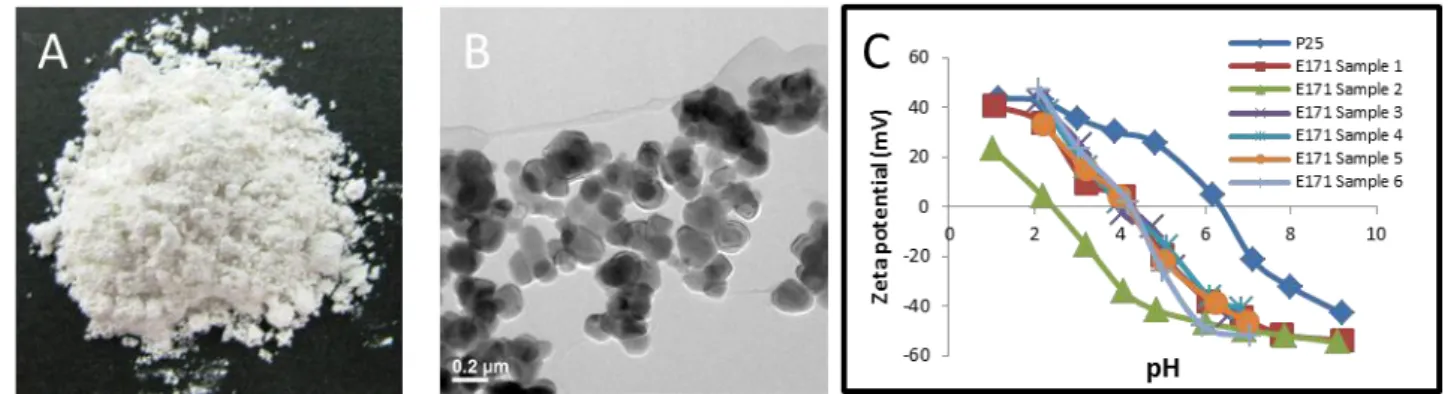
Fig. 1. A: Food grade TiO2 / B: TEM image of food grade TiO2 / C: Zeta potential of food grade and P25 TiO2
In this study, we evaluated whether P25 and food grade particles are similar. For this purpose, several food grade TiO2 samples and P25 particles were investigated for their physicochemical characteristics (size distribution, shape, crystallinity, reactivity, surface properties). Several methods relevant from physical chemistry were applied: transmission electron microscopy TEM, X-ray diffraction XRD, laser scattering particle size distribution analyzer, X-ray photoelectron spectrometry XPS, zeta potential measurements, Raman and IR spectroscopies, Inductively coupled plasma atomic emission spectroscopy ICP-AES, Diffuse Reflectance Infrared Fourier Transform Spectroscopy DRIFTS and specific surface area analysis. The results show that E171 and P25 have different compositions and surface chemistry. TEM analysis confirmed the presence of nano-sized particles in food grade TiO2 E171, with a mean diameter of 131 nm and 26% of nanoparticles, whereas P25 particles have a mean diameter of 23 nm with 100% of nanoparticles. The E171 isoelectric points lie between pH 2 and pH 4.2, whereas P25 isoelectric point is pH 6.2. In accordance with zeta potential measurements, laser scattering particle size distribution analysis shows that E171 tend to form larger agglomerates at pH < 5 whereas P25 forms larger agglomerates at pH > 5. Moreover, XRD, XPS, FT-RAMAN, DRIFTS, surface specific area analysis and ICP-AES
NANO 2016, Québec, Canada
analysis confirmed that P25 is a mixture of 75% rutile and 25% anatase with a low degree of hydrolysed surface oxygens, whereas the crystalline variety of E171 is anatase only, coated with hydroxide in a larger extend, some organic species in variable proportions, and sometimes Silicon and Aluminum, depending on the suppliers. This work confirms the recent paper of Yang et al., 2014 [4] and provides additional data. We also found a certain heterogeneity among food grade TiO2 samples, leading us to strongly recommend researchers to take into account the different surface chemistry of E171 particles for their studies and properly characterize their samples before each of their toxicological studies. In any case, using Degussa P25 particles does not appear to be a reliable model to study the fate of food grade TiO2 in the gastro-intestinal tract.
References
[1] A. Weir, P. Westerhoff, L. Fabricius, K. Hristovski, N. von Goetz. Environ Sci Technol, 2012, 46:2242– 2250.
[2] IARC, 2010, Volume 93.
[3] B. Jovanović, 2015, Integrated Environmental Assessment and Management 11(1):10-20
[4] Y. Yang, K. Doudrick, X. Bi, K. Hristovski, P. Herckes, P. Westerhoff, and R. Kaegi, Environmental Science
& Technology, 2014, 48 (11), 6391-6400
Acknowledgements
This work has been carried out in the framework of the Labex Serenade (ANR-11-LABX-0064) and of the A*MIDEX project (ANR-11-IDEX-0001-02), funded by the «Investissements d’Avenir» French Government program managed by the French National Research Agency (ANR).