HAL Id: hal-01366525
https://hal.archives-ouvertes.fr/hal-01366525
Submitted on 21 Dec 2017
HAL is a multi-disciplinary open access
archive for the deposit and dissemination of
sci-entific research documents, whether they are
pub-lished or not. The documents may come from
teaching and research institutions in France or
abroad, or from public or private research centers.
L’archive ouverte pluridisciplinaire HAL, est
destinée au dépôt et à la diffusion de documents
scientifiques de niveau recherche, publiés ou non,
émanant des établissements d’enseignement et de
recherche français ou étrangers, des laboratoires
publics ou privés.
Immersed in a Viscous Fluid
Wafik Abassi, Adil El Baroudi, Fulgence Razafimahéry
To cite this version:
Wafik Abassi, Adil El Baroudi, Fulgence Razafimahéry. Vibration Analysis of Euler-Bernoulli Beams
Partially Immersed in a Viscous Fluid. Physics Research International, 2016, 2016, pp.67613721
-6761372-14. �10.1155/2016/6761372�. �hal-01366525�
Research Article
Vibration Analysis of Euler-Bernoulli Beams Partially
Immersed in a Viscous Fluid
Wafik Abassi,
1Adil El Baroudi,
1and Fulgence Razafimahery
2 1Arts et M´etiers ParisTech, ENSAM Angers, 2 boulevard du Ronceray, 49035 Angers, France 2IRMAR, Universit´e de Rennes 1, Campus de Beaulieu, 35042 Rennes Cedex, FranceCorrespondence should be addressed to Adil El Baroudi; [email protected] Received 17 September 2015; Revised 20 January 2016; Accepted 27 January 2016 Academic Editor: Israel Felner
Copyright © 2016 Wafik Abassi et al. This is an open access article distributed under the Creative Commons Attribution License, which permits unrestricted use, distribution, and reproduction in any medium, provided the original work is properly cited. The vibrational characteristics of a microbeam are well known to strongly depend on the fluid in which the beam is immersed. In this paper, we present a detailed theoretical study of the modal analysis of microbeams partially immersed in a viscous fluid. A fixed-free microbeam vibrating in a viscous fluid is modeled using the Euler-Bernoulli equation for the beams. The unsteady Stokes equations are solved using a Helmholtz decomposition technique in a two-dimensional plane containing the microbeams cross sections. The symbolic software Mathematica is used in order to find the coupled vibration frequencies of beams with two portions. The frequency equation is deduced and analytically solved. The finite element method using Comsol Multiphysics software results is compared with present method for validation and an acceptable match between them was obtained. In the eigenanalysis, the frequency equation is generated by satisfying all boundary conditions. It is shown that the present formulation is an appropriate and new approach to tackle the problem with good accuracy.
1. Introduction
The objective of this paper is to provide an analytical method to calculate the coupled frequencies of vibration of microbeams partially immersed in a viscous fluid. The microbeams are clamped on one edge while the other edge is free.
The motivation of this work is to provide a theoretical model that can be used in the design and interpretation of density and viscosity sensors.
Due to their size and potential for highly sensitive and low cost compact device applications, microstructures are becoming increasingly attractive for sensing applications and have been studied extensively in recent years. Microstruc-tures are commonly used in atomic force microscopy (AFM) to probe surface properties and to measure interfacial forces [1–7], in biological and chemical sensors [8–10]. A precise modeling of the solid-fluid interaction and the determina-tion of the frequency response enable the measurement of the density and the rheological behavior of fluids [11–16]. Reference [16] uses finite element analysis (FEA) method in order to predict the dynamic response of the cantilever beam.
This method can be easily applied to the measurement of the fluid viscosity.
For microstructures, fluid viscosity can greatly affect their frequency response. Reference [7] presented a rigorous theoretical model for the frequency response of cantilever beams that are undergoing flexural vibrations and immersed in viscous fluids, which is of particular relevance to applica-tions of the AFM. The knowledge and understanding of the frequency analysis of microbeams are of fundamental practi-cal importance in application to the AFM.
The frequency analysis of a microbeam can be dramat-ically affected by the properties of the fluid in which it is immersed. Whereas calculation of the natural frequencies in vacuum can be performed routinely, analysis of the effects of immersion in fluid poses a formidable challenge. The modal response of an immersed microbeam can be considerably affected by the properties of fluid. The added mass effect due to the fluid structure interaction can, however, cause consid-erable variations in natural frequencies. The knowledge and understanding of this viscous fluid-structure coupling are lacking at present.
Volume 2016, Article ID 6761372, 14 pages http://dx.doi.org/10.1155/2016/6761372
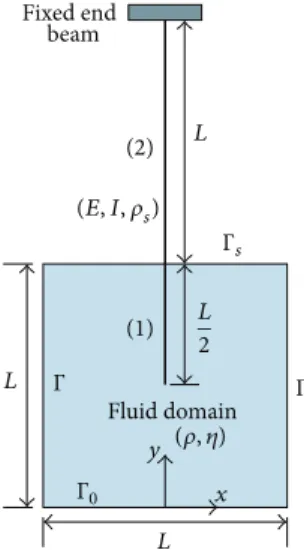
x y Fixed end beam Fluid domain (1) (2) L L L L 2 Γ Γ Γs Γ0 (𝜌, 𝜂) (E, I, 𝜌s)
Figure 1: Sketch of beam composed of 2 uniform beam segments
(denoted by(1) and (2)) partially immersed in a fluid-filled
rectan-gular geometry.
In this contribution, we investigate the vibrational behav-ior of microbeams partially immersed in a viscous fluid, which describes the interrelation between the fluid’s density and viscosity. For a viscous fluid problem, the analytical formulation is based upon a convenient decomposition of the velocity field into two contributions, one being related to the scalar potential and the other being the vector potential. The solutions of the differential equations of motion turn out to be complex and can be conveniently treated with the aid of the symbolic software Mathematica. Furthermore, this work investigates the influence of the fluid’s viscosity on the vibrational behavior of the microbeams.
2. Modal Analysis of Beams and
Frequency Equation
Modal analysis of elastic immersed structures is needed in every modern construction and should have wide engineer-ing application. In this study, modal analysis is important to predict the dynamic behavior of the submerged beams. It is well known that the natural frequencies of the submerged elastic structures are different from those in vacuum. The effect of fluid forces on the immersed beam decreases the natural frequencies from those that would be measured in the vacuum. This decrease in the natural frequencies is caused by the increase of the kinetic energy of the fluid-beams system without a corresponding increase in strain energy. The Euler-Bernoulli beam is partially immersed inside rectangular fluid
domain (Figure 1). Consider a beam of length 3.06⋅10−2[m],
width 4.6⋅10−3[m], and thickness 1.27⋅10−4[m] as shown in
Figure 1, which corresponds to a model developed in [16]. The interaction between the fluid and the Euler-Bernoulli beams is taken into account to calculate the natural frequencies and mode shapes of the coupled system. The dynamics of each beam portion are treated separately. It is assumed that the beam has aligned neutral axis.
2.1. Mathematical Formulation. In this section we present the general theory for the dynamic deflection of beams partially submerged in a viscous fluid. A schematic depiction of beams partially submerged in viscous fluid is displayed in Figure 1. We begin by discussing some general assumptions and approximations taken into account in the present the-oretical model. It is assumed that the cross section of the beams is uniform over its entire length and the length of the beams greatly exceeds its width. Also the beams are an isotropic linearly elastic solid and internal frictional effects are negligible. The amplitude of the vibrations of the beams is small. In addition, we shall neglect all torsional effects in the beams and only consider the flexural modes of vibration and
we shall consider modes whose motion is strict in the
𝑥-direction. For beams vibrating at small amplitudes (small compared to the beams dimensions), the governing dynam-ical equations ignoring shear deformation and rotary inertia
effects for the transverse deflection𝑢𝑖(𝑦, 𝑡) (𝑖 = 1 for
sub-merged portion and𝑖 = 2 for portion in vacuum) of uniform
elastic beams can be written in the form
EI𝜕 4𝑢 1(𝑦, 𝑡) 𝜕𝑦4 + 𝜌𝑠𝑆𝜕 2𝑢 1(𝑦, 𝑡) 𝜕𝑡2 = 𝑓fluid, 𝐿 2 ⩽ 𝑦 ⩽ 𝐿, (1) EI𝜕 4𝑢 2(𝑦, 𝑡) 𝜕𝑦4 + 𝜌𝑠𝑆𝜕 2𝑢 2(𝑦, 𝑡) 𝜕𝑡2 = 0, 𝐿 ⩽ 𝑦 ⩽ 2𝐿, (2)
where𝑢1(𝑦, 𝑡) and 𝑢2(𝑦, 𝑡) are the lateral deflections at
dis-tance𝑦 (spatial coordinate) along the length of the beams and
𝑡 is time; EI, 𝜌𝑠, and𝑆 are the flexural rigidity, the mass per unit
volume, and the cross-sectional area of the beam, respectively. 𝑓fluidis the external force per unit length acting on the beam
in the direction of the flexural displacement, which is caused by the viscous fluid in the beams. The dynamics of each beam portion are treated separately.
For a beam moving in a viscous fluid, the applied load
𝑓fluidcan be obtained by integrating the normal component
of the total force exerted by the fluid over the beam section.
To proceed with the analysis, the general form of𝑓fluid is
required. We therefore examine the equations of motion for the fluid. For this, the viscous fluid mode shapes are first com-puted for the square domain fluid assuming the boundary conditions given in Figure 1. From conservations of mass and momentum, the motion of the fluid is governed by (see [17])
∇ ⋅ k = 0, (3)
𝜌𝜕k𝜕𝑡 + 𝜌 (k ⋅ ∇) k = ∇ ⋅ 𝜎, (4)
in whichk = {V𝑥, V𝑦}𝑇is the fluid velocity vector,𝜌 is the
den-sity of the fluid, and𝜎 is the total fluid stress tensor (pressure
and viscous forces). Since the amplitude of vibration of each beam is small compared to its cross-sectional dimensions, it then follows that all nonlinear convective inertial effects in the fluid can be neglected, and the hydrodynamic loading on the beam will be a linear function of its displacement. This implies that the fluid dynamics can be modeled as
an unsteady linear Stokes flow. Assuming that the fluid is Newtonian, its constitutive equation is given by
𝜎 = 𝜏 − 𝑝I with 𝜏 = 𝜂 [∇k + (∇k)𝑇] , (5)
whereI is a unit tensor, 𝜂 is the dynamic viscosity, and 𝑝 is
the fluid pressure. The boundary conditions which define the fluid domain are
k ⋅ n = 0 on Γ, (6)
k = 0 on Γ0, (7)
𝜎 ⋅ n = 0 on Γ𝑠. (8)
The equations of motion (3) and (4) are highly complex and coupled. However, a simpler set of equations can be
obtained by introducing scalar potentials𝜙 and 𝜓, known as
the Helmholtz decomposition [18] in a way which permits easily transferring the vector problem formulation ((3) and (4)) to scalar problem formulation. In flow fields, the velocity is thereby decomposed into a potential flow and a viscous
flow. In other words, the velocityv can be expressed as a sum
of the gradient of a scalar potential𝜙 and the curl of a vector
potentialΨ as follows [18]:
k = ∇𝜙 + ∇ × Ψ, (9)
whereΨ is a vector stream function. Using the problem
sym-metry, the vector potentialΨ reduces to a scalar equation; that
is,Ψ = (0, 0, 𝜓), using the condition ∇ ⋅ Ψ = 0, and
substitut-ing the above resolutions into (3) and (4), after some manipu-lations, the equation for the conservation of mass (3) becomes the Laplace equation
∇2𝜙 = 0 (10)
and the equation for the conservation of momentum (4) becomes ∇2𝜓 −1 ] 𝜕𝜓 𝜕𝑡 = 0, 𝑝 + 𝜌𝜕𝜙𝜕𝑡 = 0, (11)
where] is the kinematic fluid viscosity and ∇2 = 𝜕2/𝜕𝑥2+
𝜕2/𝜕𝑦2is the Laplacian operator. Thus, the Stokes equation is
reduced to formulation (10) and (11). Moreover, adopting the
Cartesian coordinate system(𝑥, 𝑦) and using expression (9),
the velocity components,V = (V𝑥, V𝑦), may be expressed as
simple functions of compressional and shear wave potentials in the form V𝑥= 𝜕𝜙 𝜕𝑥+ 𝜕𝜓 𝜕𝑦, V𝑦= 𝜕𝜙 𝜕𝑦 − 𝜕𝜓 𝜕𝑥 (12)
and the pertinent stress-velocity relations are
𝜎𝑥𝑥= 𝜌𝜕𝜙𝜕𝑡 + 2𝜂𝜕V𝜕𝑥𝑥, 𝜎𝑥𝑦 = 𝜂 (𝜕V𝑥 𝜕𝑦 + 𝜕V𝑦 𝜕𝑥) , 𝜎𝑦𝑦= 𝜌𝜕𝜙 𝜕𝑡 + 2𝜂 𝜕V𝑦 𝜕𝑦. (13)
2.1.1. Field Expansions. Consider time harmonic motion
throughout with angular frequency𝜔 and with the exp(𝑖𝜔𝑡)
dependence suppressed for simplicity. Applying the classical technique of separation of variables in the Cartesian coordi-nates, the solution of (10) and (11) after some manipulations, and taking into account boundary condition (6) can be shown to be
𝜓 = sin (𝛽𝑥) [𝐴 cos (𝛿𝑦) + 𝐵 sin (𝛿𝑦)] , (14)
𝜙 = cos (𝛽𝑥) [𝐶 cos (𝜆𝑦) + 𝐷 sin (𝜆𝑦)] , (15)
𝑝 = 𝜂𝛼2cos(𝛽𝑥) [𝐶 cos (𝜆𝑦) + 𝐷 sin (𝜆𝑦)] (16)
with the complex-valued coefficients 𝜆 = 𝑗𝛽,
𝛿 = 𝑗√𝛽2− 𝛼2,
𝛼 = 1 − 𝑗
√2 √ 𝜔],
(17)
where 𝛽 = 𝑛𝜋/𝐿 and 𝑛 is an integer. 𝐴, 𝐵, 𝐶, and 𝐷
are unknown coefficients which will be determined later by imposing the appropriate boundary conditions. Hence, the fluid particle velocity field can be determined from (12) in the form
V𝑥= sin (𝛽𝑥) {𝛿[𝐵 cos (𝛿𝑦) − 𝐴 sin (𝛿𝑦)]
− 𝛽 [𝐶 cos (𝜆𝑦) + 𝐷 sin (𝜆𝑦)]} , (18)
V𝑦= cos (𝛽𝑥) {𝜆 [𝐷 cos (𝜆𝑦) − 𝐶 sin (𝜆𝑦)]
− 𝛽 [𝐴 cos (𝛿𝑦) + 𝐵 sin (𝛿𝑦)]} . (19)
Consequently, direct substitution of the expansions (14)–(19) into the stress-velocity relations (13), after some manipula-tions, leads to
𝜎𝑥𝑥= 𝜂 cos (𝛽𝑥) {2𝛽𝛿[𝐵 cos (𝛿𝑦) − 𝐴 sin (𝛿𝑦)]
𝜎𝑦𝑦= 𝜂 cos (𝛽𝑥) {2𝛽𝛿[𝐴 sin (𝛿𝑦) − 𝐵 cos (𝛿𝑦)] − (2𝜆2+ 𝛼2) [𝐶 cos (𝜆𝑦) + 𝐷 sin (𝜆𝑦)]} , (21) 𝜎𝑥𝑦= 𝜂 sin (𝛽𝑥) ⋅ {(2𝛽2− 𝛼2) [𝐴 cos (𝛿𝑦) + 𝐵 sin (𝛿𝑦)] + 2𝛽𝜆 [𝐶 sin (𝜆𝑦) − 𝐷 cos (𝜆𝑦)]} . (22)
In order to determine the unknown constants, the appropri-ate boundary conditions (7) and (8) must be explicitly used. Substituting the total fluid stress tensor components (20)– (22) into boundary conditions equations (8) and velocity components (18)-(19) into boundary conditions equations (7), and after some considerable algebraic manipulation, the
scalar potentials𝜙 and 𝜓 become
𝜓 = 𝐴 sin (𝛽𝑥) [cos (𝛿𝑦) +𝛽𝛿2Φ sin (𝛿𝑦)] , (23)
𝜙 = 𝐴 cos (𝛽𝑥) [𝛽Φ cos (𝜆𝑦) +𝛽 𝜆sin(𝜆𝑦)] , (24) where Φ = 2𝛿 sin (𝛿𝐿) + (2𝛽 2− 𝛼2) (sin (𝜆𝐿) /𝜆) 2𝛽2cos(𝛿𝐿) − (2𝛽2− 𝛼2) cos (𝜆𝐿) . (25)
Using the expressions of𝜓 and 𝜙 from (23) and (24), in (12),
we have the following expressions for the velocity compo-nents: V𝑥= 𝐴 sin (𝛽𝑥) {𝛿[𝛽 2 𝛿Φ cos (𝛿𝑦) − sin (𝛿𝑦)] − 𝛽 [𝛽Φ cos (𝜆𝑦) +𝛽𝜆sin(𝜆𝑦)]} , (26) V𝑦= 𝐴 cos (𝛽𝑥) {𝜆 [𝛽 𝜆cos(𝜆𝑦) − 𝛽Φ sin (𝜆𝑦)] − 𝛽 [cos (𝛿𝑦) + 𝛽2 𝛿Φ sin (𝛿𝑦)]} . (27)
Components of the stress tensor can be obtained by
substitut-ing the expressions of velocity componentsV𝑥;V𝑦, from (26)
and (27), and the expression of scalar potential𝜙 from (24) in
(13) which comes out as
𝜎𝑥𝑥= 𝐴𝜂 cos (𝛽𝑥) {2𝛽𝛿[𝛽2
𝛿Φ cos (𝛿𝑦) − sin (𝛿𝑦)]
− (2𝛽2+ 𝛼2) [𝛽Φ cos (𝜆𝑦) +𝛽
𝜆sin(𝜆𝑦)]} ,
(28)
𝜎𝑦𝑦= 𝐴𝜂 cos (𝛽𝑥) {2𝛽𝛿[sin (𝛿𝑦) −𝛽𝛿2Φ cos (𝛿𝑦)]
− (2𝜆2+ 𝛼2) [𝛽Φ cos (𝜆𝑦) +𝛽 𝜆sin(𝜆𝑦)]} , (29) 𝜎𝑥𝑦= 𝐴𝜂 sin (𝛽𝑥) ⋅ {(2𝛽2− 𝛼2) [cos (𝛿𝑦) + 𝛽2 𝛿Φ sin (𝛿𝑦)] + 2𝛽𝜆 [𝛽Φ sin (𝜆𝑦) −𝛽 𝜆cos(𝜆𝑦)]} . (30)
Now we can integrate the normal component of the total force exerted by the fluid over the beam section in order to obtain the external force per unit length acting on the beam
in the direction of the flexural displacement𝑓fluid. Hence, the
deflection of the immersed part of the beam (which is equal
to𝑢1(𝑦, 𝑡) = 𝑢1(𝑦) exp (𝑗𝜔𝑡)) can be determined from (1) and
(28) in the form 𝑢1 (𝑦) − 𝜌𝑠𝑆𝜔2 EI 𝑢1(𝑦) =2𝐴𝛽𝜂 cos (𝛽𝐿/2) EI {𝛽 2Φ cos (𝛿𝑦) − 𝛿 sin (𝛿𝑦) − (𝛽2+𝛼2 2 ) [Φ cos (𝜆𝑦) + sin(𝜆𝑦) 𝜆 ]} , (31)
where primes denote differentiation with respect to the
posi-tion variable𝑦.
2.2. Method of Solution and Frequency Equation. The general solutions of the ordinary differential equations (31) and (2) for the beams system, as shown in Figure 1, can be written in dif-ferent segments in terms of trigonometric functions and rep-resent propagating waves and hyperbolic functions reprep-resent evanescent waves as
𝑢1(𝑦) = 𝐴1cos(Ω𝑦) + 𝐵1sin(Ω𝑦) + 𝐶1cosh(Ω𝑦)
+ 𝐷1sinh(Ω𝑦) +2𝐴𝛽𝜂 cos (𝛽𝐿/2) EI { 𝛿 sin (𝛿𝑦) − 𝛽2Φ cos (𝛿𝑦) Ω4− 𝛿4 +𝛽2+ 𝛼2/2 Ω4− 𝜆4 [Φ cos (𝜆𝑦) + sin(𝜆𝑦) 𝜆 ]} , (32)
𝑢2(𝑦) = 𝐴2cos(Ω𝑦) + 𝐵2sin(Ω𝑦) + 𝐶2cosh(Ω𝑦)
+ 𝐷2sinh(Ω𝑦) , (33)
whereΩ is the flexural wavenumber and is given by
Ω = √𝜔 (𝜌𝑠𝑆
EI)
1/4
Equation (32) shows that the parameters 𝜔𝑐= (𝑛𝜋 𝐿 ) 2 √ EI 𝜌𝑠𝑆, 𝜔𝑐= (𝑛𝜋/𝐿)2 √𝜌𝑠𝑆/EI + 1/] (35)
are resonance frequency parameters and can be plotted for
different values of𝑛.
The nine constants𝐴1,𝐵1,𝐶1,𝐷1,𝐴2,𝐵2,𝐶2,𝐷2, and𝐴
can be found by imposing the following boundary conditions. Equations (32) and (33) are the general solution for the vibra-tion modes of beams partially immersed in fluid. In the case of a coupled system, the effect of fluid viscosity on the flexible beams must be considered. On the fluid-beams interface, the normal velocity must be continuous. Therefore, the fluid
velocity and the deflection of a beam𝑢1satisfy the relation
V𝑥𝑥=𝐿/2= 𝑗𝜔𝑢1(𝑦) , 𝐿
2 ⩽ 𝑦 ⩽ 𝐿. (36)
Substituting (26) and (32) into (36), and after some manipu-lations, leads to the following equation:
𝐴 [1 + 2𝜆𝜔𝜂 EI(Ω4− 𝛿4) tan (𝛽𝐿/2)] ⋅ [𝛽2Φ cos (𝛿𝑦) − 𝛿 sin (𝛿𝑦)] − 𝐴 [𝛽2+ 2𝜆𝜔𝜂 (𝛽 2+ 𝛼2/2) EI(Ω4− 𝜆4) tan (𝛽𝐿/2)] ⋅ [Φ cos (𝜆𝑦) + sin(𝜆𝑦) 𝜆 ] = 𝑗𝜔
sin(𝛽𝐿/2)[𝐴1cos(Ω𝑦) + 𝐵1sin(Ω𝑦)]
+ 𝑗𝜔
sin(𝛽𝐿/2)[𝐶1cosh(Ω𝑦) + 𝐷1sinh(Ω𝑦)] .
(37)
Both sides of (37) are integrated over𝐿/2 < 𝑦 < 𝐿 to yield the
following equation:
𝐴 = 𝑗𝜔
Υ sin (𝛽𝐿/2)(𝐴1𝐼1+ 𝐵1𝐼2+ 𝐶1𝐼3+ 𝐷1𝐼4) , (38)
whereΥ and the coefficients 𝐼1,𝐼2,𝐼3, and𝐼4are written down
explicitly in Appendix E. Now the expression of the lateral movement of the submerged beams in contact with the fluid
𝑢1can be formulated using (32) and taking into account (38)
as 𝑢1(𝑦) = 𝐴1[cos (Ω𝑦) + 𝐼1𝑈 (𝑦)] + 𝐵1[sin (Ω𝑦) + 𝐼2𝑈 (𝑦)] + 𝐶1[cosh (Ω𝑦) + 𝐼3𝑈 (𝑦)] + 𝐷1[sinh (Ω𝑦) + 𝐼4𝑈 (𝑦)] , (39) where 𝑈 (𝑦) = 2𝜆𝜂𝜔 EIΥ tan (𝛽𝐿/2)[ 𝛿 sin (𝛿𝑦) − 𝛽2Φ cos (𝛿𝑦) Ω4− 𝛿4 +𝛽2+ 𝛼2/2 Ω4− 𝜆4 (Φ cos (𝜆𝑦) + sin(𝜆𝑦) 𝜆 )] . (40)
Now, to derive the frequency equation of beams partially immersed in fluid, one assumes that, on the interface between
each portion of the beam at the position𝑦 = 𝐿, the deflection,
the rotation angle, the internal shear force, and bending moment of the beam must be continuous. This is satisfied when 𝑢1(𝐿) = 𝑢2(𝐿) , 𝑢 1(𝐿) = 𝑢2(𝐿) , 𝑢1 (𝐿) = 𝑢2(𝐿) , 𝑢1 (𝐿) = 𝑢2 (𝐿) . (41)
To complete the formulation of the boundary-value problem, the four boundary conditions for the beam ends (𝑦 = 𝐿/2 = 𝑎
and𝑦 = 2𝐿 = 𝑏) considered in this work are specified as
follows: 𝑢1(𝑎) = 0, 𝑢1 (𝑎) = 0, 𝑢2(𝑏) = 0, 𝑢2(𝑏) = 0. (42)
Combining the boundary conditions ((41) and (42)) with (33) and (39) yields the following linear homogeneous system of eight equations:
MX = 0, X = [𝐴1, 𝐵1, 𝐶1, 𝐷1, 𝐴2, 𝐵2, 𝐶2, 𝐷2]𝑇, (43)
where M is a 8 × 8 matrix whose elements are designated
as𝑀𝑖𝑗. This system can have nontrivial solutions only if the
determinant of the matrix M is zero, leading to the
fre-quency equation. The matrixM is written down explicitly in
Appendix F.
3. Analytical and Numerical
Results and Validation
The model that was developed in Section 2 can be validated by comparing the analytical results to model results calculated using Comsol Multiphysics FEM Simulation Software. This
comparison used beams with Young’s modulus being 𝐸 =
200⋅109[Pa], Poisson’s ratio being] = 0.3, and density being
𝜌 = 9450 [kg/m3]. The fluid used in the rectangular container
for which density of965 [kg⋅m−3] and dynamic’s viscosity of
0.1 [Pa⋅s] is assumed.
For coupled vibration analysis of beams partially immersed in a viscous fluid, the accuracy of the present method has been compared with the results obtained with
Table 1: The first 24 coupled natural angular frequencies 𝜔 of the partially immersed beams in a viscous fluid. Comparison of frequency between FEM and present method.
Order Present FEM Difference(%)
1 4.90 4.86 0.82 2 18.18 17.91 1.50 3 20.26 20.01 1.24 4 21.11 20.86 1.19 5 24.68 24.50 0.73 6 30.48 30.20 0.92 7 31.59 31.44 0.47 8 39.24 38.91 0.84 9 44.68 44.51 0.38 10 47.65 47.31 0.71 11 50.20 49.72 0.96 12 54.68 54.02 1.22 13 56.10 55.33 1.39 14 61.47 61.25 0.35 15 61.90 61.36 0.88 16 64.57 64.15 0.65 17 67.29 66.72 0.85 18 73.47 72.99 0.65 19 79.63 79.21 0.53 20 80.06 79.42 0.80 21 85.67 85.41 0.30 22 87.58 87.09 0.56 23 91.33 90.85 0.52 24 97.44 97.10 0.35
Comsol Multiphysics FEM Simulation Software. The FEM
used model had585039 number of degrees of freedom and
was analyzed using the algorithm based on the UMFPACK method [19].
In this paper the comparison of the values of the angular
frequency parameter𝜔 is given in Table 1. As one can see from
the comparison, very good agreement with those of FEM is obtained.
With the derived eigenfrequency equations, natural
fre-quencies𝜔 are calculated in the software Mathematica. To
validate the analytical results, the natural frequencies and mode shapes are also computed using Comsol Multiphysics FEM Simulation Software. The natural frequencies are com-puted directly from determinant of (43).
Table 1 shows the comparison of the first 24 natural fre-quencies and the corresponding mode shapes of viscous fluid by FEM and the present method (43). The good agreement is observed between the results of the present method and
those of FEM and the relative difference(100 × (Present −
FEM)/FEM) is ⩽2%. This shows that the algorithm imple-mented in Comsol Multiphysics [20] software for numerical computation is highly reliable and accurate. Mesh refinement can significantly decrease the relative difference.
The two possible first coupled mode shapes are repre-sented in Figure 2. A very good agreement with Figure 3 of [16] confirms the adequate implementation of the method in the FEM software.
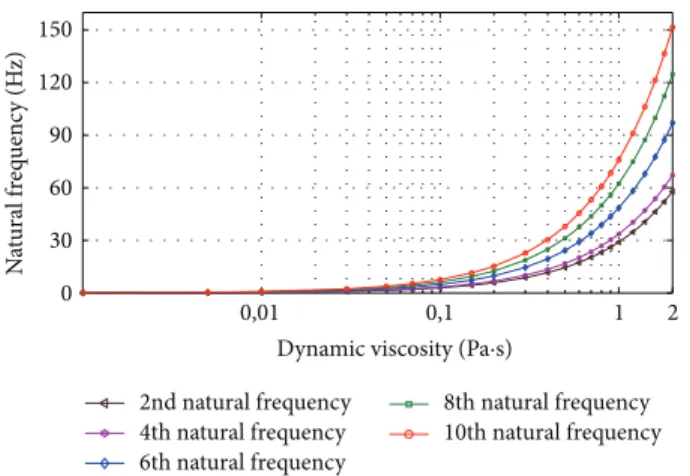
Figures 3 and 4 show the influence of fluid’s viscosity on the odd and even natural frequencies. It is seen that
Figure 2: Two possible first coupled mode shapes.
0,01 0,1 1 2 0 30 60 90 120 150 N at ural f req uenc y (H z) 1st natural frequency 3rd natural frequency 5th natural frequency 7th natural frequency 9th natural frequency Dynamic viscosity (Pa·s)
Figure 3: The influence of fluid’s viscosity on the first five odd natural frequencies. 0,01 0,1 1 2 0 30 60 90 120 150 N at ural f req uenc y (H z) 2nd natural frequency 4th natural frequency 6th natural frequency 8th natural frequency 10th natural frequency Dynamic viscosity (Pa·s)
Figure 4: The influence of fluid’s viscosity on the first five even natural frequencies.
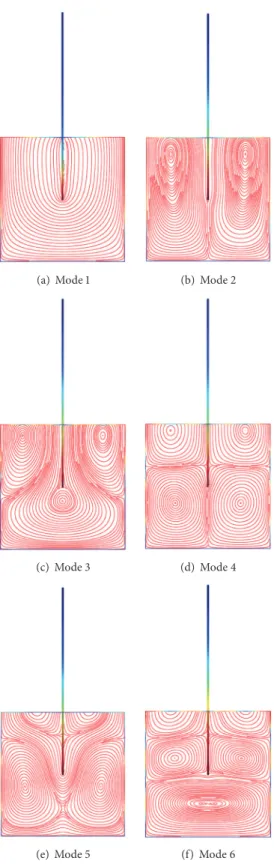
(a) Mode 1 (b) Mode 2
(c) Mode 3 (d) Mode 4
(e) Mode 5 (f) Mode 6
Figure 5: View of displacement filled of beams and Stokes eddies, showing various mode shapes for the coupled vibration.
the effect of viscosity is very interesting and decreases the frequency of beams. These figures show also for small fluid’s viscosity that the model is not suitable to describe properly the vibrational behavior of beams immersed in a viscous fluid. In this case, the most appropriate model is the
model developed in [21]. In other words, the viscosity terms can be neglected and the resulting model is called inertial coupling [22].
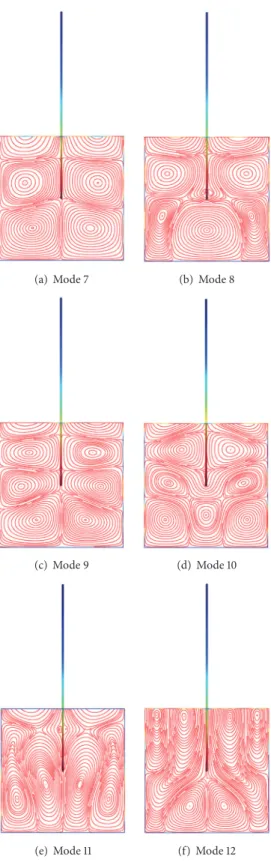
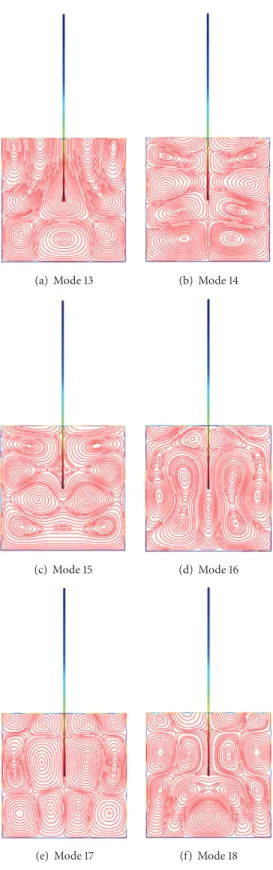
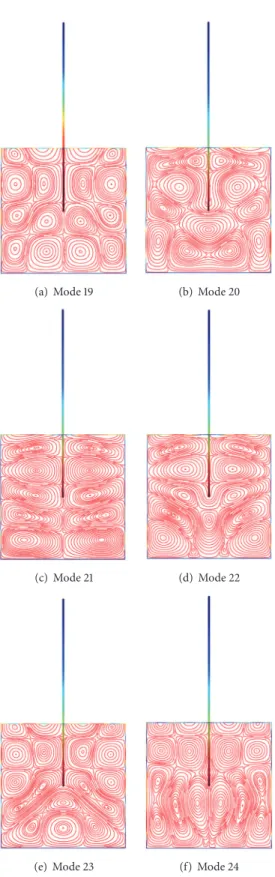
Figures 5(a)–5(f)–8(a)–8(f) obtained by Comsol show the first 24 coupled modal shapes with the corresponding
(a) Mode 7 (b) Mode 8
(c) Mode 9 (d) Mode 10
(e) Mode 11 (f) Mode 12
Figure 6: View of displacement filled of beams and Stokes eddies, showing various mode shapes for the coupled vibration.
eigenvalues𝜔. In these figures, solid lines denote streamlines
(i.e., Stokes eddies) caused by system boundaries and fluid structure interaction. In addition, the formation of Stokes eddies is not affected by the presence of an obstacle (beam)
in the fluid domain. As expected these Stokes eddies increase when the angular frequency is raised like in the case without obstacle. Finally, these Stokes eddies are symmetric with respect to the obstacle.
(a) Mode 13 (b) Mode 14
(c) Mode 15 (d) Mode 16
(e) Mode 17 (f) Mode 18
Figure 7: View of displacement filled of beams and Stokes eddies, showing various mode shapes for the coupled vibration.
4. Conclusion
This paper has presented an analytical method to understand the modal behavior of beams partially immersed in a viscous fluid. The validity of the present solution is solidly confirmed
numerically. The main application of the proposed method is in characterization of rheological properties of viscous mate-rials [16]. In addition the study can be also extended further for the optimization tool for complex engineering design problems.
(a) Mode 19 (b) Mode 20
(c) Mode 21 (d) Mode 22
(e) Mode 23 (f) Mode 24
Appendices
A. Analytical Expression for
the Scalar Potentials
(i) Solution of (11). A time harmonic dependence exp(𝑗𝜔𝑡) is
assumed, with𝑗 being the imaginary unit, 𝜔 being the circular
frequency, and𝑡 being the time. We introduce a new auxiliary
variable𝛼 defined as 𝛼 = ((1 − 𝑗)/√2)√𝜔/]. The first of the
two subequations (Equation (11)) consists of determining the
scalar potential𝜓(𝑥, 𝑦) satisfying the homogeneous diffusion
equation
𝜕2𝜓
𝜕𝑥2 +
𝜕2𝜓
𝜕𝑦2 + 𝛼2𝜓 = 0. (A.1)
By separation of variables, the scalar potential𝜓(𝑥, 𝑦) can be
written as
𝜓 (𝑥, 𝑦) = 𝜓𝑥(𝑥) 𝜓𝑦(𝑦) , (A.2)
where𝜓𝑥(𝑥) and 𝜓𝑦(𝑦) are given by the following ordinary
differential equation: 1 𝜓𝑥(𝑥) 𝑑2𝜓 𝑥(𝑥) 𝑑𝑥2 +𝜓 1 𝑦(𝑦) 𝑑2𝜓𝑦(𝑦) 𝑑𝑦2 + 𝛼2= 0. (A.3)
The linear independent solutions of these equation yield a general pressure field of the form
𝜓 (𝑥, 𝑦) = [𝑎1cos(𝛽𝑥) + 𝑎2sin(𝛽𝑥)]
⋅ [𝑎3cos(𝛿𝑦) + 𝑎4sin(𝛿𝑦)] , (A.4)
where𝑎1,𝑎2,𝑎3, and𝑎4are unknown coefficients which will
be determined later by imposing the appropriate boundary conditions.
(ii) Solution of (10). In a similar manner, the solution of (10) can be defined. The solution consists of determining the
scalar potential𝜙(𝑥, 𝑦) satisfying the Laplace equation
𝜕2𝜙
𝜕𝑥2 +
𝜕2𝜙
𝜕𝑦2 = 0. (A.5)
By separation of variables, after some elementary manipula-tions, the linear solution of these equations yields a general
scalar potential𝜙(𝑥, 𝑦) of the form
𝜙 (𝑥, 𝑦) = [𝑎1sin(𝛽𝑥) − 𝑎2cos(𝛽𝑥)]
⋅ [𝑎5cos(𝜆𝑦) + 𝑎6sin(𝜆𝑦)] . (A.6)
(iii) Boundary Conditions. The boundary condition equation (6) can be expressed by 𝜕𝜙 𝜕𝑥𝑥=0+ 𝜕𝜓 𝜕𝑦𝑥=0 = 0, 𝜕𝜙 𝜕𝑥𝑥=𝐿+ 𝜕𝜓 𝜕𝑦𝑥=𝐿= 0. (A.7)
Substituting 𝜙(𝑥, 𝑦) and 𝜓(𝑥, 𝑦) into boundary condition
above gives the analytical solution for potential function (14) and (15). Now using the second equation of (11), the pressure can be presented by (16).
B. No-Slip Condition and Stress-Free
Boundary Condition
In this paper the interfaceΓ0(7) is assumed to be rigid, leading
to
V𝑥𝑦=0= 0,
V𝑦𝑦=0= 0.
(B.1)
Substituting (18) and (19) into above rigid boundary equa-tions gives
𝛿 𝐵 − 𝛽𝐶 = 0,
𝜆𝐷 − 𝛽𝐴 = 0. (B.2)
The interfaceΓ𝑠 (8) is assumed to be free boundary stress,
leading to
𝜎𝑥𝑦𝑦=𝐿= 0,
𝜎𝑦𝑦𝑦=𝐿= 0. (B.3)
Substituting (21) and (22) into above free boundary stress equations gives the first conditions, for example,
𝐴𝛽2𝛿 sin (𝛿𝐿) + (2𝛽
2− 𝛼2) (sin (𝜆𝐿) /𝜆)
2𝛽2cos(𝛿𝐿) − (2𝛽2− 𝛼2) cos (𝜆𝐿) − 𝐶 = 0. (B.4)
Note that, from the above equation, we can obtain
𝐶 = 𝐴𝛽2𝛿 sin (𝛿𝐿) + (2𝛽
2− 𝛼2) (sin (𝜆𝐿) /𝜆)
2𝛽2cos(𝛿𝐿) − (2𝛽2− 𝛼2) cos (𝜆𝐿)
= 𝐴𝛽Φ.
(B.5)
By replacing the constants into (14) and (15), the potential
functions𝜙 and 𝜓 can be expressed by
𝜓 = sin (𝛽𝑥) [𝐴 cos (𝛿𝑦) + 𝐵 sin (𝛿𝑦)]
= sin (𝛽𝑥) [𝐴 cos (𝛿𝑦) +𝛽
𝛿𝐶 sin (𝛿𝑦)]
= sin (𝛽𝑥) [𝐴 cos (𝛿𝑦) +𝛽𝛿𝐴𝛽Φ sin (𝛿𝑦)]
= 𝐴 sin (𝛽𝑥) [cos (𝛿𝑦) +𝛽𝛿2Φ sin (𝛿𝑦)] ,
(B.6)
𝜙 = cos (𝛽𝑥) [𝐶 cos (𝜆𝑦) + 𝐷 sin (𝜆𝑦)]
= cos (𝛽𝑥) [𝐴𝛽Φ cos (𝜆𝑦) +𝛽
𝜆𝐴 sin (𝜆𝑦)]
= 𝐴 cos (𝛽𝑥) [𝛽Φ cos (𝜆𝑦) +𝛽
𝜆sin(𝜆𝑦)] .
C. Solution of the Submerged Part of the Beam
We postulate the following solution of (1):
EI𝜕 4𝑢 1(𝑦, 𝑡) 𝜕𝑦4 + 𝜌𝑠𝑆𝜕 2𝑢 1(𝑦, 𝑡) 𝜕𝑡2 = 𝜎𝑥𝑥(𝐿2, 𝑦) (C.1)
describing the lateral deflexion of the submerged beam
𝑢1= 𝑢1(𝑦) exp (𝑗𝜔𝑡) . (C.2)
Substitution into (1) and taking into account (28) yield
EI𝑑 4𝑢 1(𝑦) 𝑑𝑦4 − 𝜌𝑠𝑆𝜔2𝑢1(𝑦) = 𝐴𝜂 cos (𝛽𝐿2 ) ⋅ {2𝛽𝛿[𝛽2 𝛿Φ cos (𝛿𝑦) − sin (𝛿𝑦)] − (2𝛽2+ 𝛼2) [𝛽Φ cos (𝜆𝑦) +𝛽𝜆sin(𝜆𝑦)]} . (C.3)
The software Mathematica was used in order to obtain (32) solution of the above equation. Similarly, we can also find (33) solution of (2) describing the lateral deflexion of the beam in vacuum.
D. Frequency Equation
For nontrivial solution, the determinant of the matricesM
must be equal to zero
detM = 0. (DM)
This equation indicates a relationship between the kinematic
fluid viscosity], fluid density 𝜌, angular frequency 𝜔, and the
elastic constants. For given material and geometric proper-ties, (DM) constitutes an implicit transcendental function of 𝑛 and 𝜔. The roots 𝜔 may be computed for a fixed 𝑛.
E. Auxiliary Coefficients
The coefficients Υ, 𝐼1, 𝐼2, 𝐼3, and𝐼4 in (38) are defined as
follows: Υ = ∫𝐿 𝑎 {[1 + Λ Ω4− 𝛿4] [𝛽2Φ cos (𝛿𝑦) − 𝛿 sin (𝛿𝑦)] − [Λ (𝛽 2+ 𝛼2/2) Ω4− 𝜆4 + 𝛽2] ⋅ [Φ cos (𝜆𝑦) +sin(𝜆𝑦) 𝜆 ]} 𝑑𝑦, (E.1) where Λ = 2𝜆𝜔𝜂 EI tan(𝛽𝐿/2), 𝐼1= ∫ 𝐿 𝑎 cos(Ω𝑦) 𝑑𝑦, 𝐼2= ∫𝐿 𝑎 sin(Ω𝑦) 𝑑𝑦, 𝐼3= ∫𝐿 𝑎 cosh(Ω𝑦) 𝑑𝑦, 𝐼4= ∫𝐿 𝑎 sinh(Ω𝑦) 𝑑𝑦. (E.2)
F. The Elements of the
M Matrix
The matrixM in (13) is defined as follows:
M = [M11, M21, M31, M41, M51, M61, M71, M81]𝑇, (F.1) where M11= {𝑀11, 𝑀12, 𝑀13, 𝑀14, 𝑀15, 𝑀16, 𝑀17, 𝑀18} , M21= {𝑀21, 𝑀22, 𝑀23, 𝑀24, 𝑀25, 𝑀26, 𝑀27, 𝑀28} , M31= {𝑀31, 𝑀32, 𝑀33, 𝑀34, 𝑀35, 𝑀36, 𝑀37, 𝑀38} , M41= {𝑀41, 𝑀42, 𝑀43, 𝑀44, 𝑀45, 𝑀46, 𝑀47, 𝑀48} , M51= {𝑀51, 𝑀52, 𝑀53, 𝑀54, 0, 0, 0, 0} , M61= {𝑀61, 𝑀62, 𝑀63, 𝑀64, 0, 0, 0, 0} , M71= {0, 0, 0, 0, 𝑀75, 𝑀76, 𝑀77, 𝑀78} , M81= {0, 0, 0, 0, 𝑀85, 𝑀86, 𝑀87, 𝑀88} , (F.2) where 𝑀11= 𝑔1(𝐿) , 𝑀12= 𝑔2(𝐿) , 𝑀13= 𝑔3(𝐿) , 𝑀14= 𝑔4(𝐿) , 𝑀15= 𝑓1(𝐿) , 𝑀16= 𝑓2(𝐿) , 𝑀17= 𝑓3(𝐿) , 𝑀18= 𝑓4(𝐿) , 𝑀21= 𝑔1(𝐿) , 𝑀22= 𝑔2(𝐿) , 𝑀23= 𝑔3(𝐿) , 𝑀24= 𝑔4(𝐿) ,
𝑀25= 𝑓1(𝐿) , 𝑀26= 𝑓2(𝐿) , 𝑀27= 𝑓3(𝐿) , 𝑀28= 𝑓4(𝐿) , 𝑀31= 𝑔1(𝐿) , 𝑀32= 𝑔2(𝐿) , 𝑀33= 𝑔3(𝐿) , 𝑀34= 𝑔4(𝐿) , 𝑀35= 𝑓1(𝐿) , 𝑀36= 𝑓2(𝐿) , 𝑀37= 𝑓3(𝐿) , 𝑀38= 𝑓4(𝐿) , 𝑀41= 𝑔1(𝐿) , 𝑀42= 𝑔2(𝐿) , 𝑀43= 𝑔3(𝐿) , 𝑀44= 𝑔4(𝐿) , 𝑀45= 𝑓1(𝐿) , 𝑀46= 𝑓2(𝐿) , 𝑀47= 𝑓3(𝐿) , 𝑀48= 𝑓4(𝐿) , 𝑀51= 𝑔1(𝑎) , 𝑀52= 𝑔2(𝑎) , 𝑀53= 𝑔3(𝑎) , 𝑀54= 𝑔4(𝑎) , 𝑀61= 𝑔1(𝑎) , 𝑀62= 𝑔2(𝑎) , 𝑀63= 𝑔3(𝑎) , 𝑀64= 𝑔4(𝑎) , 𝑀75= 𝑓1(𝑏) , 𝑀76= 𝑓2(𝑏) , 𝑀77= 𝑓3(𝑏) , 𝑀78= 𝑓4(𝑏) , 𝑀85= 𝑓1(𝑏) , 𝑀86= 𝑓2(𝑏) , 𝑀87= 𝑓3(𝑏) , 𝑀88= 𝑓4(𝑏) , 𝑓1(𝑦) = cos (Ω𝑦) , 𝑔1(𝑦) = cos (Ω𝑦) + 𝐼1𝑈 (𝑦) , 𝑓2(𝑦) = sin (Ω𝑦) , 𝑔2(𝑦) = sin (Ω𝑦) + 𝐼2𝑈 (𝑦) , 𝑓3(𝑦) = cosh (Ω𝑦) , 𝑔3(𝑦) = cosh (Ω𝑦) + 𝐼3𝑈 (𝑦) , 𝑓4(𝑦) = sinh (Ω𝑦) , 𝑔4(𝑦) = sinh (Ω𝑦) + 𝐼4𝑈 (𝑦) . (F.3)
Conflict of Interests
The authors declare that there is no conflict of interests regarding the publication of this paper.
References
[1] G. Y. Chen, R. J. Warmack, T. Thundat, D. P. Allison, and A. Huang, “Resonance response of scanning force microscopy can-tilevers,” Review of Scientific Instruments, vol. 65, no. 8, pp. 2532– 2537, 1994.
[2] P. K. Hansma, J. P. Cleveland, M. Radmacher et al., “Tapping mode atomic force microscopy in liquids,” Applied Physics
Letters, vol. 64, no. 13, pp. 1738–1740, 1994.
[3] M. Mertesdorf, M. Sch¨onhoff, F. Lohr, and S. Kirstein, “Scan-ning near-field optical microscope designed for operation in liquids,” Surface and Interface Analysis, vol. 25, no. 10, pp. 755– 759, 1997.
[4] M. Despont, H. Takahashi, S. Ichihara et al., “Dual-cantilever afm probe for combining fast and coarse imaging with high-resolution imaging,” in Proceedings of the IEEE 13th Annual
International Conference on Micro Electro Mechanical Systems (MEMS ’00), Cat. No.00CH36308, pp. 126–131, Miyazaki, Japan,
January 2000.
[5] M. Napoli, W. Zhang, K. Turner, and B. Bamieh, “Characteri-zation of electrostatically coupled microcantilevers,” Journal of
Microelectromechanical Systems, vol. 14, no. 2, pp. 295–304,
2005.
[6] C. P. Green and J. E. Sader, “Torsional frequency response of cantilever beams immersed in viscous fluids with applications to the atomic force microscope,” Journal of Applied Physics, vol. 92, article 6262, 2002.
[7] J. E. Sader, “Frequency response of cantilever beams immersed in viscous fluids with applications to the atomic force micro-scope,” Journal of Applied Physics, vol. 84, no. 1, pp. 64–76, 1998.
[8] G. Muralidharan, A. Wig, L. A. Pinnaduwage, D. Hedden, T. Thundat, and R. T. Lareau, “Adsorption-desorption character-istics of explosive vapors investigated with microcantilevers,”
Ultramicroscopy, vol. 97, no. 1–4, pp. 433–439, 2003.
[9] K. M. Goeders, J. S. Colton, and L. A. Bottomley, “Microcan-tilevers: sensing chemical interactions via mechanical motion,”
Chemical Reviews, vol. 108, no. 2, pp. 522–542, 2008.
[10] B. Rogers, L. Manning, M. Jones et al., “Mercury vapor detection with a self-sensing, resonating piezoelectric cantilever,” Review
of Scientific Instruments, vol. 74, no. 11, pp. 4899–4901, 2003.
[11] J. O. Kim, Y. Wang, and H. H. Bau, “The effect of an adjacent vis-cous fluid on the transmission of torsional stress waves in a sub-merged waveguide,” Journal of the Acoustical Society of America, vol. 89, no. 3, pp. 1414–1422, 1991.
[12] S. Inaba, K. Akaishi, T. Mori, and K. Hane, “Analysis of the reso-nance characteristics of a cantilever vibrated photothermally in a liquid,” Journal of Applied Physics, vol. 73, no. 6, pp. 2654–2658, 1993.
[13] C. Bergaud and L. Nicu, “Viscosity measurements based on experimental investigations of composite cantilever beam eigenfrequencies in viscous media,” Review of Scientific
Instru-ments, vol. 71, no. 6, pp. 2487–2491, 2000.
[14] W. Y. Shih, X. Li, H. Gu, W.-H. Shih, and I. A. Aksay, “Simultane-ous liquid viscosity and density determination with piezoelec-tric unimorph cantilevers,” Journal of Applied Physics, vol. 89, no. 2, pp. 1497–1505, 2001.
[15] J. O. Kim and H. Y. Chun, “Interaction between the torsional vibration of a circular rod and an adjacent viscous fluid,” Journal
of Vibration and Acoustics, vol. 125, no. 1, pp. 39–45, 2003.
[16] A. Hossain, L. Humphrey, and A. Mian, “Prediction of the dynamic response of a mini-cantilever beam partially sub-merged in viscous media using finite element method,” Finite
Elements in Analysis and Design, vol. 48, no. 1, pp. 1339–1345,
2012.
[17] L. D. Landau and E. M. Lifshitz, Fluid Mechanics, Pergamon Press, 1959.
[18] M. Morse and H. Feshbach, Methods of Theoretical Physics, McGraw-Hill, New York, NY, USA, 1946.
[19] T. A. Davis, “Algorithm 832: UMFPACK, an unsymmetric-pat-tern multifrontal method,” ACM Transactions on Mathematical
Software, vol. 34, no. 2, pp. 165–199, 2003.
[20] COMSOL Multiphysics, User’s Guide and Reference Guide, Version 3.5a, 2008.
[21] A. El Baroudi and F. Razafimahery, “Transverse vibration analy-sis of Euler-Bernoulli beam carrying point masse submerged in fluid media,” International Journal of Engineering & Technology, vol. 4, no. 2, pp. 369–380, 2015.
[22] F. Axisa and J. Antunes, Fluid Structure Interaction, vol. 3 of
Modeling of Mechanical Systems, Elsevier, New York, NY, USA,
Submit your manuscripts at
http://www.hindawi.com
Hindawi Publishing Corporation
http://www.hindawi.com Volume 2014
High Energy PhysicsAdvances in
World Journal
Hindawi Publishing Corporation
http://www.hindawi.com Volume 2014
Hindawi Publishing Corporation
http://www.hindawi.com Volume 2014
Fluids
Journal ofAtomic and Molecular Physics
Journal of
Hindawi Publishing Corporation
http://www.hindawi.com Volume 2014 Hindawi Publishing Corporation
http://www.hindawi.com Volume 2014 Condensed Matter Physics
Optics
International Journal ofHindawi Publishing Corporation
http://www.hindawi.com Volume 2014
Hindawi Publishing Corporation
http://www.hindawi.com Volume 2014
Astronomy
Advances inInternational Journal of
Hindawi Publishing Corporation
http://www.hindawi.com Volume 2014
Superconductivity
Hindawi Publishing Corporation
http://www.hindawi.com Volume 2014 Statistical Mechanics
International Journal of
Hindawi Publishing Corporation
http://www.hindawi.com Volume 2014
Gravity
Hindawi Publishing Corporation
http://www.hindawi.com Volume 2014
Astrophysics
Journal ofHindawi Publishing Corporation
http://www.hindawi.com Volume 2014 Physics
Research International
Hindawi Publishing Corporation
http://www.hindawi.com Volume 2014 Solid State PhysicsJournal of Computational Methods in Physics Journal of
Hindawi Publishing Corporation
http://www.hindawi.com Volume 2014
Hindawi Publishing Corporation
http://www.hindawi.com Volume 2014
Soft Matter
Hindawi Publishing Corporation http://www.hindawi.com
Aerodynamics
Journal ofVolume 2014
Hindawi Publishing Corporation
http://www.hindawi.com Volume 2014
Photonics
Hindawi Publishing Corporation
http://www.hindawi.com Volume 2014
Journal of
Biophysics
Hindawi Publishing Corporation
http://www.hindawi.com Volume 2014