HAL Id: hal-01122239
https://hal.archives-ouvertes.fr/hal-01122239
Submitted on 3 Mar 2015
HAL is a multi-disciplinary open access
archive for the deposit and dissemination of sci-entific research documents, whether they are pub-lished or not. The documents may come from teaching and research institutions in France or abroad, or from public or private research centers.
L’archive ouverte pluridisciplinaire HAL, est destinée au dépôt et à la diffusion de documents scientifiques de niveau recherche, publiés ou non, émanant des établissements d’enseignement et de recherche français ou étrangers, des laboratoires publics ou privés.
Indoor On-body Channel Ray Tracing and Motion
Capture Based Simulation
Meriem Mhedhbi, Nicolas Amiot, Stéphane Avrillon, Bernard Uguen
To cite this version:
Meriem Mhedhbi, Nicolas Amiot, Stéphane Avrillon, Bernard Uguen. Indoor On-body Channel Ray Tracing and Motion Capture Based Simulation. IC1004 Scientific Meeting, May 2014, Aalborg, Den-mark. �hal-01122239�
EUROPEAN COOPERATION IN THE FIELD OF SCIENTIFIC
AND TECHNICAL RESEARCH
———————————————— EURO-COST ———————————————— IC1004 TD(14)10058 Aalborg, Denmark May 26-28, 2014 SOURCE: IETR University of Rennes 1 France
Indoor On-body Channel Ray Tracing and Motion Capture Based Simulation
Meriem Mhedhbi, Nicolas Amiot, St´ephane Avrillon, and Bernard
Uguen
IETR UMR 6164 (Bat 11 D )
Avenue du G´en´eral Leclerc, Campus de Beaulieu
35042 - Rennes Cedex France
Phone: +33 - 02 23 23 60 33
Abstract
The presented work addresses a comparison between measured and simulated data in an Indoor On-body channel for motion capture scenario. Measured data used in this work come from a large dataset of BAN channel open data, shared by the NICTA laboratory. The simulated data are produced using the PyLayers physical simulation platform based on graph based ray tracing techniques.
1
Introduction
In the last years the interest in Body Area Networks (BAN) is increasing and occupying many researchers and industrials mostly because of anticipated huge applications around the upcoming Internet of Things and nomadic connectivity.
In general, in the context of communication systems conception and design, the study of the propagation channel characteristics is fundamental. This is especially true, in the WBAN context, where the channel is considerably affected by the anthropoid nature of the motion.
Any propagation channel study begins with measurements for extraction of specific statistical models with the depth required by the targeted use case. Besides, it is also important to build ADAP (As Deterministic As Possible) simulators to address the very large space of particular situations defined and parameterized by data, which are becoming, over time, more and more available at the application level. The desirable balance between deterministic and statistical description of the channel being strongly dependent on the context, e.g very different whether only localization or only communications is involved. Moreover, any design of a simulation strategy has to do compromises between computation time and level of physical description, mostly when dealing with upper layer abstractions. In that very purpose, the presented work is aiming to investigate how the anthropoid nature of the subject motion is ”etched” into the multi link indoor WBAN radio channel and how good (or bad) deterministic simulations compare with real data. Thus, in this work a PyLayers
[1],[2],[3], on-body channel motion capture based multi link simulation, has been compared to
the corresponding scenario extracted from a sample of the measurement database carried out and
shared by the NICTA laboratory,[4][5].
The measurements campaign is presented in section2. The section3recalls the used simulation
setup. Finally, in the section 4 a comparison between simulation and measurement results is
presented and discussed.
2
Measurement Setup
A measurement campaign was carried out by the NICTA laboratory [5] aiming to study the different
BAN channels (On-body, Off-body...) in several configurations (standing, walking, running...) at different frequencies (400 MHz, 900 MHz and 2400 MHz) in indoor environment.
In this work, only the data relative to On-body links has been used. The measurement
envi-ronment is an indoor office presented in Figure 1. The human subject is moving on a treadmill.
In this work, the walking scenario at the speed of 3 km/h during 60seconds has been selected for comparison.
For the On-body measurement the devices are located on the different limbs (right/left wrists and ankles) and the trunk (front/back chest and left/right hip). This configuration, illustrated in
Figure 2allows the study of on-body dynamic and static channel characterization.
Figure 1: On-Body Experimental treadmill environment, including subject location (from [5])
Figure 2: Devices positions on the subject (from [5])
Regarding the frequency, the channels was measured at different frequencies bands. In this work, the simulation and comparison are performed at f = 2.4 GHz. At this frequency the used antenna, Octane BW-2400-2500, is approximately omni-directional. The antenna were worn such as the E-plane is perpendicular to the environment floor.
3
Simulation Setup
3.1 Layout and propagation environment
The PyLayers simulation work-flow starts by defining the propagation environment. Here, the layout is a 3 meters × 5.5 meters room where the human subject is moving on a treadmill. Notice
room as, for instance, the treadmill which may have had some effect on the propagation channel
(see e.g fig 1(d) of [5]).
3.2 Large scale and body scale mobility
PyLayers simulator has been designed to handle large scale mobility [3], i.e, the mobility of an agent,
considered as summarized to its center of gravity. In this paper this feature is not fully exploited because the center of gravity of the subject is assumed steady above the treadmill. After describing precisely the position and orientation of each device on the body, the trajectory is centered to simulate the walking on treadmill trajectory during the same 60 s measurement time and at speed = 3 km/h.
In order to simulate the BAN channel, the human motion has to be superimpose over the introduced. This has been done using the motion capture files C3D (Coordinates 3D) of a walking
sequence [6]. The corresponding body sequence (PyLayers topos concept) is presented in Figure3.
This walking sequence is generic and do not correspond to the actual motion of the subject during the measurement. This is a source of deviation between the simulated and measured data. Further work should investigate such comparison in exploiting the actual motion capture of the subject under test.
Figure 3: Motion capture sequence from [6]
The data extracted from these files is plugged in the PyLayers simulator and synchronized with the large scale mobility. In the current case the trajectory is limited to the center of gravity of the
body. Then, the same devices configuration as measurements, in Figure2, is set up.
3.3 Perturbed Antenna Model
The antenna modeling is key in the presented approach. Aiming the comparison with the Octane BW-2400-2500 antenna used in measurements a patch antenna radiating at f = 2.4GHz with
similar radiation pattern has first been modeled using HFSS simulator, Figure 4.
0 50 100 150 200 250 300 350 0 20 40 60 80 100 120 140 160 180 0 50 100 150 200 250 300 350 0 20 40 60 80 100 120 140 160 180 θ in d eg re es φ in degrees Eθ in Free space 50 45 40 35 30 25 20 15 10 5 0 Eφ in Free space φ in degrees 50 45 40 35 30 25 20 15 10 5 0
Figure 4: Simulated antenna in free space
The antenna pattern is expanded in terms of spherical harmonics coefficients [7],[8]. This approach reduces the amount of data required for describing the full antenna pattern. This has been the chosen manner for describing the antenna pattern in the PyLayers simulation platform.
The ray tracing is used to take into account the interaction on walls of the environment. This is much more questionable to apply the ray tracing for the On-body channel. There is current
investigation in that direction [9], but this is not this approach which has been chosen here.
The direct link between the different nodes on the body is taken into account by a proper modification of the antenna radiation pattern in the spherical harmonics space. We introduce a
perturbation on the antenna, modeling the human presence. This approach is detailed in [10]. The
free space antenna spherical harmonics coefficients are modified directly to generate the coefficients representing the perturbed antenna by the human body presence. By resorting to this approach, we avoid the ray tracing on the body and the body effect is taken into account into the antenna
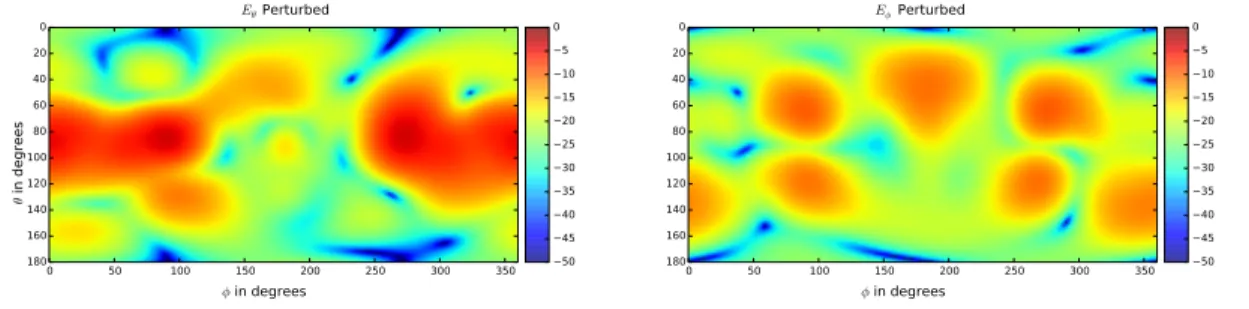
pattern itself. The Figure 5 shows the perturbed antenna outcome obtained from the perturbed
model. In this figure the antenna has been placed at a distance of 5 mm from a 70 mm diameter cylinder. One all the aforementioned elements are set up, a ray tracing simulation is done for each link of interest and for each time-stamp.
0 50 100 150 200 250 300 350 0 20 40 60 80 100 120 140 160 180 0 50 100 150 200 250 300 350 0 20 40 60 80 100 120 140 160 180 θ in d eg re es φ in degrees Eθ Perturbed 50 45 40 35 30 25 20 15 10 5 0 Eφ Perturbed φ in degrees 50 45 40 35 30 25 20 15 10 5 0
Figure 5: Simulated antenna perturbed by the model
4
Simulations vs Measurements Comparison
This section presents a preliminary comparison in terms of path loss amplitude of a multi links time series and the corresponding cumulative distribution functions (CDF) both for the measurements and simulations of the above described walking scenario.
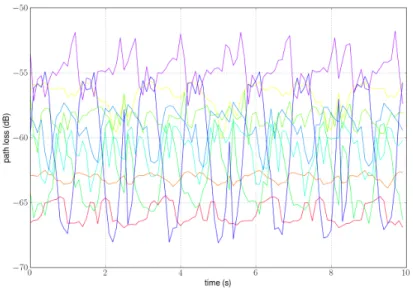
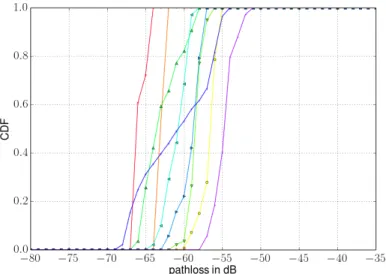
The Figures 6 and 7 show the variation of the measured and simulated path loss during a
walking sequence in indoor environment for the different on-body links. The Figures 8 and 9
represent the corresponding CDF evaluated over 60 s of walking sequence. The link legend and the
color are shared between all figures 6,7 and 8 and 9 . Those 4 Figures show that the simulation
are quite close to the measurement data at least on a relative scale. The breadth of the shadowing is clearly underestimated in the simulation. The current interpretation of this effect is that the trunk shadowing is underestimated by the perturbed antenna model which has been used. The dependency of the model with the radius of the equivalent cylinder associated to the trunk is clearly not properly handled and should be calibrated. This point has to be investigated more, hopefully
the NICTA dataset is perfectly suited for this calibration task. Notice that in the presented
measurement/simulation comparison there was no ad hoc effort for having an absolute fitting of the channel gain.
Figure 6: Path loss for walking sequence from measurements
Figure 7: Pathloss for walking sequence from PyLayers simulation
variation during the walking motion is well recovered. As it is observed in the measurement data,
the best link is right hip to right wrist (purple curve in Figure 6). Interestingly the shape of the
channel gain is very well retrieved with a peak appearing when both link antennas are in close vicinity just before digging in the shadow region. This shape is probably very dependent from one subject to an other depending on the subject gait. Further statistical analysis on that point would probably be of interest. This observed relatively good agreement in the multi link structure argues for the relevance of the approach which is potentially a good compromise between efficient implementation and physical realism.
Figure 8: CDF of the path loss from NICTA measurements
Figure 9: CDF of the path loss from PyLayers simulations
The front/chest to back/chest link which is static and intrinsically NLOS is well retrieved and of course those results would be completely impossible to model if the antenna patterns were kept unperturbed. Interestingly, the adopted approach exploits actual data from the knowable free space, far field antenna pattern. This means that the proposed approach could benchmark different antenna design in complex WBAN scenario, ceteris paribus.
However, other links are not well retrieved, for example the right hip to chest link. In fact, the simulated path loss is overestimated compared to the measurements. This link is more reliable in simulation because of the antenna perturbation model which introduce, here, the perturbation of the member on which the antenna is placed. This might be admitted for the antenna on the trunk but it is not the case of the antenna on the wrist which is perturbed by the trunk too.
5
Conclusions
This paper has presented a comparison between real data from a WBAN walking experiment and the simulation from the site specific simulator PyLayers. The results are in quite good agreement if we consider that the used human motion corresponds in each case to different subject. The relative level of the different link is quite well retrieved. It has to be noticed that PyLayers simulator can provide a much richer information about the channel as e.g angular and delay structure of the channel over ultra wide bandwidth. This comparison confirms a well admitted fact that the very nature of the multi link variation is strongly related to the human motion which can be captured and digitized for semi deterministic simulation. The motion captured is a key technology for decoding the rich information carried out by the multi-link variation observed in the BAN.
In this comparison the large scale motion of the problem has been removed because the subject is staying at the same place. The quality of the obtained results is strongly dependent on the manner the radiation pattern is handled. This is the key factor behind the presented comparison. This first validation paves the way for investigations of far more sophisticated scenarios as those which are currently investigated in the French ANR CORMORAN project as indoor group navigation.
In the future work we aim to simulate other UWB BAN channel, for instance, Body-to-Body and Body-to-infrastructure channels. Further step is to produce improved antenna model describing
better the trunk perturbation and to introduce the statistic model described in [11] for the on body
channel because the current implemented approach cannot give access to the correct CIR delays.
Acknowledgment
This work has been carried out in the frame of the CORMORAN project, which is funded by the French National Research Agency (ANR) under the contract number ANR-11-INFR-010.
References
[1] PyLayers: Python Indoor Simulator for Mobile Localization. http://www.pylayers.org ,
https://github.com/pylayers/pylayers.
[2] Nicolas Amiot. Design of a Simulation Platform Joining Site Specific Radio Propagation and
Human Mobility for Localization Applications. PhD thesis, Universit´e de Rennes 1, 2013.
[3] Nicolas Amiot, Meriem Mhedhbi, Stephane Avrillon, and Bernard Uguen. Pylayers : An indoor propagation tool for studying localization in wban context. In IC1004 Aalborg COST meeting (TD-10021), 2014.
[4] Nicta body area network radio channel data. http://tinyurl.com/jwp55gs.
[5] David B. Smith, Leif Hanlen, Jian (Andrew) Zhang, Dino Miniutti, David Rodda, and Ben Gilbert. First- and second-order statistical characterizations of the dynamic body area
prop-agation channel of various bandwidths. Annales des T´el´ecommunications, 66(3-4):187–203,
2011.
[6] Cmu graphics lab motion capture database : Subject 7: walk (0701.c3d). http://mocap.cs.
cmu.edu/search.php?subjectnumber=%&motion=%.
[7] J. Rahola, F. Belloni, and A. Richter. Modelling of radiation patterns using scalar spherical harmonics with vector coefficients. In Antennas and Propagation, 2009. EuCAP 2009. 3rd European Conference on, pages 3361–3365, 2009.
[8] R. Burghelea, S. Avrillon, and B. Uguen. Ultra-compact parametric modelling of
three-dimensional antenna radiation pattern for impulse radio-ultra-wide band ray tracing. Mi-crowaves, Antennas Propagation, IET, 6(11):1251–1258, 2012.
[9] Eric Plouhinec, Bernard Uguen, Meriem Mhedhbi, and St´ephane Avrillon. 3d utd modeling
of a measured antenna disturbed by a dielectric circular cylinder in wban context. In 79th Vehicular Technology Conference: VTC2014-Spring - Seoul, volume 1, May 2014.
[10] Meriem Mhedhbi, St´ephane Avrillon, Troels Pedersen, and Bernard Uguen. Modelling of UWB
antenna perturbed by human phantom in spherical harmonics space. In The 8th European Conference on Antennas and Propagation (EuCAP 2014) (EuCAP 2014), The Hague, The
Netherlands, April 2014http://vbn.aau.dk/files/195257751/1569855541.pdf.
[11] R. D’Errico and L. Ouvry. Delay dispersion of the on-body dynamic channel. In Antennas and Propagation (EuCAP), 2010 Proceedings of the Fourth European Conference on, pages 1–5, April 2010.
![Figure 1: On-Body Experimental treadmill environment, including subject location (from [5])](https://thumb-eu.123doks.com/thumbv2/123doknet/11510091.294103/4.918.341.582.169.499/figure-body-experimental-treadmill-environment-including-subject-location.webp)
![Figure 3: Motion capture sequence from [6]](https://thumb-eu.123doks.com/thumbv2/123doknet/11510091.294103/5.918.182.798.909.1062/figure-motion-capture-sequence-from.webp)