OUT OF AFRICA
WHY PEOPLE
MIGRATE
edited by Giovanni Carbone
introduction by Paolo Magri
the right policies to address immigration requires a deepunderstanding of its root causes. Why do Africans decide to leave their home countries? While the dream of a bet-ter life in Europe is likely part of the explanation, one also needs to examine the prevailing living conditions in the large and heterogeneous sub-Saharan region. This Report investigates the actual role of political, economic, demo-graphic and environmental drivers in current migration flows. It offers a comprehensive picture of major migration motives as well as of key trends. Attention is also devoted to the role of climate change in promoting migration and to intra-continental mobility (two-thirds of sub-Saharan migrant flows start and end within the region). Two coun-try studies on Eritrea and Nigeria are also included to get a closer sense of local developments behind large-scale migration to Europe.
Senior Associate Research Fel-low and Head of the Africa Pro-gramme at ISPI, and Professor of Political Science at Università degli Studi di Milano. He was pre-viously a Research Associate at the Crisis States Programme of the London School of Econom-ics (LSE) and the Principal Inves-tigator of an European Research Council (ERC) project.
The Italian Institute for Inter-national Political Studies (ISPI) is an independent think tank dedicated to being a resource for government officials, busi-ness executives, journalists, civil servants students and the public at large wishing to better understand international issues. It monitors geopolitical areas as well as major trends in interna-tional affairs.
Founded in Milan in 1934, ISPI is the only Italian Institute – and one of the few in Europe – to place research activities side by side to training, organization of international conferences, and the analysis of the international environment for businesses. Comprehensive interdisciplinary analysis is achieved through close collaboration with experts (academics and non-academ-ics alike) in political, economic, legal, historical and strategic studies and through an ever-growing network of think tanks, research centers, and Universi-ties in Europe and beyond.
AFRIC A. WHY PE OPLE MIGR A TE euro 12
Why People Migrate
Out of Africa. Why People Migrate Edited by Giovanni Carbone
First edition: October 2017 Cover Photo: Giro 555 SHO/Flickr Print ISBN 9788867056699 ePub ISBN 9788867056675 Pdf ISBN 9788867056712 DOI 10.14672/67056699 ISPI. Via Clerici, 5
20121, Milano www.ispionline.it
Introduction...
Paolo Magri
1. Between a Rock and a Hard Place:
Why Africans Migrate... Giovanni Carbone
2. Demystifying African Migration:
Trends, Destinations and Returns... Marie-Laurence Flahaux
3. Climate Change and Migration:
Insights from the Sahel... Sara Vigil
4. The Hidden Side of the Story:
Intra-African Migration... Blessing U. Mberu, Estelle M. Sidze
5. Fleeing Repression: Inside Eritrea... Nicole Hirt
6. Nigeria: Leaving Africa’s Giant... Aderanti Adepoju
Conclusions. Policy Implications for the EU...
Annex... The Authors... 7 13 31 51 73 95 119 141 147 167
Migration from Africa commonly evokes the picture of a conti-nent fleeing from its evils towards the European Eldorado. Such alarmist representations of an African mass exodus, fuelled by the media and policy makers alike, are actually quite far from the real dynamics of African migration. In Europe, notably in the traditional destination countries, since the 1970s migration has turned into a politicised topic, increasingly leading to more restrictive migration policies, but it is only in the past few years that it has sparked off a crisis throughout the whole continent. The EU and its member states have failed to look below the surface of migration flows as they have repeatedly preferred to turn a blind eye to their root causes. Against this backdrop, this ISPI Report investigates why some Africans decide to leave their countries and how they do it, also with a view to challenging ste-reotyped perceptions. For this purpose, the experts brought to-gether in this volume help reveal the hidden side of African mi-gration, delving into its drivers, trends and effects. Contrary to popular perceptions, their findings suggest that, far from being exceptional, the size and destinations of African migration are impressively similar to global migratory patterns. In other words, African migrants too, when crossing an international border, are more likely to move to neighbouring countries within their African sub-region than elsewhere, because of the higher costs of moving over longer distances. Costs which may ultimately include the loss of their own lives. Actually, if something excep-tional has to be found in African migration, it is the striking number of sub-Saharan countries each hosting over two million
displaced people last year: South Sudan, Sudan, the Democratic Republic of Congo, Somalia, and Nigeria.
Migration is a complex and multi-faceted phenomenon. Resorting to easy explanations may appear as a convenient short-cut but ultimately, twists the truth. This complexity is only very rarely reflected in the politicy choices adopted by receiving coun-tries. By continuously placing the spotlight on border protection and on how European societies are affected by migration flows, they ultimately produce unintended effects. For instance, restric-tive European migration policies have caused migrants to diver-sify their destination countries and to resort to riskier routes and irregular practices. These policies also have a negative impact on migrants’ decision to return to their home countries: even if they want to, migrants are less likely to leave Europe if they know it will be difficult to eventually come back.
By the same token, the impact of Africa’s recent economic and political transformations has had a complex and – to some ex-tent – unexpected result in terms of African mobility. Contrary to popular belief, a higher level of development – rather than poverty – is a strong driver of African migration, especially over greater distances. Indeed, the spread of new technologies – es-pecially mobile communication as a result of economic growth – as well as political stabilisation in some countries may have in-creased Africans’ capabilities and aspirations to move. However, this is just another piece of a much bigger picture. Large swathes of the continent are still rife with conflict and repression, and Africa’s growth has hardly been inclusive. And this still remains a crucial driver of migration.
In a nutshell, the rationale behind African migration is much more nuanced. It requires a careful, objective analysis highlight-ing the complexity of migration dynamics and merghighlight-ing short-term views with long-short-term prospects. This is ultimately the goal of this ISPI Report. In the first chapter, Giovanni Carbone pre-sents a broad overview of the demographic, economic, political, and environmental developments of contemporary sub-Saha-ran Africa, and investigates the role these may play in migsub-Saha-rants’
decisions to leave their country. Carbone warns against seeing migration only as a response to external conditions such as global inequalities: if that were enough, many more African migrants would be on the move over long distances. Instead, personal cir-cumstances must also be taken into account, moving away from classic approaches (push-pull factors and historical-structural ac-counts), which downplay the role of personal decisions.
Empirical evidence helps give a clearer picture. This goal is at the core of Marie-Laurence Flahaux’s chapter, in which she anal-yses macro and micro data on migration to debunk the myths surrounding African migration. Has the number of African mi-grants been on the rise? And do most of them live outside the continent? In seeking to answer these and other questions, her chapter illustrates the scale and destinations of African migra-tion in recent decades. Her analysis reveals that migramigra-tion from Africa, in proportion to the total African population, has actu-ally slightly decreased since the 1990s and that, especiactu-ally with regards to sub-Saharan migration, it has mostly been directed towards other African countries.
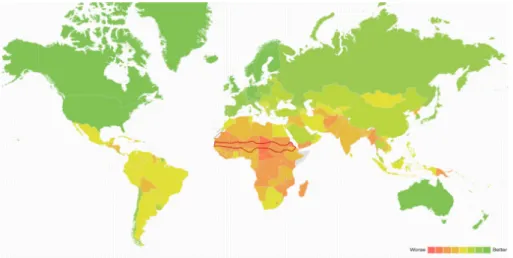
Environmental disruptions and climate change are often portrayed by the media as drivers of migration and conflict. Drawing evidence from the Sahel, the “ground zero” for climate change because of its high geographical exposure to tragic en-vironmental events, Sara Vigil explores the multifaceted nexus between climate change and mobility through examples of peri-odic droughts and seasonal floods. Rather than as the root cause, climate change is presented as a threat multiplier and a supple-mentary stress factor compounding already difficult realities: weak governance, limited infrastructure and political instability are just some of the socio-political frameworks that influence the effects of climate change on people’s propensity to migrate.
Flahaux’s findings in chapter 2 are supported by Blessing Mberu and Estelle Sidze’s analysis in chapter 4, in which the authors also attempt to explain why most sub-Saharan African migrants remain in Africa. They question the claim that African migrants move out of Africa to chase better socio-economic
opportunities. Quite the opposite: historical trends show that sub-Saharan Africans, especially those hailing from western and southern Africa, have long been involved in labour migration within their regions. So, far from being pushed by dire situations of environmental, demographic or underdevelopment pressures, many voluntarily decide to resettle in neighbouring countries. Besides this, the authors also investigate the relatively recent trend of sub-Saharan migration towards MENA countries as temporary or final destinations.
Shifting to country-specific analyses, the last two chapters of the Report are devoted to Eritrea and Nigeria, two countries that have made headlines in recent years as top countries of or-igin in sea arrivals to the EU. Last year Eritreans were the sec-ond largest nationality reaching European shores via the central Mediterranean route, yet those arriving in Italy are just a minori-ty of those who flee the country, since most remain in neighbour-ing states. To devise better migration policies, it is indispensable to understand the motivations and the routes of Eritrean flight, and in chapter 5 Nicole Hirt seeks to explain how Eritrea, once a “beacon of hope”, after much-awaited independence eventually became a harsh autocracy characterised by a command economy, a militarised society, and a mandatory open-ended national and military conscription – that turns out to be the major cause of Eritrean migration.
The second case study focuses on Nigeria, Africa’s top sending country to Europe but also Africa’s demographic and economic giant. Considering that its population is growing by 3% annual-ly, the challenges its government will have to face in coming years are serious and should not be understated by international ac-tors. Addressing the key drivers of Nigerian migration, Aderanti Adepoju investigates the migratory pressure posed by the dispar-ity between labour force growth and job creation, which ended up creating “jobless growth”. He identifies this as the major mi-gration determinant, but still acknowledges that also conflicts, poverty, and human deprivation need to be factored in.
Finally, the editor sums up the volume’s main findings and draws some policy recommendations for Europe. Throughout the Report, several authors showed how restrictive migration policies aimed at better patrolling the EU’s external borders have not solved the issue of migration from Africa, instead generating unintended consequences. Likewise controversial are Western proposals suggesting that higher economic development in sending countries would reduce migration flows. In fact, some chapters have discussed how more economic resources availa-ble to would-be African migrants might actually make migra-tion more affordable to a bigger pormigra-tion of them, at least in the short-to-medium term. Finally, to contain climate-induced mi-gration, instead of focusing only on the climate-change threat itself, it has been stressed that policies should also address the pre-existing political and economic vulnerabilities that amplify climate-related effects.
So, why do people migrate in and from Africa? As this volume shows, the reality is more nuanced than what common media reporting depicts. This Report joins new studies in demystifying such common assumptions on African migration. All the authors agree on the fact that African migration will not be disappearing any time soon. But far from being the hopeless continent, such a diverse region deserves more consideration now that, at a time of crisis, only a deeper understanding of the political and socio-eco-nomic conditions affecting sub-Saharan people in their home countries can inform better migration policies in Europe. That might require much effort and time but, as a Sudanese proverb goes, “patience is the key which solves all problems”.
Paolo Magri ISPI Executive Vice President and Director
Giovanni Carbone
Beyond the Mediterranean, south of the Sahara A kind of short-sightedness seems to dominate European per-ceptions of international migration. National governments and publics peer over the horizon to monitor the infringement of the land and maritime frontiers of the European Union by mi-grants nearing the continent by boat, by walking on foot or by some other means. The migrants’ often-dramatic journeys are observed with a primary focus on how and whether they will actually enter the EU, requiring some direct responses and in-terventions. This, in turn, is followed by concerns about how to manage asylum-seekers and economic immigrants who want to cross further national borders within the EU, how to deal with their presence in European host societies, and how to possibly fa-vour their return home. In the process, our gaze only rarely goes much beyond the southern edges of the Mediterranean Sea1.
Yet, since a substantial share of migrants to the EU hails from sub-Saharan Africa, the story of what lies behind contemporary migration is – to a large extent – to be found in the region. A more complete understanding of the root causes and immediate 1 Migration scholarship itself is affected by a similar “receiving-country bias – the
tendency of migration studies to focus on the consequences of immigration in wealthy, migrant receiving societies, and to ignore the causes and consequences of migration in origin countries” (S. Castles, H. De Haas, M.J. Miller, The Age of Migration. International Population Movements in the Modern World, Basingstoke,
triggers of migration thus requires us to look further than we are used to, and to inquire into both the particular contexts and the shared processes that characterise the migrants’ places of origin. What type of economic, political or social situations are these people trying to leave behind – maybe even flee – in their home countries, if any? In seeking to answer these questions, the vol-ume illustrates and disentangles the impact of certain conditions that are specific to national or even sub-national realities (see, for example, Nicole Hirt’s chapter on Eritrea and the role that an open-ended military and national service plays in encourag-ing clandestine emigration) from that of broader and common phenomena shaping reality across state borders (as, for example, with regard to climate change and migration in the Sahel sub-re-gion, discussed in Sara Vigil’s chapter).
Understanding migration
Migration is widely recognised as a complex phenomenon that cannot be easily reduced to any single factor, but rather results from multiple, overlapping and shifting motives. The common understanding that international migrants essentially respond to global inequalities and geographical differences in wealth, free-dom and wellbeing is a helpful but limited starting point, as it cannot explain, for example, “why do so few people migrate”2– 244 million in 2015, or just about 3.3% of the world popula-tion – nor the reasons why this percentage stayed relatively un-changed for at least the past half-century (the figure was 2.4% in 1960 and 2.1% in 1980)3. Besides economic and political con-ditions in origin and destination countries, and existing national 2 K. Koser, International Migration. A Very Short Introduction, Oxford University
Press, 2016 (II edition), p. 35.
3 The figure on the number of migrants for 2015 is from the Global Migration
Data Analysis Centre, Global Migration Trends 2015. Factsheet, Berlin, International
Organisation for Migration, Genève, 2016, p. 5. Percentages have been calculated based on the World Bank’s World Development Indicators (accessed on 28 July 2017).
and international policies, any sound inquiry into this subject must account for the crucial role that a migrant’s personal cir-cumstances, and the family and social networks he or she relates to, play in a decision to move that cannot be reduced to a semi-au-tomatic response to external conditions.
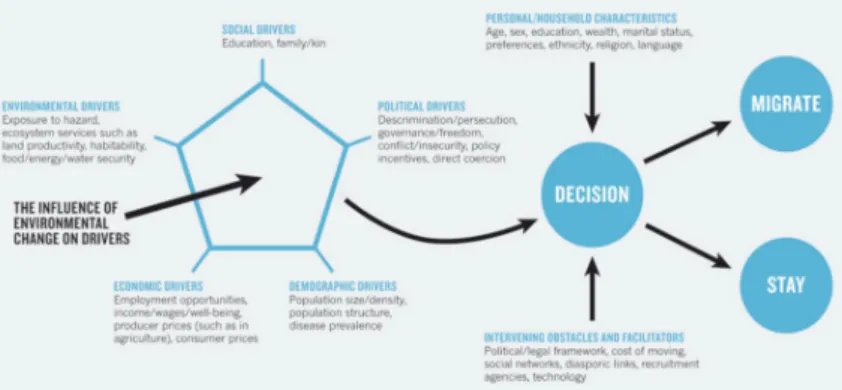
One classic if simplistic way of framing the various explana-tory factors that are presumed to lead to migration is to distin-guish between a macro, a meso and a micro level4. Macro-level causes are structural drivers that, in principle, indistinctly affect each and every potential migrant. A country’s demographics, its geographic location and climatic events, economic wealth and performance, established political arrangements and security is-sues, and migration policies – both with regard to origin as well as to transit and destination countries – all fall into this category. On the opposite side, micro-level conditions include both the long list of an individual’s personal features (age, gender, health, language, ethnicity, etc.) as well as the resources available to him or her (notably, finances and skills, including education). In be-tween the two, a less obvious meso-level category accounts for those elements connecting the individual with the broader socie-ty, such as an extended family group, ethnic, religious or regional communities, and wider social networks, comprising those pow-ered by internet and the new social media. It is well-document-ed, for example, that migrant networks connecting “migrants, for-mer migrants, and non-migrants in origin and destination areas through bonds of kinship, friendship, and shared community origin … decrease the economic, social and psychological costs of migration”5, thus favouring the probability that a specific per-son will embark on the journey as well as affecting how the latter unfolds.
Yet how exactly one or more of the abovementioned factors actually lead to migration requires a specific causal story, that is, 4 Cf. C. Cummings, J. Pacitto, D. Lauro, M. Foresti, Why people move: understanding the drivers and trends of migration to Europe, London, ODI, 2015, p. 25.
a theoretical explanation. And there is no lack of such accounts6. In a rather deterministic way, “push-pull” or “gravity” approach-es look at international migration as a rapproach-esponse to the wide dif-ferences in the demographic structure and economic opportu-nities of individual countries, towards a functional equilibrium. Asymmetric relations between economically advanced and poor countries are also at the basis of a second set of explanations – at times referred to as historical-structural – but in this case the emphasis lies on the uneven and exploitative nature of (mostly labour) migration under global capitalism. Human migration, however, is hardly the kind of rational, passive and smooth re-sponse to external conditions that both push-pull and histor-ical-structural accounts would posit. Ultimately, an individual chooses to migrate, and this may have to do more – or at least also – with his or her perceptions, aspirations and resources, with risk-sharing and diversification strategies within the family, or with the established mobility patterns of the cultural or regional community he or she belongs to. Recent versions of migration transition theories7 try to incorporate the role of an individu-al’s decisions within a macro-level approach. The central tenet is that migration is essentially “an intrinsic part of broader processes of social change, usually embodied in the concept of ‘develop-ment’”8, and unfolds in a non-linear way. As societies develop and transform, increased awareness, aspirations and assets make individuals more likely to decide to migrate. But the process also leads to a point where, once a country achieves a certain level of development, the balance between emigration and immigration shifts, with the former declining while the latter increases.
In their efforts to explain mobility, migration studies made several common or common-sense assumptions much more 6 This section is mainly based on S. Castles, H. De Haas, M.J. Miller (2014), pp. 25-54. 7 H. De Haas, Migration transitions. A theoretical and empirical inquiry into the developmen-tal drivers of international migration, Working Papers Paper 24 - DEMIG project paper
1, International Migration Institute, Oxford, 2010; W. Zelinsky, “The hypothesis of the mobility transition”, Geographical Review, vol. 61, no. 2, 1971, pp. 219-249. 8 H. De Haas (2010), p. 3.
problematic than they at first appear. Far from being a modern phenomenon, migration is found across ages and societies (with a peak of intensity during the XIX century). As a matter of fact, asking why, today, so many people move may not even be the right question: in a global world that is otherwise characterised by freedom of movement – can we imagine a situation in which only 3% of supermarket products, television programmes, web-sites or books come from abroad? – the share of migrants over the world population actually looks abnormally low9. Also, there is now widespread consensus that the same individual may have different motivations for leaving his or her country, that these motives may change over time and often blur the distinction between economic migrants and refugees. Contrary to popular perceptions, it is not the poorest and the destitute that depart their home places to try and reach more advanced nations, since some basic financial resources and skills are necessary to afford long-distance mobility10. Most migrants typically remain within the world region they were born in11. For the same reason, cli-mate and environmental changes per se are likely not enough to ignite very large extra-continental migration flows, as feared by some. Global inequalities may be less relevant than migra-tion networks and a “culture of migramigra-tion” in shaping patterns of international migration and making them self-perpetuating processes. The very notion that promoting aid, investment, trade and other forms of exchange between countries of destination and countries of origin can help contain people’s movements may be misplaced, as closer links may turn out to actually foster the volume of migration. Finally, in spite of mounting anti-im-migration fears across a number of Western countries, there is 9 G. Sciortino, Rebus immigrazione, Bologna, il Mulino, 2017, p. 22.
10 C. Dustmann and A. Okatenko, “Out-migration, wealth constraints, and the
quality of local amenities”, Journal of Development Economics, vol. 110, 2014, pp.
52-63.
11 C. Wihtol de Wenden, “Current patterns of migration flows. The challenge of
migration and asylum in Europe”, in M. Ambrosini (ed.), Europe: no migrant’s land?,
increasing evidence of a positive economic impact of migration in receiving economies12.
Does “Africa on the move” mean “Africans on the move”?
Ever since sub-Saharan countries gained independence back in the 1960s, the region has consistently remained the poorest in the world bar Southern Asia. With a US$3,922 per capita in-come at purchasing-power parity in 201613, the area has long been synonymous with development failure: a stagnating region with few signs of change and little prospects of advancement. The peak of disappointment was the “lost decade” of the 1980s and early 1990s, when “devastatingly bad economic perfor-mance” led to a visible decline in living standards14. By the end of the century, per capita income was at the same level it was in the early 1960s15.
Since around the mid-1990s and then the early 2000s, howev-er, sub-Saharan Africa began to witness quite substantial progress. More optimistic – and at times over-optimistic – assessments made their appearance and rapidly multiplied as if by conta-gion. By then, many observers deemed Africa “on the move”, “fast-changing”, “in transformation”, or “rising”. While the oc-casionally hyperbolic accounts risked hiding the extent to which many things remained just as they were – including the lifestyles, resources and vulnerabilities of many remote rural areas, as the current hunger crisis in East Africa reminds us all too clearly – sub-Saharan societies did see the emergence of new dynamics and important progress. Besides the latter, long-term ongoing processes also continued to unfold, implying additional, if more 12 K. Koser (2016), p. 97.
13 International Monetary Fund, World Economic Outlook Database, April 2017
(ac-cessed on 24 July 2017).
14 J. Darnton, “‘Lost decade’ drains Africa’s vitality”, New York Times, 19 June 1994. 15 International Monetary Fund (2017), accessed on 24 July 2017.
gradual, changes. Some of the key transformations underway in recent years include massive demographic expansion, remark-able economic performances, technological innovations, social improvements, political renewals, and environmental change. What have been the main implications – if any – for African mobility?
With extraordinarily high population growth rates, the num-ber of Africans south of the Sahara doubled from 493 million in 1990 to almost 1 billion in 2015, or a 96% increase (by way of comparison, Asians grew by “only” 37% over the same period). The region is expected to double yet again by 2050 (reaching 2.2 billion people) and then by 2100 (4 billion), driving the world’s population dynamics and approaching the size of Asia16. The trend towards strong demographic expansion is the result of the “striking contrast” between rapid health improvements – lead-ing to sharp declines in mortality rates, particularly for children – and a slow reduction in fertility rates17. With an astounding average of 7.6 children per woman – the world’s highest fertility rate – the population of Niger will more than triple from today’s 20 million to almost 70 million in 2050. A medium-sized coun-try such as Uganda, which was inhabited by just 5 million people in 1950, will have 214 million at the end of this century. Since sub-Saharan Africa has historically displayed comparatively low levels of population density, however, it only overtook Europe in recent years and remains far behind Asia (i.e. 44 versus 142 inhabitants per square kilometre in 2015).
The massive expansion of youth cohorts and the clash be-tween their economic expectations and lack of employment opportunities in their home countries is one of the most-fre-quently cited motives behind migration flows towards Europe. In principle, however, the possibility exists of turning Africa’s 16 “Medium variant” projections, United Nations Population Division, World Population Prospects: The 2017 Revision, Department of Economic and Social Affairs,
New York, 2017.
17 J. May, The Demographic Dividend, Revisited, Population Reference Bureau,
expanding working-age population into an asset for economic and social development, as opposed to a Malthusian burden and a source of competition and challenging tensions for land, jobs, public services, etc. As shown by a number of successful Asian countries, a so-called demographic dividend “becomes possible when fertility declines sufficiently to increase the number of the working-age population relative to the rest of the population and to reduce the investments needed to care for children (an improvement in the dependency ratios)”18. The dividend period is estimated to last some five decades or more, until reduced fer-tility diminishes the rate of expansion of a labour force that has to care for an ever-growing elderly population19. Indulging in the hope of reaping the benefits of massive population growth, the former head of the African Union Commission, Nkosazana Dlamini-Zuma, established a direct link with migration when, at the 2014 EU-AU summit, she observed that “Africa could be the only continent with a young labour force by 2050. If we concen-trate on skilling-up our people, they will not have to come [into Europe] through Lampedusa or the desert … and [more will stay at home, where they] will drive development in Africa”20.
Economic change south of the Sahara has already been kick-started. Many economies in the area achieved a string of impressive growth results over the first decade and a half of the XXI century. The region as a whole accelerated its pace from the meagre 2% yearly average GDP increases of the 1990s to a much more substantial 5.6% in 2000-201421. In spite of the turmoil and disappointment that prevailed in markets such as Côte d’Ivoire or Zimbabwe for the better part of the period, sev-eral other countries experienced a period of unprecedented eco-nomic progress, including the likes of Nigeria, Angola, Ethiopia, 18 Ibid.
19 R. Lee and A. Mason, “What is the demographic dividend?”, Finance & Development, IMF, vol. 43, no. 3, 2006.
20 “Some partners are more equal than others”, Africa Confidential, vol. 55, no. 7, 4
April 2014.
Rwanda, Mozambique, Sierra Leone and Chad. In a number of cases, oil and mineral exports undeniably played a key role. But if these were the only explanation, neither Ethiopia, nor Rwanda nor Mozambique would ever be counted among the brightest performers in the region. The continent’s economic recovery was sustained by additional factors (particularly, sounder macroeco-nomic management, reformed political arrangements, and rising levels of international aid) and cut across many sectors. After a long period of decline in the key agricultural sector, particularly in the 1970s and 1980s, a revival began to take shape in the 1990s, leading to 4.6% average yearly growth rates for the sector in 2002-2010 and an even higher 5.2% in 2011-2015. This new scenario, observed across all major sub-regions, turned “the past 15 years ... [into] the longest period of sustained economic and agricultural growth since independence”22.
Economic growth was accompanied by an impressive spread of new technologies, which was all the more revolutionary in Africa since it permitted addressing some infrastructural bottle-necks (of which there are still plenty on the continent). Thus, for example, Africans quickly embraced mobile phones to leapfrog the development of historically dysfunctional landline networks. This, in turn, fed into the pioneering use of mobile money, also a way around the lack of a specific kind of physical infrastructure, namely local bank branches. These new channels of information, communication and exchange have been highly consequential for would-be as much as for actual migrants. Some observers have pointed out that recent transformations help explain the growing numbers of emigrants from the region, as they “increased young Africans’ capabilities and aspirations to migrate”23.
22 O. Badiane and J. Collins, “Agricultural Growth and Productivity in Africa:
Recent Trends and Future Outlook”, in J. Lynam et al. (eds.), Agricultural Research in Africa: Investing in Future Harvests, International Food Policy Research Institute
(IFPRI), Washington DC, 2016, pp. 3-30, cit. p. 5.
23 M.-L. Flahaux and H. De Haas, “African migration: trends, patterns, drivers”, Comparative Migration Studies, vol. 4, no. 1, 2016, p. 23.
But to what extent did economic growth actually matter for potential migrants in the region? As the economic recovery sta-bilised a decade or so ago, concerns began to focus on the extent to which ordinary Africans were actually benefitting from their countries’ remarkable performances. This was also a time when rising global inequalities were increasingly coming under the spotlight24. In Africa, the pace of economic growth was good, but was its distribution? While social indicators did show im-provements virtually across the board, including a slow decline of poverty levels (see below), there appeared to be little progress by way of expanding employment opportunities. Africa’s growth was largely “jobless” – as stressed, for example, by Aderanti Adepoju’s chapter on Nigeria in this Report – hardly the kind of “inclusive growth” that the new development jargon increasing-ly demanded, that is, “growth that the poor and disadvantaged share in”25. Moreover, as this debate started to kick in, several key markets on the continent were hit by the economic down-turn that began in late 2014, including 185-million-people and Africa’s largest oil-producer Nigeria, but also South Africa and Angola, among others. As a result, the growth picture in the re-gion has become significantly more nuanced and diversified than it used to be some five or ten years ago, with certain countries 24 J. Stiglitz, The Price of Inequality. How Today’s Divided Society Endangers Our Future,
New York, W.W. Norton & Company, 2012; T. Piketty, Capital in the Twenty-First Century, Cambridge MA, Harvard University Press, 2014.
25 This early use of the concept of “inclusive growth” is from the Asian Development
Bank, Asian Development Outlook 2000. The social challenge in Asia, 2000, p. 224. The
World Bank subsequently defined it “growth that allows people to contribute to and benefit from economic growth… [implying] a longer term perspective as the focus is on productive employment rather than on direct income redistribution, as a means of increasing incomes for excluded groups” (World Bank, What is inclusive growth?, Washington DC, 10 February 2009, pp. 1-2). Inclusive growth was
explic-itly mentioned among the Sustainable Development Goals (United Nation, “Goal 8. Promote sustained, inclusive and sustainable economic growth, full and produc-tive employment and decent work for all”, Transforming our world: the 2030 agenda for sustainable development, New York, 2015). See also the African Development Bank, Inclusive growth agenda, Briefing Note 6, 10 April 2012.
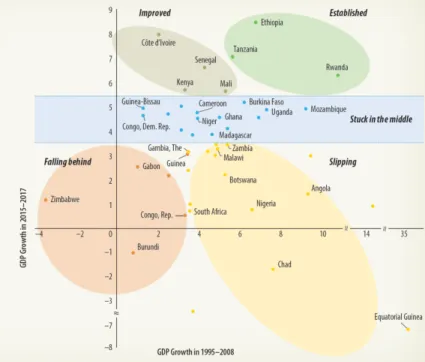
still showing strong performances and prospects – including Ethiopia, Tanzania, Côte d’Ivoire or Kenya – and others slipping into an area of slower growth and even stagnation (Figure 1).
In the case of contemporary Africa, the broader issue of wheth-er the net effect of development is to increase migration (particu-larly in the medium- and short-term) or to reduce it (mostly in the long-term) is thus further complicated by both the ups and downs of growth – with increasingly divergent trajectories po-tentially affecting intra-continental migration patterns – as well as by the latter’s nature, namely whether “growth without jobs” matters at all, that is, whether or the extent to which growth of this nature can produce the kind of impact that “development” purportedly generates by expanding available resources.
Had the nature of Africa’s growth been different, the extent and depth of poverty across the continent would have been af-fected in a much more substantial way. Africa was the only de-veloping region to fail the target of halving extreme poverty set by the Millennium Development Goals. Contrary to the “lost decade”, the past twenty years were not wasted. Poverty south of the Sahara did decline from a peak of 57% in 1999 to 41% in 2013, and possibly even more than that26. But, as mentioned, the fall was not as fast as it was hoped. Moreover, due to pop-ulation increases, the actual number of poor went up by about 100 million: from 288 million in 1990 to 389 million in 2012, with rural and chronic poverty remaining particularly pervasive. The uphill struggle for socio-economic inclusion is also revealed by the proportion of Africans with access to electricity, a figure that almost doubled from 19.2% in 1991 to 37.4% in 201427, but remains well below the modest target of covering half of the continent’s population.
26 World Bank, World Development Indicators, Databank (accessed on 28 July 2017).
See also World Bank, Poverty in a rising Africa, Washington DC, World Bank, 2016,
p. 1.
Fig. 1 - Growth in sub-Saharan African countries, 1995-2008 versus 2015-2017
Source: World Bank, Africa’s pulse, 2017, p. 21
Political violence, dictatorial rule and discrimination can also be important drivers of migration. The political landscape of 2017 sub-Saharan Africa is vastly different from pre-1990 politics. A number of states have gradually become more stable – both a condition for and a consequence of economic devel-opment – and governments were democratised to an unprec-edented degree28. Up until the late 1980s, political normalcy consisted of repressive military rule or largely uncompetitive 28 For an overview, see N. Cheeseman, Democracy in Africa, Cambridge, Cambridge
one-party regimes. A tide of reforms was then rapidly ushered in across the region. In spite of the limits of the initial reforms, and of the many setbacks that followed, elections contested by multiple parties and candidates are now an accepted standard, and most countries allow a substantial degree of freedom for op-position politics and media outlets. Recent progress includes a historic election in Nigeria, in 2015, where the opposition was for the first time able to oust an incumbent President29. In 2016, the longstanding authoritarian ruler of the Gambia was surpris-ingly defeated at the polls, while the sitting Gabonese President only marginally avoided a similar fate. In early 2017, Somalia held a restricted election that nevertheless had significant po-tential for the process of rebuilding the state. Later in the year, Kenya had to abide by an unprecedented Supreme Court ruling that demanded a re-casting of the presidential vote, whose result had been contested by the opposition.
But contentious politics, conflict and repression still feature prominently in many corners of the continent. Instability in neighbouring countries made Uganda the fifth top refugee-re-ceiving country in the world, with 940,800 refugees in 2016, followed by Ethiopia with 791,600 (UNHCR 2017). In South Sudan, the world’s youngest state, a devastating civil war be-tween the ethno-political factions of the President and of the for-mer Vice-President contributed to the famine that was officially declared in early 2017. In Ethiopia, a state of emergency was declared for 10 months following violent unrest in Oromia and other regions, itself the result of a bogus election in which the rul-ing party and its allies won all parliamentary seats. Neighbourrul-ing Eritrea remains one of the most politically-closed and oppressive autocracies in the world. North-eastern Nigeria was profoundly destabilised by the Boko Haram insurgency, which caused some 30,000 deaths and displaced some 2 million people30.
29 G. Carbone and A. Cassani, “Nigeria and democratic progress by elections in
Africa”, Africa Spectrum, no. 3, 2016, pp. 33-59.
30 Data from Council on Foreign Relations, Nigeria Security Tracker (accessed on 25
These and other political developments are mirrored by the ups and down of migration flows, with the likes of Eritrea, Somalia, Nigeria, South Sudan, Ethiopia or the Gambia list-ed among the top “sending countries”. In 2016, for example, 12,000 Gambians – out of a total population of just about 2 million people – reached the shores of Italy. Yet, following the surprise electoral ousting of Yahya Jammeh, the dictator who had ruled the country for over two decades and viewed migrants as an unpatriotic and undeserving bunch, Gambians began to feel they had lost their legitimate claim to asylum in Europe, even though most had probably fled poverty rather than persecution31.
The 2017 food crisis – and particularly the famine in South Sudan – put the spotlight on the intertwine of political and en-vironmental factors in driving human mobility. The very origin and pace of human migration out of Africa, with the waves of dispersal of homo sapiens between around 120,000 and 15,000 years ago, has long been linked to climatic events and environ-mental change, since the latter deeply affects the availability of resources and thus the “carrying capacity” of a given region (i.e. the human population it can support), shaping human dis-persal32. Today, the International Organisation for Migration (IOM) defines “environmental migrants” as those “persons or groups of persons who, for reasons of sudden or progressive changes in the environment that adversely affect their lives or living conditions, are obliged to leave their habitual homes, or choose to do so, either temporarily or permanently, and who move either within their country or abroad”33. It is the combina-tion of the existing demographic, socio-political and economic
Council, Global Report on Internal Displacement 2017, Genève, 2017.
31 L. Hunt, “Meet the Gambian migrants under pressure to leave Europe”, IRIN,
20 July 2017.
32 P.B. deMenocal and C. Stringer, “Climate and the peopling of the world”, Nature,
vol. 538, no. 7623, October 2016, pp. 49-50.
33 International Organisation for Migration (IOM), World Migration Report 2008: Managing Labour Mobility in the Evolving Global Economy, 2008, p. 493; Global
vulnerabilities, alongside region-specific geographical features, that makes the sub-Saharan area disproportionately exposed to climate-change events – both sudden-onset events, such as droughts or floods, and slow-onset ones such as desertification or sea-level rise – as Sara Vigil explains clearly in her chapter. For this very reason, whether initiatives such as the Great Green Wall of the Sahara and the Sahel will help contain migration flows or actually make it easier for Africans to afford to move remains an open question34.
Conclusion
International migration is an increasingly complex reality. The task of the analyses contained in this Report and similar works is to contribute to a better-informed understanding of the phe-nomenon and possibly to a related improvement of public ac-tion. The trouble is that much of the public systematically pre-fers quick and clear-cut representations of the world, rather than more nuanced investigations.
The prevailing narrative on African migration, with its rhet-oric and images, is most often stereotyped. As Marie-Laurence Flahaux points out in her chapter, migration is typically report-ed through alarmist discourses about an African “exodus” or an “invasion” of Europe driven by poverty and wars. In fact, much of this reporting is based on assumptions that new studies are increasingly questioning, and, overall, African migration appears to be less exceptional than it is often thought. From a Western and European perspective, emphasis is often placed on the grow-ing number of Africans – in absolute terms – on the move. But, as Flahaux argues, the number of African emigrants as a share of (a fast-expanding) population is essentially stable. Moreover, most of them “simply” move somewhere else on the continent (see Blessing Mberu and Estelle Sidze’s chapter).
34 J. Filipovic, “Will Africa’s Great Green Wall discourage migration to Europe?”, The Guardian, 19 July 2017.
The stereotyped migration narrative builds on a broader, well-established Afro-pessimism as a simplistic view that por-trays African development as an overall and intractable failure. This perspective, dominant ever since at least the 1970s (but one may trace its roots much further back35), was only challenged during the past ten to fifteen years – roughly, from the beginning of the new millennium – when an opposite narrative quickly and surprisingly began to gain ground. The “Africa rising” story looked at the continent as the fastest-changing developing area, with unprecedented and sustained economic growth in countries across the region. This was also partly a somewhat stereotyped narrative, and the economic downturn that began in late 2014, with the fall of oil and other commodity prices, led to a scenario in which, as mentioned, national growth prospects are more di-versified than they were in previous years.
The barriers between the abovementioned perspectives – the over-pessimistic (as for migration) and the over-optimistic (as for early XXI economic performances) – should be lowered. As much as we should avoid a uniform reading of the different real-ities across Europe, a grown-up view of contemporary sub-Saha-ran Africa, a region almost seventy times the size of Germany, is needed. One that looks at it as a land where poverty and conflict are at times on the rise (as with the increasing instability in parts of the Congo-Kinshasa or with the violence of the Fulani militias in the Nigerian middle belt), and may feed into migration flows, but also as a land of growth and dynamism, transformations and opportunities that have recently attracted not just foreign com-panies and investments, but also immigrants from other coun-tries of the global South (notably from China) and even of the global North (as in the case of Portuguese migrants to Angola or Mozambique in the years following the financial crisis36).
35 Joseph Conrad’s Heart of darkness novel was published in 1899. See C. Achebe,
“An image of Africa: Racism in Conrad’s Heart of Darkness”, Massachusetts Review,
vol. 18, 1977.
36 See A. Akwagyiram, “Portugal’s unemployed heading to Mozambique
The demystification of outsiders’ perspectives on Africa is key to lessening the fear that grips part of the public in EU countries, and to expanding the room for manoeuvre for policy-makers in addressing issues such as migration. Because Africa is a diverse and fast-evolving region, and migration – including African mi-gration – is a fact of life that is here to stay.
Marie-Laurence Flahaux
In public opinion and political discourses, African migration is most of the time described as high and increasing, mainly direct-ed toward the North, and generally explaindirect-ed by poverty and wars. African migrants are often perceived as poor individuals fleeing the difficult context of their place of origin and migrating massively to rich countries. In addition, it is sometimes believed that smuggling, carried out by profit-seeking criminals, is the cause of migration from the African continent to Europe. Also, it is often expected that most migrants intend to settle perma-nently in those countries of destination and never return to their origin countries.
These ideas or “myths” are influenced by media images of “boat migration” in the Mediterranean. Images of boats full of migrants have contributed to drawing public and policy atten-tion to African migraatten-tion to Europe. The Mediterranean crisis, with the drowning of African (and non-African) migrants who attempt to reach Italy, has reinforced the alarmist discourses of various stakeholders, including those of politicians, and have spread in the public opinion through the media at national and international levels. The phenomenon of African migrants trav-elling by sea despite the risks is not new but fuels the idea of an “exodus” from Africa and an “African invasion” in Europe1. 1 D. Lessault and C. Beauchemin. “Ni invasion, ni exode. Regards statistiques sur
les migrations d’Afrique subsaharienne”, Revue européenne des migrations internation-ales, Nouvelles migrations chinoises en Afrique et en Amérique latine, vol. 25, no. 1, 2009,
However, these ideas are based on observations selected by journalists. These ideas, widespread in public opinion, mainly reflect impressions rather than the realities of African migration2. Firstly, this chapter intends to summarise empirical evidence revealed by research conducted on African migration. Analyses of “macro” data (from estimations of the volume of African migrants or “stocks”) and “micro” data (from surveys carried out among African migrants) demystify the common representations of African migration. We will particularly focus on the following questions:
• Is there an increase of African migration? • Do most African migrants live outside Africa? • Is poverty the main driver of African migration?
• Is smuggling the cause of migration from Africa to Europe?
• Do African migrants return to their origin country? Recent research allows us to answer these questions in the next section.
Secondly, based on the empirical evidence explained in the next section, this chapter will discuss the effect of measures im-plemented by European countries in order to stop or – at least – reduce African migration. On the one hand, European coun-tries indeed want to restrict the flows of African migration, but, on the other hand, they seem unable to do it, as illustrated by the tragic events at the southern border of Europe, despite the budgets allocated to reinforce European borders. Thus, in the second section of this chapter, the effectiveness of policies aiming at managing African migration will be discussed.
The findings revealed by recent studies and summarised below are based on two types of data.
On the one hand, estimations of stocks of internation-al migrants are now available. The Globinternation-al Bilaterinternation-al Migration Database, released by the World Bank, contains bilateral 2 M.-L. Flahaux and H. De Haas, “Migration from, to and within Africa: the role
migration population or stocks data for 226 countries, major territories and dependencies for 1960, 1970, 1980, 1990 and 20003. Migration stocks for 1990, 1995, 2000, 2005, 2010 and 2015 that have been estimated by the United Nations Population Division (Department of Economic and Social Affairs) are also available. These volumes of migrants are estimated from census data and population register records. Despite the possibilities of analyses offered by these databases, it is important to bear in mind that they are not perfect and that they contain limitations. Unauthorised migration is not included, for example, when the data comes from population registers (and to a certain extent when it comes from population censuses). And when data is based on migration defined from the “country of citizenship” criterion rather than from the “country of birth” criterion, the stocks are likely to be underestimated.
On the other hand, survey data carried out in 2008-2009 on migration between Africa and Europe also provide more specif-ic empirspecif-ical evidence on Congolese, Senegalese and Ghanaian migration. Household surveys were carried out in the region of the capital cities of the countries of origin, and biographical (in-dividual) surveys took place both in origin and in destination countries in Europe. These surveys provide detailed information on many aspects of migration (and non-migration)4. The find-ings from this data source developed in this chapter focus on the case of migration from Senegal and the Democratic Republic of Congo (DR Congo). These case studies are interesting to com-pare as these countries’ political and economic climates have evolved very differently since their independence. While Senegal has been politically stable since independence, DR Congo has 3 C. Özden, C.R. Parsons, M. Schiff, T.L. Walmsley, “Where on Earth is Everybody?
The Evolution of Global Bilateral Migration 1960-2000”, The World Bank Economic Review, vol. 25, no. 1, 2011, pp. 12-56.
4 For information on the Migration between Africa and Europe (MAFE)
pro-ject and data (household and individual/biographical surveys) that investigated Congolese, Ghanaian and Senegalese migration, see the MAFE, http://mafepro-ject.site.ined.fr/en/
experienced manifold troubles over decades. Living conditions have become more difficult for the population of both countries over time, but the economic crisis has been far deeper in DR Congo. While these two cases studies are not representative of the whole of Africa, the comparison highlights that the context in the countries of origin and destination plays an important role for many aspects related to migration, and that migration is not homogenous across the African continent.
Empirical evidence from research on African migration
Is there an increase of African migration?
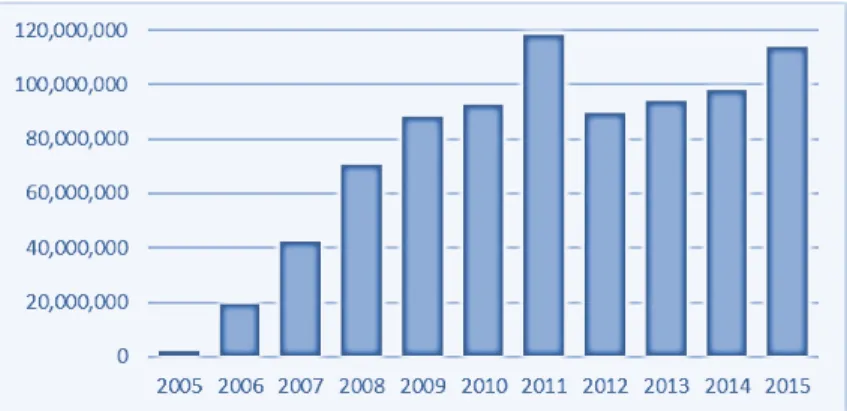
Contradicting common ideas, empirical analyses using data on migration stocks reveal that there has not been an increase in African migration in recent decades. Figure 1 shows that the to-tal number of African migrants was stable between 1990 and 2000, but rose afterward from 21.6 million in 2000 (16.3 mil-lion from sub-Saharan Africa) to 32.6 milmil-lion in 2015 (23.9 million from south of the Sahara). However, it is important to take into account the fact that the African population has also increased over time. Consequently, to measure the extent of em-igration, it is more appropriate to consider Figure 2, showing the trends of African migrants as a percentage of the population of Africa. It indicates that emigration from the African continent has not increased, but instead slightly decreased between 1990 and 2015, albeit the downward trend was marginally reversed after 2005 (after 2010 for sub-Saharan Africa). Less than 3% of the African population live in a country other than its country of origin. This is even less than the average worldwide, as about 3.3% of the world population is a migrant5.
5 M. Czaika and H. De Haas, “The Globalization of Migration: Has the World
Fig. 1 - Total numbers of African international migrants (1990-2015)
Source: UN Department of Economic and Social Affairs (author’s calculations)
Fig. 2 - African migrants as a percentage of the population in Africa (1990-2015)
Source: UN Department of Economic and Social Affairs and UN Population Division (author’s calculations)
In-depth analyses of the evolution of African migration be-tween 1960 and 2000 reveal that most African migrants migrate within Africa6. They indicate that emigration from the poorest countries is mainly a short-distance migration, predominant-ly directed towards neighbouring countries. On the one hand, Figure 3 (a) indicates that there was an increase of emigration out of the African continent from Maghreb countries between 1960 and 1980. This increase to non-African destinations does not appear from the other regions of Africa. On the other hand, Figure 3 (b) shows a decrease in intra-continental migration from East Africa and to a much lesser extent from Southern, Central and North Africa. This declining evolution of migration within Africa may be related to processes of post-colonial state forma-tion and their imposiforma-tion of barriers against free circulaforma-tion after independence, or to the intensification of nationalism that led to the implementation of restrictions to movements. Therefore, it has become more difficult for African people to migrate within the continent and it may have resulted in less emigration. The evolution of intra-continental migration for West African coun-tries was more stable between 1960 and 2000. It may be related to the fact that strong migration patterns were already estab-lished under the French colonisation (as in the case of migration between Burkina Faso and Ivory Coast), that migrants continue to have social networks across borders, and to the absence of visa requirements between ECOWAS (Economic Community of West African States) countries that makes migration of their citizens easier7.
Do most African migrants live outside Africa?
Contradicting some perceptions and although the proportion of Africans living in the North (North America and Europe mainly) has increased, Figure 4 confirms that most African mi-grants are still located in African countries, with the exception 6 M.-L. Flahaux and H. De Haas (2016).
of migrants from Maghreb countries. The main destinations of North African migrants are Europe and Asia (Gulf countries), followed by Africa. For the other regions (West, East, Southern and Central Africa), Europe is, after the African continent, the second continent of destination. However, America and Oceania also appear to be continents of destination for migrants from Southern Africa. But it can still be acknowledged that the major-ity of African migrants do not live outside Africa.
Figure 5 represents the destinations of African migrants in the world in 2000. Some coastal countries on the African continent appear to have high numbers of African migrants, in particu-lar Ivory Coast, Nigeria, South Africa, Mozambique, Kenya, Ethiopia and Libya. Outside the African continent, African migrants are also present in Europe, with which most African countries had colonial links, but also in North America, in Saudi Arabia and in Australia.
Fig. 3 - Evolution of emigration intensity by African region (per 1000; weighted by population size)
Source: Global Bilateral Migration Database (in M.-L. Flahaux and H. De Haas, 2016)
Fig. 4 - Destinations of African migrants in 2000, by region of origin and continent of destination
Source: Global Bilateral Migration Database (author’s calculations)
Is poverty the main driver of African migration?
While it is often believed that poverty, demographic pressure, conflicts and environmental degradation are the main drivers of African migration and that “development” of the coun-tries would stop emigration, empirical evidence suggests the opposite.
At a macro level, as previous analyses have demonstrated earlier, most African migrants do not move from the poorest countries to the wealthiest countries. Emigration is generally lower from sub-Saharan Africa, which is a poorer region, and higher when a certain level of “development” has been reached, which is the case with North African countries. Migration from poorer countries or regions is primarily directed towards other African countries, while more “developed” regions like North Africa have a higher level of extra-continental migration. This result suggests that populations of the least developed countries are less able to move, and tend to migrate over shorter distances
Source: Global Bilateral Migration Database (in M.-L. Flahaux and H. De Haas, 2016)
when they do. Conversely, people living in richer countries have access to better infrastructures and transportation, which facil-itates migration and enables movements of populations over greater distances. Actually, the countries with a higher level of extra-continental migration correspond to the relatively more “developed” countries, that are located on the coast, that have a higher level of urbanisation, a higher GDP per capita, and that are more advanced in the demographic transition (they have a lower level of both mortality and fertility)8.
Analyses conducted at a micro level are along the same lines. Surveys on migration between different countries in Africa and Europe have shown that Congolese people living in households with sufficient resources are more likely to migrate to Europe than those living in poor households, and that Senegalese peo-ple who own some property (land, house, business, etc.) are also more likely to do so.9 Similarly, individuals from these countries with a high educational level have greater chances to migrate than those with a lower educational level. An individual from the Democratic Republic of Congo with a superior educational level (i.e. someone who studied after secondary school) is ten times more likely to leave the country compared to a Congolese who has not studied beyond primary school. In the case of Senegal, we observe the same trend: a more educated individual is six times more likely to leave Senegal compared to someone who has never been to school or has a primary educational level. Educational level is thus a strong determinant explaining emigration. In de-tail, results indicate interestingly that the effect of education is more pronounced for African migration toward northern coun-tries, including Europe, and less for migration within Africa, as revealed for Senegalese and Congolese migration10.
8 Ibid.
9 A. González-Ferrera et al., Factors of Migration between Africa and Europe: Assessing the Role of Resources, Networks and Context. A Comparative Approach, MAFE working
paper 22, 2013, http://www.ined.fr/fichier/s_rubrique/22089/wp22_determi-nantssynthesis.en.2.fr.pdf
These findings confirm that people only migrate when they have the financial and human resources to do so, in particular for long-distance migration. Migrating requires resources. It ex-plains why poor people are less likely to migrate, and not more likely to do so.
Is smuggling the cause of migration from Africa to Europe?
International organisations and governments often blame smug-glers for the deaths of migrants in the Mediterranean or for the arrivals of migrants from Africa in Europe. Every time, they claim that they will again implement new measures to combat il-legal migration in order to stop migrants from reaching Europe. However, implementing new measures in order to fight irregular migration is very likely to fail because it is the border controls that actually force migrants to take more risks and more dan-gerous routes to reach Europe, and to depend on smugglers to cross borders. In sum, smuggling is actually a reaction to border controls rather than a cause of migration11.
Do African migrants return to their origin country?
Return migration is also a topic generating increasing public and policy attention. However, due to the dearth of data, very little is actually known about this phenomenon. The research using the Migration between Africa and Europe (MAFE) surveys indicates that there is an important gap between policy presuppositions and the realities of return migration to Africa12.
tendances migratoires congolaises et sénégalaises”, in C. Beauchemin, L. Kabbanji, P. Sakho, B. Schoumaker, Migrations africaines: le co-développement en questions. Essai de démographie politique, Paris, INED/Armand Colin, 2013, pp. 91-125.
11 H. De Haas, “Smuggling is a reaction to border controls, not the cause of
mi-gration”, 2013, http://heindehaas.blogspot.co.uk/2013/10/smuggling-is-reac-tion-to-border.html
12 The analyses described in this section come from the following publication:
M.-L. Flahaux, Retourner au Sénégal et en RD Congo. Choix et contraintes au cœur des trajectoires de vie des migrants, Université catholique de Louvain, Presses universitaires
Policy-makers often believe that African migrants travel one-way to destination countries in Europe and never return home. However, the analyses reveal that at the time of their arrival in Europe half of Senegalese and Congolese migrants intend to re-turn to their country of origin, and that actual rere-turns to Africa are not insignificant. However, migrants are less likely to intend to return at the beginning of their migration when the condi-tions in their home country are deteriorating, which is especial-ly the case for migrants from DR Congo since 1990. Similarespecial-ly, migrants are also less likely to return when the situation in their country is becoming more difficult. It shows that a particularly difficult context in origin countries encourages migrants to move permanently or to postpone their return. This is particularly the case for Congolese students. At the moment of their arrival in Europe, they had high prospects for planning to return (probably after the end of their studies), but in actual fact, their prospects for return are not as high as expected, which is probably due to the unstable context in their country of origin, at a political and economic level. This result does not appear true for Senegalese migrants who migrated to study and who are likely to return to Senegal, as the context there is more favourable13.
Actually, migrants anticipate their reintegration. According to what they feel to be the most suitable for themselves and for their family, they can intend, from the beginning, to stay temporarily in Europe or to settle there definitely. In general, Senegalese and Congolese migrants who positively imagine a future reintegra-tion in the origin country plan to return. Those who migrate to study, for example, generally intend to return because they know that a European diploma is likely to have a positive effect on their life after having returned. Senegalese migrants who migrate in order to improve their living conditions are also more likely to intend to return because they expect their savings to be useful to
de Louvain, Louvain-la-Neuve, 2013, p. 348.
13 M.-L. Flahaux, “Return migration to Senegal and DR Congo: intention and
living better in Senegal. The preparation for return is crucial for the return. It appears that migrants who intended to return are more likely to return than those who had not planned a return, and Congolese migrants who live in households with sufficient resources have higher prospects of returning14.
Policy-makers in European countries also assume that it is nec-essary to encourage and to force migrants to return. However, the large majority of returns are voluntarily by the migrants themselves and are not forced or encouraged by the authorities in the coun-tries of destination. As shown in Figure 6, it appears that returns linked to “problems with residence status” concerned just 11% of Senegalese and 3% of Congolese migrants who returned. It means that migrants are actually much more likely to return when they have prepared their return themselves. As Figure 6 also shows, the first motive for return to the Democratic Republic of Congo is professional, while it is related to family for returns to Senegal.
Fig. 6 - Main motive for return from Europe to Democratic Republic of Congo and Senegal (%)
14 M.-L. Flahaux (2013).
Another important result shows that undocumented Congolese migrants are less likely to return than those who are documented. It confirms that most of the returns are not forced and that restric-tive immigration policies have a negarestric-tive effect on the migrants’ return. While governments of destination countries in Europe im-plement programmes in order to encourage migrants to return, analyses reveal that these measures do not have an impact on re-turns. These programmes are implemented together with policies restricting the access of migrants to Europe. In such a context, migrants are reluctant to return because they know that it will be difficult to migrate again if they decide to return and if their rein-tegration process is problematic. When policies are implemented to restrict migration, it is harder to migrate to Europe, but mi-grants are also less likely to intend to return or do return15.
In sum, the situation prevailing in origin countries is crucial for the question of return. Migrants are more likely to return when the context is favourable, but much less if the political situation is unstable and the economic situation difficult, because they know that the difficulties that they could encounter after their return are likely. Secondly, it has been highlighted that documented migrants – and those who live in good conditions – in destination countries are much more likely to return. This suggests that a better integra-tion of migrants in Europe would lead to more returns, since be-ing better integrated allows for a better preparation for the return. Thirdly, it is demonstrated that restrictive migration policies, which aim to limit the inflows of migrants in Europe, have a negative im-pact on returns. Migrants tend to stay in Europe because they are not sure of having the possibility to migrate again after their return. Discussing the effectiveness of migration policies Since the economic crisis in Europe in the early 1970s, migra-tion has more and more become a politicised topic in France, 15 Ibid.