UNIVERSITÉ DU QUÉBEC À MONTRÉAL
LE VOILE ISLAMIQUE ET LES ORlENTATIONS D'ACCULTURATION DES FRANCOPHONES DU QUÉBEC
THÈSE PRÉSENTÉE
COMME EXIGENCE PARTIELLE DU DOCTORAT EN PSYCHOLOGIE
PAR
SHABA EL-GELEDI ANNAAMI
UNIVERSITÉ DU QUÉBEC
À
MONTRÉAL Service des bibliothèquesAvertissement
La diffusion de cette thèse se fait dans le respect des droits de son auteur, qui a signé le formulaire Autorisation de reproduire et de diffuser un travail de recherche de cycles supérieurs (SDU-522 - Rév.01-2006). Cette autorisation stipule que «conformément
à
l'article 11 du Règlement no 8 des études de cycles supérieurs, [l'auteur] concèdeà
l'Université du Québec à Montréal une licence non exclusive d'utilisation et de publication de la totalité ou d'une partie importante de [son] travail de recherche pour des fins pédagogiques et non commerciales. Plus précisément, [l'auteur] autorise l'Université du Québec à Montréal à reproduire, diffuser, prêter, distribuer ou vendre des copies de [son] travail de rechercheà
des fins non commerciales sur quelque support que ce soit, y compris l'Internet. Cette licence et cette autorisation n'entraînent pas une renonciation de [la] part [de l'auteur]à
[ses] droits moraux nià
[ses] droits de propriété intellectuelle. Sauf entente contraire, [l'auteur] conserve la liberté de diffuser et de commercialiser ou non ce travail dont [il] possède un exemplaire.»REMERCIEMENTS 1
En premier lieu,je tiens à remercier les professeurs et les étudiants des universités qui m'ont permis de prendre de leur temps pour recueillir ces données. Sans leur précieuse collaboration cette thèse n'aurait pu avoir lieu.
Ensuite, je remercie mon directeur de thèse, Richard Y. Bourhis, pour son support tout au long de ma thèse. C'était inspirant de voir une personne aussi passionnée par la recherche sur les relations intergroupes et qui est prête à se battre pour la minorité, même si cela veut dire aller contre la norme.
Je remercie également les membres de mon jury de thèse, Dr. Catherine Amiot et Dr. Robert VaJlerand, professeurs au département de psychologie de l'Université du Québec à Montréal, et Dr. Homa Hoodfar, professeur au département de sociologie et d'anthropologie de l'Université Concordia. Leurs commentaires et suggestions ont été très stimulants.
Je tiens aussi à remercier Dr. Jean Bégin, statisticien au département de psychologie de l'Université du Québec à Montréal. Sa disponibilité et la clarté de ses conseils ont
contribué à la qualité des analyses effectuées.
Je remercie mes collègues et amis, Elisa Montaruli et Simon-Pierre Harvey. Leur support, aide et présence durant mes études doctorales ont été très précieux et appréciés.
Je tiens à remercier mes très bonnes amies Geneviève Barrette et Geneviève Mageau pour leur support, encouragement, amitié et pour avoir consacré généreusement leur temps pour m'aider avec mes statistiques.
Je tiens aussi à remercier ma meilleure amie, Julie Roussin, ma sœur, Sarah, et mon frère, Firas, pour leur amour et support inconditionnel durant toutes les étapes de mon cheminement doctoral et personnel.
Je dédie cette thèse à mes parents qui ont beaucoup sacrifié pour me permettre de grandir et d'étudier dans un pays qui valorise l'indépendance et la diversité sous toutes ses formes.
Je dédie aussi cette thèse à mon conjoint, Eric Marshall, pour m'avoir donné la force de continuer jusqu'au bout et d'atteindre un objectif longtemps attendu. Son amour, sa confiance en moi, sa présence et les innombrables heures passées à lire mes différents travaux m'ont été indispensables.
AVERTISSEMENT
Dans cette thèse, le genre masculin est utilisé à titre épicène partout où le contexte le permet et dans l'unique but de faciliter la lecture du texte.
Considérant que la doctorante a effectué ses études primaires en arabe en Libye et en Arabie Saoudite et ses études post-secondaires en anglais au Cégep Vanier et à l'université McGill, le Sous-comité d'admission et d'évaluation des programmes d'études de cycles supérieurs du département de psychologie lui a octroyé I~autorisation de rédiger la présente thèse en anglais.
TABLE DES MATIÈRES
LISTE DES FIGURES VII
LISTE DES TABLEAUX... VIII RÉSlTMÉ... Xl CHAPITRE 1
INTRODUCTION GÉNÉRALE .
1.1 Introduction .. 3
1.2 Process of acculturation .. 4
1.3 Uni-dimensional and bi-dimensional acculturation models . 4
lA Interactive Acculturation Model . 6
1.5 Endorsement of hast community accu Itu ration orientations ..
la
1.6 Arab Muslims as a devalued immigrant group in Quebec .. II1.7 Attitudes toward the lslamic veil in Quebec .. 13
1.8 Presentation of the two articles .. 18
CHAPITRE II ARTICLE 1 23 CHAPITRE III ARTICLE 2 :... 59 CHAPITRE IV DISCUSSION GÉNÉRALE 95
4.1 Theoretical and practical implications 97
4.1.1 Quebec Francophone attitudes toward women wearing the Islamic
veil 97
4.1.2 Impact of ethnic, linguistic, and religious outgroup membership on
endorsement of acculturation orientations 98
4.1.3 Impact of ethnic, linguistic, and religious outgroup membership on Quebec Francophone attitudes and heJping behaviour toward Arab
MusJims... 100
4.2 Research limitations 103
VI
Concludi ng Note... 106
RÉFÉRENCES 107
APPENDICE A
Form ulaire de consentement averti utilisé pour article 1- études 1 et 2... 117 APPENDICEB
Questionnaire de l'article 1 - étude 1... 121 APPENDICE C
Consignes de l'article 1 - étude 2 ,... 131 APPENDICED
Première page du questionnaire l'article 1 - étude 2 avec avec nom
québécois francophone... 135
APPENDICE E
Première page du questionnaire de l'article 1 - étude 2 avec avec nom arabe
musulman :... 139
APPENDICE F
Questionnaire de l'article 1-étude 2 143
APPENDICE
G-Questionnaire de 1) article 2 173
APPENDICEH
Accusés de réception des deux articles... 177
LISTE DES FIGURES
Figure Page
CHAPITRE 1
Interactive Acculturation Model... 6
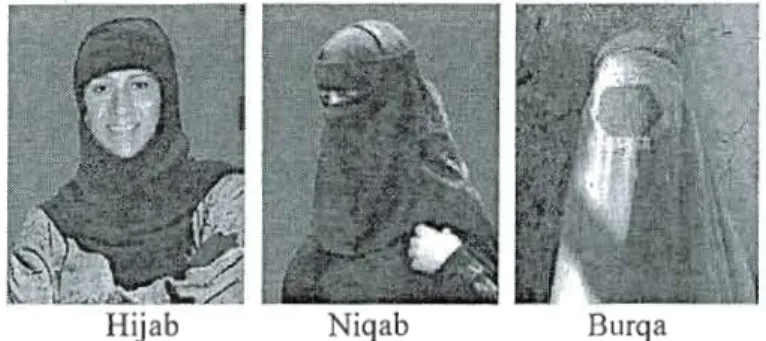
2 Types ofIslamic veil .. 14
3 Globe and Mail aIiicle, June 2,2006 . 16
CHAPITRE II
Photos of same computer generated image of female dressed in
different dress codes 33
CHAPITRE III
1 Computer generated photos demonstrating different types ofIslamic
veil (El-Geledi & Bourhis, 2010) ; .. 68
2 Percentage of Quebec Francophones who completed the questionnaire in phase 2 as a function of the dress code ofthe
Vlll
LISTE DES TABLEAUX
Tableau Page
CHAPITRE II
Study l: Ratings of women in different dress codes (photos; N = 76) 34
2 Study 2: Rating the female experimenter and attitudes and acculturation orientations toward Arab Muslim immigrants in the
four experimentaJ conditions .
47
CHAPITRE III
2
Quebec Francophone rating of the experimenter depending on dress code conditions in phase 1...
Quebec Francophone use of French or English depending on the
dress code and French/English plea of the experimenter at phase 1 . 78
RÉSUMÉ
Dans les villes multiculturelles où les membres des communautés d'accueil et les immigrants se câtoient quotidiennement, les différents groupes ethnoculturels doivent s'adapter les uns aux autres. L'acculturation renvoie au processus d'adaptation
bidirectionnel qui implique un contact direct et soutenu entre des groupes ethnoculturels et qui engendre des changements chez les groupes impliqués (Redfield, Linton, & Herskovits, 1936). Le Modèle d'acculturation interactif (MAI) a été proposé afin de mieux rendre compte des relations entre les immigrants et les membres de la majorité d'accueil en fonction de leurs orientations d'acculturation respectives (Bourhis, Moïse, Perreault, & Senécal, 1997). Les orientations d'acculturation sont une combinaison d'attitudes, de croyances et d'intentions de comportement qui guide les façons de penser et d'agir des individus. Celte thèse se concentre sur les orientations d'acculturation de la communauté d'accueil. Selon le MAI, les membres de la majorité d'accueil peuvent endosser les six orientations
d'acculturation suivantes à l'égard des immigrants: l'individualisme, l'intégrationnisme, l'intégrationnisme de transformation, l'assimilationnisme, le ségrégationnisme et
l'exclusionnisme. Depuis la conception du MAI, toutes les études mesurant les orientations , d'acculturation de la communauté d'accueil à l'aide de l'Échelle d'acculturation de la
communauté d'accueil (ÉACA) ont été menées par des expérimentateurs qui appartenaient au même groupe ethnique que celui des participants, donc, dans un cadre intragroupe. Dans ces circonstances, un postulat fondamental du MAI a été développé selon lequel les
orientations d'acculturation sont plus stables et sont plus profondément intégrées cognitivement que des attitudes intergroupes qui sont moins stables (Bourhis, Montreuil, Barrette, & Montaruli, 2009). Cependant, aucune étude jusqu'à présent n'a testé ce postulat de base en manipulant les groupes d'appartenance de l'expérimentateur. L'objectif principal de cette thèse est d'utiliser le voile islamique pour tester ce postulat. Plus spécifiquement, la thèse est composée de deux articles empiriques traitant de deux études de laboratoire et d'une étude de terrain pour tester l'impact du hijab (voile islamique couvrant les cheveux seulement) et du niqab (voile islamique intégral couvrant le visage entier sauf les yeux) sur les attitudes ethniques, le c9mportement d'aide et les orientations d'acculturations des étudiants québécois francophones envers des immigrants arabes musulmans.
Depuis les attentats terroristes à New York et Washington en septembre 2001 par des Arabes musulmans fondamentalistes, les Arabes musulmans subissent une couverture médiatique négative ainsi que des attitudes défavorables de la palt de majorités d'accueil à travers les pays occidentaux (Antonius, 2002). De plus, les femmes musulmanes qui portent le voile islamique sont devenues des victimes d'attitudes et de comportements négatifs dans les pays de l'Union Européenne (UE; Allen & Nielsen, 2002). Le voile islamique est devenu la cible des débats sur l'intégration des immigrants non seulement dans l'UE, mais aussi au Canada et spécialement dans la province de Québec. Ainsi, avant de tester l'impact du voi le islamique sur les attitudes et orientations d'acculturation des Québécois, il a été nécessaire d'évaluer les attitudes envers le hijab et le niqab comparativement à d'autres types
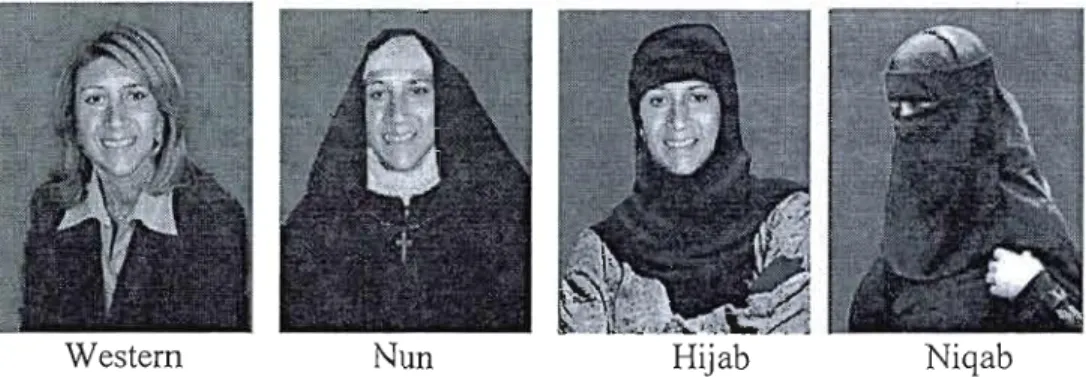
d'habillement. La première étude avait donc comme objectif d'examiner les attitudes des Québécois francophones envers différents types d'habillement. Des étudiants québécois francophones (N = 76) ont complété des questionnaires contenant des photos d'une femme portant une tenue occidentale, d'une sœur catholique, d'une femme portant le hijab et d'une
Xl!
femme pOltant le niqab. Les résultats ont démontré que les participants avaient les attitudes les moins favorables envers la femme portant le niqab, suivi par la sœur catholique et la femme portant le hijab, tandis qu'ils avaient les attitudes les plus favorables envers la femme portant la tenue occidentale.
La deuxième étude a manipulé l'habillement religieux et l'ethnicité dans une expérimentation en classe afin de tester la stabilité des orientations d'acculturation comparativement à celle des attitudes ethniques envers des immigrants arabes musulmans. Des étudiants québécois francophones (N = 345) ont complété l'ÉACA ainsi que des
mesures attitudinales envers des immigrants arabes musulmans. La même expérimentatrice a distribué les questionnaires dans les quatre conditions expérimentales suivantes: 1)
condition contrôle avec expérimentatrice portant une tenue occidentale et déclarant un nom franco-québécois (n = 86); 2) expérimentatrice portant une tenue occidentale et dé.clarant un nom arabe musulman (n = 83); 3) expérimentatrice portant le hijab et déclarant un nom arabe musulman (n = 81); 4) expérimentatrice portant le niqab et déclarant un nom arabe
m~sulman (n = 95). Les résultats ont démontré qu'aucune des orientations d'acculturation n'a varié selon les conditions expérimentales, à l'exception de ['orientation individualiste. Contrairement aux résultats attendus, les Québécois francophones avaient des attitudes plus favorables envers les immigrants arabes musulmans lorsque l'expérimentatrice portait le niqab que lorsqu'elle portait un habillement occidental avec un nom québécois francophone. Ces résultats peuvent être en partie expliqués par l'effet de contre-stéréotype. L'étude 1 a démontré que les Québécois francophones perçoivent les femmes qui portent le niqab comme étant plus passives et moins intelligentes et compétentes que les femmes qui portent un habillement occidental. Par contre,-l'expérim-entairice pôrtant le niqab dans l'étude 2 était une femme éduquée, compétente et qui parlait bien le français. L'écart entre les stéréotypes négatifs dominants des femmes qui portent le niqab et celui de l'expérimentatrice
compétente qui était physiquement en leur présence peut avoir mené les participants à avoir des attitudes moins négatives envers les immigrants arabes musulmans en général. En ligne avec ces résultats, des études ont démontré qu'être exposé à des leaders de groupes
minoritaires et à des femmes scientifiques était suffisant pour réduire les stéréotypes et préjugés automatiques mesurés par des tests implicites (Dasgupta & Asgari, 2004; Dasgupta & Greenwald, 2001).
La troisième étude de la thèse avait comme objectif de vérifier l'effet du voile islamique sur la stabilité des orientations d'acculturation, ainsi que le comportement d'aide des Québécois francophones dans une étude de terrain. Les attitudes défavorables envers le voile islamique ont antérieurement été liées à des comportements négatifs envers les Musulmans (Unkelbach, Forgas, & Oenson, 2008). Donc, dans la mesure où les Québécois francophones endossent des attitudes négatives envers les Arabes musulmans, leur
compOltement envers les femmes qui pOltent le voile islamique devrait être concordant avec de telles attitudes négatives. Une façon plus subtile de mesurer les attitudes envers le voile islamique est le comportement d'aide intergroupe (Gaertner & Dovidio, 1986; Hendren & Blank, 2009). Un nombre important d'études sur le comportement d'aide a démontré que 1) les individus sont plus susceptibles d'aider des membres de leur propre groupe (endogroupe) que des membres d'un autre groupe (exogroupe; Dovidio, Gaertner, Validzic, Motoka,
Xlll
Johnson, & Frazer, 1997) et 2) que plus le coût de l'aide augmente, plus le comportement d'aide diminue (Dovidio, 1984). Lorsque le coût est bas, l'appartenance à l'endogroupe ou à l'exogroupe est moins susceptible de prédire le comportement d'aide intergroupe. Par contre, lorsque le coût de l'aide est élevé, la catégorie d'appartenance de l'aidé ainsi que celui de l'aidant est plus susceptible de prédire le comportement d'aide intergroupe.
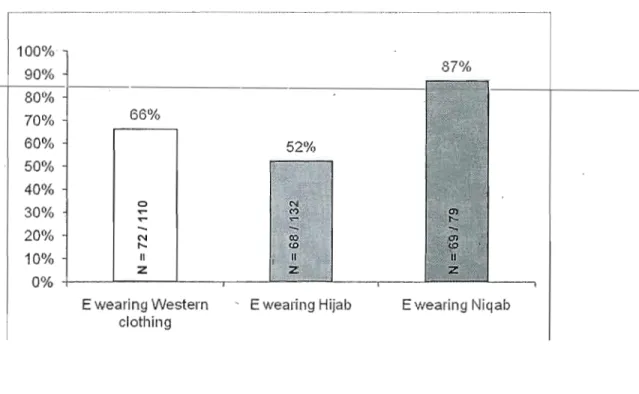
Basé sur ces principes d'aide intergroupe, l'étude de terrain comportait deux étapes expérimentales. Tout d'abord, 323 étudiants francophones québécois se sont fait aborder au hasard par une expérimentatrice habillée en tenue occidentale, portant le hijab ou portant le niqab. L'expérimentatrice leur a demandé des directions pour se rendre à la librairie universitaire, soit en français soit en anglais (coüt d'aide peu élevé; étape 1). Ensuite, une complice habillée en tenue occidentale a approché les mêmes participants et leur a demandé en français s'ils pouvaient remplir un questionnaire de deux pages qui comprenait entre autre l'ÉACA (coût d'aide élevé; étape 2). Les résultats ont démontré que les orientations
d'acculturation des étudiants québécois francophones sont demeurées stables peu importe la langue ou J'habillement de l'expérimentatrice. De plus, les résultats ont démontré que presque tous les participants (96%) ont convergé vers l'anglais, alors que tous ont indiqué le chemin à l'expérimentatrice, peu importe sa tenue vestimentaire. Donc, lorsque la demande d'aide avait un coût peu élevé, tous les participant ont aidé et ce, peu importe la langue ou l'habillement religieux de l'expérimentatrice. Tel que prévu, lorsque le coût de l'aide a augmenté (étape 2), les participants ont aidé les membres de l' endogroupe plus que les membres de l'exogroupe. Eh ligne avec les attitudes défavorables des Québécois
francophones envers les femmes qui portent le voile (étude 1), les participants ont moins aidé la complice lorsque l'expérimentatrice portait le hijab (52%) que lorsqu'elle portait une tenue occidentale (65%). Cependant, contrairement aux attentes, les participants ont aidé la complice en remplissant le questionnaire plus souvent lorsque l'expérimentatrice portait le niqab (87%) que lorsqu'elle pOliait le hijab (52%) ou la tenue occidentale (65%). Ces résultats peuvent être dû en partie à l'effet du contre-stéréotype étant donné que l'expérimentatrice était une femme éduquée et indépendante.
Une explication alternative tient au racisme aversif (avers ive racism, Gaertner & Dovidio, 1986), selon lequel les individus sont plus susceptibles d'exprimer leurs préjudices et à discriminer dans une situation ambigüe, où les attitudes ou comportements défavorables sont moins susceptibles d'être justifiés sur des bases raciales, qu'une situation non-ambigüe où les attitudes ou comportements peuvent être clairement interprétés comme
discriminatoires (Hodson, Dovidio, & Gaertner, 2009). Au Québec beaucoup plus de femmes portent le hijab que le niqab. Donc, refuser de remplir un questionnaire distribué par la complice d'une expérimentatrice portant le hijab pourrait être une situation ambigüe permettant aux participants de moins se soucier que leur comportement soit interprété comme étant discriminatoire. Cependant, la rareté des femmes portant le niqab au Québec (30 au total) peut avoir accentué la saillance de cette appartenance religieuse et fait en sorte que le refus d'aider la complice de l'expérimentatrice portant le niqab entraîne une certaine préoccupation d'être jugé ou accusé de comportements discriminatoires.
XIV
En résumé, alors que les attitudes (étude 2) et les comportements d' aide (étude 3) des Québécois francophones ont été affectés par la présence d'une femme portant le voile islamique, l'endossement des orientations d'acculturation quant à elle est demeurée stable. Ces résultats suggèrent que les orientations d'acculturation sont plus près d'une croyance profondément intégrée que les attitudes ethniques, qui sont plus superficielles et malléables. En ce qui a trait aux attitudes plus favorables envers les arabes musulmans (étude 2) et l'augmentation du comportement d'aide (étude 3) des Québécois francophones en présence d'une femme qui porte le niqab en comparaison avec une femme qui porte une tenue occidentale, deux explications ont été suggérées: celle du contre-stéréotype et celle du racisme avers if. Puisqu'aucune d'entre elles expliquent entièrement les résultats contre intuitifs obtenus, des études futures devraient explorer davantage ces deux hypothèses. Enfin, les résultats des études de cette thèse, en ligne avec l'Hypothèse du contact d' AllpOli (1954; Pettigrew & Tropp, 2006), semblent indiquer que même un faible niveau de contact avec une femme qui porte le voile islamique est suffisant pour améliorer ou du moins neutraliser les attitudes négatives de la majorité d'accueil envers les femmes musulmanes au Québec.
Mots clés: acc.ulturation, orientations d'acculturation, voile islamique, hijab, niqab, Arabes musulmans, communauté d'accueil, contre-stéréotype, racisme aversif
CHAPITREI
1.1 Introduction
North American metropolises are becoming increasingly multicultural ma king
immigration a fact of life for many people who live in these cities. The adaptation of
immigrants and their descendants to the country of settlement is affected by numerous
sociological and psychological factors. Amongst the most important socio-psychological
factors are attitudes held by host society members toward immigrants and related behaviours
such as inclusion or exclusion expressed in everyday life and within public and private
institutions (van Oudenhoven, Prins, & Buunk, 1998). Host majority attitudes and behaviours toward immigrants contribute to the social climate toward immigration and ethnocultural
d iversity (Bourhis, Moïse, Perreault, & Senécal, 1997). Better knowledge of this social climate of acceptance or rejection is useful for a number of reasons. It is fair to assume that
an intolerant c1imate does not benefit the immigrant or ho st society population (Berry, 2009).
It is not only the immigrants who adapt poorly when faced with rejection, but also host
majority members who feel that their identity is threatenéd by the presence of immigrants
who they blame for not integrating properly within the host society. In the long run, this
process can generate problematic and antagonistic intergroup relations between immigrants
and members of the host majority. A better understanding of immigrant and host majority
intergroup relations can be useful in developing more efficient public policies to improve
attitudes toward immigrant communities, thus contributing to the social cohesion of
increasingly multiethnic receiving societies (Forest & Kearns, 2001; Laurence, 2009).
After the terrorist attacks in New York and Washington in September 200} (9fl}) by Muslim Arab fundamentalists, there has been a great deal of negativemedia attention toward
both Arabs and Muslim immigrants aèross the Western world (Antonius, 2002; Biles & Ibrahim, 2002). Moreover, Muslim women who wear the Islamic veil became victims of
negative attitudes and behaviours in the European Union (EU; Allen & Nielsen, 2002). The issue of the Islamic veil became the flashpoint of the integration debate not only in the EU
but also in Canada with the French province of Quebec being at the crossroad of the
4
Francophone host majority represents the integration of Arab Muslims within French "secular" Quebec.
1.2 Process of accu lturation
Immigrants once in their country of settlement need to adapt to new cultures, languages, and institutions. Immigration normally implies an adaptation process on the part of the migrating communities as weil as on the part of the host society. Acculturation is
defined as the process of bi-directional change that takes place between host community members and immigrants who experience sustained intercultural contact (Redfield, Linton, & Herskovits, 1936; Sam, 2006). The term psychological acculturation was proposed to account for changes experienced by an individu al whose cultural group is collectively experiencing acculturation (Graves, 1967). This definition of acculturation implies that dominant as weil as non-dominant cultural groups are influenced and transformed by their intercultural contacts and are expected to modify sorne aspects of their respective culture as a mean of adaptation to ethnocultural diversity (Berry, 1997, Bourhis et al., 1997).
1.3 Uni-dimensional and bi-dimensional acculturation models
Theories on acculturation cou Id be categorized according to two major tendencies (Liebkind, 2001). Traditional models conceptualize acculturation as a linear assimilation process whereby first and second generation immigrants progressively abandon their culture of origin for that of the host majority (Alba, 2003; Sam, 2006). Early uni-dimensional models of acculturation proposed that immigrants move from one pole to another of an assimilation continuum, going from maintenance of their language and culture of origin to the complete and total adoption of the host community language and culture (Gordon, 1964). Within this framework, the adoption of the hast community culture often implied the loss of the native culture. The middle point ofthis continuum was bilingualism and biculturalism, a transitional state leading to assimilation to the dominant host majority culture.
5
Recent acculturation models focus instead on a bi-dimensional process of
acculturation (Sam, 2006; Snauwaert, Soenens, Vanbese1aere, & Boen, 2003). Berry (1974, 1980) proposed a bi-dimensional model of acculturation for immigrants which to this day remains the predominant mode1 of psychological acculturation in the field (Berry, 2006, 2009; Jasinskaja-Lahti, Liebkind, Horenczyk, & Schmitz, 2003). This classic model proposes that the maintenance of one's native culture and the contact with the host community culture can be considered as independent dimensions instead of extreme points on a single
assimilation continuum (Berry, 1990, 1997). Consequently, immigrants face two choices which are independent one from the other: (1) maintaining orriot their culture of origin and (2) engaging or not in contacts with members of the host community majority. According to Berry (1997), immigrants can adopt fourdifferent acculturation strategies based on these two choices: integration, assimilation, separation; and marginal isation. A significant body of research showed that the bi-dimensional model of immigrant acculturation was a more valid and useful operationalization of acculturation than the uni-dimensional model of
acculturation (Berry & Sam, 1997; Ryder, Alden, & Pau1hus, 2000; Sabatier & Beny, 2008; Verkuyten & de Wolf, 2002).
Despite the advantages of Berry's bi-dimensional model, it had some limitations. For instance, the early bi-dimensiona1 mode1 neglected the impact of the host community in shaping and regulating the acculturation process of immigrant communities (Bourhis et aL,
1997; Georgas, Berry, Shaw, Christakopoulou, & My10nas, 1996; LaFramboise, Coleman, & Gerton, 1993; Ward, 1996). In the last decade, research focused on the importance of considering not on1y the acculturation orientations held by members of immigrant
communities but also those members of the dominant host community would like immigrants to endorse (Bourhis & LepiC<j, 1993; Bourhis et al., 1997).
6
1A Interactive Acculturation Model
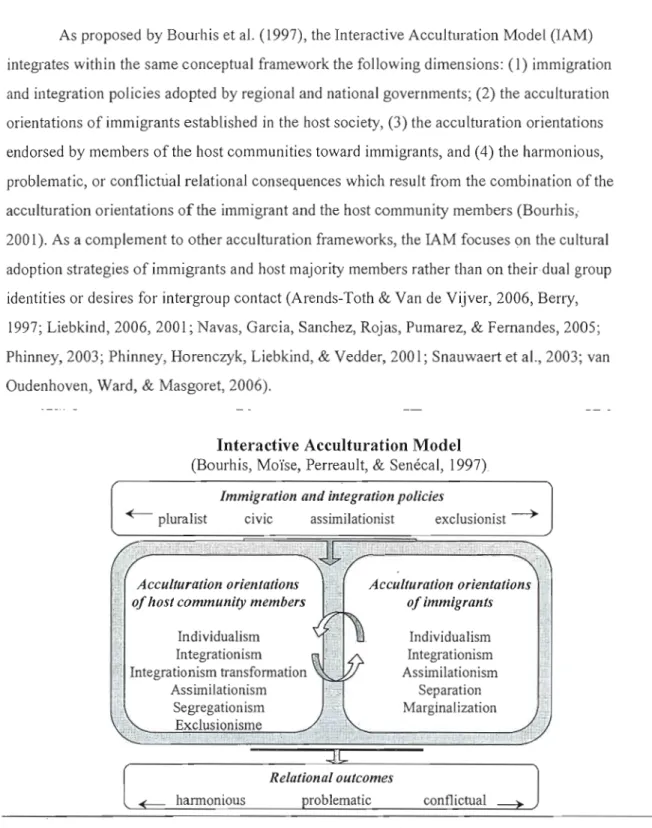
As proposed by Bourhis et al. (1997), the Interactive Acculturation Model (IAM) integrates within the same conceptual framework the following dimensions: (1) immigration and integration policies adopted by regional and national governments; (2) the acculturation
orientations of immigrants established in the host society, (3) the acculturation orientations
endorsed by members of the host communities toward immigrants, and (4) the harmonious,
problematic, or conflictual relational consequences which result from the combination of the
acculturation orientations of the immigrant and the host community members (Bourhis,
2001). As a complement to other acculturation frameworks, the lAM focuses on the cultural adoption strategies of immigrants and host majority members rather than on theirdual group
identities or desires for intergroup contact (Arends-Toth & Van de Vijver, 2006, Beny, 1997; Liebkind, 2006, 2001; Navas, Garcia, Sanchez, Rojas, Pumarez, & Fernandes, 2005; Phinney, 2003; Phinney, Horenczyk, Liebkind, & Vedder, 2001; Snauwaert et al., 2003; van Oudenhoven, Ward, & Masgoret, 2006).
Interactive Acculturation Model (Bourhis, Moïse, Perreault, & Senécal, 1997)
Immigration and integration policies
~ pluralist civic assimilationist exclusionist ~
Acculturation orientations Acculturation orientations of host community members of immigrants
Individualism Individualism
Integrationism Integrationism
.... Integrationism transformation Assimilationism
Assimilationism Separation
Segregationism Marginalization
Exclusionisme
Relation al outcomes
harmonious roblematic conflictual
7
Immigration and integration policies partially reflect and shape the social climate of
immigrant and host community intergroup relations. The IAM proposes a continuum of the
different types of ideologies guiding these public policies and suggests that these integration
policies influence the acculturation orientations ofhost community and immigrant group
members. In democratic countries, these immigration and integration policies are often a
reflection of public opinions as embodied by elected members of mainstream political parties
who adopt such policies in the Parliament or National Assembly. Accordingly, the proposed
continuum situates four integration ideologies ranging from a pluralist pole to an exclusionist
pole with civic and assimilationist ideologies in between (Bourhis et aL, 1997; Bourhis,
2001).
Most acculturation research measure acculturation attitudes or strategies. However, the IAM uses the term accu/ruration orientations which are defined as a combination of attitudes, beliefs, and behavioural intentions that guide the way people think and behave
(Bourhis et aL, 1997). In contrast to the term strategies, the IAM model considers
orientations as not being necessarily conscious or fuily thought-out. Building on the classic
Berry (1997) approach, the JAM proposes five accu lturation orientations that immigrants can endorse: integrationism, assimilationism, separatism, marginalisation, and individualism.
These acculturation orientations are based on two fundamental questions: (l) the wi l1ingness of immigrants to maintain their culture of origin and (2) their wil1ingness to adopt the culture
of the dominant majority. Immigrants who endorse the integrationist orientation wish to keep their culture of origin and adopt key features of the dominant culture of the host society.
Immigrants who endorse the assimilationist orientation renounce their culture of origin and replace it by adopting the culture of the host majority. Immigrants who adopt the separatist
orientation wish to maintain all aspects of their culture of origin and are not interested in
adopting the culture of the host majority. Marginalized immigrants feel rejected as much from their culture of origin as from the host community culture. The individualist orientation is endorsed by immigrants who neither desire to maintain their culture of origin nor adopt the
host society's culture, 110t because of the sentiment of rejection but because group
8
their personal characteristics and merits rather than on their group belonging (Bourhis et al., 1997).
By virtue of their dominant majority position in the country of settlement, the IAM proposes that acculturation orientations endorsed by host community members may influence the acculturation orientations endorsed by immigrants. The IAM proposes that members of the host community may endorse six acculturation orientations toward immigrant groups: integrationism, integrationism transformation, assimilationism, segregationism,
exclusionism, and individualism. lntegrationism is endorsed by host community members
who accept and value that immigrants maintain sorne aspects oftheir heritage culture and also accept and value that immigrants adopt impoliant features of the host majority culture. Integrationists value a stable bicuituralism/bilingualism amongst immigrant communities that, in the long term, may contribute to cultural and linguistic pluralism as an enduring feature of the host society. lntegrationism transformation is endorsed by members of the
majority group who not only endorse the integrationist acculturation orientation, but also have a personal engagement to change aspects oftheir own habits and institutional procedures in order to accommodate the cultural needs of immigrant communities
(Montreuil, Bourhis, & Vanbeselaere, 2004). Assimilationism corresponds to the traditional
concept of absorption whereby host community members expect immigrants to relinquish their language and cultural identity for the sake of adopting the dominant culture and language of the dominant host majority. Segregationism refers to host community members
who accept that immigrants maintain their heritage culture and values as long as immigrants keep their distance from host members, as they do not wish immigrants to transform or dilute the host culture and value system. Segregationists prefer immigrants to remain together in separate urban/regional enclaves, and are ambivalent regarding the status of immigrants as rightful members of the ho st society. Exclusionists deny immigrants the right to adopt
features of the host community culture. They also deny immigrants the choice to maintain their heritage language, culture or religion and believe that sorne immigrants have customs and values t/1at can never be socially lncorporated within the h~st comm'unity mainstream.
9
categories. Because it is personal qualities and individual achievements that count most,
individualists will tend to interact with immigrants in the same way they would with other
individuals who happen to be members of the host community. These six acculturation
orientations are measured using the validated Host Community Acculturation Scale (HCAS;
Barrette, Bourhis, Capozza, &Hichy, 2005; Bourhis, Barrette, & Moriconi, 2008; Montreuil & Bourhis, 2001, 2004; Montreuil et al., 2004).
According to the lAM, the quality of interpersonal and intergroup relations between immigrant and host community members is in part a result of the concordant or discordant
acculturation orientations endorsed by such groups in contact (Bourhis et al., 1997). The
quaJity ofthese relational outcomes varies on a continuum ranging from harmonious to
prob1ematic to conflictual. Relationa1 outcomes may include patterns of intercultural
communication between immigrants and host community members, interethnic attitudes and
stereotypes, acculturative stress, and discriminating behaviours between dominant host
majority group members and immigrant minority individuals in domains such as housing,
employment, schooling, and the police (Bourhis, El-Geledi, & Sachdev, 2007). A body of research has confirmed that the concordance or discordance between host community and
immigrant acculturation orientations influences the quality of intergroup relations between
such communities (Barrette, Bourhis, Personnaz, & Personnaz, 2004; Bourhis, Barrette, El Geledi, & Schmidt, 2009a; Jasinskaja-Lahti et al., 2003; Rohmann, Piontkowski, & van
Randenborgh, 2008). An exception was a study measuring American-Japanese co-worker
relations which found that relational outcomes were similar between harmonious and
la
1.5 Endorsement of host community acculturation orientations
The present thesis focuses on Quebec Francophone host community acculturation orientations toward devalued immigrants.It is thus worth expanding on the endorsement of host community acculturation orientations. Overall, research using the IAM show that host community university undergraduates in NOlth America, Western Europe, and Israel endorse the acculturation orientations of individualism and integrationism to a greater degree than assimilationism, segregationism, and exclusionism (Barrette et al., 2004; Bourhis et al., 2008; Bourhis & Bougie, 1998; Bourhis & Dayan, 2004; Montreuil & Bourhis, 2001, 2004; Montreuil et al., 2004; Safdar, Dupuis, Lewis, El-Geledi, & Bourhis, 2008). Most
participants in these studies are undergraduate students for whom strong endorsement of individualism and integrationism is concordant with the meritocratic and individualistic organizational culture of higher education institutions (Bourhis et al., 2009a). Similar endorsement of integrationism was obtained in other acculturation studies conducted with host community adolescents and adults in Europe (Jasins.kaja-Lahti et al., 2003; Rohman, Florack, & Piont-kowski, 2006; Zagefka &'Brown, 2002}
The IAM proposes that each acculturation orientation can be endorsed to varying degrees depending on key factors. The valued or devalued status of the immigrant
communities being considered is one factor that can affect the level of endorsement of each acculturation orientation by host community members. The valued or devalued status of a group reflects the positive or negative stereotypes held by host community members toward immigrant groups. These stereotypes depend on the country of origin of immigrant groups, their socio-economic status, their perceived similarity with the culture and values of the host society, their perceived threat to the security of the host society, and their categorization as a "visible" or "non-visible" minority. For example, a host majority member may more strongly endorse the integrationist orientation toward a valued immigrant group than toward a
devalued immigrant group whose religion, language, and values are seen to be very different. To date, studies in different parts of the world have confirmed that hast majority members are more inclined to endorse welcoming acculturation orientations, such as individualism,
Il
integrationism, and integrationism transformation, toward valued than devalued immigrants. Conversely, host majorities are more likely to endorse unwelcoming acculturation
orientations, such as assimilationism, segregationism, and exclusionism, toward devalued immigrants than toward vallled immigrants. (Barrette et aL, 2004, 2005; Bourhis & Bougie, 1998; Bourhis & Dayan, 2004; Bourhis, Montaruli, EI-Geledi, Harvey, & Barrette, 2010; Bourhis, Montreuil, Barrette, & Montaruli, 2009b, Bourhis et al., 2008, 2009a; Montreuil & Bourhis, 2001, 2004; Montreuil et al., 2004; Safdar et al., 2008).
In the Quebec setting, it was found that host majOl'ity Quebec Francophones endorsed the integrationist, integrationist transformation, and individualist acculturation orientations toward White French speaking immigrants from France more than toward Arab Muslim immigrants. Conversely, they were more likely to endorse assimilationism,
segregationism, and exclusionism toward devalued Arab Muslim immigrants than toward other French speaking immigrants from France (Bourhis et al., 2008; Montreuil & Bourhis, 200 l, 2004; Montreuil et al., 2004).
1.6 Arabs Muslims as a devalued immigrant group in Quebec
Ethnie Arabs have one ofthe world's highest birth rates and the population increase in Muslim countries is also one ofthe highest in the world. Currently, the twenty-one Arab countries of the world have a total population of 255 million people. The political instability in many ofthese countries has resulted in the out-migration ofthousands of Arab peoples to other parts of the world, including Canada (AI-Krenawi & Graham, 2000). The West Asüin and Arab adult community is expected to be the fastest growing visible minority in Canada, with the population in 2016 projected to be four times higher than in 1991 (Canadian Census, 2001). Quebec is the home to the largest number of Arabs in Canada (37.2%; Canadian Census, 2006). There are 109000 Arabs in Quebec, representing 12.8% ofthe province's immigrant population and 2.8% of its total population. The top three countries of birth of Arabs who immigrate to Quebec are Lebanon (32.0%), Morocco (30.7%), and Aigeria (27.1 %). These countries represent Quebec's fifth, sixth, and seventh highest immigrant population, respeCtively. More than 85% of the Arabs in Quebec speak French; it
12
is the highest rate of French spoken by immigrants in the province after immigrants from
France (MICC, 2009). Arabs thllS contribllte to the maintenance of the French speaking
majority in Qllebec. However, as a sizable proportion of immigrants from Arab countries are
Mllslims, they tend to be perceived negatively by Qllebec Francophones who remain
predominantly Roman Catholic (Antoruus, 2002).
With the Arab Trade embargo that increased U.S. gasoline prices fourfold in the
early 1970's, the bombing of the Marine barracks in Beirllt in the mid 1980s, the 2001
suicide bombing of the World Trade Center in New York, and the more recent terrorist
attacks in Madrid and London by Mlls1im Arab fllndamentalists, Arab Muslims have become
victims ofnegative stereotypes held by both the media'and host majority members in the
Western world (Antonius, 2002; Biles & Ibrahim, 2002; Helly, 2004; Sheridan, 2006). A
number of studies and public opinion poils suggest that Arab Muslims are perceived as a
devalued immigrant group in both Canada and Quebec (Berry & Kalin, 1995; Bourhis et al., 2008; Montreuil & Bourhis, 2001, 2004; Montreuil et al., 2004). According to a 2002 public opinion surv.ey, 45.% ofQueb~cers,)7% 9f Albertans, 33% ofOntarians, and 22% of British Colombia residents agreed with the statement: "The September Il attacks made me more
mistrustful of Arabs or Muslims coming from the Middle-East" (IPSOS-Reid, 2002, in Helly,
. 2004). Another survey conducted across Canada shortly after the 9/11 events showed that it
was in the province of Quebec that people expressed the strongest Anti-Arab sentiment
(Jedwab, 2003). A recent survey showed that 51 % of Quebec Francophones had an
unfavourable opinion of Muslims while similar perceptions were less likely to be expressed
toward other religious groups such as Catholics (5%), immigrants in general (20%), and
Jews (28%; Canadian Studies Association, 2009). A number of studies conducted in French
colleges showeéi that Quebec Francophone undergraduates were the least comfortable with,
felt more threatened by, wanted less contact with, and felt more intercultural anxiety in the
presence of Arab Muslim immigrants than other visible minority immigrant groups including
Haitians and West Indians (Bourhis et al., 2008; Montreuil & Bourhis, 200 1,2004;
13
1.7 Attitudes toward the Islamic veil in Quebec
Following the events of 9/1 1, the European Monitoring Centre on Racism and Xenophobia anticipated a rise in Islamophobia1 and implemented a system to record anti Islamic reactions across the 15 European Union states. Tt was found that the single most important factor in determining who was to be a victim of an attack or infringement was visual appearance as a Muslim. The primary visual cue of being labeled a Muslim was the hijab worn by Muslim women (Allen & Nielsen, 2002).
What one wears in public serves social and political functions which symbolize an important ideological dimension of non-verbal communication (Gordon, Tengler, & Infante, 1982; Hoodfar, 2003,2001; Morris, 1977). As with speech style, dress styles reveal certain category memberships such as the gender, geographical origin, religion, ethnic and linguistic origin, profession, and social class of the wearer (Abu-Luhod, 1986; Rugh, 1986; Thourlby,
1978). Like skin colour, ethnic origin, and gender, stereotypes about dress style can also be vigorous given the perceived voluntary nature of its adoption by individuals. The political and public debates surrounding wearing of the Islamic veil suggests that it serves much more than a personal religious affiliation.
Extensive qualitative research has sought to understand the Islamic veil from the perspective of the women who wear it (Alvi, Hoodfar, & McDonough, 2003). From the point ofview of Muslim women settled in Western democracies, the veil can symbolize personal and collective identification with particular varieties of the Islamic faith but can also serve as a tool of social differentiation from the Christian mainstream (Hoodfar, 200 1, 2003; Meshal, 2003). Alternatively, as shown with veiled women interviewed in Quebec and Ontario, the veil may serve to reassure the family that one remains loyal to the princip les ofIslam despite involvement in activities in the public domain that are considered unconventional for Muslim women such as leaving the parents home to pursue higher education (Hoodfar, 2003). Much
14
of the prevailing feelings in Quebec toward the Islamic veil have been widely surveyed in
media and public opinion poils. However, besides a historically rich analysis ofQuebec
media portrayal of the Islamic veil (McDonough, 2003), little empirical research has been
done on the actual perceptions of women who wear the Islamic veil in French Quebec. Given
the social psychological focus of this thesis, a quantitative and experimental approach was
used to explore Quebec Francophone majority attitudes and acculturation orientations toward
the Islamic veil.
Before discussing host majority attitudes and reactions toward the Islamic veil as
expressed in the media and in public opinion polis, it is useful to distinguish between types
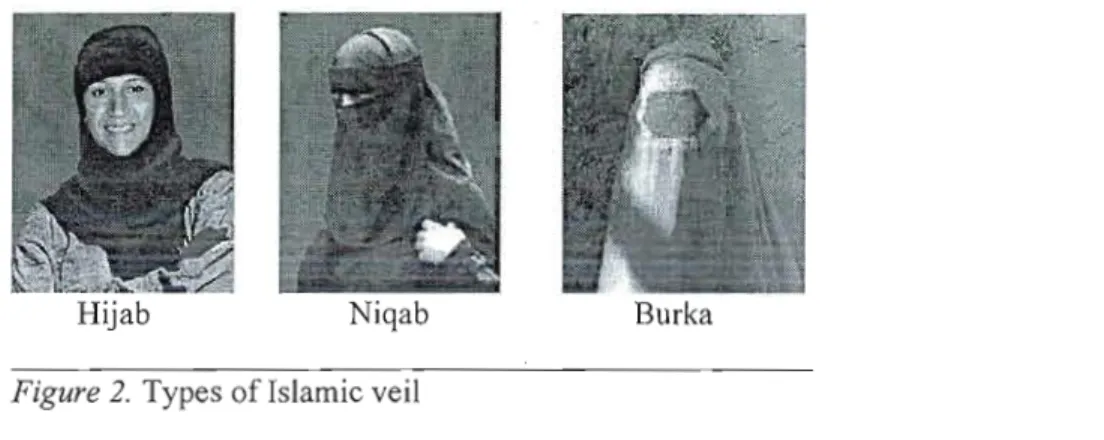
ofIslamic dress which vary widely across the world (Hoodfar, 2001; see Figure 2). In line
with a religious prescription in the Qur'an requiring women to dress modestly, most Muslim
women wear a scarf covering only their hair, leaving the face visible. This has different
names but is more commonly known, and will be referred to in this thesis, as the "hijab".
Much less prevalent than the hijab, the "niqab" is prescribed mainly in Saudi Arabia and
involveswearing a'black cloth which covers the body and entire face, leaving-only the eyes
visible. Even more rare, the "burka" is prescribed mainly in Afghanistan and is an ail
enveloping robe which covers the entire body except for the eyes which arè concealed
behind a cross-hatched net (Hoodfar, 2001, 2003). In this thesis, the term Islamie veil will be
used generically in referring to any form of Islamic head covering, but the correct terms
described above will be used when referring to a specifie item.
Hijab Niqab Burka
Figure 2. Types of Islamic veil
1 Islamophobia is functionally similar to 'anti-Semitis~' and to the more generic term xenophobia which refers to a fear, dislike, and hatred toward outgroups. Thus, Islamophobia refers to the dread or hatred of Islam and therefore a fear or dislike of Muslims (Sheridan, 2006)
15
Attitudes tO\Nard the niqab and the burqa are very negative in the EU (McGoldrick, 2006; Welch, 2007). Invoking public security concerns, Belgium adopted a law banning the niqab and burka in public settings in 2010. After banning the hijab in state schools in 2004, France is in the process ofpassing a law against wearing the niqab and burqa in public settings including hospitals, mass transit, and on the streets by the end of2010. It also proposed that women who wear the niqab or burka in such public settings be fined a sum of 750 euros. In the United Kingdom, police women in some municipalities can wear the hijab and there are no laws against wearing of the niqab and burka. However, attempts have been made to ban such Islamic veils in British state schools and other public institutions (Welch, 2007).
A recent study measured Belgian host community attitudes toward the Islamic veil, subtle prejudice, and anti-Arab attitudes (Saroglou, Lamkaddem, van Pachterbeke, & Buxant, 2009). Results showed that willingness to ban the Islamic veil and being
uncomfortable with its use were related to subtle prejudice against immigrants in general and high scores on the anti-Arab Western ethnocentrism scale. The researchers concluded that "aversion toward the veil thus seems to refiect both ethnie prejudice and anti-religious disposition" (pA27).
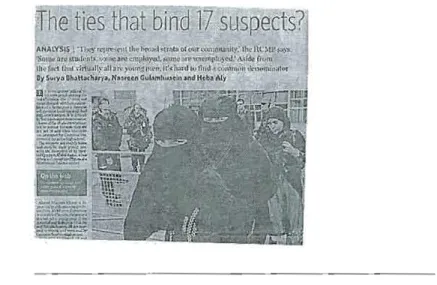
On June 2nd 2006, 17 Muslim men were arrested for aUegedly planning to commit a series ofterrorist attacks against Canadian targets in Toronto and Ottawa. The mass media coverage of the court appearances of the Must im suspects incl uded the presence of their femate family members; most wearing the niqab, sorne the hijab. One Globe and Mail article had the headline "The ties that bind 17 suspects" above the photo of spouses wearing the niqab (see Figure 3; Bhattacharya, Gulamhusein, & Aly, 2006). Such coverage fosters negative attitudes toward all Arab Muslims and aIl women wearing the Islamic veil in Canada even though the convicted terrorists of2006 constituted a very small proportion of the Arab population in the country.
16
Figure 3. Globe and Mail article, June 2, 2006
The wearing of the Islarriic veil can be seen as the right of individuals to express religious freedom in a democratic society with its Charter of Rights and Freedom enshrined in the Canadian constitution and the Quebec Charter ofRights and Freedom. For host majority members less open to religious diversity, the Is1amic veil can be seen as 1) a symbol of female sUbordination to Muslim men undermining the hard fought equal rights achieved by the women's movement of the last fifty years (Lepicq & Ciceri, 2001; McDonough, 2003); 2) a political symbol of the rising power of the religious fundamentalists in the
Muslim world and in the diaspora (Gheadah, 2001), 3) a badge ofreligious separatism from the secular and/or Christian Quebec host majority mainstream, or 4) a refusai by Muslim women to integrate within mainstream Quebec society (Lepicq & Ciceri, 2001; McDonough, 2003).
The present research was conducted during a time when the Islamic veil issue was a controversial topic in Quebec as reflected in a series of media articles and surveys reporting public discontent regarding the integration of immigrants. One such survey conducted with a representative sample of the Quebec population (N = 1000) showed that 62% of Quebec Francophones believed that Muslim women who wear the Islamic veil pose a problem for living in Quebec society (Roy & Gagné, 2007). Another representative survey (N = 1003) found that 66% of Quebec Francophones did not agree with the statement: "young Muslim
17
girls should be allowed to wear the hijab in public schools" (Canadian studies association,
2009). In 2007, media aliicles and polis portraying Quebec Francophone discontent with reasonable accommodations2 toward religious minorities led the premier of Quebec to establish a public Consultation CommisSion on Accommodation Practices Related to
Cultural Differences which tabled its final report in 2008 (Bouchard & Taylor, 2008). Public hearings shown on national TV during the Commission allowed less tolerant Quebec
Francophones to voice negative attitudes toward immigrant minorities, including Arab
Muslims wearing the Islamic veil.
Because the niqab and burka coyer the whole face, public attitudes toward such
Islamic veils are more negative than those toward the hijab. A 2007 survey showed that 94% of Quebec Francophones were in favour of banning women who wear the niqab from voting
(Sondage SOM, 2007). In March 2010, a Muslim woman wearing the niqab was expelled from a French language course offered to new immigrants by the Quebec government at a
college in Montreal. Following this incident, the Quebec governmerit proposed Bill 94 which requires public employees, such as education and health workers, as weil as citizens seeking
government services to uncover their faces. A recent Canadian public opinion poli showed
that 95% of Quebecers- and 80% of ail Canadians- supported this provincial ban on the niqab (Angus Reid Public Opinion, 2010).
2 Reasonable accommodation "stems from labour-related jurisprudence. [It] designates a form of alTangement or relaxation aimed at combating the discrimination that a seemingly neutral norm can bring about in its effect, usually an infringement of an individual's right to equality. In [public
discourse], the meaning of the concept has gone beyond this legal defmition and encompasses ail forms of arrangements allowed by managers in public or private institutions in respect of students, patients, customers, employees, and so on" (Bouchard & Taylor, 2008, p.7).
18
1.8 Presentation of the two articles
Ali studies measuring host community acculturation orientations using the HCAS were conducted by experimenters whose ethnie group membership was the same as that of the participants. Therefore, completing the HCAS has always been do ne in an intragroup classroom setting. Under those circumstances, a basic premise of the IAM was developed which states that acculturation orientations are more stable and more strongly and deeply embedded cognitively and emotionally than less stable intergroup attitudes (Bourhis et al., 2üü9b). However, no study to date has tested this basic premise by manipulating the category membership of the experimenter as a single or double outgroup3 member as opposed to an ingroup member. The main goal of the present thesis is to use the Islamic veil to test this basic premise of the IAM. More specifically, the thesis is composed of two research articles that include two controlled-c1assroom-experiments and a field study to test the impact of the hijab and the niqab on the ethnie attitudes, acculturation orientations, and helping behaviour ofQuebec Francophone undergraduates toward devalued Arab Muslim immigrants.
Before testing the impact of the different types ofIslamic veils on Quebec Francophone attitudes and acculturation orientations, it was necessary to assess attitudes toward the hijab and niqab relative to other dress styles. Using a paper-and-pencil
questionnaire, Study 1 was designed to explore attitudes toward women in photos wearing the hijab and niqab relative to other dress codes such as western style clothing and a woman dressed as a Catholic nun.
J Outgroups refer to the groups that an individual does not belong to. The ingroup refers to the group
19
The second study m31üpulated religious dress code and ethnicity in a controlled classroom-experiment to test tl1e stability of acculturation orientations compared to ethnie attitudes toward Arab Muslim immigrants. A questionnaire containing the HCAS and numerous attitude scales was distributed to 345 Quebec Francophone undergraduates during class time. The same female ex.perimenter distributed the questionnaires in the following four experimental conditions: 1) control condition with experimenter wearing western style clothing and with a Francophone name (ingroup membership); 2) Arab condition with experimenter wearing the same western clothing as in the control condition, but with an Arab Muslim name (single outgroup membership: ethnicity); 3) hijab condition with experimenter wearing the hijab and with the same Arab Muslim name (double outgroup membership: ethnicity and religiosity); 4) niqab condition with experimenter wearing the niqab and with the same Arab Muslim name as previous two conditions (double outgroup membership: ethnicity andreligiosity). Based on these experimental manipulations, Study 2 addressed the following two research questions:
1. Will attitudes toward the female experimenter dressed in the secular and religious dress codes be concordant with attitudes toward the secular and religious women portrayed in photos in Study I?
2. Based on the premise of the IAM, will the ethnicity and religious dress code of the experimenter have more of an impact on ethnie attitudes than endorsement of acculturation orientations toward Arab Muslim immigrants?
a. Will acculturation orientations toward Arab Muslim immigrants remain stable regardless of the experimenter's ethnicity and dress code?
b. Will attitudes toward Arab Muslim immigrants vary depending on the ethnicity and dress code of the experimenter?
20
The third study tested the impact of the Islamic veil on the stability of Quebec Francophone acculturation orientations and helping behaviour in a field study. Negative attitudes toward the Islamic veil have been shown to be related to negative behavioural consequences toward Muslims (Unkelbach, Forgas, & Denson, 2008). Thus, to the degree that Quebec Francophones harbour negative attitudes toward women who wear the Islamic veil and Arab Muslims, their behaviour toward women who wear the Islamic veil should be concordant with such negative attitudes. An indirect and candid measure of negative
attitudes toward the veil is helping behaviour (Gaertner & Dovidio, 1986; Hendren & Blank, 2009). A number of studies on intergroup helping behaviour have shown that individuals are more likely to help members of their owngroup than to help members of an outgroup (Bourhis & Giles, 1976; Bourhis & Gagnon, 2001; Dovidio, Gaertner, Validzic, Motoka, Johnson, & Frazer, 1997; Wegner & Crano, 1975). The classic helping behaviour research also showed that as costs increase, helping decreases (for review see, Dovidio, 1984; Penner, Dovidio, Piliavin, & Schroeder, 2005). When cost is low, ingroup vs. outgroup category membership is less likely to predict intergroup helping. Rowever, when the cost of helping is high,' the category rilembership of helpers and recipients should better predict helping behaviour: individuals are more likely to help ingroup than outgroup others.
Based on these intergroup helping principles, the field study had two phases. In phase l, Quebec Francophone undergraduates (N = 323) weI:e randomly approached bya female experimenter who voiced a plea for directions in either English or French, wearing either western style clothing, a hijab, or a niqab. In phase 2, a White female confederate approached the same participants and asked them in French to complete a questionnaire, which included the ReAS. The experimenter asking for directions to the university bookstore involved a low cost helping behaviour from undergraduates who could provide verbal directions in less than a minute. However, helping the confederate in phase 2 involved a higher cost for the respondents as it consisted of completing a two-page questionnaire. Based on this research design, the field study addressed the following two research questions:
21
1. How will the religious and linguistic prime manipulations affect the intergroup helping behaviour of Quebec Francophones?
2. Will the low vs. high cost of helping combined with the religious and linguistic category
memberships influence the intergroup helping behaviour of Quebec Francophones?
3. Can the more stable and deeply processed acculturation orientations toward immigrants
be affected by the religious dress code and linguistic membership of the female
experimenter?
Taken together, the three studies proposed in this thesis are conceptually and
methodologically complementary. They allow a better understanding of the relationship
between acculturation orientations, group category differences based on language and
CHAPITRE II
Running head: ISLAMIC VEIL, ATTITUDES AND ACCULTURATION ORIENTATIONS 25
Testing the impact of the Islamie veil on intergroup attitudes and host community acculturation orientations toward Arab Muslims
Shaha El-Geledi and Richard Y. Bourhis Université du Québec à Montréal, Canada
Author Note
The research was made possible thanks ta a grant to the second author from the Canadian Social Sciences and Humanities Research Council (SSHRC 0410.2009.1312)
Correspondence concerning this article should be addressed to Shaha EI-Geledi or
Richard Y. Bourhis, Département de psychologie, Université du Québec à Montréal, C.P. 8888, Succursale Centre-ville, Montreal, Quebec, Canada, H3C 3P8. Tel: (514) 987-3000, 4852#, Fax: (514) 987-7953. Emails: [email protected] or
Abstract
The Islamic veil was used to test the stability of host community acculturation orientations toward Arab Muslims. Study 1 investigated Quebec Francophone (N = 76) attitudes. toward the IsJamic veil. Results revealed that undergraduates had the least favorable attitudes toward a woman wearing a niqab followed by one wearing the hijab, while favorable attitudes were held toward a woman dressed in western style clothing. Relative to a western dress control condition, Study 2 tested the hypothesis that acculturation orientations would be less affected by Islamic veil dress conditions than would attitudes toward Arab Muslim immigrants. The same fema1e experimenterdistributed survey questionnaires in the following experimental conditions: 1) control condition, experimenter wearing western clothing with Francophone name (n = 86); 2) experimenter wearing western clothing with an Arab Muslim name (n =
83); 3) experimenter wearing a hijab with an Arab Muslim na me (n
=
81); and 4) experimenter wearing a niqab with an Arab Muslim name (n = 95). Results showed that experimental conditions did not affect endorsement of five out of six acculturation orientations attesting to the psychological stability of acculturation orientations. Attitudes toward Arab Mustims were affected by the dress code orthe experimenter, but not in the expected direction. Participants had more favorable attitudes toward Arab Muslims in the niqab condition than in the control condition, a result partially accounted by acounterstereotype effect.
Key words: acculturation, host community, interactive acculturation mode l, Arab Muslim,
Running head: ISLAMIC VEIL, ATTITUDES AND ACCULTURATION ORJENTATIONS 27
Testing the impact of the Islamic veil on intergroup attitudes and hast community
acculturation orientations toward Arab MusJims
Acculturation is defined as the process of bi-d irectional change that takes place between hast community members and immigrants who experience sustained intercultura!
contact. Acculturation therefore implies that dominant as wel1 as non-dominant culturaJ
gl'OUpS are inf1uenced and transformed by their mutual intercultural contacts (Sam, 2006).
In the last decade, research has not only focused on the importance of immigrant
adaptation strategies but also on those hast community members would like immigrants to
endorse. The Interactive Acculturation Madel (IAM) integrates within the same conceptual
framework the fol1owing elements: (l) acculturation orientations of immigrants established in the hast society, (2) acculturation orientations ofhost community members toward
immigrants, and (3) harmonious ta conflictual intergroup outcomes resulting from
combinations ofimmigrant and hast community acculturation orientations (Bourhis, Moïse,
Perreault, & Senécal, 1997). As a complement ta other acculturation frameworks, the IAM focuses 6n the cultural adoption strategies of immigrant and hast majority members rather than on their dmiJ group identities or desires for intergroup contact (e.g., Arends-Toth & Van de Vijver, 2006; Berry, 1997; Liebkind, 2006; Van Oudenhoven, Ward & Masgoret, 2006).
Acculturation orientations are defined as a combination of attitudes, beliefs, and
behavioral intentions that guide the way people think and behave. A basic premise of the
IAM is that acculturation orientations are more stable and more strorigly and deeply
embedded cognitively and emotional1y than intergroup attitudes (Bourhis, Montreuil,
Barrette, & Montaruli, 2009a). The main goal ofthe present studies was ta test this premise. We used the Islamic veil as a religious prime manipulation ta test the psychological stability
of Quebec Francophone hast majority acculturation orientations.
Acculturation orientations of hast cornrnunity mernbers
The IAM proposes that members of the hast community may endorse six
acculturation orientations toward different immigrant groups.lntegrationism is endorsed by hast community members who accept that immigrants maintain some aspects oftheir
28 Running head: ISLAMIC VEIL, ATTITUDES AND ACCULTURATfON ORIENTATIONS
culture. Integrationism transformation is endorsed by members of the majority group who
not only endorse the integrationist acculturation orientation, but also wish to change aspects of host majority customs and institutional procedures in order to accommodate the cultural needs of immigrant c.ommunities. Assimilationism corresponds to the traditional concept of
absorption whereby host community members expect immigrants to relinquish thèir language and cultural identity for the sake of adopting the culture and language of the dominant host majority. Segregation/sm refers to hast community members who accept that immigrants
maintain their heritage cutture as long as immigrants keep their distance from host
community members, as they do not wish immigrants to transform or dilute the host culture. Segregationists prefer immigrants to remain together in separate urban/regional enclaves, and are ambivalent regarding the status of immigrants as rightful members of the host society.
Exclusionists deny immigrants the right to adopt features of the host community culture.
They also deny immigrants the choice to maintain their heritage language, culture or religion and believe that sorne immigrants have customs and values that can never be socially incorporated within the host majority mainstream. Individualists define themselves and
others as persons rather than as members of group categories. Because it is personal qualities and individual achievements that count most, individualists will tend to· interact-with
immigrants in the same way they would with other individuals who ha ppen to be members of the host community. These acculturation orientations are measured using the validated Host Community Acculturation Scale (HCAS; Barrette, Bourhis, Capozza, & Hichy, 2005; Montreuil & Bourhis, 2001).
Overall, research using the IAM show that host community undergraduates in North America and Western Europe endorse Individualism and Integrationism more than Assimilationism, Segregationism, and Exclusionism (Bourhis et al., 2üü9a). Most participants in these studies are undergraduate students for whom strong endorsement ofIndividualism and Integrationism is concordant with the meritocratic and individualistic organizational culture of higher education institutions (Bourhis, Barrette, El-Geledi & Schmidt, 2üü9b). Similar endorsement ofIntegrationism was obtained in other acculturation studies conducted with host community adolescents
Running head: ISLAMIC VEIL, ATTITUDES AND ACCULTURATION ORJENTATIONS 29
and adults (Zagefka & Brown, 2002; Rohman, Florack, & Piontkowski, 2006; Navas, Fernândez, Rojas, & Garcia, 2007).
Attitudes toward Arab Muslim immigrants
Since the September 11111 terrorist attacks in New York and Washington and recent terrorist attacks in Madrid and London by Muslim fundamentalists, Arab Ml1slim
comml1nities have become the target of negative stereotypes in the media and by host majority members in the Western world (Biles & Ibrahim, 2002). In Canada, a national survey showed that while 45% ofCanadians believe Islam encourages violence, as many as 63% of Quebec Francophones endorse this view (Geddes, 2009).
Quebec is the home to the largest number of Arabs in Canada (37.2%). There are 109,000 Arab people in Quebec, representing 12.8% of the province's immigrant population and 2.8% of its total population (Canadian Census, 2006). More than 85% of the Arabs in Quebec speak French; it is the highest rate of French spoken by immigrants in the province after immigrants from France. Arabs thus contribute to the maintenance of the French speaking majority in Quebec. However, as a sizable proportion of immigrants from Arab countries are Muslims, they tend to be perceived negatively by Quebec Francophones who remain predominantly Roman Catholic (Antonius, 2002). Studies conducted in French colleges in Quebec showed that Quebec Francophones were least comfortable with Arab Muslims and evaluated them less favorably than other immigrant groups, while feeling more threatened by their presence than by other immigrant groups including Haitians and West Indians (Bourhis, Barrette, & Moriconi, 2008; Montreuil, Bourhis, & Vanbeselaere, 2004).
Attitudes toward the Islamic 1Je il
What one wears in public serves social and political functions which symbolize an important ideological dimension of non-verbal communication. As with speech style, dress styles can serve as a marker of gender, geographical origin, religious affiliation, ethnie origin, profession, and social class (Hoodfar, 2003). Like skin color, ethnie origin, and gender, stereotypes about dress style can also be vigorous given the perceived voluntary nature of its adoption by individuals.
Hoodfar (2001) provided descriptions of different Islamic veils used across the Muslim world. In line with religious prescriptions requiring women to dress modestly, many