HAL Id: hal-01868757
https://hal-imt-atlantique.archives-ouvertes.fr/hal-01868757
Submitted on 5 Sep 2018
HAL is a multi-disciplinary open access
archive for the deposit and dissemination of
sci-entific research documents, whether they are
pub-lished or not. The documents may come from
teaching and research institutions in France or
abroad, or from public or private research centers.
L’archive ouverte pluridisciplinaire HAL, est
destinée au dépôt et à la diffusion de documents
scientifiques de niveau recherche, publiés ou non,
émanant des établissements d’enseignement et de
recherche français ou étrangers, des laboratoires
publics ou privés.
Low-complexity decoders for non-binary turbo codes
Rami Klaimi, Charbel Abdel Nour, Catherine Douillard, Joumana Farah
To cite this version:
Rami Klaimi, Charbel Abdel Nour, Catherine Douillard, Joumana Farah. Low-complexity decoders
for non-binary turbo codes. 10th International Symposium on Turbo Codes & Iterative Information
Processing (ISTC 2018), Dec 2018, Hong Kong, Hong Kong SAR China. �10.1109/ISTC.2018.8625359�.
�hal-01868757�
Low-complexity decoders for non-binary turbo
codes
Rami Klaimi, Charbel Abdel Nour and Catherine Douillard
IMT Atlantique, CNRS UMR 6285 Lab-STICC, Brest, France
e-mail: [email protected]
Joumana Farah
Faculty of Engineering, Lebanese University, Roumieh, Lebanon
e-mail: [email protected]
Abstract—Following the increasing interest in non-binary coding schemes, turbo codes over different Galois fields have started to be considered recently. While showing improved performance when compared to their binary counterparts, the decoding complexity of this family of codes remains a main obstacle to their adoption in practical applications. In this work, a new low-complexity variant of the Min-Log-MAP algorithm is proposed. Thanks to the introduction of a bubble sorter for the different metrics used in the Min-Log-MAP decoder, the number of required computations is significantly reduced. A reduction by a factor of 6 in the number of additions and compare-select operations can be achieved with only a minor impact on error rate performance. With the use of an appropriate quantization, the resulting decoder paves the way for a future hardware implementation.
Index Terms—Non-binary turbo codes, decoding algorithm, bubble check, complexity reduction.
I. INTRODUCTION
Non-binary (NB) turbo codes (TC) designed over Galois Fields GF(q) are shown to have a real potential in outper-forming existing binary error correction codes [1]. Designed over finite fields and directly mapped to the corresponding Quadrature Amplitude Modulation of the same order (e.g. q-QAM), these codes can benefit from the capacity gain observed between a coded modulation and a bit-interleaved coded modulation [2]. A main obstacle to their wide adoption resides in the fact that their decoding complexity increases with the order q of the finite field. The computational com-plexity of the symbol-based BCJR algorithm [3] in terms of
additions and compare-select (ACS) operations scales as qν+1,
ν being the code memory, whereas the storage requirements for the extrinsic information varies linearly with q and the
state metric memory is in the order of qν.
Complexity-related issues have already been addressed for the implemention of non-binary low-density parity-check (NB-LDPC) codes. Several complexity reduction techniques were proposed in the literature. In [4], [5], the extended Min-Sum (EMS) decoding algorithm was introduced, reducing
the computational complexity from the order of q2 to the
order of n2
m, with nm << q, as shown in [6]. Later, the
bubble checkalgorithm was introduced [7], which reduces the
computational decoding complexity to the order of nm
√ nm. Inspired by the EMS algorithm simplifications, a modified Min-Log-MAP algorithm is proposed in this work. It targets the reduction of the number of performed ACS operations through the use of a modified bubble check algorithm. The paper is organized as follows: the structure of the considered
non-binary component convolutional codes is described in Section II. The proposed low complexity decoding algorithm is presented in Section III and a computational complexity analysis of this algorithm is carried out in Section IV. Compar-isons of error correcting performance and complexity results are shown in Section V. Finally, Section VI concludes this work.
II. NON-BINARY RECURSIVE SYSTEMATIC
CONVOLUTIONAL CODE SRUCTURE
The NB-TC structure considered in this paper is based on the concatenation of two constituent recursive systematic codes designed over GF(q). In order to limit the complexity
of the decoder, constituent codes with memory ν = 1 are
used, as illustrated in Fig. 1(a). It can be shown that if the
code coefficients a1, a2 and a3 are chosen so as to respect
a1 , 0 and a2 + a3 , 0, the trellis of the resulting code is
fully connected and the q2 transitions in the trellis are labeled
by the q2 possible combinations of the systematic and parity
symbols s and p [8]. An example of a fully connected trellis for a code designed on GF(4) is shown in Fig. 1(b).
D
+
S
P
I
+
𝑎1 𝑎2 𝑎3 s/p State 0/0 0 1 2 3 1/2 2/3 3/1 3/2 2/0 1/1 0/3 1/3 0/1 3/0 2/2 2/1 3/3 0/2 1/0a
b
State 0 1 2 3Fig. 1. (a) Structure of a NB recursive convolutional code with one memory element. (b) Trellis of a NB recursive convolutional code defined over GF(4).
III. SIMPLIFIED DECODING OFNBCONVOLUTIONAL
CODES
A. Min-Log-MAP decoding of NB convolutional codes The reference decoding algorithm considered in the study is the scaled Min-Log-MAP algorithm. This algorithm is equiv-alent to the well-known scaled Max-Log MAP algorithm [9], except that we adopt a log-likelihood ratio (LLR) definition which is the opposite of the conventional definition:
L(a)= − lnP(x= a)
P(x= ˜a), a ∈ GF(q) (1)
wherea˜= Argmax
a ∈GF(q)
With this definition, the LLRs are positive and searching for the most likely symbol comes to find the minimum LLR, which is better suited to a compact hardware representation of the LLRs.
Decoding using the Min-Log-MAP algorithm requires the repeated computation of the minimum of cumulated terms (Min-Sum), for the derivation of the state metrics and of the extrinsic LLRs.
The forward state metric related to state Si = j, j ∈
{0 · · · q − 1} at trellis stage i is computed through the forward recursion as:
αi( j)= min
j0∈ {0···q−1}(αi−1( j 0)+ γ
s,i−1( j0, j) + γp,i−1( j0, j)) (2)
where αi−1( j0) is the forward state metric related to state
Si−1 = j0 at trellis stage i −1, γs,i−1( j0, j) and γp,i−1( j0, j) are the systematic and parity transition metrics between states
Si−1 = j0 and Si = j, respectively. Similarly, the backward
state metric related to state Si = j at trellis stage i is computed
through the backward recursion as:
βi( j)= min
j0∈ {0···q−1}(βi+1( j 0)+ γ
s,i( j, j0)+ γp,i( j, j0)) (3) Additionally, the extrinsic LLR related to symbol a ∈ GF(q) at trellis stage i is computed using:
Lie(a)= min
( j, j0)∈ {0···q−1}2| s(j, j0)=a(αi( j)+ βi+1( j 0
)+ γp,i( j, j0)) (4)
where s( j, j0) is the systematic data symbol in GF(q) labeling
transition ( j, j0).
The straightforward computation of Eq. 2 or Eq. 3 for the q encoder states requires, at each trellis stage, the computation
of q2 cumulated terms that are compared using q(q − 1)
compare and select operations. The same holds for the compu-tation of Eq. 4 for the q different symbols in GF(q). For high values of q, such as 64, 256 or larger, the decoding complexity becomes prohibitive and cannot be efficiently implemented in hardware without simplification. Therefore, we propose a low-complexity algorithm for Min-Log-MAP decoding of NB convolutional codes. The proposal is inspired by the bubble
check algorithm proposed in [7] to simplify the elementary
check node processing of the extended min-sum algorithm for NB-LDPC codes.
B. The bubble check algorithm
The bubble check algorithm described in [7] is based on bubble sorting and aims to simplify check node processing in NB-LDPC decoders using the EMS algorithm. First of all,
only a limited number nmof messages at the input of the check
node are considered, in order to reduce the computational burden of the check node update. From two sorted vectors
U= (U(1), U(2), · · · , U(nm)) and V = (V(1), V(2), · · · , V(nm)),
the bubble checker calculates an output vector E, containing
the sorted values of the set {U(i)+V(j)}, (i, j) ∈ [1 · · · nm]2 in
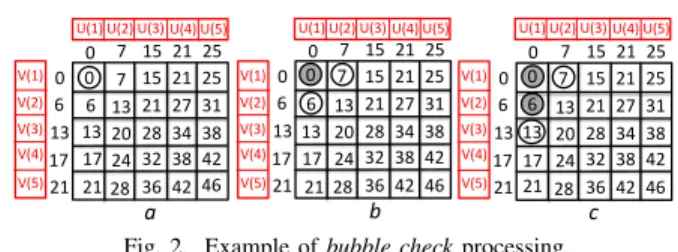
a limited number of operations. An example is illustrated in Fig. 2. The first activated bubble is (U(1), V (1)) as indicated in
Fig. 2(a). Therefore, E(1)= U(1)+V(1) and then two bubbles
can be activated: (U(1), V (2)) and (U(2), V (1)), as shown in
Fig. 2(b). Since U(1)+V(2) < U(2) +V(1), the algorithm sets
E(2) = U(1) + V(2) and the bubble (U(1), V(3)) is activated
next. The process continues until the row or the column number reaches the maximum value allowed for the sorter size. This algorithm was shown to reduce the computational
decoding complexity to the order of nm
√ nm [7]. 0 7 15 2125 0 6 13 17 21 0 7 15 21 25 6 13 21 27 31 13 20 28 34 38 17 24 32 38 42 21 28 36 42 46 a 0 7 15 21 25 0 6 13 17 21 0 7 15 21 25 6 13 21 27 31 13 20 28 34 38 17 24 32 38 42 21 28 36 42 46 b 0 7 15 2125 0 6 13 17 21 0 7 15 21 25 6 13 21 27 31 13 20 28 34 38 17 24 32 38 42 21 28 36 42 46 c
U(1)U(2)U(3)U(4) U(5) V(1)
V(2) V(3) V(4) V(5)
U(1)U(2)U(3)U(4) U(5) U(1)U(2)U(3)U(4) U(5) V(1) V(2) V(3) V(4) V(5) V(1) V(2) V(3) V(4) V(5)
Fig. 2. Example of bubble check processing.
However, this algorithm cannot be directly applied for the Min-Sum processing of metrics and LLRs in the Min-Log-MAP algorithm, due to several reasons:
• Min-Sum processing does not require any sorting of the
LLRs or cumulated metrics: only their minimum value has to be found;
• the computation of each cumulated term in Eq. 2, Eq. 3
and Eq. 4 involves the addition of three terms instead of two : sorting the cumulated values according to the standard bubble check algorithm would require running it twice;
• all the combinations of values are not possible in each
sum: in other terms, some cells in the sorting table are empty.
C. Simplified Min-Sum processing for NB convolutional codes The proposed Min-Sum processing algorithm takes these differences into consideration. Due to the second point, two sorting processes should be used in turn, requiring two sorting tables. However, in order to limit the computational complex-ity, we implemented the search for the minimum cumulated term using only one table, with rows and columns indexed with two among the three terms of the sum.
The Min-Log-MAP algorithm requires, at every trellis stage
and in each iteration, q2 addition and comparison operations
for its recursive calculation of the forward and backward state metrics. Inspired by the algorithm described in [7], a new low complexity decoder is proposed next. In the following, we detail the application of the proposed algorithm for the computation of the forward state metrics. However, the same algorithm can be applied for the backward metrics and the extrinsic LLRs.
Considering the calculation of the forward metric αi( j)
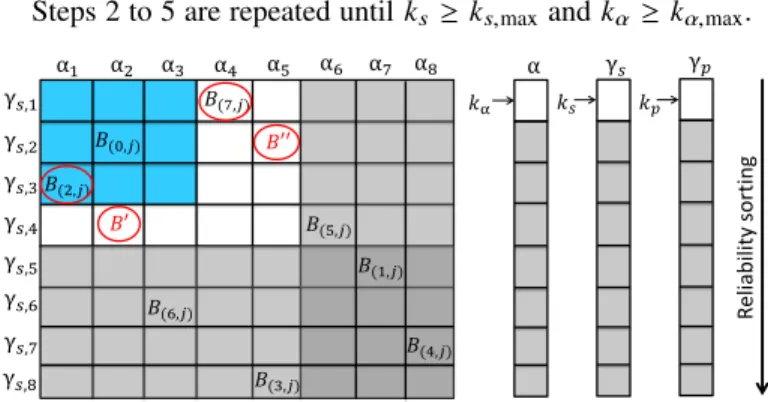
given by Eq. 2, the sorting table contains the q values of the different terms B( j0, j) = αi−1( j0)+ γs,i−1( j0, j) + γp,i−1( j0, j), called bubbles, by analogy with [7]. The rows and columns of the table are arranged according to the values of the
forward metrics αi−1( j0) and the values of the systematic
transition metrics γs,i−1( j0, j), both sorted in increasing order:
{αkα}, kα= {1 · · · q} and {γs,ks}, ks= {1 · · · q}. Each bubble
corresponding αi−1( j0) and γs,i−1( j0, j) values. The parity
tran-sition metrics γp,i−1( j0, j) are sorted separately in increasing
order following index kp= {1 · · · q}.
In the fully connected trellis of the code structure described
in Fig. 1, each transition corresponds to one of the q2 cells
of the table. However, when computing Eq. 2, only the q
transitions merging at state Si = j are considered. In the
studied code structure, all the transitions merging at a given state are labeled with different values of systematic symbols.
Therefore, the q values of B( j0, j) in the table are all placed
in different rows and columns. An example of such a table is
shown in Fig. 3 for q= 8.
To reduce the number of computations involved in Min-Sum processing, a preliminary step consists in defining a radius R which sets the boundaries of the table region
cor-responding to the R2 lowest, i.e. most reliable, values of
αi−1( j0)+ γs,i−1( j0, j). Before starting the computation, the proposed algorithm checks whether this high reliability zone (colored in blue in Fig. 3) contains at least one bubble. If not, it is highly unlikely that the considered state has been visited
by the encoder. Therefore, the corresponding αi( j) value is set
to a predefined high value. The value of R has an impact on the complexity and the error rate performance of the decoder, as shown in Section V.
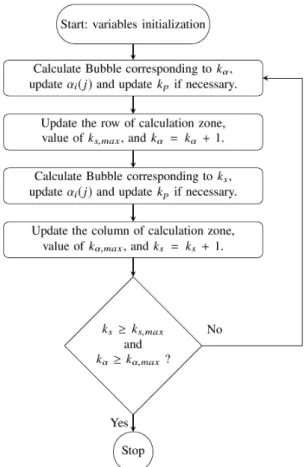
If the radius-R region contains one bubble or more, the com-putation process can be launched according to the flowchart of Fig. 4. The algorithm processes the bubbles alternately vertically and horizontally (or vice-versa) and updates two
upper bounds, kα,max and ks,max, on the maximum values of
indexes kα and ks to be processed.
• Step 1 – Initialization: Initialize kα, ks and kp to 1 and
initialize kα,max, ks,maxto q.
• Step 2 – Vertical processing: 1) Calculate the bubble in
the column indexed by kα. 2) Update αi( j) with the computed
bubble Bi( j0, j) if Bi( j0, j) < αi( j). 3) If the parity transition metric term γp,i−1( j0, j) in Bi( j0, j) is γp,kp, increment kp.
• Step 3 – Update ks,max and increment kα: Let m be
the row number of the systematic transition metric term γs,i−1( j0, j) used to compute Bi( j0, j) in step 2. Compute a
dummy bubble B0 with the lowest values of αi−1( j0) and
γp,i−1( j0, j) not yet used (that is with indexes kα+ 1 and kp
due to the applied sorting) and with γs,m+1: B0 = α
kα+1 + γs,m+1 + γp,kp. This dummy bubble sets a lower bound on the values of the actual bubbles located at rows with indexes
greater than m+ 1. If B0≥αi( j), there is no need to continue
the calculation process below this row: ks,maxis set to m+ 1.
kα is incremented for the next iteration.
• Step 4 – Horizontal processing: 1) Calculate the bubble
in the row indexed by ks. 2) Update αi( j) with the computed
bubble Bi( j0, j) if Bi( j0, j) < αi( j). 3) If the parity transition metric term γp,i−1( j0, j) in Bi( j0, j) is γp,kp, increment kp.
• Step 5 – Update kα,max and increment ks: Let n be
the column number of the state metric term αi−1( j0) used to
compute Bi( j0, j) in step 4. Compute a dummy bubble B00
with the lowest values of γs,i−1( j0, j) and γp,i−1( j0, j) not yet
used (that is with indexes ks+ 1 and kp due to the applied
sorting) and with αn+1: B00 = αn+1+ γs,ks+1 + γp,kp. This
dummy bubble sets a lower bound on the values of the actual
bubbles located at columns with indexes greater than n+ 1.
If B00 ≥ αi( j), there is no need to continue the calculation
process to the right of this column: kα,max is set to n+ 1. ks
is incremented for the next iteration.
Steps 2 to 5 are repeated until ks ≥ ks,maxand kα ≥ kα,max.
α1 γ𝑠,1 𝐵(2,𝑗) α6 α2 α3 α4 α5 γ𝑠,2 γ𝑠,3 γ𝑠,4 γ𝑠,5 γ𝑠,6 𝐵(0,𝑗) 𝐵(7,𝑗) 𝐵(3,𝑗) 𝐵(5,𝑗) 𝐵(6,𝑗) α7 α8 γ𝑠,7 γ𝑠,8 𝐵(4,𝑗) 𝐵(1,𝑗) 𝐵′ 𝐵′′ R elia bility sorting 𝑘α 𝑘𝑠 𝑘𝑝 α γ𝑠 γ𝑝
Fig. 3. Example of sorting table used for the computation of αi( j) with Eq. 2
for q= 8. All B(j0, j) values, j = 0 · · · q −1 are placed in different rows and columns. Min-Sum processing is performed with radius R= 3, ks,max= 5
and kα,max= 6. Illustration of Steps 2 and 3 (resp. Steps 4 and 5) for kα= 1
(resp. for ks= 1), and illustration of sorted vectors α, γs and γp. The proposed decoding algorithm limits the activated
bub-bles to the ones lying inside the area bounded by kα,max and
ks,max.
The same process is repeated for every state j ∈ {0 · · · q−1} and at each trellis stage.
The proposed algorithm can also be directly applied for the computation of backward state metrics and extrinsic LLRs.
A question that arises is the choice of the metric to be handled separately in the process (e.g the parity transition metric in the example above). Although any metric could play this role, in practice it is better to keep in the table the metrics that are refined during the iterative decoding process thanks to the incoming extrinsic information, i.e. the state metric and the systematic transition metric: this speeds up the computation over the iterations.
D. Additional simplification and vector sorting
In order to further reduce the complexity of the decoding process, the previously described algorithm does not need to consider all the q state metrics and systematic transition metrics to find the minimum bubble value. Similarly to the EMS decoding algorithm of NB-LDPC codes, only the first
nm lowest (i.e. most reliable) metrics need to be sorted, with
nm << q. Therefore, in the algorithm of Section III-C, q can
be replaced by nm. The impact of the value of nm on the
complexity and error correction performance is assessed in Section V.
An example of hardware architecture for the generation of the sorted truncated vectors can be found in [10].
IV. COMPLEXITY ANALYSIS
The computational complexity for the calculation of the forward state metrics, backward state metrics and extrinsic
Fig. 4. Flow chart of the proposed simplified Min-Sum processing algorithm.
LLRs is assessed in terms of the average number of ACS operations executed per decoded frame. For the full Min-Log-MAP algorithm, it is calculated as follows:
ACSM L M = 3nenc.Ks.nit.q2 (5)
where nenc denotes the number of component encoders in
the TC structure – for conventional TCs, nenc = 2, Ks is the
number of GF(q) symbols in the messages to be encoded and
nit represents the number of executed decoded iterations. The
factor 3 stands for the three processes needed to compute the forward and backward probabilities and the extrinsic information.
For the proposed bubble check algorithm, the number of
operations ACSBC is upper bounded by:
ACSBC= 3nenc.Ks.nit.2nm.q (6)
The factor 2 in (6) accounts for the update of the metrics in Steps 2 or 4 of the algorithm (see Section III-C) and of the
update of kmax in Steps 3 or 5: for each of the q encoder
states, at most 2nm ACS operations are needed. Therefore,
from (5) and (6), it can be inferred that the proposed Min-Sum processing reduces the complexity of the Min-Log-MAP
algorithm, provided that nm< q2.
V. RESULTS AND DISCUSSION
The error correction performance of the proposed decoder in terms of frame error rate (FER) is evaluated by simulations
over a Gaussian channel. The simulated NB-TC consists of two identical constituent codes with the structure shown in
Fig. 1 and defined over GF(64). The coefficients a1, a2 and
a3 are taken equal to 41, 2 and 0, respectively. Since no
puncturing is applied, the overall coding rate is R= 1/3. The
message length at the encoder input is Ks = 900 symbols,
corresponding to Kb = 5400 bits. The coded symbols are
transmitted using a 64-QAM constellation. An almost regular permutation (ARP) [11] is used for internal interleaving. Interleaver parameters and corresponding minimum spread
Smin and girth values are given in Table I.
The turbo decoding algorithms are simulated using nit = 8
decoding iterations, unless otherwise specified. 8 quantization bits are used for the representation of the input symbol LLRs and 9 bits for the state metrics – forward and backward.
Three decoding configurations, shown in Table II, are compared in terms of error rate performance and complexity, which differ in the radius value R and in the truncation length
nm (see Section III-D).
TABLE I
ARPINTERLEAVER PARAMETERS, GF(64), Ks= 900SYMBOLS AND
R= 1/3 (ARPEQUATION: Π(i)= (Pi + S (iMODQ)) MODKs).
Smi n Girth P Q (S(0),...,S(Q-1))
30 8 137 4 (0,854,396,362) TABLE II
VALUES OF PARAMETERSRANDnm FOR THE THREE SIMULATED
CONFIGURATIONS.
Configuration C1 C2 C3
R 10 4 2
nm 16 8 4
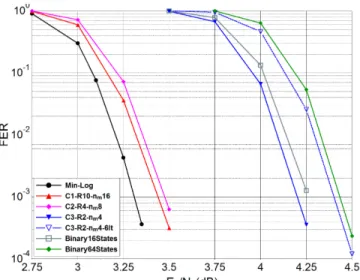
Fig. 5 shows the error correction loss due to the reduced-complexity decoding algorithm, with respect to the original Min-Log-MAP algorithm. This loss varies from 0.1 to 0.9 dB
at a FER equal to10−3, depending on the configuration. Two
additional curves were added, corresponding to the simulation of two binary TCs using 16-state and 64-state constituent codes and decoded with the Min-Log-MAP algorithm under the same simulation conditions. We can observe that the proposed NB-TC outperforms both binary codes even when a complexity reduction is applied. The proposed code can compete with the binary TC using the same number of states, even when performing only 6 decoding iterations (curve
labeled C3-R2-nm4-6It) and even with the binary 16-state
binary turbo code, which displays a lower decoding threshold than the binary 64-state code.
A comparison of the computational complexity was also carried out. First, Table III presents the values of the upper bound on the number of ACS for the proposed reduced-complexity decoding algorithm obtained according to (6) and that of the full Min-Log-MAP algorithm obtained with (5), as well as the percentage gain for the three simulated configurations.
Fig. 6 compares the actual computational complexity of the different schemes in terms of measured ACS operations as a function of the FER. The complexity reduction with respect to the classical scaled Min-Log-MAP algorithm varies from
Fig. 5. Performance comparison, in terms of FER, of the 3 low-complexity decoding configurations with Min-Log-MAP algorithm for NB-TC, and 16-state and 64-16-state binary TC. Transmission using 64-QAM over the AWGN channel. Generator polynomial for binary 16-state and 64-state component codes: (1, 35/23) and (1, 171/133) respectively, in octal notation.
TABLE III
UPPER BOUNDS ON THE NUMBER OFACSOPERATIONS BY FRAME FOR
DIFFERENT DECODING ALGORITHMS.
Algorithm MLM Bubble Check nm= 16 nm= 8 nm= 4
# ACS×106/Frame 176.9 88.4 44.2 22.1
Min. complexity
reduction (%) 0 50.1 75.1 87.5
a factor 3 to almost 10, depending on the configuration. For instance, accepting a loss in the order of 0.2 dB in perfor-mance will result in a complexity reduction by a factor of 6
using configuration C2. When comparing with the binary
16-state, the NB-TC decoded with the Min-Log-MAP algorithm is 20 times more complex and 6 times when comparing with the 64-state TCs, for a corresponding gain in performance of 0.9 dB and 1.2 dB. With the simplified configuration C2, a performance gain of 0.8 dB can still be achieved compared to the 16-state TC, at the price of a complexity multiplied by 4. Note that, although not shown in the figure, we observed that the NB-TC is able to achieve lower error floors than the 16-state binary TC.
Moreover, even when requiring a higher number of oper-ations, the decoder of a NB-TC over GF(q) would enhance the throughput, compared to the binary TC, thanks to
symbol-based processing that provides log2(q) bits when decoding a
trellis section. Indeed, comparisons should be performed at the same throughput level which would require considering high order radix-based decoder for binary codes.
VI. CONCLUSION
In this work, a reduced-complexity decoding algorithm for NB-TC is proposed. It extends the bubble check algorithm used for NB-LDPC codes to the particular case of metric computations of NB turbo decoders. Based on the Min-Log-MAP decoder, this algorithm largely reduces the number of
Fig. 6. Computational complexity comparison in terms of ACS operations as a function of the achieved FER.
required addition/comparison operations. Different trade-off levels can be achieved between performance and complexity. When compared to their binary counterparts, the NB-TCs still show better performance at an affordable additional complexity. This paves the way to future hardware implemen-tations.
ACKNOWLEDGMENT
This work was partially funded by the EPIC project of the EU’s Horizon 2020 research and innovation programme under grant agreement No. 760150, by Orange Labs and by the Pracom cluster. It has also received support from the PHC CEDRE program.
REFERENCES
[1] G. Liva, E. Paolini, B. Matuz, S. Scalise, and M. Chiani, “Short turbo codes over high order fields,” IEEE Trans. Commun., vol. 61, no. 6, pp. 2201–2211, June 2013.
[2] G. Caire, G. Taricco, and E. Biglieri, “Bit-interleaved coded modula-tion,” IEEE Trans. Inform. Theory, vol. 44, no. 3, pp. 927–946, 1998. [3] L. Bahl, J. Cocke, F. Jelinek, and J. Raviv, “Optimal decoding of linear
codes for minimizing symbol error rate (corresp.),” IEEE Trans. Inform. Theory, vol. 20, no. 2, pp. 284–287, 1974.
[4] D. Declercq and M. Fossorier, “Decoding algorithms for nonbinary LDPC codes over GF (q),” IEEE Trans. Commun., vol. 55, no. 4, pp. 633–643, 2007.
[5] A. Voicila, D. Declercq, F. Verdier, M. Fossorier, and P. Urard, “Low-complexity decoding for non-binary LDPC codes in high order fields,” IEEE Trans. Commun., vol. 58, no. 5, pp. 1365–1375, 2010. [6] L. Conde-Canencia, A. Al-Ghouwayel, and E. Boutillon, “Complexity
comparison of non-binary LDPC decoders,” in ICT MobileSummit, 2009, pp. 1–8.
[7] E. Boutillon and L. Conde-Canencia, “Bubble check: a simplified algorithm for elementary check node processing in extended min-sum non-binary LDPC decoders,” Electron. Lett., vol. 46, no. 9, pp. 633–634, 2010.
[8] R. Klaimi, C. Abdel Nour, C. Douillard, and J. Farah, “Design of low-complexity convolutional codes over GF (q),” arXiv preprint arXiv:1807.02481, 2018.
[9] J. Vogt and A. Finger, “Improving the Max-Log-MAP turbo decoder,” Electron. Lett., vol. 36, no. 23, pp. 1937–1939, Nov 2000.
[10] A. A. Ghouwayel and E. Boutillon, “A systolic LLR generation archi-tecture for non-binary LDPC decoders,” IEEE Commun. Lett., vol. 15, no. 8, pp. 851–853, August 2011.
[11] C. Berrou, Y. Saouter, C. Douillard, S. Kerouédan, and M. Jézéquel, “Designing good permutations for turbo codes: towards a single model,” in IEEE Int. Conf. Communications, vol. 1, Paris, France, 2004, pp. 341–345.