Science Arts & Métiers (SAM)
is an open access repository that collects the work of Arts et Métiers Institute of Technology researchers and makes it freely available over the web where possible.
This is an author-deposited version published in: https://sam.ensam.eu Handle ID: .http://hdl.handle.net/10985/7877
To cite this version :
Alexandre GENTNER, Carole BOUCHARD, Daniel ESQUIVEL, Carole FAVART - Mapping a multi-sensory identity territory at the early design stage - International Journal of Affective Engineering - Vol. 12, n°2, p.191-200 - 2012
Any correspondence concerning this service should be sent to the repository Administrator : [email protected]
ORIGINAL ARTICLES
MAPPING A MULTI-SENSORY IDENTITY TERRITORY DURING
THE EARLY DESIGN PHASES
Alexandre GENTNER*
+**, Carole BOUCHARD*, Daniel ESQUIVEL** and Carole FAVART**
*CPI Laboratory, Arts&Métiers ParisTech, 151 Boulevard de l’Hôpital, 75013 Paris, France **Kansei Design, Toyota Motor Europe, Hoge Wei 33, 1930 Zaventem, Belgium
Abstract: This article presents a kansei design methodology. It is placed at the very beginning of the design process and aims to
influence the following steps in order to improve the user’s understanding and experiencing of the designed product. The experimentation combines in a subtle way the design thinking approach of learning by doing and the kansei engineering quantitative approach. The research presented is based on the results of a previous study that defined the semantic and emotional scope of future hybrid cars for European using visual stimuli. Building on this scope this kansei design methodology creates and assesses multi-sensory atmospheres is order to provide tangible direction composed of vision, touch, hearing and smell stimuli. From the cognitive and affective responses of the 42 participants we were able to detail 3 directions for future cars interiors that aim to enrich the styling design briefs and to influence the design strategies such as the management of the different grades. The research presented here was supported by the Kansei Design department from Toyota Motor Europe (TME-KD). This collaboration also brought an industrial context to it.
Keywords: Kansei design, Identity territory, multi-sensory perception, design direction, emotional design
1. INTRODUCTION
The car industry is a very competitive and rapidly evolving field. We see new values, semantic references and emotions appearing in the styling, communication and actions of the different manufacturers. This phenomenon has been amplified by the economical and ecological crisis. The experimentation presented in the article aims to help the process of understanding new trends and of creating and assessing new user-experience concept proposals putting together sensory perception, meaning, aesthetics and emotions.
2. LITERATURE REVIEW 2.1. Introduction
In the literature multiple models describe the internal processes occurring during the perception of an object. In the paper we reviewed, the flow presented in the basic model of communication [1] (straight flow from a “source” to a “destination” through a “transmitter”, a “channel” and a “receiver”) is still is use. In this article,
we will put the stress on the “receiver” corresponding to the sensory perception process, on the “destination”, in this case the user response to perception and on the consequences of this communication on the states of the user and of the product (or “transmitter”).
A study by Crilly et al. [2] divides the user response into three: the cognitive response (aesthetics, semantic), the affective response (emotions) and the behavioral response that results from the two previous ones. It is also important to insist on the interaction and interdependences of cognitive and affective responses [3] and on the fact that these responses form the user experience as described by Desmet et al. (aesthetic experience, emotional experience and experience of meaning) [4].
Concerning the unconscious or conscious aspect of these responses, Rieuf et al. presented a model that takes into consideration this duality and describes the process as 2 complementary paths [5]. On figure 1 a basic model schematizes the user response to product discussed in
this section. This simplified version will be detailed in the following of the literature review.
2.1. Aesthetics
By looking at products, people often find them visually attractive, elegant or beautiful or on the other side ugly or unattractive [6]. Often the activity of perceiving the object is pleasurable by itself, independently of other value judgments that might be made [7]. According to Coates [6], there is a part of subjectivity and a part of objectivity within the aesthetic impression. Both of these parts are divided into 2 aspects, information and concinnity: information takes into consideration the shape, colors, and textures that can be observed whereas concinnity considers the harmony of the whole together with the sense that it makes. In this project, our researches in this area where mainly centered on objective information as well as on objective concinnity. A good example of objective information is the work by Itten [8]. He presented in a functionalist approach, ground knowledge about color that he was able to acquire during the art lessons that he gave at art schools including the Bauhaus. He gives as example are the different kinds of point of view that are possible in the study of color, which are the constructive point of view (intellectual and symbolic), the expressive (psychic) and the point of view from the “impression” (sensitive and optical). According to him they are all linked together and have the same roots. He also presents a color wheel, from which it is possible to create objective color harmonies and a list of types of contrast that are possible to use as well as effects on perception. He uses the same approach for shape and textures: he sorts them, categorizes them and explains how to use them properly [9].
For objective concinnity the Gestalt Principles,
centered on the effect due to the arrangement of shapes, are the major design principle that we can use [10]. They show how people better perceive a well-organized pattern or whole, instead of many separate parts.
As they are more closer related with the individual meaning we interpret from the objects and emotions we get from them, the subjective information and subjective concinnity will be studied directly during the experimentation, by focusing on particular stimuli (shapes, colors, textures, sounds…) the emotional and semantic response to them. Practical applications of such evaluations [11] were also a useful source of inspiration for the creation of the experimentation’s methodology.
2.3. Semantic
The semiotics theory by de Saussure [12] [13] divides a sign into the signifier and the signified. De Saussure uses an analogy with the game of chess, noting that the value of each piece depends on its position on the chessboard. The sign is more than the sum of its parts.
Designed objects have functional attributes as they operate in someway to perform the task for which they are made for and used. That’s why an important portion of the value assigned to products may be attributed to their utility. This comprises practical qualities such as function, intuitiveness, performance, efficiency and ergonomics that should be taken into account from the early design phases. Semantic approaches are available for designers in order convey these various aspects of the product usability through the different sensory channels [14], some of them being for instance the use of metaphors [15], of semantic layers or of metonyms. Moreover, the perceived meaning of a product not only influences the user’s understanding (the product usability) but also the user’s experiencing (the product experience) which is now requested by customers [4].
2.4. Emotions
Emotions are part of the user “affective response”, which is an umbrella term for user response considering moods, feelings as well as emotions. Concerning response to product, feelings will be relatively mild when compared to the possible spectrum of human emotions [16]. This makes them more difficult to capture as well. In order to measure these emotions that are subjective and uncontrolled, different types of tools have been developed.
The PrEmo software [17] (released in 2003) is an emotion-measuring tool based on 14 different emotions
Figure 1: Response to product perception
PRODUCT Product’s characteristics Perception process 5 Senses Action Approach,Interact, Avoid Affective process Emotions Cognitive process Aesthetics, Semantics USER
represented by drawings that get animated when someone clicks on them. Each animation comes also with a specific sound. It is designed to measure emotions elicited by product appearance or usage. The graphical nature makes this support ideal for cross-cultural environments. The participants have then to evaluate each emotion on a 3-point scale: “I do feel the emotion expressed by this animation”, “To some extent I feel the emotion expressed by this animation” and “I do not feel the emotion expressed by this animation”. Since then, the tool has evolved with the release of PrEmo2 [18]. In order to be more accurate and cross-cultural the emotion set has been recalibrated and the animations redesigned. Another emotion measuring tool is the “Geneva
emotions wheel” [19]. In this tool, a list of emotions
(keywords) is displayed in a circle. The respondent is asked to indicate the emotion that he or she experienced by choosing intensities for a single emotion or a blend of several emotions out of 20 distinct emotion families. They are all arranged in a wheel shape with the axes being defined by two major appraisal dimensions (control and pleasantness). Four degrees of intensity are proposed with circles of different sizes. In addition “No emotion felt” and “other emotion felt” options are also proposed.
The two methods have been compared have shown excellent potential for the measurement of emotions for consumer products with specific strength and weaknesses on both sides [20]. We used both methods as inspiration for the design our experimentation in which we would like to measure the meanings and emotions perceived by the participants.
2.5. Behavioral response
The behavioral response, to which the affective and cognitive responses are leading, is characterized by an “approach” or “avoid” behavior from the user towards the product. For Krippendorf [14] these two types of behaviors make to user navigate between three modes of attentions: “recognition”, “exploration” and “reliance”. The user and the product are then not anymore in a context of perception but of interaction with two opposite communication flows connecting them. In the methodology we present, the behavioral response appears in the engagement of the users towards the samples in the selection process
2.6. Multi-sensory stimulation
People use all their senses to explore around them and
all the senses together create an overall product experience. A study realized by Spence [21] as well as many studies have suggested that the greater the number of senses modalities that are stimulated at any once time, the richer our experiences will be. At the same time all of our senses are not used in the same way and are not sensitive to the same type of stimulation [22]. The two above mentioned researches have shown that in specific contexts vision and touch are dominated by the functional dimension, whereas audition, olfaction and taste are more concentrated on the emotional dimension. Knowing the roles that the different senses play in people’s interactions with products, designers have now the key to choose the best sensory channel to communicate through their products [23]. For instance, because of the importance of the emotional experience while using the olfactory modality, designers who want to increase a product emotional appeal could work on the smell of the products.
People’s perception of a product in a given sensory modality is frequently affected by the sensations that are simultaneously being perceived by another modality. Moreover customers are not typically completely unaware of this effect. In a study by Zampini et al. [24] participants were asked to evaluate the pleasantness and roughness of an electric toothbrush. The results show they were also evaluating the sound of the toothbrush: by simply amplifying the sounds of it, the same toothbrush was judged rougher and less pleasant.
Other studies show examples of how these cross-modal correspondences link the senses to each other as for example sound and vision (with the example of CD), smell and vision (perfumes), touch and smell (gel) or vision and taste (soda or potato chips) [22]. The authors recommend handling these effects very carefully because of the major bad impression that wrong associating could generate.
The five senses have also a different influence on consumer’s mental imagery, which is influent on them while they are not interacting with the product. For instance, before they buy the product, customer often already create part of the product experience in their mind (what they would feel while using the product) and also prepare to how they will show the product to their friends. People mental imagery can also appear after having bought the product.
With this in mind, Schifferstein [25] realized an experiment to understand the importance of the different sensory modalities in the mental imagery process. The mental image depends a lot of the product taken into consideration, but the author was able to conclude that all senses are able to produce a significant mental image. In average, the vividness ratings obtained were only slightly, but significantly, lower for smell and taste (both ranged from 4.9/7), than for vision touch and audition (ranged from 5.4/7 to 5.7/7).
3. HYPOTHESIS
With this experimentation we wanted to verify this hypothesis:
HP - The creation of multi-sensory atmospheres by the participants (using non-visual sensory stimuli) will bring us more cognitive and affective information concerning the future hybrid identity territory.
In the following sections you will learn more about the methodology we create and the results from the experimentation.
4. METHODOLOGY 4.1. Introduction
The methodology was inspired by the Kansei Engineering approaches [16] and was also influenced by Clos’ work [26] on multi-sensory stimuli evaluation. We built this methodology using the results of a previous research focused on vision that defined interdependent categories characterising the perception of European for future hybrid using images and keywords. This research was founded on more that 800 stimuli and 32 hours of interviews [27]. The seven categories distinguished could be classified into two groups:
- Three “families” having a clear visual interpretation because they had a strong link to the aesthetic perception. They are named “technological, innovative” (family 1), “smooth, fluid” (family 2), organic, natural” (family 3)
- Four “nuances” centered on values and emotions: “serene, peace of mind” (nuance a), “calm, refinement” (nuance b) “joy, energy” (nuance c), different, unexpected” (nuance d)
The methodology presented in this article is using visual, tactile, olfactory and sound stimuli as well as semantic and emotion keywords. The participants had to define three multi-sensory atmospheres corresponding to
their image of future hybrid vehicles (one for each family previously identified). In order to assist them, seven different stations were created. The figure 2 shows the experimentation flow for the family 1. Participants had to go through this process for each of the three families. In the next paragraphs details about the different stations
will be given.
4.2. Mood-boxes selection
As explained earlier the study on which this experiment is based defines three families and four nuances through visual stimuli (axed on aesthetics, meaning or colors). In order the cover the field identified there, we decided to combine each “family” with each “nuance”. As result we had a matrix of 12 briefs different in terms of cognitive and affective information conveyed. These briefs were combination of keywords and inspiration pictures and were used for the creativity session that followed.
Mood-boxes are transparent cuboid boxes (37x26x6cm) with low height and display a composition of inspirational elements such as fabrics or products as well as metallic and paint samples. This representation permits to convey a very specific atmosphere in a small tangible space. It is also used for the communicating and the evaluation of style directions at early ideation stage. The Mood-boxes allow us to investigate two senses
Figure 2: Experimentation flow (example: family 1)
Station I llustration Action
Fam. 1 Mood-boxes Select 1 out of 4 nuances Blind-touches Associate stimuli : Completely Somewhat Not at all Sounds Smells Semantics Emotions Multi-sensory atmosphere Rate and comment the “creation”
channels at the same time: vision and touch. In preparation of the creation of the Mood-boxes in order to get the needed material, we also visited several shops (furniture, fashion, fabric, art and design) in Brussels and in Paris. Designers from TME-KD, using as inspiration the 12 briefs, have then executed the Mood-boxes. The Mood-box 1a (corresponding to the family 1 and nuance a) is presented as an example on Picture 1. At the first station participants were asked to look and touch the Mood-boxes. They were grouped four by four, organized family. After having felt all the different atmospheres the participants were invited to select one Mood-box from each family. At this stage the participants had also to evaluate the global impression that they had from the three different families (group of four Mood-boxes) by rating them as a whole being “not at all” fitting with their idea of future hybrid interior, fitting “somewhat” or fitting “completely”. This question will help us, during the analysis phase, to establish a ranking of the families.
The participants will now have to complement the three atmospheres they selected through the following stations. During this process they will use the four senses through which a car stimulates a human.
4.3. Addition of sensory information
The first station focuses on the sense of touch. It has been developed using “Sensotact”, a haptic tool developed in order to standardize touch description in the same way than color-matching systems such as “Pantone” are doing for colors. Out of the nine groups of samples proposed we selected four considered as being very important for the touch experience in a car and matching with the results of the first survey: thermal
touch (from warm, lukewarm and cold feeling), orthogonal hardness touch (from very soft to hard), tangential relief touch (scattered grain, low, medium and high grain density) and tangential fibrous touch (slick, rough and soft). While blind touching these 15 samples, the participants had to define if the tested stimuli were in harmony with the three Mood-boxes they choose at first. This process permits us to collect a significant amount of data about touch characteristics related with the ambiances created by the Mood-boxes.
The next station is composed of 14 different samples selected from an inspiration sound library developed by sound design. The selection process was done through a brainstorming involving four designers and the briefs from the previous experiment [27]. The evaluation process is the same for the sound station than for the touch station: for each of the 14 samples, the participants had to define if the tested samples were in harmony with the 3 Mood-boxes they choose at first using the scale:
not at all, somewhat or completely.
The last sensory station is about smell. It is composed of 7 different samples has been developed in collaboration with a scent design agency. The creation was based on a brief using the 7 areas of investigation. The workshop helped us to be able to interact with the participants and help them, as smell was for them the hardest sense to evaluate. The evaluation process is the same as for the 2 previous stations.
These stations have been built in order for the participants to create in a structured way a multi-sensory atmosphere in order to test the hypothesis we made.
4.4. Addition of semantic and emotional information
The last station could be considered as a conclusion of the experimentation. Participants had to define the three ambiances, based on the Mood-boxes and further defined with the stimuli from the different station. In order to make this task easier to achieve cards were prepared. On each of them a value or an emotion was written. Using the literature review as reference, we narrow down the list of keywords after a pilot survey in order to keep only the more adapted ones.
During the experimentation, participants had to classify the cards board into the same three categories (not at all, somewhat or completely) as for the previous stations, evaluating separately values and emotions.
As the emotion evaluation part reefers to the affective response which uses subconscious mechanisms and in
order to detect the largest possible amount of emotions we putted this step at the very end of the sensory journey, assuming that through the process the participants will enter more and more in the ambiances they are creating and therefore be more likely to detect and understand the emotions they are experiencing.
4.5. Rating and description of the atmosphere created
The last step of the sensory part was a discussion with the participant. Notes were taken at the same time on the evaluation form. During this discussion they were asked to describe the 3 Mood-boxes (and atmosphere including touch, sound and smell) with their own words. They were also asked to rank them according to their image of “future hybrid interior” from 1 (not matching) to 3 (completely matching).
5. RESEARCH PROCESS AND RESULTS 5.1. Introduction
The experimentation took place in Zaventem at the Toyota Motor Europe Research & Development Centre following the methodology explained above. The interview took in average one hour per participant. For budget and confidentiality reasons the participants were all Toyota members. We had a good distribution of the participants in terms of gender, age, division and nationality. According to the results of previous studies that compared results outside and inside of Toyota, the panel of Toyota members is a good representation of the average European population.
We received in total 42 participants from 18 European nationalities including 33% of women. Approximately half of them already participated to the first experimentation. The participants were enthusiastic to come and enjoyed the survey. Many of them asked to be informed of the result. They were also impressed by the quality of the stimuli and especially by the Mood-boxes. In the same way as for the first survey we decided to have only hybrid car drivers or participants whose work is related with to hybrid technology because we considered them as being the person with the most interest in the technology. They were also the most able to overcome all types of prejudices.
5.2. Participants’ means of expression
With the above-presented methodology participants had 3 ways to express their opinions about their arrangements of Mood-boxes and stimuli. On the top of these three possibilities a fourth source of information
was the selection ratio of each Mood-box among the 42 participants and the nature of the stimuli associated to each Mood-boxes during the experiment process. The first was directly linked with the selection of the Mood-boxes they made. It fact, by choosing the 3 Mood-boxes they preferred, they expressed their opinions about the different nuances. These results are presented in the following chart and show a clear preference by male and female participants for the nuance b centered on harmony and refinement. For the other nuance we find differences between male and female selection ratio. These show us that the hybrid is not interpreted the same way by everybody and that gender can be an influential characteristic. For instance, we see that generally females prefer nuances c and d to nuance a. These are the most active and most stimulating nuances (reference to the visual stimuli experiment).
Most chosen Least chosen Female Nuance b (38%) Nuance c (24%) Nuance d (19%) Nuance a (19%) Male Nuance b (38%) Nuance a (28%) Nuance d (19%) Nuance c (16%) Total Nuance b (38%) Nuance a (25%) Nuance d (19%) Nuance c (18%) Table 1: Nuance chosen classified by selection ratio
The rating of the families done by the participants reflects their opinions about the whole families (composed of four Mood-boxes). It is the second type of data we used to identify the preferences of the participants. It shows that the preferred family is not the same for males and for females. In general the “smooth, fluid” family (family 2) is by far the preferred one and it keeps a good score for both genders. On the contrary the “natural, organic” family (family 3) is liked by females but not by male and the contrary happened for the family “technological/innovative” (family 1).
Best rated Worse rated
Female Family 3 (2,36) Family 2 (2,00) Family 1 (1,78) Male Family 2 (2,36) Family 1 (2,18) Family 3 (1,63) Total Family 2 (2,24) Family 1 (2,07) Family 3 (1,88)
Table 2: Average rating of the families (from 0 “Not
at all” to 2 “Completely” fitting with participants’ image of future hybrid)
At the end of the sensory part of the experimentation, participants also could add comments to the
Mood-boxes and the multi-sensory atmosphere related. We made a summary presenting for each of the 12 Mood-boxes all positive and negative feedbacks and could record this way the different point of views for the same Mood-boxes. We observed that there were always more positive than negative comments. It confirms that all the Mood-boxes created are relevant for future hybrid. Tangible output is the concerning the participants perception could be found with the rating of the atmospheres they made at the very end of the experimentation process. The table hereafter shows the 4 best-rated atmospheres (the code presented refers to the Mood-box they are related to).
1st 2nd 3rd 4th Female 1d (3,0) 2c (2,6) 1a (2,3) 2a (2,0) Male 1c (2,7) 1b (2,6) 2d (2,6) 2c (2,5) Total 1d (2,7) 2c (2,5) 2d (2,5) 2a (2,3) Table 3: Top 4 of the atmospheres and their related
Mood-box by score (score from 0 to 3)
Finally we also considered the selection ratio as a useful piece of information that we could extract from this survey. The three most selected Mood-boxes considering the 42 participants are presented here. Combined with the results concerning the ratings of the atmospheres we were able to reach a clear picture of the most influent Mood-boxes and atmospheres related to them in the process of creating 3 identity territories.
1st 2nd 3rd Total 3b (55%) 1b (42%) 2c (31%) Table 4: Top 3 of the Mood-boxes by selection ratio
5.3. Principal Component Analysis (PCA) and Cluster Analysis (CA)
By choosing the Mood-boxes, the participants chose atmospheres that they relate to the concept of “future hybrid interior”. With the three sensory stations (touch, sound and smell), the values and emotions evaluation and the open discussion (see above) they continue to define these concepts.
The nature of the stimuli associated to each Mood-boxes during the experimentation process not only gave us a precise definition of what participants associate to their perception of the Mood-boxes they had selected but
it also permit us to map on a two axis diagram all the stimuli (Mood-boxes, touch, sound and smell stimuli) as well as values and emotions through a principal component analysis. Based on the table we get from the PCA a cluster analysis was also conducted. From the dendrogram we distinguished six different trends that combined all types of stimuli, values and emotions. Finally and as summary we get Figure 3, which is a combination of the principal component analysis and the cluster analysis. By analysing the repartition we came up with names characterizing the horizontal and vertical axes: from “relaxation” to “active” for the horizontal one and from “subtle&minimalism” to “more stimulation” for the vertical one.
By using the PCA the complementary samples helped a lot to define the Mood-boxes and by mapping the results of the 42 participants, we were able to map a two-dimensional space with trends going in different directions. By filtering the rendering of the mapping and showing only one type of stimuli, trends according to touch, sound, smell, values and emotions were visually easier to identify and logics of repartition were observed for each of them. Due to the quantity of diagram these figures are not shown it this article.
The view combining all the information (presented in Figure 3) allowed us to merge the data and logics we gained previously and to understand the specificities of each areas of the diagram in order to interpret correctly to global PCA. It also showed us that our hypothesis was valid. Taking into consideration the 42 participants’ opinions, strong link could be established between the Mood-boxes and the different types of sensory samples as well as the values and the emotions.
We could make different interesting observations by looking at the global PCA. One of them concerns the upper-left part of it. We can see that this area contains four out the five best-rated Mood-boxes: 1c, 1d, 2c, 2d (see Table 3) and at the same time most of the emotions presented with the cardboards. Moreover all the emotions we can find there (such as curious, enthusiastic, exciting, stimulated,..) are related to an active state. This observation can confirm the link between positive and active emotions felt and liking of the participants. Through a cluster analysis based of the PCA results we distinguished six different trends that, after analysis, we titled “extreme nature”, “isolated samples”, “unexpected”, “innovative and high-tech”, “simple but
not simplistic” and “zen” (in red on Figure 8). Except for “isolated samples” these trends or cluster are combination of stimuli, values and emotions that are the most related to each-others. The cluster can also be related to the Mood-boxes they cover on the PCA diagram. For the Mood-boxes not included in any cluster, the closest ones are taking this role.
Our hypothesis was therefore also confirmed. At this stage of the data analysis we have five valid trends mapping the identity territory of future hybrid interiors. These are combination of visual stimuli as well as touch, sound and smell ones described with linked values and emotions which are confirming the research on which we founded this experimentation but which are at the same time more precise.
5.4. Extraction of three directions
At this stage of the data analysis we had five different trends for future hybrid interiors provided by the PCA and CA. These trends were defined precisely by different sensory-clusters. As noted previously, active emotions were grouped in one area whereas passive emotions were in others. The same idea of polarization centers was observed for the others stimuli but with other poles and at the end we noted that some trends were compatible and provided together a more tangible output than they were alone. Moreover, we also wanted to combine the results from the other means of expression of the participants with the five trends in order to simplify the comprehension of the output of the survey.
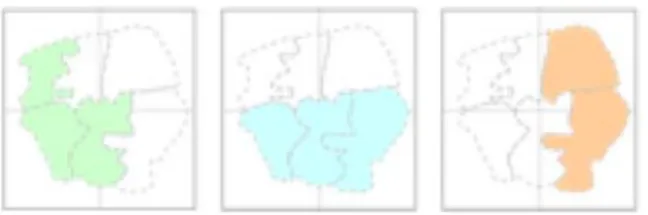
Our final direction proposals seek therefore to encompass the full spectrum of preferences and to identify in them the three major directions for the hybrid identity. They can be represented on the PCA diagram (see Figure 4) and combine trends from the CA using key data from the participants’ other means of expression. These proposals can therefore be described with the material from the experimentation: inspirational Mood-boxes, touch, sounds and smell stimuli as well as semantic and emotional keywords.
The description of the three areas of the identity territory include also some results from the first survey as color harmonies and color harmony indications, inspirational samples and indicators showing how the grades are related to the seven trends detected with the previous experiment [27]. Finally three brand new Mood-boxes were created using all the information we gathered as briefs. For confidentiality reasons only the methodology used to overlap the data and create the three areas of the “future hybrid interior” identity territory will be presented. The final outputs will remain confidential. This is how we proceed to find these three directions:
We observed that the nuance b (harmony, relaxing and refinement) was by far the most chosen nuance of Mood-box (see Table 1). On the mapping the Mood-Mood-boxes 3b, 1b, 2b correspond to the clusters “Extreme nature”, “Zen” and “Simple but not simplistic”. Inspired by these clusters and the flagship Mood-boxes they contained: 3b, 1b, 2a (top ranked in terms of rating and selection ratio), we created the first direction: “Light and organic refinement” (see Figure 4).
The Mood-boxes family 2 (smooth, fluid, silence, elegance) was the preferred family (see Table 2). It was also the only one reaching a consensus between males and female. The family is represented in the clusters “Zen”, “Simple but not simplistic”, “Innovative and High-tech” that cover all the lower part of the mapping (direction “subtle&minimalist”) and both combined created the second direction: “Simple&smooth aquatic life” (see Figure 4).
Finally the emotionally active Mood-boxes 1d, 2c and 2d have the highest average score from the participants (see Table 3). Therefore we created the third direction: “Intelligent and surprising high-technology” (see Figure 4) based on these three Mood-boxes, the Mood-box 1c (ranked 1st for Males and 5th in general) also present in
Figure 3: Combination of the PCA and the 6 trends
this area as well as more generally on the clusters “Unexpected” and “Innovative and high-tech”.
6. CONCLUSION
The methodology presented in this experimentation is placed in the most upstream phase of the design process of new products and the conclusive results let us consider the three “identity areas” as a pillar for design inspiration. They are able to enrich the styling design briefs and to influence the design strategies such as the management of the different grades
The results of a previous experimentation presented seven trends representing the European perception of future hybrid cars and based on visual perception. In order to take into consideration more aspects of human perception, a strong trend in the literature, the next step had to study cognitive and affective aspects of multi-sensory perception.
With this in mind we worked on the presented methodology. It has been designed to take the best of the previous results and to go deeper in the description of the European perception of future hybrid car interiors. It made evolve some of the TME-KD tools such the Mood-boxes and also integrated elements from literature review in the new experimentation methodology developed. On this basis, the assumption was made that the taking into account more sensory channels would help us to identity more in detail the cognitive and affective profiles of future trends. Finally the identity territory we get and the precision of the different direction confirmed this hypothesis.
After the interview and the analysis phases, the three families and four nuances became three areas of the “kansei identity territory”. These directions describe three visions that match with the European perception of future hybrid cars. They include visual stimuli, with specific work on shapes and colors, touches, smells,
sounds and a description of the semantic interpretation and the emotions linked to them.
7. SUGGESTION
Further steps are already under study to better take into consideration human being’s personality (for instance personal values or culture) in the way we perceive and communicate about experiences [28]. For future steps in the direction explored by the presented research, improvements could be made in the creation of the atmosphere feeling. The Mood-boxes could for instance be made bigger or could have more depth. Using these new Mood-boxes would make the selection of the other types of stimuli more precise and accurate.
The methodologies designed for the above-presented experimentations have limited potential of evolution because they are using interview and have as output the participants’ conscious understanding on their different types of responses to perception therefore further studies should include as part of their outputs physiological measurements.
Together with the multi-sensory perception, the interaction between human and objects should be explored using specific objects designed for the experimentation such as interactive Mood-boxes. Cultural and ethnological studies about people’s everyday life habits and cultural specificities (objects, organizations of elements, logics, interactions, traditions...) are also a huge information source about perception and interaction that should be explored more deeply.
Acknowledgment
We would like to thank Yann and Antoine, two designers from TME-KD for their help in process of creating the Mood-boxes and in the set-up of the experimentation.
REFFERENCES
1. C.E. SHANNON, “A mathematical theory of communication”, Bell System Technical Journal, 27, 379-423, (1948)
2. N. CRILLY, J. MOULTRIE, P.J. CLARKSON, “Seeing things: consumer response to the visual domain in product design”, Design Studies, 25(6), 547-577, (2004)
Figure 4: Final directions represented on the PCA
diagram. From left to right: “Light and organic refinement”, “Simple and smooth aquatic life” and “Intelligent and surprising high-technology”
3. D.A. NORMAN, “Emotional Design: Why we love (or hate) everyday things”, Basic Books, New-York, ISBN: 0-465-05136-7, (2004)
4. P. DESMET and P. HEKKERT, “Framework of Product Experience”, International Journal of Design, 1(1), 55-66 (2007)
5. V. RIEUF, C. BOUCHARD and A. AOUSSAT, “Assisting Conjoint Trend Analysis with Virtual Reality”, EKSIG Proceedings, (2011)
6. D. COATES, “Watches tell more than time: product design, information and the quest for elegance”, McGraw-Hill. (2003)
7. D.E. BERLYNE, “Studies in the new experimental aesthetics”, Hemisphere Publishing Corporation. (1974)
8. J. ITTEN, “The Art of Color: the subjective experience and objective rationale of color”, Van Nostrand Reinhold, New York, (1967)
9. J. ITTEN, “Design and form: the basic course at the Bauhaus”, Dessain et Tolra, (1983)
10. K. KOFFKA, “Principles of Gestalt Psychology”, New-York: Harcourt, Brace, (1935)
11. M. PRATS, S. LIM, I. JOWERS, S.W. GARNER and S. CHASE, “Transforming shape in design: observations form studies of sketching”, Design Studies, 5(30), 503-520, (2009).
12. F. DE SAUSSURE, “Cours de linguistique générale”, Payot, ISBN: 978-2-228-88942-1, (1967)
13. D. CHANDLER, “Semiotics: the basics”, 2nd edition, Routledge, ISBN: 978-0-415-36376-1, (2007)
14. K. KRIPPENDORFF, “The Semantic Turn; A New Foundation for Design”, London, New York: Taylor&Francis, (2006)
15. P. HEKKERT and N. CILA, “Metaphorical communication and appreciation in product design”, IASDR 2009 Proceedings, (2009)
16. M. NAGAMACHI, “Kansei engineering as a powerful consumer oriented technology for product development”, Applied Ergonomics, 33, 289–294, (2002)
17. P. DESMET, “Measuring emotion; development and application of an instrument to measure emotional
responses to products”. In: M.A. Blythe, A.F. Monk, K. Overbeeke, & P.C. Wright (Eds.), Funology: from Usability to Enjoyment, 111-123, Dordrecht: Kluwer Academic Publishers, (2003)
18. G. LAURANS and P. DESMET, “Introducting PrEmo 2”, Design&Emotion 2012 Proceedings, (2012)
19. K. R. SCHERER, “What are emotions? And how can they be measured?”, Social Science Information, 44(4), 695-729, (2005)
20. D. GÜIZA CAICEDO and M. VAN BEUZEKOM, “How do you feel? An assessment of existing tools for the measurement of emotions and their application in consumer product research”, Delft University of Technology, Department of Industrial Design, (2006)
21. C. SPENCE, “The ICI report on the secret of senses”, London: The Communication Group, (2002)
22. H.N.J. SCHIFFERSTEIN, C. SPENCE, “Multisensory Product Experience”, In: Schifferstein, H.N.J., Hekkert, P. (Eds.) Product Experience, 1(5), 133-161, Elsevier, (2008)
23. M. LINDESTROM, “Brand sense: build powerful brands through touch, taste, smell, sight, and sound”, New York: Free Press, (2005).
24. M. ZAMPINI, S. GUEST and C. SPENCE, “The role of auditory cues in modulating the perception of electric toothbrushes”, Journal of Dental Research, 82, 929-932, (2003)
25. H.N.J. SCHIFFERSTEIN, “Comparing mental imagery across the sensory modalities”, Imagination, Cognition and Personality, 28(4), (2008)
26. F. CLOS, “Building relevant contexts to design experiences”, KEER 2010 Proceedings, (2010) 27. A. GENTNER, C. BOUCHARD and D. ESQUIVEL,
“How can semiology and emotional studies support a design process?”, CONFERE 2010 Proceedings, (2010)
28. A. GENTNER, C. BOUCHARD, D. ESQUIVEL and G. OPREA, “Creativity comparison between Japanese and European at the concept creation stage”, ICDC 2012 Proceedings, (2012)