HAL Id: hal-00300596
https://hal.archives-ouvertes.fr/hal-00300596v3
Preprint submitted on 12 Feb 2009
HAL is a multi-disciplinary open access
archive for the deposit and dissemination of
sci-entific research documents, whether they are
pub-lished or not. The documents may come from
teaching and research institutions in France or
abroad, or from public or private research centers.
L’archive ouverte pluridisciplinaire HAL, est
destinée au dépôt et à la diffusion de documents
scientifiques de niveau recherche, publiés ou non,
émanant des établissements d’enseignement et de
recherche français ou étrangers, des laboratoires
publics ou privés.
Improvement of missing genotype imputation through
bi-directional parsing of large SNP panels
Christine Sinoquet
To cite this version:
Christine Sinoquet. Improvement of missing genotype imputation through bi-directional parsing of
large SNP panels. 2008. �hal-00300596v3�
L
ABORATOIRE D’I
NFORMATIQUE DEN
ANTES-A
TLANTIQUE— Bioinformatics —
R
ESEARCH
R
EPORT
No hal-00300596
February 2009
Improvement of missing genotype imputation
through bi-directional parsing of large SNP panels
Christine Sinoquet
Computer Science Institute of Nantes-Atlantic (Lina),U.M.R.C.N.R.S. 6241, University of Nantes, 2 rue de la Houssinière, BP 92208, 44322 Nantes Cedex, France
LINA, Université de Nantes – 2, rue de la Houssinière – BP 92208 – 44322 NANTES CEDEX 3
Tél. : 02 51 12 58 00 – Fax. : 02 51 12 58 12 – http
:
//www.sciences.univ-nantes.fr/lina/
Christine Sinoquet
Improvement of missing genotype imputation
through bi-directional parsing of large SNP panels
14p.
Les rapports de recherche du Laboratoire d’Informatique de Nantes-Atlantique sont disponibles aux formats PostScript®et PDF®à l’URL :
http://www.sciences.univ-nantes.fr/lina/Vie/RR/rapports.html
Research reports from the Laboratoire d’Informatique de Nantes-Atlantique are available in PostScript®and PDF®formats at the URL:
http://www.sciences.univ-nantes.fr/lina/Vie/RR/rapports.html
Improvement of missing genotype imputation
through bi-directional parsing of large SNP panels
Christine Sinoquet
Abstract
Such difficult analyses as disease association studies, which aim at mappping genetic variants underlying complex human diseases, rely on high-throughput genotyping techniques. However, a shortcoming of these techniques is the generation of missing calls. Computational inference of missing data represents a challenging alternative to genotyping again the missing regions. In this paper, we presentSNPShuttle, an algorithm designed to gain accuracy over a former method described by Roberts and co-authors [7] (NPUTE). Given anSNPpanel,NPUTEalgorithm infers missing data through a single parse, relying on local similarity within sliding windows. Instead,SNPShuttle scans anSNPpanel in an iterative bi-directional way, to resolve missing data with more confidence.
Introduction
DNA strings consisting of billion of chemical bases A, T, C and G constitute the hereditary material stored in the pairs of chromosomes of eukaryotes. These genetic sequences contain information that influences physical traits, the likelihood of suffering from disease as well as response to pathogens, chemicals and other agents. Differences in individual bases are the most common type of genetic variation. These genetic differences, called single nu-cleotide polymorphisms (SNPs), are detected on chips analyzed through high-throughput genotyping techniques. In the domain of genetical epidemiology, associations studies attempt to link genetic variants to the risk for spe-cific illnesses, with the objective of proposing new methods of preventing, diagnosing, and treating diseases. Case-control association studies are considered to be the simplest framework to help elucidate the genetic basis of complex diseases. Such studies deal with populations of unrelated individuals split into cohorts diagnosed with the disease of interest and cohorts of unaffected controls. The issue at stake is identifying genetic determinants - possibly combinations of determinants - , which should accumulate among cases. Amongst various difficulties likely to introduce a bias in the studies, not a least problem to cope with is the presence of undeterminedSNPs, or "missing calls", in the data generated by genotyping techniques (approximately between5% and 10%).
There are three alternatives to repeating the genotyping for the missing data, a prohibitive task both in terms of time and cost: (i) merely dismissing entire rows and columns of theSNPpanel containing the missing calls is quite a drastic solution, with a strong impact on the power to detect disease-predisposing variants; (ii) inferring missing data prior to the task of interest (i.e., disease association study, genetic mapping· · · ), (iii) handling missing data
while the task of interest is performed. Indeed, this third category amounts to off-line or on-line inference. A peculiar case may lead to some confusion in minds: standard genotyping techniques can not distinguish the two homologous chromosomes of an individual, therefore only the "unphased" genotype (i.e., the combination of the two homologous haplotypes) is directly observable. Thus, when the task of interest, genotype phasing, applies to data containing missing calls, two missing-data problems interfer. From now on, we will refer to genotypes as unphased genotypes.
Various computational methods have been proposed to infer - or impute - missing genotypes. Assignment of the most frequent allele identified to the missing call concerned and k-nearest neighbor voting methods (KNN) are the most simple. A review of eight methods has been more specifically dedicated to such previous methods, as well as various regression methods [13]. Other methods implement expectation maximization [6], Bayesian approaches [4], Decision Forest pattern recognition [12], neural networks [13,11], as well as Gibbs sampling combined with tree-based approach [1].
Other methods explicitly cope with the haplotype block structure of eukaryotic genomes. Empirical studies have confirmed that over short regions (a few kilobases in human genome), haplotypes tend to cluster into groups [5,14], which entails interesting constraints for the corresponding genotypes. To inpute missing calls, this feature is exploited in various ways: entropy measure combined with dynamic programming to partition haplotypes into blocks [10], cluster membership allowed to change continuously along the chromosome according to a hidden Markov model [8]. In this line, Roberts and co-authors designed a new algorithm,NPUTE, which performsKNN
imputation in the context of sliding windows modelling haplotype blocks [7]. Their algorithm deals with SNP panels where the number of markers is much higher than the number of individuals (up to104in the case of some
chromosomes). The very point central toNPUTEis efficient knowledge management from current window to next one.
Finally, among specific softwares yet also able to handle missing data, we mention for illustration methods dedicated to genotype phasing [2,8] and detection of causal variants that have not been directly genotyped, in the framework of association studies [3,9].
Thoroughly examiningNPUTE, we identified in dependencies between sliding windows a promising lead to infer missing calls with more confidence, therefore expecting a gain of accuracy.
6
Methods
Foreword
Beside gaining accuracy due to bi-directional parsing, we are also resolute to design a method which would not depend on memory availability constraints.To meet this second purpose, we implemented successive loadings of consecutive "small"SNP blocks during each parsing of the SNP panel. Thus, contrary to NPUTE, memory needs only be allocated for a SNP block rather than for the wholeSNP panel. Therefore, we wish to design a variant of algorithm NPUTE, KNNWinOpti, together with a novel algorithmSNPShuttle. In the following, we will first briefly describe the original method of Roberts and co-authors. In this occasion, we will highlight the existence of calculation dependencies between blocks of theSNPpanel. Moreover, theseSNPblock dependencies are either backward or forward dependencies, which makes the design of software also managing SNP block loading a delicate task. Then we will presentKNNWinOpti. Finally, the scheme ofSNPShuttle will be depicted.
The common basic concepts of NPUTE, KNNWInOpti and SNPShuttle
The input parameters forNPUTEalgorithm are theSNPpanel, loaded as the matrixsnp[0 .. M − 1][0 .. N − 1]
ofM rows (markers) and N columns (individuals) and L, the "half-size" of any sliding window. The elements of
theSNPmatrix belong to{0, 1, 2}, where 0 denotes the allele with major frequency for each genetic marker, 1
is that of the least frequent allele and2 is the label for "missing data". The key idea ofNPUTEis performing fast imputation over overlapping sliding windows. In the sequel, we will respectively denote sub-matrices and rows as
snp[m .. m′][n .. n′] and snp[m .. m′][n]. snp∗[m − L .. m + L][n .. n′] will refer to a matrix deprived of row m.
Specifically,snp∗[m − L .. m + L][0 .. N − 1] will be named W
m, for conciseness.
The idea central to NPUTEis to infer the missing markerm of some individual n, snp[m][n], "copying" it
from the markerm of the nearest neighbour of individual n, say individual nn, in the contextWm. Such contexts
roughly model the concept of haplotype block. Namely,nn is identified as the individual minimizing a distance
criterion, denoted∆, over Wm. Computing the distance∆(snp∗[m − L .. m + L][n], snp∗[m − L .. m + L][n′])
involves comparing the projection of individualsn and n′onto current windowW m:
∆(snp∗[m − L .. m + L][n
n], snp∗[m − L .. m + L][n]) = Σi=m+Li=m−L,i6=m∆m(snp[i][n], snp[i][n′]).
The distance between markers,∆m, is merely computed as follows:
∆_m(i, j) = 0 if i = j 2 if (i, j) = (0, 1) or(i, j) = (1, 0) 1 if i = 2 or j = 2
It must be highlighted that in this algorithm, the miss-ing calls (”2”) of the context participate in the distance computation. We now denote Wm the vector of the
n (n − 1)/2 pairwise mismatch distances between individual projections onto current window Wm. GivenWm,
the Pairwise Mismatch Vector (PMV) related toWm, inference for any missingsnp[m][n] is straightforward:
con-sidering only theN − 1 relevant entries (n, n′) (n < n′) and (n′, n) (n′ < n) in W
m, the smallest distance with
individualn is identified, say, for individual nn. Provided thatsnp[m][nn] is not missing itself, it is assigned to
snp[m][n]. From now on, we will name P M V (m) the Pairwise Mismatch Vector with n(n − 1)/2 entries such
thatP M V (m)[(n, n′)] = ∆
m(snp[m][n], snp[m][n′]), (n < n′).
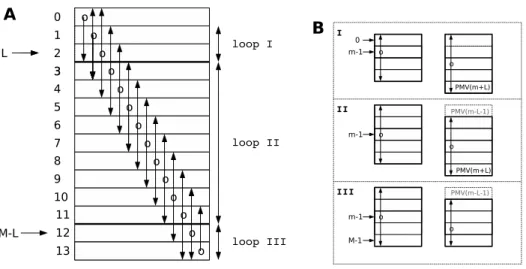
For tractability over largeSNP panels, NPUTEfully exploits window sliding. The parsing of the SNP panel is implemented shifting the current window one range further at each step. Thus, the PMV relative to a window centered on rangem is merely the PMV relative to the previous overlapping window centered on range m − 1,
from which the contribution of rangem − L − 1 must be substracted and that of range m + L must be added (see
Figure2). In addition, note that there are 2 × L + 1 non symmetric windows to be specially processed, among
which2 × L are not symmetric.
However, in the simple case of a symmetric window,Wmis not merely computed asWm−1− P M V (m −
L − 1) + P M V (m + L). Row m itself does not contribute to the calculation of Wm, which is indeed computed
as follows
7
Figure 1: Sliding windows.M = 14; L = 2. Depending on the row m of theSNPinferred, the sliding window is either centered onm or is non symmetric.
Now all basic concepts common to NPUTE, KNNWinOpti and SNPShuttle are settled. However, even the original algorithm,NPUTE, is not so simple since special care must be taken regarding non symmetric windows. In the sequel, we will proceed gradually in the presentation of the sketch of the original algorithm, the adaptations implemented to meet the memory sparing purpose and the innovative bi-directional variant.
Sketch of the original method
The sketch forSNPpanel processing is reminded in Algorithm 1. The algorithm processes apart the non symmetric
window0 (lines 1 to 3 ), then runs three loops. First loop (line 5) processes non symmetric windows 1 through L − 1 and first symmetric window L. Third loop (line 18) processes only non symmetric windows M − L through M − 1. General formula (1) (line 14) is adapted to the case of the L windows successively encompassing an
increasing number of rows (line7), whereas it is symmetrically tuned to the case of the L last windows (line 20).
Algorithm 1N P U T E(M, N, SN P, L)
Input: M, the number of genetic markers; N, the number of individuals; a matrix SNP[0 .. M − 1][0 .. N − 1] of known markers (belonging to {0, 1})
and missing markers (2), each column corresponding to a given individual; L, half-size of a sliding window.
Output: matrix SNP, where each previously missing value2 is now replaced with either 0 or 1.
1: W← sum_of _P MV s_f rom_to(1, L)
2: inf erence_of _missing_markers_f or_range(0)
3: previous_P M V ← compute_P MV (0)
4:
5: form= 1 to L //LOOPI
6: (1) current_P MV ← compute_P MV (m)
7: W ← W + previous_P MV − current_P MV + compute_P MV (m + L)
8: (2) previous_P MV ← current_P MV
9: inf erence_of _missing_markers(W )
10: endfor
11:
12: form= L + 1 to M − L − 1 //LOOPII
13: process as in(1)
14: W← +W + previous_P MV − current_P MV + compute_PMV(m + L) − compute_PMV(m − L − 1) 15: process as in(2)
16:endfor 17:
18:form= M − L to M − 1 //LOOPIII
19: process as in(1)
20: W← +W + previous_P MV − current_P MV − compute_P MV (m − L − 1)
21: process as in(2)
8
Management of backward and forward dependencies for the purpose of memory sparing
Before adaptingSNPblock loading to the previous algorithm, a remark is imperative. In line14 of Algorithm 1, dueto backward dependencies (compute_P M V (m − L − 1)) and forward dependencies (compute_P M V (m + L)),
the computation ofW s is not optimized. Indeed, P M V (m + L) will be computed again as a contribution to Wm+L (line13 referring to line 6). Similarly, P M V (m − L − 1) (line 14) has already been computed since it
had to be dismissed fromWm−L−1as "current_P M V ". These remarks point out that the memorization should
not restrain to the single last PMV vector calculated (lines8, 15 and 21 in algorithm ), but should extend to the
latestL PMVs computed instead. Moreover, similarly, forward dependencies will be accounted for through the
memorization of theL PMVs relative to the highest row numbers calculated.
It now remains to combine such dependency management with the loading of successiveSNPblocks ofR rows
(R is an input parameter). The sketch of this novel version,KNNWinOpti, is described in Algorithm 2. Since the combination of the two modifications (dependency management,SNPblock loading) brings complexity in the description of the novel version, we will carefully comment it in the following.
In the original version, two PMVs are computed for rowm, P M V (m + L) and P M V (m − L − 1) (Algo. 1,
line14). Instead, in novel Algo. 2, P M V (m + L) is computed (line 12) and stored in the FIFO P M V _f orward
(line13) for further reuse (line 25 referring to line 11). Besides, when it is time to infer missing data in a given row,
not only is the PMV relative to this row available as head of FIFOP M V _f orward (line 25 referring to line 11),
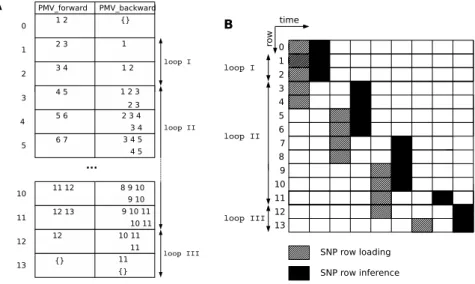
its update after inference is added to FIFOP M V _backward (line 27 pointing to line 16) so that it may be reused
asP M V (m′− L − 1), the head of the previous FIFO at the time of inference for row m′(m′= m + L + 1), at
line26. Figure 3 A shows on a simple example how the two FIFO lists are synchronized. Finally, theSNPblock loading manager (lines23 and 32) ensures that row i + L was also loaded for last row i in each newly loaded block
ofLOOPII. The preliminary loading of a block of2 × L + 1 rows, required by inference of row 0 andLOOPI, is crucial to the whole synchronization of theSNPblock loading manager with the inferring process under way. Note thatLOOPIII does not refer to forward dependencies. Figure3 B illustrates the synchronization between inference
and block loading.
Depending on the number of rows involved inLOOPII, the last iteration in this loop may require the loading of less thanR rows, which explains a special (trivial) treatment (lines 20 and 31 to 34).
Figure 2: A Synchronization of forward and backward FIFO lists; B Synchronization ofSNPblock loading manager and missing data inference;M = 14; L = 2; R = 4.
9
Algorithm 2KN N W inOpti(M, N, SN P, L, R)
Input and Output: in addition to those of algorithm , input parameter R, size of the SN P blocks to be successively loaded
Auxiliary variables:
P M V _backward, P M V _f orward: two F IF O lists initialized as empty lists
1: SN P← load_next_ranges(2L + 1)
2: W← 0
3: fori= 1 to L
4: P M V ← compute_P MV (i); add_queue(P MV _f orward, P MV ); W ← W + P MV
5: endfor
6: current_P M V _inf erred← inf erence_of _missing_markers(W ) inference for row 0
7: add_queue(PMV_backward, current_PMV_inferred)
8: previous_P M V ← current_P MV _inf erred
9:
10: fori= 1 to L //LOOPI
11: (1) current_P MV ← remove_head(P MV _f orward)
12: PMV_forward_aux← compute_PMV(m + L)
13: add_queue(PMV_forward, PMV_forward_aux)
14: W← W + previous_P MV − current_P MV + P MV _f orward_aux
15: (2) current_P MV _inf erred ← inf erence_of _missing_markers(W )
16: add_queue(PMV_backward, current_PMV_inferred)
17: previous_P M V ← current_P MV _inf erred
18: endfor
19:
20: (nb_loadings, lastIterApart, rest) ← compute_nb_SN P _block_loadings()
21:
22: fori= 1 to nb_loadings //LOOPII
23: SN P← load_next_ranges(R)
24: forj= 1 to R
25: process as in(1)
26: W← W + previous_P MV − current_P MV + P MV _f orward_aux − remove_head(PMV_backward)
27: process as in(2)
28: endfor
29: endfor
30:
31: iflastIterApart //LOOPII (end)
32: SN P← load_next_ranges(rest)
33: process as in lines23 through 27 (withrest instead of r)
34: endif
35:
36: form= 1 to L //LOOPIII
37: current_P M V ← remove_head(P MV _f orward)
38: W← W + previous_P MV − current_P MV − remove_head(P MV _backward)
39: current_P M V _inf erred← inf erence_of _missing_markers(W )
40: previous_P M V ← current_P MV _inf erred
10
Iterative bi-directional inference
In their method, Roberts and co-authors use a specific data structure, a mismatch accumulator array MMA, which is computed before performing inference. To be short, it plays the same role inW computation as the PMV vectors
aforementioned. However, since the MMA is calculated off-line, the inference for rowm will not benefit from
the inference for rows of lower ranks. That is, in all cases where distance∆m(i, j) is approximated as 1 if i or j
is equal to2, an update would possibly lead to a refined distance 0 or 1. We took this remark into account when
designing Algorithm 2, which is therefore not a simple transcription of Roberts and co-workers’ method merely augmented with block loading and FIFO list management. Indeed, we are careful that any newly inferred row is added to theP M V _backward list (line 15), so that the inference might be more accurate.
Moreover, this update concern allows further optimization. It was of no consequence for Roberts et al. to scan theSNPpanel from top to bottom (TB) or from bottom to top (BT) since contextWmdid not account of the results
of previous inference for rowsm − L to m − 1. Nonetheless, it is attractive to confront the result of aTBscan with that of aBTscan, in order to resolve the missingSNPs with more confidence, which is implemented in our second version,SNPShuttle. Thus, anySNPinferred as the same allele identifier by successiveTBandBTscans can be fixed. Any uncertainSNPwill remain tagged as "missing" until a further iteration yields identicalTBandBT
results. The entire process is to be iterated until a minimal percentage of missing data remains uncertain or until a maximal number of iterations is reached. TheSNP panel is successively cleared from its missing calls, starting with the markers easiest to guess and enriching the context ofSNPs more difficult to infer.
Algorithm 3 presents the scheme of SNPShuttle. At line 4, the call to top_to_bottom_scan procedure is
actually a call toKNNWinOpti. Similarly, callbottom_to_top_scan is applied on the currentSNPpanel inverted row per row.
Algorithm 3SN P Shuttle(M, N, SN P, L, R, τ )
Input and Output: in addition to those of algorithm , input parameter τ specifies the minimal percentage of missing data allowed to remain uncertain
1: modif ied← true; percentage_of _non_solved_SN P s ← 100
2: while(modif ied and (percentage_of _non_solved_SN P s > τ ))
3: modif ied← f alse
4: T B_inf erred_SN P s← top_to_bottom_scan(SN P )
5: BT _inf erred_SN P s← bottom_to_top_scan(SN P )
6: solved_SN P s← compare(T B_inf erred_SN P s, BT _inf erred_SN P s)
7: if(solved_SN P s is not empty)
8: updateW ith(SN P, solved_SN P s)
9: update(percentage_of _non_solved_SN P s)
10: modif ied← true
11: endif
12:endwhile
Conclusion
Roberts and co-authors precursory work provided a promising basis to gain accuracy with a simple algorithm. In this paper, we proposed a novel algorithm, based on iterative bi-directional parsing ofSNPpanels. We are currently implementing the two algorithms,KNNWinOpti andSNPShuttle. Also do we have to adaptKNNWinOpti (the core ofSNPShuttle) to obtain pre-processing software dedicated to the identification of the optimized window "half-size"L (the corresponding accuracy is computed for all non missing markers, temporarily considered as missing
calls and inferred). As chip resolution increase will also rise the number of SNPs available for each chromosome, it is crucial to implement SNP block loading, as we plan to do, if the software is intended to run on on standard computer. Finally, one of our future tasks is more thoroughly examining the idea of benefitting from previously inferred missing calls, locally relying on regions of high quality.
11
References
1. J Y Dai, I Ruczinski, M LeBlanc, and C Kooperberg. Imputation methods to improve inference in snp association studies. Genet Epidemiol, 30(8):690–702, 2006.
2. E Halperin and E Eskin. Haplotype reconstruction from genotype data using imperfect phylogeny.
Bioin-formatics, 20(12):1842–1849, 2004.
3. J Marchini, B Howie, S Myers, G McVean, and P Donnelly. A new multipoint method for genome-wide association studies by imputation of genotypes. Nature Genetics, 39:906–913, 2007. doi:10.1038/ng2088. 4. T Niu, Z S Qin, X Xu, and J S Liu. Bayesian haplotype inference for multiple linked single-nucleotide
polymorphisms. Am J Hum Genet, 70(1):157–169, 2002.
5. N Patil, A J Berno, D A Hinds, W A Barrett, J M Doshi, C R Hacker, C R Kautzer, D H Lee, C Marjoribanks, D P McDonough, B T Nguyen, M C Norris, J B Sheehan, N Shen, D Stern, R P Stokowski, D J Thomas, M O Trulson, K R Vyas, K A Frazer, S P Fodor, and D R Cox. Blocks of limited haplotype diversity revealed by high-resolution scanning of human chromosome 21. Science, 294(5547):1719–1723, 2001. 6. Z S Qin, T Niu, and J S Liu. Partition ligation expectation maximization algorithm for haplotype inference
with single nucleotide polymorphisms. Am J Hum Genet, 71(5):1242–1247, 2002.
7. A Roberts, L McMillan, W Wang, J Parker, I Rusyn, and D Threadgill. Inferring missing genotypes in large snp panels using fast nearest-neighbor searches over sliding windows. Bioinformatics, 23(13):i401–i407, 2007. doi:10.1093/bioinformatics/btm220.
8. P Scheet and M Stephens. A fast and flexible statistical model for large-scale population genotype data: applications to inferring missing genotypes and haplotypic phase. Am J Hum Genet, 78(4):629–644, 2006. 9. B Servin and M Stephens. Imputation-based analysis of association studies: candidate regions and
quanti-tative traits. PLoS Genetics, 3(7), 2007. e114.
10. S-C Su, C-C Jay Kuo, and T Chen. Inference of missing snps and information quantity measurements for haplotype blocks. Bioinformatics, 21(9):2001–2007, 2005.
11. Y V Sun and S L Kardia. Imputing missing genotypic data of single-nucleotide polymorphisms using neural networks. Eur J Hum Genet, 16(4):487–95, 2008.
12. Q Xie, L D Ratnasinghe, H Hong, R Perkins, Z-Z Tang, N Hu, P R Taylor, and W Tong. Decision for-est analysis of 61 single nucleotide polymorphisms in a case-control study of esophageal cancer; a novel method. BMC Bioinformatics, 6(2), 2005. doi:10.1186/1471-2105-6-S2-S4.
13. Z Yu and D J Schaid. Methods to impute missing genotypes for population data. Hum Genet,
122(5):495–504, 2007.
14. K Zhang, J Zhu, J Shendure, G J Porreca, J D Aach, R D Mitra, and G M Church. Long-range polony haplotyping of individual human chromosome molecules. Nature genetics, 38(3):382–387, 2006.
L
ABORATOIRE D’I
NFORMATIQUE DEN
ANTES-A
TLANTIQUEImprovement of missing genotype imputation
through bi-directional parsing of large SNP panels
Christine Sinoquet
Abstract
Such difficult analyses as disease association studies, which aim at mappping genetic variants underlying complex human diseases, rely on high-throughput genotyping techniques. However, a shortcoming of these techniques is the generation of missing calls. Computational inference of missing data represents a challenging alternative to genotyping again the missing regions. In this paper, we presentSNPShuttle, an algorithm designed to gain accuracy over a former method described by Roberts and co-authors [7] (NPUTE). Given anSNPpanel,NPUTEalgorithm infers missing data through a single parse, relying on local similarity within sliding windows. Instead,SNPShuttle scans anSNPpanel in an iterative bi-directional way, to resolve missing data with more confidence.
LINA, Université de Nantes 2, rue de la Houssinière