
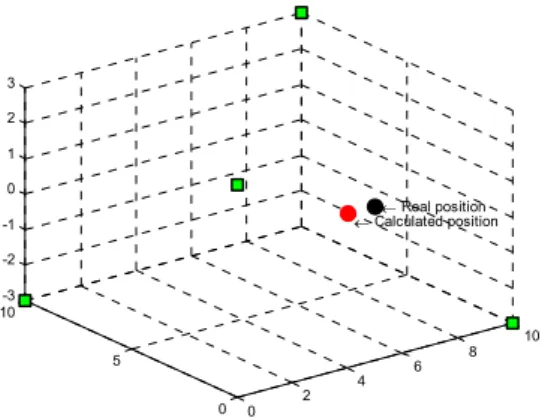
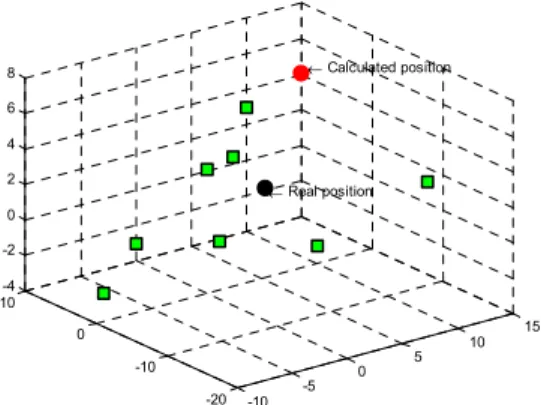
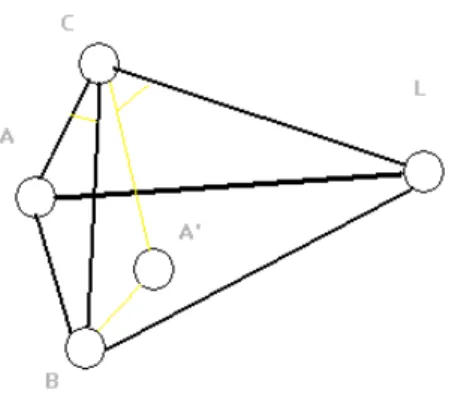
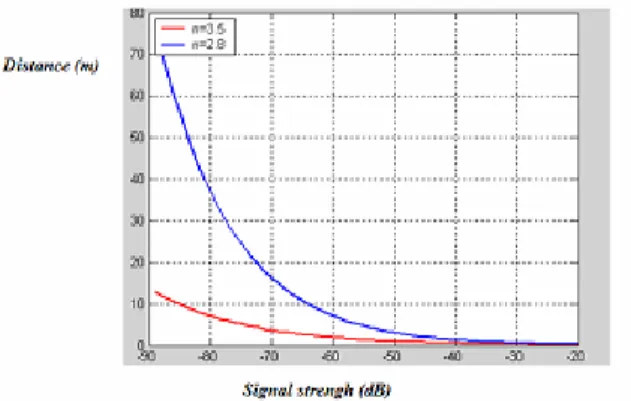
New techniques for indoor positioning, combining deterministic and estimation methods
Texte intégral
Figure
Documents relatifs
used in Barker et al. versus the Dirichlet via simulation. © Inra/Elsevier, Paris genetic distance / estimation / precision / Dirichlet3. Résumé - À propos de
In this figure, in a general manner, one can observe that the effect of the interactions on the capture width ratio are much stronger for the first body (which meets the wave
Among them, the four major knee ligaments (anterior and posterior cruciate ligaments, ACL and PCL, medial and lateral collateral ligaments, MCL and LCL, respec- tively), together
[2005], and Felzer and Brodsky [2006] all used a selection criterion to first select mainshocks, based on their relative isolation from previous, close‐by, large earthquakes, and
permutation, transposition, reduced expression, combinatorial dis- tance, van Kampen diagram, subword reversing, braid
Self positioning systems: the mobile node computes its own location by receiving the signals of different (anchored) trans- mitters whose locations are known Indirect remote
We will study algebraic hyper-surfaces on the real unit sphere S n − 1 given by an homogeneous polynomial of degree d in n variables with the view point, rarely exploited, of
In section 3, we use Theorem 1.1 to give an alternative proof for the proportional Dvoretzky-Rogers factorization; in the symmetric case, we recover the best known dependence
