Virologic therapy response significantly correlates with the number of
active drugs as evaluated using a LiPA HIV-1 resistance scoring system
Rainer Ziermanna, Linda Celisb, Inge Derdelinckxc, Christine Lambertd, Jurgen Veecke, Maria Gabriella Rizzof, Bart Vanderborghtg, Georges Zissish, Nathan Clumeckh, Katrien Franseni, Dolores Vairaj, David Hendricksa, Kristel Van Laethemc, Anne-Mieke Vandammec, Jean-Claude Schmitd, Heribert Knechtene, Andrea De Lucaf, Joost Louwagieb, Pascale Segersb, Kristel De Boeckb, Hans Pottelb, Annelies De Brauwerb, Frank Hulstaertb a Bayer HealthCare LLC, Diagnostics Division, 800 Dwight Way, Berkeley, CA 94710, USAbInnogenetics NV, Technologiepark 6, B-9052 Gent, Belgium
c Rega Instituut voor Medisch Onderzoek, Katholieke Universiteit Leuven, Minderbroederstraat 10, B-3000 Leuven, Belgium Centre de Recherche Public-Sante, Laboratoire de retrovirologie, Rue E Barbie 4, L-1210 Luxembourg, Luxemburg e Gemeinschaftspraxis, Blondelstrasse 9, D-52062 Aachen, Germany
Istituto di Clinica delle Malattie Infettive, Universita Cattolica del Sacro Cuore, Largo Francesco Vita 1,1-168 Roma, Italy
g Hospital Universitario Clementina Frago Filho, Av. Brigadeiro Trompowski 1, Cidade Universitaria, Ilha doFundao, CEP 21949-900, Rio de Janeiro, Brazil
AIDS Research Laboratory, UZ-Sint Pieter, Hoogstraat 322, B-1000 Brussel, Belgium i Instituut voor Tropische Geneeskunde, Nationalestraat 155, B-2000 Antwerpen, Belgium
jLaboratoire de Reference SIDA, Centre Hospitalier Universitaire Liege, Domaine Universitaire de Sart-Tilman, Bdtiment B23, B-4000 Liege, Belgium
Abstract
Background: Resistance testing is increasingly accepted as a tool in guiding the selection of human
immunodeficiency virus type 1 (HIV-1) antiretroviral therapy in HIV-1 infected individuals who fail their current regimen.
Objectives: To descriptively compare the correlation between virologic treatment response and results using
three genotypic HIV-1 drug resistance interpretation systems: the VERSANT® HIV-1 Resistance Assay (LiPA) system and two sequence-based interpretation systems.
Study design: Specimens from 213 HIV-1-infected subjects, either starting (n = 104) or switching to (n = 109) a
regimen of three or four anti retroviral drugs, were collected retrospectively at baseline and after 3 months of uninterrupted therapy. The correlation between viral load change and the number of predicted active drugs in the treatment regimen was assessed. An interpretation algorithm was recently developed to process VERSANT® HIV-1 Resistance Assay (LiPA) data. The number of active drugs predicted using this algorithm was rank correlated with the viral load change over a 3-month treatment period. For comparison, a similar calculation was made using two sequence-based algorithms (REGA version 5.5 and VGI GuideLines™ Rules 4.0), both applied on the same sequences.
Results: Statistically significant (p<0.05) correlation coefficients for each of the three HIV-1 drug resistance
interpretation systems were observed in the treatment-experienced subjects on a 3-drug regimen (-0.39, -0.38, and -0.42, respectively) as well as on a 4-drug regimen (-0.33, -0.31, and -0.37, respectively). However, no significant correlation was observed in treatment-naïve subjects, probably due to the very low frequency of drug resistance in these subjects.
Conclusion: All three genotypic drug resistance interpretation systems (LiPA version 1, REGA version 5.5, and
VGI GuideLines™ Rules 4.0) were statistically significantly correlated with virologic therapy response as measured by viral load testing.
Keywords: HIV-1; Antiretroviral drug resistance; Interpretation algorithm; Line probe assay
1. Introduction
Resistance testing is increasingly accepted as a tool in guiding the selection of human immunodeficiency virus type 1 (HIV-1) antiretroviral therapy in HIV-1 infected individuals who fail their current regimen (Hirsch et al., 2003; The EuroGuidelines Group for HIV Resistance, 2001). More recently, resistance testing has been recommended for acute or recent (i.e., within 12 months) infection and for treatment-naïve individuals with established infection as well (Hirsch et al., 2003; Little et al., 2002). Genotypic assays, including DNA sequencing and reverse-hybridization line probe techniques such as the line probe assay (LiPA), are currently used to identify mutations associated with reduced susceptibility to HIV-1 antiretroviral drugs (Schinazi et al., 2000). These tests require interpretation of the genotypic resistance profile results to aid treating physicians in making recommendations for therapy changes (Vandamme et al., 2001). For this reason, interpretation
algorithms have been developed for DNA sequencing-based systems.
The LiPA technique differs from sequencing in that it only detects specific mutations known to be associated with drug resistance and their respective wild-type sequences. Therefore, a LiPA-based HIV-1 drug resistance interpretation system was developed. To validate this interpretation system, well-defined clinical specimens from both treatment-naïve and treatment-experienced HIV-1 infected subjects were retrospectively analyzed in a multicenter study. The main objective of the study was to determine whetherthere was a correlation between the number of active drugs predicted using the LiPA system, based on VERSANT® HIV-1 Resistance Assay (LiPA) results, and viral load change over a 3-month treatment period. A similar correlation was calculated for two sequencing-based HIV-1 drug resistance interpretation systems (REGA version 5.5 (Van Laethem et al., 2002) and VGI GuideLines™ Rules 4.0).
2. Materials and methods
2.1. Plasma specimens from individuals infected with HIV-1
Stored ethylenediaminetetraacetic acid (EDTA) plasma specimens, collected from HIV-1-infected subjects at the time of therapy switch (n = 109) or therapy start (n = 104) between 1999 and 2001 (except for five specimens collected in 1998) in seven European centers and one in Brazil, were tested retrospectively. Only specimens with an HIV-1 concentration of 500 HIV RNA copies/ml or higher were included in the study. All highly active antiretroviral therapy (HAART) regimens consisted of combinations of three orfourof the following 15 drugs: zidovudine (ZDV or AZT), didanosine (ddl), zalcitabine (ddC), lamivudine (3TC), stavudine (d4T), aba-cavir (ABC), nevirapine (NVP), delavirdine (DLV), efavirenz (EFV), saquinavir (SQV), indinavir (IDV), nelfinavir (NFV), amprenavir (APV), ritonavir (RTV), and lopinavir (LPV). In case RTV was administered to boost other protease inhibitors, it was not counted as a separate drug.
Subjects remained on their new therapy for at least 3 months without treatment interruption. All of the specimens studied were obtained from individuals who, according to the clinical investigator, adhered to the prescribed treatment regimen during this period. Individuals whose treatment regimen had not been guided by genotypic results were preferentially selected (N= 124). Specimens from 89 additional individuals who had received genotype-directed therapy change were also selected.
Viral load data were available at baseline and after 3 months of therapy (range 2-6 months). The assays used to determine viral load included the Amplicor HIV-1 Monitor Assay (Roche, Basel, Switzerland), NucliSens-QT Assay (Organon Technika, Turnhout, Belgium), and branched DNA (bDNA) Quantiplex HIV Assay (Bayer Corporation, Tarry town, NY).
Different aliquots of the same specimens were used for DNA sequencing and LiPA testing. For most of the specimens obtained from treatment-naïve subjects, DNA sequencing was performed in parallel with LiPA testing, whereas for all specimens obtained from treatment-experienced subjects, DNA sequencing was performed prior to LiPA testing.
2.2. Systems for detecting HIV-1 drug resistance
2.2.1. LiPA system
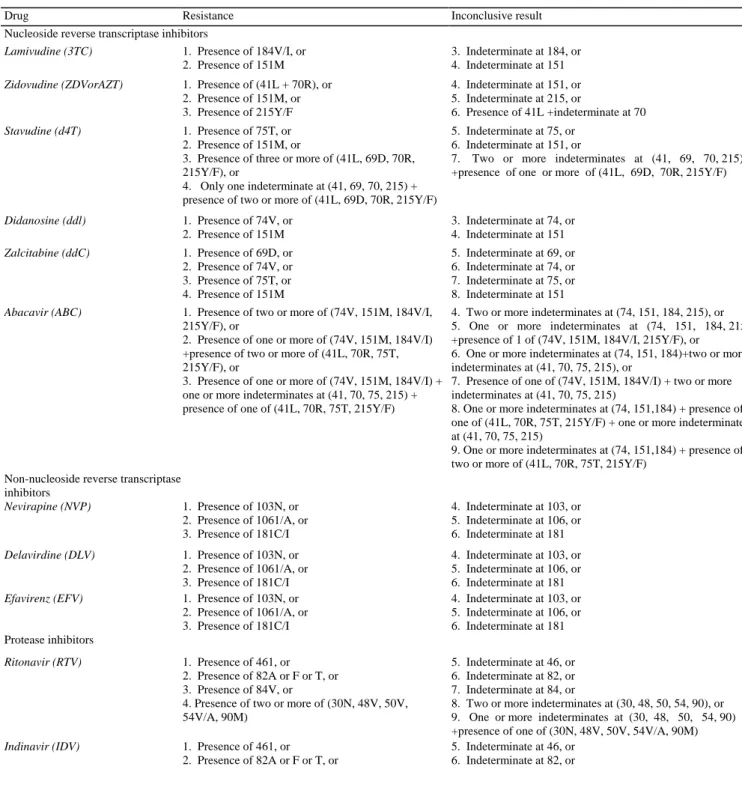
A recently developed interpretation algorithm for LiPA was applied to the results obtained with the VERSANT®
HIV-1 Resistance Assay (LiPA) and is presented in Table 1.
The three different VERSANT® HIV-1 Resistance Assay (LiPA) strips (designated PRO 30-84, PRO 90, and RT) contain oligonucleotide probes in lines for the wild type, mutant type, or polymorphisms at 19 selected codons of the protease and reverse transcriptase (RT) regions of the pol gene that are most frequently associated with drug susceptibility (Celis et al., 2002; De Smet et al., 2000). Extraction and RT-PCR was performed using the QIAamp® Viral RNA Mini kit and QIAGEN® OneStep RT-PCR kit (Qiagen, Westburg b.v, Leusden, The Netherlands) according to the manufacturer's instructions. Tests were performed using the VERSANT® HIV-1 RT Resistance (LiPA) and VERSANT® HIV-1 Protease Resistance (LiPA) Assays (Bayer Corporation, available for research use only) according to the manufacturer's instructions. All strips were run on the semi-automated
The LiPA interpretation system (version 1) processes VERSANT® HIV-1 Protease Resistance and VERSANT® HIV-1 RT Resistance (LiPA) Assay results and provides an output of "resistance, score = 0", "no indication of resistance, score =1", or "inconclusive result" associated with an indeterminate result on LiPA for each of 14 FDA-EMEA-approved drags at the time of the study, with the exception of LPV. The "inconclusive result" call for a given drag was scored as 0.9 in treatment-naïve subjects and as 0.5 in treatment-experienced subjects. This distinction was made because indeterminate results on LiPA are more likely to represent mutated codons in treatment-experienced subjects than in treatment-naïve ones. These scores were arbitrarily chosen. Indeterminate results are caused by non-hybridization of the amplicon to either wild type or mutant probes on the LiPA strips and are considered within the "inconclusive result" of the LiPA algorithm. The LiPA interpretation system was developed in collaboration with Dr. A. Vandamme and coworkers (Rega Institute, Leuven, Belgium) and three clinical experts in the field of HIV-1 drag resistance testing reviewed its rales.
Table 1 : LiPA interpretation algorithm version la
Drug Resistance Inconclusive result
Nucleoside reverse transcriptase inhibitors
Lamivudine (3TC) 1. Presence of 184V/I, or 2. Presence of 151M
3. Indeterminate at 184, or 4. Indeterminate at 151
Zidovudine (ZDVorAZT) 1. Presence of (41L + 70R), or 2. Presence of 151M, or 3. Presence of 215Y/F 4. Indeterminate at 151, or 5. Indeterminate at 215, or 6. Presence of 41L +indeterminate at 70 Stavudine (d4T) 1. Presence of 75T, or 2. Presence of 151M, or
3. Presence of three or more of (41L, 69D, 70R, 215Y/F), or
4. Only one indeterminate at (41, 69, 70, 215) + presence of two or more of (41L, 69D, 70R, 215Y/F)
5. Indeterminate at 75, or 6. Indeterminate at 151, or
7. Two or more indeterminates at (41, 69, 70, 215) +presence of one or more of (41L, 69D, 70R, 215Y/F)
Didanosine (ddl) 1. Presence of 74V, or 2. Presence of 151M 3. Indeterminate at 74, or 4. Indeterminate at 151 Zalcitabine (ddC) 1. Presence of 69D, or 2. Presence of 74V, or 3. Presence of 75T, or 4. Presence of 151M 5. Indeterminate at 69, or 6. Indeterminate at 74, or 7. Indeterminate at 75, or 8. Indeterminate at 151
Abacavir (ABC) 1. Presence of two or more of (74V, 151M, 184V/I, 215Y/F), or
2. Presence of one or more of (74V, 151M, 184V/I) +presence of two or more of (41L, 70R, 75T, 215Y/F), or
3. Presence of one or more of (74V, 151M, 184V/I) + one or more indeterminates at (41, 70, 75, 215) + presence of one of (41L, 70R, 75T, 215Y/F)
4. Two or more indeterminates at (74, 151, 184, 215), or 5. One or more indeterminates at (74, 151, 184, 215 +presence of 1 of (74V, 151M, 184V/I, 215Y/F), or 6. One or more indeterminates at (74, 151, 184)+two or more indeterminates at (41, 70, 75, 215), or
7. Presence of one of (74V, 151M, 184V/I) + two or more indeterminates at (41, 70, 75, 215)
8. One or more indeterminates at (74, 151,184) + presence of one of (41L, 70R, 75T, 215Y/F) + one or more indeterminates at (41, 70, 75, 215)
9. One or more indeterminates at (74, 151,184) + presence of two or more of (41L, 70R, 75T, 215Y/F)
Non-nucleoside reverse transcriptase inhibitors Nevirapine (NVP) 1. Presence of 103N, or 2. Presence of 1061/A, or 3. Presence of 181C/I 4. Indeterminate at 103, or 5. Indeterminate at 106, or 6. Indeterminate at 181 Delavirdine (DLV) 1. Presence of 103N, or 2. Presence of 1061/A, or 3. Presence of 181C/I 4. Indeterminate at 103, or 5. Indeterminate at 106, or 6. Indeterminate at 181
Efavirenz (EFV) 1. Presence of 103N, or 2. Presence of 1061/A, or 3. Presence of 181C/I 4. Indeterminate at 103, or 5. Indeterminate at 106, or 6. Indeterminate at 181 Protease inhibitors Ritonavir (RTV) 1. Presence of 461, or 2. Presence of 82A or F or T, or 3. Presence of 84V, or
4. Presence of two or more of (30N, 48V, 50V, 54V/A, 90M)
5. Indeterminate at 46, or 6. Indeterminate at 82, or 7. Indeterminate at 84, or
8. Two or more indeterminates at (30, 48, 50, 54, 90), or 9. One or more indeterminates at (30, 48, 50, 54, 90) +presence of one of (30N, 48V, 50V, 54V/A, 90M)
Indinavir (IDV) 1. Presence of 461, or 2. Presence of 82A or F or T, or
5. Indeterminate at 46, or 6. Indeterminate at 82, or
Table 1 (Continued)
Drug Resistance Inconclusive result
3. Presence of 84V, or
4. Presence of two or more of (30N, 48V, 50V, 54V/A, 90M)
7. Indeterminate at 84, or
8. Two or more indeterminates at (30, 48, 50, 54, 90), or 9. One or more indeterminates at (30, 48, 50, 54, 90) +presence of one of (30N, 48V, 50V, 54V/A, 90M)
Saquinavir (SQV) 1. Presence of 48V, or 2. Presence of 90M, or
3. Presence of two or more of (30N, 461, 50V, 54V/A, 82A/F/T, 84V, 90M)
4. Indeterminate at 48, or 5. Indeterminate at 90, or
6. Two or more indeterminates at (30, 46, 50, 54, 82, 84, 90), or 7. One or more indeterminates at (30, 46, 50, 54, 82, 84, 90) + presence of one of (30N, 461, 50V, 54V/A, 82A/F/T, 84V, 90M)
Nelfinavir (NFV) 1. Presence of 30N, or 2. Presence of 82A, or 3. Presence of 90M, or
4. Presence of two or more of (461, 48V, 50V, 54V/A, 82F/T, 84V)
5. Indeterminate at 30, or 6. Indeterminate at 82, or 7. Indeterminate at 90, or
8. Two or more indeterminates at (46, 48, 50, 54, 82, 84), or 9. One or more indeterminates at (46, 48, 50, 54, 82, 84) +presence of one of (461, 48V, 50V, 54V/A, 82F/T, 84V)
Amprenavir (APV) 1. Presence of 50V + one or more of (461, 54V/A, 82A/F/T, 84V, 90M), or
2. Presence of two or more of (461, 54V/A, 82A/F/T, 84V, 90M)
3. Indeterminate at 50 + one or more indeterminates at (46, 54, 82, 84, 90), or
4. Indeterminate at 50 +presence of one of (461, 54V/A, 82A /F/T, 84V, 90M), or
5. Presence of 50V + one or more indeterminates at (46, 54, 82, 84, 90), or
6. Two or more indeterminates at (46, 54, 82, 84, 90), or 7. One or more indeterminates at (46, 54, 82, 84, 90) +presence of one of (461, 54V/A, 82A/F/T, 84V, 90M)
a For each of the drugs, the rules have to be applied in numerical order.
The VERSANT® HIV-1 Protease and RT Resistance Assay (LiPA) data were generated at four European and one Brazilian center and interpretation of drag resistance was performed at Innogenetics (Gent, Belgium). 2.2.2. Sequencing-based systems
Sequencing was performed using the TRUGENE™ HIV-1 Genotyping kit (Visible Genetics Inc., Toronto, Canada), the ViroSeq™ HIV-1 Genotyping System (version 2) (Applied Biosystems, Foster City, CA), each according to the manufacturer's instructions, or home-brew assays.
The REGA interpretation algorithm (version 5.5 (Van Laethem et al., 2002)) and the VGI interpretation
algorithm (GuideLines™ Rules 4.0; TRUGENE™ HIV-1 Genotyping kit, VG30220 version date 10 April 2001, Visible Genetics Inc., Product insert Appendix III) were designed to determine the presence of resistance to a given antiretrovi-ral drag based on sequence data, thus allowing prediction of the number of active drags in a given regimen. An intermediate level of resistance (REGA) or possible resistance (VGI) was scored as 0.5 fortius calculation in both treatment-experienced and treatment-naïve subjects (De Luca et al., 2001; Van Laethem et al., 2002). The different assignment of scores for the treatment-naïve subjects between the "intermediate" results in the sequence-based algorithms (0.5) and the "inconclusive" results in the LiPA
algorithm (0.9) is due to the fact that "intermediate" results using REGA and VGI are determined by interpreting genotypic profiles obtained by the sequencing assays whereas "inconclusive" results based on LiPA are in part the result of a lack of either wild type or mutation reactivity on the LiPA strips. Such lack of reactivity is not due to the presence of intermediate resistance, but to sequence variability in the probe region, which is estimated to be less likely accompanied by the presence of resistance mutation at the tested position. The scoring system was designed prior to the study reported here.
2.3. Correlating number of predicted active drugs with viral load change
For each 3- or 4-drug regimen, a sum of scores or "predicted number of active drugs" was calculated for the three systems studied. In the analysis of the data generated with the LiPA algorithm, LPV was always considered to be active, because the HIV-1 Protease Resistance Assay, in its current form, does not contain sufficient codon information to assess LPV drug resistance.
The absolute viral load change was defined as the log viral load of follow-up specimen minus the log viral load of baseline specimen. When the viral load of a specimen was below the lower detection limit, the detection limit itself was taken as the viral load. These lower detection limits were dependent on the assay used by the different centers and ranged from 40 to 500 HIV-1 RNA copies/ml.
The correlationbetween the number of active drugs as predicted by the interpretation systems and the change in viral load was assessed by non-parametric techniques (Spearman rank correlation with 95% confidence
intervals); no linear or other predefined relationship was assumed. Because there were three or four antiretroviral drugs in the regimen, and because the intention of the study was to focus on the variability associated with drug resistance, stratification of the analysis for the number of drugs in the regimen was required. In addition, analyses were performed separately for treatment-experienced and treatment-naïve populations.
Power analysis suggested that a minimum sample size of 73 was needed to show that a rank correlation of 0.3 was significantly different from zero with a power of 80%. This 0.3 rank correlation coefficient was expected based on results in treatment-experienced patients published by De Luca et al. (2003). Because of the low frequency of HIV-1 resistance in treatment-naïve patients, the assumptions for a standard power calculation were not fulfilled in this group.
3. Results
3.1. Study subjects and specimen disposition
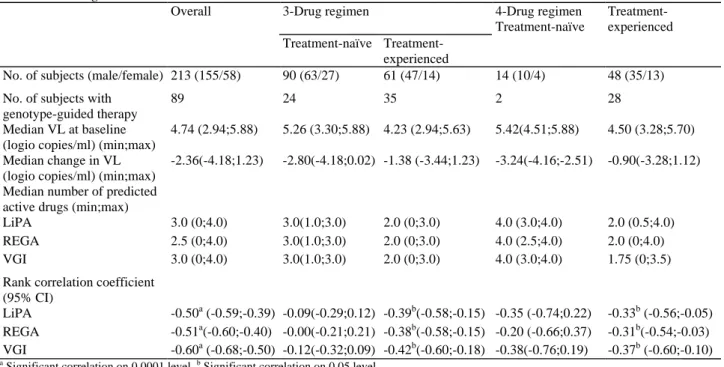
Specimens were collected from 213 subjects (Table 2), of whom 155 were males and 58 females. The mean age of the subjects was 38.8 ± 10.2 years and 68.5% were infected with HIV-1 subtype B. On average, the specimens for HIV-1 resistance testing and follow-up viral load measurement were collected 31 days before and 95 days after the start or switch of the treatment regimen. The drugs most frequently included in the treatment regimen of the treatment-experienced population were d4T (58%), LPV (43.1%), ddl (40.4%), 3TC (38.5%), and ABC (34.9%). In the regimen of the treatment-naïve population, 3TC (84.5%), ZDV (62.1%), IDV (39.8%), d4T (38.8%), and NFV (25.2%) were most common. The treatment-experienced group had been previously exposed to an average of seven antiretroviral drugs. Amplification success rates (initial and repeat testing) were 89.4% and 97.8% for PRO 30-84,89.8%and 97.7%for PRO 90, and 92.3%and 98.9% for RT, respectively. The amplification success rates were calculated based on a larger group of patient samples (N= 290), which included all study samples.
Table 2: Study population demographics and correlation between number of predicted active drugs and absolute viral load change
Overall 3-Drug regimen 4-Drug regimen
Treatment-naïve
Treatment-experienced naïve
Treatment-experienced
No. of subjects (male/female) 213 (155/58) 90 (63/27) 61 (47/14) 14 (10/4) 48 (35/13)
No. of subjects with genotype-guided therapy
89 24 35 2 28
Median VL at baseline (logio copies/ml) (min;max)
4.74 (2.94;5.88) 5.26 (3.30;5.88) 4.23 (2.94;5.63) 5.42(4.51;5.88) 4.50 (3.28;5.70) Median change in VL
(logio copies/ml) (min;max)
-2.36(-4.18;1.23) -2.80(-4.18;0.02) -1.38 (-3.44;1.23) -3.24(-4.16;-2.51) -0.90(-3.28;1.12) Median number of predicted
active drugs (min;max)
LiPA 3.0 (0;4.0) 3.0(1.0;3.0) 2.0 (0;3.0) 4.0 (3.0;4.0) 2.0 (0.5;4.0)
REGA 2.5 (0;4.0) 3.0(1.0;3.0) 2.0 (0;3.0) 4.0 (2.5;4.0) 2.0 (0;4.0)
VGI 3.0 (0;4.0) 3.0(1.0;3.0) 2.0 (0;3.0) 4.0 (3.0;4.0) 1.75 (0;3.5)
Rank correlation coefficient (95% CI)
LiPA -0.50a (-0.59;-0.39) -0.09(-0.29;0.12) -0.39b(-0.58;-0.15) -0.35 (-0.74;0.22) -0.33b (-0.56;-0.05)
REGA -0.51a(-0.60;-0.40) -0.00(-0.21;0.21) -0.38b(-0.58;-0.15) -0.20 (-0.66;0.37) -0.31b(-0.54;-0.03)
VGI -0.60a (-0.68;-0.50) -0.12(-0.32;0.09) -0.42b(-0.60;-0.18) -0.38(-0.76;0.19) -0.37b (-0.60;-0.10)
a
Significant correlation on 0.0001 level. b Significant correlation on 0.05 level. .
3.2. Correlation between change in viral load and number of predicted active drugs
The baseline viral load, change from baseline, and the average number of predicted active drugs determined by the LiPA, REGA, and VGI interpretation systems are presented in Table 2. Not unexpectedly, median viral load and change in viral load was highest in the treatment-naïve group.
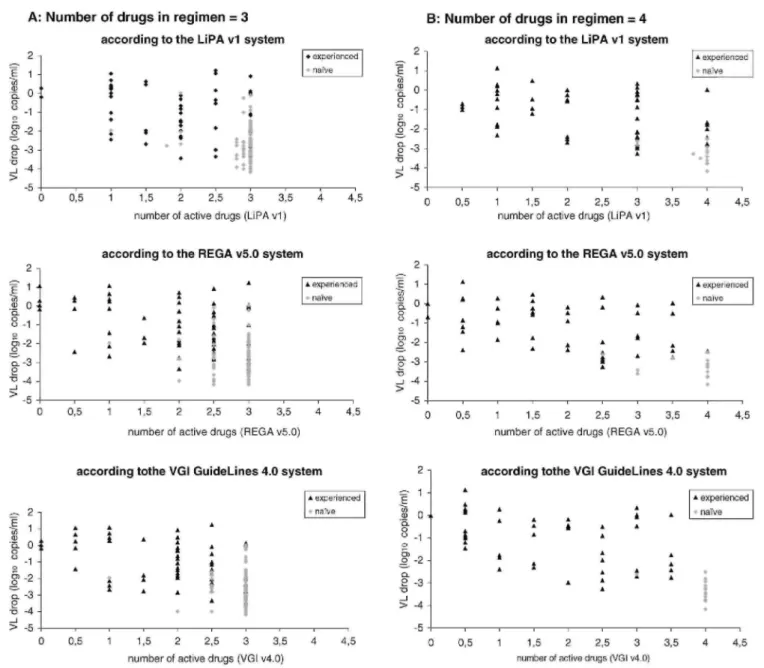
The relationship between viral load change and number of predicted active drugs, according to each interpretation system, is illustrated in Fig. 1. The number of active drugs, as predicted by LiPA or sequence-based algorithms, has been rank-correlated with the absolute viral load decline. Table 2 shows the Spearman correlation coefficient for the populations studied (treatment-naïve or treatment-experienced individuals on a 3- or 4-drug regimen). All correlations were significantly different from zero, except for the analyses performed for the two groups of treatment-naïve subjects.
A relatively small number of discordances for each drug were observed between the calls of the different systems. Minor discordance rates (resistance or no evidence for resistance according to one system, intermediate or possible resistance according to the other) were similar (15-20%) when any set of two systems was compared for treatment-experienced patients. For treatment-naïve patients these scores were 8.9%, 2.7%, and 11.5% for LiPA versus REGA, LiPA versus VGI, and VGI versus REGA, respectively. Major discordance rates (resistant by one, sensitive by the other) were on average higher when the LiPA system was compared to either sequencing system (1.3% and 14.3% versus REGA and 1.8% and 16.0% versus VGI for naïve and experienced patients, respectively), than when the two sequencing systems were compared to each other (0.8% and 1.1% for naïve and experienced patients, respectively). The LiPA results were inconclusive in ± 11% of all cases, this number was somewhat higher in experienced patients compared to the naïve patients.
4. Discussion
Interpretation algorithms based on genotyping results are essential in order to convert the complex genotypic data sets into information that can be used to predict antiretroviral drug resistance. The VER ANT® HIV-1 Protease Resistance and VERSANT® HIV-1 RT Resistance (LiPA) Assays identify the presence or absence of mutations at 19 codons in the protease and RT regions of the pol gene. The version 1 LiPA interpretation system is applicable to 14 of the 20 currently approved antiretroviral drugs. The version 1 LiPA system does not predict Lopinavir resistance; therefore, all specimens were considered to be sensitive to this drug. In this study,
resistance to Lopinavir was a rare occurrence, observed in specimens from only 4/109 and 0/109 treatment-experienced subjects as determined by the REGA and VGI algorithms, respectively. Thus, although the lack of a Lopinavir score limits the use of the current version 1 LiPA interpretation system, the fact that hardly any Lopinavir resistance was noticed by the other systems supports the fairness of the current comparison. As mentioned earlier, at the time of the study, emtricitabine, enfuvirtide, atazanavir, and tenofovir were not approved and no study subjects were receiving these drugs.
In this study, the LiPA-based interpretation system was evaluated by calculating the correlation between viral load change and the number of predicted active drugs and by comparing the LiPA correlation with correlations based on the use of two routinely used sequence-based interpretation systems. Because this study was not designed to prove equivalence, only a descriptive comparison of the correlation coefficients and confidence intervals could be performed. We found a statistically significant correlation between viral load change and the number of active drugs predicted by the version 1 LiPA interpretation system in the treatment-experienced population. The correlation coefficients obtained with the LiPA system were similar to those obtained for the same population using DNA sequencing followed by interpretation with either of the two published algorithms. It should be noted that VGI Guidelines™ Rule has been updated to 7.0 as of August 2003, while the Rega System was updated to 6.2 by November 2003. No comparisons between the LiPA Assay and the more recent sequence based systems have been performed, therefore, the types and rates of discrepancies between the interpretation systems may currently be different. The purpose of the study was however not to document discrepancies, but to evaluate the performance of the LiPA HIV-1 drug resistance interpretation system. Compared to the treatment-experienced group, a very low frequency of drug resistance was observed in the treatment-naïve population with all of the three systems under study. As a result, nearly all naïve subjects had a susceptibility score of three or higher. Because of the lack of a significant number of results with a score lower than three, no statistically significant correlation with viral load change was obtained. It should therefore not be concluded from these results that these three systems are not appropriate for genotyping a naïve population.
Our observation of a correlation between viral load change and the number of active drugs in the treatment-experienced group does not unequivocally demonstrate the clinical utility of the LiPA system. Only randomized prospective trials can provide a conclusive insight into the relative clinical benefit value of interventions based on different systems for predicting HIV-1 drug resistance, as has been demonstrated for sequence-based and phenotypic systems (Baxter et al., 2000; Clevenbergh et al., 2000; Cohen et al., 2002; Durant et al., 1999; Tural et al., 2002). The current results however support further efforts to investigate such clinical benefit of the version 1 LiPA Assay, or any other assay, which measures only a selected number of resistance mutations. The
correlation models used in this study to evaluate systems for detecting HIV-1 drug resistance have limitations, similar as other studies reported so far. The change in HIV-1 viral load is an accepted indicator of response to antiretroviral treatment. In this study, a treatment period of 3 months, with a range of 2-6 months, was selected. This is a sufficient time period to observe a drug effect, although for most subjects, no adaptation to the treatment regimen, i.e., the development of mutations linked to drug resistance, would be expected in this relatively short time period.
Fig. 1. Correlation between viral load change and number of active drugs: (A) correlation between viral load
change and number of active drugs for treatment-experienced (♦) and treatment-naïve ( ) subjects on a 3-drug regimen, as assessed by the three interpretation systems; (B) correlation between viral load change and number of active drugs for treatment-experienced (▲) and treatment-naïve ( ) subjects on a 4-drug regimen, as assessed by the three interpretation systems.
The interpretation of the correlation coefficients is not straightforward. Although statistically significant, these correlation coefficients only explain a fraction of the variation in viral load change. This is a general observation in studies investigating clinical validation of interpretation systems (De Luca et al., 2003). A number of
parameters that are known to contribute to the relationship between the predicted effectiveness of the treatment regimen and the observed change in plasma viral load are not measured in such studies. For example, differences in intrinsic antiretroviral activity, absorption, distribution, and metabolism between the drugs were not taken into account. Ritonavir-boosted and non-boosted protease inhibitors were scored in the same way. Treatment-adherence assessments, such as the one applied here, are of limited value. However, these limitations applied equally to all of the HIV-1 resistance systems evaluated in our study, thus enabling a comparative analysis to be made. We have also observed that the correlation coefficients varied between the different centers (data not shown). Variables that can influence these results include differences between centers in terms of treatment adherence, the use of HIV-1 drug resistance information to guide therapy, or the data included in the case history. These findings indicate that caution should be taken when interpreting resistance data, irrespective of the system used.
The number of major discordances (i.e., resistant versus sensitive) between the LiPA and the two sequence interpretation systems was larger than between the two sequence-based interpretation systems. However, a possible bias during PCR amplification should be taken in account. The same sequencing result was used in both sequencing interpretation systems, whereas the LiPA interpretation was applied to LiPA data that resulted from a separate PCR amplification step. The "inconclusive result" calls, arbitrarily scored in between "no evidence of resistance" and "resistant", did not seem to have a major negative impact. The consequence of such inconclusive results for drug selection remains to be evaluated in a prospective study.
Although the LiPA Assay provides information for a limited number of key mutations only, results were similar to the other two widely used sequence-based systems in this study. Several studies using retrospective data have reported on the ability of the LiPA RT strip assay to predict treatment failure (Brites et al., 2001; Setti et al., 2001; Van Vaerenbergh et al., 2000) and to estimate the prevalence of RT mutations in a population of treatment failures (Tanuri et al., 2002). Although the LiPA Assay does not have the flexibility of the sequence-based systems, it does include most of the key mutations with a few notable exceptions such as K65R a mutation which was quite rare at the time of sampling, which was before the use of tenofovir. Because of its ease of use and sensitivity in detecting low frequency drug-resistant variants, this assay could be used for testing individuals with primary infection, treatment-naïve individuals with established infection, and pregnant women. In conclusion, we have demonstrated a significant correlation between the number of active drugs predicted using a LiPA-based HIV-1 drug resistance interpretation system, and change in viral load. This correlation was similar to those obtained using two sequence-based interpretation systems, despite the difference in starting paradigm between the systems.
Acknowledgements
The authors gratefully acknowledge the assistance of Dr. Jan Brissinck, Barbara Judson, Fred Shapiro, and Tessa James for revising the manuscript and for editorial comments. The authors also wish to thank Sergio Garcia Ribas (Instituut voor Tropische Geneeskunde, Antwerpen), Marc Van Ranst (AIDS Reference Laboratory, Leuven), and Eric Van Wijn-gaerden (AIDS Reference Center, Leuven) for their valuable contribution to the study. Drs. C Boucher, R. D'Aquila, and D. Richman are thanked for reviewing the LiPA algorithm rules.
References
Baxter JD, Mayers DL, Wentworth DN, et al. A randomized study of antiretroviral management based on plasma genotypic antiretroviral resistance testing in patients failing therapy. CPCRA 046 Study Team for the Terry Beirn Community Programs for Clinical Research on AIDS. AIDS 2000;14:F83-93.
Brites C, Bahia F, Gilbert M, et al. Evaluation of viral resistance to reverse transcriptase inhibitors (RTI) in HIV-1-infected patients before and after 6 months of single or double antiretroviral therapy. Braz J Infect Dis 2001;5:177-82.
Celis L, Schmit JC, Kaye S, et al. Performance analysis of the VERSANT® HIV-1 RT Resistance Assay (LiPA). In: Proceedings of the 6th International Congress on Drug Therapy in HIV Infection; 2002 [Abstract].
Clevenbergh P, Durant J, Halfon P, et al. Persisting long-term benefit of genotype-guided treatment for HIV-infected patients failing HAART The Viradapt Study: week 48 follow-up. Antivir Ther 2000;5:65-70.
Cohen C, Hunt S, Sension M, et al. A randomized trial assessing the impact of phenotypic resistance testing on antiretroviral therapy. AIDS 2002;16:579-88.
De Luca A, Cingolani A, Di Giambenedetto S, et al. Variable prediction of antiretroviral treatment outcome by different systems for interpreting genotypic human immunodeficiency virus type 1 drug resistance. J Infect Dis 2003;187:1934-13.
De Luca A, Cingolani A, Trotta MP, et al. Prediction of virological and immunological outcomes by different interpretation systems for genotypic resistance in a cohort of highly active antiretroviral therapy-failed patients. Antivir Ther 2001;6(Suppl 1):70.
De Smet K, Celis L, Schmit JC, et al. Identification of key mutations in the HIV-1 protease using the INNO-LiPA HIV protease assay. In: Proceedings of the 2nd Frankfurt Symposium on the Clinical Implications of HIV Drug Resistance; 2000 [Abstract 50].
Durant J, Clevenbergh P, Halfon P, et al. Drug-resistance genotyping in HIV-1 therapy: the VIRADAPT randomised controlled trial. Lancet 1999;353:2195-9.
Hirsch MS, Brun-Vezinet F, Clotet B, et al. Antiretroviral drug resistance testing in adults infected with human immunodeficiency virus type1: 2003 recommendations of an International AIDS Society-USA Panel. Clin Infect Dis 2003;37:113-28.
Little SJ, Holte S, Routy JP, et al. Antiretroviral-drug resistance among patients recently infected with HIV. N Engl J Med 2002;347:385-92 Schinazi RF, Larder BA, Mellors JW. Mutations in retroviral genes associated with drug resistance: 2001 update. Int Antivir News 2000;8:65-91.
Setti M, Bruzzone B, Ansaldi F, et al. Identification of key mutations in HIV reverse transcriptase gene can influence the clinical outcome of HAART. J Med Virol 2001;64:199-206.
Tanuri A, Caridea E, Dantas MC, et al. Prevalence of mutations related to HIV-1 antiretroviral resistance in Brazilian patients failing HAART. J Clin Virol 2002;25:39-16. The EuroGuidelines Group for HIV Resistance. Clinical and laboratory guidelines for the use of HIV-1 drug resistance testing as part of treatment management: recommendations for the European setting. AIDS 2001;15:309-20.
Tural C, Ruiz L, Holtzer C, et al. Clinical utility of HIV-1 genotyping and expert advice: the Havana trial. AIDS 2002;16:209-18. Van Laethem K, De Luca A, Antinori A, Perno CF, Vandamme AM. A genotypic drug resistance interpretation algorithm that significantly predicts therapy response in HIV-1 infected patients. Antivir Ther 2002;7:123-9.
Van Vaerenbergh K, Van Laethem K, Van Wijngaerden E, et al. Baseline HIV type 1 genotypic resistance to a newly added nucleoside analog is predictive of virologic failure of the new therapy. AIDS Res Hum Retroviruses 2000;16:529-37.
Vandamme AM, Houyez F, Banhegyi D, et al. Laboratory guidelines for the practical use of HIV resistance tests in patient follow-up. Antivir Ther 2001;6:21-39.