Analysis of the Technical/Economic Performance of Four Cropping Systems
Involving Jatropha curcas L. in the Kinshasa Region (Democratic Republic of
the Congo)
J.D. Minengu1, P. Mobambo1& G. Mergeai2
Keywords:Jatropha Crop combinations Yield Family farm income Kinshasa DR Congo
Résumé
Analyse
des
performances
technico
économiques de quatre systèmes de
culture basés sur la production de
Jatropha curcas L. dans la région de
Kinshasa (RDC)
Afin d’évaluer la durabilité de la production de
Jatropha curcas L. dans la partie rurale de la région
de Kinshasa, quatre systèmes de culture de la plante ont été comparés: la culture pure de J.
curcas avec et sans engrais, l’association de J. curcas avec des cultures vivrières (maïs Zea mays
L., haricot commun Phaseolus vulgaris L.) avec et sans engrais. Les fortes attaques de ravageurs (principalement Aphthona sp.) subies par les plantes de J. curcas dans la région rendent indispensable la réalisation d’au moins deux traitements insecticides par an. Les rendements en graines sèches de J. curcas obtenus en 4ème année
de culture s’élevaient respectivement à 753 kg ha1
en culture pure de J. curcas sans engrais, 797 kg ha1 en cultures associées sans engrais, 1158 kg
ha1 en culture pure de J. curcas avec engrais et
1173 kg ha1en cultures associées avec engrais. Les
rendements des cultures vivrières n’ont pas été améliorés par l’application d’engrais. Ils s’élevaient en moyenne à 815 kg ha1 pour le maïs et 676 kg
ha1 pour le beans commun. La rentabilité de
l’association de J. curcas avec le maïs et le beans commun est meilleure que la culture pure de J.
curcas. Le revenu agricole d’un ha de cette
association s’élève respectivement à 1102 USD ha1
sans engrais et à 1049 USD ha1 avec engrais.
L’exploitation durable de J. curcas dans les conditions d’étude nécessite la mise au point de méthodes efficaces de contrôle des adventices et des ravageurs et d’amélioration de la fertilité du sol
minimisant l’emploi d’engrais minéraux.
Summary
In order to assess the sustainability of cultivating
Jatropha curcas L. in rural areas in the Kinshasa
region, four cropping systems were compared: cultivation of J. curcas as a sole crop with and without fertilisers, a combination of J. curcas with subsistence crops (maize Zea mays L., the common bean Phaseolus vulgaris L.) with and without fertilisers. The major attacks by pests (mainly Aphthona sp.) suffered by J. curcas plants in the region make it vital to conduct at least two insecticide treatments per year. Dry seed yields of
J. curcas obtained in the 4th year of cultivation
amounted to 753 kg ha1 when J. curcas was
cultivated as a sole crop without fertilisers, 797 kg ha1 for intercropping without fertilisers, 1158 kg
ha1when J. curcas was cultivated as a sole crop
with fertilisers and 1173 kg ha1 for intercropping
with fertilisers. Yields from the two annual crops were not improved by the application of mineral fertilisers on the J. curcas plants. They amounted to an average of 815 kg ha1for maize and 676 kg ha1
for the beans. It is more profitable to cultivate J.
curcas with maize and beans than to cultivate it as
a sole crop. By combining crops in this way, a one
hectare farm can earn 1102 USD ha1 without
fertilisers and 1049 USD ha1 with fertilisers.
Sustainable cultivation of J. curcas under the test conditions requires the development of efficient weed/pest control methods and improved soil
fertility management, in order to
minimise the use of mineral fertilisers.
1University of Kinshasa, Faculty of Agricultural Sciences, Kinshasa, Democratic Republic of the Congo.
2University of Liege, Gembloux AgroBio Tech, Laboratory of Tropical Crop Husbandry and Horticulture, Gembloux, Belgium
.
*Corresponding author: Email: [email protected]Introduction
Jatropha curcas L. is a plant from the
Euphorbiaceae family and comes from Central America. It was introduced to the Cap Verde islands by Portuguese sailors in the 16th century, followed by GuineaBissau. It later spread across Africa and Asia. It is cultivated in the tropical regions of the world (4). With its seeds rich in oil (35% on average) with a high fuel value, J. curcas has attractive characteristics for agrofuel production. However, the development of J. curcas plants and yields are low in most regions where it is grown (15). Some authors state that J. curcas can be cultivated on marginal land without the use of inputs (16, 19).
The Batéké Plateau near Kinshasa is an ideal place for testing the possibilities opened up by the cultivation of J. curcas, in terms of making full use of largely infertile land in a humid tropical climate. Using the soil for cultivation in this area actually leads to a rapid fall in its fertility, due to the mineralisation of the humus accumulated during fallow time. Different J. curcas cropping systems co exist in this area, which are characterised by cultivation of this crop alone or in intercropping with subsistence crops (mainly the common bean
Phaseolus vulgaris L. and maize Zea mays L.) and
the quantity of mineral fertilisers used. This article aims to assess the technical/economic performance of the four cropping systems used for
J. curcas cultivation (sole cropping with and without
fertilisers; intercropping with maize, followed by beans with and without fertilisers) on a 4year old plantation established in poor quality soil in rural areas in the province of Kinshasa.
Materials and methods
Characteristics of the study site
The study site is located on the Batéké Plateau (4°47’ latitude south, 16°12’ longitude east) at an altitude of 684 m. The plantation was set up after a short fallow period (5 years) on an area covering 3 ha in December 2007 in very poor soil, the arable horizon of which consisted of 94.2% sand (48.7% coarse sand 0.2–2 mm, 45.5% fine sand 0.05–0.2 mm), 1.4% silt (1.1% coarse silt 0.02–0.05 mm,
0.3% fine silt 0.002–0.02 mm), 3.3% clay (<0.002 mm), 5.3 g/kg organic carbon and 1.1% humus, with a pH of 5.3. The climate belongs to the AW4 type, according to Köppen’s classification system. This humid tropical climate is characterised by a rainy season that lasts from midSeptember until midMay and is interrupted by a brief dry season between midJanuary midFebruary. The first part of the rainy season occurring before the short dry season is called “season A” and the second part of the rainy season occurring after the short dry season is called "season B”. The long dry season lasts four months – from midMay until mid September. The average annual temperature is 25 °C and rainfall fluctuates at around 1500 mm/year (18). Plant formations on the Batéké Plateau consist mainly of shrub savannahs, which alternate with grassy savannahs (23).
Composition and arrangement of test plots
The study was conducted on a plantation established on completely flat terrain. The planting density was 2500 plants per ha1 (2 m x 2 m). The planting materials consisted of plants grown from seedlings from seeds collected from a Mwabo ecotype (Bandundu Province in the DRC), which were grown for 3 months in a nursery. In order to increase the number of shoots, the J. curcas plants were pruned twice using the method advocated by Henning (12).
No inputs were used on the plants, which were not combined with other crops in the first two years after planting. Dry seed yields of J. curcas obtained during the first three years, after the plantation was established, rose to 97 kg ha1in the first year, 182 kg.ha1 in the second year and 372 kg ha1 in the third year. In April 2011, the total area of the plantation was divided into four 0.5 ha plots (100 m x 50 m) on which the treatments indicated in Table 1 were applied in a random fashion. Mineral fertilisers (50 kg urea.ha1 and 50 kg NPK 171717 ha1) were applied on 5 April 2011 within 30 cmradius circles at the foot of each J. curcas plant. As the canopy of J. curcas was still far from covering all the soil, 4 years after the plantation was established, the space left free made it possible to plant intercrops (Figure 1).
Local varieties of the common bean (semierect dwarf variety from the Lower Congo, 10 April 2011) and maize (local population from the Batéké Plateau) were sown as intercrops on 3 October 2011, with 5 lines of beans (83,500 plants.ha1 – 0.3 m x 0.3 m) between two lines of J. curcas and 4 lines of maize (40,200 plants ha1– 0.5 m x 0.4 m)
between two lines of J. curcas.
Morphological observations and yields
The root collar diameter, plant height (main stem length) and total number of branches were measured on 3 April 2011 (first measurement) and 15 February 2012 (second measurement) on 125 J.
curcas plants from each experimental unit. The dry
seed yields of J. curcas, beans and maize were measured, after harvesting all the plants from each plot.
Calculation of technical/economic performance
This evaluation of the technical/economic performance of the different systems used to cultivate J. curcas is based on Dufumier’s method (7). The amortisation period for J. curcas plantation
has been estimated at 30 years (4). For agricultural tools and drying racks, the amortisation period has been estimated at 5 and 2 years, respectively.
Validation of results
The study site is representative of the most unfavourable cultivation conditions on the plateau, in terms of soil fertility and pest pressure (Aphthona sp. and Stomphastis thraustica Meyrick). In order to compare the results measured during the test to those obtained for J. curcas crops at other locations in the region, the other J. curcas plantations established on the Batéké Plateau (Menkao, Domaine des Sources in Mongata and N’sele) were visited from early 2008.
Results and discussion
Morphological characteristics of J. curcas plants
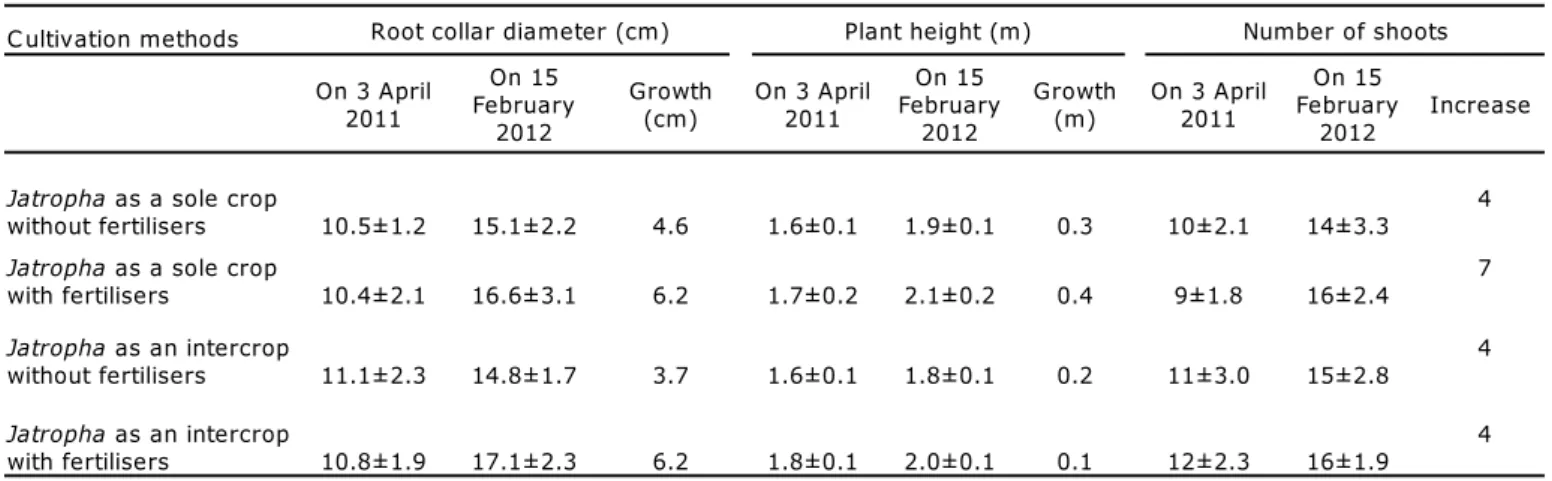
The use of fertilisers promoted the plant development for all the parameters analysed (Table 2). Vegetative growth achieved by J. curcas after four years of cultivation is low compared to that observed in other regions of the world, such as Brazil (Aw climate and oxisol soil type) and other locations in the Kinshasa region, where cultivation
Table 1
J. curcas cropping systems compared in the test.
Figure 1: Jatropha cultivated on its own (A), intercropping of Jatrophamaize (B) and Jatrophabeans (C) in
the 4thyear of cultivating Jatropha.
C B
conditions are more favourable. A study of J. curcas in Brazil indicates that average plant heights at 12, 24 and 36 months were 1.3±0.4 m, 2.3±0.3 m and 2.5±0.3 m, respectively (17). In a market garden located in N’sele, in the suburbs of Kinshasa, where the plants are irrigated and regularly fertilised, J. curcas grows to a height of over 2 metres after three years and the number of shoots per plant is well over 20. If, at the same time, we consider plants cultivated as sole crops and intercrops, the use of mineral fertilisers results in increased root collar diameter, height and number of branches. If we consider plants cultivated with and without the use of fertilisers, those that were cultivated as sole crops show the most growth in terms of the observed parameters.
Crop yields
The productivity of J. curcas depends on the rainfall, which determines the number of fructifications and therefore annual harvests (16). In the Kinshasa region, J. curcas can be harvested twice per year (Table 3). The first production is harvested between April and July (this period extends from Season B until the start of the dry season) and the second production is harvested between September and December (Season A). The better yields obtained in Season A can be explained by the higher and better distribution of rainfall during this period. Season B is shorter and rainfall is more irregular. Due to the very poor soil water economy, approx. 70% of the seeds contained in the capsules produced during the short rainy season fail to reach maturity, as the last stage of their development
Table 2
Comparison of influence of treatments on vegetative growth of J. curcas plants.
The averages and standard deviations were calculated using 125 plants selected at random for each treatment.
Table 3
Crop yield.
occurs after the start of the long dry season (July). Tests involving the application of mulch on soil on J.
curcas plots close to our crops have shown that this
technique makes it possible to significantly improve the maturation of seeds produced during the short rainy season. The yield obtained by cultivating J.
curcas is subject to the same order of magnitude,
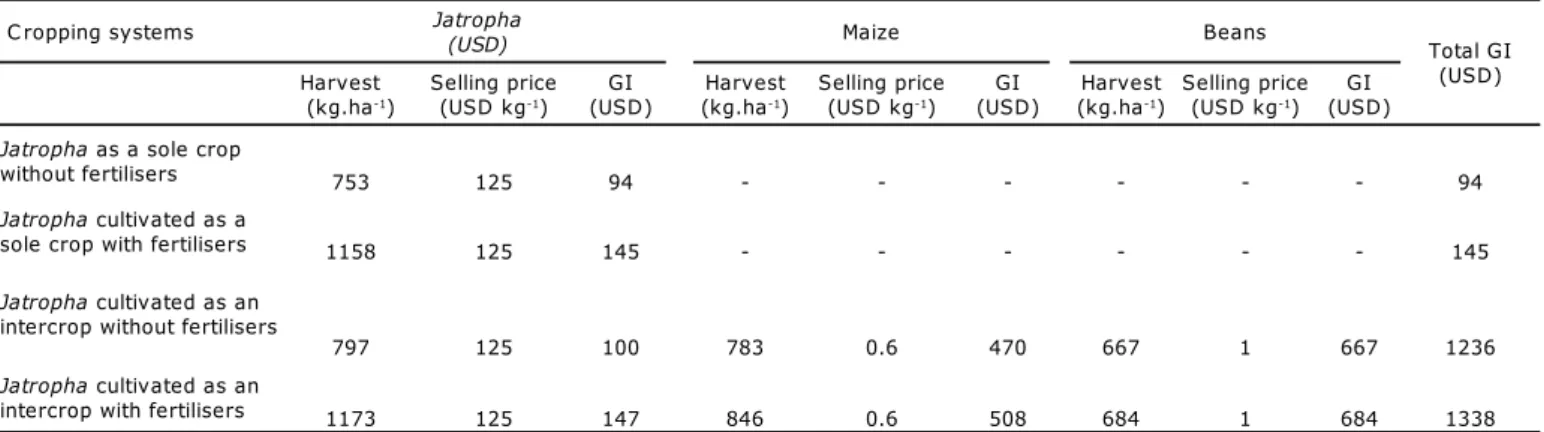
whether it is a sole crop or intercrop. If fertilisers are not used, it amounts on average to 774 kg ha1 (753 kg ha1as a sole crop and 797 kg ha1 as an intercrop). If fertilisers are used, it reaches an average of 1166 kg ha1(1158 kg.ha1as a sole crop and 1173 kg ha 1as an intercrop).
The use of mineral fertilisers only makes it possible to obtain an average gain of 396 kg ha1, which is equivalent to 4 kg of J. curcas seeds kg1of fertiliser used. Until now, no research has been conducted, in order to determine the most suitable formula and dosage of mineral fertilisers for promoting J. curcas growth in the soil of the Batéké Plateau. It is possible that higher yields could be obtained with a different dosage of mineral fertilisers than that used during our test.
The average yields obtained for annual intercrops, with or without the use of fertilisers, were approx. 815 kg ha1for maize (783 kg ha1without fertilisers and 846 kg ha1 with fertilisers) and 675 kg ha1for the common bean (667 kg ha1 without fertilisers and 684 kg ha1with fertilisers). The absence of any effect caused by intercrops on the J. curcas yield can be attributed to the fact that J. curcas plants grown by seed propagation develop taproots, which hardly compete with the subsistence crops that are cultivated with them (6). This is true, as long as the perennial plant does not grow too much, in relation to the density of the two intercrops.
J. curcas is a plant, whose growth depends greatly
on soil fertility and responds positively to the use of mineral fertilisers (20). The yields obtained after four years of cultivation are lower than those indicated for crops of the same age in Nicaragua (2500 kg ha1) with 650 mm rainfall year1 (8), in Sadivayal (India) (4000 kg ha1) with 2000 mm rainfall per year1 (11) and in Allahabad (India) (2000 kg ha1) with 1000 mm rainfall year1 (1). The very low soil fertility and major pest pressure suffered by the plants in the test area may explain
the low yields obtained. According to different authors (14, 19, 21), J. curcas produces its full potential yield after 35 years. However, recent studies (3, 5) have shown that it could take longer than 5 years for the shrubs to produce their maximum yield. It is likely that the J. curcas plants on the plots observed in Mbankana will continue to grow and therefore produce a higher yield during the next few years. It is difficult to predict with accuracy the maximum yield that they should produce, but it is unlikely that the latter will exceed the estimated yields suggested by Trabucco et al. (22) (2500 kg ha1) for the region, once they have reached their full potential.
Technical/economic performance of J. curcas cultivation systems
Gross income
As there are still no structured markets for J. curcas seeds in the DRC, the price of 0.125 USD kg1, based on the average selling price in other African countries where a market already exists (10), has been used to calculate the gross income generated. The gross income generated by cultivating J. curcas seeds as a sole crop and without using fertilisers (94 USD ha1) is lower than that generated by the corresponding intercrops (1236 USD ha1) (Table 4). The use of fertilisers on J. curcas only makes it possible to obtain an additional gain of approx. 100 US dollars ha1, if it is cultivated as an intercrop with subsistence crops, and about 50 US dollars ha1 if it is cultivated as a sole crop.
Inputs
In cropping systems without mineral fertilisers, the most costly inputs are the insecticides (40 USD ha1 year1) (Table 5). The use of pesticides is vital in the study area, if J. curcas is to be cultivated. If they are not used, the leaves and buds are completely destroyed by a beetle of the Aphthona genus (18). In cropping systems with mineral fertilisers, the latter represent by far the most costly input (150 USD ha1year1).
Table 4
Gross income ha1year1.
Key: GI (gross income)
Table 5
Inputs.
Table 6
Amortisation
In this context, amortisation refers to the initial cost of establishing the plantation and purchasing small agricultural equipment. The cost of setting up a onehectare plantation is estimated at 292 USD (Table 6) and the life span of this investment is estimated at 30 years. The small equipment used for the cultivation of J. curcas consists of small agricultural tools (hoes, spades, rakes and backpack pressure sprayer), which cost a total of 80 USD and pay for themselves over 5 years (16 USD year1). The last fixed asset consists of trays used for drying
J. curcas seeds, two of which are needed per ha.
They cost 20 USD each and pay for themselves over a 2year period. The total value of annual amortisations is therefore 46 USD.
Labour
Weeding, harvesting and shelling J. curcas fruit are the most labourintensive tasks (Table 7). Eighty mandays ha1year1are needed for weeding and 50 mandays ha1 year1 for harvesting and shelling fruit, for an average yield of 800 kg ha1 year1of dry seeds, based on 16 kg of dry seeds collected per person and per day (harvesting and shelling of the capsules).
As the longer the plantation is cultivated the more the yield increases, it is certain that the labour required to complete seed collecting tasks will also increase. The high number of mandays devoted to weeding is linked to major pressure from weeds (Cynodon dactylon L., Digitaria sp., Imperata
cylindrica, etc.) on cultivated plots on the Batéké
Plateau. The quantity of seeds obtained per man
Table 7
Required labour (mandays ha1year1).
Table 8
Family farm income.
day under the conditions of our test appears low compared to figures published for other parts of the world (9). It is, however, consistent with the figures put forward by Henning (13) based on observations in Mali. The number of capsules harvested per working hour depends on a range of factors: the height and width of the shrub, method used to collect fruits, planting density and productivity of each shrub (the higher the yield, the more efficient the collecting process becomes) (5).
Land rent
The land rent (4 USD year1) was calculated by dividing the purchase price of the land, on which the plantation was established (120 USD ha1), by the life span of the plantation (30 years).
Family farm income
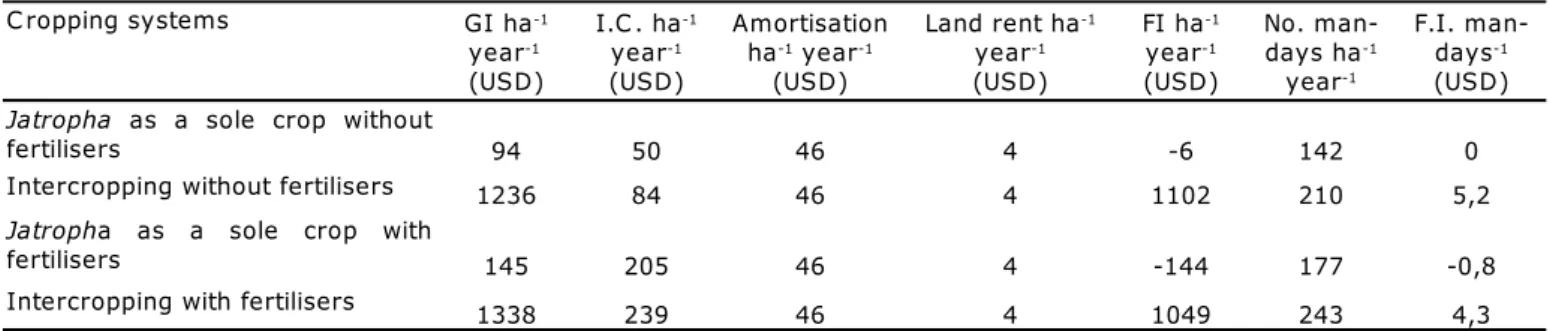
As a sole crop, if the selling price is 0.125 USD kg1 for dry seeds, the cultivation of J. curcas results in a loss of family farm income amounting to 6 USD ha1 without fertilisers and 144 USD ha1 with fertilisers (Table 8). Based on the price of 0.125 USD kg1, the dry seed yields that need to be produced, in order to cover the costs associated with J. curcas cultivation as a sole crop, amount to 872 kg.ha1 without fertilisers and 2112 kg.ha1 with fertilisers. In order to make 2 USD manday1, depending on conditions when the plantation was established, the selling price of J. curcas seeds should be 0.52 USD kg1 without fertilisers and 0.54 USD kg1 with fertilisers. The profitability of combining J. curcas cultivation with maize and beans is better than that of cultivating J. curcas as a sole crop, in terms of income per ha and income per manday. Due to the selling price of J. curcas seeds, the use of mineral fertilisers is not at all viable. One kg of fertilisers costing on average 1.5 USD only makes it possible to increase production by 4 kg dry seeds or 0.5 USD (for a seed selling price of 0.125 USD). The application of at least two insecticide treatments is vital for the growth of J. curcas plants. As has been observed in other parts of the world, it is likely that pest pressure increases as the cultivated areas are extended (2, 6). The very high cost of inputs (fertilisers and insecticides), the amount of work that it takes to weed the plots and
the small quantities of seeds harvested per man day are the main causes of the very small amounts paid for family labour, as calculated for the cultivation of J. curcas as a sole crop. A major reduction in production costs for J. curcas as a sole crop could be obtained, by planting a cover crop that requires little or no maintenance. However, with the productivity observed during the test in terms of collecting seeds, even an infinite yield increase would not make it possible to pay family workers an amount that would correspond to the labour opportunity cost (2 USD day1). In fact, the amount paid for one working day spent harvesting, shelling pods and drying seeds corresponds to its opportunity cost (16 kg of dry seeds day1 x 0.125 USD kg1= 2 USD day1). This means that, based on the selling price of 0.125 USD kg1, the cultivation of J. curcas as a sole crop will always result in a loss, as long as no solution is found, in order to increase the productivity of work devoted to harvesting and postharvesting. In other regions of the world, the increased yield ha1 and use of mechanical shellers (6, 9) make it possible to achieve yields of 40 kg seeds collected per manday. With this kind of daily yield, based on a seed selling price of 0.125 USD kg1, the yield to be achieved per ha, in order to cover all expenses, if fertilisers are used (including the labour at its opportunity cost), amounts to 6129 kg ha1 with manual weeding and 3549 kg.ha1if a cover crop is planted. If we allow for a seed collection yield of 40 kg manday1and current production costs (with the use of fertilisers and labour costs estimated at their opportunity cost), the selling price of seeds, in order to cover running costs, if the maximum yield reaches 2500 kg ha1, amounts to 0.215 USD kg1 with manual weeding and 0.143 USD kg1 if a maintenancefree cover crop is planted.
Conclusion
The quantification of the technical and economic performance of J. curcas sole cropping, with and without the use of fertilisers, on a 4year old plantation in the Batéké Plateau region, has made it possible to highlight the absence of financial profitability for the production of this crop, using the cultivation methods compared in this study. Based
Literature
1. Achten W.M.J, Verchot L., Franken Y.J., Mathijs E., diesel production and use, Biomass Bioenergy, 32, 10631084.
2. Achten W.M.J., Maes W.H., Aerts R., Verchot L., Trabucco A., Mathijs E., Singh V.P. & Muys B., 2010, Jatropha: from global hype to local opportunity, J.
Arid Environ., 74, 1, 164165.
3. Anonyme, 2011, Evaluation et optimisation du
potentiel de développement d’une culture oléagineuse
à hautes performances énergétique et
environnementale pour la production de biodiesel, le
Jatropha curcas. Rapport final Cirad, Enerbio, Fondation Tuck. http://www.fondation tuck.fr/resultats/projets/2008/documentsprojet 01/2008 P01rapportfinal.pdf, (29/02/2012). 4. Brittaine R. & Lutaladio N., 2010, Jatropha: a
smallholder bioenergy crop. The potential for propoor development. Integrated Crop Management, vol 8.
Food and Agriculture Organization of The United Nations, Rome.
5. De Jongh J. & Nielsen F., 2011, Lessons Learned: Jatropha for local development. Repport for FACT Foundation.
6. Domergue M. & Pirot R., 2008, Jatropha curcas L.
Rapport de synthèse bibliographique, CIRAD, France,
118.
7. Dufumier M., 1996, Les projets de développement agricoles, manuel d’expertise. Karthala, Paris, France. 8. Foidl N., Foidl G., Sanchez M., Mittelbach M. & Hackel S., 1996, Jatropha curcas L. as a source for the production of biofuel in Nicaragua, Bioresour
.
Technol., 58, 7782.
9. Franken Y.J. & Nielsen F., 2010, Plantation
establishment and management. In: The Jatropha
Handbook: From Cultivation to Application, Eds: Jan de Jongh. Fact Foundation, Netherlands, 827 10. GEXSI, 2008, Global Market Study on Jatropha. Final
Report. Prepared for the World Wide Fund for Nature
(WWF). London/Berlin: Global Exchange for Social Investment.
11. Gunaseelan V.N., 2009, Biomass estimates, characteristics, biochemical methane potential, kinetics and energy flow from Jatropha curcas on dry lands, Biomass Bioenergy, 33, 589596. 12. Henning R., 2007, Identification, selection and
multiplication of high yielding Jatropha curcas L. plants and economic key points for viable Jatropha oil production costs. (Henning paper).
13. Henning R., 2009, The Jatropha System An
integrated approach of rural development. The Jatropha Book.
14. Jongschaap R.E.E., Corre W.J., Bindraban P.S. & Brandenburg W.A., 2007, Claims and facts on
Jatropha curcas L.: Global Jatropha curcas evaluation, breeding and propagation programme. Report 158
(Plant Research International BV, Wageningen, The Netherlands and Stichting Het Groene Woudt, Laren, The Netherlands).
15. Les Amis de la terre, 2010, Afrique: terre(s) de
toutes les convoitises, Ampleur et conséquences de l'accaparement des terres pour produire des agrocarburants. Rapport, 36.
on a seed selling price similar to that given in other African countries (0.125 USD kg1), losses in family farm income per ha amount to 6 USD if no fertilisers are used and 144 USD if fertilisers are applied. The low yields obtained, the very high cost of inputs (fertilisers and insecticides) and weeding, combined with the small quantities of seeds harvested per manday, are the main causes of the low income generated by cultivating of J. curcas as a sole crop. The profitability of combined cultivation of J. curcas shrubs with maize and beans is greater than for the
cultivation of J. curcas as a sole crop. Family farm income from one ha, if crops are combined in this way, amounts to 1102 USD ha1 without fertilisers and 1049 USD ha1 with fertilisers. Cultivating J.
curcas as an intercrop with subsistence crops
therefore appears the best solution for establishing rural plantations in the region. Sustainable cultivation of these plantations will require, however, the development of efficient methods for controlling weeds and pests, as well as improving soil fertility, while minimising the use of mineral fertilisers and pesticides.
16. Maes W.H., Trabucco A., Achten W.M.J. & Muys B., 2009, Climatic growing conditions of Jatropha curcas L, Biomass Bioenergy, 33, 14811485.
17. Moreira Miquelino E.T.C., Antônio Gonçalves Jacovine L., De Paula Toledo D., Pedro Boechat Soares C., Cerruto Ribeiro S. & Cristina Martins M., 2011, Biomass and Carbon stock in Jatropha curcas L. Cerne, Lavras, 17, 3, 353359.
18. Nyst J., 2010, Contribution à l’étude des possibilités
de culture de Jatropha curcas L. sur le Plateau des Batéké RDC. Travail de fin d’études présenté en vue
de l’obtention de diplôme de master bioingénieur en sciences agronomiques, orientation agronomie tropicale, Université de LiègeGembloux AgroBio Tech, Belgique, 81.
19. Openshaw K., 2000, A review of Jatropha curcas: an oil plant of unfulfilled promise, Biomass Bioenergy, 9, 115.
20. Patolia, J., Ghosh A., Chikara J., Chaudhary D.R.,
Parmar D.R. & Bhuva H.M., 2007, Response of Jatropha curcas grown on wasteland to N and P
fertilization. Expert Seminar on Jatropha curcas L.
Agronomy and Genetics. Wageningin 21. Rao G.R., Korwar G.R., Shanker A.K. & Ramakrishna Y.S., 2008, Genetic associations, variability and diversity in seed characters, growth, reproductive phenology and yield in Jatropha curcas (L.) accessions, Trees Structure Function, 22,
5, 697709.
22. Trabucco A., Achten W.M.J., Bowe C., Aerts R., Van Orshoven J., Norgrove L. & Muys B., 2010, Global mapping of Jatropha curcas yield based on response of fitness to present and future climate. Global Change Biol, Bioenergy, 2, 3, 139151. 23. Vermeulen C. & Lanata F., 2006, Le domaine de chasse de BomboLumene: un espace naturel en péril aux frontières de Kinshasa. Parcs et réserves, 61, 2, 48.
J.D. Minengu, Congolese, PhD Student, Assistant, University of Kinshasa, Faculty of Agricultural Sciences, Kinshasa, Democratic Republic of the Congo.
P. Mobambo, Congolese, PhD, Professor, University of Kinshasa, Faculty of Agricultural Sciences, Kinshasa, Democratic Republic of the Congo.
G. Mergeai, Belgian, PhD, Professor, University of Liege, Gembloux AgroBio Tech, Laboratory of Tropical Crop Husbandry and Horticulture, Gembloux, Belgium.