Belgian Surveillance Plans to Assess Changes in Salmonella Prevalence in
Meat at Different Production Stages
1,2Yasmine Ghafira,b, Bernard Chinab, Nicolas Korsakb, Katelijne Dierickc, Jean-Marc Collardc, Claudine Godardc, Lieven De Zutterd, and Georges Daubeb3
a Belgian National Reference Laboratory in Food Microbiology for the Federal Agency for the Safety of the Food
Chain, University of Liege, Department of Food Sciences, Faculty of Veterinary Medicine, Microbiology, Liege, Belgium4; bDepartment of Food Sciences, Microbiology, Faculty of Veterinary Medicine, University of Liege, Liege,
Belgium; cScientific Institute of Public Health, Brussels, Belgium; and d Faculty of Veterinary Medicine, Food Microbiology, University of Ghent, Ghent, Belgium
Introduction
Salmonella and Campylobacter are the most common reported causes of outbreaks of bacterial
foodborne disease in Europe (Tirado and Schmidt, 2001) and the United States (Mead et al., 1999; Wallace et al., 2000). In Belgium, this pathogen is the primary cause of bacterial gastroenteritis as reported by public health services (Anonymous, 2004). Consumption of contaminated egg, meat, poultry, and their products is frequently associated with foodborne outbreaks (Tirado and Schmidt, 2001). In Europe, two new pieces of European legislation were published in 2003 (Directive 2003/99/EC and Regulation 2160/2003), which outlined objectives to be reached in terms of
Salmonella incidence for products from three animal species (e.g., reproductive poultry by the end of
2005 and broilers by the end of 2006) (Anonymous, 2003a; Anonymous, 2003b).
The objectives of this study were (i) to assess changes in Salmonella prevalence at different stages through the pork, poultry, and beef meat production chains and (ii) to assess whether the sampling plan used is adequate.
Materials and Methods
Sampling plan. From 1997 to 1999, the prevalence of Salmonella was assessed at different stages
through the pork, poultry, and beef meat production chains in Belgium. Different dilutions of the initial sample suspension were analyzed to provide a semiquantitative evaluation of Salmonella contamination and to determine the most representative dilution necessary to detect a reduction in prevalence. An average of 300 samples for each type of meat were analyzed. According to Fisher’s exact test, the dilution to be used to detect a reduction in prevalence was chosen based on an initial prevalence of 20 to 26%. Based on this introductory study, a new sampling plan representative of the nationwide Belgian meat production process was used from 2000 through to 2003. Carcasses, trimmings, and minced meat from pork, beef, and poultry were sampled from slaughterhouses, processing plants, and/or retail establishments.
1 Reprinted with permission from the Journal of Food Protection. Copyright held by the International Association for Food Protection, Des Moines, Iowa, U.S.A
2Abstract from
:
Ghafir, Y., China, B., Korsak, N., Dierick, K., Collard, J.-M., Godard, C., De Zutter, L., Daube, G., 2005. Belgian surveillance plans to assess changes in Salmonella prevalence in meat at different production stages. Journal of Food Protection 68, 2269-2277.
3 Correspondance : Bat.B43b, Sart Tilman, 4000 Liege, Belgium. [email protected] 4The Belgian Federal Agency for the Safety of the Food Chain financially supported this study.
Sample collection and microbiological analyses. Carcasses were sampled in the cooling room
between 2 and 4 h after slaughtering. For each pig and bovine half-carcass, four surfaces (constituting one sample) were chosen according to the procedure of wet and dry swab technique (Korsak et al., 2003). For poultry carcasses, 25 g of neck and breast skin from each carcass was aseptically sampled in the laboratory.
The sampling covered all periods of the year, was executed by trained samplers and the analyses were carried out by accredited laboratories using an identical analytical method.
The detection of Salmonella was assessed using the official method SP-VGM002 from the Ministry of Public Health (with BPW enrichment, Diasalm plating, XLD isolation, biochemical confirmation and conventional serotyping). To detect Salmonella in 1 or 0.1 g (in 24 cm2 or 2.4 cm2 for pork carcasses), a dilution was made by taking aliquots from the main suspension witch were transferred into a tube filled with BPW.
Results and Discussion
The preliminary study carried out in 1997, 1998, and 1999 revealed that Salmonella contamination of pork carcasses, cut and minced meat was approximately 20% in 25 g or on 600 cm2, but less than 8 and 4% of the samples were still contaminated in 25 times (in 1 g or on 24 cm2) and 250 times (in 0.1 g or on 2.4 cm2) lower concentrations, respectively. In broiler and layer carcasses, the contamination rate ranged respectively from 40 to 80%, with a very high level of contamination, especially for layer carcasses (more than 50% of the 0.1-g samples still were positive). Chicken fillet was the least contaminated chicken product in this study (about 25% of 25-g samples but 6% of 1-g samples). For bovine meat production, only a very small number of samples were contaminated with Salmonella (0 to 4.2%).
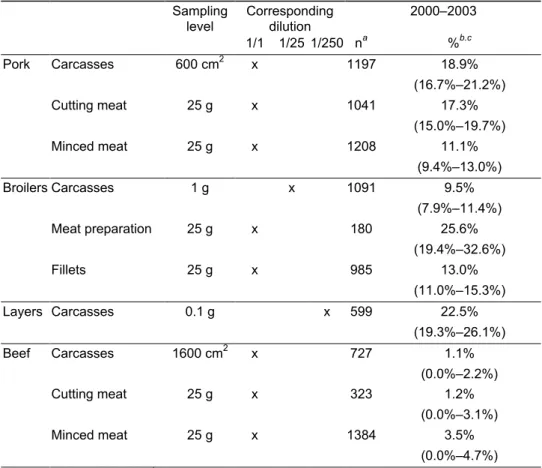
The rate of Salmonella contamination of meat in Belgium decreased or remained constant between 2000 and 2003. A constant and significant decrease in Salmonella prevalence was observed for pork carcasses, trimmings, and minced meat and for beef minced meat (P < 0.001). This decrease may have been due to implementation of hazard analysis critical control point procedures in the processing establishments. The very low prevalence in beef carcasses and trimmings (less than 3%) may not allow the detection of improvements in slaughtering and processing. For poultry, the study confirmed the consistently high rate and level of contamination of poultry meat: broiler and layer carcasses were the most contaminated samples followed by broiler fillets and poultry meat preparations. The prevalence of Salmonella in pork, poultry, and beef from 2000 to 2003 is shown in Table 1.
Between 2000 and 2003, the predominant serotypes of Salmonella isolated from pork in Belgium were
S. Typhimurium, S. Derby, and S. Brandenburg. In chicken, S. Virchow, S. Bredeney, S. Paratyphi B,
and S. Hadar were found, and their ratios fluctuated from year to year. The proportion of S. Enteritidis in layer carcasses exceeded 90%. In beef, despite the low number of isolates, the predominant serotype was S. Typhimurium, which was found in more than 40% of the isolates.
Table 1: Salmonella prevalence in pork, poultry and beef samples between 2000 and 2003 Sampling level Corresponding dilution 2000–2003 1/1 1/25 1/250 na %b.c x 18.9% Pork Carcasses 600 cm2 1197 (16.7%–21.2%) x 17.3% Cutting meat 25 g 1041 (15.0%–19.7%) x 11.1% Minced meat 25 g 1208 (9.4%–13.0%) x 9.5% Broilers Carcasses 1 g 1091 (7.9%–11.4%) x 25.6% Meat preparation 25 g 180 (19.4%–32.6%) x 13.0% Fillets 25 g 985 (11.0%–15.3%) 22.5% Layers Carcasses 0.1 g x 599 (19.3%–26.1%) x 1.1% Beef Carcasses 1600 cm2 727 (0.0%–2.2%) x 1.2% Cutting meat 25 g 323 (0.0%–3.1%) x 3.5% Minced meat 25 g 1384 (0.0%–4.7%)
a Number of samples; b Prevalence of Salmonella; c Values are mean (values with 95% CI)
These results indicate that chicken may be a source of salmonellosis in Belgium from consumption of undercooked meat or cross-contamination, but it does not seem to be the major vector for reported cases. In Belgium, some beef and pork ground meat (and occasionally chicken preparations) are eaten raw, which also constitutes a health risk. The reduction of contamination in all production chains seems to be possible, as has been accomplished in Northern Europe (Wegener et al., 2003), by taking measures in the preharvest phase, channeling of slaughtering, and requiring decontamination treatment of meat (e.g., thorough cooking). Changes also may be made at the processing level. Controls must be tightened in establishments with Salmonella contamination rates higher than the national average. Appropriate application of hygiene is a basic requirement and could be monitored by indicators as Escherichia coli, Enterobacteriaceae, total plate counts. These indicators could be evaluated simultaneously with Salmonella, which is economically feasible, and would provide information about the processing hygiene of each establishment sampled.
The Belgian survey carried out from 2000 to 2003 allowed the monitoring of bacterial zoonotic agents in the Belgian meat production sector because the sampling plan took into account the number and capacity of producing establishments and the samples were taken by well-trained samplers during 10 to 11 months each year. The laboratories performing the analysis were accredited according to the ISO 17,025 standard, and all laboratories used the same analytical method. The contamination rate was assessed during an introductory study, which allowed the determination of the number of samples
and sample dilutions (detection of Salmonella in 25 g or in a dilution of the initial suspension) to be tested. Such an evaluation of the optimum sampling scheme should be repeated periodically on the basis of the results and changes in the previous years. A survey plan in line with the present study could be used in the future to monitor the effects of the planned measures and to follow the changes in Salmonella contamination at all stages of the food chain in the European Union.
References
Anonymous, 2003a. Directive 2003/99/EC of the European Parliament and of the Council of 17 November 2003 on the monitoring of zoonoses and zoonotic agents, amending Council Decision 90/424/EEC and repealing Council Directive 92/117/EEC. Official Journal of the European Union L325, 31-40.
Anonymous, 2003b. Regulation no. 2160/2003 of the European Parliament and of the Council of 17 November 2003 on the control of Salmonella and other specified foodborne zoonotic agents. Official Journal of the European Union L325, 1-15.
Anonymous, 2004. Annual report on human Salmonella and Shigella in Belgium 2003. National Reference Centre for Salmonella and Shigella. Scientific Institute of Public Health. Begium.
Ghafir, Y., China, B., Korsak, N., Dierick, K., Collard, J.-M., Godard, C., De Zutter, L., Daube, G., 2005. Belgian surveillance plans to assess changes in Salmonella prevalence in meat at different production stages. Journal of Food Protection 68, 2269-2277.
Korsak, N., Jacob, B., Groven, B., Etienne, G., China, B., Ghafir, Y., Daube, G., 2003. Salmonella contamination of pigs and pork in an integrated pig production system. Journal of Food Protection 66, 1126-1133. Mead, P.S., Slutsker, L., Dietz, V., McCaig, L.F., Bresee, J.S., Shapiro, C., Griffin, P.M., Tauxe, R.V., 1999.
Food-related illness and death in the United States. Emerging Infectious Diseases 5, 607-625.
Tirado, C., Schmidt, K., 2001. WHO surveillance programme for control of foodborne infections and intoxications: preliminary results and trends across greater Europe. World Health Organization. The Journal of Infection 43, 80-84.
Wallace, D.J., Van Gilder, T., Shallow, S., Fiorentino, T., Segler, S.D., Smith, K.E., Shiferaw, B., Etzel, R., Garthright, W.E., Angulo, F.J., 2000. Incidence of foodborne illnesses reported by the foodborne diseases active surveillance network (FoodNet)-1997. FoodNet Working Group. Journal of Food Protection 63, 807-809.
Wegener, H.C., Hald, T., Lo Fo Wong, D., Madsen, M., Korsgaard, H., Bager, F., Gerner-Smidt, P., Molbak, K., 2003. Salmonella control programs in Denmark. Emerging Infectious Diseases 9, 774-780.