VALIDATION DE SPÉCIFICATIONS DE SYSTÈMES
D’INFORMATION AVEC ALLOY
par
Mohammed Ouenzar
Mémoire présenté au Département d’informatique
en vue de l’obtention du grade de maître ès sciences (M.Sç.)
FACULTÉ DES SCIENCES
UNIVERSITÉ DE SHERBROOKE
1+1
Library and Archives Canada Published Heritage Branch Bibliothèque et Archives Canada Direction du Patrimoine de l'édition 395 Wellington Street Ottawa ON K 1A0N 4 Canada 395, rue Wellington Ottawa ON K1A 0N4 CanadaYour file Votre référence ISBN: 978-0-494-95109-5 Our file Notre référence ISBN: 978-0-494-95109-5
NOTICE:
The author has granted a non
exclusive license allowing Library and Archives Canada to reproduce, publish, archive, preserve, conserve, communicate to the public by
telecomm unication or on the Internet, loan, distrbute and sell theses
worldwide, for commercial or non commercial purposes, in microform, paper, electronic and/or any other formats.
AVIS:
L'auteur a accordé une licence non exclusive permettant à la Bibliothèque et Archives Canada de reproduire, publier, archiver, sauvegarder, conserver, transmettre au public par télécomm unication ou par l'Internet, prêter, distribuer et vendre des thèses partout dans le monde, à des fins com merciales ou autres, sur support microforme, papier, électronique et/ou autres formats.
The author retains copyright ownership and moral rights in this thesis. Neither the thesis nor substantial extracts from it may be printed or otherwise reproduced without the author's permission.
L'auteur conserve la propriété du droit d'auteur et des droits moraux qui protege cette thèse. Ni la thèse ni des extraits substantiels de celle-ci ne doivent être imprimés ou autrement
reproduits sans son autorisation.
In compliance with the Canadian Privacy A ct some supporting forms may have been removed from this thesis.
W hile these forms may be included in the document page count, their removal does not represent any loss of content from the thesis.
Conform ém ent à la loi canadienne sur la protection de la vie privée, quelques
form ulaires secondaires ont été enlevés de cette thèse.
Bien que ces form ulaires aient inclus dans la pagination, il n'y aura aucun contenu manquant.
L e 2 2 m a r s 2 0 1 3
le jury a accepté le mémoire de Monsieur Mohammed Ouenzar dans sa version finale.
Membres du jury
Professeur Marc Frappier Directeur de recherche Département d’informatique
Monsieur Benoît Fraikin Codirecteur
Département d’informatique
Professeur Jean-Louis Lanet Évaluateur externe Université de Limoges
Professeur Richard St-Denis Président rapporteur Département d’informatique
Sommaire
Le présent mémoire propose une investigation approfondie de l’analyseur Alloyafin de juger son adaptabilité en tant que vérificateur de modèles. Dans un premier temps, l’étude dresse un tableau comparatif de six vérificateurs de modèles, incluant Alloy, afin de dé
terminer lequel d’entre eux est le plus apte à résoudre les problématiques de sécurité fonc tionnelle posées par les systèmes d’information. En conclusion de cette première phase,
Alloy émerge comme l’un des analyseurs les plus performants pour vérifier les modèles sur lesquels se fondent les systèmes d’information. Dans un second temps, et sur la base des problématiques rencontrées au cours de cette première phase, l’étude rapporte une sé rie d’idiomes pour, d’une part, présenter une manière optimisée de spécifier des traces et, d’autre part, trouver des recours afin de contourner les limitations imposées par Alloy. À
ces fins, le mémoire propose deux nouveaux cas d’espèce, ceux d’une cuisinière intelli gente et d’une boîte noire, afin de déterminer si oui ou non l’analyseur est capable de gérer les systèmes dynamiques possédant de nombreuses entités avec autant d’efficacité que les systèmes qui en possèdent moins. En conclusion, le mémoire rapporte que Alloy est un bon outil pour vérifier des systèmes dynamiques mais que sa version récente, DynAlloy,
peut être encore mieux adapté pour le faire puisque précisément conçu pour faire face aux spécificités de ce type de système. Le mémoire s’achève sur une présentation sommaire de ce dernier outil.
Mots-clés: A l l o y ; b o îte n oire ; id io m e d e sp écifica tio n ; lo g iq u e d y n am iq u e ; lo g iq u e du p rem ier ordre ; sécu rité ; so lu tio n n eu rs d e satisfiab ilité ; sp écifica tio n fo r m e lle ; sûreté ; v é rification d e m o d èles.
Remerciements
Dans un premier temps, je tiens à remercier mon directeur, le professeur Marc Frappier, qui m’a proposé d’entamer une recherche en informatique au sein du laboratoire qu’il di rige à l’Université de Sherbrooke. Sa bonne humeur, sa patience, sa minutie et son sens de l’organisation ont été de précieux recours dans la réussite de ce projet. Par delà les connais sances qu’il aura su me transmettre, son fameux mantra, "Il n’y a pas de miracle", aura toujours été pour moi le catalyseur d’une motivation réelle à positiver et à soutenir mes efforts durant les moments de difficulté et de découragement.
Merci au Docteur Benoît Fraikin, mon codirecteur de maîtrise, qui a su partager une partie de ses connaissances scientifiques avec moi. Celles-ci ont été d’une grande utilité pour ma recherche. Malgré son emploi du temps chargé, M. Fraikin a toujours su trouver le temps de répondre à mes questions quand bien même celles-ci n’avaient aucun rapport avec l’objet de ma recherche.
Je suis également reconnaissant à l’égard du Professeur Richard St-Denis, parangon de rigueur et d’honnêteté. Merci à vous pour votre aide et votre contribution.
Un grand merci à Guillaume Bouffard, Michel Embe Jiague, Romain Chossart, Alexis Mehdi Mantrach et à tous mes amis et collègues, qui ont participé, d’une manière ou d’une autre, à la réalisation de ce projet de recherche.
Je remercie également les employés du Département informatique de l’Université de Sherbrooke, et en particulier les techniciens Michel Benoît, Serge Cadorette et Jean-Francois Gauthier qui facilitent au quotidien la vie du personnel au département. Enfin, un merci aux professeurs Jeans-louis Lanet et Benoît Crespin grâce à qui j ’ ai pu bénéficier du programme de coopération entre l’Université de Limoges et l’Université de Sherbrooke.
Abréviations
APIS Automatic Production of Information Systems (production automatique de systèmes d’information)
ADL Activities of Daily Living (activités de la vie quotidienne) BCG Binary Coded Graph (graphe codé binaire)
BDD Binary Decision Diagram (diagramme de décision binaire) CNF Conjunctive Normal Form (forme normale conjonctive)
CSP Communicating Sequential Processes (processus séquentiels communicants) ER Entité-Relation
IS Information System (système d’information)
KSE Kitchen Stove Element (élément composant un four) LTL Linear Temporal Logic (logique temporelle linéaire)
LTS Labelled Transition System (système de transitions étiquetées) MDE Model-Driven Engineering (ingénierie dirigée par les modèles) OOL Object-Oriented Language (langage orienté objet)
PwSN People with Special Needs (personnes avec des besoins spécifiques) UML Unified Modelling Language (langage de modélisation unifié) XTL eXtended Temporal Logic (logique temporelle étendue)
Table des matières
Sommaire i
Remerciements ii
Abréviations iii
Table des matières iv
Liste des figures vii
Liste des tableaux viii
Liste des programmes ix
Introduction 1
1 La vérification de modèles et Alloy 5
1.1 Présentation de la vérification de m o d è le s ... 5
1.2 Introduction à Al l o y... 6
1.3 Le fonctionnement interne de Al l o y... 6
1.4 Les outils de Al l o y... 7
1.5 Avantages et limitations... 8
1.6 Processus du développement d’un modèle en Al l o y... 10
2 Comparaison de six vérificateurs de modèles 13 2.1 Introduction... 15
Tab l ed e s m a tières
2.2 Related W o rk ... 16
2.3 Presentation of the Case S tu d y ... 17
2.4 An Overview of the Model Checkers... 19
2.4.1 Sp i n... 19 2.4.2 NuSM V...20 2.4.3 fdr2 ... 21 2.4.4 c a d p... 22 2.4.5 Al l o y... 23 2.4.6 ProB ... 23
2.5 Specifying the Model and the Properties... 24
2.5.1 Sp i n...,... 24 2.5.2 NuSM V... 26 2.5.3 f d r2 ... 27 2.5.4 c a d p... 28 2.5.5 Al l o y... 29 2.5.6 ProB ... 30
2.6 Analysis of the Case S tu d y ... 31
2.7 Conclusion ... 33
3 La vérification de modèles et l’informatique ubiquitaire 35 3.1 Introduction ... 37
3.2 InovusIntelligent Oven Project... 38
3.2.1 C o n tex t... 38
3.2.2 Scenario... 38
3.2.3 Specifications... 39
3.2.4 A pproach... 40
3.3 Related W o r k ... 41
3.3.1 Consistency Issue in Software Development P ro c e s s ... 41
3.3.2 Formal Specifications... 42
3.3.3 Introducing Al l o y... 43
3.3.4 Tests and Alloy C om bination... 44
3.4 InovusDevelopment P ro c ess... 44
Tab l ed e s m a tières
3.4.1 First Prototype Specifications...45
3.4.2 First Increment D esig n ...45
3.4.3 First Increment Implementation Using Al l o y... 47
3.5 InovusModel Verification with Al l o y... 50
3.5.1 More About AlloyS y n ta x ...50
3.5.2 Model A nalysis...51
3.5.3 Additional Validation Tools in Al l o y... 52
3.6 Results and D iscussion... 52
3.6.1 Relevancy of the Proposed Process... 52
3.6.2 Evaluation of Alloyin Pervasive C om puting... 53
3.7 Conclusion ... 54
4 Idiomes 55 4.1 Revue de littérature... 55
4 .2 Les traces en Al l o y... 5 6 4.3 Les propriétés de type arborescente... 59
4.4 Boîtes noires ... 63
4.4.1 La vérification de modèles et les boîtes n o ires... 64
4.4.2 Implémentation des boîtes noires... 65
4.5 DynAl l o y... 67
Conclusion 71
Liste des figures
1.1 Le processus du traitement interne de Alloy ... 8
1.2 Exemples de la limitation réelle et de la limitation a b s o lu e ... 10
1.3 Idiome du développement d’un modèle en Al l o y... 12
2.1 Requirement class diagram of the library system ... 17
2.2 Model checking duration in seconds for the properties of the library specification... 33
3.1 Inovus architecture in the h o m e e n v ir o n m e n t... 4 0 3.2 Classical process with the proposed additional s t e p ...41
3.3 Coverage difference between tests and model c h e c k in g ...44
3.4 Simplified class d ia g ra m ... 46
3.5 Translation example from a UML class into its corresponding Alloysignature 48 4.1 Principe des boîtes n o ires...64
Liste des tableaux
3.1 Risks considered in this in crem en t... 45
4.1 Tableau récapitulatif du temps d’exécution par rapport aux bornes choisies . 63 4.2 Tableau récapitulatif du temps d’exécution par rapport aux bornes choisies . 66
Liste des programmes
1.1 Exemple illustrant quelque aspects de A l l o y... 9
3.1 A l l o y translation o f the property Exceeding the hot threshold temperature for a temperature sensor must be detected as a risk situ a tio n...50
3.2 Trace example in Alloy... 51
4.1 Exemple d’une trace initiée par un prédicat ... 57
4.2 Exemple d’une trace sans état initial prédéfini (partie 1 ) ... 57
4.3 Exemple d’une trace sans état initial prédéfini (partie 2 ) ...58
4.4 Exemple d’une trace sans état initial prédéfini (partie 3 ) ... 58
4.5 Exemple de la technique du stu tte rin g...60
4.6 L’ensemble des prédicats assurant le bon fonctionnement des actions Return, Leave et Cancel (partie 1 ) ... 61
4.7 L’ensemble des prédicats assurant le bon fonctionnement des actions Return, Leave et Cancel (partie 2 ) ...62
4.8 L’ensemble des prédicats assurant le bon fonctionnement des actions Return, Leave et Cancel (partie 3 ) ... 63
4.9 Exemple d’une p i l e ...66
4.10 Action E m p ile r ... 66
4.11 Propriété R-8 (partie 1 ) ... 66
4.12 Propriété R-8 (partie 2 ) ...67
4.13 La spécification de l’action Leave avec D y n A llo y (partie 1 ) ... 68
4.14 La spécification de l ’action Leave avec DynAlloy (partie 2 ) ... 68
4.15 La spécification de l ’action Leave avec A l l o y ... 69
A .l La spécification de la bibliothèque (partie 1 ) ... 74
A.2 La spécification de la bibliothèque (partie 2 ) ...75
List e d e s p r o g r a m m e s
A.3 La spécification de la bibliothèque (partie 3 ) ...75
A.4 La spécification de la bibliothèque (partie 4 ) ...76
A.5 La spécification de la bibliothèque (partie 5 ) ...77
A.6 La spécification de la bibliothèque (partie 6 ) ... 79
A.7 La spécification de la bibliothèque (partie 7 ) ... 79
A.8 La spécification de la bibliothèque (partie 8 ) ... 81
A.9 La spécification de la bibliothèque (partie 9 ) ... 81
A. 10 La spécification de la bibliothèque (partie 1 0 ) ...82
A .l l Spécification des propriétés en Alloy (partie l ) ... 84
A. 12 Spécification des propriétés en Alloy (partie 2 ) ... 84
A. 13 Spécification des propriétés en Alloy (partie 3 ) ... 86
A. 14 Spécification des propriétés en Alloy (partie 4 ) ... 87
A. 15 Spécification des propriétés en Alloy (partie 5 ) ...88
A. 16 La propriété 14 en Alloy avec un état initial (partie 1 ) ... 89
A. 17 La propriété 14 en Alloy avec un état initial (partie 2 ) ...90
A. 18 La propriété 14 en Alloy avec un état initial (partie 3 ) ...90
A. 19 La propriété 14 en Alloy sans un état initial prédéfini (partie 1 ) ... 92
A.20 La propriété 14 en Alloy sans un état initial prédéfini (partie 2 ) ... 92
A.21 La propriété 14 en Alloy sans un état initial prédéfini (partie 3 ) ... 93
Introduction
Contexte
« L ’information, c ’est le pouvoir »
Dans une économie du savoir, les informations sont devenues de véritables actifs stra tégiques pour les entreprises en quête de performance. Depuis plusieurs années déjà, nom breuses sont celles à avoir investi massivement dans l’acquisition de systèmes d’informa tion efficaces afin de mieux collecter, traiter et diffuser les informations dont elles disposent à l’interne. Mais plus que l’efficacité, c’est se doter d’un système d’information fiable, sans failles, qui est devenu un véritable enjeu pour ces entreprises, car de nombreux cas d’in stabilité informatique ont prouvé que des brèches au niveau de la sécurité des systèmes pouvaient se traduire par des pertes financières (p.ex. affaire Kerviel en France) et hu maines (p.ex. affaire de l’institut contre le cancer à la ville de Panama) aussi colossales que dramatiques.
Le propos de ce mémoire s’inscrit précisément dans le cadre de la problématique de sécurité fonctionnelle généralement posée par les systèmes d’information.
Motivations et problématique
Le laboratoire du GRIL (Groupe de recherche en ingénierie du logiciel), à l’Université de Sherbrooke, a créé pour les systèmes d’information une méthode formelle baptisée a p is
(Automatic Production of Information Systems) [22]. Elle utilise la méthode e b3, elle aussi
développée au laboratoire du GRIL, pour modéliser les systèmes d’information. À ce stade, les méthodes de validation doivent être implémentées afin de vérifier si les spécifications
In t r o d u c t io n
EB3sont conformes aux exigences formulées par le client. Pour ce faire, deux possibilités s’offrent aux chercheurs : soit de développer un nouvel outil ad hoc taillé sur mesure ou soit d’utiliser des outils déjà existants. Puisque la première alternative est à l’évidence plus « coûteuse » en ressources (temps et personnes) que la seconde, c’est donc la deuxième voie que nous avons choisie dans le cadre de la présente recherche. Ce faisant, au gré de nos explorations préliminaires de la littérature du domaine de vérification de modèles, nous avons remarqué d’emblée une absence assez notable d’études comparatives portant sur les vérificateurs de modèles, justifiant ipso facto la nécessité de mener une étude à la fois pionnière et approfondie sur le sujet. À cette fin, notre groupe de chercheurs a donc choisi de polariser son attention sur la comparaison de six des principaux vérificateurs de modèles : Alloy, Spin, NuSMV, ProB , cadpet fdr2.
Le corpus du présent mémoire se scinde en deux phases successives : dans un premier temps, le rapport se concentre sur l’évaluation, puis le développement parallèle, d’idiomes servant à exprimer certaines des propriétés les plus répandues au sein des systèmes d’in formation ; dans un second temps, et sur la base des résultats obtenus à l’issue de cette évaluation préliminaire, l’étude se focalise sur l’utilisation d’un des vérificateurs jugés les mieux adaptés aux exigences d’un contexte d’application particulier des systèmes d’infor mation, celui de l’informatique ubiquitaire (pervasive computing). Cette étape a pour but de faciliter le rajout d’une couche de sécurité au processus de développement habituel du domaine de l’ubiquité numérique. Ce travail est réalisé en collaboration avec le laboratoire DOMUS (domotique et informatique mobile de l’Université de Sherbrooke).
Méthodologie
Tel que susmentionné, la méthodologie adoptée dans le cadre de la présente étude se déroule en deux phases successives : dans une première phase, nous tentons d’établir un profilage technique de l’outil Alloyafin de mieux comprendre les fonctionnalités qu’il in tègre et identifier les atouts et limitations majeurs qu’il possède. La raison qui justifie la nécessité d’identifier les limitations du vérificateur réside dans le fait que celles-ci mettent au clair les propriétés difficilement vérifiables, condition sine qua non au développement ultérieur des idiomes de vérification visant à les valider. Une fois complétée, cette étape vise finalement à déterminer qui de Alloy ou d’un des autres vérificateurs à l’étude dé
In t r o d u c t io n
montre la meilleure adaptabilité pour les systèmes d’information. Afin de corroborer ces conclusions, la seconde phase de l’étude se concentre quant à elle sur l’étude de Alloy dans un contexte de développement bien particulier : celui de l’informatique ubiquitaire. Par l’entremise d’une étude de cas, l’objectif de cette seconde étape vise à évaluer la capa cité du vérificateur à répondre aux diverses problématiques rencontrées dans le domaine de l’informatique ubiquitaire. Une fois compilées, les observations collectées à l’issue de cette étape doivent non seulement nous aider à préciser où se situent concrètement les diverses forces et faiblesses de Alloy, mais aussi et surtout à confirmer (ou infirmer) si le fait de
l’avoir privilégié à d’autres vérificateurs dès la première étape était un choix pertinent ou pas.
Résultat
En définitive, l’étude approfondie de A l l o y permet de mieux en comprendre les fonc
tionnalités diverses en même temps qu’elle facilite l’identification de ses principales forces et faiblesses. Globalement, et en raison de ses atouts majeurs (syntaxe proche de la pro grammation orientée objet, structure basée sur la logique du premier ordre, analyse au tomatisée), A l l o y peut être considéré au côté de P r o B comme l’un des deux meilleurs
vérificateurs qui soient dans le cas des systèmes d ’information. On remarque entre autres que le vérificateur permet d’écrire les propriétés de type « préservation d’invariant » ainsi que la plupart de celles de type LTL [7], celles concernant les systèmes d’information, assez facilement, même si cette facilité varie grandement selon que la propriété est en soi diffici lement spécifiable ou pas. Dans le cas des propriétés CTL [7] notamment, A l l o y révèle ses
limites, la structure de ce genre de propriétés semblant difficilement, voire parfois même carrément non vérifiable : parmi elles, les propriétés de type réinitialisation (largement uti lisées dans le cadre des systèmes d’information), exigent par exemple le développement d’un processus complexe en A l l o y afin de pouvoir être vérifiées. Une comparaison entre deux différentes manières de spécifier les traces a d’ailleurs facilité la compréhension des avantages et des inconvénients d’une telle approche. Toutes les propriétés de type LTL ou CTL ont été exprimées en logique du premier ordre en se basant sur les traces ou les arbres d’exécution. Enfin, dans le domaine de l’informatique ubiquitaire, on observe qüe A l l o y
donne de bons résultats à l’exception près que la spécification des actions et des scénarios
In t r o d u c t io n
d’exécution qui y prend place est souvent longue. Pour contourner ce problème, nous sug gérons donc l’utilisation d’une version dynamique de Alloy, DynAlloy, en raison de sa
meilleure adaptabilité aux contingences propres au contexte de « l’ubiquité numérique ».
Structure du mémoire
Le reste du mémoire est organisé comme suit. Le premier chapitre introduit les prin cipes fondamentaux du fonctionnement de l’analyseur Alloy. Le deuxième chapitre dresse
une comparaison de six vérificateurs de modèles, dont l’analyseur Alloy. Le troisième cha
pitre illustre dans une première partie l’usage des vérificateurs de modèles dans le domaine de l’informatique ubiquitaire, ainsi, en deuxième partie, le chapitre brosse un tableau des différents avantages et limitations de l’usage de l’analyseur Alloydans ce domaine. Enfin, le dernier chapitre présente un ensemble d’idiomes qui facilitent l’écriture de certains types de propriétés.
Chapitre 1
La vérification de modèles et
A
lloy
Ce chapitre a pour but de présenter les principes et la théorie de la vérification de mo dèles. Ce chapitre commence avec une présentation des principes et la théorie de la vérifi cation de modèles ainsi que le langage/analyseur/vérificateur Alloy. Après l’introduction,
le chapitre explique le fonctionnement interne de cet analyseur en citant ses outils internes et externes. Une fois cette phase achevée, le chapitre continue avec une description d ’un idiome de spécification et de vérification de modèles pour finir avec un résumé des limita tions de cet outil.
1.1 Présentation de la vérification de modèles
La vérification de modèles est un processus qui assure la satisfaction d’une formule logique dans un modèle abstrait. Autrement dit, elle répond à la question suivante : un système M satisfait-il une propriété F ? En termes logiques : M est-il un modèle de F ? La vérification de modèles consiste donc dans les grandes lignes à explorer exhaustivement l’espace d’états du modèle afin de vérifier qu’il n’existe pas de contre-exemple des formules (propriétés) à vérifier. Edmund M. Clarke et E. Allen Emerson ont introduit les premières notions de vérification de modèles avec des formules de logique temporelle en 1981 [14], suivies par les études de Jean-Pierre Queille et Joseph Sifakis en 1982 [48, 49], Certes, après trente ans de recherche, le problème de l’explosion de l’espace d’états reste toujours
1 .2 . In t r o d u c t io n à Allo y
un défi scientifique. Cependant, au fil des années, l’optimisation et la création de nouvelles techniques ont permis de réduire considérablement le temps de traitement et d’intégrer de plus en plus la vérification de modèles dans le processus de développement des entreprises.
Dans le monde de la vérification de modèles, on peut distinguer deux grandes familles : la vérification de modèles symboliques et la vérification de modèles explicites. La première approche est en grande partie basée sur les diagrammes de décision (BDD) : elle consiste donc à représenter le modèle sous la forme de formules booléennes, ce qui entraîne le problème d’ordonnancement des variables. La seconde approche passe quant à elle par des représentations intermédiaires (p.ex. réseaux de Pétri, automates) afin de réduire la taille du graphe qui représente le modèle.
1 .2
Introduction
à AlloyA l l o y est un vérificateur/analyseur de modèles développé au MIT (Massachusetts Ins titute o f Technology) par le professeur Daniel Jackson et ses étudiants du SDG (Software Design Group). De sa première version, Nitpick, ayant vu le jour en 1995, à sa version
actuelle, A l l o y 4.0, l’outil a évolué considérablement, tant dans le fond que de la forme,
en conservant toutefois la même base conceptuelle, celle de la logique du premier ordre. En effet, dans A l l o y les relations sont utilisées pour présenter les types de données, les
structures et le temps. Pour analyser le modèle, autrement dit, pour vérifier sa cohérence et trouver des contre-exemples à des propriétés à vérifier, A l l o y utilise une des implémenta
tions de la théorie du S AT [37]. L’outil propose plusieurs types et structures de base comme les entiers, les entiers naturels et les booléens. Il offre par ailleurs certaines structures de base sous forme de modules, comme par exemple les séquences, rendant ainsi la tâche de modélisation plus facile, plus rapide et automatisée.
1 .3
Le fonctionnement interne de
AlloyLes axiomes, le modèle et la cohérence sont les éléments clés encadrant le fonctionne ment de Alloy. En effet, Alloynécessite à l’entrée une spécification qui se définit comme un ensemble de signatures et de formules appelées axiomes. Une fois la spécification for
1 .4 . Le s o u t il sd e Alloy
en cherchant un modèle M qui les satisfasse toutes (en d’autres termes, pour une représen tation concrète de chaque signature donnée par M, toutes les formules de F sont satisfaites) puis, dans un second temps, de vérifier par approximation si une propriété est satisfaite dans tous les modèles de F. Comme cela est en général impossible à vérifier exhaustivement,
Alloy« inverse » la problématique en cherchant un modèle M « imitant » le modèle F qui arrive à contredire la propriété F'. Dans l’éventualité où il en trouve un, ceci signifie que la propriété F' n’est pas valide dans l’ensemble des modèles. Dans l’éventualité où il n’en trouve pas, puisque l’utilisateur définit la taille maximale du modèle à chercher, on ne peut toujours pas conclure que la propriété soit satisfaite dans tous les modèles. Pour mettre en œuvre ces fonctionnalités, Alloyoffre deux commandes principales :
- ru n : commande permettant de chercher une instance du modèle qui satisfait les contraintes imposées par sa spécification. Cette commande est essentiellement utili sée pour assurer la cohérence du modèle, c’est-à-dire que les formules du modèle ne se contredisent pas.
- check : commande permettant de chercher un contre-exemple d’une propriété que l’on désire satisfaire dans tous les modèles de la spécification.
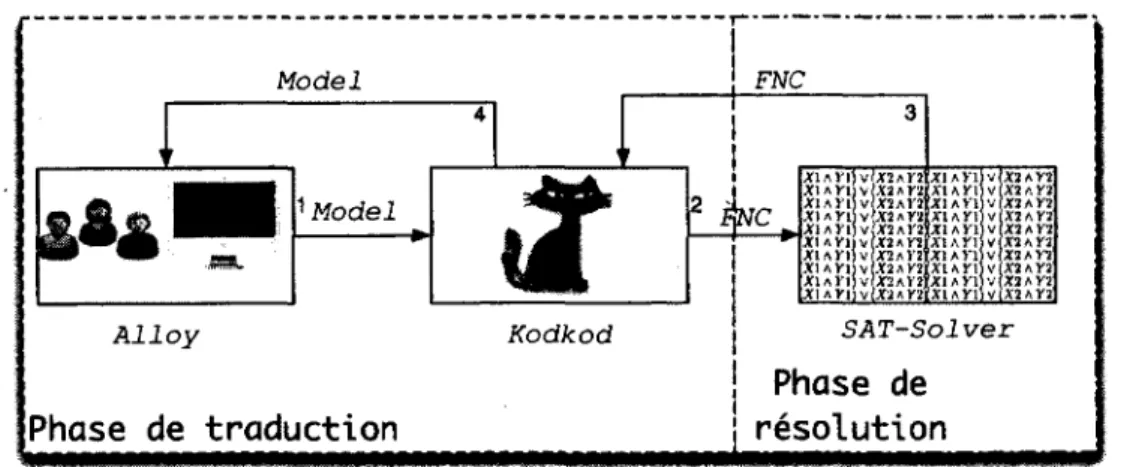
À chaque utilisation de ces deux commandes, A l l o y fait appel à Kodkod [56], un
outil qui permet la traduction automatique d’un modèle relationnel en modèle booléen dans une forme normale conjonctive (FNC) [37]. Ensuite, ces formules sont passées au SAT-solver qui, à son tour, fait le traitement nécessaire pour renvoyer des solutions sous FNC.Finalement, celles-ci sont traduites encore une fois par Kodkod et transférées à l’uti lisateur via l’interface de A l l o y . La figure 1.1 résume le fonctionnement interne de A l l o y .
La spécification 1.1 basé sur l’histoire d ’Adam et d ’Eve illustre certains aspects de
Alloy.
1 .4
Les outils de
AlloyAlloypossède deux types d’outils : internes et externes. Les outils internes permettent l’analyse (cohérence du modèle) et la vérification de propriétés sur le modèle et sont to talement transparents à l’utilisateur. Parmi eux, on retrouve, entre autres, les SAT-solvers,
Kodkod et Unsat-core [16], un outil utilisé pour identifier les formules qui causent la non-
satisfaction/incohérence dans le modèle. À l’inverse, les outils externes sont visibles par
1 .5 . Avantagese tlimitations M o d e l F N C 1 M o d e l m e I H Â T T T v T H A n î x r a v T ) v (X 2 a y i X I A Yi} V X2 A V 'iÎA't A VI V X2 A Y i A V l j v X 2 a V 2 ïX 1 a V 1 ) v [ X 2 A Y 2 A K l) v X2 a n ï x t A K l) V X2 A Y i A V I) v X2 A V 2ÏX I A V I) V X2 A Y I A K l! v (X2 A n ï x t A YI V (X 2 A Y i X I A V I) V X 2 A V 2 ïX tA V I V X2 A V2 ' A V l)v X 2 A V 2 ÎX IA V I V1X2AV2 X IA V I) V (X 2 AV 2ÎX 1A V I V (X 2 A V2 XI A y iiv fX 2 A V 2 ÎX lA V lW (X 2 A y 2 ] A l l o y Phase de traduction K o d k o d S A T - S o l v e r Phase de résolution
figure 1.1 - Le processus du traitement interne de Alloy
l’utilisateur, lui permettant d’évaluer les instances du modèle et les contre-exemples des propriétés. Parmi eux, on retrouve notamment Evaluator et dot1. Alors que le premier per met d’évaluer les formules en rapport avec la réponse obtenue après l’évaluation/réponse de l’analyseur (en demandant par exemple la cardinalité d’un ensemble ou l’évaluation d’un prédicat sur une transition du système trouvé), le second offre la possibilité de représenter automatiquement une structure d’information sous la forme d’un graphe (autrement dit, il donne une représentation graphique des instances et des contre-exemples obtenus).
1.5 Avantages et limitations
Parmi les avantages qui distinguent Alloydes autres vérificateurs de modèles, on peut citer, entre autres, sa notation proche de celle de la plupart des langages orientés objet, son meilleur temps de traitement des opérations de vérification [21] ainsi que son intégration de modules de base et d’outils de visualisation et d ’évaluation. Bien que ces caractéris tiques représentent de réels atouts pour l’utilisateur, Alloy souffre de certaines limites qui circonscrivent parfois son champ d’application. Parmi elles, le vérificateur possède deux limitations majeures : une limitation absolue et une limitation réelle. La limitation absolue correspond au fait que le nombre d’atomes, une entité ayant une définition très proche à celle de l’objet, est limité à 232, ce qui dépend en grande partie de la taille et du nombre de
1 .5 . Avantagese tlimitations
— model e n t i t i e s d e f i n i t i o n .
sig Person
{
— l o n e : ô . . 1
father : lone Men, mother : lone Women,
— s e t ; © . , n
children : set Person, brother : set Person, sister : set Person,
}
sig Men extends Person
{
wife : lone Women
>
one sig Adam extends Men {} sig Women extends Person
{
husband : lone Men
}
one sig Eve extends Women {}
— axioms f a c t { some mother.Eve some father.Adam — Eve h a s no m o th e r and no f a t h e r no Eve.mother no Eve.father no Adam.mother no Adam.father — E v e ’ s husband i s Adam Eve.husband = Adam Adam.wife = Eve }
— g e n e r a t e a model s a t i s f y i n g t h e s i g n a t u r e s and t h e axioms.
pred show []{} run show for 4
prog 1.1 - Exemple illustrant quelque aspects de Alloy
1 .6 . Pr o c e s s u s d u d é v e l o p p e m e n td’u n m o d è l ee n Alloy
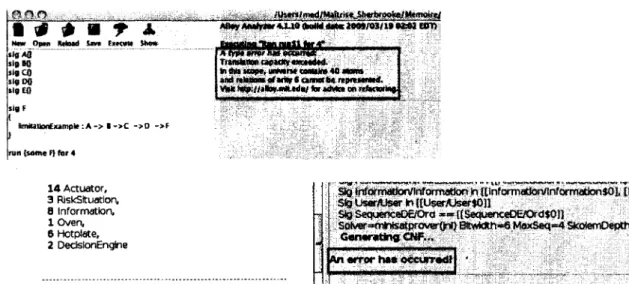
produits cartésiens dans le modèle. Par exemple, pour une relation binaire (une signature qui contient un champ unaire), le nombre d’atomes ne peut pas dépasser 216, et pour une relation ternaire (une signature qui contient un champ binaire), le nombre d’atomes ne peut pas dépasser 210, et ainsi de suite. La limitation absolue est une limitation posée par la struc ture interne des données de Alloy. En revanche, la limitation réelle dépend entièrement de
la complexité du modèle. Si le modèle est très complexe, Alloyrisque d’être à court de mé
moire et le traitement est alors arrêté. La figure 1.2 présente un exemple illustrant chacune de ces limitations.
OOP
1 # # a r a
New Open R tlu d S m Execute Show sifAà HaM sigeo sig d o sigeo sig F ( ItmtttüonExampte : A -> I ->C ->D ->F
run {some F} for 4
AtteyAM*yxW44a*<boM d e * 2009/03/1» E0T>
Traishaon apuclyciacM tM . In thb K sp t, i M m conuM 40 a u » and n ta o m « fariiy C caiM b * m n u m r f .
Visa t e «M es on ntesoHng 1 4 Actuator, 3 RlskSituatlon, 8 Information, X Oven, 6 Hotplate, 2 DeclslonEnglne
Sig information/information In [[Information/Information XO], [I Sig User/User In ([User/User$0)1
Sig SequenceDE/Ord ™ [ESequenceDE/OrdtOl]
Solver =*minfsstprcrver(jnl) Bltwi<*h«6 MaxSeq=4 SkolemDepth
Generating CNF...
An erro r has occurred!
figure 1.2 - Exemples de la limitation réelle et de la limitation absolue
1 .6
Processus du développement d’un modèle en
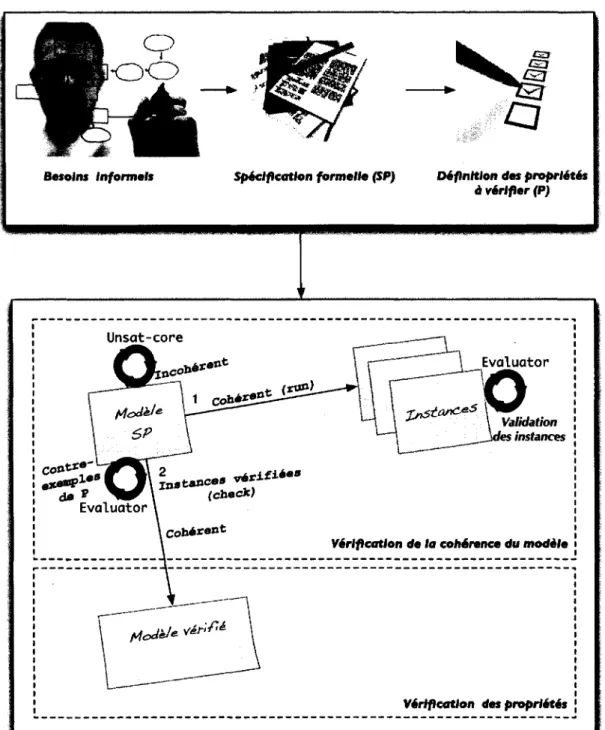
AlloyFaire le lien entre les langages de programmation et les analyseurs de modèles semble difficile de prime abord en raison du temps de développement du modèle. C’est pourquoi, il appert important de définir un idiome qui décrit la façon optimale de réaliser un déve loppement sûr. Cette technique consiste à écrire le modèle d’une manière incrémentale en s’assurant à chaque fois que sa cohérence reste intacte. La logique de cette approche au « pas-à-pas » repose sur le fait que plus le modèle devient grand, plus le temps de détection des éventuelles incohérences augmente. Dans l’éventualité où une incohérence est détectée, l’utilisateur est alors confronté à deux alternatives possibles : la première est d’utiliser le
1 .6 . Pr o c e s su sd u d é v e l o p p e m e n td’u nm o d è l ee n Alloy
Unsat-core et la seconde est d’éliminer les assertions d’une façon itérative, et ce, dans l’op tique conjointe de mettre le doigt sur ce qui cause l’incohérence. Une fois que cette phase est achevée et que tous les prédicats sont cohérents, l’utilisateur peut passer à la deuxième étape de l’analyse, à savoir : celle de la vérification des propriétés. La figure 1.3 résume le fonctionnement de ce processus de vérification incrémentale et itérative.
1 .6 . Pr o c e s su s d u d é v e l o p p e m e n td’u n m o d è l ee n Allo y
Spécification formalin (SP) Définition des propriétés à vérifier (P) Besoins Informels
Unsat-core
Evaluator
SP ides instancesValidation
In s ta n c e s v é c u e s (check)
Evaluator
Vérification de la cohérence du modèle
Vérification des propriétés
Chapitre 2
Comparaison de six vérificateurs de
modèles
Résumé
Cet article présente une comparaison de six vérificateurs de modèles sur un cas d’étude qui est celui de la bibliothèque. Cette étude vise à mettre en évidence les outils les plus adaptés à la vérification de systèmes d’information dans une approche d’ingénierie dirigée par les méthodes.
Commentaires
Cet article a été publié à la conférence ICFEM 2010 qui a eu lieu à Shanghai en novembre 2010. Ma participation à l’article concerne toutes les parties qui sont en rapport à Alloy, ainsi que les tests effectués sur le serveur du département
pour chacun des six vérificateurs de modèles comparés.
Comparison of Model Checking Tools for Information
Systems
Marc Frappier, Benoît Fraikin, Romain Chossart, Raphaël Chane-Yack-Fa, Mohammed Ouenzar
Département d’informatique, Université de Sherbrooke, Sherbrooke, Québec, Canada J1K 2R1
Abstract
This paper compares six model checkers (Alloy, cadp, fd r 2 , NuSMV, ProB , Spin) for the validation of information system specifications. The same case
study (a library system) is specified using each model checker. Fifteen properties of various types are checked using temporal logics (CTL and LTL), first-order logic and failure-divergence (fd r 2 ). Three characteristics are evaluated: ease of
specifying information system i) behavior, ii) properties, and iii) the number of IS entity instances that can be checked. The paper then identifies the most suitable features required to validate information systems using a model checker.
2 . 1 . In t r o d u c t io n
2.1 Introduction
Information systems (IS) now play a prominent role in our society to support business processes and share organisational data. Yet, even if they are one of the early application domains of computing, their development relies mostly upon a manual and informal pro cess. The problem addressed in this paper is the formal validation of IS specifications using model checking. Model checking is an interesting technique for IS specification validation for several reasons: it provides broader coverage than simulation or testing, it requires less human interaction than theorem proving, and it has the ability to easily deal with both safety and liveness properties.
The validation of IS specification is of particular interest in model-driven engineering (MDE) and generative programming, which aim at synthesizing an implementation of a system from models (i.e., specifications). Hence, if the synthesis algorithms are correct, one only needs to validate the models to produce correct systems. IS MDE specification languages usually do not have any dedicated model checker. Since developing a model checker is a long process and since several model checkers already exist, it is simpler to choose an existing tool that is maintained by a team specialized in the model checking field. In this paper, we compare six model checkers: Spin [30], NuSMV [9], fd r 2 [50], c a d p [24], A l l o y [32] and P r o B [35], which are representative of the main classes of model checkers:
explicit state, symbolic, bounded and constraint satisfaction. The comparison is based on a single case study which is representative of IS structure and properties. Our comparison aims at answering the following questions.
1. Is the modeling language of the model checker adapted for the specification of IS models? This is especially important in the context of MDE IS, since it must be straightforward to automatically translate an IS MDE specification into the language of the model checker.
2 . Is the property specification language adapted to specify IS properties?
3. Is the model checker capable of checking a sufficient number of instances of IS enti ties?
Our case study focuses on the control part of an IS, which determines the sequences of actions that the IS must accept. Validation of input-output behavior (data queries) and user interactions with graphical user interface are omitted.
2 . 2 . Re la ted Wo r k
This paper is structured as follows. Section 2 .2 presents a synthesis of related work
on model checking of IS. Section 2 .3 presents a description of the case study, a library IS.
Section 2 .4 provides an overview of the model checkers, comparing relevant points. The
modeling and verification process of the IS for each tool is provided in Sect. 2 .5 . Then, the analysis of processes and the model checking results for the case study are presented in Sect. 3 .6 . Finally, we conclude in Sect. 2 .5 .
2.2 Related Work
There is an extensive literature on model checking. This section focuses on compara tive studies of model checkers related to IS. Model checking has been extensively applied to business process modelling. Yeung [58] proposes a framework to analyse suspendible
business transactions modelling with statecharts and csp [50]. It is applied to a library specification similar to the one studied in this paper. However, the paper does not actually experiment with model checkers to check business process. In [5], a travel agency business process has been modelled with Spin and Promela, and CIA and csp (LP). Safety proper ties and deadlocks have been successfully verified with both model checkers; reachability properties have not been tested. The authors propose an extension of csp with notion of “compensation” (a behavior to compensate a process failure). In [43], business processes are converted from BPEL to automata, but also to Petri nets and csp and lotos [1 0 ]. It
concludes that process algebras are suitable for verification of the reliability of IS, in the particular case of business process. In [ 15], the authors study the verification of data-driven applications in the particular case of web-based systems using an ASM-like [52] specifi cation language. The study focuses particularly on reachability properties, but any type of property can be used for modelling. The modelling process is complex and demands significant expertise. Both modelling techniques give an insight on what can be done with these subclasses of IS. In [6], four state-based model modeling techniques with their model checkers (USE, Alloy, ZLive and ProZ) are compared along four criteria: animation, gener ation of pre and postconditions, execution analysis and expertise. The study mostly checks invariant properties.
Each of these studies provides partial answers to our questions, for a subset of model checkers, using different case studies and properties. This makes it difficult to compare
2 . 3 . Pr e sen t a t io n o ft h e Ca s e St u d y
model checkers and identify the one best suited for IS validation.
2.3 Presentation of the Case Study
This section presents the user requirements of a library system which is used for the formal verification of properties. In order to avoid any confusion, key concepts are first defined. Lending a book means that a user borrows a book without reserving it beforehand.
Taking a book means borrowing a book after having reserved it. Borrowing a book denotes
either taking or lending it. In the requirements list, a member is a person who has joined (and still not left) library membership.
reservation Reserve Take Cancel book m em b er bookld : BOOKID m em berid : MEMBERID Join Leave A cquire Discard loan Lend Renew Return
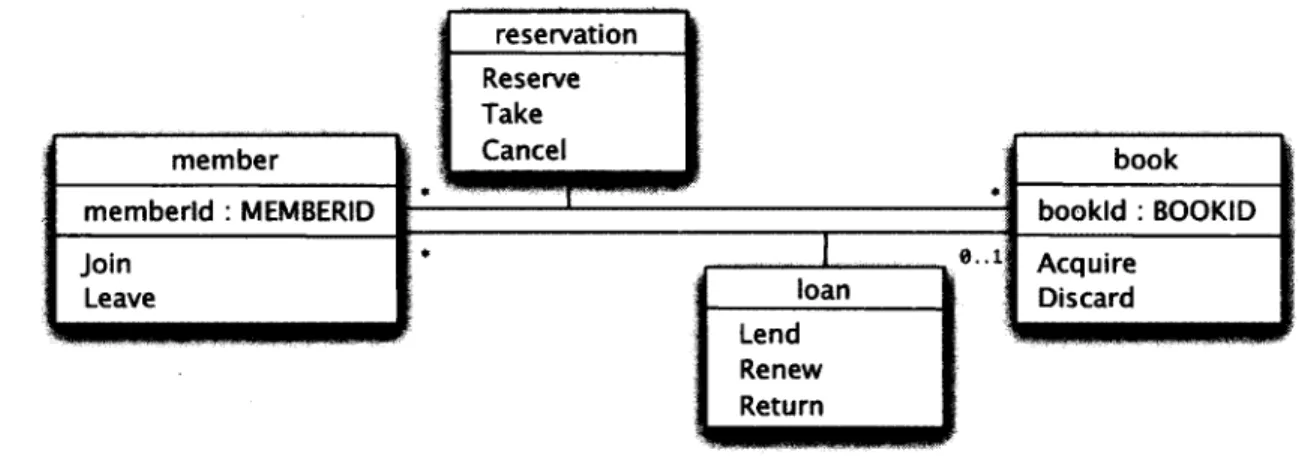
Figure 2.1: Requirement class diagram of the library system
The requirement class diagram corresponding to the model is given in Figure 2.1. Entity attributes are listed in the upper part of each class, while entity actions are listed in the lower part. The library system only contains two entity types: books and members. Members can J o in and then Leave library membership whereas books can be A cquired and then D iscarded. Members can Lend, Renew several times and R eturn a book. They can also Reserve a book under certain conditions (e.g. if it cannot be lent at that moment), and then, either Cancel the reservation or Take the book. Hence the library system contains
10 actions.
The following list describes the properties that we verify using the model checkers. 1. A book can always be acquired by the library when it is not currently acquired.
2 . 3 . Presen t a t io no ft h e Ca s e St u d y
2. A book cannot be acquired by the library if it is already acquired.
3. An acquired book can be discarded only if it is neither borrowed nor reserved. 4. A person must be a member of the library in order to borrow a book.
5. A book can be reserved only if it has been borrowed or already reserved by another member.
6. A book cannot be reserved by the member who is borrowing it. 7. A book cannot be reserved by a member who is reserving it. 8. A book cannot be lent to a member if it is reserved.
9. A member cannot renew a loan if the book is reserved.
10. A member is allowed to take a reserved book only if he owns the oldest reservation. 11. A book can be taken only if it is not borrowed.
12. A member who has reserved a book can cancel the reservation at anytime before he takes it.
13. A member can relinquish library membership only when all his loans have been returned and all his reservations have either been used or canceled.
14. Ultimately, there is always a procedure that enables a member to leave the library. 15. A member cannot borrow more than the loan limit defined at the system level for all
users.
In the context of IS, one usually distinguishes two types of properties. The first one is called a liveness property. It represents the fact that the system is still alive, i.e. not stuck in a deadlock (the system is blocked in a single state) or a livelock (the system loops in a subset of states considered as non-evolving). They can also express the fact that an action implies a reaction from the system; the latter is however rarely used in information sys tems, where actions are human-driven (one cannot force a user to trigger specific actions). Properties 1, 12 and 14 are liveness properties. In IS, liveness properties usually describe
sufficient conditions to enable an action (immediately or sometime in the future). For in
stance, Property 1 states that the library has the right to acquire the book (under certain conditions). In other terms, it forces the IS to allow the action, but the user is not forced to invoke this action. The other properties are called safety properties. They usually de scribe necessary conditions to enable an action, or what a user is not allowed to do with
2 . 4 . An Ov e r v ie w o ft h e Mo d e l Ch e c k e r s
the system at a given point. The remaining properties are safety properties. A third type of properties is usually distinguished from these two. These ar& fairness properties, but as IS users cannot be forced to do some action, they seldom occur in IS specifications. Fairness is not considered in this study.
2.4 An Overview of the Model Checkers
Four large families of model checkers are considered. Explicit state model checkers, like cadp, Spinand fdr2 , use an explicit representation of the transition system associated to
a model specification. This transition system is either computed prior to property verifica tion, as in cadp and fdr2, or on-the-fly while checking a property, as in Spin (also possible in some cases with cadp and fdr2). Symbolic model checkers, like NuSMV, represent the
transition system as a Boolean formula. Bounded model checkers, like NuSMV and Alloy (indirectly), consider traces, of a maximal length k, of the transition system and represent them using a Boolean formula. Constraint satisfaction model checkers, like ProB, use logic programming to verify formula. Spin, cadp, NuSMV and ProB support temporal lan
guages (LTL [47], CTL [17] and XTL [38]) for property specification. Alloy and fdr2 use
the same language for both model specification and property specification (first-order logic and csp, respectively).
2.4.1
SpinSpinwas one the first model checker developed, starting in 1980. It introduced the clas sical approach for on-the-fly LTL model checking. Specifications are written in Promela and properties in LTL. An LTL property is compiled in a Promela n ev er claim, i.e. a Biichi automaton. Spingenerates the C source code of an on-the-fly verifier. Once compiled, this verifier checks if the property is satisfied by the model. Working on-the-fly means that
Spin avoids the construction of a global state transition graph. However, it implies that transitions are (re-)computed for each property to verify. Hence, if there are n properties to verify, a transition is potentially computed n times, depending on optimizations.
Promela, the model specification language of Spin, is inspired from C. Hence, it is an
imperative language, with constructs to handle concurrent processes. State variables can
2 . 4 . An Ov e r v ie w o ft h e Mo d e l Ch e c k e r s
be global and accessed by any process. Pr o m el aoffers basic types like char, b i t , i n t and
arrays of these types. Processes can communicate by writing and reading over a channel, either synchronously using a channel of length 0, or asynchronously, using a channel of length greater than 0. Operator atom ic allows a compound statement to be considered as a single atomic transition, except when this compound contains a blocking statement, such as a guard or a blocking write or read over a channel, in which case the execution of the atom ic construct can be interrupted and control transferred to another process. Statements can be labeled and these labels can be used in LTL formulae.
Spin uses prepositional LTL, with its traditional operators always, eventually and until.
The latter is sometimes referred as the “strong until” operator, as opposed to the “weak until” operator. The next operator is not allowed to ensure that partial order reduction can be used during the model checking. An LTL formula can refer to labels and state variable values of a Pr o m el a specification. Sp in only considers states; there is no notion of event
on a transition. An LTL formula holds for a Pr o m el a specification if and only if it holds
for every possible run of the Pro m ela model. A run is an execution trace consisting of the
sequence of states visited during execution. It can be infinite.
2.4.2 NuSMV
NuSMV is a model checker based on the SMV (Symbolic Model Verifier) software, which was the first implementation of the methodology called Symbolic Model Checking described in [39]. This class of model checkers verifies temporal logic properties in finite state systems with “implicit” techniques. NuSMV uses a symbolic representation of the specification in order to check a model against a property. Originally, SMV was a tool for checking CTL properties on a symbolic model. But NuSMV is also able to deal with LTL (+Past) formulae and SAT-based Bounded Model Checking. The model checker allows to write properties specification both in CTL or LTL and to choose between BDD-based symbolic model checking and bounded model checking.
NuSMV uses the SMV decription language to specify finite state machines. A specifi cation consists of module declarations and each module may include variable declarations and constraints. System transitions are modelled by assignment contraints or transition constraints, which define next values for declared variables in a module. An assignment
2.4. An Ov e r v ie w o ft h e Mo d e l Ch e c k e r s
gives explicitly a value for a variable in the next step, while a transition constraint, given by a boolean formula, restricts the set of potential next values. Each module can be in stantiated by another one, for example by the main module, as a local variable. In fact, each instance of a module is by default processed synchronously with the others during an execution. But NuSMV can also model interleaving concurrency by using the “process” keyword in module instantiation. To get different instances of module, instantiations can be parameterized. However, the description language is quite low-level. All assignments, parameters or array indexes have to be constant. Thus, specifications may be longer than
in Pr o m e l a, because each case has to be explicitly written. As NuSMV modules can de
clare state variables and input variables, an SMV specification can be both state or event oriented. Input variables are used to label incoming transitions and their values can only be determined by specifying transition constraints.
CTL properties can only be expressed by using state variables, but NuSMV allows to use input variables and state variables in LTL specifications. Moreover, NuSMV can also check invariant properties, which can be written in a temporal manner as Always p where p is a boolean formula. Invariant specifications are checked by a specialized algorithm during reachability analysis, that gives a result faster than CTL or LTL algorithms.
2 . 4 .3 f dr2
f d r2 is an explicit state model checker for c s p, the well known process algebra. f d r2 can check refinement, deadlocks, livelocks and determinacy of process expressions. It gradu ally builds the state-transition graph, compressing it using state-space reduction techniques, while checking properties, which also makes it an implicit state model checker.
Models are described using a variant of c s p, called CSPm. It supports classical process algebra operators like prefix, choice, parallel composition with synchronisation, sequential composition and guards. Quantified versions of choice, parallel composition and sequen tial are supported. f d r2 supports basic data types like integer, boolean, tuples, sets and sequences. Lambda terms can be used to define functions on these types. Expressions are dynamically typed (except for actions, called channels in c s p, which are declared and typed), c s pdoes not support state variables; however, they can be simulated to some extent
by using a recursive process with parameters.
2.4. An Ov e r v ie w o ft h e Mo d e l Ch e c k e r s
Properties are expressed as c sp processes. They are checked using process refinement. f d r2 supports three refinement relations: C r (trace refinement), Cf (stable-failure refine
ment) and Cfd (stable-failure-divergence refinement). We say that P QT Q iff the traces of
Q are included in the traces of P. A trace of a process P is a sequence of visible events that P can execute. We say that P Ef Q iff the failures of P are included in the failures of Q.
A failure (t, S ) of a process P denotes the set of events S that P can refuse after executing trace t. Trace refinement is used to check safety properties, while stable failure is used to check liveness (or reachability) properties. Failure-divergence refinement is used to check livelocks (infinite loops on internal actions), which are not relevant for our case study.
2.4.4
c a d pca dp is a rich and modular toolbox. We have selected loto s-n t to specify models and
XTL to specify properties. The XTL model checker takes as input a labelled transition system (LTS), encoded in the BCG (Binary Coded Graph) format, lo to s-n t is a variant
of lotos that supports local states variables. A l o to s-n t specification is translated into a
LTS using Caesar. This LTS is minimized into a trace equivalent LTS. Finally, properties written in XTL are checked against this LTS using the XTL model checker.
lo to s-n t is inspired from lo t o s. A l o to s-n t specification is divided into two comple
mentary parts: an algebraic specification of the abstract data types and a process expression.
lo to s-n toffers traditional process algebra operators like sequence, choice, loop, guard and
parallel synchronization. It supports state variables, which are local to a process and can not be referred by another process. Assignment statements can be freely mixed with other process expression constructs.
XTL, the property specification language of c a d p, is used to express temporal logic properties. XTL provides low-level operators which can be used to implement various temporal logics like HML, CTL, ACTL, LTAC, as well as the modal mu-calculus. XTL formulae are evaluated on a LTS. XTL allows one to refer to transitions (events) and values of their parameters. No LTL library is currently provided. In this paper, the CTL and HML libraries are used.
Since the LTS does not contain any state variable, the difficult part in writing XTL properties for lo to s-n t models is to characterize states. Indeed, the specifier can only use
2 . 4 . An Ov e r v ie w o ft h e Mo d e l Ch e c k e r s
action labels to define particular states. The HML library, with its two handy operators
Dia and Box, is used for this purpose. Box(a, p) holds in a given state if and only if every
action matching action pattern a leads to a state matching state pattern p. On the other hand,
Dia(a, p) holds for a given state if and only if there exists at least one action matching action
pattern a leading to a state matching state pattern p. An XTL formula holds for a LTS if and only if it holds for all states of the LTS.
2.4.5
A l l o yAl l o y is a symbolic model checker. Its modeling language is first-order logic with
relations as the only type of terms. Basic sets and relations are defined using “signatures”, a construct similar to classes in object-oriented programming languages, which supports inheritance. All o y uses SAT-solvers to verify the satisfiability of axioms defined in a
model and to find counterexamples for properties (theorems) which should follow from these axioms.
An Alloy specification consists of a set of signatures, noted (sig), which basically
define sets and relations. Constraints, noted f a c t, are formulae which condition the values of sets and relations. The declaration s ig X {r : X -> Y} declares a set X and a ternary relation r which is a subset of the Cartesian product X x X x Y. Allo y supports usual
operations on relations, like union, intersection, difference, join, transitive closure, domain and range restriction. Integer is the only predefined type. Cardinality constraints can be defined on relations (e.g., injections and bijections). Properties are simply written as first- order formulae.
2.4.6 P
roB
ProB is a model checking and an animation tool designed for the B Method [1]. Cur rently it also supports CSPW, Z, and Event-B. This study uses the B Method and the B language.
B specifications are organized into abstract machines (similar to classes and modules). Each machine encapsulates state variables, an invariant constraining the state variables, and operations on the state variables. The invariant is a predicate in a simplified version of the ZF-set theory, enriched by many relational operators. In an abstract machine, it is
2 . 5 . Sp e c if y in gt h e Mo d e l a n dt h e Pr o pe r t ie s
possible to declare abstract sets by giving their name without further details. This allows the actual definition of types to be deferred to implementation. Operations are specified in the Generalized Substitution Language, which is a generalization of Dijkstra’s guarded command notation. Hence, operations are defined using substitutions, which are like as signment statements. A substitution provides the means for identifying which variables are modified by the operation, while avoiding mentioning those that are not. The gener alization allows the definition of non-deterministic and preconditioning substitutions. The preconditioning substitution is of the form PRE P THEN S END, where P is a predicate and S a substitution. When P holds, the substitution is executed; otherwise, the result is undetermined and the substitution may abort.
Properties in ProB can be written in LTL, past LTL or CTL, hence combining the strengths of each language. In addition, ProB allows for the inclusion of first-order formu lae in temporal formulae. It also offers two convenient operators for LTL. The first one, denoted by e(A), checks if the action A is executable in a given state of a sequence. The second one, denoted by [A] checks if A is the next operation in the sequence. Consequently ProB can express properties on either states or events.
2.5 Specifying the Model and the Properties
This section describes how the IS model and properties are specified with each model checker. For sake of conciseness, specifications are omitted. They are available in [13].
2.5.1
SpinTwo styles have been considered for the Sp in specification. In the first style, there is
only one process which loops over a choice between all actions. It was quickly abandoned, because it blows quite rapidly in terms of number of states. In the second style, there is one process for each instance of each entity and each association. The process describes the entity (or the association) life cycle. Therefore, the Pr o m el a specification of the case study
contains four process definitions, one for each entity (book and member) and one for each association (loan and reservation). Each process definition is instantiated n, times to model n, instances of entity i, and n, * tij times to model an association between entity i and j.
2 . 5 . Spe c ify in g t h e Mo d e la n d t h e Pro pe r t ies
We use a producer-modifier-consumer pattern as the basis of a life cycle for an entity and an association. It can be represented by the following regular expression P.M*.C where
P is the producer (for example Acquire), M is a modifier and C is a consumer (for example
D iscard). The concatenation operator of regular expressions can be represented by a semi-colon the sequential composition operator of Pr o m el a, or an arrow that denotes the same operator. Some events have a precondition which is not represented in the regular expression. For example, a book cannot be discarded if it is still borrowed. Consequently the execution of an event is guarded by a precondition.
When a member takes a book he has reserved, two associations are involved: the loan association and the reservation association. This leads to ensure that both processes execute the ta k e event in an atomic step. It is not obvious and straightforward. To achieve an atomic step, the ta k e event is split into two events: one in the reservation association process (as a consumer) and one in the loan reservation (as a producer). A channel with an empty capacity is used to ensure the handshake. This is a classic strategy in Pr o m e l a. Nevertheless, the handshake cannot be made within an atom ic instruction. This could break the local atomicity in the sender. But it could be used at the end of an atom ic and at the beginning of another. In this way, no other process can be interleaved with the handshake of the two processes. The result is a pattern described in [ 13], in which an event is simultaneously the consumer of an association and the producer of another one.
In Sp in, the properties are expressed using LTL. Reachability properties are difficult to express in LTL. Fortunately, since event preconditions are explicitly written via labels in the specification, expressing a property like “a book can be acquired” is straightforward. Consequently, when a property asserts the possibility of an event execution, it is repre sented by a prepositional formula in the LTL formula that uses a label of the process and, sometimes, the precondition of this event. For example, “the book bQ can be acquired” is expressed as “process book bQ is at the d isc a rd e d label”.
Property 14 is not expressible in LTL, since it is equivalent to a reset property. The reset property is known to be expressible in CTL only. LTL and CTL are complementary lan guages. The semantics of LTL formulae is defined on traces of the transition system, while the semantics of CTL formulae is defined on the transition system itself, which allows one to refer to the branching structure of the execution. Some properties can only be expressed in either LTL or CTL. For instance, a reset property, which states that it is always possible
2 . 5 . Sp e c if y in g t h e Mo d e l a n dt h e Pr o pe r t ies
to go back to some desired state, cannot be expressed in LTL, since this transition to reset does not have to occur in each possible run of the system. Since an LTL formula holds if and only if it holds for every possible run of the system, an LTL property would force this reset transition to occur in every run. Dually, a property of the form “eventually p always holds” cannot be expressed in CTL [19], due to the branching nature of the logic.
Two simple patterns can express almost 70 % of the requirements. In LTL and with the state-oriented paradigm, these patterns are expressed as “if action A can be executed then the state verifies F ’ or “if P holds then action A can be executed” where P is only true between B and C. Therefore the two main patterns are □ (can_A => P) or □ (P => can_A). Inexpressible properties cannot simply be considered as negligible. This is an important weakness of Sp in that cannot be overcome.
2.5.2 NuSMV
To model the library system example in an SMV specification, we use a systematic method based on the structure of the class diagram. Each class, that represents an object and has attributes, is encoded into a module containing variables and parameterized by a key to identify entities. Then, for each kind of action defined in the system, a new module is created, parameterized by class modules involved in that action. Action modules check that a given precondition is satisfied. Then, if the precondition holds, they modify variables of entities to apply postconditions using assignment constraints.
Properties of the library system can be expressed by CTL formulae on state variables, or by using LTL formulae with state variables or input variables. Specifications on state variables are close to Promela specifications, except that NuSMV can check CTL and LTL properties. This allows to easily express all requirements. Specifications on input variables are event-oriented. However, only LTL can be used to write event-oriented specifications in NuSMV.
Property 1 is a sufficient condition to enable an event. It is easily expressed as follows: AG ( !b o o k l.is _ a c q u ire d -> EX b o o k l.is _ a c q u ire d ). Property 12 is specified in a similar manner, except that it must be repeated for each position in the array representing the reservation queue. Hence, the text of properties may linearly grow with the number of entity instances, an unfortunate limitation due to the restriction to constants in accessing