Rovibrational controlled-
NOTgates using optimized stimulated Raman adiabatic passage
techniques and optimal control theory
D. Sugny,1L. Bomble,2T. Ribeyre,2O. Dulieu,3and M. Desouter-Lecomte2,4,
*
1
Institut Carnot de Bourgogne, UMR 5209 CNRS, Université de Bourgogne, BP 47870, 21078 Dijon Cedex, France 2
Laboratoire de Chimie Physique, Université de Paris-Sud, Unité Mixte de Recherches 8000, Orsay F-91405, France 3
Laboratoire Aimé Cotton, CNRS, Université Paris-Sud, Bât. 505, 91405 Orsay Cedex, France 4
Département de Chimie, B6c, Université de Liège, Sart-Tilman, B-4000 Liège 1, Belgium 共Received 31 March 2009; published 23 October 2009兲
Implementation of quantum controlled-NOT共CNOT兲 gates in realistic molecular systems is studied using stimulated Raman adiabatic passage共STIRAP兲 techniques optimized in the time domain by genetic algorithms or coupled with optimal control theory. In the first case, with an adiabatic solution 共a series of STIRAP processes兲 as starting point, we optimize in the time domain different parameters of the pulses to obtain a high fidelity in two realistic cases under consideration. A two-qubitCNOTgate constructed from different
assign-ments in rovibrational states is considered in diatomic共NaCs兲 or polyatomic 共SCCl2兲 molecules. The difficulty of encoding logical states in pure rotational states with STIRAP processes is illustrated. In such circumstances, the gate can be implemented by optimal control theory and the STIRAP sequence can then be used as an interesting trial field. We discuss the relative merits of the two methods for rovibrational computing共structure of the control field, duration of the control, and efficiency of the optimization兲.
DOI:10.1103/PhysRevA.80.042325 PACS number共s兲: 03.67.Lx, 82.50.Nd, 03.67.Ac
I. INTRODUCTION
Implementing logical gates on molecular systems for clas-sical Boolean logic 关1,2兴 or quantum computing 共see Refs.
关3–10兴 to cite a few兲 is now a well-recognized topic with
numerous theoretical studies and potential experimental ap-plications关2,11兴. From the theoretical point of view, a large
amount of works using optimal control theory共OCT兲 关12,13兴
or genetic algorithms共GAs兲 关14兴 has been done in the recent
literature to implement one- or two-qubit gates using vibra-tional modes of molecules关3,6,7,15–19兴 or rotational states
关8,20兴. Recently, even more complex schemes such as a
full adder 关21兴, adder-subtractor 关22兴, Deutsch-Jozsa
关3,11,18,20,23,24兴, or Shor 关7兴 algorithms have been
consid-ered. Adiabatic passage techniques共APTs兲 are also powerful methods to transfer population or to implement quantum gates in molecular systems 关25兴. One of the most
well-known adiabatic techniques is the stimulated Raman adia-batic passage 共STIRAP兲 scheme. For optical cavity, it has been shown that a series of STIRAP processes can be used to implement quantum gates关26,27兴 and algorithms as, for
in-stance, the Grover’s search algorithm关28兴. Such systems are
ideal in the sense that all the levels populated during the control are degenerate. This is no longer the case for molecu-lar systems where the duration of the control has to be ad-justed since the levels are not degenerate. This means that the relative phase of the different states of the gate varies as a function of the total duration of the control.
We consider a two-qubit controlled-NOT 共CNOT兲 gate 共controlled-NOT gate in which the target qubit flips if and only if the control qubit is equal to 1兲 and two particular control techniques: the APT process optimized by a genetic algorithm in time domain and APT coupled to an
optimiza-tion by OCT. We show that the efficiency of the transforma-tion driven by APT strongly depends on the assignments of the qubit states to various choices of vibrational and rota-tional levels of the molecule. A previous study 关8兴 has
al-ready examined the fidelity of a CNOTgate according to the choice of the control qubit in a diatomic molecule. This work used shaped mid-infrared pulses optimized by a genetic al-gorithm to manipulate the qubit states. In this paper, the APT method is based on transitions via an excited electronic state. Therefore, we revisit this problem by operating in the uv-visible spectrum. This has been recently proposed 关29兴 to
implement gates from rovibrational states and illustrated in the Na2 molecule. Due to the complexity of the considered systems, the APT process alone does not give a sufficient fidelity. To overcome this difficulty, the idea consists in com-bining APT and optimization. In a first step, the adiabatic technique allows us to determine the structure of the control field. In a second step, we optimize different parameters to recover a high efficiency for the control. We have chosen an optimization by GA in the time domain, the parameters being the intensity of the different pulses, their duration, and the position of the center of each pulse共these parameters modify the relative positions of the different pulses兲. For two-qubit gates, the number of parameters is of the order of 10. Note that such techniques combining adiabatic passage and opti-mization共without GA兲 of a finite number of parameters have already been used for the transfer of population in molecules 关16,17,30,31兴. The present approach is thus different from
the usual optimization by GA in the frequency domain 关7,8,32兴. When the APT sequence cannot drive the gate
transformation, we use OCT with spectral constraints in or-der to get realistic pulses. The APT sequence constitutes then an interesting trial field to guide the optimization toward a simpler control field even if a part of the robustness of the adiabatic techniques is lost.
We consider two molecular systems: a polar diatomic molecule NaCs and a polyatomic molecular system SCCl2. *[email protected]
Polar diatomic molecules in the context of cold molecules 关33–35兴 have been suggested as promising materials for
scal-able quantum computing关9,10,36,37兴. The SCCl2 molecule has been already used to simulate quantum computing with excited rovibrational states关7,22兴.
The paper is organized as follows. In Sec.II, we recall the principles of the adiabatic passage techniques, genetic algo-rithms, and optimal control theory. The different qubit as-signments in rovibrational states are presented in Sec.III. We illustrate the role of the assignment of qubit states in a di-atomic system in Sec. IV and in a polyatomic molecule in Sec.V. Conclusions and prospective views are given in Sec.
VI. Some technical points are reported in Appendixes A and B.
II. METHODOLOGY
The Hamiltonian of each diatomic or polyatomic system is expressed in a rovibrational basis set belonging to two electronic states for which the Born-Oppenheimer approxi-mation is valid. After integration over the electronic coordi-nates, the Hamiltonian operator acting in the rovibrational nuclear wave-function space reads
H =
冉
H0 1 0 0 H02冊
−冉
0 12
21 0
冊
E共t兲, 共1兲 where H0␣= TN+ V␣ 共␣= 1 , 2兲 is the Hamiltonian describing the nuclear dynamics in the ground 共␣= 1兲 and excited 共␣= 2兲 states 共TNis the kinetic-energy operator of the nuclei and V␣ is the BO electronic potential energy兲. 12 is the electronic transition dipole momentum and E共t兲 the electric field. In a rovibrational basis set 共i.e., after integrating the Schrödinger equation over the nuclear coordinates兲, each H0␣ block is diagonal and contains the rovibrational energies for each electronic state. The off-diagonal blocks␣contain all coupling elements. They are discussed in Appendix A. The coupled equations are integrated by the Runge-Kutta method 关38兴 in the interaction representation 共but without anyrotating-wave approximation兲. E共t兲 is chosen linearly polar-ized so that the simulations are performed for a constant value of the quantum number M 共here, M =0兲, where M is the projection of the total angular momentum on the polar-ization direction of the control field which corresponds to the axis OZ of the laboratory frame共see Appendix A兲.
A. Description of the adiabatic processes
We consider an adiabatic process introduced in Refs. 关26,27兴 for optical cavity and applied to molecular systems
in Ref.关29兴. This process is composed of a series of STIRAP
processes 关25兴. A STIRAP process transfers the population
from an initial state to a final state共uncoupled to the initial state兲 via an intermediate state 兩I典. Transition between the initial state and the intermediate one is called pump and the one between the intermediate and the final state is called Stokes. When the pump-Stokes sequence is applied in a counterintuitive order 共the Stokes pulse before the pump pulse兲 with a properly chosen overlap between the two pulses, the intermediate state 兩I典 is not populated during the
transfer. In molecular systems, due to the coupling to other rovibrational states, the state 兩I典 can be slightly populated during the process. For aCNOTgate, the following transitions must be driven by a single control field:
兩00典 → 兩00典;兩01典 → 兩01典;兩10典 → 兩11典;兩11典 → 兩10典. The sequence of population inversions proposed in Ref.关29兴
to implement aCNOTgate by STIRAP techniques is schema-tized in Fig. 1.
The first STIRAP makes the transfer from兩11典 to a shelv-ing state 兩S典 by applying ⍀S 共Stokes兲 and then ⍀11 共pump兲 where⍀=ijA共t兲/ប is the Rabi frequency for the transition and ij is the dipolar matrix element between the chosen rovibrational states and A共t兲 is the pulse envelope. The sec-ond STIRAP makes the transfer from 兩10典 to 兩11典 by apply-ing⍀11 and then⍀10. The third STIRAP makes the transfer from兩S典 to 兩10典 by applying ⍀10and then⍀S. All the trans-fers are realized via兩I典 which remains slightly populated. By this way, one inverses 兩10典 and 兩11典 leaving 兩00典 and 兩01典 unchanged. In this pulse sequence, when two consecutive pulses are identical, one could use only one pulse instead of two 关29兴. In that way, a pulse corresponds to the pump for
one STIRAP process and to the Stokes pulse for the next STIRAP process. This is very interesting since the optical resources are reduced. The sequence of pulses for a CNOT gate is then⍀S⍀11⍀10⍀Swhere the second and fourth pulses have a phase exp共i兲 to enforce the correct relative phases of the final states关29兴. Adjusting the parameters of the different
pulses of the STIRAP processes will be realized by genetic algorithms. The optimization must allow us to realize the four transformations of theCNOTgate with a phase constraint
1 2共兩00典 + 兩01典 + 兩10典 + 兩11典兲 → 1 2共兩00典 + 兩01典 + 兩10典 + 兩11典兲e i , 共2兲 where the phase can take any value between 0 and 2. This transformation ensures that the phases of the final states
FIG. 1. 共Color online兲 Transitions involved in the adiabatic
pro-cess for computing a CNOT gate by the pulse sequence
of the gate are equal and that the pulse can realize the gate transformation on any superposition of the computational ba-sis states关3,39兴. In other words, this implies that a true
uni-tary transformation is implemented by the control field. If the phase constraint is not satisfied, then only the population inversion is realized. This means therefore that a classical and not a quantum gate is implemented by the laser fields. In the different numerical computations, we will see that the transformation on the phase is the most difficult to realize. The simulations are done in the interaction representation 共which gives a good numerical stability兲 so that the dynami-cal phases are omitted 共see Ref. 关29兴兲. However, the time
scale of the rovibrational field-free dynamics is of the order of 100 ps and the phase constraint in the Schrödinger repre-sentation is expected to be satisfied after a similar timing which is shorter than the duration of the pulse.
B. Optimization by genetic algorithms
We describe in this section the computational details of GA we have used 关40兴. We consider a series of Gaussian
pulses which are characterized by their intensity, their dura-tion, and the position of the maximum of the pulse. This last parameter allows us to modify the delay between the differ-ent fields. Each Gaussian pulse has the following general form:
Ek共t兲 = E0kexp关− 共t − tk兲2/2␥k 2兴cos共
kt兲. 共3兲
The carrier frequency kis fixed to the value of the corre-sponding transition. The parameters optimized by GA are E0k and tkfor each pulse, ␥k being fixed. Since the sequence is composed of four pulses, we have eight parameters to opti-mize. We have used GA with the following characteristics. Each individual is formed by the eight parameters共the chro-mosomes兲. At each iteration of the algorithm, we consider a population of 12 individuals and we compute the fitness function corresponding here to the fidelity of theCNOTgate. We choose 12 new individuals by selecting 12 times the best among three drawn randomly 共it is possible that the same parent can be chosen several times兲. This new set of indi-viduals is modified by mutation共the probability of mutation is 0.5兲 or by crossover 共the probability of crossover is 0.8兲. The fitness of these new individuals is calculated and the algorithm is iterated. Different choices can be done to esti-mate the fitness of a gate with the phase constraint关8,20,41兴.
To accelerate the convergence of the algorithm and to keep the structure of the STIRAP sequence at each step of the algorithm, we define the fitness not from the final fidelity of the gate but from a mean over the fidelity of the three popu-lation inversions involved in the sequence. With this defini-tion, one has to assess the fidelity Fn after each STIRAP process n with n = 1 , 2 , 3. This intermediate fidelity Fnis de-fined as the overlap between the time-depending wave func-tion i
n共t兲 共initial wave function evolving because of the field兲 and the wave function which the transformation drives toward nf共tn兲 at the final time of step n: Fn =兩具i
n共t兲兩 f n共t
n兲典兩2. For example, for the first inversion, n = 1, we have i n共t = 0兲 =1 2共兩00典 + 兩01典 + 兩10典 + 兩11典兲 →f n共t n兲 =1 2共兩00典 + 兩01典 + 兩10典 + 兩S典兲.
The initial state is a superposition of the qubit states in order to reach the phase constraint 关Eq. 共2兲兴. The global fidelity,
defined as F =共F1+ F2+ F3兲/3, is calculated for each indi-vidual.
C. Optimization by optimal control
The other method used to improve or replace the STIRAP sequence is the multitarget optimal control theory 关12,13兴.
The optimal field maximizes the objective functional with the constraint that the Schrödinger equation is satisfied at any time J =
兺
n=1 Z再
兩具i n共t f兲兩f n典兩2− 2Re冋
冕
0 tf 具f n共t兲兩 t+ i បHˆ 兩i n共t兲典dt册
冎
−␣冕
0 tf E2共t兲dt, 共4兲where ␣ is a positive penalty factor chosen to weight the importance of the laser fluence. For a N-qubit gate,
Z = 2N+ 1, where 2Nis the number of input-output transitions
in the gate unitary transformations and the supplementary equation is the phase constraint关Eq. 共2兲兴. Thei
n共t兲 are the wave packets which are propagated forward in time in inter-action representation共as in the APT approach兲 with the ini-tial conditionsi
n共t=0兲= i n
, n = 1 , . . . , Z. The Lagrange mul-tipliersf
n共t兲 are propagated backward in time with the final conditions f
n共t=t f兲=f
n
, n = 1 , . . . , Z. Note that for a two-qubit gate, N = 2 and Z = 22+ 1 = 5. The universal gate field able to drive any input toward the corresponding output is a sum of Z contributions Ej共t兲 = − 共s共t兲/ប␣兲Im
冋
兺
n=1 Z 具f n 共t兲兩j兩i n共t兲典册
, 共5兲where j denotes the polarization direction of the electric field. It is chosen to be the OZ laboratory axis. A switching function s共t兲=sin2共t/t
f兲 is introduced to provide a smooth on and off switch of the field关4兴. At each iteration noted 共k兲,
the field is given by E共k兲j = E共k−1兲j +⌬E共k兲j , where ⌬Ej共k兲 is cal-culated by Eq. 共5兲 关41兴 and j is expressed in interaction representation. The fidelity of the gate F is given by the average performance index of each transformation including that corresponding to the phase constraint
F =1 Z
兺
n=1 Z 兩具i n共t兲兩 f n典兩2. 共6兲Usually, OCT leads to complicated field containing unrealis-tic frequencies too low or too high according to the model or to the corresponding experimental process and some filtering is necessary to improve the field. We apply a filtering on the Fourier transform of the optimal field. The filter is composed
of bandpass filters around the vibrational frequencies of the model with a bandwidth fixed to a fraction of the vibrational frequencies 共see below for details兲. This scheme does not preserve the monotonic convergence of the algorithm but however a good convergence is achieved. Note that mono-tonically convergent algorithms with filtering have been pro-posed recently in the literature关42兴.
III. QUBIT ASSIGNMENT IN MOLECULAR STATES
The four logical states involved in the CNOTgate are ob-tained by varying the value of the controlled and the target qubits qc= 0 , 1 and qt= 0 , 1 leading to the computational ba-sis set states兩00典, 兩01典, 兩10典, and 兩11典. TheCNOT transforma-tion is UCNOT=
冢
1 0 0 0 0 1 0 0 0 0 0 1 0 0 1 0冣
.The four logical states can be mapped onto the molecular rovibrational states in different ways. The molecular states are denoted by two quantum numbersv and J related to the vibrational and the rotational degrees of freedom, respec-tively. 共The quantum number M is fixed to M =0兲. Among the different assignment possibilities presented below, we first consider two values ofv共v1andv2兲 and two values of J 共J1 and J2兲 to choose the four molecular states. Even in this way, there are still two possibilities to assign the controlled qubit qc.
共1兲 qc is encoded in the rotation qc= 0→J=J1 and
qc= 1→J=J2. The target qtis thus in the vibration. The
com-putational basis set is then mapped onto
兩00典,兩01典,兩10典, and 兩11典 → 兩J1v1典,兩J1v2典,兩J2v1典, and 兩J2v2典. The CNOT transformation leads to a transition between two target vibrational statesv1↔v2for the population of the ro-tational state J2but to no transition for the population of the state J1.
共2兲 qcis encoded in the vibration states qc= 0→v=v1and qc= 1→v=v2. The target qtis now in the rotation. The com-putational basis set is then mapped onto
兩00典,兩01典,兩10典, and 兩11典 → 兩v1J1典,兩v1J2典,兩v2J1典, and 兩v2J2典. TheCNOTtransformation leads to the inversion of the popu-lation of two target rotational states only if the vibrational state is v2and no transition occurs if the vibrational state is
v1.
共3兲 qc and qt are encoded in four different vibrational states
兩00典,兩01典,兩10典, and 兩11典 → 兩v1J1典,兩v2J2典,兩v3J3典, and 兩v4J4典. The third possibility consists in choosing different rotational states belonging to four different vibrational states. The in-terpretation of a controlled qubit in terms of the rotation or of the vibration is lost. TheCNOTtransformation corresponds to an inversion of population between two rovibrational states
of two different vibrational manifolds v3↔v4. The differ-ence with case共1兲 comes from the fact that the population of a rotational state J1or J2 which remains unaltered belong to different vibrational states v1orv2.
IV. DIATOMIC SYSTEM
We now examine the feasibility of the different assign-ments in rovibrational states 兩␣,v , JM⍀典 of a diatomic mol-ecule. The quantum numbers denote the electronic 共␣兲, vi-brational 共v兲, and rotational states 共J,M兲, respectively. ⍀=⌳+⌺, where ⌳ is the projection of the total electronic angular momentum on the molecular axis and ⌺ the projec-tion of the total electronic spin. ⌳=0 for the 1⌺+ state, ⌳=1 for the 1⌸ state, and ⌺=0 for both states. The elec-tronic potential-energy curves of the NaCs molecule have been computed and published recently关43兴. They are shown
in Fig. 2. The four qubit states and the shelving state are rovibrational states of the 1⌺+ ground electronic state 共␣ = 1兲. The excited electronic state supporting the intermediate state 兩I典 must not interact non-adiabatically through pro-nounced avoided crossings generated by the strong spin-orbit interaction between singlet and triplet states. Such interac-tions should lead to a nonradiative decay of the intermediate state. As seen in Fig.2, the bottom of the lower B 1⌸ state 共␣= 2兲 is well isolated from the other ones so that no strong interaction is expected. It is thus a good candidate to support the rovibrational intermediate state兩I典.
The energies of the rovibrational states are estimated by the approximation of the rigid rotor valid for the low levels
E␣,v,J= E␣0+共v + 1/2兲ប␣+关J共J + 1兲 − ⍀2兴B ␣共v兲. The rotational constant for each vibrational statev is given by B␣共v兲=2mប2具v兩R12兩v典, where R is the internuclear distance
1 5 0.2 0.4 0.6 0.8 1 R (nm) (D) -8 -7.5 -7 -6.5 -6 -5.5 -5 -4.5 4 cm -1 1 X Σ+ 1 B Π Na(3s) + Cs(6s) Na(3s) + Cs(6p) Na(3p) + Cs(6s) ) E(1 0
FIG. 2. 共Color online兲 Upper panel: Potential energy curves of NaCs. The1⌺+and1⌸ singlet states are in full lines 共blue for the 1⌺+states and red for the1⌸ states兲 and the triplet states3⌸ are in dotted lines. The selected electronic states are the ground X1⌺+and B1⌸ states 共noted by an arrow兲. Lower panel: Electronic transition dipole moment between the selected X 1⌺+ and B 1⌸ electronic states.
and m the reduced mass. The basis set for the numerical simulation contains the rotational states up to J = 5共M =0兲 of the vibrational statesv = 0 , 1 , 2 , 3 in the1⌺+state. For the1⌸ state, one retains thev = 4 state and the rotational states from
J = 1共lowest value for a ⌸ state兲 to J=4. The size of basis set
is chosen sufficiently large to avoid numerical boundary er-rors. All the vibrational states involved in the assignment 3 are kept. Other vibrational states are safely discriminated given the pulse duration chosen here. Rotational states are retained by taking into account the ⌬J= ⫾1 selection rule. The calculation of the matrix elements of the electronic tran-sition moment12 关Eq. 共1兲兴 in the rovibrational basis set is
summarized in Appendix A.
A. Assignment 1: Control qubit qcencoded
in the rotational states
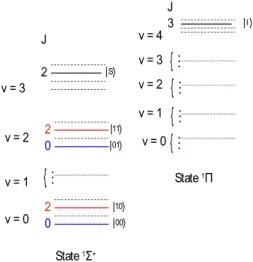
Figure 3 schematizes the rovibrational states used and gives their quantum numbers共the energy scale is arbitrary兲.
1. APT and GA
One observes that the STIRAP sequence is not efficient when the control qubit is encoded in a pure rotational state, for instance, J = 0共logical state 0兲 and J=2 共logical state 1兲. The parameters of the pulses giving the largest possible fi-delity are gathered in Appendix B. A vibrational transition must occur only from the state J = 2 and not affect the state J = 0 belonging to the same vibrational state. As shown in the lower panel of Fig. 4, it is possible to optimize a STIRAP sequence realizing the transformation 兩11典 共兩1⌺+, 2 , 2典兲→兩10典 共兩1⌺+, 0 , 2典兲 or vice versa but this solution does not preserve the populations in states兩00典 共兩1⌺+, 0 , 0典兲 and 兩01典 共兩1⌺+, 2 , 0典兲 as illustrated in the upper panel of Fig.4.
Figure 5 gives a scheme of the levels and of the corre-sponding transitions which explains why the ⍀S⍀11⍀10⍀S sequence also interacts with the兩00典 and 兩01典 states. Due to the regularity of the rotational levels, the energy gaps
be-tween the states 兩00典 and 兩01典 and some states acting as in-trusive shelving state 兩S
⬘
典=兩1⌺+, 3 , 0典 and intermediate one 兩I⬘
典=兩1⌸,4,1典 have the same orders of magnitude as the fre-quencies of the pulse. Since the STIRAP process allows a detuning between the frequency of the laser field and the transition frequency of the energy levels 关25兴, this leads tounwanted transitions. The same negative result has been ob-tained for longer duration of pulses of the order of some
FIG. 3. 共Color online兲 Scheme of the qubit states with qcin the rotation for the diatomic molecule.v and J are the vibrational and rotational quantum numbers, respectively.兩S典 and 兩I典 are the shelv-ing and intermediate states of the STIRAP sequence共see Fig.1兲.
0.5 1 Population 0 0.5 1 Time (ns) 0.5 1 Population 01 00 01 00 11 S’ S 10 11 10
FIG. 4. 共Color online兲CNOTgate by APT with the control qubit encoded in the rotational states J = 0 and J = 2 and the target qubit in the vibrational statesv = 0 and v = 2共see Fig.3兲. Upper panel:
Evo-lution of the populations which should remain unaltered when the control qubit is 0, 兩01典 共full line兲→兩S⬘典 共dashed line兲→兩00典 共dotted line兲 and 兩00典 共full line兲→兩01典 共dotted line兲. The new shelving state found by the system is兩S⬘典=兩1⌺+, 3 , 0典 and the new intermediate state is兩I⬘典=兩1⌸,4,1典. Lower panel: Evolution of the populations of the states when the control qubit is 1 共see Fig.1兲,
兩11典 共full line兲→兩S典 共dashed line兲→兩10典 共dotted line兲 and 兩11典 共full line兲→兩10典 共dotted line兲.
FIG. 5.共Color online兲 Scheme showing the unwanted transitions due to the⍀S⍀11⍀10⍀Spulse sequence with assignment 1共control qubit encoded in the rotational states兲. The expected transitions from the 兩10典 and 兩11典 states are drawn in dashed lines. The un-wanted transitions from the兩00典 and 兩01典 states are drawn in dotted lines共intrusive shelving state 兩S⬘典=兩1⌺+, 3 , 0典 and intrusive interme-diate one兩I⬘典=兩1⌸,4,1典兲.
hundreds of nanoseconds. As the population inversion al-ready breaks down, we do not introduce the phase constraint but we further optimize the gate by OCT.
2. OCT
This example illustrates that STIRAP processes are not pertinent to assign the control qubit in pure rotational states. However, this scheme can be used with OCT in a standard multitarget optimal control algorithm. We have optimized the five transformations of theCNOTgate with a phase constraint 关Eq. 共2兲兴. We recall that this constraint allows us to
imple-ment not only population inversions but also a complete uni-tary transformation, which is required in quantum comput-ing. OCT permits in principle to find pulses with shorter duration and to work in different spectral range. Here, we consider the uv-visible range by cycling via an excited elec-tronic state. In this case, OCT requires a starting guess con-taining at least one frequency corresponding to the electronic transition. We compare two trial fields and two pulse dura-tions. We use a first-trial field composed of two Gaussian pulses with carrier frequencies corresponding to⍀11and⍀10 共see Fig.1兲. The parameters of each Gaussian pulse 关Eq. 共3兲兴
are ␥= 0.29 ns, t = 0.69 ns, and E0= 10.28 106 V m−1. We also try the STIRAP sequence as a trial field with carrier frequencies⍀11,⍀10, and⍀S. The parameters are gathered in Table A of Appendix B. This choice allows us to guide the algorithm toward a particular mechanism. For each case, we compare a long pulse 共1.4 ns兲 and another pulse 10 times shorter. We first discuss the long duration pulses. We com-pute the Fourier transform of the optimal fields converged with a fidelity of 99.9% in about ten iterations. They are shown in the upper panels of Fig. 6. The optimized field before filtration seems very simple. It mainly contains the frequencies of the trial field but also some weak transitions
which do not belong to the model. The filtering is mainly done because we use a truncated basis set so it seems more consistent to avoid frequencies lying in a domain out of the model to ensure convergence if the field was applied with a larger basis set. An experimental OCT working with the full space could probably find very different and efficient path-ways. We apply a bandpass filter around the four vibrational frequencies retained in the model with a width of about 25% of the vibrational frequency to remove irrelevant frequencies. The filtering of these unrealistic frequencies notably de-creases the fidelity to 30% 共first trial field兲 and 53% 共STI-RAP as trial field兲. The pulses are optimized again in ten new iterations and filtered along the same lines. Only four cycles are necessary in each case to reach a stable fidelity of 99.9%. The Fourier transforms of the final fields are shown in the lower panels of Fig. 6. The filtering also allows to decrease the final intensity of the control field and to find new path-ways to reach the objective. The maximum amplitude does not exceed 107 V m−1 when the STIRAP solution is the zero-order field and 8 107 V m−1in the other case. One can see in panels 共c兲 and 共d兲 of Fig. 6 that after filtering, the mechanism involves transitions via the v = 1 vibrational level. One also observes in panel共d兲 that the new mechanism finds the ⍀S frequency which is typical of the STIRAP se-quence.
As could be expected, OCT leads to a lower robustness than the one obtained in a STIRAP process for both trial fields. This is due to the higher complexity of the spectrum and of the pulse envelop. We show in Fig.7the realization of the CNOT gate with the optimized pulse starting from the STIRAP sequence. Only the main active populations are drawn. One sees for instance that the populations in states 兩00典 and 兩10典 do not evolve smoothly at the end of the pro-cess. 0 500 1000 1500 A rbi trary un it 15000 15500 16000 Frequency (cm-1) 0 500 1000 1500 A rbi trary un it 0 2000 4000 6000 8000 Arbitrary unit 15000 15500 16000 Frequency (cm-1) 0 1000 2000 3000 4000 Arbitrary unit a) b) c) d) ΩS Ω11 Ω10 Ω11 Ω11 Ω10 ΩS ΩS Ω10 Ω11 Ω10
FIG. 6. 共Color online兲 Frequencies in cm−1of the Fourier trans-form of the OCT field for theCNOTgate with the control qubit in the rotational states J = 0 and J = 2 and the target qubit in the vibrational statesv = 0 and v = 2共see Fig.3兲 for the NaCs system. 共Upper
pan-els兲 First optimization without filtering 共a兲 with the STIRAP se-quence as a trial field and 共b兲 with a guess field containing the frequencies⍀11and ⍀10.共Lower panels兲 Spectrum of the optimal fields after filtering.
0.5 1 Popu lat ion 0 0.5 1 Time (ns) 0.5 1 Popu lat ion 0 0.5 1 Time (ns) 00 S’ 01 01 00 11 10 11 S 10
FIG. 7. 共Color online兲CNOTgate with phase constraint关Eq. 共2兲兴
optimized by OCT with the control qubit encoded in the rotational states J = 0 and J = 2 and the target qubit in the vibrational ones v = 0 and v = 2 共see Fig.3兲. Population evolution of the four qubit
states: 兩00典 共兩1⌺+, 0 , 0典兲 in full lines, 兩01典 共兩1⌺+, 2 , 0典兲 in dotted line, 兩10典 共兩1⌺+, 0 , 2典兲 in dotted line, and 兩11典 共兩1⌺+, 2 , 2典兲 in full line. One observes intermediate populations of the state 兩S⬘典=共兩1⌺+, 3 , 0典兲 or 兩S典 共兩1⌺+, 3 , 2典兲. The population of the other states of the basis set is not drawn.
Shorter pulse durations have been considered. The struc-tures of the trial fields are similar to those of the long pulses 共1.4 ns兲 but the duration is now of 140 ps. The convergence of the algorithm is slower but a good fidelity is still achieved. However, when the maximum intensity of field is of the same order of magnitude共107– 7 107 V m−1兲, the spectrum is composed of a lot of unrealistic frequencies and the filter-ing procedure is now inefficient. It is possible to get a spec-trum similar to the one of the long pulse but at the price of an amplitude at least 10 times larger. This confirms that long control duration has to be chosen even with OCT.
B. Assignment 2: Control qubit encoded in the vibrational states
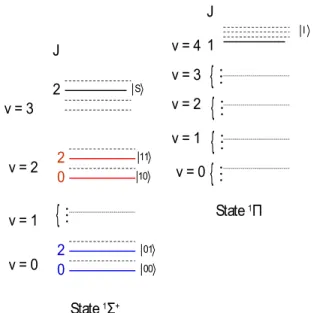
This case is illustrated in Fig.8. The STIRAP process also misses the objective with the assignment 2. The expected transition is 兩10典共兩1⌺+, 2 , 0典兲↔兩11典共兩1⌺+, 2 , 2典兲, i.e., a rota-tional inversion in a given vibrarota-tional state. This time, the ⍀S⍀11⍀10⍀S pulse sequence does not act on the 兩00典 and 兩01典 states as expected. However, the states 兩10典 共兩1⌺+, 2 , 0典兲 and兩11典 共兩1⌺+, 2 , 2典兲 both interact with the same pulse. For example, when⍀S⍀11 is applied, 兩11典 共兩1⌺+, 2 , 2典兲 is trans-ferred to the shelving state 兩S典=兩1⌺+, 3 , 2典, but 兩10典 共兩1⌺+, 2 , 0典兲 is also transferred to another intrusive shelving state 兩S
⬘
典=兩1⌺+, 3 , 0典 via the same intermediate one 兩I⬘
典=兩1⌸,4,1典, so we are not able to make aCNOTgate by the STIRAP sequence using this assignment. This could be done by OCT as in the case of assignment 1.
C. Assignment 3: Qubit states in four different vibrational levels
Figure9schematizes this third assignment. The adiabatic approach optimized by GA leads to a very high fidelity of the order of 98.9% when the qubit states are encoded in
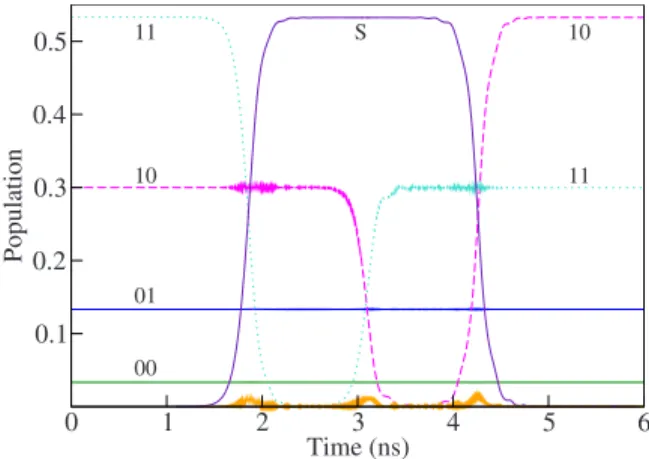
rota-tional states of four different vibrarota-tional states 共assignment 3兲. The evolution of the populations is shown in Fig. 10
starting from a superposition of the four qubit states with unequal weights. The optimized parameters are given in Table A of Appendix B. We have observed that the phase constraint requires longer pulses than the classical population inversion. The optimized pulse is longer than in the previous examples. The width ␥k= 0.6 ns of each pulse 关Eq. 共3兲兴 is fixed by the rotational resolution 共about 5.9⫻10−2 cm−1兲 leading to a time scale of 0.56 ns. We have checked that longer pulses do not correct the pathology of assignments
FIG. 8. 共Color online兲 Scheme of the qubit states with qcin the vibration for the diatomic example.v and J are the vibrational and rotational quantum numbers, respectively.兩S典 and 兩I典 are the shelv-ing and intermediate states of the STIRAP sequence共see Fig.1兲
FIG. 9. 共Color online兲 Scheme of the qubit states belonging to four different vibrational states for the diatomic example. v and J are the vibrational and rotational quantum numbers, respectively. 兩S典 and 兩I典 are the shelving and intermediate states of the STIRAP sequence共see Fig.1兲
0 1 2 3 4 5 6 Time (ns) 0.1 0.2 0.3 0.4 0.5 Popu lat ion 11 S 10 10 10 01 00
FIG. 10. 共Color online兲 CNOTgate by the STIRAP sequence with phase constraint关Eq. 共2兲兴 when the qubit states are encoded in
the rovibrational states J = 0 of different vibrational statesv = 0, 1, 2, and 3共see Fig.9兲. The initial state is a superposition of all the qubit
states with unequal weights. The populations in the states 兩00典 共兩1⌺+, 0 , 0典兲 and 兩01典 共兩1⌺+, 1 , 0典兲 remain constant. One observes the exchange of the populations in兩11典 共兩1⌺+, 3 , 0典兲 in dotted line and of 兩10典 共兩1⌺+, 2 , 0典兲 in dashed line. The shelving state 兩S典 is 共兩1⌺+, 4 , 0典兲.
1 and 2 which is not related to the rotational resolution but to the large detunings allowed by the STIRAP process.
V. POLYATOMIC MOLECULE
We finally show that the optimized adiabatic strategy can be efficient in a polyatomic molecule. We consider only the assignment 3 where the rotational states belong to different vibrational levels since the other assignments are irrelevant. We use a molecular system already proposed in the literature in the context of vibrational computing关7兴. The qubit states
and the shelving states are chosen among rovibrational states of the X ground electronic surface of thiophosgene SCCl2. The intermediate state is a rovibrational state of the B excited electronic state. We take back the vibrational levels and vi-brational transition dipole moments given in Table I of Ref. 关7兴. Other vibrational levels which are not taken into account
in the computation are expected to play a minor role in the control. Table I gathers the data extracted from Table I of Ref. 关7兴 for the four qubit states, the shelving, and
interme-diate states. The states 共兩10典,兩11典,兩S典兲 which exchange their population in the STIRAP process to realize the CNOTgate are chosen among the contiguous vibrational levels with the largest transition dipole moments. The SCCl2molecule is an asymmetric top molecule with rotational constants
A = 0.119 cm−1, B = 0.116 cm−1, and C = 0.059 cm−1 in the
X state and A = 0.139 cm−1, B = 0.084 cm−1, and
C = 0.052 cm−1 in the B state. The rotational factors of the
transition dipole moment for the asymmetric top molecule are computed in the eigenbasis of the symmetric-top mol-ecule共see Appendix A兲. The rotational states for each qubit state and the shelving state are, respectively, J = 0, Ka= 0, and Kc= 0 and J = 1, Ka= 0, and Kc= 1 for the intermediate state. The simulation includes 共29⫻9兲 states, i.e., 28 vibrational states in the X state and one vibrational state in the B state with nine rotational states共up to J=2兲 per vibrational levels. The optimized parameters关Eq. 共3兲兴 for theCNOTgate are given in Table B. We have observed that the APT sequence of the diatomic molecule is already an optimized field for the
polyatomic system because the rotational resolution is of the same order 共about 5.2⫻10−2 cm−2兲. The fidelity is 99.1% 共with a phase constraint, i.e., for a complete unitary transfor-mation兲. Figure 11 shows the evolution of the population when theCNOTgate is applied to a superposition with differ-ent weights. Similar results are obtained for any superposi-tion. The APT sequence is robust and the fidelity is very high but it is very difficult to decrease the duration of the opti-mized sequence. As already mentioned for the diatomic mol-ecule, this remark indicates that a long control duration has to be chosen when the phase constraint is taken into account.
VI. CONCLUSION
A promising architecture to implement scalable quantum computation is arrays of entities which can be individually addressed and controlled independently from the states of the other ones but ensure coupling among qubits encoded in neighboring sites. A challenging possibility is an ensemble of trapped polar molecules 关10,35–37兴. Formation and control
of ultracold molecule are currently a domain in full expan-sion 关44兴. In this context, the realization of quantum
net-works requires to split the overall process in several intramo-lecular and intermointramo-lecular gates. Here, we have examined the implementation of aCNOTintramolecular gate. We have mainly analyzed the role of the assignment in rotational states when a CNOTgate is implemented by APT or OCT. APT operates in the ns range. It offers the advantage of the simplicity and robustness of control pulses but it is relevant only for a particular encoding scheme共scheme 3兲 which in-volves rovibrational states belonging to four different vibra-tional manifolds. Even very long control durations 共some hundreds of nanoseconds兲 do not prevent unwanted transi-tions for the encodings 1 and 2. The impossibility of imple-menting the quantum gates in theses cases by APT is thus due to the encoding. In the favorable case 共scheme 3兲, the phase constraint which is essential to realize a quantum uni-tary transformation is more difficult to satisfy than the simple
TABLE I. State numbers, energies, and transition dipole mo-ments of vibrational states extracted from Table I of Ref.关7兴 for the
molecule SCCl2and qubit assignment for theCNOTgate共see also Fig.1兲. Vibrational state number 7 Rotational state Vibrational wave number 共cm−1兲 Dipolar moments 共D兲 Qubit assignment X state 11 兩000典 8239.53 0.36 兩00典 12 兩000典 8246.35 0.38 兩01典 13 兩000典 8264.26 0.96 兩10典 14 兩000典 8273.98 0.75 兩11典 27 兩000典 8481.07 0.84 兩S典 B state 29 兩101典 35125.0 兩I典 0 1 2 3 4 5 6 Time (ns) 0.1 0.2 0.3 0.4 0.5 Popu lat ion 11 S 10 10 11 01 00
FIG. 11.共Color online兲CNOTgate by the STIRAP sequence with phase constraint关Eq. 共2兲兴 and with the qubit states encoded in the
rovibrational states 兩000典 of different excited vibrational states of SCCl2共see TableI兲. Evolution of the populations in the qubit states
兩00典 and 兩01典 which remain constant. Evolution of the interchanging populations兩10典 in dashed line and 兩11典 in dotted line.
population inversion. This constitutes an intrinsic limitation to quantum computing with respect to classical one when using optimized APT. In view of practical implementations in molecular systems, classical operations such as adder or subtractor could be therefore more promising in a near fu-ture.
OCT achieves a high fidelity of the quantum gate with phase constraint for any assignment of the qubit states. In any case, the adiabatic solution can be used as a very effi-cient trial field. Since there exists no unique optimal solution, we can select by an adequate choice of the trial field and by the use of spectral constraints a particular control field and a particular pathway for the dynamics. The APT starting guess is a trick inspired from a basic mechanism with a cycling in the uv-visible range through an excited electronic state. The advantages are a smaller intensity of the optimal field and a simpler structure but obviously OCT can work anyhow with different trial fields and shorter durations. However, we note that the third typical frequency of the STIRAP sequence has been recovered by OCT starting with a different trial field based on two frequencies only. No limitation on the control duration has been observed with OCT but the structure of the optimal control field can be more complicated for a short duration. There is no physical reason to select a simple con-trol field rather than a more complex one. However, to our knowledge, a control field with a simple structure in the time or frequency domain is generally easier to implement experi-mentally and more robust with respect to experimental inac-curacies or with respect to inacinac-curacies of the theoretical model. Finally, we remark that the present approach based on a cycling between the ground and an excited electronic state is a strategy complementary to the previous study done in midinfrared domain关8兴.
ACKNOWLEDGMENTS
The computing facilities of IDRIS 共Projects No. 061247 and No. 2006 0811429兲 as well the financial support of the FNRS in the University of Liège SUN Nic2 project are gratefully acknowledged. We thank for the support of the COST Action CM0702 CUSPFEL. The research has also been supported by Triangle de la Physique Convention No. 2009-039T.
APPENDIX A: ROTATIONAL FACTOR OF THE TRANSITION MOMENT
We first discuss the diatomic case. By using the transfor-mation of the electric-dipole moment operator from the body fixed to the space-fixed frame p=兺q=−11 Dpq共1兲ⴱ共,, 0兲q, where the tensorial components p and q refer to the labora-tory frame and the molecular one, respectively, the matrix element of the dipolar interaction between two rovibronic states兩k典=兩⌳k,vk, JkMk⍀k典 becomes ជif. Eជ=
兺
p,q=0,⫾1共− 1兲 q E−p具vf兩q⌳f⌳i兩vi典 ⫻具JiMi⍀i兩Dpq共1兲ⴱ兩JfMf⍀f典,where兩JM⍀典=共−1兲M−⍀
冑
2J+14 DM共J兲⍀共,, 0兲 is the Wignerro-tation matrix for a diatomic system, with J the total angular momentum, M its projection on the OZ laboratory axis,⍀ its projection on the Oz molecular axis, and v are the vibra-tional functions. The rotavibra-tional factors of the transition ele-ments are expressed in terms of the Wigner 3j symbols关45兴
具JiMi⍀i兩Dpq共1兲ⴱ兩JfMf⍀f典 =
冑
共2Ji+ 1兲共2Jf+ 1兲冉
Ji 1 Jf − Mi p Mf冊
⫻冉
Ji 1 Jf −⍀i q ⍀f冊
, 共A1兲 with冉
j1 j2 j3 m1 m2 m3冊
=共− 1兲 j1−j2−m3 1冑
2j3+ 1 ⫻具j1m1j2m2兩j1j2j3,− m3典.We consider a linearly polarized electric field leading to
p = 0 and a perpendicular transition between⌺ and ⌸ states
so that q = 1.
The rotational Hamiltonian of the asymmetric top is
Hrot= 1 h2共AJˆa 2 + BJˆb 2 + CJˆc 2兲 = 1 h2
再
B + C 2 Jˆ 2+冉
A −B + C 2冊
Jˆz 2 +B − C 4 关共Jˆz +兲2+共Jˆ z −兲2兴冎
,where A, B, and C are the rotational constants. The energies
EJK
aKc
for J = 0 , 1 , 2 are calculated by diagonalizing the rota-tional Hamiltonian in the basis set of eigenvectors兩JMK典 of the symmetric top. Eigenvectors and eigenvalues are tabu-lated in Ref.关45兴. The rotational factors 具JK
a ⬘K c ⬘
⬘
兩Dpq兩JK a ⬙K c ⬙⬙
典 are the corresponding combinations of the rotational factors of the symmetrical top具JiMiKi兩Dpq兩JfMfKf典 =
冑
共2Ji+ 1兲共2Jf+ 1兲冉
Ji 1 Jf − Mi p Mf冊
⫻冉
Ji 1 Jf − Ki q Kf冊
.We consider here the cases with p = 0 共linear polarization兲 and q = 0 共parallel transitiona⫽0兲.
APPENDIX B: PARAMETERS OF THE PULSES
Optimized parameters of the STIRAP sequence ⍀S⍀11⍀10⍀S 共see Fig. 1兲 implemented in the NaCs system for the three assignments presented in Sec. III. The parameters are those of Eq.共3兲.
␥k=1,4 共ns兲 E01 共V/m兲 t1 共ns兲 E02 共V/m兲 t2 共ns兲 E03 共V/m兲 t3 共ns兲 E04 共V/m兲 t4 共ns兲 1 0.145 13.16 106 0.363 −7.30 106 0.610 5.66 106 0.815 −10.18 106 1.038 2 0.145 −13.52 106 0.363 20.05 106 0.597 18.97 106 0.837 14.24 106 1.009 3 0.605 4.52 106 1.209 −4.061 106 2.430 2.788 106 3.702 −4.020 106 4.892
Optimized parameters of the STIRAP sequence⍀S⍀11⍀10⍀S共see Fig.1兲 implemented in the SCCl2system for assignment in four different vibrational states. The parameters are those of Eq.共3兲.
␥k=1,4 共ns兲 E01 共V/m兲 t1 共ns兲 E02 共V/m兲 t2 共ns兲 E03 共V/m兲 t3 共ns兲 E04 共V/m兲 t4 共ns兲 0.605 4.520 106 1.209 −4.061 106 2.430 2.788 106 3.702 −4.020 106 4.892
关1兴 F. Remacle and R. D. Levine, Phys. Rev. A 73, 033820 共2006兲. 关2兴 L. Bomble, B. Lavorel, F. Remacle, and M. Desouter-Lecomte,
J. Chem. Phys. 128, 194308共2008兲.
关3兴 C. M. Tesch and R. de Vivie-Riedle, J. Chem. Phys. 121, 12158共2004兲.
关4兴 B. M. R. Korff, U. Troppmann, K. L. Kompa, and R. de Vivie-Riedle, J. Chem. Phys. 123, 244509共2005兲.
关5兴 S. Suzuki, K. Mishima, and K. Yamashita, Chem. Phys. Lett. 410, 358共2005兲.
关6兴 M. Zhao and D. Babikov, J. Chem. Phys. 126, 204102 共2007兲. 关7兴 D. Weidinger and M. Gruebele, Mol. Phys. 105, 1999 共2007兲. 关8兴 M. Tsubouchi and T. Momose, Phys. Rev. A 77, 052326
共2008兲.
关9兴 D. DeMille, Phys. Rev. Lett. 88, 067901 共2002兲.
关10兴 E. Kuznetsova, R. Côté, K. Kirby, and S. F. Yelin, Phys. Rev. A 78, 012313共2008兲.
关11兴 J. Vala, Z. Amitay, B. Zhang, S. R. Leone, and R. Kosloff, Phys. Rev. A 66, 062316共2002兲.
关12兴 W. Zhu, J. Bottina, and H. Rabitz, J. Chem. Phys. 108, 1953 共1998兲; W. Zhu and H. Rabitz, ibid. 109, 385 共1998兲. 关13兴 Y. Ohtsuki, Y. Teranishi, P. Saalfrank, G. Turinici, and H.
Rabitz, Phys. Rev. A 75, 033407共2007兲.
关14兴 D. E. Goldberg, Genetic Algorithms in Search Optimization and Machine Learning 共Addison-Wesley, Reading, MA, 2005兲.
关15兴 T. Cheng and A. Brow, J. Chem. Phys. 124, 034111 共2006兲. 关16兴 D. Sugny, C. Kontz, M. Ndong, Y. Justum, G. Dive, and M.
Desouter-Lecomte, Phys. Rev. A 74, 043419共2006兲. 关17兴 D. Sugny, M. Ndong, D. Lauvergnat, Y. Justum, and M.
Desouter-Lecomte, J. Photochem. Photobiol., A 190, 359 共2007兲.
关18兴 M. Ndong, D. Lauvergnat, X. Chapuisat, and M. Desouter-Lecomte, J. Chem. Phys. 126, 244505共2007兲.
关19兴 M. Schröder and A. Brown, J. Chem. Phys. 131, 034101 共2009兲.
关20兴 K. Shioya, K. Mishima, and K. Yamashita, Mol. Phys. 105,
1283共2007兲.
关21兴 L. Bomble, D. Lauvergnat, F. Remacle, and M. Desouter-Lecomte, J. Chem. Phys. 128, 064110共2008兲.
关22兴 L. Bomble, D. Lauvergnat, F. Remacle, and M. Desouter-Lecomte, Phys. Rev. A 80, 022332共2009兲.
关23兴 Y. Ohtsuki, Chem. Phys. Lett. 404, 126 共2005兲.
关24兴 K. Mishima, K. Tokumo, and K. Yamashita, Chem. Phys. 343, 61 共2008兲; K. Mishima and K. Yamashita, ibid. 361, 106 共2009兲.
关25兴 N. V. Vitanov, T. Halfmann, B. Shore, and K. Bergmann, Annu. Rev. Phys. Chem. 52, 763共2001兲.
关26兴 Z. Kis and F. Renzoni, Phys. Rev. A 65, 032318 共2002兲. 关27兴 H. Goto and K. Ichimura, Phys. Rev. A 70, 012305 共2004兲. 关28兴 D. Daems, S. Guérin, and N. J. Cerf, Phys. Rev. A 78, 042322
共2008兲.
关29兴 C. Menzel-Jones and M. Shapiro, Phys. Rev. A 75, 052308 共2007兲.
关30兴 V. Kurkal and S. A. Rice, Chem. Phys. Lett. 344, 125 共2001兲. 关31兴 I. Vrabel and W. Jakubetz, J. Chem. Phys. 118, 7366 共2003兲. 关32兴 C. Gollub and R. de Vivie-Riedle, Phys. Rev. A 78, 033424
共2008兲.
关33兴 J. Deiglmayr, A. Grochola, M. Repp, K. Mörtlbauer, C. Glück, J. Lange, O. Dulieu, R. Wester, and M. Weidemüller, Phys. Rev. Lett. 101, 133004共2008兲.
关34兴 M. Viteau, A. Chotia, M. Allegrini, N. Bouloufa, O. Dulieu, D. Comparat, and P. Pillet, Science 321, 232共2008兲.
关35兴 K. Mishima and K. Yamashita, J. Chem. Phys. 130, 034108 共2009兲.
关36兴 E. Charron, P. Milman, A. Keller, and O. Atabek, Phys. Rev. A 75, 033414共2007兲; 77, 039907E 共2008兲.
关37兴 L. D. Carr, D. Mille, R. V. Krems, and J. Ye, New J. Phys. 11, 055049共2009兲.
关38兴 W. H. Press, B. P. Flannery, S. A. Teukolsky, and W. T. Vet-terling, Numerical Recipes共Cambridge University Press, Cam-bridge, England, 1986兲.
关40兴 The code used is taken from http://eodev.sourceforge.net/ 关41兴 J. P. Palao and R. Kosloff, Phys. Rev. A 68, 062308 共2003兲. 关42兴 C. Gollub, M. Kowalewski, and R. de Vivie-Riedle, Phys. Rev.
Lett. 101, 073002共2008兲; M. Lapert, R. Tehini, G. Turinici, and D. Sugny, Phys. Rev. A 79, 063411共2009兲.
关43兴 M. Aymar and O. Dulieu, Mol. Phys. 105, 1733 共2007兲. 关44兴 O. Dulieu and C. Gabbanini, Rep. Prog. Phys. 72, 086401
共2009兲.
关45兴 R. N. Zare, Angular Momentum: Understanding Spatial As-pects in Chemistry and Physics共Wiley, New York, 1988兲.