Titre:
Title:
The kinematic theory and minimum principles in motor control : a conceptual comparison
Auteurs:
Authors: Moussa Djioua et Réjean Plamondon
Date: 2008
Type: Rapport / Report
Référence:
Citation:
Djioua, M. & Plamondon, R. (2008). The kinematic theory and minimum
principles in motor control : a conceptual comparison (Rapport technique n°
EPM-RT-2008-03).
Document en libre accès dans PolyPublie
Open Access document in PolyPublie URL de PolyPublie:
PolyPublie URL: https://publications.polymtl.ca/3164/
Version: Version officielle de l'éditeur / Published versionNon révisé par les pairs / Unrefereed Conditions d’utilisation:
Terms of Use: Tous droits réservés / All rights reserved Document publié chez l’éditeur officiel
Document issued by the official publisher Maison d’édition:
Publisher: Les Éditions de l’École Polytechnique
URL officiel:
Official URL: https://publications.polymtl.ca/3164/
Mention légale:
Legal notice: Tous droits réservés / All rights reserved
Ce fichier a été téléchargé à partir de PolyPublie, le dépôt institutionnel de Polytechnique Montréal
This file has been downloaded from PolyPublie, the institutional repository of Polytechnique Montréal
EPM–RT–2008-03
THE KINEMATIC THEORY AND MINIMUM PRINCIPLES IN MOTRO CONTROL : A CONCEPTUA. COMPARISON
Moussa Djioua et Réjean Plamondon Département de Génie électrique
Laboratoire Scribens École Polytechnique de Montréal
EPM-RT-2008-03
The Kinematic Theory and Minimum Principles
in Motor Control: a Conceptual Comparison
Moussa DJIOUA et Réjean PLAMONDON
Département de Génie Électrique,
Laboratoire Scribens,
École Polytechnique de Montréal.
©2008
Moussa Djioua, Réjean Plamondon Tous droits réservés
Dépôt légal :
Bibliothèque nationale du Québec, 2008 Bibliothèque nationale du Canada, 2008
EPM-RT-2008-03
The Kinematic Theory and Minimum Principles in Motor Control: a Conceptual Comparison
: Moussa Djioua, Réjean Plamondon
Département de génie électrique, Laboratoire Scribens École Polytechnique de Montréal
Toute reproduction de ce document à des fins d'étude personnelle ou de recherche est autorisée à la condition que la citation ci-dessus y soit mentionnée.
Tout autre usage doit faire l'objet d'une autorisation écrite des auteurs. Les demandes peuvent être adressées directement aux auteurs (consulter le bottin sur le site
http://www.polymtl.ca/) ou par l'entremise de la Bibliothèque :
École Polytechnique de Montréal
Bibliothèque – Service de fourniture de documents Case postale 6079, Succursale «Centre-Ville» Montréal (Québec)
Canada H3C 3A7
Téléphone : (514) 340-4846 Télécopie : (514) 340-4026
Courrier électronique : [email protected]
Ce rapport technique peut-être repéré par auteur et par titre dans le catalogue de la Bibliothèque : http://www.polymtl.ca/biblio/catalogue/
Abstract:
This paper presents a comparative study of two motor control theories that have put forward mathematical expressions to describe the stereotypical velocity profiles of rapid movements: the Kinematic Theory and the Minimization Theory. Among the various forms of the latter, the Minimum Square-Derivatives (MSD) principle and the Minimum-Time model are analyzed. It is shown that their concepts are linked and describe, with different arguments, a paradigm similar to the one used in the Kinematic Theory to model a velocity profile with a Delta-Lognormal equation. This unifying paradigm represents the functioning of a neuromuscular system by the convolution product of an infinite number of subsystem impulse responses. A second finding emerging from the present study is that the analytical models of velocity profiles, as described by the minimum principles under study correspond, with more or less accuracy, to an approximation of the Delta-Lognormal equation. Overall, the Kinematic Theory can be seen as relying on a general optimization principle and the use of the Minimization Theory in motor control gets new insights.Keywords Delta-Lognormal model, Kinematic Theory, Minimum-Jerk, Minimum
Principles, Minimum-Time, Motor Control.
1. Introduction
Over the years, several psychophysical studies have highlighted the fact that the velocity profile of a rapid aimed movement is strongly stereotypical. Under various experimental conditions, it has been reported that the tangential velocity had a bell-shaped profile (Lacquaniti et al. 1983), which was considered as symmetrical in the first studies (Morasso et al. 1981;1983), with slight variability between subjects (Miall & Haggard.1995), and decrease in variability with practice (Georgopoulos et al.1981). Since 1993, precise curve fitting results have confirmed the basic asymmetry of the velocity profiles (Plamondon et al. 1993).
Thus, when a healthy human subject produces a point-to-point rapid movement with his dominant hand from a restful posture, the corresponding trajectory is characterized by
several properties (Gielen et al. 1985; Latash 1998; Morasso 1981; Plamondon 2003; Plamondon & Djioua 2006; Zatsiorsky 1998):
• The trajectory is nearly straight.
• There might be up to two reversals in the direction of motion at the end of the trajectory (or one at the beginning and one at the end).
• The velocity profile might have up to three peaks, the dominant one being slightly asymmetric.
• The asymmetry of the main velocity peak might be reversed at very high speed. • The acceleration profile might have up to four peaks.
Moreover, when a subject repeats the same rapid movement many times, some variability is observed, but each individual trajectory possesses the above-mentioned properties, as long as the movements are fast and there is no trembling or hesitation (Plamondon & Djioua, 2006).
Several computational models have been proposed, among many other approaches, to tentatively explain how the central nervous system generates and controls rapid human movements characterized by such asymmetric bell-shaped velocity profiles. Some models describe the movement kinematics with analytical expressions (Alimi 2003; Engelbrecht 2001; Hogan 1984; Nelson 1983; Plamondon 1995a) and others proceed through the numerical resolution of a system of differential equations (Bullock & Grossberg 1988; Harris & Wolpert 1998; Neilson 1993; Neilson & Neilson 2005; Tanaka et al. 2006; Uno et al. 1986).
Since all these models depict, using different mathematical descriptions, the same physical phenomenon, it make sense to investigate the potential existence of possible relationships between some of these and to study the approximations and hypotheses that lead to their various mathematical expressions.
Previous curve fitting experiments have shown that the Delta-Lognormal model was producing smaller reconstruction errors as compared to the Minimum-Jerk (Feng et al. 2002) as well as to twenty six other models (Alimi 1995; Alimi & Plamondon 1996). In this paper, a theoretical comparison tool is developed, which exploits the concepts of the diverse models to bring to the fore their different assumptions and approximations. Since, to be relevant, a comparison must be made in a normalized space, this study deals only with models that make use of analytical expressions for their description of velocity profiles. Precisely, we analyze models based on the Minimization Theory and compare them with the Delta-Lognormal model. We investigate both theories throughout their basic concepts and provide new insights about the use of minimum criteria in motor control. We also highlight some elements that most likely explain the greater performance obtained in curve fitting experiments by the Delta-Lognormal model.
In section 2, the Kinematic Theory concepts are summarized through the Delta- Lognormal model, while the minimum principles methods are presented in section 3. In this latter section, we are proposing some changes of variables in the analytical expressions of the minimum models to make these comparable with the Delta-Lognormal model. The comparison between models, as reported in section 4, takes advantage of the Central Limit Theorem as a classification platform to rank hierarchically each model according to a convergence criterion. In section 5, we briefly discuss the interest of using
a Minimization Theory in motor control and its relationship to a Kinematic Theory. We also point out how the basic representation scheme provided by the Kinematic Theory can be exploited in a minimization context.
2. Overview of the Delta-Lognormal model
The Delta-Lognormal model is considered as the basic kernel of the Kinematic Theory. It describes the velocity profile v t
( )
of a rapid movement by the difference of two lognormal components which represent the impulse responses of an agonist and an antagonist neuromuscular systems, weighted by their respective input commands and , activated at time (Plamondon 1995a; 1995b). The resulting Delta-Lognormal equation is expressed as:1 D 2 D t0
( )
(
2)
(
)
1 ; , ,0 1 1 2 ; , ,0 2 2 v t = ΛD t t μ σ −D Λ t t μ σ2 (1) with(
)
(
)
(
)
2 0 0 2 2 0 0 1 exp 1 ln for 2 2 ; , , 0 e t t t t t t t t μ σ σ π σ μ ⎧ ⎧ ⎡ ⎤ ⎫ lsewhere − − − > ⎨ ⎬ ⎪ − ⎣ ⎦ Λ =⎨ ⎩ ⎭ ⎪ ⎩ (2) and 1, 2D D : The respective amplitudes of the input commands. Their effects correspond to the distances covered by the individual agonist and the antagonist velocity components.
: The time occurrence of the input commands, a time-shift parameter. t0
1, 2
μ μ : The logtime delays, the respective time delay of the agonist (1) and antagonist (2) neuromuscular systems expressed on a logarithmic time scale. Explicitly, eμ represents the median of a lognormal profile.
1, 2
σ σ : The logresponse times, the respective response time of the agonist (1) and antagonist (2) neuromuscular systems expressed on a logarithmic time scale. Explicitly, it represents a proportional coefficient that links the response time to the time delay of a lognormal profile
r T d T Λ
( )
t : (Tr ≈σTd with and ).( )
t d = Λ d T∫
t t dt 2(
) ( )
2 2 r Td Λ t T =∫
t−Thus, the generation of velocity profiles according to equation (1) requires seven parameters, three acting as the motor commands ( ) and four, characterizing the timing properties of the neuromuscular systems (
0, ,1 2
t D D
1, ,1 2,
μ σ μ σ ) that respond to these commands.
This representation does not emanate from a curve fitting process but it is prompted from the structure of a neuromuscular system (NMS), which can be considered as a network made up of an infinite number of linear subsystems linked in hierarchical and parallel groupings. According to this scheme, one can distinguish two main processes involved in the generation of rapid aimed movements: the movement activation from an action plan and the movement execution. The distance to be covered, the direction of the movement, and the time occurrence of the NMS activation are provided by the central nervous system (CNS), while the execution of the resulting motor task is done by the NMS within
the context of its own timing constraints. The triggering of a neuromuscular system (agonist or antagonist) is represented by a Dirac-Impulse U t t0
(
− 0)
occurring at and weighted by a distance parameter0
t
, 1,2 i
D i = , while the execution process itself is modeled by the convolution product of a large number of linear subsystem responses. Thus, the bell-shaped pattern of the velocity profile emerges from the synergetic coupling of numerous neuromuscular subsystems. Furthermore, to explain the asymmetric shape of each velocity component, the theory assumes that the cumulative time delays of a sequence of dependent subsystems are governed by a proportionality relationship (Plamondon 1995a). Under this latter hypothesis, it has been proved, using the Central Limit Theorem, that a neuromuscular system can be globally described as a linear system having a lognormal impulse response (Feng 2005; Djioua 2007; Plamondon et al. 2003). According to this global paradigm, to execute the motor tasks leading to a rapid movement, various subsystems are recruited and configured by the CNS in two main neuromuscular systems acting in opposite directions. The resulting effect, as observed at the end-effector (for example a hand) is a movement produced by the agonist and the antagonist components working in synergy (see Figure1).
Figure 1. The generation of a rapid movement is modeled by two agonist and antagonist neuromuscular
systems working in synergy. The velocity profile of a rapid movement corresponds to the difference of the weighted impulse responses of these coupled systems.
According to Figure 1, the output v t ti
(
− 0)
of each coupled system converges towards a lognormal profile when the number of subsystems tends towards infinity. When is finite, this limit profile is not reached and the impulse response is equal to the difference between an ideal lognormal profileN N
( )
t;...Λ and a convergence errorEconv
(
t;...)
, given by (Feng 2005; Djioua 2007; Plamondon et al. 2007):(
)
(
)
(
)
( )
2 0 2 0 0 1 exp ln ,... ; 1,2 2 2 i i iN i conv iN iN D v t t t t D E t i t t σ μ σ π ⎧ ⎫ − = ⎨− ⎡⎣ − − ⎤⎦ ⎬− = − ⎩ ⎭ (3) and,(
2)
(
0)
(
0)
3(
0 3 ln ln ; , , 3 ;... 6 iN iN iN conv iN iN iN iN iN t t t t E t t μ σ χ μ μ t σ σ σ ⎡ ⎛ − − ⎞ ⎛ − − ⎞ ⎤ ⎢ ⎜ ⎟ ⎜− ⎟ ⎥Λ ⎢ ⎝ ⎠ ⎝ ⎠ ⎥ ⎣ ⎦)
(4)where , 2 and
iN
iN iN
μ σ χ are the first moment, the second and the third centered moments of a lognormal function respectively.
In other words, when is infinite, N Econv
( )
t;... tends towards zero and the limit profile is reached. Taking into account the synergetic action of two systems, the Delta-Lognormal model expresses the theoretical limit towards which the velocity profile of a rapid movement converges.In short: to depict the motor control of a simple rapid aimed movement, the Kinematic Theory symbolizes the command signal by a Dirac-Impulse and the output of the neuromuscular system by the convolution product of an infinite number of subsystems such that the global response corresponds to a lognormal velocity component. By considering a neuromuscular synergy made up of an agonist and antagonist systems, the velocity profile of rapid movement is then modeled by a Delta-Lognormal equation. The Kinematic Theory has been used over the years to describe and explain a large body of experimental data dealing with human movements such as speed-accuracy trade-offs (Plamondon and Alimi 1997) primitive definition (Woch & Plamondon 2004; Woch 2006); stroke variability (Djioua 2007; Plamondon & Djioua 2005; 2006), handwriting segmentation and generation (Guerfali 1996; Plamondon & Guerfali, 1998) and signature representation (Leclerc 1996)
3. Minimization Theory as applied in motor control
Since Bernstein drew attention on the ill-defined motor tasks of skilled point-to-point movements in motor control, a basic challenge in modeling has been to explain how the
central nervous system chooses one trajectory among an infinite number of possibilities. According to early thinking in this field, the smooth stereotypical trajectories made by the motor system are specially chosen to optimize a cost function or a performance index under physical constraints, like minimizing jerkiness ( Hogan, 1984), minimizing torque (Uno et al. 1989), maximizing efficiency (Nelson 1983) or, as an alternative, maximizing a movement precision (Harris & Wolpert 1998). One possible answer to Bernstein question is thus based on minimization theories, adapted from minimization principles largely used in sciences including physics, chemistry, biology, economics, and engineering (for a review see Engelbrecht 2001). For example, it is shown in physics that the trajectory described by an object moving between two different potential energy levels, corresponds to the one that minimizes the lost of energy when transforming the potential to kinetic energy and vice versa. Two important minimization principles are used in motor control: the minimization of energy and of movement time (Engelbrecht 2001). Concerning the first principle, Hogan (1984) postulated that hand trajectories are chosen by the central nervous system (CNS) such that the time integral (or the mean) of the squared magnitude of hand jerk is minimal, which is equivalent to maximizing the smoothness of the trajectory. Starting from dynamical equations dealing with torques, he proposed to model the trajectory of a point-to-point rapid movement with analytical equations. He claimed that the motor control was done in a kinematic space, an assumption supported through experimental results (Flash and Hogan 1985; Wolpert et al. 1995).
In the context of the second principle, a movement between two equilibrium positions is produced by minimizing the time duration, leading to a “bang-bang” control (Hermes &
Lasalle 1969). In this case, the velocity profile is generally symmetric (Nelson 1983). Thus, the neural control signal has to be instantaneously switched between its maximum positive and negative values to accelerate and decelerate the movement. In a strict sense, it is thus assumed that a shifted Heaviside control signal aims at executing movements with null movement time. The filtering effect of the biological neuromuscular system that opposes to these instantaneous changes leads to a minimum movement time instead (Partridge 1966; 1973).
Most of the resulting models were primarily built using a mechanical representation of the musculoskeletal system by a second order equation where the state-variable was the position and the input command represented the neural signal observed in the alpha motoneurons (Bizzi et al. 1978; Harris & Wolpert, 1998; Hogan 1984). The main differences between all these models were relying both on the optimization criterion adopted and on the optimization techniques used to plan the selected trajectory. In this context, we have limited our study to the following family of kinematic models: (1) the Minimum Square-Derivatives models (particularly the Jerk and the Minimum-Snap) and (2) the Minimum-Time model as presented by Engelbrecht (2001) from the “bang-bang” model proposed by Hermes and Lasalle (1969) and by Endle and Wolf (1987). These models propose analytical solutions to the optimal trajectory and then, can be directly analyzed and compared with the Delta-Lognormal model.
3.1. Overview of the Minimum Square Derivative Approaches
Minimizing the square derivatives of a position is an easy and popular interpretation of the minimization principle. This principle emerged by considering that the execution of a
skilled movement is done to reach an objective under constraints, such as optimizing the movement time or the distance to be covered. The performance regarding the realization of such an objective is expressed in terms of minimizing some physical cost (Nelson 1983). Let assume that the nth derivative of the position profile θ
( )
t of an end-effectortrajectory exists. Then the cost function, considered as energy1, is given by:
( )
2 0 min MT n n n d C t dt dt θ ⎡ ⎤ = ⎢ ⎥ ⎣ ⎦∫
→ (5) where MT represents the movement time (or movement duration). As a constraint, this principle deals with particular point-to-point rapid movements described in a compact time interval[
0, MT]
which covers the total distance . The trajectory that minimizes the cost function can be found from Euler equation of variation calculus. From this minimization process, three main models have been proposed, depending on the order of the derivatives. For n=2, n=3 and n=4, equation 5 leads respectively to the Minimum acceleration (Neilson 1993; Neilson & Neilson 2005; Nelson 1983), the Minimum-Jerk and the Minimum-Snap (Flash & Hogan 1985; Hogan 1984) models. In the following section, we restrain our detailed study to the Minimum-Jerk model.D
1 Here, by analogy, the energy refers to the mean square of the kinematic quantity
( )
n( )
n d
q t t
dt θ
= i.e. to the cost function 2
( )
t
q t dt
3.1.1. Overview of the Minimum-Jerk model
The Minimum-Jerk is a mathematical model which can be used to interpret single- and multi-joint classes of voluntary movements. Taking into account the starting position θ0 (occurring at t =0) and the ending position θf (occurring at t MT= ) as boundary constraints where both the angular velocity and acceleration are equal to zero, the corresponding trajectory vs time, given by resolving equation (5), is then described by a fifth-order polynomial (Hogan 1984):
( )
t 0(
f 0)
10 MTt 3 15 MTt 4 6 MTt 5 0 tθ =θ + θ −θ ⎡⎢ ⎛⎜ ⎞⎟ − ⎜⎛ ⎞⎟ + ⎛⎜ ⎞⎟ ⎤⎥ ≤ ≤
⎝ ⎠ ⎝ ⎠ ⎝ ⎠
⎢ ⎥
⎣ ⎦ MT (6)
3.1.2. Analyzing the Minimum-Jerk model and its extensions
Later on, studies carried out with the Minimum-Jerk model have shown that the analytical expression minimizing the Snap (time derivative of the jerk) gave better reconstruction of the trajectory when applied to experimental data (Wiegner & Wierzbicka 1992). In a similar perspective, another interesting result dealing with a generalized expression for the velocity profile was suggested by Richardson and Flash (2002) and given by:
( )
(
) ( )
1 2 2 1 ! 1 ( 1)! n n n t n ω =ω − ⎡⎣τ −τ ⎤⎦ − − (7) where ωn( )
t is the angular velocity, ω =(
θf −θ0)
MT the average velocity andt MT
τ = , a normalized time parameter. For the Minimum-Jerk (n=3), one can calculate the following analytical expression for the velocity from equation (6) or equation (7):
( )
(
)
230 1
t
ω = ω τ⎡⎣ −τ ⎤⎦ (8) Taking into account the expression for the angular position only, one gets a fifth-order polynomial (equation 6) which does not provide any information about the movement organization or the motor control. However, if we consider the time derivative of this position, i.e. the movement velocity, the resulting analytical expression is more significant. Indeed equation (7) can then be seen as an incomplete generalization and by expanding the rearrangement of the coefficients, we obtain a Beta function.
( )
(
1,)
1(
1)
1 ,if 0 0 elsewere B β α ω τ τ τ α β ω τ − − ⎧ − < <1 ⎪ = ⎨ ⎪ ⎩ (9) with B(
α β,)
( ) ( )
(
α β)
α β Γ Γ =Γ + and Γ
( )
. a Gamma function.In this context, the Minimum-Jerk model corresponds to the case where α and β are integers and equal to 3. Indeed:
(
,)
( )
( )
2 2 n n B n α β= = → α β = Γ Γ (10.a)( ) (
)
integer 1 ! n → Γ n = n− (10.b)( )
( )
( )
(
(
)
)
(
)
(
)
(
(
)
)
1 1 2 2 2 2 1 ! 1 1 ! n n n n n n n ω τ =ωΓ τ −τ − =ω − τ 1−τ − − Γ (10.c) 3( )
2(
(
)
3 1 5! Minimum-Jerk 3 1 2! n ω τ ω τ τ − → = → = −)
(10.d)( )
(
(
)
)
2 3 30 1 ω τ =ω τ −τ (10.e) From equation (9), fixing n=4, we can get in the same way the analytical expressions for the Minimum-Snap and similarly n=2 leads to the minimum acceleration model.Noting that from equation (7) or (9), the corresponding velocity profile can be expressed by Bernstein polynomials, currently used in the construction of Bezier, B-Splines and NURB curves (Faraway et al. 2007; Piegl & Tiller 1997), the velocity profile can be rewritten as:
( )
(
)
2( 1)( )
1 2 1 n n t n B ω ω − − = − n t)
(11) where m( )
m(
1)
n m and n n B t t t m − ⎛ ⎞ =⎜ ⎟ − ⎝ ⎠(
! ! ! n n m m n m ⎛ ⎞ = ⎜ ⎟ − ⎝ ⎠ a polynomial coefficient. Consequently, the maximization of smoothness to control a movement leads to velocity profiles that correspond to a particular class of Beta functions and, since the parameter α and β are even integers and equal, this results in the stereotypical symmetric velocity profiles generated by the Minimum Square-Derivatives family of models.According to equation (5), minimizing the jerk or the snap corresponds to minimizing the energy associated with a particular physical quantity and this process leads to a smooth Beta velocity profile2.
3.2. Overview of the Minimum-Time model
A second approach that could be used by the CNS to control a movement is to minimize its duration instead of other physical cost, as described above. According to the Minimum-Time principle highlighted by Engelbrecht from the popular bang-bang model
2Beta functions have been used to perform curve fitting in handwriting analysis (Alimi 2003; Bezine et al.
(Endle & Wolf 1987; Harris 1998; Hermes & Lasalle 1969; Nelson 1983; Partridge 1966; 1973) the command signal is modeled by a binary signal switching between its maximum and its minimum values and the neuromuscular system is modeled by a linear system3.
For a rapid movement, the neuronal input signal to a neuromuscular system is modeled by a shifted Heaviside step function when dealing with the trajectory, and the interneuron and neuromuscular synapses of the NMS are schematized by low-pass filters (Partridge 1973). The trajectory position is then considered as the step response of a serial network of low-pass filters. Theoretically, the step command aims at executing movements with null duration: the command commutes instantaneously between two extreme values. In practice, the low-pass filtering of the NMS avoids such an unrealistic prediction and leads to rapid movements with minimum duration instead of null duration. Mathematically, we can interpret the effect of a low-pass filter synapse as a spread of the movement time, generally described by a convolution product:
( )
( ) (
1)
0
t
n t hn n t d
ϕ =
∫
τ ϕ − −τ τ (12) with ϕn a postsynaptic signal, ϕn−1 a pre-synaptic signal and h tn( )
the impulse response of a synapse, a response that decreases exponentially with time. The convolution integral, described by the operator *, becomes:( )
1( )
( )
1(
)
0 * ln t , n t n t h tn τ n t d e λ ϕ ϕ α α ϕ τ τ α − − − = = −∫
− ≡ (13)3 Another interpretation of the Minimum-Time principle (Tanaka et al. 2006), not studied in this paper, was
developed in the context of the speed-accuracy tradeoffs and presented as an alternative for the Minimum-Variance model (Harris & Wolpert, 1998). The optimal trajectory is obtained by resolving numerically a system of linear differential equations.
The end-response that corresponds to the trajectory position can thus be interpreted as the result of the propagation of the command signal through a large number of n synapses. This successive filtering leads to continuous trajectory, even if
is discontinuous. The step response of such a system is then given by (Engelbrecht 2001):
( )
n t ϕ( )
0 t ϕ( )
0 t ϕ( )
( )
1 0 ˆ 1 , ! k n t k n k t U t e t k λ λ ln ϕ − − λ = ⎛ ⎞ = ⎜ − ⎟ ≡ − ⎝∑
⎠ α (14) where U t( )
is the Heaviside step function. The corresponding impulse response h t( )
is then given by:( )
( )
( )
( ) ( )
1 1 * 2 *...* 1 ! n n n h t h t h t h t t e n t ω ω − − = = − (15)3.2.1. Analyzing the Minimum-Time model
In the Minimum-Time model, the general architecture of the neuromuscular system is represented by the convolution product of n first order low-pass filters. The motoneuron command is modeled by a Heaviside function profile and the step response of such a system is assimilated to the position vs time trajectory. As it has been done for the Minimum-Jerk model, we are interested in the velocity profile rather than the position. Consequently, if the step response ϕn
( )
t describes the position, then the impulseresponse represents the velocity profile, as described by equation (15). Rewriting this equation:
( )
h t( )
(
)
/ 1 1 1 t h t t eα β α β α − + = Γ + (16) with α n 1,β 1,(
α 1)
α! ϖ = Γ + == − , its Laplace transform can be computed by:
( )
(
) (
) (
)
1 1 1 1 / 1 n n n H s s s s α ϖ ϖ ϖ β + = = = + + + (17)These two results reflect the properties of a Gamma function both in time-based and in Laplace-based representations. Indeed, as h t ii
( )
, =1,...,n decreases exponentially (Poisson-like profile), it is shown in probability theory that when n is large, the convolution product of Poisson-like densities tends towards a Gamma function (Feller 1966; Papoulis 1962). As a result, the analytical expression of the velocity profile as described in the Minimum-Time model can be seen as a special case of a Gamma model, with integer values ofα .4. Comparison results
4.1. Comparison of the Square-Derivatives with the Minimum-Time models
Let us consider a particular case described in equation (15) when the time t is bounded between 0 and 1 (after normalization). Neglecting the Taylor coefficients of rank greater than one, the following relationship is obtained:
( ) ( )
1 ! 1(
1 !)
1(
1 n n n t n h t t e t t n n ϖ ϖ − − ϖ − ϖ)
= − − − (18) with( )
1, 2,3,... ! n t n n ϖ =Moreover, if we consider non-zero integer values of ϖ such that:
[ ]
(
) (
)(
)(
) (
)
* 0,1 ; , 1 1 1 1 ... 1 1 t t ϖ t t t t ϖ ϖ t ϖ ∀ ∈ ∃ ∈ − = − − − − ≈ − 14444244443 (19) then( ) ( ) (
1 1) ( ) ( )
1 1 1(
)
1 1 ! 1 ! n n n n h t t t t t t t n n 1 ϖ α β ϖ − ϖ ϖ − − − − − ∝ − − − (20) with α =n, and β ϖ= +1In the light of these successive approximations, the Beta profile can be seen as a special case of a Gamma profile. In other words, the Minimum-Square-Derivatives (MSD) models, which are a particular case of a Beta model, can be seen as an approximation of the Minimum-Time model. The fundamental representation used in the MSD models can thus be interpreted as indirectly built on the assumption that a neuromuscular system output can be described by the convolution product of a large number of bounded impulse response functions . This deduction has already been pointed by Papoulis (1962) when approximating a convolution product of bounded transient functions by a Beta function.
( )
i
h t
In this global perspective, the minimum models analyzed in this paper deal with the same basic paradigm, initially proposed in the context of the Kinematic Theory: representing
the neuromuscular impulse response by the convolution product of a large number of subsystem impulse responses, which correspond here to synapse impulse responsesh ti
( )
. This point of view becomes the common denominator upon which we can compare the models of the Kinematic and the Minimization Theories. According to the analytical expression of the velocity profile proposed by the two minimum models, the motoneuron command can then be modeled by an impulse. The differences observed in the resulting mathematical expressions describing their outputs rely on the different assumptions taken up both to represent the profile of h ti( )
and to fix the number of corresponding subsystems. Indeed, as we have seen for the MSD models, the impulse response h ti( )
of each subsystem is defined inside a bounded interval[
a bi, i]
and, when the number N of subsystems is large, the convolution product tends toward a symmetrical Beta profile in this bounded interval[ ]
a b, , such that1 1 N N i i i b = = and
a=
∑
a =∑
bi (Papoulis 1962). For the Minimum-Time model, the half-bounded h ti( )
functions decrease exponentially with time and when N is large, the convolution product tends towards an asymmetric Gamma profile. Since the velocity profiles of simple rapid movements are intrinsically asymmetric, the analytical expression proposed by the Minimum-Time model seems more general and accurate than the profile proposed by the Minimum-Square-Derivatives, including the Minimum-Jerk model.However, neither of these minimum models explicitly takes into account the antagonist activity observed in the physiological behavior of the neuromuscular components (muscles). This is equivalent to neglecting these opposite effects, especially the corresponding antagonist velocity component.
4.2. Comparison of the two theories
After establishing a common ground between the Minimization and the Kinematic Theories, one can use the Central Limit Theorem (CLT), as a comparison platform, to determine the position of each model relative to the others, using two criteria: (i) the convergence limit and (ii) the dependency of the subsystems.
Concerning the convergence of independent subsystems, it has been shown in probability theory that the convolution product of large number of N Poisson-like densities converges towards a Gamma profile and that the convolution product of large number of
N Gamma densities converges towards a lognormal profile (Thorin 1977). When N tends
toward infinity, the CLT states that all these convolution products will converge towards a Gaussian profile (Feller 1966; Papoulis 1962). These results remain valid if they are transposed from a probabilistic space to linear system space where the densities represent the impulse responses of the constituting subsystems (Luce 1986; Papoulis 1962).
As one can see, a symmetric Gaussian function becomes the theoretical limit profile for the Minimum-Square-Derivatives and the Minimum-Time models. Indeed, according to the CLT, both the Beta and the Gamma profiles will tend toward a Gaussian function when N tends towards infinity and the convergence errors that emerge when N is finite will be expressed by the Jacobi polynomials J tN
(
; ,α α β+ −1)
and by the Laguerre polynomials L( )Nα( )
t respectively (Papoulis 1962).With respect to our second comparison criterion: the dependent behavior of the subsystems, if these were independent, the convolution product would tend towards a
symmetric Gaussian function. However, in real life, neuromuscular subsystems are physically connected to each others and the system dependency cannot be neglected, as it is done in the two minimum models studied here. The Kinematic Theory takes that dependency into account by assuming a proportionality relationship between the cumulative time delays of adjacent subsystems (Plamondon 1995a).
In this general context, the asymmetric shape of the velocity profile could be explained using two scenarios: either (i) the subsystems are represented by independent Poisson-like impulse responses, in which case the velocity profile converges towards a lognormal asymmetric function when N is large but finite; or (ii) the subsystems are dependent and linked with a proportionality relationship, in which case the velocity converges towards a lognormal asymmetric function whatever the form of the individual impulse responses as long as N is infinite. In both cases, the lognormal function is considered as the upper limit of the asymmetric profile to be used for the description of a neuromuscular system response. According to physiological observations where the subsystems, made up of neuronal and muscular units are dependent in the sense that they form a network where one unit is directly or indirectly connected to a huge number of other units, the second scenario is privileged in this study. Moreover simulations studies (Djioua & Plamondon 2003; 2004; Plamondon and Alimi 1997) using a network of second order subsystems have shown that the error of convergence towards a lognormal was negligible when the number of dependent subsystems exceeded 12, quite a small number. Finally, when the antagonist action is explicitly taken into account, as it is the case in the Kinematic theory, a Delta-Lognormal profile becomes the limit profile upon which the velocity profile of rapid movements converges. This profile accounts for all the
main observations reported in the introduction. For example, it can have up to three peaks while all other models generate a single peak (Plamondon & Djioua 2006; Woch & Plamondon 2004)
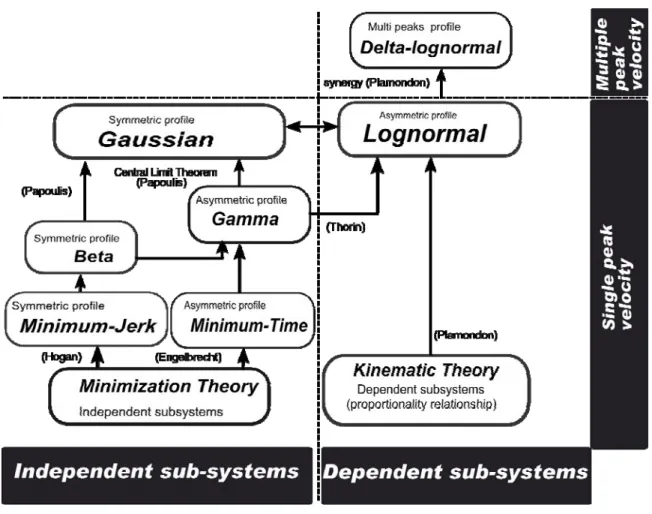
We have summarized all these comparisons in Figure 2 where the analytical expressions proposed by the various models are positioned in the global context of various successive approximations of a Delta-Lognormal function. For example, to get a Minimum-Time model from a Delta-lognormal, one must neglect the antagonist component; assume a finite number of N independent subsystems and, constraint the impulse response of such subsystem to decrease exponentially in time (Poisson-like profile). Similarly, to get a Minimum-Jerk model, one must also assume the approximations described in equations (18) to (20).
Figure 2: Classification of some kinematic models according to the Central Limit Theorem: The arrows
highlight the convergence from a model to another. Notice that the Gaussian and the Lognormal models result from the same limit model except that the lognormal description generally takes into account the subsystem dependence. Each up-pointing arrow indicates the passage from a less to a more precise velocity description, which converges towards a lognormal limit, as described by the Central Limit Theorem. The Delta-Lognormal model is an extension of a lognormal model: it also considers the neuromuscular synergy that describes a multiple peaks observed on a velocity profile of rapid movement.
5. Discussion
In the Minimum-Jerk model, one is not interested in the command profile sent by the CNS. It is directly assumed that the alpha motoneuron signals, observed at the muscle level, correspond to a movement trajectory, which suggests that the neuromuscular network is just a system that converts a virtual trajectory to a real one with the same profile by transforming metabolic energy to mechanical movement. This representation
does not take into account the movement genesis, i.e. the instant when the command is sent to the end-effector, neither the time required by the CNS to build and send the appropriate signals to the motor cortex neurons nor the moment when the muscle starts to contract. Furthermore, this model refers to movement organization without offering any insights about the structure of the neuromuscular system.
Concerning the Minimum-Time model, the command signal is explicitly modeled by a set of step functions when the observable variable is the position and by Dirac impulses when one is dealing with the velocity profile. In this paradigm, the neuromuscular system is explicitly represented by a serial network of interneuron and neuromuscular synapses, where the sequence of Dirac impulse commands propagates to produce an end-effector movement with a Gamma velocity profile.
As previously derived, the Beta velocity profile, proposed as a generalization of the Minimum-Jerk, is itself a particular case of the Gamma model. Thus, implicitly and explicitly, both of these models express the velocity profile as the impulse response of a convolution product, made up of a large number of subsystem impulse responses. The subsystem represents the functioning of a set of neuronal or neuromuscular populations which are recruited to contribute in the movement generation.
As a consequence, the Minimization Theory can be analyzed within the same framework than the Kinematic Theory, except that it exploits different assumptions and approaches to describe the functioning of the motor control. Indeed, it considers the subsystems as independent and assumes specific forms for their impulse responses. To generate a rapid movement, the NMS requires a relatively small number (for example 3 for a Minimum-Jerk) of these subsystems and then the response time of each subsystem must be
represented at the same time-scale as the movement response. This latter assumption is difficult to support biologically: the duration of the synapse responses is generally expressed in milliseconds (Kandel et al. 2001), while the rapid movement duration is expressed in hundred of milliseconds i.e. typical values of 200 ms to 500 ms (Harris & Wolpert 1998; Haruno & Wolpert 2005; Tanaka et al. 2006). In other words, the subsystems and the global system responses are described at different time-scales and a large number of subsystems (more than one hundred) are thus required in a convolution product to move from a lower to an upper time level.
In this perspective, the Kinematic Theory seems more realistic. First, the subsystems are not considered as independent and no special constraints are put on the form of the individual impulse responses. The production of a rapid movement requires a large number of subsystems (the number depends on a characteristic of subsystem impulse response and 12 seems realistic when considering those described within the same time scale than the velocity) and two neuromuscular systems (agonist and antagonist) work in synergy. These latter assumptions seem fundamental and probably explain why the Delta-Lognormal model leads to a most accurate expression for a velocity profile (Plamondon et al. 1993; Feng et al. 2002).
Moreover, we can also propose another interpretation to the Minimum-Square-Derivatives criteria. Indeed, for the case of independent subsystems and single peak velocity, it has been shown that when the number of subsystems is finite, the limit profile is not reached and the resulting convergence error is proportional to the third time-derivative of a Gaussian function (see equation 4). This convergence error distorts the smooth theoretical profile, leading to the emergence of very small ripples. To maximize
the smoothness and reduce these ripples, one can minimize the lost energy, described previously as a cost function and now associated to the convergence error function. In this context, the minimization criteria introduced by Hogan (1984) and other authors, can be given another interpretation: they are special cases of a more general minimization process in the context of the existence of a theoretical limit profile, given by the Central Limit Theorem.
To illustrate this point, let consider the case of the Minimum-Snap. To get a smoothest trajectory one can use the following minimization criterion:
( )
2( )
2 4 3 4 4 3 0 0 min d d C t dt t dt dt θ dt ω ∞⎡ ⎤ ∞⎡ ⎤ = ⎢ ⎥ = ⎢ ⎥ ⎣ ⎦ ⎣ ⎦∫
∫
→ (21) where ω( )
t is the corresponding velocity of the smoothest trajectory.Under the same condition of independent subsystems, and according to the Kinematic Theory, ω
( )
t would then converge towards a Gaussian profile N t( )
;... as the energy associated to the convergence error Econv( )
t;... tends towards zero.( )
3(
2)
3( )
3 ; , 6N conv t dtd t N N dt χ μ σ ω Ε Ν ∝ d3 t (22)In other words, the smoothest limit velocity profile will be reached when the energy associated with the convergence error Econv
( )
t;... will be minimal.( )
3( )
2 2 3 0 0 ;... 0 conv N d E t dt t dt dt ω ∞ ∞ →∞ ⎡ ⎤ ≈ ⎢ ⎥ → ⎣ ⎦∫
∫
(23)This is the condition exploited in the Kinematic Theory. Combined with the hypothesis of dependent neuromuscular subsystems, it results in an optimal descriptor of the velocity profiles.
On that account, two improvements have been provided in this paper. On the one hand, we have provided a new perspective on the minimization models studied here. Although these processes could not be analyzed so far in term of motor control, in a sense that the motoneuron command was not explicitly defined, we have shown that these processes could be related to the convergence process of the convolution product of a large number of subsystem impulse responses and that in this perspective, they could be considered as the result of a motor control or at least as the execution process of motor tasks by the neuromuscular system. Following the approach of the Kinematic Theory, we have added supplementary knowledge to the Minimization Theory by modeling its control signal by a weighted Dirac-impulse.
On the other hand, the Kinematic Theory had not been studied through the point of view of ill-defined motor control as depicted by Bernstein (1967). In the light of this study, this theory can now be considered as an optimization process. In other words, it can be seen as the ultimate minimization theory and the process of trajectory selection can thus be described as the process of recruiting a sufficient number of neuromuscular units to produce the most perfect Delta-Lognormal profile under the required circumstances. Indeed, this theory explains and models the functioning of the neuromuscular system and the control signal by explicitly highlighting the motor control through the parameter and where controls the movement distance and
1
D
2
D D D1− 2 D D1 2 controls the
movement time (Plamondon 1995b; Plamondon & Alimi 1997). In the context of the present study, such a prediction will be more or less exact depending on the error of convergence associated with the process. The larger the number of neuromuscular subsystems, the smaller the convergence error: and the smaller the convergence error, the
better the Delta-Lognormal approximation, and the better the selection of a specific trajectory from the input commands.
6. Conclusion
In this study, we have reviewed and compared the Minimization and the Kinematic Theories through their basic concepts and their different analytical expressions to model stereotypical velocity profiles. We have postulated that some relationships between these models should exist. To highlight these similarities, we have studied the approximations and methods used by these models to represent rapid aimed movements. It has been shown that the two theories can be seen as being built on the same concepts: from a functional point of view, the neuromuscular system can be represented by the convolution product of a large number of subsystem impulse responses while the command signal can be modeled by a Dirac impulse weighted by a movement distance. Moreover, relying on the hypothesis that minimization principles express the fact that the CNS seems to recruit the motor units that either minimize the lost energy, represented by a cost function or that minimize the movement duration, we have expressed these same criteria within the context of the convergence of a convolution product toward a limit velocity profile. This has leaded us to a way of ranking the various models, based on the hidden approximations and assumptions used by these models to construct their analytical expression of a velocity profile. In this perspective, the Minimum-Jerk, the Minimum-Time, the Beta and the Gamma models can be considered as resulting from successive approximations of the Delta-Lognormal model and, the Kinematic Theory can be seen as an ultimate minimization theory.
Acknowledgment
This work was supported by grant RGPIN-915 from NSERC to Réjean Plamondon.
Bibliography
Alimi, A. (1995) Contribution au développement d’une théorie de génération de mouvements simples et rapides: application au manuscrit. Thèse de Doctorat en Génie Électrique. Montréal: École Polytechnique. 280 pages.
Alimi, A. & Plamondon, R. (1996) A comparative study of speed/accuracy tradeoffs formulations: the case of spatially constrained movements where both distance and spatial precision are specified. In Handwriting
and drawing research: basic and applied issues M. L. Simner, G.Thomassen, A.J.T.W.M., Ed. Amsterdam.
127-142.
Alimi, M. A. (2003) Beta neuro-fuzzy systems, TASK Quarterly J., Special Issue on “Neural Networks” eds. W. Duch and D. Rutkowska, 7(1):23–41.
Bernstein, N. (1967) The coordination and regulation of movements, Oxford: Pergamon.
Bezine, H. Kefi, M. & Alimi, M.A. (2005) On the Beta-elliptic model for the control of the human arm movement. International Conference on Graphonomics 12:69–73.
Bezine, H. Kefi, M. & Alimi, M.A. (2007) On the Beta-elliptic model for the control of the human arm movement. International Journal of Pattern Recognition and Artificial Intelligence.21(1) :5-19. Bizzi, E. Dev, P. Morasso, P. & Polit, A. (1978) Effect of Load Disturbances During Centrally Initiated Movements. Journal of Neurophysiology. 41:542-556.
Bizzi, E. Accornero, N. Chapple, W. & Hogan. N.(1984) Posture control and trajectory formation during arm movement. The journal of Neuroscience. 4: 2738-2744.
Bullock, D. and Grossberg, S. (1988). The VITE model: A neural command circuit for generating arm and articulator trajectories. In J.A.S. Kelso, A.J. Mandell, and M.F. Shlesinger(Eds.), Dynamic Patterns in
Complex Systems. Singapore: World Scientific Publishers, 305–326
Djioua M.and Plamondon, R.(2003) "Relationship between proportionality law and lognormality of a coupled system response," 11th International Conference on Graphonomics Society, Scottsdale , Arizona USA, vol. 11, pp. 81-85.
Djioua, M. and Plamondon, R. (2004) The generation of velocity profiles with an artificial simulator,"
International Journal of Pattern Recognition and Artificial Intelligence, vol. 18, pp. 1207-1219
Djioua, M. (2007) Contributions à la compréhension à la généralisation et à l’utilisation de la Théorie Cinématique dans l’analyse et la synthèse du mouvement humain. Ph.D. Thesis, École Polytechnique de Montréal, 380 pages.
Do-Hoon, L. & Hwan-Gue, C. (1998) The Beta-Velocity Model for Simulating Handwritten Korean Scripts, Lecture Notes in Computer Science, Spinger.1375:252-264.
Enderle, J. D. & Wolfe, J. W. (1987) Time-optimal control of saccadic eye movements. IEEE Transactions
on Biomedical Engineering. 34:43-55.
Engelbrecht, S. E.(2001) Minimum Principles in Motor Control. Journal of Mathematical Psychology. 45: 497-542.
Faraway J.J., Reed M.P. , Wang J. (2007) Modelling three-dimensional trajectories by using Bézier curves with application to hand motion Journal of the Royal Statistical Society: Series C (Applied Statistics) 56(5):571
Feller, W. (1966) An introduction to probability theory and its applications, vol. 2. John Wiley and Sons Eds.
Feng, C. Woch, A. & Plamondon, R.(2002) A comparative study of two velocity profile models for rapid stroke analysis. 16th International Conference on Pattern Recognition.4:52-55.
Feng, C. (2005) Effets des délais temporels sur certains modèles de réseaux biologiques. Ph.D. Thesis. École Polytechnique de Montréal, 191 pages.
Flash, T. & Hogan, N. (1985) The coordination of Arm Movements: An experimentally conformed mathematical model. The journal of Neuroscience. 5:1688-1703.
Georgopoulos, A.P. Kalaska, J.F. & Massey, J. T. (1981) Spatial trajectories and reaction times of aimed movements: Effects of practice, uncertainty, and change in target location. Journal of Neurophysiology. 725-743.
Gielen, C.C.A.M, Van den Oosten, K., Van den Pullter, G.F. (1985) Relation between EMG activation patterns and kinematic properties of aimed arm movement. Journal of Motor Behaviour.17:421-442. Guerfali, W. (1996) Modèle Delta-Lognormal vectoriel pour l’analyse du mouvement et la génération de l’écriture manuscrite. Ph.D. Thesis. École Polytechnique de Montréal. 257 pages.
Harris, C.M. (1998) On the optimal control of behavior: a stochastic perspective. Journal of neuroscience
methods. 83:73-88.
Harris, C.M. & Wolpert, D.M. (1998) Signal-dependent noise determines motor planning. Nature. 394: 780-784.
Haruno, M. & Wolpert, D.M. (2005) Optimal control of redundant muscles in step tracking wrist movements. Journal of Neurophysiology. 94(6):4244-55
Hermes, H. & LaSalle, J.P. (1969) Functional analysis and time optimal control. Academic Press. Hogan, N. (1984) An organization principle for a class of voluntary movements. The Journal of
Neurosciences. 4: 2745-2754.
Kandel, E.R. Schwartz, J.H. & Jessell, T. M. (2000) Principles of Neural Science. McGraw Hill. Lacquaniti, F. Terzuolo, C. & Viviani, P. (1983) The law relating the kinematic and figural aspects of drawing movements, Acta Psychologica. 54:115–130.
Leclerc, F. (1996) Modèle de génération de mouvements rapides en représentation de signatures manuscrites. Ph.D. Thesis. École Polytechnique de Montréal. 230 pages.
R. D. Luce (1986) Response times. Their role in infering elementary mental organisation, . New York: Oxford University Press Inc..
Miall, R. C. & Haggard, P. (1995) The curvature of human arm movements in the absence of visual experience. Experimental Brain Research.103: 421-428.
Morasso, P. (1981) Spatial control of arm movements. Experimental Brain Research. 42: 223-227. Morasso, P. (1983) Three dimensional arm trajectories. Biological Cybernetics. 48:187-194. Neilson, P.D. (1993) The problem of redundancy in movement control: the adaptive model theory approach. Psychological Research. 55:99-106.
Neilson, P.D. & Neilson, M.D. (2005) An overview of adaptive model theory: solving the problems of redundancy, resources and nonlinear interactions in human movement control. Journal of Neural
Engineering. 2(3):279-312.
Nelson, W.L.(1983) Physical principles for economies of skilled movements.Biological Cybernetics. 46:135-147.
Papoulis, A. (1962) The Fourier Integral and Its Applications. McGraw-Hill.
Partridge, L. D. (1966) Signal-handling characteristics of load-moving skeletal muscle. American Journal
of Physiology. 210:1178-1191.
Partridge, L. D. (1973) Integration in the central nervous system. Engineering Principles in Physiology, S. S. G. J.H.U Brown, Ed. New York. 47-98.
Piegl, L. & Tiller W. (1997) The NURBS Book, Springer-Verlag.
Plamondon, R. Alimi, A. M. Yergeau, P. & Leclerc, F. (1993) Modelling velocity profiles of rapid movements : a comparative study.Biological cybernetics. 69:119-128.
Plamondon, R. (1995a) A kinematic theory of rapid human movements : Part I: Movement representation and generation. Biological Cybernetics..72:295-307.
Plamondon, R. (1995b) A kinematic theory of rapid human movements : Part II. Movement time and control. Biological Cybernetics. 72:309-320.
Plamondon R, Alimi A (1997) Speed/accuray tradeoffs in target directed movements. Behavioral and Brain Sciences 20(2): 325-248.
Plamondon, R. & Guerfali, W. (1998) The generation of handwriting with delta- lognormal synergies.
Biological Cybernetics. 78:119-132.
Plamondon, R. (1998) A kinematic theory of rapid human movements : Part III. Kinetic outcomes.
Biological Cybernetics..78:133-145.
Plamondon, R. Feng, C. &Woch, A. (2003) A kinematic theory of rapid human movement. part IV: a formal mathematical proof and new insights. Biological Cybernetics. 89:126–138.
Plamondon, R. (2003). A unified framework to study human movements under isotonic and isometric conditions. Neuroscience, New Orleans, USA.
Plamondon, R. & Djioua, M.(2005) Handwriting stroke trajectory variability in the context of the Kinematic Theory. International Conference on Graphonomics. 12:250-254.
Plamondon, R. & Djioua, M. (2006) A multi-level representation paradigm for handwriting stroke generation. Human Movement Science. 25:586-607.
Plamondon, P. Feng, C. & Djioua, M. (2007) A Kinematic Theory of Rapid Human Movements, Part V : the Convergence of a Neuromuscular Impulse Response Towards a Lognormal, from Theory to Practice (submitted to Biological Cybernetics).
Richardson, M. J. E. & Flash, T. (2002) Comparing Smooth Arm Movements with the Two-Thirds Power Law and the Related Segmented-Control Hypothesis. The Journal of Neuroscience. 22:8201-8211. Tanaka, H. Krakauer, J. W. & Qian, N.(2006) An optimization Principle for Determining Movement Duration. Journal of Neurophysiology. 95:3875-3886.
Thorin, O. (1977) On the infinite divisibly of the lognormal distribution," Scandinavian Actuarial Journal. 121-148.
Uno, Y. Kawato, M. & Suzuki, R. (1989) Formation and control of optimal trajectory in human multijoint arm movement. Biological Cybernetics. 61:89-101.
Wiegner, A. W. & Wierzbicka, M. M. (1992) Kinematic models and human elbow flexion movements: Quantitative analysis. Experimental Brain Research. 88:665-673.
Woch, A & Plamondon, R.(2004) Using framework of the kinematic theory for the definition of a Movement primitive. Motor Control. 8:547-557.
Woch, A. (2006) Étude des primitives bidirectionnelles du mouvement dans le cadre de la théorie cinématique: confirmation expérimentale du modèle delta-lognormal. Ph.D. Thesis, École Polytechnique de Montréal.
Wolpert, D.M. Ghahramani, Z. & Jordan, M.I. (1995) Are arm trajectories planned in kinematic or dynamic coordinates? An adaptation study. Experimental Brain Research. 103:460-470.