Chemin : Department of Economics, University of Quebec at Montreal, case postale 8888, succursale Centre-Ville, Montréal (Québec) Canada H3C 3P8 and CIRPÉE
I am grateful to Tim Besley and Robin Burgess for their many comments and fine guidance. I would like to thank Wolfgang Koehling for his kind help, Francesco Caselli, Simeon Djankov, Maitreesh Ghatak, Markus Goldstein, the participants of LSE/EOPP, CIRPEE seminars for numerous useful comments. Financial support from ESRC, STICERD, Royal Economic Society, PAFARC is gratefully acknowledged. I would also like to thank the National Sample Survey Organisation for providing the data.
Cahier de recherche/Working Paper 07-26
Decoding the Code of Civil Procedure: Do Judiciaries Matter for
Growth?
Matthieu Chemin
Abstract:
This paper attempts to measure the causal impact of the speed of judiciaries on economic activity by using two novel instrumental variables measuring judicial procedural ambiguity and complexity. First, I find that temporally exogenous conflicting judicial decisions taken in India due to the Code of Civil Procedure’s ambiguity lead to higher expected trial duration as judges are required to spend considerable time in choosing between several conflicting views. Second, I find that Indian High Court amendments complicating procedures to treat a case are related to higher trial duration. By using spatial and temporal variations in the occurrence of conflicting decisions and enactment of amendments as instrumental variables, I am able to measure the impact of judicial speed on credit markets, agricultural development and manufacturing performance.
Keywords: Law and economics, Institutions, Courts, Economic Growth, Industrial Performance
I
Introduction
This paper contributes to the empirical literature on the e¤ects of institutions on economic performance. One key question in this literature is causation, because insti-tutions are arguably endogenous. The …rst issue when relating instiinsti-tutions to economic performance is one of reverse causality. For example, States with higher per capita incomes are able to devote more funds to improving institutions and thus have better institutions. The second issue is one of unobservable omitted variables, which are driving both judicial and economic outcomes, such as pessimism regarding a particular State’s prospects or the “backwardness”of another. For these reasons, it is important, but not easy, to …nd exogenous sources of variation in the quality of institutions if one wishes to relate it to economic performance.
This paper focuses on the judiciary, a topic of …rst-order importance in this literature, and on its speed, an objective measure identi…ed as a key problem in India. In this paper, I focus on procedural ambiguity and complexity as two potential reasons for the slowness of Courts in India. I read and classi…ed all con‡icting judicial decisions pertaining to the Code of Civil Procedure taken by High Courts between 1971 and 1996. Con‡icting judicial decisions, in other words violations of precedents already established by High Courts, are found to increase trial duration as judges are required to spend considerable time in choosing between several con‡icting views. I also read and classi…ed the 430 State amendments to the Code of Civil Procedure enacted by High Courts between 1971 and 1996. In particular, I …nd that the 94 amendments complexifying procedures that have to be followed by the Courts (subsequently named “Court red tape”amendments), not explicitly designed to deteriorate speed, signi…cantly increase expected duration of trials in High Courts. I then exploit the spatial and
temporal variation of con‡icting judicial decisions and “Court red tape” amendments to instrument the impact of expected duration of a trial in High Court on economic activity.
There are four reasons to believe that these two variables (con‡icting judicial deci-sions and “Court red tape” amendments) could represent good instrumental variables. First, I use a panel data analysis and include State …xed e¤ects to account for perma-nent di¤erences across States in policies and outcomes. If systematic determinants of amendments are time invariant characteristics, this will remove endogeneity concerns. Second, the temporal variation in con‡icting judicial decisions is exogenous as they arise after the arbitrary occurrence of cases pertaining to ambiguous sections of the Code of Civil Procedure. Third, “Court red tape” amendments were not explicitly designed to deteriorate the speed of Courts. As such, they were not endogenous to the judicial slow-ness at the time the amendment was passed. Fourth, I try to account for forces leading to amendments enactment by looking at the political in‡uence of parties in determining High Court amendments and at the political representation of certain groups likely to in‡uence amendments.
The speed of the judiciary has been identi…ed as a key problem in India. Data on cases pending in courts indicate that there were 3.1 million cases pending in 21 High Courts and 20 million in subordinate courts in 20001. Extreme examples of judicial slowness refer to cases taking 47 years to be resolved, by which time the plainti¤ had died. Slow judiciaries could heavily shape economic activity. First, slow judicial enforcement increases the opportunistic behavior of borrowers: anticipating that creditors will not be able to recover their loans quickly via courts, borrowers will be more tempted to default. Creditors respond to this strategic behavior of borrowers by reducing the availability of credit. Second, the probability of harsh punishment in monetary or non-monetary terms
heavily dissuades opportunistic agents to default ex-post on previous agreements. Slower judiciaries make the discounted value of punishment lower, thereby weakening incentives to cooperate. For example, if a …rm wants to undertake an investment in order to supply another with a particular asset, the possibility of post-contractual opportunistic behavior by the partner arises once the investment costs are sunk. A speedy judicial system enforcing contracts swiftly could limit post-contractual opportunistic behavior and foster investment. For these reasons, it is important to …nd an explanation for the slowness of the courts in India and analyze its impact on economic activity. In this paper, I …nd that slower judiciaries reduce access to credit markets in the agricultural sector, leading to depressed agricultural outputs. I also …nd that slower judiciaries are associated with lower outputs in sectors dependent on strong judiciaries, such as registered (as opposed to unregistered) manufacturing and trade.
This paper contributes to the empirical literature on the causal e¤ects of institutions on economic performance. There are some successful attempts at resolving the endo-geneity and causality issues (Mauro, 1995; Hall and Jones, 1999; Acemoglu et al, 2001). To open the black box of “institutions”, I focus in this paper on the judiciary, in particu-lar its speed, which has been identi…ed in India as one of its key problem. The literature often exploits spatial variation in the quality of the judiciary to identify its e¤ect on economic activity. Knack and Keefer (1995) relate professional country risk measures provided by business experts to their measure of judicial quality which is the amount of contract-intensive money (the di¤erence between M2 and cash). However, it might be, for example, that states that have in general better policies are also more inclined to have e¢ cient judiciaries. But if that is the case, judicial quality just re‡ects the general better economic policies and in itself may not be important in driving better economic outcomes. Jappelli et al (2005) present a model of the e¤ect of judicial enforcement on
credit markets and then test it using panel data from Italian provinces. The authors …nd, among other things, that the duration of civil trials (measured by actual duration in the past) as well as the stock of pending civil trials per inhabitant are negatively corre-lated with loans granted to domestic companies and positively correcorre-lated with measures of credit constraints. Cristini et al (2001) relate di¤erences in judicial e¢ ciency across Argentinean provinces to the size of provincial credit markets. Castelar Pinheiro et al (2001) perform a similar analysis in Brazil. In these four papers, no attempt is made to deal with the potential endogeneity of the judicial ine¢ ciency measures.
Djankov et al (2003) have made an important contribution to the study of courts. They measured judicial formalism in 109 countries around the world. They found ju-dicial formalism greater in countries with civil rather than common law systems and that it is associated with a lack of consistency, honesty and fairness in judicial deci-sions. Endogeneity concerns were addressed by using legal origin as an instrument for judicial formalism. Acemoglu et al (2005) use the same data to relate judicial e¢ ciency to economic outcomes using legal origin as an instrumental variable. They …nd that contracting institutions have no impact on economic performance once property rights institutions are controlled for. This paper di¤ers from Acemoglu et al (2005) in two ways. First, it uses a within-country analysis of India. By limiting myself to one country, I am able to control for a range of factors and in‡uences that cannot be as convincingly controlled for in cross country data. This allows me to identify the e¤ect of judicial e¢ ciency independently from that of laws, legal origins, and other country-wide char-acteristics. Second, it generates clear policy implications regarding the desirability of simplifying reforms to the Code of Civil Procedure.
One notable exception in this literature is Visaria (2006) where a di¤erence-in-di¤erences strategy based on two sources of variation (the monetary threshold for claims
to be eligible for these tribunals and the staggered introduction of tribunals across In-dian states) is used to show that the establishment of tribunals reduces delinquency in loan repayment by between 3 and 11 percent. This paper di¤ers from Visaria (2006) in two ways. First, I focus on judiciary’s speed by showing explicitly the link between con‡icting judicial decisions and “Court red tape” amendments and decreased judicial speed. Second, I relate judiciary’s speed to credit access but also to other outcomes such as agricultural credit supply and development, registered and unregistered manufactur-ing, trade, hotel and restaurants, banking and insurance, real estate sectors development and ultimately, poverty.
The paper is structured as follows. Section II describes data collected concerning con‡icting decisions made by High Courts and amendments to the Code of Civil Proce-dure between 1971 and 1996. Section III focuses on theoretical issues, explaining both the reasons behind these amendments and the potential impact of the judiciary on eco-nomic activity. This section clari…es the econometric speci…cation used by specifying what control variables and what economic outcomes should be used. Section IV con-tains an empirical analysis of the e¤ects of both con‡icting decisions and amendments on the expected duration of High Court trials. Section V examines the e¤ects of the judiciary on economic outcomes. Section VI concludes.
II
Data
Judicial institutions are the same across courts and States. The Indian judiciary operates on three levels: a single Supreme Court at the federal level; High Courts in each of the States; and, at lower levels, district judges for civil cases and session judges for criminal cases. Speed has been identi…ed as a key problem. Examples of judicial slowness are striking:
“the highest court in the country, the Supreme Court, took 11 years to acquit the headmaster of a school on the charge of taking a bribe for signing the salary arrears bill of his school. In another case of judicial delay, the victim was former Union Law Minister, Dr. B.R.Ambedkar. The judgement came in his lifetime but it took 47 years for the Maharashtra government to execute the decree passed in his favour against illegal encroachment of his land by Pakistani refugees. By then he was dead.”2
Legal experts argue that the Code of Civil Procedure is a major reason why India’s judiciary is so slow (Debroy, 2000). To prove this, I will analyze when and which High Courts violated their own precedents using the 144th Report on “Con‡icting Judicial Decisions Pertaining to the Code of Civil Procedure, 1908”. These con‡icting judicial decisions may increase expected durations of High Court trials. I will also analyze how State amendments to the Code a¤ect the expected duration of High Court trials.
II.1
Con‡icting judicial decisions
The Code of Civil Procedure (1908) contains India’s laws relating to procedures in suits and civil proceedings. They may be summed up as follows: procedures for …ling civil cases, court powers for passing various orders, court fees and stamps involved in the …ling of cases, rights of the parties to cases, namely plainti¤ and defendant, jurisdictions and parameters within which civil courts must function, speci…c rules for case proceedings, right of appeals, reviews and references. Legal experts have long argued that ambiguity in Indian law increases delays in case treatment. For example, the Indian Law Commission’s 136th report entitled “Con‡icts in High Courts decisions on central laws— how to foreclose and how to resolve”states that “those who are entrusted with the
function of adjudicating on questions of law must spend considerable time in choosing between two or more possible views on a subject which falls to be considered before them”3. This is also true for the Code of Civil Procedure. This code is so ambiguous that opposite decisions on similar cases have been reached in di¤erent High Courts. An even worse problem is when the same High Court arrives at opposite verdicts on similar cases at di¤erent times. The underlying intuition is that, after a violation of its own precedent by a High Court, judges have no choice but to spend considerable time on choosing between two or more possible views on the subject at hand. Studying every such violation in the period from 1971 to 1996 has allowed me to relate, in the empirical section, their occurrence in certain States at certain times to the expected duration of High Court trials in view of seeing whether or not con‡icting judicial decisions caused by the Civil Procedure Code’s ambiguity may explain the country’s slow judiciary.
The occurrence of con‡icting judicial decisions could have another e¤ect on the ju-diciary. As the Law Commission of India’s 136th report states, “those whose business is to advise persons who consult them on questions of law, …nd it di¢ cult to give such advice with con…dence where the decisions are con‡icting”4. In other words, such High Court reversals may lead to increased uncertainty in case outcome. This might decrease litigants’willingness to …le cases and thereby increase judicial speed. The net impact of con‡icting judicial decisions on the expected duration of a High Court trial is therefore an empirical question. The empirical section of this paper will relate the occurrence of the same High Court precedent violations to the expected duration of High Court trials. I will now describe the data collected.
The Law Commission of India published in 1992 its 144th report on “Con‡icting Judicial Decisions Pertaining to the Code of Civil Procedure, 1908” by K.N. Singh, India’s Chief Justice from 25.11.1991 to 12.12.1991. This report summarises con‡icting
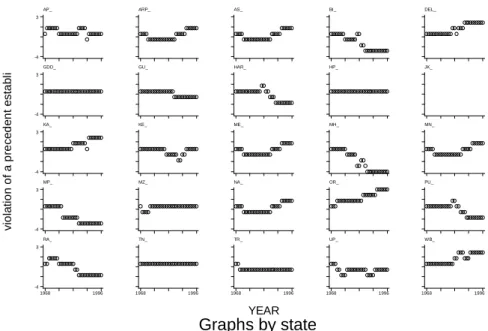
decisions made by High Courts arising from ambiguity and lack of clarity in the Civil Procedure Code. It presents a total of 30 di¤erent Code rules having led to opposite decisions by di¤erent High Courts, succinctly describing the Code’s ambiguity and listing each High Court’s opposing view. It includes 163 opposing decisions by di¤erent High Courts involving these 30 rules (see Figure III for a graph of all the decisions taken by High Court violating (+1) or con…rming (-1) prior judgements). In the following example I will consider an extreme case in which a High Court contradicted itself in two di¤erent cases based on the same point of law.
Order 23, Rule 1(3) allows for the withdrawal of suits with liberty to …le fresh suits under certain circumstances, namely “formal defect”or “su¢ cient grounds”. The ques-tion here is whether or not the rule applies in cases of partial or total suit abatement, that is, on the death of a party. Ambiguity is caused by another rule which explicitly mentions the death of a party. Order 22— Death, Marriage and Insolvency of Parties— Rule 4 states that in the case of the death of a sole defendant, or in the case of the death of one of several defendants and the right to sue does not survive against the sur-viving defendant, then the Court, on an application made on behalf of the dead party, shall cause the legal representative of the deceased defendant to be made a party and shall proceed with the suit. However, if no application is made, the suit shall abate as against the deceased defendant. Rule 9 further states that where a suit abates under this order, no fresh suit shall be brought on the same cause of action. Therefore, allowing the plainti¤ to withdraw in such circumstances and …le a fresh suit would allow him to bypass Order 22. This was the view taken in a 1936 Calcutta Case5. In the latter, a suit was directed against the sole dependant for possession. On his death, his legal repre-sentatives were not substituted and, consequently, the suit abated. Withdrawal was not permitted. However, in a later 1953 Calcutta Case6, a leave to withdraw was granted
in a case where the suit abated upon the death of one co-trespasser. Nevertheless, the view taken in 1936 reappeared later in a 1984 case7. It is worth noting that K.N. Singh (ex-Chief Justice of India and author of the report) recommended clarifying the code in such a way that the death of a party would not constitute grounds for withdrawal. This recommendation was never introduced and the ambiguity remains to this day.
I argue that High Court reversals such as these increase the likelihood of longer case durations. In fact, in cases where the defendant dies, judges are required to carefully consider not only Order 23, Rule 1(3), Order 22— Death, Marriage and Insolvency of Parties— Rule 4 and Rule 9, but also the following precedents: the 1936 Calcutta Case: Ramesh v Deo Mehar Bibi, 40 CWN 1019 (RC Mitter J.); the 1953 Calcutta Case: Hakir Mahamed v Abdul Majid, AIR 1953 Cal 588, para 3; and the 1984 Calcutta Case: Shyam Ray v Harnam De, AIR 1984 Cal 67, 70 para 12. Because Singh’s recommendation was not adopted, coming to a decision is all the more di¢ cult. In this case, I increment by 1, from 1984 on in West Bengal, a “violation of a precedent established by the same High Court” variable. I also subtract it by 1 when a decision taken in a case is con…rmed explicitly by another later case. There have been 31 such occurrences in India’s States between 1971 and 1996 (see Figure IV for the graph of this variable per state per year). I expect to see a positive correlation with the expected duration of High Court trials.
The crucial feature of the analysis is the temporally random occurrence of this am-biguous case. In this particular example, the “violation of a precedent established by the same High Court” variable takes the value 1 in 1984 in West Bengal due to the occurrence of a death of one party in a case in 1984 and the subsequent necessity to use Orders 22 and 23 of the Code of Civil Procedure. The temporal variation in the “vio-lation of a precedent established by the same High Court” variable is not endogenous to the economic, political or judiciary’s conditions, but is rather due to the arbitrary
occurrence of cases pertaining to ambiguous sections of the Code of Civil Procedure. Spatial variation in this variable is not necessarily random. The fact that judges contradict precedents previously established by their own High Court is perhaps merely a re‡ection of their ability. The “violation of a precedent established by the same High Court” could simply be a measure of a High Court’s quality. An empirical analysis relating this variable to the expected duration of a trial in High Court could possibly confuse the Code of Civil Procedure’s ambiguity with the quality of a particular court. I therefore control for the quality or level of competence of a particular court in the empirical analysis.
To measure procedural ambiguity, I have codi…ed the 163 con‡icting judicial decisions according to the 144th report on “Con‡icting Judicial Decisions Pertaining to the Code of Civil Procedure, 1908”published in 1992 by the Law Commission of India. I will now focus on another potential reason why courts are slow in India: procedural complexity.
II.2
Amendments to the Code of Civil Procedure
The Code of Civil Procedure (1908) is common across Indian Courts and States. It is thus impossible to evaluate the impact of its complexity on judicial speed. A temporal variation in the complexity of the Code of Civil Procedure could be used to look at the evolution of judicial speed before and after the reform. However, several changes could happen in the mean time and drive the observed evolution of judicial speed. A spatial variation in the complexity of the Code of Civil Procedure could be used to look at the evolution of judicial speed in States where High Courts enacted changes. However, High Courts which enact changes could maybe be situated in States more prone to reform. It might be, for example, that states that have in general better policies are also more
inclined to have e¢ cient judiciaries.
Ideally, one should use spatial and temporal variations in the complexity of the Code of Civil Procedure. This would allow for a di¤erence-in-di¤erences analysis: States that enacted changes to the Code of Civil Procedure would be compared to States that did not, before and after these changes. The advantage of a di¤erence-in-di¤erences approach is that it deals with any preexisting systematic di¤erence between States. A di¤erence-in-di¤erences approach would isolate the causal impact of these spatial and temporal variations in the complexity of the Code of Civil Procedure on judicial speed conditional on the common time e¤ects assumption: States that enacted changes, had they not enacted these changes, would have evolved in the same way as States that did not enact changes.
In this paper, I …nd such spatial and temporal variations in the complexity of the Code of Civil Procedure. This Code has been amended from time to time by various Acts of Central and State Legislatures. According to Section 1228, High Courts have power to amend, by rules, procedures laid down by the Orders. These High Court amendments set precedents for the entire State since India functions according to the common law system— the actions of High Court judges set precedents for the functioning of subordinate courts in their particular State. The exercise of these powers has brought 430 amendments to the Orders by various High Courts since 1971. I read each of these amendments and isolated the “Court red tape”amendments which add procedures to be followed by the Court. An example of such amendments concerns Order 39— Temporary Injunctions and Interlocutory Orders, Rule 4:
“Order for injunction may be discharged, varied or set aside.-Any order for an injunction may be discharged, or varied, or set aside, by
the Court, on application made thereto by any party dissatis…ed with such order [...].”
Compare this with the Madhya Pradesh High Court amendment enacted in 1984: “Order for injunction may be discharged, varied or set aside.-Any order for an injunction may be discharged, or varied, or set aside, by the Court for reasons to be recorded, either on its own motion or on application made thereto by any party dissatis…ed with such order [...].”
Reasons for putting aside an injunction must be recorded in Madhya Pradesh after 1984. This may slow down the courts. I therefore classify this amendment as a +1 in the “Court red tape” variable from 1984 onward for Madhya Pradesh and expect a positive correlation with the expected duration of High Court trials. There have been 94 such amendments in India between 1971 and 1996 (see Figure I for a graph of these “Court red tape” amendments by State and year). Such an amendment was designed to increase the quality of the courts by forcing the judge to record a valid reason in a written form.
In this paper, I focus solely on “Court red tape” amendments. These amendments, as per the example given, were not designed explicitly to decrease the speed of the judi-ciary. This is an important element to keep in mind for the econometric analysis. Other amendments, called “explicit speed” amendments, were explicitly designed to a¤ect ju-dicial speed. These amendments are by de…nition endogenous to the economic, political but most of all judicial conditions of the time. The overall assessment of amendments to the Code of Civil Procedure is that there are two types of amendments: supply-side and demand-side amendments. Table I de…nes each amendment category and presents a number of descriptive statistics (Column (2) presents the sum of the amendments
weighted by their direction, Column (3) presents the ratio of the weighted sum by the total number of amendments: “explicit speed” amendments in India generally favour the shortening of procedures). If one visualizes demand and supply curves for dispute resolution, supply-side amendments involve a shift of the supply curve. Because of the shift, the number of cases disposed will go up or down. There are two types of supply-side amendments found in the Code of Civil Procedure: “Court red tape”and “explicit speed” amendments. Demand-side amendments, which involve shifting the demand curve, may also a¤ect judicial speed. Some amendments are likely to a¤ect litigants’ willingness to go to court. This in turn a¤ects case backlog and thus overall judicial speed. I classify these demand-side amendments in nine di¤erent categories according to sections of the population they are likely to a¤ect. I call them: “Defendant red tape”, “poor”, “agricultural”, “business”, “government”, “judgment-debtor”, “demand-side solution”, “plainti¤ red tape” and “certainty”. Table I provides a de…nition for each amendment as well as some descriptive statistics. Data Appendix 1 provides ex-amples of such amendments. Based on these categories, I further de…ne broad indexes: “Speed”amendments include all amendments likely to have an impact on speed, namely these nine demand-side categories and the two supply-side categories. This allows me to de…ne a …nal category: “implicit speed”amendments equal to the di¤erence between “speed” and “explicit speed” amendments. There have been 288 amendments of this type in India between 1971 and 1996 (see Figure II for a graph of these “implicit speed” amendments by State and year). Data Appendix 2 describes Allahabad State’s complete amendment history, providing an overall view of the codi…cation.9
This section has isolated two potential determinants of judicial speed: con‡icting judicial decisions and Code of Civil Procedure amendments likely to a¤ect expected durations of trials (“Court red tape” amendments). I will now discuss possible
endo-geneity concerns arising from these two determinants as well as the expected impact of the judiciary on economic activity.
III
Theory
This paper attempts to …nd the causes of judicial ine¢ ciency in India. I have identi-…ed 31 con‡icting judicial decisions and 94 “Court red tape”amendments between 1971 and 1996 which could a¤ect the expected duration of a trial in High Court.
The paper’s second objective is to relate the judiciary’s speed to economic perfor-mance. Cross section analysis relating judicial speed to economic performance is not appropriate in answering such a question since unobserved State heterogeneity might in‡uence the results. I employ a panel data analysis dealing with unobserved time con-stant State heterogeneity. There might still, however, be unobserved time variant State heterogeneity. One response to this problem would be to …nd exogenous sources of vari-ation in the quality of the judiciary. This would allow for a causal interpretvari-ation of judicial quality on economic outcomes. This paper seeks to locate sources of variation in the speed of the judiciary. Immediately after a “violation of a precedent established by the same High Court”or a “Court red tape”amendment in a particular State, I expect the duration of a High Court trial to increase and thus economic performance to be a¤ected. This is the instrumental variable approach intuition, one in which “Court red tape” amendments and “violation of a precedent established by the same High Court” are instrumental variables for the expected duration of High Court trials in a regression on economic performance.
Two questions remain. First, one instrumental variable approach assumption is that instruments must be exogenous. I will present in this section the reasons to believe why
such violations or amendments may be good instrumental variables. Second, I need to clarify exactly what economic outcomes are likely to be in‡uenced by the judiciary; just what are the mechanisms through which the judiciary a¤ects economic activity.
III.1
Quality of the instrumental variables
There are four reasons to believe that these variables could represent good instrumental variables.
First, this paper uses spatial and temporal variation in amendments a¤orded by the Indian federal system to estimate the impact of amendments to the Code of Civil Proce-dure on the judiciary’s outcomes. State …xed e¤ects account for permanent di¤erences across States in policies and outcomes. If systematic determinants of amendments are time invariant characteristics, this will remove endogeneity concerns. A speci…city of this paper is that the …rst-stage of the instrumental variable estimation is much like a di¤erence-in-di¤erences estimator between 1971 and 1996.
Second, as explained in the example given about one con‡icting judicial decision, the temporal variation in con‡icting judicial decisions is exogenous as they arise after the arbitrary occurrence of cases pertaining to ambiguous sections of the Code of Civil Procedure.
Third, in this paper, I focus solely on “Court red tape”amendments, which were not explicitly designed to deteriorate the speed of Courts. As such, they were not endogenous to the judicial slowness at the time the amendment was passed. Other amendments such as “explicit speed” amendments were enacted with the explicit objective to a¤ect judicial speed. This is obvious in the following example. Consider Order 9— Appearance of Parties and Consequences of Non-Appearance, Rule 5 of the Civil Procedure Code:
un-served, fails for one month to apply for fresh summons.-Where, after a summons has been issued to the defendant, or to one of several defendants, and returned unserved, the plainti¤ fails, for a period of one month from the date of the return made to the Court by the o¢ cer certifying to the Court returns made by the serving o¢ cers, to apply for the issue of a fresh sum-mons the Court shall make an order that the suit be dismissed as against such defendant, unless [...]”
Compare it with the Bombay High Court amendment enacted in 1987:
“Dismissal of suit where plainti¤, after summons returned
un-served, fails for two months to apply for fresh summons.-Where,
after a summons has been issued to the defendant, or to one of several defen-dants, and returned unserved, the plainti¤ fails, for a period of two months from the date of the return made to the Court by the o¢ cer certifying to the Court returns made by the serving o¢ cers, to apply for the issue of a fresh summons the Court shall make an order that the suit be dismissed as against such defendant, unless [...]”
I have italicized the di¤erence between the two amendments. This di¤erence could potentially a¤ect case backlog. It implies that, in India, a case is dismissed after one month if the plainti¤ fails to apply for a fresh summons once a defendant summons returns unserved. However, in the Bombay High Court, and consequently in all Maha-rashtra courts, cases are dismissed after only two months. This may have slowed down case dismissal in Maharashtra State after 1987. I therefore classify this amendment as a -1 in the “explicit speed” variable forever after 1987 for Maharashtra10 11. I do not consider “explicit speed”amendments in the analysis as these amendments are obviously
endogenous. I only consider “Court red tape”amendments, which only include amend-ments adding procedures to the courts and do not explicitly posit delay reduction as an objective.
However, even if “explicit speed” amendments are discounted, one could still ar-gue that high court “Court red tape” amendment making is a purposeful action, one responsive to economic, political or even judicial conditions within the State.
Fourth, as Besley et al [2000] advocate in this case, I try to identify and account for the forces leading to these amendments. One endogeneity concern is related to political in‡uence. It may be that political parties that pursue less market-friendly economic policy changes are also more likely to allow court red tape to increase. Additionally, they may have in‡uence on the High Courts in their State and hence a¤ect the “Court red tape”amendments. Under Section 122 of the Code of Civil Procedure, High Courts have the power to amend, by rules, procedures laid down in the Orders. No political in-terference in decision making is expected in theory; however, considering the tumultuous relations between India’s Executive and Judiciary, this assumption seems unreasonable. Political parties and sensitivities in each State in‡uence the making of amendments. It is particularly instructive to examine the history of con‡icts between Executive and Judiciary between 1971 and 1996, and in particular the history of judge appointment, in order to determine the degree of independence enjoyed by decision-making courts. To do this, I will borrow from Bhagwan D. Dua’s survey in “A Study in Executive-Judicial Con‡ict: The Indian Case”.
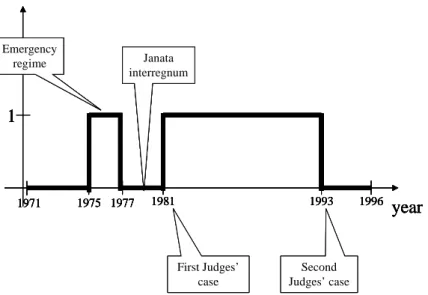
In the 1970s, India’s judiciary was free from any political interference. In June 1975, Allahabad’s High Court found the Prime Minister guilty of electoral fraud and ordered her removed from Parliament and banned from running for an additional six years. Instead of confronting the charges, Mrs. Gandhi declared a State of Emergency and
launched a massive crackdown on civil liberties and political opposition. Judges then began to interpret the Constitution in light of the new political climate.
The Janata Interregnum (1977-79) attempted to restore to judges some degree of self-con…dence. The government cancelled Mrs. Gandhi’s mass transfer of High Court judges in order to emphasize that the Constitution was not in the business of punitive transfers (i.e. transfers without consultation of India’s Chief Justice) of judges.
However, the return to power of the Congress (I) Party in 1980 revived memories of the Emergency regime. Mrs. Gandhi has often viewed the courts as centres of political opposition and in 1981 bluntly called into question the judicial integrity of the Janata-appointed judges12. Chief Justice Chandrachud complained that:
“Since the Executive is controlled by political leaders...it may, it is feared, transfer a judge to a far-o¤ place like Sikkim, the Andaman Islands or Assam, or refuse to grant him further extension if he does not toe the line”13.
Due to internal dissension, the Supreme Court undermined in the same year its independence in the Judges’Transfer Case, in which the majority of a seven-judge Con-stitutional Bench o¤ered the government carte blanche to hire Supreme Court judges, …re temporary judges and transfer (except on a mass scale) High Court judges without the consent of India’s Chief Justice. In other words, Mrs. Gandhi was given a free hand to manage the judiciary as she liked.
In 1993, the policy of transferring judges without consent was abandoned following the Second Judges’case. The Supreme Court introduced the concept of the primacy of the Chief Justice of India in matters of recommending persons for appointment to the higher judiciary14.
of various amendments. However, political interference was limited to certain periods and parties. I measure a State’s political inclination by the proportion of seats won in Legislative Assemblies by four di¤erent party groupings: the Congress Party (Indian National Congress, Indian Congress Socialist, Indian National Congress Urs), a hard left grouping (Communist Party of India, Communist Party of India Marxist), a soft left grouping (Socialist Party, Praja Socialist Party), and Hindu parties (Bhartiya Janata Party, Bhartiya Jana Sangh). I include these terms in the regressions and also interact these variables with an all-India dummy at value 1 in cases where political interference is expected, such as during the Emergency Regime (1975-77) and during the years 1981-93 when the First Judges’case was prevalent (described in Figure V). I include the political variables interacted with this dummy as control variables in all the regressions in order to remove bias resulting from omission of these variables.
Another endogeneity concern is that certain groups not divided along party lines but sharing common interests might succeed in in‡uencing the judiciary. An intuitive hypothesis would posit the in‡uence of scheduled castes and tribes in the Legislative Assemblies on the judiciary which favoured their particular groupings. The suggestion that such castes and tribes would strive to improve access to justice for poorer sections of the society would appear intuitive. I therefore expect “Scheduled Castes and Scheduled Tribes in Legislative Assemblies” to exert pressure on courts in regards to demand-side amendments favouring judicial access. There is growing evidence suggesting that seat reservation a¤ects public goods allocation in a way that favours the group bene…ting from the reservation. Pande [2003] found that reservations of seats for Scheduled Castes and Scheduled Tribes in State Legislative Assemblies led to increased transfers towards these groups. After accounting for the direct impact of the fraction of the population that comprises a State’s Scheduled Castes and Scheduled Tribes, a 1% rise in the
frac-tion of seats reserved to Scheduled Castes in State Legislature is associated with a 0.6% increase in job quotas for Scheduled Castes. A 1% rise in the fraction of seats reserved for Scheduled Tribes in State Legislatures is associated with an increase of 0.8 percent-age points in the share of total State spending devoted to welfare programs targeted to Scheduled Tribes. At the Panchayat level, Besley et al. [2004] found that reservation of leadership positions for a Scheduled Caste or Scheduled Tribe increases— by about 7 percentage points— the likelihood that a Scheduled Castes or Scheduled Tribes village household has access to toilets, electricity connections or private water connections via government schemes. I have thus included the proportion of seats reserved for Sched-uled Castes and SchedSched-uled Tribes as well as the group’s population share according to government census following Pande [2003].
This section shows that the use of panel data, the temporally exogenous con‡ict-ing judicial decisions and the “Court red tape” amendments not explicitly designed to increase judicial speed are good theoretical reasons to believe that con‡icting judicial decisions and “Court red tape”amendments might be good instrumental variables. Ad-ditionally, the composition of executive power and Scheduled Castes/ Scheduled Tribes representation must be accounted for in all regressions because the judiciary is not free, during certain periods, from political interference a¤ecting the enactment of amend-ments. The second question of how the Judiciary a¤ects economic activity remains.
III.2
A model for the Judiciary
There is increasing evidence suggesting that court system e¢ ciency is important to well-functioning economies. Slow judiciaries increase costs of accessing legal systems and favour those with more extra-legal bargaining power. There are two key areas
where courts may play a role in India: credit markets (di¢ culties in repaying loans) and contract enforcement. I expect legal system ine¢ ciency to contribute to poor conditions for society’s most vulnerable as well as for its most intensive users of the judiciary. For example, I expect the poor (society’s most vulnerable), creditors (as opposed to debtors), registered sectors (as opposed to unregistered sectors using extra legal dispute resolution mechanisms) and contract-intensive activities (such as trade) to be adversely a¤ected by ine¢ cient legal systems. I will now describe the mechanisms through which the judiciary a¤ects credit markets and …rms’contracting behavior.
Judicial systems in‡uence …rms’debt contracts. As Pagano et al [2002] explain: “The key function of courts in credit relationships is to force solvent borrowers to repay when they fail to do so spontaneously. By the same token, poor judicial enforcement increases the opportunistic behavior of borrowers: anticipating that creditors will not be able to recover their loans easily and cheaply via courts, borrowers will be more tempted to default. Creditors respond to this strategic behavior of borrowers by reducing the availability of credit.”
The authors develop a model in which collateral is used as a device to solve credit ra-tioning. They …nd that improved judicial e¢ ciency reduces credit rationing and expands lending. One should expect ine¢ cient judiciaries to disproportionately a¤ect sections of society unable to provide collateral. I will test this theoretical implication by examining the situation of farmers, who typically comprise the poor in India.
The second intuitive consequence of an imperfect judiciary is the modi…cation of economic agents’willingness to cooperate in previously signed contracts. We know that judiciaries act as important deterrents to fraud that might be more economically
attrac-tive in the short run. The probability of harsh punishment in monetary or non-monetary terms would heavily dissuade opportunistic agents to default ex-post on previous agree-ments. In particular, I expect trade to be negatively a¤ected by weak judiciaries. John-son et al [1999] state that …rms work to sustain relationships in order to avoid searching for new trading partners. To do so, they o¤er trade credit. But to o¤er trade credit is to trust that it will be repaid.
One could also expect the quality of judiciaries to impact on investments undertaken by the …rm. I consider the case where a …rm would undertake an investment in order to supply another with a particular asset. However, as Klein et al (1978) emphasized, the possibility of post-contractual opportunistic behavior arises. Indeed, to induce the supplier to undertake an investment, a …rm can either write a long-term contract with favorable terms for the supplier or guarantee exclusivity rights. But once the costs of the investment are sunk, there is an immediate incentive for the …rm to renege on the contract and capture the suppliers’ rents. Alternatively, if search costs to …nd a new supplier are high, there is an immediate incentive for the supplier to use its monopoly power to impose higher prices. These frictions could reduce the incentive to invest; Klein et al (1978) conclude that vertical integration will supersede market systems in such cases. But another way to limit post-contractual opportunistic behavior is a speedy judicial system that enforces contracts swiftly. This shows that judiciaries should a¤ect the economic performance of contract-intensive activities. I will test this implication by examining the performance of manufacturing. If agriculture, trade and manufacturing are negatively a¤ected by weak judiciaries, I also expect poverty to increase. I will test these theoretical implications and present the econometric method used.
IV
Methods and Results
This section will relate both con‡icting decisions and amendments to the Code of Civil Procedure to judicial functioning. I expect the “violation of a precedent established by the same High Court”(a High Court decision violating an earlier decision by the same High Court because of ambiguity in the Code of Civil Procedure) to have an e¤ect on the expected duration of a trial in High Court. I also expect “Court red tape”amendments ( which modify procedures to be followed by the courts) to be related to the expected duration of a trial in High Court. It is noteworthy that this section is in fact the …rst stage of an Instrumental Variable estimation of the impact of the judiciary on economic activity. In the next section I will relate judicial functioning to economic activity using these con‡icting decisions and amendments as Instrumental Variables.
In this section, the outcome of interest is the expected duration of a trial in High Court (durationit). It is equal to the number of pending cases plus the number of …led cases within the year divided by the number of cases disposed of within the year. This duration is measured in years. Figure VI shows the graph of this variable in 25 states between 1971 and 1996. To relate “violation of a precedent established by the same High Court” (violationit) and amendments of the Code of Civil Procedure (amendmentsit) and to the expected duration of a trial in High Court, I perform regressions of the form:
(1) durationit= i+ t+ violationit+ amendmentsit+ xit+ uit
where i corresponds to a state, t to time. i are state …xed e¤ects, t time …xed e¤ects. xit are control variables. These xit will include incrementally the ratio of dismissed appeals to total appeals from the respective high court. This variable determines the probability that a High Court decides correctly. The underlying assumption here is that
the Supreme Court is not biased and it is not subject to errors, and that the majority of the cases are appealed. This is therefore a measure of the quality of courts and an important variable to take into account in order to isolate the impact of ambiguity in the Code of Civil Procedure with violationit and not only the impact of court quality. I also include political political controls: the proportion of seats won by Congress parties, hard left parties, soft left parties and Bharatiya Janta parties interacted with a dummy indicating when Legislative Assemblies are likely to in‡uence judicial process15. I then include the proportion of seats reserved to Scheduled Castes/Scheduled Tribes in State Legislative Assemblies interacted with a dummy indicating when Legislative Assemblies are likely to in‡uence judicial process and the proportion of Scheduled Castes/Scheduled Tribes in the population according to censuses, according to the reasoning developed in the theoretical section above. I include the number of Panchayats per million capita in the State to account for alternative dispute resolution mechanisms as well as the proportion of total revenue expenditure spent on Organs of State lagged for two years to account for the budget devoted to judicial functioning. uit is a disturbance term. I cluster the standard errors by State in order to deal with concerns over serial correlation [Bertrand et al, 2002]. State …xed e¤ects captures time-constant State-speci…c factors such as culture and geography. Year e¤ects capture common shocks such as the central amendments to the Code of Civil Procedure that took place in 1976 (and in 1999 and 2002, though the latter two are not included in the observation sample from 1971 to 1996) as well as other centrally implemented policies. The coe¢ cients of interest are and .
Table II relates con‡icting judicial decisions and “Court red tape” amendments to expected durations of High Court trials. In Column (1), the dependent variable is durationit. The only explanatory variables are “violation of a precedent established by
the same High Court” and “Court red tape” amendments. State …xed e¤ects and year …xed e¤ects are included. One extra violation of a precedent established by the same High Court will increase the expected duration of a trial in High Court by 18.8 days. This coe¢ cient is statistically signi…cant. It con…rms the intuition that judges must spend more time in choosing between con‡icting views when the same High Court vio-lates its own precedents. One extra “Court red tape”amendment increases the expected duration of a trial in High Court by 3.3 days. This coe¢ cient is statistically signi…cant. It con…rms the intuition that adding or complicating Court procedures increases delays. However, the “violation of a precedent established by the same High Court” variable could very well be correlated with the quality of judges. I therefore include the ratio of dismissed appeals in Column (2). I also add political controls following the theoreti-cal section, which highlighted the fact that “Court red tape” amendments are perhaps responsive to political conditions. I measure a State’s political inclination by the pro-portion of seats won in Legislative Assemblies by four di¤erent party groupings: the Congress Party (Indian National Congress, Indian Congress Socialist, Indian National Congress Urs), a hard left grouping (Communist Party of India, Communist Party of India Marxist), a soft left grouping (Socialist Party, Praja Socialist Party), and Bhartiya Janata Party. I further interact these variables with an all-India dummy taking a value 1 when I expect some political interference, such as during the Emergency Regime of 1975-77 and the years 1981-93, when the First Judges’case was taking place (as described in Figure V)16. The coe¢ cients are very similar in Column (2). Another hypothesis is that increased representation of Scheduled Castes/Scheduled Tribes in Legislative Assemblies a¤ects judicial quality as Scheduled Castes/Scheduled Tribes push for reforms dispro-portionately favouring their groups of origin. I included in Column (3) the proportion of seats reserved for Scheduled Castes/Scheduled Tribes in State Legislative Assemblies
interacted with a dummy indicating when the former are likely to in‡uence the judicial process and the proportion of Scheduled Castes/Scheduled Tribes in the population ac-cording censuses following Pande’s [2003] methodology. The coe¢ cients are again very similar. In Column (4), I also include the number of Panchayats per million capita in the State to account for alternative dispute resolution mechanisms. In fact, it is often claimed that judicial systems have only limited impact on economies because peo-ple resort to alternative dispute resolution institutions, particularly to informal ones. Koehling [2002] describes one such informal Indian institution: the Panchayats. They play a crucial role in settling and avoiding rural disputes. Panchayats, with their limited judicial authority, are used to settle disputes about land usage, tenure and commons. As locally-bound institutions, they are highly e¢ cient since they are familiar with village situations and litigants. As a result, their level of acceptance among the population is high. In cases of dispute resolutions, Panchayats can impose very limited sanctions, but the social pressure created by judgements serves as strong incentives to comply with judgements. I also include in Column (4) the proportion of total revenue expenditure spent on the Organs of State17 lagged two years in order to account for budgets devoted to judicial functioning. The coe¢ cients remain similar. Other types of amendments could potentially a¤ect the expected duration of a trial in High Court. In Column (5), I include “speed” amendments. The latter is a cumulative variable increased by 1 after any amendment likely to have an impact on the speed of the courts is passed. This variable includes explicit speed, court red tape, defendant red tape, judgement-debtor, demand-side solution, plainti¤ red tape, and certainty amendments. There is no e¤ect of this variable on the expected duration of a trial in High Court. In Column (6), I include “implicit speed” amendments. This variable is the di¤erence between speed amendments and explicit speed amendments. I subtract “explicit speed” amendments
because these amendments are clearly responsive to judicial conditions and are therefore endogenous to the expected duration of a case in trial. I do not argue that “Court red tape”amendments are any less endogenous, but at least they are not explicitly designed to reduce delays. Column (6) shows no signi…cant impact of “implicit speed” amend-ments. I also included separately or together every di¤erent type of amendment and consistently found that only “Court red tape” amendments and “violation of a prece-dent established by the same High Court”were signi…cant18. Column (4) is the preferred speci…cation because it includes only signi…cant amendments a¤ecting duration and the most complete set of controls. It is interesting to note that the F-value of the F-test of the joint signi…cance of “Court red tape” amendments and “violation of a precedent established by the same High Court” is 8.06 signi…cant at 5 percent. This means that “Court red tape” amendments and “violation of a precedent established by the same High Court” a¤ect signi…cantly the expected duration of a trial in High Court.
To conclude this section, I found in the panel data analysis that “violation of a precedent established by the same High Court”and “Court red tape”amendments were signi…cant determinants of the expected duration of High Court trials. This con…rms the intuition presented in the theoretical section. Having found two sources of variation in judicial speed, I am now able to relate it to economic performance, particularly to the functioning of credit markets, registered manufacturing and trade sector performance.
V
The impact of the judiciary on economic
outcomes
I use the following regressions:
(2) eit = i+ t+ durationit+ xit+ it
where i corresponds to a State and t to time. eit is an economic outcome of in-terest. I will …rst test Proposition 1, applied to the agricultural sector where issues of credit availability are more stringent, by using measures of agricultural credit supply and development. I will then test Proposition 2 by using measures of the development of registered manufacturing, unregistered manufacturing, trade, hotel and restaurants, banking and insurance, real estate sectors development and ultimately, poverty. i are State …xed e¤ects and tare time …xed e¤ects. xit are control variables. I use the exact same control variables used in Table II. it is a disturbance term. Standard errors are clustered by State to take into account concerns over serial correlation [Bertrand et al, 2002]. State …xed e¤ects capture State-speci…c factors such as culture and geography. Year e¤ects capture common shocks such as central amendments to the Code of Civil Procedure as well as other centrally implemented policies. The coe¢ cient of interest is
.
There can clearly be some endogeneity between the e¢ ciency of a particular insti-tution and the economic performance of a particular State. The …rst issue is one of reverse causality: States with higher per capita incomes are able to devote more funds to improving institutions and thus have better institutions. The second issue is one of unobservable omitted variables, which are behind both judicial and economic outcomes, such as pessimism regarding a particular State’s prospects or the “backwardness” of another. This is why two instrumental variables are employed for the expected duration of High Court trials: “violation of a precedent established by the same High Court”and
“Court red tape” amendments.
As highlighted in section III.1, there are four reasons to believe these variables could be good instrumental variables (the use of panel data, the temporally exogenous con-‡icting judicial decisions, the “Court red tape” amendments not explicitly designed to increase judicial speed, the control for forces that could lead to amendment enactment). The previous section also demonstrated that “violation of a precedent established by the same High Court” and “Court red tape” amendments were signi…cantly related to the expected duration of High Court trials. In Table II, Column (4), the F-test of the joint signi…cance of the two instruments is 8.06.
In addition to this evidence, I present statistical tests of the quality of the in-struments. I will present over identi…cation as well as Hausman’s tests. The over-identi…cation test is a test of joint signi…cance of both instruments in a regression of the …tted residuals from the second-stage on these instruments (and all exogenous variables). This test e¤ectively measures the correlation between instrumental variables and the er-ror term, which should be insigni…cantly di¤erent from zero for appropriate instrumental variables. The Hausman [1978] test is a test of the endogeneity of the judicial measure and of the quality of the instruments. It tests the equality of the coe¢ cients between OLS (e¢ cient and consistent under H0 only) and IV (always consistent). There should be a systematic di¤erence between OLS and IV results in the case of an endogenous measure of judicial speed and appropriateness of the instruments.
Table III examines the relationship between High Court trial duration and credit sup-ply to agricultural sectors. For reasons highlighted in the theoretical section, I expect credit availability to be reduced in regions with slower judiciaries. I expect this problem to be more stringent for borrowers with less collateral, typically farmers. Column (1) shows an OLS regression of real per capita agricultural bank …nance on the expected
duration of a High Court trial. The result is insigni…cant. Column (2) presents a reduced form version of the impact of “violation of a precedent established by the same High Court”and “Court red tape”amendments on real per capita agricultural bank …nance. This con…rms the fact that these two variables have an impact on real per capita agri-cultural bank …nance. One extra “violation of a precedent established by the same High Court”decreases real per capita agricultural bank …nance by 6 percent, while one extra “Court red tape”amendment decreases it by 0.6 percent. This is consistent with the hy-pothesis that “violation of a precedent established by the same High Court”and “Court red tape” amendments increase the expected duration of High Court trials, which, in turn, discourages creditors from o¤ering credit, since they know it will be harder to recover defaulted loans. It is possible to present some instrumental variable evidence. Column (3) instruments the expected duration of a trial in High Court with “violation of a precedent established by the same High Court”and “Court red tape”amendments. The coe¢ cient of duration is now negative and signi…cantly di¤erent from 0. For ex-ample, an extra 18.8 days in the expected duration of a trial in High Court19 decreases real per capita agricultural bank …nance by 6 percent. The fact that the instrumented coe¢ cient is now statistically di¤erent from 0 as opposed to the OLS case may arise from the presence of unobserved State heterogeneity. Suppose that in a particular State citizens are especially fastidious, displaying meticulous attention to detail. They will thus be more litigious and …le more cases since they are excessively sensitive to even the slightest deviation in the terms of a contract. This will increase the expected duration of a trial in High Court. On the other hand, economic performance will increase thanks to the citizenry’s careful attention to detail. This unobserved variable, if omitted, will bias upward the coe¢ cient between duration and economic performance. If the instrumental variables are appropriate, then this bias should be removed. This may be why I …nd
a signi…cantly negative coe¢ cient in Column (3) as opposed to Column (1). The over-identi…cation test in Column (3) shows that the correlation between the instruments and the error term is not signi…cantly di¤erent from 0. The instrumental variables pass the over-identi…cation test. This con…rms the fact that these two instruments are ap-propriate. The 2 of the Hausman [1978] test is signi…cantly di¤erent from 0. This means that there is a systematic di¤erence between OLS and IV. It is appropriate to instrument duration with “violation of a precedent established by the same High Court” and “Court red tape” amendments. This …rst result is con…rmed in Columns (4) and (5). An increase of 18.8 days in the expected duration of a High Court trial decreases the account number of commercial bank advances to agriculture per capita by 3.3 per-cent and real per capita regional rural bank credit by 6.4 perper-cent. This reduced credit availability impedes agricultural development. An increase of 18.8 days in the expected duration of a trial in High Court decreases by 1.7 percentage points the ratio of irrigated agricultural land. As a result, agricultural performance is impeded by a weak judiciary. An increase of 18.8 days in the expected duration of a trial in High Court decreases per capita State agricultural domestic product by 0.6 percent. The over identi…cation tests are always conclusive.
Table IV examines the relationship between the expected duration of a trial in High Court and the economic performance of various sectors. In each case I instrument the expected duration by “violation of a precedent established by the same High Court” and “Court red tape” amendments. Column (1) shows that an increase of 18.8 days in the expected duration of a trial in High Court decreases a State’s per capita manufac-turing domestic product by 6 percent. This con…rms the fact that this sector should be a¤ected by weak judiciaries, since one of the characteristics of this sector in India is the prevalence of relationship-speci…c investment, heavily dependent on strong
judicia-ries. Column (2) shows that the registered manufacturing sector is even more a¤ected. Column (3) shows that an increase of 18.8 days in the expected duration of a trial in High Court decreases per capita State trade, hotel and restaurant domestic product by 4 percent. This con…rms the intuition that a sector relying heavily on trade credit to sustain relationships must trust that it will be repaid to perform well. As manufacturing and trade are negatively a¤ected by weak judiciaries, I also expect people employed in these sectors to be a¤ected. I use the urban head count index (in percentage) as the dependent variable in Column (4) to measure the impact of the judiciary on poverty. The latter shows that an increase of 18.8 days in the expected duration of a trial in High Court increases the urban head count index by 1.9 percentage points. Overidenti…cation tests are consistently conclusive.
These results seem to indicate that the judiciary plays a considerable role in the economic outcomes of India’s States. I found that farmers have less access to credit markets. As a result, agricultural development is impeded. I also found that contract-intensive sectors of the economy, such as manufacturing and trade, are adversely a¤ected by weak judiciaries. The judiciary impacts the weaker sections of the country, such as the poor and farmers.
VI
Conclusion
In this paper, I have found two sources of variation of judicial speed that are used to evaluate its impact on economic activity. First, the ambiguity of the Code of Civil Procedure, measured by the violation of precedents established by the same High Court, a¤ects expected durations of High Court trials. This is because judges must spend time choosing between con‡icting views after such events. Second, amendments to the Code of Civil Procedure that add or complicate procedures to be followed by the Court a¤ect
expected durations of High Court trials.
I then relate expected durations of High Court trials to economic outcomes using . I used these two variables, “violation of a precedent established by the same High Court” and “Court red tape”amendments, as instrumental variables for the expected duration of a case in trial. There are four reasons to believe that these two variables could rep-resent good instrumental variables. First, I use a panel data analysis and include State …xed e¤ects to account for permanent di¤erences across States in policies and outcomes. If systematic determinants of amendments are time invariant characteristics, this will remove endogeneity concerns. Second, the temporal variation in con‡icting judicial de-cisions is exogenous as they arise after the arbitrary occurrence of cases pertaining to ambiguous sections of the Code of Civil Procedure. Third, “Court red tape” amend-ments were not explicitly designed to deteriorate the speed of Courts. As such, they were not endogenous to the judicial slowness at the time the amendment was passed. Fourth, I try to account for forces leading to amendments enactment by looking at the political in‡uence of parties in determining High Court amendments and at the political representation of certain groups likely to in‡uence amendments.
Additionally, I presented statistical tests concerning the validity of these instruments. First, in a …rst-stage regression, these two instruments are signi…cantly related to trial duration. Second, these two instruments are not related to the error term of the second-stage regression and thus pass the over-identi…cation test of the endogeneity of the instrumental variables. Third, the instrumental variable estimation passes the Hausman Test.
In this paper, I found that the judiciary heavily shapes the economic outcomes of In-dia’s States and that farmers have less access to credit markets. As a result, agricultural development is impeded. I also found that contract-intensive sectors of the economy,
such as registered manufacturing and trade, are adversely a¤ected by weak judiciaries. Judiciaries impact weaker sections of the country, such as the poor and farmers.
The policy implications of this paper are clear. The Code of Civil Procedure’s am-biguity must be reduced by simplifying and clarifying confusing and redundant rules. For example, the recommendations of India’s Ex-Chief Justice K.N. Singh in the 144th Law Commission Report entitled “Con‡icting Judicial Decisions Pertaining to the Code of Civil Procedure, 1908” could be followed. They have yet to be incorporated into the Civil Procedure Code. Clarifying each ambiguous rule will allow judges to save time by liberating them from having to deliberate over so many con‡icting views. Alterna-tively, to reduce expected durations of High Court trials, the number and complexity of procedures to be followed by the Courts must be reduced.
References
[1] Acemoglu, Daron, Johnson, Simon and James Robinson, [2001], “The Colonial
Origins of Comparative Development: An Empirical Investigation”, The American Economic Review, V.91, 1369-1401.
[2] Acemoglu, Daron and Simon Johnson, [2005], “Unbundling Institutions”, Journal of Political Economy, University of Chicago Press, vol. 113(5), pages 949-995, October. [3] Bertrand, Marianne, Esther DuFlo and Sendhil Mullanaithan, [2004], “How Much Should We Trust Di¤erences-in-Di¤erences Estimates?”, The Quarterly Journal of Economics, 119, no. 1, 249-275
[4] Besley, Timothy and Anne Case, [2000], “Unnatural Experiments? Estimating the Incidence of Endogenous Policies”, The Economic Journal, 110, November, F672-F694
[5] Besley, Timothy, Rohini Pande, Lupin Rahman and Vijayendra Rao, [2004], “The Politics of Public Goods Provision: Evidence from Indian Local Government”, Jour-nal of the European Economic Association vol. 2 no. 2/3, 416-426.
[6] Castelar Pinheiro, Armando and Celia Cabral, [2001], “Credit Markets in Brazil: The Role of Judicial Enforcement and Other Institutions”, Chapter 5, pp. 157-188 in: Marco Pagano (ed.), Defusing Default. Incentives and Institutions, John Hopkins University Press, Washington, D.C., 2001).
[7] Cristini, Marcela, Moya, Ramiro and Andrew Powell, [2001], “The Importance of an E¤ective Legal System for Credit Markets: The Case of Argentina”, Chapter 4, pp. 119-156 in: Marco Pagano (ed.), Defusing Default. Incentives and Institutions, John Hopkins University Press, Washington, D.C., 2001).
[8] Debroy, B., [2000], Governance, Decentralization and Reform in China, India and Russia, edited by Jean-Jacques Dethier, Kluwer Academic Publishers, chap.12 pp. 339 - 368
[9] Djankov, Simeon, La Porta, Rafael, Lopez-de-Silanes, Florencio and Andrei Shleifer, [2003], “Courts”, The Quarterly Journal of Economics, V.118(2), 453-517.
[10] Dua, Baghwan D., [1983], “A Study in the Executive-Judicial Con‡ict: the Indian Case”, Asian Survey, Vol.33, N.4 (Apr), 463-483.
[11] Du‡o, Esther, [2005], “Why Political Reservations?”, Journal of the European Eco-nomic Association, April-May 2005; 3(2-3): 668-78.
[12] Du‡o, Esther and R. Chattopadhyay, [2004], “The Impact of Reservation in the Panchayati Raj: Evidence from a Nationwide Randomized Experiment”, Economic and Political Weekly, February 2004, (2-28-04), 979-986.
[13] Jappelli, Tullio, Pagano, Marco and Magda Bianco, [2005], “Courts and Banks: E¤ects of Judicial Enforcement on Credit Markets”, Journal of Money, Credit, and Banking, April 2005; 37(2): 223-44.
[14] Johnson, Simon, McMillan, John and Christopher Woodru¤, [1999], “Contract En-forcement in Transition”, CEPR Discussion Paper Series Number 2081.
[15] Knack, Stephen and Philip Keefer, [1995], “Institutions and Economic Performance: Cross Country Tests Using Alternative Institutional Measures”, Economics and Politics, V.7(3).
[16] Koehling, Wolfgang, [2002], “The Economic Consequences Of A Weak Judiciary: Insights From India”, Law and Economics 0212001, Economics Working Paper Archive at WUSTL.
[17] Hall, Robert E. and Charles I. Jones, [1999], “Why Do Some Countries Produce so Much More Output per Worker than Others?“, Quarterly Journal of Economics, V.114(1), 83-116.
[18] Mauro Paolo, [1995], “Corruption and Growth”, Quarterly Journal of Economics, V.110(3), 681–712.
[19] Moulton, Brent, [1990], “An Illustration of a Pitfall in Estimating the E¤ects of Aggregate Variables on Micro Units”, The Review of Economics and Statistics, V.72(2), 334-338.
[20] Moog, Robert S., [1998], “Elite-Court Relations in India: an Unsatisfactory arrange-ment”, Asian Survey, V.38, N.4 (Apr), 410-423.
[21] North, Douglass C., [1990], “Institutions, Institutional Change, and Economic Per-formance”, Cambridge University Press, New York.
[22] Pande, Rohini [2003], “Can Mandated Political Representation Increase Policy In-‡uence for Disadvantaged Minorities?”, American Economic Review vol. 93 no. 4, 1132-1151.
[23] Visaria, Sujata, [2006], “Legal Reform and Loan Repayment: The Microeconomic Impact of Debt Recovery Tribunals in India”, IED Working Paper Number 157, Boston University.