HAL Id: hal-02161083
https://hal.laas.fr/hal-02161083
Submitted on 20 Jun 2019HAL is a multi-disciplinary open access
archive for the deposit and dissemination of sci-entific research documents, whether they are pub-lished or not. The documents may come from teaching and research institutions in France or abroad, or from public or private research centers.
L’archive ouverte pluridisciplinaire HAL, est destinée au dépôt et à la diffusion de documents scientifiques de niveau recherche, publiés ou non, émanant des établissements d’enseignement et de recherche français ou étrangers, des laboratoires publics ou privés.
Development of a New Micromachined Metal Oxide Gas
Sensor: Application to Hazardous Gas Detection for
Automotive Air Quality Control
Philippe Menini, H. Chalabi, E. Scheid, F. Parret, C Tropis, A. Martinez,
Véronique Conédéra, Ludovic Salvagnac, Sandrine Assié-Souleille, B.
Chaudret, et al.
To cite this version:
Philippe Menini, H. Chalabi, E. Scheid, F. Parret, C Tropis, et al.. Development of a New Microma-chined Metal Oxide Gas Sensor: Application to Hazardous Gas Detection for Automotive Air Quality Control. SENSACT’05, Dec 2005, Noisy-le-Grand, France. �hal-02161083�
Development of a New Micromachined Metal Oxide Gas Sensor:
Application to Hazardous Gas Detection
for Automotive Air Quality Control
Ph. Ménini1, H. Chalabi1, E. Scheid1, F. Parret1, C. Tropis1, A. Martinez1, V. Conedera1, L. Salvagnac1, S. Assie-Souleille1, B. Chaudret2, A. Maisonnat2, K. Soulantica2, P. Fau2,
and K. Aguir3
1 LAAS-CNRS, M2D group.
7 avenue du Colonel Roche 31077 Toulouse cx4, France Tél : (+33).5.61.33.62.18 Fax : (+33).5.61.33.62.08
2 LCC-CNRS,
205 route de Narbonne 31077 Toulouse cx4, France
3 L2MP UMR CNRS 6137
Université Paul CEZANNE Aix-Marseille, FST St-Jérôme, Avenue E. N. Niémen 13013 Marseille, France
Biographie of Philippe Ménini
Ph. Ménini was born in Toulouse, France, in 1970. He received the PhD degree in
electronics from the Paul Sabatier University, Toulouse in 1998. His doctoral studies were concentrated on characterization and modelling of capacitive pressure sensor. Since 1999, he has been an assistant professor at Paul Sabatier University. At the same time, he joined the “Laboratoire d’Analyse et d’Architecture des Systèmes du Centre National de la Recherche Scientifique” (LAAS-CNRS), Toulouse. His research interests include microtechnology, analogue IC for Microsystems, instrumentation, electrical modelling and design of MEMS.
Topics: Gas Sensors for Interior (Air Quality Control)
Keywords: Micromachined gas sensor; Temperature cycling; Discriminate variables Abstract
This article deals with a new generation of semiconducting gas sensor based on a microhotplate realized on a silicon nitride membrane associated with an optimized temperature profile (T.P.) applied on heating resistor. Firstly, the technological process has been modified in order to enhance as a priority the long term stability and to allow the sensor working at higher temperature (>450°C). Secondly, a new method of data treatment is also investigated from normalized transient response of the sensor. The main goal of this new method is to identify different gas mixtures and quantify the target gas concentration. In this
article, this new operating mode applied to a single Pt-doped SnO2 gas sensor is presented to
discriminate CO-concentrations in synthetic air in presence of interfering gases as NO2 and
C3H8 independently of relative humidity rate. One of applications is the air quality control in
Introduction
Presently, most of metal oxide gas sensors have poor selectivity and instability because of their own electrical behaviour. These sensors are generally realized even on ceramic substrates with a platinum resistor as heater on the backside or on microhotplate with a silicon membrane and a polysilicon resistor as heater. The first kind of sensor is well known and easy to do technologically but provides significant thermal inertia. On the opposite, the microhotplate on membrane yields to very low thermal inertia (30ms for temperature growing from ambient to 450°C). Moreover, it is compatible with low cost silicon technology. The problem is the well known drift of the polysilicon resistance when it is run right across an important level of current density (few hundreds kilo amps per square inches).
From the development of new thin films and nanostructured sensitive layers that improve significantly the surface/volume ratio, the sensitivity of this new sensors have been multiplied by a factor 5 at least [1].
In an other hand, even if the selectivity can be theoretically improved by adding dopants (Pt, Pd,…) in the sensing material [2] or filters on top of it, the experimental figures show mitigated results in a standard operating mode (i.e. at constant temperature). Finally, their instabilities are now a day not solved. Previous studies have demonstrated the interest to use micromachined gas sensors in temperature modulation to improve performances in term of gas selectivity and sensitivity and to reduce significantly the influence of relative humidity rate [3-4].
In order to improve significantly these 3 capital sensor features, we work in two parallel ways: Firstly, we try to design and to develop technologically a new micro-hotplate with reliable thermo-electrical behaviour [5]. Secondly, we investigate a new operating mode that consists in short temperature cycles to discriminate different target gases [6]. Associated to a suitable data processing, we are able to quantify for example CO concentrations in a mixture with a
single Pt-doped SnO2 sensor. This work, concerning the data processing, has been initiated
in the frame of the “Nanosensoflex” European project (G5RD-CT-2002-00722 ; 2002-2005) in collaboration with 9 partners from which Mics (Microchemical Systems, CH), University of Saarland (D), Nanosense (F) and CRF (Fiat Research Center, I).
Sensor description
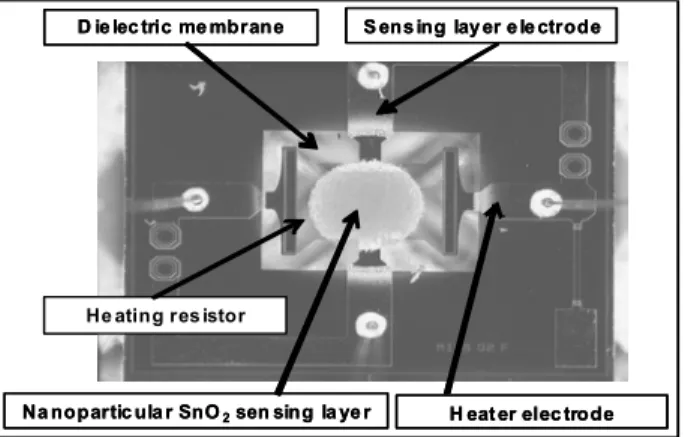
The sensors used in this study consist in a microhotplate platform and metal oxide sensing layers. The first generation of microhotplate architecture was initially developed conjointly by LAAS and Motorola and presently exploited by Microchemical Sensors S.A (figure 1).
D ie lec tric me mbrane S ens ing lay er e le ctrode
He ating res istor
H eat er elec trode Na nopartic ula r SnO2sen sing la ye r
D ie lec tric me mbrane S ens ing lay er e le ctrode
He ating res istor
H eat er elec trode Na nopartic ula r SnO2sen sing la ye r
A SiOxNy membrane of about 2 µm of thickness supports an n-type polysilicon heater of 600µm x 430µm. Geometry and sizes were optimized to achieve good thermo-mechanical reliability and good homogeneity of temperature on the active area. This first generation with
polysilicon heater can reach temperatures of about 450oC with power consumption lower than
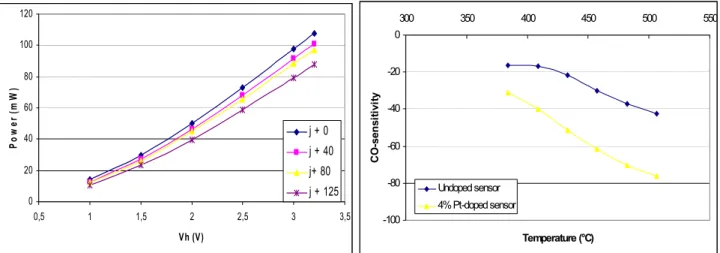
100mW. An important result from the European project studies lies in the comparison with simulation, which, in spite of a general agreement concerning the design dependence, indicates some discrepancies concerning the temperature distribution. The most innovative result in this study is the fact that these discrepancies are dues to the aging of the resistance. Infra-red observations have revealed that this aging, which is included in the fabrication process, leads to higher non homogeneities of temperature in the hottest parts. This also indicates that the aging at high temperature has two opposite effects: an increase of the global resistance, and a decrease of the resistance in the hottest part of the resistor. This would have an impact on a possible optimization of the aging procedure. Moreover, the drift measured during the first 4 months (of about 10%Rh/month) induces a decrease of the power (i.e a decrease of temperature -50°C), then a decrease of sensitivity: about -20% of the sensor CO-sensitivity (S = 100*(Rgas-Rair)/Rair) (figure 2).
undoped sensor 0 20 40 60 80 100 120 0,5 1 1,5 2 2,5 3 3,5 Vh (V) Po w er ( m W ) j + 0 j + 40 j+ 80 j + 125 -100 -80 -60 -40 -20 0 300 350 400 450 500 550 Temperature (°C) CO-sen si ti vi ty Undoped sensor 4% Pt-doped sensor
Figure 2 : a) Power efficiency degradation vs. time ; b) Isotherm CO-sensitivity vs. working temperature
This drift could be explained partially by the polysilicon drift, but also by other phenomena like the sensitive layer ageing electrically (modification of the contact quality, of the charge mobility, oxidation rate, pollutants in the sensitive layer), morphologically (but no particle size variation has been observed at TEM microscopy) or finally thermo-mechanically (cracks,…). Finally, the dispersion observed on a wafer can reach 30% on the heater resistances that implies to sort out them rigorously.
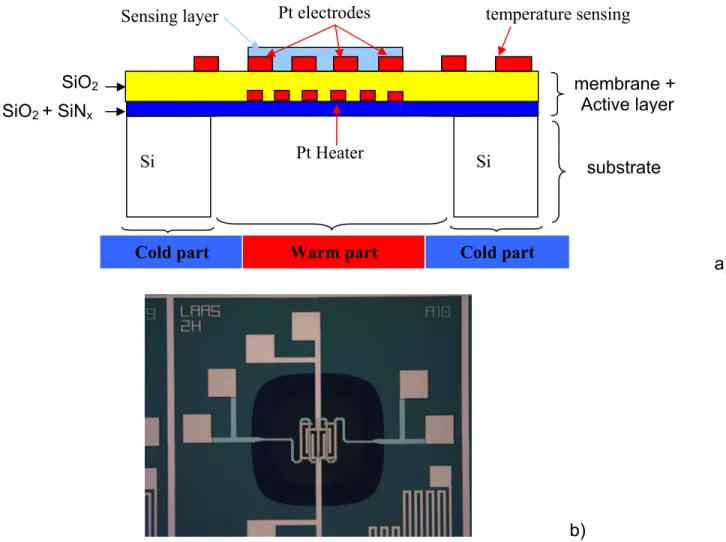
Recent developments have been made by LAAS-CNRS and L2MP, to conceive a new generation of microhotplate which integrates platinum heater (figure 3). The main interest consists in replacing polysilicon heater by a platinum one with potential longer lifetime. The
membrane is presently realized with a SiO2-SiNx bi-layer (respectively 1.4µm and 0.6µm of
thickness) with x≈1.2 in order to obtain a very low residual stress (< 100MPa) and a good thermo mechanical behavior. Different geometries of heater resistors have been designed, simulated thermo-electrically with ANSYS software and realized to compare the power efficiency (yield) and the lower temperature gradient as possible in the active layer region (∆T<±20°C on ±150µm around the center of the membrane). Then, a 0.5µm of insulated layer
interdigitated electrodes are realized with Ti/Pt metallization obtained by electron beam evaporation with a specific annealing to minimize residual stress of Pt. Finally, the membrane is elaborated at the end of the fabrication process by DRIE (Deep Reactive Ion Etching) of the silicon on the backside which allows vertical walls and with an etching rate of about 3.2µm/mn.
temperature sensing
Sensing layer Pt electrodes
a)
b)
Figure 3: New generation of Microhotplate developed by LAAS-CNRS and L2MP: a) cross section scheme; b) top of view of the microhotplate.
On the other side, the sensitive layer could be either a “standard” WO3 metal-oxide
deposited by reactive RF magnetron sputtering [7] (developed by L2MP) or a crystalline SnO2
nanomaterial synthesized by the decomposition and oxidation of a tin based organometallic
precursor ([Sn(Nme2)2]2), with a mean grain size near 15 nm of diameter (developed by
LCC-CNRS). Doping of this second one is achieved by decomposing an organometallic precursor under dihydrogen at the surface of the tin/tin oxide preformed particles. Upon heating in situ
on the platform the tin material is transformed into SnO2, whereas the doping agents are
oxidized into PdO or PtO nanocrystals which mostly remain at the surface of tin oxide. This nanomaterial is then deposited using a microinjection technique over the platinum electrodes placed in the homogeneous temperature region of the heater. This heater permits the full
oxidation into SnO2 with a controlled temperature cycle from ambient to 500°C. Mics has
already developed this technique industrially to dispense the colloid very quickly (few
thousand sensors a day) and very precisely (± few microns)(see the SnO2 drop on figure 1).
membrane + Active layer SiO2 + SiNx SiO2 Pt Heater Si Si substrate
Experimental details
In collaboration with LCC-CNRS, we developed a semi-automatic test bench that allows characterization of 15 sensors in parallel under controlled atmosphere. The experimental set-up consists of a gas delivery system, an exposure glass vessel of one liter (padding time of 2min) and an electronic circuit for resistance determination through voltage measurements.
Tests have been performed under CO, NO2 and C3H8 mixtures. With a constant flow rate, the
relative humidity rate has been fixed from 30% to 70% to evaluate its influence. a) Sensor operating mode
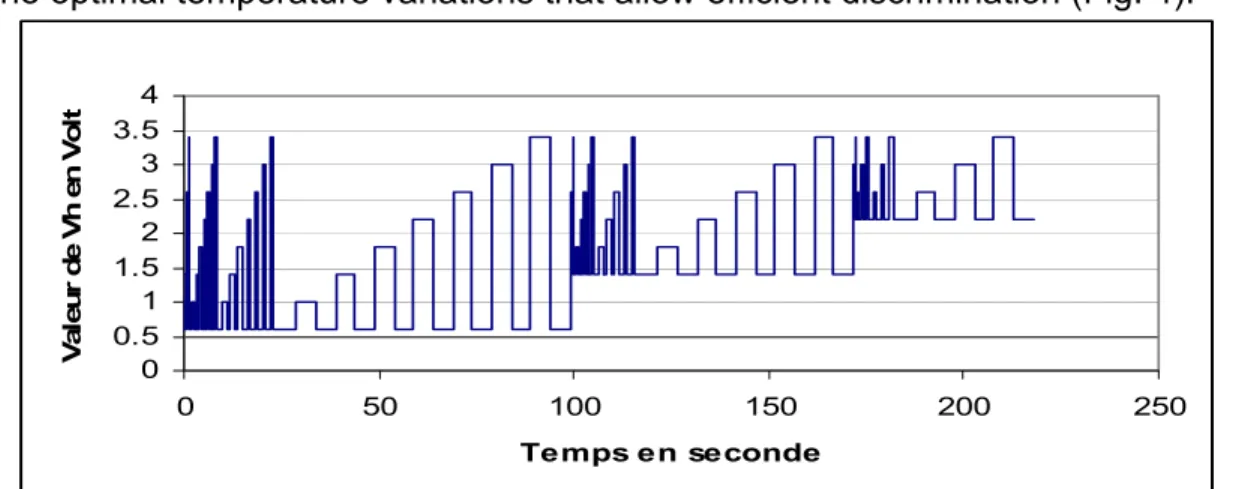
Most of semiconducting gas sensors work at constant temperature and some others use a pulsed working temperature. In this second mode, the data are generally collected up to 15 or 20 seconds after the end of the pulse to release the response from the humidity influence. More recent articles [8-9] use a “rapid” temperature modulation to evaluate transient response but with a too slow sample acquisition time to observe all transient chemisorption’s effects. Our main objective was to conceive a test profile with flexible parameters in order to find quickly the optimal temperature variations that allow efficient discrimination (Fig. 4).
3 paliers de température, 4 périodes de 0.2, 1, 2 et 10s.
0 0.5 1 1.5 2 2.5 3 3.5 4 0 50 100 150 200 250 Temps en seconde Va le ur de Vh e n Vol t
Figure 4: full working temperature profile: temperatures steps through voltage steps on the heater
For that, we make varying the temperature between ambient and 500°C (max) corresponding to 3.4V on heater. In this test profile, the flexible parameters are temperature variation, frequency and temperature offset (base line). We cycled this profile and realise test under different ambient atmosphere (relative humidity level (%RH), gas concentrations, mixtures …).
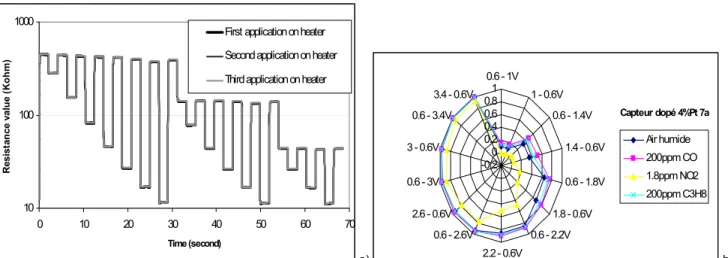
Typical response curve of the pulsed sensors when exposed to constant CO concentration (200 ppm) is shown on figure 5. These curves have been obtained reproducibly at three different tests successively.
a) b) Capteur dopé 4%Pt 7a -0.20 0.2 0.4 0.6 0.8 1 0.6 - 1V 1 - 0.6V 0.6 - 1.4V 1.4 - 0.6V 0.6 - 1.8V 1.8 - 0.6V 0.6 - 2.2V 2.2 - 0.6V 0.6 - 2.6V 2.6 - 0.6V 0.6 - 3V 3 - 0.6V 0.6 - 3.4V 3.4 - 0.6V Air humide 200ppm CO 1.8ppm NO2 200ppm C3H8 10 100 1000 0 10 20 30 40 50 60 7 Time (second) Re sist an ce v alu e (K o h m )
First application on heater Second application on heater Third application on heater
0
Figure 5. a) Example of sensor responses: 3 sequences referenced at the same time to show the reproducibility ; b) ∆Rs evolution versus voltage variations for 4%Pt-doped SnO2 sensor
From this full temperature profile, we can define an optimized operating mode dedicated to one application (one target gas in a mixture). The figure 5b shows the resistance variations at
different temperature steps. It can be seen that the NO2 can be discriminated at low level of
temperature. This new optimized temperature profile1 (figure 6), with a total duration of three
seconds, is based on a first step of high temperature to assure the sensor stability and reproducibility associated with three specific temperature levels allocated to the gas measurement. After these 4 steps the heater is switched off to minimize the mean power consumption lower than 40mW and to allow calculation time lower than 10s.
0 100 200 300 400 500 600 0 1 2 3 4 5 Time (s) Te m pe rat ur e ( °C ) {1} Step for a stable sensor response {2} Profile allocated to the discrimination {3} Power off {1} {2} {3} 0 100 200 300 400 500 600 0 1 2 3 4 5 Time (s) Te m pe rat ur e ( °C ) {1} Step for a stable sensor response {2} Profile allocated to the discrimination {3} Power off {1} {2} {3}
Figure 6 : Optimized working Temperature Profile for CO-detection with a single Pt-doped SnO2 gas sensor.
b) Data acquisition
In order to get more accurate insight on the transient responses of the sensitive layer
on each temperature variation, each resistance value Ri is normalized according to the
following equation: (1) f f i n R R R R =( − )/
Where Rn is the normalized value for the resistance Ri measured at time t and Rf is the last value measured on each step of temperature.
c) Example of experimental results
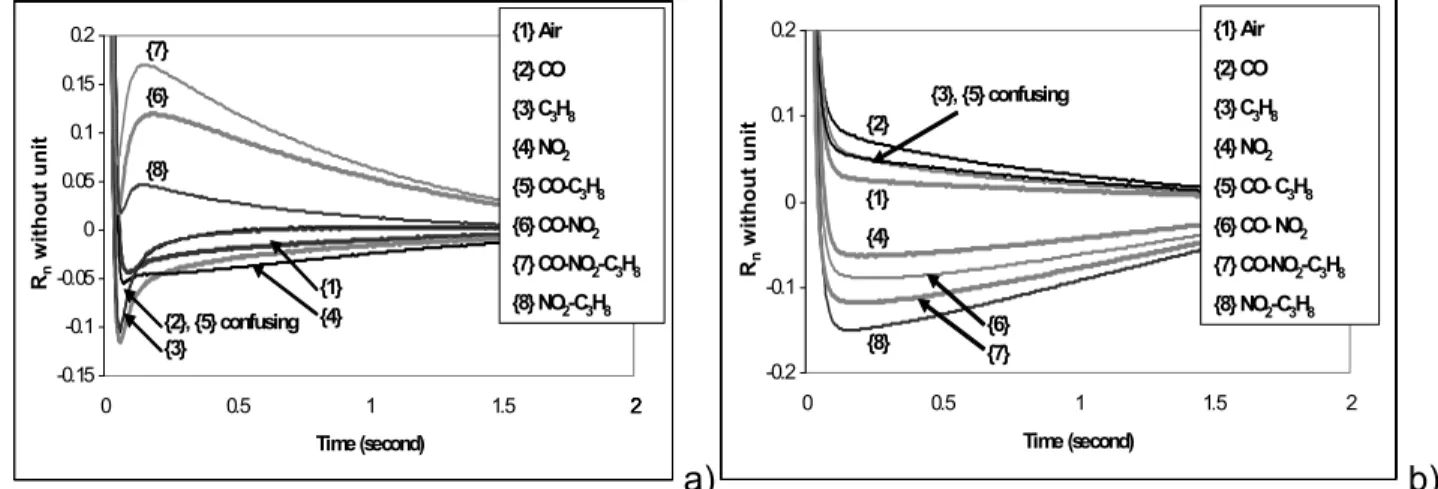
Typical conductance transient responses of the Pt-doped SnO2 sensor exposed to stabilized
gas mixtures yield to different response shapes which are dependent to ambient mixture and in a lower range to gas concentrations (figure 7).
These first results have been obtained under different gases separately (without mixture),
then with mixtures of CO, C3H8 and NO2, and with 50% of relative humidity.
a) b) -0.2 -0.1 0 0.1 0.2 0 0.5 1 1.5 2 Time (second) D R w it hout uni t {1} Air {2} CO {3} C3H8 {4} NO2 {5} CO- C3H8 {6} CO- NO2 {7} CO-NO2-C3H8 {8} NO2-C3H8 {6} {4} {3}, {5} confusing {1} {2} {7} {8} -0.2 -0.1 0 0.1 0.2 0 0.5 1 1.5 2 Time (second) D R w it hout uni t {1} Air {2} CO {3} C3H8 {4} NO2 {5} CO- C3H8 {6} CO- NO2 {7} CO-NO2-C3H8 {8} NO2-C3H8 {6} {4} {3}, {5} confusing {1} {2} {7} {8} Rn w ith ou t u ni t -0.2 -0.1 0 0.1 0.2 0 0.5 1 1.5 2 Time (second) D R w it hout uni t {1} Air {2} CO {3} C3H8 {4} NO2 {5} CO- C3H8 {6} CO- NO2 {7} CO-NO2-C3H8 {8} NO2-C3H8 {6} {4} {3}, {5} confusing {1} {2} {7} {8} -0.2 -0.1 0 0.1 0.2 0 0.5 1 1.5 2 Time (second) D R w it hout uni t {1} Air {2} CO {3} C3H8 {4} NO2 {5} CO- C3H8 {6} CO- NO2 {7} CO-NO2-C3H8 {8} NO2-C3H8 {6} {4} {3}, {5} confusing {1} {2} {7} {8} Rn w ith ou t u ni t -0.15 -0.1 -0.05 0 0.05 0.1 0.15 0.2 0 0.5 1 1.5 Time (second) ◊ R w it hout u n it {1} {4} {3} {2}, {5} confusing {6} {7} {8} {1} Air {2} CO {3} C3H8 {4} NO2 {5} CO-C3H8 {6} CO-NO2 {7} CO-NO2-C3H8 {8} NO2-C3H8 -0.15 -0.1 -0.05 0 0.05 0.1 0.15 0.2 0 0.5 1 1.5 Time (second) ◊ R w it hout u n it {1} {4} {3} {2}, {5} confusing {6} {7} {8} {1} Air {2} CO {3} C3H8 {4} NO2 {5} CO-C3H8 {6} CO-NO2 {7} CO-NO2-C3H8 {8} NO2-C3H8 Rn w ith ou t u nit -0.15 -0.1 -0.05 0 0.05 0.1 0.15 0.2 0 0.5 1 1.5 Time (second) ◊ R w it hout u n it {1} {4} {3} {2}, {5} confusing {6} {7} {8} {1} Air {2} CO {3} C3H8 {4} NO2 {5} CO-C3H8 {6} CO-NO2 {7} CO-NO2-C3H8 {8} NO2-C3H8 -0.15 -0.1 -0.05 0 0.05 0.1 0.15 0.2 0 0.5 1 1.5 Time (second) ◊ R w it hout u n it {1} {4} {3} {2}, {5} confusing {6} {7} {8} {1} Air {2} CO {3} C3H8 {4} NO2 {5} CO-C3H8 {6} CO-NO2 {7} CO-NO2-C3H8 {8} NO2-C3H8 Rn w ith ou t u nit 2222
Figure 7: Normalized response curves at two different temperature steps : a) from 300°C to 400°C ; b) from 110°C to 240°C
These results demonstrate the interest to observe the shape of the sensing layer response which depends of the temperature variations.
The classification of the different classes has been realized by Linear Discriminate Analysis (LDA) (figure 8). y = -0.0261x2 + 0.2836x - 1.0507 R2 = 1 -2 -1.5 -1 -0.5 0 0.5 1 1.5 2 2.5 3 -10 -8 -6 -4 -2 0 2 4 6 Discriminant function 1 ( 68.4% ) D is c ri m ina nt f u nc tion 2 ( 2 1. 6 % ) Concentrations : 1,8 ppm of NO2 200 ppm of C3H8 CO concentration varying from 40 ppm to 120 ppm C3H8 + NO2 Synthetic Air 120 ppm 80 ppm 40 ppm CO+C3H8+NO2 Variation of CO Conc
Figure 8: LDA projection for discrimination the 5 classes (with two r.h.values). Conclusion
A new generation of semi-conducting gas sensor has been designed and realised. It consists in a new microhotplate which uses platinum resistor as heater, a 2µm-thickness
SiO2+SiNx membrane on silicon etched by DRIE, SiO2 by PECVD as insulated layer and platinum contact. This die includes also a platinum resistance as ambient temperature sensor. The sensing layer is either a nanostructured SnO2 deposited by drop deposition or a 50 nm-thickness of WO3 deposited by RF magnetron sputtering.
First characterisation results have been obtained with nanoparticular SnO2 sensor. We
demonstrated that the sensor could be selective in a mixture and independent of relative humidity when it works in very fast temperature modulation. These first results show that the shape of the sensing layer response on a temperature variation is significantly affected by a gas or gas mixture. These shapes, formed with peak and slope, can be treated and exploited by using efficient variables. The feasibility of CO detection has been shown with a specific operating mode. This new profile with a total duration of 3 seconds includes one step for stabilization and 3 steps for discrimination. Three different CO concentrations (40ppm, 80 ppm and 120ppm) have been discriminated in a mixture of two interfering gasses (1.8ppm of N02 and 200ppm of C3H8).
The extraction of these efficient variables and a mathematical analysis like FDA could be implemented in an appropriate integrated circuit (microcontroller, DSP,…) to realize a prototype of selectively gas detector for automotive application.
References
[1] C. Nayral, et. Al, Advanced Materials, 1999, 11, 61.
[2] A. Maisonnat, “New generation of micro machined silicon gas sensors”, Proceeding Eurosensors XVIII, Rome, Italy, Sept. 2004.
[3] M. Schweizer-Berberich, “Pulsed mode of operation and artificial neural network
evaluation for improving the CO selectivity of SnO2 gas sensor”, Sensors and Actuactors,
B65, pp 91-93, 2000.
[4] M. Guerrero, “Method of C2H4 detection in humid atmospheres using nanoparticular SnO2
gas sensor”, Eurosensors XVII, pp 873-875, sept 2003. [5] S. Astie, PhD Thesis, LAAS report, N° 98537, 1998.
[6] F. Parret, P. Menini et al , “optimised dynamic temperature operating mode specifically dedicated to micromachined Sno2 gas sensors”, EurosensorsXIX, 11-15 Sept 2005, Barcelona, Spain.
[7] M. Gillet et al., Grain size effect in sputtered WO3 thin films on the sensitivity to O3, Thin Solid Films 484, (2005), 358-363.
[8] Baumbach Marc ; Kammerer Thomas ; Sossong Armin ; Schütze Andreas - A new method for fast identification of gases and gas mixtures after sensor power up. - In: Proceedings IEEE Sensors Conf. 2004, Vienna, Austria, Oct. 25-27, 2004
[9] A. Ruiz, R. Diaz, X. Illa, A. Romano, J.R. Morante – Analyses of the ammonia response of integrated gas sensors working in pulsed mode, EurosensorsXIX, in proceeding MP15, 11-15 Sept 2005, Barcelona, Spain