RESEARCH ARTICLE
Varietal susceptibility of maize to larger grain
borer, Prostephanus truncatus (Horn)
(Coleoptera; Bostrichidae), based on grain
physicochemical parameters
De´thie´ NgomID1,2*, Marie-Laure Fauconnier3, Paul Malumba4, Cheikh Abdou Khadre
Mbacke´ Dia1, Cheikh Thiaw2, Mbacke´ Sembène1,5
1 Department of Animal Biology, Laboratory of Entomology and Acarology, Sciences and Technics Faculty, Cheikh Anta DIOP University, Dakar, Senegal, 2 Senegalese Institute of Agricultural Research (ISRA), Dakar, Senegal, 3 Agro-Biosystems Chemistry - Agronomy, Bioengineering and Chemistry (AgroBioChem), Gembloux Agro-Bio Tech, University of Liege, Gembloux, Belgium, 4 TERRA Teaching and Research Center, FoodIsLife Care, Gembloux Agro-Bio Tech, University of Liege, Gembloux, Belgium, 5 Biology Laboratory of Sahelo-Sudanese Animal Populations (BIOPASS) - Research Institute for Development (IRD), Dakar, Senegal
Abstract
Maize (Zea mays L) is one of main nutrients sources for humans and animals worldwide. In Africa, storage of maize ensures food resources availability throughout the year. However, it often suffers losses exceeding 20% due to insects such as the larger grain borer, Prostephanus truncatus (Horn) (Coleoptera; Bostrichidae), major pest of stored maize in the tropical countries. This study aims to select resistant varieties to reduce maize storage losses and explain the physicochemical parameters role in grains sus-ceptibility. In the first study, maize grains were artificially infested under no-choice method with insects. Susceptibility parameters such as weight loss, grain damage, num-ber of emerged insects, median development time and susceptibility index varied signifi-cantly through maize varieties. Dobie susceptibility index (SI) was assessed as a major indicator of resistance. The most resistant varieties were Early-Thaï, DMR-ES and Tzee-Yellow. Conversely, Synth-9243, Obatampa and Synth-C varieties were suscepti-ble. SWAN, Across-Pool and Tzee-White were classified as moderately resistant varie-ties. The insect reproductive potential was significantly different in the nine maize varieties and Early-Thaï, DMR-ES and Tzee-Yellow varieties were the least favourable host. To assess the relationship between grains physicochemical characteristics and varietal susceptibility, moisture, total phenolics, palmitic acid, proteins, amylose, den-sity and grain hardness were evaluated according to standardized methods. Palmitic acid, SI, insects emerged and grain damage were significantly and positively correlated with each other, and negatively correlated with grains hardness, phenolics and amylose contents. Maize susceptibility index was significantly and negatively correlated to amy-lose, and phenolics contents and positively correlated to palmitic acid content. This a1111111111 a1111111111 a1111111111 a1111111111 a1111111111 OPEN ACCESS
Citation: Ngom D, Fauconnier M-L, Malumba P, Dia CAKM, Thiaw C, Sembène M (2020) Varietal susceptibility of maize to larger grain borer, Prostephanus truncatus (Horn) (Coleoptera; Bostrichidae), based on grain physicochemical parameters. PLoS ONE 15(4): e0232164.https:// doi.org/10.1371/journal.pone.0232164
Editor: Craig Eliot Coleman, Brigham Young University, UNITED STATES
Received: September 7, 2019 Accepted: April 8, 2020 Published: April 24, 2020
Peer Review History: PLOS recognizes the benefits of transparency in the peer review process; therefore, we enable the publication of all of the content of peer review and author responses alongside final, published articles. The editorial history of this article is available here:
https://doi.org/10.1371/journal.pone.0232164
Copyright:© 2020 Ngom et al. This is an open access article distributed under the terms of the
Creative Commons Attribution License, which permits unrestricted use, distribution, and reproduction in any medium, provided the original author and source are credited.
Data Availability Statement: All relevant data are within the manuscript and its Supporting Information files.
study identified three resistant maize varieties to P. tuncatus and revealed that the major factors involved in this resistance were hardness, phenolic and amylose contents of grains.
1. Introduction
Ensuring global food security, nutrition and livelihood is one of the main challenges for the 21st century. Nowadays, maize (Zea mays L.), extensively grown in America, Asia and some parts of Africa, is the largest staple crop produced worldwide, which alone contributes over 20% of as food calories in parts of Africa and Mesoamerica [1]. In Sub-Saharan Africa, maize is widely consumed among many people and covers lean periods in some parts of these coun-tries [2,3]. In these regions, production is generally seasonal while consumer needs extend throughout the year [4]. Thus, the storage of maize assures the food resources availability, which is one of the important factors of food security. However, huge amount of maize pro-duction is lost [5] between harvest and consumption. During storage, insects are the principal pests of maize [6] and one of the most important insects is the larger grain borer,Prostephanus truncatus (Horn) (Coleoptera; Bostrichidae) [7–9]. The infestation starts in the field and adults attack mainly whole or broken grains and flour during storage [10,11]. In developing coun-tries, this insect is a serious pest of economic importance, causing maize-grain losses during storage ranging from 30% [12] to greater 40% of total production in 6 months [13]. This beetle reduces maize germination, increases the grain’s moisture content [14,15] and facilitates the storage contamination by fungi and bacteria [16]. These fungi, particularlyAspergillus flavus, introduce a lot of aflatoxins in food products [10]. This carcinogenic substance poses many problems for consumers’ health (consumed part) and for the export of African food products. Prostephanus truncatus was intercepted in Senegal in 2007 [17], and represents since then a threat to maize conservation in the country. The management actions taken against pests to reduce storage losses were primarily chemical. More recently, the fumigants (CO2, N2,. . .) and hermetical storage structures (walls, zinc, drums,. . .) are also used onP. truncatus control. However, residual insecticides currently used in grain storage are also subject to human health, environmental safety and pest resistance considerations due to misuse [18]. In developing countries, most of farmers have not access to hermetic storage structures and fumigants due to availability and cost reasons.
Use of varieties more tolerant to risk infestation during storage, is one of new principles and provisions on the integrated pest protection, encouraged by FAO [19] and European regulation to reduce insecticide use [20]. In fact, currently cultivated varieties, selected primarily for their high-yielding properties, often have increased susceptibility to insects, which would be due to the loss of their resistance characteristics to pest attack [21–23]. Resis-tant varieties are of particular interest in developing countries where lack of proper storage facilities can lead to substantial postharvest losses by insects. Several studies have concluded maize grains physicochemical constitution can play major role in damage during storage by insect pests [24–31]. Much research have claimed maize grains have properties that can mod-erate damage fromP. truncatus infestations. Among them we have grain hardness [32,33], phenolic acids [34–37], proteins [38] and amylose content of total starch [39].
Thus, the knowledge of the physicochemical bases of the natural resistance, virtually unknown for maize varieties commonly used in Senegal, is crucial to the identification of resis-tance traits, which can be used for high-yielding insect-resistant varieties. Hence the present study has chosen the major insect pest of maize,P. truncatus in order to find solutions at ento-mological context of maize protection research in Senegal. The main objectives of present
Funding: Funding: This study has been totally funded by Cheikh Anta Diop University (grant number: 8729). The funder had no role in study design, data collection and analysis, decision to publish, or preparation of the manuscript. Competing interests: The authors have declared that no competing interests exist.
study were (1) to evaluate the resistance of nine maize varieties toP. truncatus infestation in storage, and (2) to determine the physicochemical properties effect on the maize grains susceptibility.
2. Material and methods
2.1. Maize varieties used
Maize varieties not treated with insecticides used in these experiments were provided by Sene-galese’s seed services. Varieties evaluated were Early-Thaï, SWAN, DMR-ES, Tzee-White and Tzee-Yellow (obtained from Peanut and maize Seed Growers’ Cooperative (COPROSA)-Nioro du Rip—Senegal) and Obatampa, Across-pool, Synth-C and Synth-9243 (obtained from National Center for Agricultural Research (CNRA)-ISRA /Bambey—Senegal). Maize grains were placed for three weeks in a freezer (at -5˚ C approximately) to eliminate any previous infestation before use.
2.2. Insect rearing
Prostephanus truncatus specimens used were obtained from the phytosanitary laboratory of Food Technology Institute (Senegal). Insects were reared in March 2017, at Entomology and Acarology laboratory of Sciences and Techniques Faculty (Cheikh Anta Diop University, Sene-gal). Glass jars (15 x 4 cm) were each loaded with 250 g of maize grains, and then 50 mixed sex adults were introduced into each jar. After 14 days, adults were separated to grains by sieving and sorting. Infested grains were incubated in insectarium under ambient temperature (25–35 ˚C) and relative humidity (70–80%) until newly adults emerged. Three generations were obtained from mass rearing techniques. Artificial infestation of samples was carried with young adults (two to three days-old) emerging from this rearing.
2.3. Screening of insect-maize varieties interactions
Varietal susceptibility was assessed through no-choice artificial infestation, which is better suited for screening candidate varieties [40]. In this experiment, three replications of 60 g of grains, placed in aerate glass jar with lid mesh (2 mm) were realized per maize variety. In each glass jar, three male/female pairs (two days-old) ofP. truncatus were placed. The female stands out with the male by the high number of tubers on her head [41]. Adults were removed from the grains after 14 days laying period. Infested maize grains were incubated in insectarium at ambient temperature (25–35 ˚C) and relative humidity (70–80%) for 6 days. From there, emerged adults were counted daily until 55thday after the test start. Then, the following criteria were determined.
1. Total number of F1progeny emerged (TPE). 2. Multiplication rate per female:Mr=♀ ¼ TPE
Number‐female parents
3. Net multiplication capacity:Nmr ¼ TPE Number‐parents
4. Median development time (MDT): is the period (days) from the middle of the oviposi-tion period to the middle of the emergence (i.e. 50 percent of emergence) of the F1 prog-eny [42].
5. Rate of increase per week:Ri=w ¼Nmr X 7 MDT
6. Dobie’s Susceptibility Index (SI) toP. truncatus attacks, given by the formula: SI ¼½lnðTPEÞx 100�MDT
The Dobie susceptibility index, ranging from 0 to 11 [25,43], was used as the criterion to separate varieties into different resistance groups.
SI from 0 to 4: was classified as resistant varieties SI from 4.1 to 7.0: was moderately resistant varieties SI from 7.1 to 10.0: was susceptible varieties
SI � 10.1: was classified as highly susceptible varieties.
7. Percent of grains attacked (grain damage percent):% Attack ¼Number‐damaged grains
Number‐total grains x 100
8. Percent of grains weight loss was calculated using Boxal [44] counting and weighing method: %Weight loss ¼ðB x EÞ ðC x DÞ
E ðBþCÞ x 100
B = number of damaged grains C = number of undamaged grains D = weight of damaged grains E = weight of undamaged grains
2.4. Physicochemical analyses
The moisture content of maize grains was determined by drying in oven at 105 ˚C for 24 hours (method 967.03, [45]. Their protein content was determined through nitrogen determi-nation by Dumas methodology using a Rapid N cube1combustion and analysis system (ele-mentar, Nebraska, USA) (N× 6.25; method 981.10; [45]. Starch content was determined according to Ewers polarimetric method (ISO 10520: 1997) with a polarimeter (Bellingham Stanley Ltd. ADP220, UK). Amylose/amylopectin ratio of starches was evaluated with method of Morrison and Laignelet [46]. Crude oil content was extracted according to method of Folch et al. [47] using chloroform/methanol mixture (2/1, v/v). Fatty acids contents of extracted oil were determined after derivatization in BF3/methanol mixture by Gas Chromatography with Flame Ionization Detector (GC-FID). Total phenolics content was first extracted from 1 g of maize flour using pure methanol under sonication method. Methanolic extracts were assayed by adopting Bourgou et al. protocol [48] using colorimetric method with Folin-Ciocalteu reagent described by Singleton and Rossi [49]. Phenolics content were expressed asμg gallic acid equivalent per gram of maize dry matter (μg EAG / g DM). To evaluate hardness of grains, Stenvert hardness tester (Culatti microhammer mill, Labtech Essa, Belmont, Australia) fitted with a 2 mm aperture particles creen at a speed of 2500 rpm when empty was used on basis of method that described by Pomeranz et al. and Blandino et al. [50,51]. The time in seconds to collect 20 g of maize flour through 2 mm of mesh sieve was registered, at three replications for each maize variety. Average grain size parameters (length, width and thickness) were deter-mined using a digital caliper (foot to slide). Grain density was deterdeter-mined from the ratio weight to volume measured on 30 individuals’ grains according to Fox and Manley method [52]. Compositional characteristics were expressed in dry matter (DM). Each analysis was at least triplicated.
2.5. Statistical analyses
All susceptibility parameters as well as physicochemical characteristics were analysed using R software (R-3.4.1 version) [53]. Normality assumption was tested using Shapiro-Wilk’s test and homogeneity of variance by Bartlett’s test. For data whose series were followed normal distribu-tion with homogeneous variance, one-way analysis of variance (ANOVA) was performed, then complemented with Tukey HSD test for separation of the mean values atα of 5%.
Kruskal-Wallis and Wilcoxon tests were used to analyze data whose series did not follow normal distri-bution and/or had not homogeneous variance (Moisture, Protein, Amylose, SI and Dmd).
Variables-PCA and Biplot-PCA: binary and multiple analyses with Spearman method were performed to determine interactions between variables. The choice of the factorial axe number for Principal Components Analysis (PCA) was carried according to elbow criterion which enabled us to obtain the maximum of inertia kept with the minimum factorial axes. The result suggest retain first two axes which respectively explain 46.8% and 20% of information, giving 66.8% of total inertia. Then, a Principal Components Analysis (PCA) of data was carried out in the purpose of highlighting the Principal Components (PC). Eleven (11) variables were con-sidered PC of with contribution greater than 9.09% (average contribution, according to elbow criterion) for construction of axes considered. These were used to achieve a biplot combining the dispersion of PC (PCA) and maize varieties (Discriminant Analysis), in order to see the degree of correlation between the variables (susceptibility and physicochemical parameters) and the level of involvement of the physicochemical parameters to the maize varieties susceptibility.
3. Results
3.1. Total progeny emerged in F
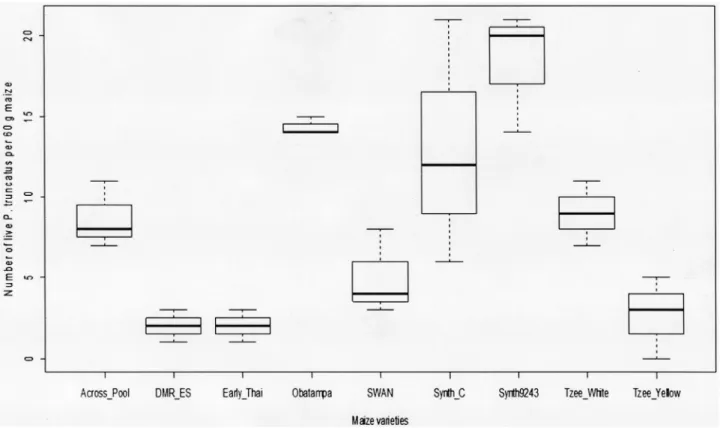
1For the adults emergence in F1(Fig 1), the results showed significant effects on the number of emerged insects due to maize varieties. The results have revealed that the group consisting Synth-9243, Obatampa and Synth-C varieties record between 7 to 9 times more insect than
Fig 1. Number of F1P. truncatus progeny emerged on 60 g grains. Number of F1P. tuncatus progeny emerged on 60 g grains of each maize varieties
after infestation out under no-choice method for 55 days on laboratory conditions. Overall differences of insects emerged between maize variety are significant at ANOVA test (P < 0.05).
group of Early-Thaï, DMR-ES and Tzee-Yellow varieties. Number of insects emerged from Synth-9243 variety was 9 times higher than that emerging from DMR-ES and Early-Thaï varie-ties, and 7 times more than that Tzee-Yellow variety. Tzee-White, Across-Pool and SWAN varieties had recorded a bit higher insects’ number than the aforementioned group (DMR-ES, Early-Thaï and Tzee-Yellow varieties).
3.2. Reproductive dynamics of
P. truncatus in F
1The maize variety had also a significant effect (Table 1) on insects median development time (MDT), on rate of multiplication per female (Mr/♀) and on rate increase per week (Ri/w). Insects fed with Synth-9243, Synth-C and Obatampa varieties had the highest growth and femele rates per week, while the DMR-ES, Early-Thaï and Tzee-Yellow insects’ varieties had the lowest. These last proved less favourable to insect development. In SWAN, DMR-ES and Across-Pool varieties, median development time ofP. truncatus was 2 to 5 days longer than other varieties. The insect median development time in Tzee-White variety was only 28.74 ±0.26 days, widely shorter.
3.3. Susceptibility of varities to
P. truncatus infestation
There were significant differences among varieties in percents of grains attacked and grains weight loss (Table 2). Early-Thaï, SWAN and Tzee-Yellow varieties had undergone lowest grains attacked and grains weight loss percentages, while Synth-9243 variety had recorded the highest percents. Significant differences (P = 0.017) were observed on susceptibility index (SI) between the maize varieties (Table 2). Out of the nine maize varieties evaluated for theirP. truncatus resistance, three susceptibility groups were identified. The susceptible varieties group, with SI that revolves around 9, is composed of Synth-C, Obatampa and Synth-9243 varieties. These maize varieties had a SI 3 times higher than group of Early-Thaï, DMR-ES and Tzee-Yellow varieties (resistant varieties group). The other group (SWAN, Across-Pool and Tzee-White), categorized as moderately resistant, had a SI that ranged from 6.01±2.96 for SWAN to 6.94±3.37 for Tzee-White.
Table 1. Effect of nine maize varieties on duration of development, number of emerged F1progeny ofP. truncatus, multiplication rate per female, rate of increase
per week and adults weight.
Varieties TPE MDT (days) Mr/♀ Ri/w
Across-Pool 8.67±2.08b 33.54±2.36bc 2.89±0.69c 0.31±0.09c DMR-ES 2.00±1.00c 34.25±0.75b 0.67±0.33d 0.07±0.04d Early-Thaï 2.00±1.00c 30.33±2.52cd 0.67±0.33d 0.08±0.04d Obatampa 14.33±0.58a 31.64±1.74c 4.78±0.19b 0.53±0.04b SWAN 5.00±2.65bc 37.00±1.00a 1.67±0.58c 0.16±0.09d Synth-9243 18.33±3.79a 31.10±0.81c 6.11±0.26a 0.69±0.03a Synth-C 13.00±7.55ba 31.42±0.08c 4.33±0.52b 0.48±0.08bc Tzee-White 9.00±2.00b 28.74±0.26d 3.00±0.67c 0.37±0.08c Tzee-Yellow 2.67±2.52c 31.73±0.07c 0.89±0.54d 0.10±0.09d Significativity P < 0.05 P < 0.05 P < 0.05 P < 0.05 F8,18=9.976 F8,chi2=18.62 F8,18=9.976 F8,18=10.39
TPE = total progeny emerged; MDT = Median development time; Mr/♀ = multiplication rate per female; Ri/w = rate of increase per week
P values of Tukey tests after ANOVA tests indicate the differences between means with the letters (a, b, c, d,. . .) at P < 0.05. Means followed by the same letter are not significantly different.
3.4. Physicochemical parameters of maize grains
Biochemical and physical characteristics of maize varieties analysed are summarized in
Table 3. There were significant differences among varieties for grain density (P = 0.031), grain hardness (P < 0.001), amylose (P = 0.003), initial moisture (P = 0.002), total phenolics (P < 0.001), palmitic acid (P < 0.001) and crude proteins (P = 0.004) grains contents. The highest protein content was observed with DMR-ES variety (13.69±0.42%), followed by Synth-C variety (13.57±0.05%), conversely the lowest protein content was registered in Early-Thaï variety (10.54±0.85%), followed by SWAN variety (10.64±0.11%). Both varieties, Early-Thai and SWAN, recorded the lowest palmitic acid content. The highest phenolics content (2864.16 ±121.00 and 2405.85±80.14 μg EAG / g DM) recorded in SWAN and Tzee-White varieties,
Table 2. Parameters characteristic of maize sensitivity.
Varieties % Attack %Weight loss SI Resistance category Across-Pool 5.23±1.18a 1.68±0.47bc 6.05±2.68b MR DMR-ES 5.12±0.64a 1.77±0.20b 3.05±1.09c R Early-Thaï 1.10±0.38e 1.10±0.38c 2.85±0.78c R Obatampa 4.00±0.43b 1.92±0.06b 9.74±0.52a S SWAN 2.53±0.78c 2.53±0.78b 6.01±2.96b MR Synth-9243 6.59±1.71a 3.80±0.56a 9.72±0.17a S
Synth-C 4.42±2.33abc 2.98±1.59abc 9.76±0.24a S Tzee-White 5.79±1.45ab 3.19±0.65ab 6.94±3.37b MR Tzee-Yellow 2.59±1.63ce 1.81±1.03bc 3.75± 0.30c R Significativity P < 0.05 P < 0.05 P < 0.05 F8,18=5.368 F8,18=3.82 F8,chi2=18.62
SI = susceptibility index; MR = moderately resistant. S = susceptible and R = Resistant.
% Attack = Percent attack of maize grains (damage percent); % Weight loss = Percent weight loss of maize grains. P values of Tukey tests after ANOVA tests indicate the differences between means with the letters (a, b, c,. . .) at P < 0.05. Means followed by the same letter are not significantly different.
https://doi.org/10.1371/journal.pone.0232164.t002
Table 3. Physicochemical characteristics of maize varieties.
Varieties Moisture TPP Palmitic Protein Amylose Density Hardness (s) (%) (μg EAG / g DM) (% DM) (% DM) (% DM) (g/mm3) (Crushing time)
Across-Pool 11.15±0.15bc 1461.60±120.55e 17.71±0.06b 12.77±0.69ab 17.89±0.82ab 1.43±0.16cb 18.53±0.49cb DMR-ES 11.12±0.01c 1297.17±74.64e 17.50±0.10c 13.69±0.42a 18.57±0.71a 1.40±0.16c 17.90±0.52cd Early-Thaï 11.31±0.03b 1650.23±40.26d 16.91±0.03f 10.54±0.85d 18.25±0.49a 1.46±0.17ab 20.67±0.42a Obatampa 11.01±0.07c 1111.94±69.50f 17.84±0.06a 12.04±0.25bc 16.17±0.32d 1.43±0.17cb 14.90±0.38e SWAN 11.47±0.07a 2864.16±121.00a 16.48±0.04g 10.64±0.11d 17.62±0.1bb 1.55±0.14a 21.53±0.03a Synth-9243 11.09±0.13c 1159.28±40.16f 17.34±0.06d 11.93±0.32bc 17.74±0.10b 1.43±0.13cb 19.23±0.17b Synth-C 10.97±0.06cd 1234.68±78.66ef 17.71±0.05b 13.57±0.05a 16.61±0.15d 1.41±0.17c 18.82±0.53cb Tzee-White 10.89±0.03d 2405.85±80.14b 17.41±0.04d 11.93±0.06bc 17.08±0.49c 1.43±0.18cb 16.97±0.33d Tzee-Yellow 11.52±0.00a 1793.88±40.35c 17.22±0.03e 12.15±0.27bc 17.11±0.01c 1.45±0.15cb 20.69±0.30a Significativity P < 0.05 P < 0.05 P < 0.05 P < 0.05 P < 0.05 P < 0.05 P < 0.05 F8,chi2=24.07 F8,18=173.2 F8,18=261.8 F8,chi2=22.54 F8,chi2=23.47 F8,261=2.159 F8,18=85.32
Moisture = Percentage of maize moisture content; TPP = Total phenolics content; Palmitic = Palmitic acid in fatty acids; Protein = Proteins content; Amylose = Amylose content in starch; Density = maize grains density; Hardness = maize grains hardness; DM = dry matter.
P values of Tukey tests after ANOVA tests indicate the differences between means with the letters (a, b, c, d, e,. . .) at P < 0.05. Means followed by the same letter are not significantly different.
were 2 times more than that those Synth-9243, Synth-C and Obatampa varieties. These last two varieties (Synth-c and Obatampa) had lowest amylose content, conversely to DMR-ES and Early-Thaï varieties, which had the highest amylose content in their grains total starch. The highest grains grinding time was recorded with SWAN variety (21.53±0.03 s.), fol-lowed by Tzee-Yellow (20.69±0.30 s.) then Early-Thaï (20.67±0.42 s.), revealing a high grain hardness, while Obatampa variety with grains faster crushed (14.90±0.38 s.), had the softest grains.
3.5. Binary correlations of evaluated variables
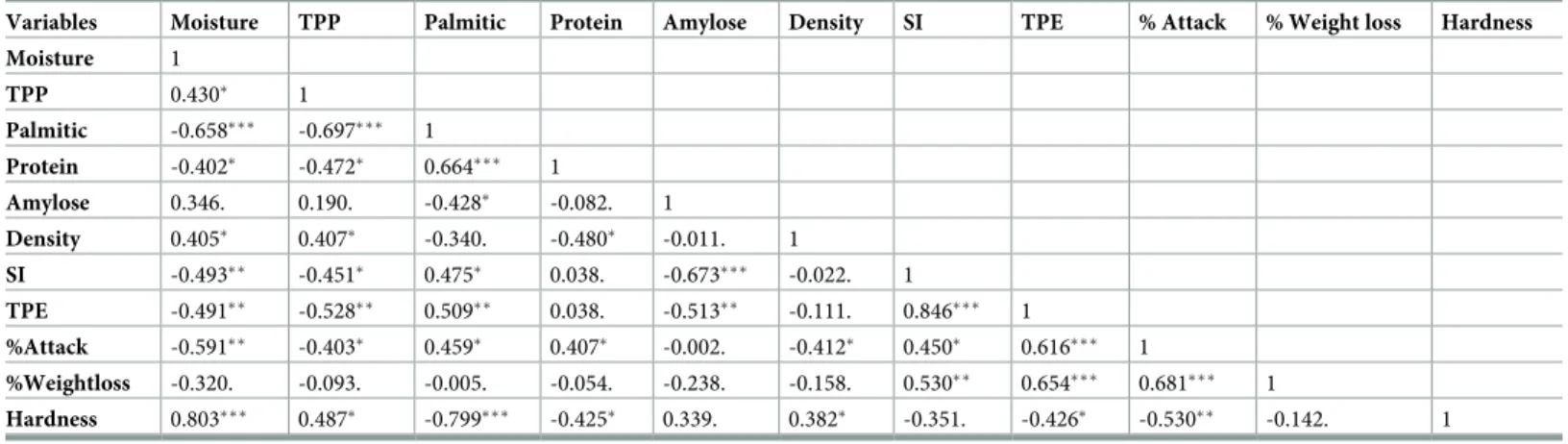
Spearman’s correlation matrix showed significant binary correlations between physical, bio-chemical and susceptibility parameters of varieties (Table 4). The increase of grain hardness, amylose and phenolics contents in grains were negatively related with the varieties susceptibil-ity index, while the increase of palmitic acid and protein contents were positively correleted with varieties susceptibility index. Number of emerged adults was negatively correlated to total phenolic content (rho = -0.528; P(rho)= 0.005), amylose content (rho = -0.513; P(rho)= 0.006), grains hardness (rho = -0.426; P(rho)= 0.027), but positively related to attack (rho = 0.616; P(rho)< 0.001), weight loss (rho = 0.654; P(rho)< 0.001), susceptibility index (rho = 0.846; P(rho)< 0.001) and palmilic acid (rho = 0.509; P(rho)< 0.001). Susceptibility index, positively related to palmitic acid content (rho = 0.475; P(rho)= 0.014), was inversely and signicantly cor-related to amylose (rho = -0.673; P(rho)< 0.001) and phenolics content (rho = -0.451; P(rho)= 0.018), but no-signicantly correlated to grains hardness. Percent of grains attacked had nega-tive significant relathionship with phenolics content (rho = -0.403; P(rho)= 0.037) and grains hardness (rho = -0.530; P(rho)= 0.004), but no-significant with amylose content. Percent of grains weight loss was negatively and significantly correlated to susceptibility index (rho = -0.530; P(rho)= 0.005), but no-significantly correlated to amylose, protein, palmitic acid and phenolics grains contents.
Table 4. Spearman correlation matrix between physical, biochemical and varietal susceptibility parameters.
Variables Moisture TPP Palmitic Protein Amylose Density SI TPE % Attack % Weight loss Hardness Moisture 1 TPP 0.430� 1 Palmitic -0.658��� -0.697��� 1 Protein -0.402� -0.472� 0.664��� 1 Amylose 0.346. 0.190. -0.428� -0.082. 1 Density 0.405� 0.407� -0.340. -0.480� -0.011. 1 SI -0.493�� -0.451� 0.475� 0.038. -0.673��� -0.022. 1 TPE -0.491�� -0.528�� 0.509�� 0.038. -0.513�� -0.111. 0.846��� 1 %Attack -0.591�� -0.403� 0.459� 0.407� -0.002. -0.412� 0.450� 0.616��� 1 %Weightloss -0.320. -0.093. -0.005. -0.054. -0.238. -0.158. 0.530�� 0.654��� 0.681��� 1 Hardness 0.803��� 0.487� -0.799��� -0.425� 0.339. 0.382� -0.351. -0.426� -0.530�� -0.142. 1 "�" Significant; "��" Significant; "���" Significant;
"." not significant Moisture = Percentage of maize moisture content; TPP = Total phenolics content; Palmitic: Palmitic acid in fatty acids; Protein = Proteins content; Amylose = Amylose content in starch; Density = maize grains density; SI = susceptibility index; TPE = total progeny emerged; % Attack = Percent attack of maize grains (damage percent); % Weight loss = Percent weight loss of maize grains; Hardness = maize grains hardness;
3.6. Multivariate analyses of parameters
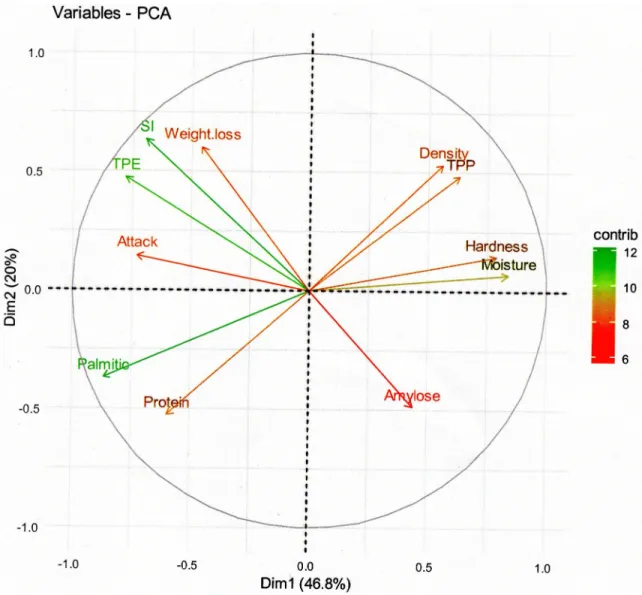
The PCA graphic (Fig 2) revealed that the first axe (46.8%) and the second axe (20%) with 66.8% total inertia were best explained theTable 4data. Principal components are colored (red to green on PCA) and selected according their significant contribution in two axes construction. Some of them participate significantly in first axe construction (SI: Cont_1 = 9.31%; Attack:
Cont_1 = 10.33%; TPE: Cont_1 = 11.73%; Hardness: Cont_1 = 12.00%; Moisture:
Cont_1 = 13.57% and Palmitic: Cont_1 = 14.51%) and others to second axe construction (TPE: Cont_2 = 10.15%; TPP: Cont_2 = 10.55%; Amylose: Cont_2 = 10.84%; Protein: Cont_2 = 12.55%; Density: Cont_2 = 12.83%; Weight loss: Cont_2 = 16.53% and SI: Cont_2 = 18.26%). A positive correlation were observed among the number of insects emerged in F1(TPE), percentage of
Fig 2. Eigenvalue diagram on PCA of maize susceptibility parameters. Eigenvalue diagram on Principal Component Analyses (PCA) of maize susceptibility parameters. The significance level for the contribution of the Principal Components (PC) is indicated by a color gradient. The annotation is TPE: Total Progeny Emerged, SI: Susceptibility Index, Attack: Attack percent of maize grains (damage percent), Weight loss: Weight loss percent of maize grains, Moisture: Percentage of grains moisture, TPP: Total Phenolics Content, Palmitic: Percentage of palmitic in grain fatty acids, Protein: Percentage of proteins in grain, Amylose: Percentage of amylose in grain starch, Density: Maize grains density, Hardness: Maize grains hardness.
attack (Attack), percentage of grains weight loss (Weight loss) and Susceptibility Index (SI), which are negatively correlated with total phenolics (TPP), moisture content and grains hardness.
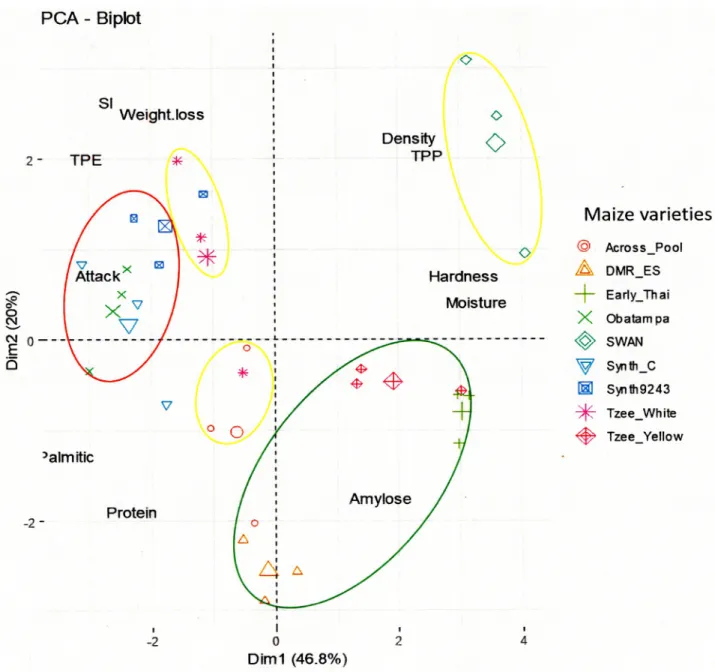
The PCA-Biplot graphic (Fig 3) of varieties discrimination classified the nine maize varie-ties into three groups according their common and discriminants characteristics. Group_G1 (in green cycle) consists of the resistant varieties (DMR-ES, Early-Thai and Tzee-Yellow), Group_G2 (in yellow circles) composed of varieties with moderate resistance (Across-Pool,
Fig 3. Discrimination of maize varieties by physicochemical and susceptibility parameters (PCA-Biplot). Discrimination of maize varieties (PCA-Biplot) by Discriminant Analysis (DA) on maize susceptibility parameters distribution. The annotation is TPE: Total Progeny Emerged, SI: Susceptibility Index, Attack: Attack percent of maize grains (damage percent), Weight loss: Weight loss percent of maize grains, Moisture: Percentage of grains moisture, TPP: Total Phenolics Content, Palmitic: Percentage of palmitic in grains fatty acids, Protein: Percentage of proteins in grains, Amylose: Percentage of amylose in grains starch, Density: maize grains density, Hardness: maize grains hardness. The susceptibility level of varieties is classified on three groups and indicated by a color gradient; Group_G1: resistant varieties (green circle), Group_G2: moderately resistant varieties (yellow circles) and Group_G3: susceptible varieties (red circle).
SWAN and Tzee- White) and Group_G3 (in red circle) with susceptible varieties (Synth-C, Synth-9243 and Obatampa) againstP. truncatus.
4. Discussion
4.1. Susceptibility parameters
The susceptibility characteristics of maize grains exposed toP. truncatus for 55 days in the lab-oratory, were highlighted in this study. First emergence of adults has shown all nine varieties are favourable to the insect development. However, variety factor had a significant effect on susceptibility parameters such as number of emerged insects, median development time, percent of grains attacked, percent of grains weight loss and susceptibility index. The current study indicate also that the number of emerged adults is positively related to attacks and weight loss percents of grains, which is consistent with previous work [22,54]. Early-Thaï, SWAN and Tzee-Yellow varieties that had the lowest susceptibility index (resistant varieties) have recorded few insects emergence in F1and exhibited lowest percents of attack and weight loss of grains. Conversely, Synth-9243, Synth-C and Obatampa varieties that had susceptibility index threefold higher (susceptible varieties), and recorded the highest insects emergence with rates of insects and females multiplication per week significantly higher. Attack and weight loss levels of grains, which resulted from both adult and larval feeding activities, were high in this maize varieties. Whereas the reverse is observed in resistant varieties, whose insect repro-duction was negatively affected and the damage on the grains was minimal. These significant variations in the susceptibility parameters of the maize varieties show the natural capacity of particular varieties to resist againstP. truncatus infestation. Such sources of maize resistance may be explained by antibiosis and antixenosis mechanisms on the basis of the grains physico-chemical characteristics.
4.2. Relation of physicochemical parameters to maize susceptibility
Past studies on maize susceptibility toP. truncatus (which mentioned in introduction section) have reported an essential role of grains physicochemical parameters. Our study showed the maize susceptibility to the larger grain borer could be explained by physical mechanisms (hardness, density,. . .) and/or biochemical mechanisms such amylose, moisture, total pheno-lics, palmitic acid and crude protein contents, which have proved very different in our varie-ties. The PCA-Biplot graphic (Fig 3) of varieties distribution according their discriminants parameters (main components), explain the varieties classification by different grain characteristics.
Group_G1: (DMR-ES, Early-Thai and Tzee-Yellow, resistant varieties).
On PCA-Biplot graphic, these three varieties are particularly characterized by high levels of amylose and moisture contents and high grains hardness. As stated earlier (Table 4), these parameters were inversely correlated to grains susceptibility index, which reveals that they are involved and seem to be the principals’ factors for the resistance of these maize varieties. In fact, increasing of amylose content can negatively affect the insect reproduction, interfering on digestion mechanism (antibiosis action). It is known that high amylomaize are less susceptible toP. truncatus larval feeding activities, due to their low digestive alpha-amylase [39]. Other-wise, high amylose content was reported to reduces the damage in maize stored and amyloid-osis is detrimental to weevil larval survival [24]. However, the no-significant correlation of amylose content with percentages of grains attacked and weight loss (Table 4), suggests that high grains amylose content not appear to have anti-feedant effect on adults. This is in agree-ment with previous studies [39], who had found high digestive alpha-amylase inP. truncatus adults. Furthermore, the moisture content increases inversely with all maize susceptibility
parameters (Table 4), so, its high content in the grain less favors the insects’ development, as indicated Arnason et al. [55]. Grain hardness, previously considered as indicator of maize resistance against insects [36] would act as mechanical strength (antixenosis action) for these maize varieties, to reduce the insects feeding and oviposition. The hardness, which increases with amylose content [38], was reported as one of maize resistance source againstP. truncatus [22,56].
As a result, the combination of this both resistance mechanisms (antibiosis and antixenosis) in these three maize varieties, involve complex interactions manifested as grains modifications which lead to limited grain accessibility (physical barriers) and creates toxicity for insects [12].
Group_G2: (SWAN, Across-Pool and Tzee- White, moderate resistant varieties).
These three moderate resistant maize varieties showed in specific characteristics for each of them.
Across-Pool variety is characterized by its palmitic acid, protein and amylose contents, con-stituents that have antagonistic actions against theP. truncatus infestation. Indeed, this work showed that the protein content increases with percent of grains attacked. This could mean that susceptibility is dependent on the nutritional content of the maize varieties studied. Our result was in agreement with previous studies, who found that protein content increased with maize susceptibility to maize weevil,Sitophilus zeamais M. [31] and with maize grains damage caused by Angouillois grain moth,Sitotroga cerealella O. [28]. In contrast, other studies reported also maize grain hardness was positively correlated to zein family of proteins [32,33,38]. The impor-tance role of the proteins content in this study suggest a more detailed analysis to quantify pro-teins families in our varieties and their involved in the larger grain borer feeding and oviposition. Although the proteins are favourable to insect development, but the high amylose content is asset for maize resistance by impacting negatively the insects’ digestion and probably caused a mortality of some larvae.
SWAN variety is characterized by high phenolics content and very hard grains. The maize resistance mechanism by phenolics content (ferulic and p-coumaric acids) is related one part to grains hardness (structural barriers), which is clearly dependent on presence of these two phenolic acids in grains pericarp and aleurone layer. Other part, its mechanism is associated to anti-feedants and toxic properties of free phenolic acids [26,57], that cause damage to midgut cells of the insects [56]. It was reported also that phenolic amines, localized in the aleurone layer [57], inhibit glutamate-dependent neuron receptors in insects [58]. However, ferulic acid, which largely composed phenolic acids in maize grains [37,59], has moderate nuisance onP. truncatus [35]. SWAN variety has an antibiosis and antixenosis actions based on grains hardness (physical barriers) and biochemical nuisances (anti-feedants and toxic free form), which are moderately effective againstP. truncatus feeding and oviposition.
Tzee-White variety has soft grains with high phenolics content and low moisture content. This significant amount of phenolics content is expected to make it resistant againstP. trunca-tus, however the low moisture content and low hardness of its grains would have favored the insect ovipostion, reduced greatly the median development time and allows the insect to mini-mize larval mortality due to phenolics.
SWAN and Tzee-White varieties, although they had phenolics content widely higher than whose DMR-ES, Early-Thai and Tzee-Yellow varieties, their susceptibility index was 2 times lower than that of these varieties. This shows, even though phenolics content is considered as good indicator of resistance, alone can not protect maize grains againstP. truncatus.
Group_G3: (Synth-C, Synth-9243 and Obatampa, susceptible varieties).
These three susceptible maize varieties showed in common high palmitic acid content, low amylose content and specific characteristics for each of them. Their vulnerability would be due particularly to low amylose content and high palmitic acid content, which were positively
correlated to all grains susceptibility parameters (Table 4). Indeed, earlier studies reported that fatty acids, particularly palmitic acid, attract insects [60] and represent a considerable nutri-tional and funcnutri-tional value for them [61]. However, the effect of palmitic acid onP. truncatus oviposition and larvae-feed needs further investigation. For Obatampa, furthermore the high palmitic acid content, this variety consists softer grains, making it vulnerable and more favour-able for insect development than Synth-C variety.
In summary, interesting varieties for maize resistance to postharvest insects, in particular to P. truncatus were identified in nine maize varieties selected for farmers under artificial infesta-tion by the larger grain borer. Resistance was related more to grains amylose content, followed the grains hardness than elevated levels of phenolics content.
5. Conclusion
In conclusion, we can say our study showed host variety resistance in maize production can be a useful component of integrated pest management ofP. truncatus. Results obtained illustrate that all maize varities can be attacked by the larger grain borer, which was found to exert differ-ent degrees of damage on varieties. Significant differences in susceptibility toP. truncatus were observed among nine maize varieties evaluated. Most resistant varieties were Early-Thaï, DMR-ES and Tzee-Yellow, followed SWAN, Across-Pool and Tzee-White (moderately resis-tant varieties) then the most susceptible varieties what are Synth-C, Synt-9243 and Obatampa. Physical and biochemical parameters associated to the maize resistance were more amylose content, followed the grains hardness than phenolics content. The most resistant maize against P. truncatus can be described as a variety with increased amylose and phenolics contents and hard grains. Thus, Early-Thaï, DMR-ES and Tzee-Yellow varieties presenting good nutritional and entomological profile may be potential maize varieties to be used to reduce the maize post-harvest loss due toP. truncatus in tropical countries. Further studies on maize attractiveness in relation of color parameters of grain (L�, a�, b�,ΔE, ΔC and H) and volatile organic
com-pounds of maize varieties against the larger grain borer is also being performed. Beyond this study in storage pests and characteristics of resistance, an ideal breeding programme would consider yield as well as pests and diseases in field.
Acknowledgments
We would like to thank Mr. Issa CISSE (COPROSA / Nioro-Senegal) and Dr. Moustapha GUEYE (CNRA-ISRA Seed Service / Senegal) for their collaboration in collecting maize samples. We gratefully acknowledge Gembloux Agro Bio-Tech Faculty of Liège University (Belgium), par-ticularly General and Organic Chemistry laboratory staff (Mr Danny TRISMAN, Mr Thomas BERTRAND,. . .) and TERRA Teaching and Research Center staff (Vanessa ARDITO, Nathalie, Romain,. . .) for their unfailing support on maize grains physicochemical characterization.
Author Contributions
Conceptualization: De´thie´ Ngom, Cheikh Thiaw, Mbacke´ Sembène.
Data curation: De´thie´ Ngom.
Formal analysis: De´thie´ Ngom, Marie-Laure Fauconnier, Paul Malumba.
Funding acquisition: De´thie´ Ngom, Mbacke´ Sembène.
Methodology: De´thie´ Ngom, Paul Malumba, Cheikh Thiaw.
Software: De´thie´ Ngom, Cheikh Abdou Khadre Mbacke´ Dia. Validation: De´thie´ Ngom, Mbacke´ Sembène.
Writing – original draft: De´thie´ Ngom, Cheikh Thiaw, Mbacke´ Sembène.
Writing – review & editing: De´thie´ Ngom, Marie-Laure Fauconnier, Paul Malumba.
References
1. Shiferaw B, Prasanna BM, Hellin J, Ba¨nziger M. Crops that feed the world 6. Past successes and future challenges to the role played by maize in global food security. Food Secur. 2011; 3: 307–327.https:// doi.org/10.1007/s12571-011-0140-5
2. Guèye MT, Badiane M, Ndiaye AB, Mbaye I, Diouf M, Ndiaye S. La protection des stocks de maïs au Se´ne´gal: enquêtes sur les pratiques d’utilisation des pesticides et plantesàeffet insecticide en milieu paysan. ITA Echos. 2008; 3: 12 p.http://www.ansd.sn/ressources/publications/RGPHAE2013 Chapitre Agriculture.pdf
3. Adjile A. Les acquisitions massves de terre agricoles, entre opportunite´ s et menaces pour la paysann-erie familiale: e´tude de cas au Sud et Centre. Be´nin, Cotonou, CEBEDES,. 2012; 149 p.
4. Ngamo LST, Hance T. Diversite´ des ravageurs des denre´es et me´thodes alternatives de lutte en milieu tropical. Tropicultura. 2007; 25: 215–220.
5. Freeman P. Common insect pests of stored food products. A Guid to their identification Br Muscum (Natural Hist Econ Ser N˚ 15 (6th ed), London. 1980; 69 p.
6. Pantenius CU. Storage Losses in Traditional Maize Granaries in Togo. Int J Trop Insect Sci. 1988; 9: 725–735.https://doi.org/10.1017/s1742758400005610
7. Verstraeten C, Haubruge E. Les processus de migration de Prostephanus truncatus Horn (Coleoptera: Bostrichidae) dans un stock de maïs e´grene´. Med Fac Landbouww Rijksuniv Gent,. 1987; 52: 235–239. 8. Borgemeister C, Adda C, Djomamou B, Degbey P, Agbaka A, Djossou F, et al. The effect of maize cob
selection and the impact of the field infestation on stored maize losses by larger grain borer (Prostepha-nus truncatus [Horn] Col., Bostrichidae) and associated storage pests. Proc 6th Int Work Conf stored Prod Prot Canberra. 1994;2: 906–909.
9. Helbig J. E´ cologie de Prostephanus truncatus au Togo examine´e notamment du point de vue des inter-actions avec le pre´dateur Teretriosoma nigriscens. GTZ, Eschborn, Ger. 1995; 111 p.
10. Delobel A, Tran M. Les Cole´optères des denre´ es alimentaires entrepose´es dans les re´gions chaudes. 1993.
11. Agbaka A, Sohounhloue KD, Dockoïmo BE, Djossou L, Foua-Bi K. Contributionàla lutte inte´gre´e contre Prostephanus truncatus (Horn) Coleoptera: Bostrichidae), par l’utilisation d’huiles essentielles. J SOACHIM. 1999; 008: 87–95.
12. Lo´pez-Castillo LM, Silva-Ferna´ ndez SE, Winkler R, Bergvinson DJ, Arnason JT, Garcı´a-Lara S. Post-harvest insect resistance in maize. J Stored Prod Res. 2018; 77: 66–76.https://doi.org/10.1016/j.jspr. 2018.03.004
13. Goergen G. Petit manuel d’identification des principaux ravageurs des denre´ es stocke´es en Afrique de l’Ouest. INRAB—IITA / Benin. 2005; 22 p.
14. Demianyk CJ, Sinha RN. Effect of infestation by the larger grain borer Prostephonus truncatus (Hom) and the lesser grain borer Rhyzoperta dominica F. (Coleoptera: Bostrichidae) on stored corn. Env Ento-mol. 1987; 16: 618–624.
15. Ejiro O, Ndowa Ekoate Sunday L, Usman Z, Emem Basil K-U. Effects of Larger grain borer
Prostepha-nus truncatus (Coleoptera: Bostrichidae) on nutrient content of dried staple roots and tubers. J Crop
Prot. 2018; 7: 337–348.
16. Lamboni Y, Hell K. Propagation of mycotoxigenic fungi in maize stores by post-harvest insects. Int J Trop Insect Sci. 2009; 29: 31–39.https://doi.org/10.1017/S1742758409391511
17. Gueye MT, Goergen G, Badiane D, Hell K, Lamboni L. First report on occurrence of the larger grain borer Prostephanus truncatus (Horn) (Coleoptera: Bostrichidae) in Senegal. African Entomol. 2008; 2000: 309–311.https://doi.org/10.4001/1021-3589-16.2.309
18. Subramanyam BH, Hagstrum DW. Resistance measurement and management. In: Subramanyam Bh & Hagstrum D W (Eds.), Integrated Management of Insects in Stored Products,. Marcel Dekker Inc, New York,. 1995; 331–397.
20. Anonyme. Directive 2009/128/CE instaurant un cadre d’action communautaire pour parveniràune utili-sation des pesticides compatibles avec le de´veloppement durable. Bruxelles Comm Eur. 2009; 21. Philogène BJR, Arnasson JT, Lambert JDH. Facteurs contribuantàla protection du maïs contre les
attaques de Sitophilus et Prostephanus. Ce´ re´ales En Re´gions Chaudes Aupelf-Uref Eds John Libbey Eurotext, Paris,. 1989; 141–150.
22. Meikle WG, Adda C, Azoma K, Borgemeister C, Degbey P, Djomamou B, et al. The effects of maize variety on the density of Prostephanus truncatus (Coleoptera: Bostrichidae) and Sitophilus zeamais (Coleoptera: Curculionidae) in post-harvest store in Benin Republic. J Stored Prod Res. 1998; 34: 45– 58.https://doi.org/10.1016/S0022-474X(97)00020-9
23. Gallo J. Crop lossesto pests. In: Pimentel D,. Encyclopedia of pest management. CRCPress; 2007. pp. 60–2.
24. Peters LL, Fairchild ML, Zuber MS. Effect of Corn Endosperm Containing Different levels of Amylose on Angoumois Grain Moth l Biology. 3. Interrelationship of Amylose levels and Moisture Content of Diets 2. J Econ Entomol. 1972; 65: 1168–1169.
25. Dobie P. The laboratory assessment of the inherent susceptibility of maize varieties to post-harvest infestation by Sytophilus zeamais Motshh. (Coleoptera, Curculioniadae). J Stored Prod Res. 1974; 10: 183–197.https://doi.org/10.1016/0022-474X(74)90006-X
26. Serratos A, Arnason JT, Nozzolillo C, Lambert JDH, Philogène BJR, Fulcher G, et al. Factors contribut-ing to resistance of exotic maize populations to maize weevil, Sitophilus zeamais. J Chem Ecol. 1987; 13: 751–762.https://doi.org/10.1007/BF01020157PMID:24302043
27. Classen D, Arnason JT, Serratos JA, Lambert JDH, Nozzolillo C, Philoge´ne BJR. Correlation of pheno-lic acid content of maize to resistance to Sitophilus zeamais, the maize weevil, in CIMMYT’S collections. J Chem Ecol. 1990; 16: 301–315.https://doi.org/10.1007/BF01021766PMID:24263491
28. Yadu YK, Saxena RC, Dubey VK. Relative susceptibility of different varieties of maize to infestation by the Sitotroga cerealella (olivier) as influenced by the biochemical content of the grains. Indian J Agric Res. 2000; 34: 243–246.
29. Garcı´a-Lara S, Bergvinson DJ, Burt AJ, Ramputh AI, Dı´az-Pontones DM, Arnason JT. The role of peri-carp cell wall components in maize weevil resistance. Crop Sci. 2004; 44: 1546–1552.
30. Abebe F, Tefera T, Mugo S, Beyene Y, Vidal S. Resistance of maize varieties to the maize weevil
Sito-philus zeamais (Motsch.) (Coleoptera: Curculionidae). African J Biotechnol. 2009; 8: 5937–5943.
Avail-able:http://www.scopus.com/inward/record.url?eid=2-s2.00034946764&partnerID=40&md5= 25a3b3783a748cf70941e2babba73533
31. Fourar-Belaifa R, Fleurat-Lessard F. Susceptibility of some cereal species and cultivars grown in Alge-ria to post-harvest damage by the rice weevil. Cah Agric. 2015; 24: 283–291.
32. Eyherabide GH, Robutti JL, Borra´s FS. Effect of near-infrared transmission-based selection on maize hardness and the composition of zeins. Cereal Chem. 1996; 73: 775–778.
33. Robutti JL, Borras FS, Eyherabide GH. Zein composition of mechanically separated coarse and fine ponions of maize kernels. Cereal Chem,. 1997; 74: 75–78.
34. Arnason JT, Gale J, Conilh de Beyssac B, Sen A, Miller SS, Philogene BJR, Lambert JDH, Fulcher RG, Serratos A, Mihm J. Role of phenolics in resistance of maize grain to the stored grain insects. J Stored Prod Res,. 1992; 28: 119–126.
35. Philogène BJR, Arnason JT. La re´sistance du maïs aux insectes phytophages: une question de mole´-cules. Univ d’Ottawa Cah Agric. 1995; 4: 85–90.
36. Santiago R, Malvar RA. Role of dehydrodiferulates in maize resistance to pests and diseases. Int J Mol Sci. 2010; 11: 691–703.https://doi.org/10.3390/ijms11020691PMID:20386661
37. Garcı´a-Lara S, Bergvinson DJ. Phytochemical and nutraceutical changes during recurrent selection for storage pest resistance in tropical maize. Crop Sci. 2014; 54: 2423–2432.https://doi.org/10.2135/ cropsci2014.03.0223
38. Dombrink-Kurtzman MA, Bietz JA. Zein composition in hard and soft endosperm of maize. Cereal Chem,. 1993; 70: 105–108.
39. Mendiola-Olaya E, Valencia-Jime´nez A, Valde´ s-Rodre´guez S, De´lano-Frier J, Blanco-Labra A. Diges-tive amylase from the larger grain borer, Prostephanus truncatus Horn. Comp Biochem Physiol—B Bio-chem Mol Biol. 2000; 126: 425–433.https://doi.org/10.1016/s0305-0491(00)00216-9PMID:11007185
40. Kossou DK, Mareck JH, Bosque-Pe´rez NA. Comparison of improved and local maize varieties in the Republic of Benin with emphasis on susceptibility to Sitophilus zeamais (Motschulsky). J Stored Prod Res. 1993; 29: 333–343.
41. Shires SW, McCarthy S. A character for sexing live adults of Prostephanus truncatus (Horn) (Bostrichi-dae, Coleoptera). J Stored Prod Res. 1976; 12: 273–275.
42. Dobie P. The contribution of the tropical stored products center to the study of insect resistance in stored maize. Trop Stored Prod Info. 1977; 34: 7–22.
43. Demissie G, Swaminathan R, Ameta OP, Jain HK, Saharan V. Biochemical basis of resistance in differ-ent varieties of maize for their relative susceptibility to Sitotroga cerealella (Olivier) (Lepidoptera: Gele-chiidae). J Stored Prod Postharvest Res. 2015; 6: 1–12.
44. Boxal RA. A critical review of the methodology for assessing farm-level grain losses after harvest. Trop Dev Res Institute, UK. 1986; 139.
45. Association of Official Analytical Chemists (AOAC) International. Official Methods of Analysis. 15th Ed Arlington, VA, USA. 1990;
46. Morrison WR, Laignelet B. An improved colorimetric procedure for determining apparent and total amy-lose in cereal and other starches. J Cereal Sci. 1983; 1: 9–20.https://doi.org/10.1016/S0733-5210(83) 80004-6
47. Folch J, Lees M, Stanley GHS. A simple method for the isolation and purification of total lipides from ani-mal tissues. J Biol Biochem. 1957; 226: 497–509.
48. Bourgou S, Beji RS, Medini F, Ksouri R. Effet du solvant et de la me´ thode d ‘ extraction sur la teneur en compose´ s phe´noliques et les potentialite´s antioxydantes d ‘ Euphorbia helioscopia. J new Sci Agric Bio-technol. 2016; 28: 1649–1655.
49. Singleton VL, Rossi Joseph A Jr. Colorimetry of total phenolics with phosphomolybdic-phosphotungstic acid reagents. Am J Enol Vitic. 1965; 16: 144–158.
50. Pomeranz Y, Hall GE, Czuchjowska Z, Lai F. Test weight, hardness, and breakage susceptibility of yel-low dent corn hybrids. Cereal Chem. 1986; 63: 349–351.
51. Blandino M, Mancini MC, Peila A, Rolle L, Vanara F, Reyneri A. Determination ofmaize kernel hard-ness: Comparison of different laboratory tests to predict dry-milling performance. J Sci Food Agric. 2010; 90: 1870–1878.https://doi.org/10.1002/jsfa.4027PMID:20602514
52. Fox G, Manley M. Hardness methods for testing maize kernels. J Agric Food Chem. 2009; 57: 5647– 5657.https://doi.org/10.1021/jf900623wPMID:19496585
53. Bloomfield VA. Using R for numerical analysis in science and engineering. Chapman Hall/CRC R Ser. 2014; 359 p.
54. Mwololo JK, Mugo SN, Tefera T, Okori P, Munyiri SW, Semagn K, et al. Resistance of tropical maize genotypes to the larger grain borer. J Pest Sci (2004). 2012; 85: 267–275.https://doi.org/10.1007/ s10340-012-0427-0
55. Arnason JT, Baum B, Gale J, Lambert JDH, Bergvinson D, Philogene BJR, et al. Variation in resistance of Mexican landraces of maize to maize weevil Sitophilus zeamais, in relation to taxonomic and bio-chemical parameters. Euphytica. 1994; 74: 227–236.
56. Kevin JM. Maize kernel components and their roles in maize weevil resistance. Int Cent Improv Wheat Maize (CIMMYT), Mex Cityhttps://www.worldfoodprize.org/documents/filelibrary/(accessed 2019/08/ 28). 2002; 17.
57. Sen A, Bergvinson D, Miller SS, Atkinson J, Fulcher RG, Amason JT. Distribution and microchemical detection of phenolic acids, flavonoids, and phenolic acid amides in maize kernels. J Agric Food Chem. 1994; 42: 1879–1883.
58. Fixon-Owoo S, Levasseur F, Williams K, Sabado TN, Lowe M, Klose M, et al. Preparation and biological assessment of hydroxycinnamic acid amides of polyamines. Phytochemistry. 2003; 63: 315–334.
https://doi.org/10.1016/s0031-9422(03)00133-xPMID:12737981
59. Bauer JL, Harbaum-Piayda B, Schwarz K. Phenolic compounds from hydrolyzed and extracted fiber-rich by-products. LWT—Food Sci Technol. 2012; 47: 246–254.https://doi.org/10.1016/j.lwt.2012.01.012
60. Roy N, Barik A. Long-chain free fatty acids from sunflower (Asteraceae) leaves: Allelochemicals for host location by the Arctiid Moth, Diacrisia casignetum Kollar (Lepidoptera: Arctiidae). J Kansas Ento-mol Soc. 2014; 87: 22–36.
61. Youn K, Kim JY, Yeo H, Yun EY, Hwang JS, Jun M. Fatty acid and volatile oil compositions of
Allomyr-ina dichotoma larvae. Prev Nutr Food Sci. 2012; 17: 310–314.https://doi.org/10.3746/pnf.2012.17.4. 310PMID:24471102