Workshops as tools for creative
collaboration: finding a balance between
facilitation and auto-organization
Catherine Elsen1, Adeline Cornet2 and Mélanie Antoine3
1LUCID, 2ID CAMPUS, 3PSGO – University of Liège, Belgium
[email protected], [email protected], [email protected]
ABSTRACT
This paper analyses four settings of so-called collaborative “creative workshops” (their methods, logistics, regulation processes) and provide peepholes on their respective features, with the informed goals of defining criteria for comparison, finding shared essence and distinctive characteristics. Key aspects such as time, facilitation and auto-organization shape a “creative continuum” that formalizes how creativity can be stimulated and how participants might collaboratively develop creative behaviors.
KEYWORDS
Creative and collaborative workshops, creative tools and methodologies, impact of time and regulation on collective creativity.
ABOUT CREATIVITY
Creativity, innovation, creative economy or creative management are
timely topics in fields such as design, economics, education or innovation research. Various initiatives around these concepts take place and, among them, invitations to experience hands-on, practical approaches of creativity - what we will call in this paper “creative workshops”.
The emergence of these workshops raises various fundamental questions about creativity. One of them concerns its very essence: can we teach it? When it comes to educate to creativity, two schools of thought coexist. Indeed, if creativity has long been considered by most as an un-explainable gift that cannot be learned nor taught (MacKenzie, 1998), others start formulating divergent opinions: properly structured by tools and methodologies, creativity (or contexts favorable to creativity) could emerge
from progressive and repetitive practice (see for instance Treffinger, 1995; de Bono’s, 2007; David Kelley’s work at Stanford’s d.school or broadly broadcasted online booklets and tutorials like Byron, 2009).
Following Popper and his seminal work on falsification (1934), we in turn believe that an accumulation of confirming instances is not enough to built universal generalization about such un-teachable creativity. Moreover, according to Kuhn (1962), ”in the practice of science, scientists will only
consider the possibility that a theory has been falsified if an alternative theory is available that they judge credible.” Our hope for this paper is
therefore double: first to demonstrate that various forms of training to creativity do coexist and, through careful examination of their methods, features and structuration, to secondly see how creativity can be taught or, at least, stimulated, supervised and positively focused. For a long time prevailing, the paradigm of creativity seen as a gift is today re-examined.
CONDITIONS FOR STIMULATED CREATIVITY
Building on the assumption that stimulated creativity can indeed take place inside specific conditions, we investigated the literature to see what those conditions could be. Three key aspects seem to impact creativity: working together vs. working alone; working inside homogeneous vs. heterogeneous groups and being regulated vs. totally free in terms of timing, sequences of tasks, tools and methodologies to use. Abundant literature can be found about those criteria and their articulation with creative teams and their “performances” (for a complete review, see Paulus, Dzindolet and Kohn, 2011), but for most of them no real consensus seems to emerge.
To begin with, there is no certitude about the added value of ideating in groups rather than alone. On the one hand, some research shows that groups are less efficient and effective than individuals when generating ideas (Diehl and Stroebe, 1987; Mullen, Johnson and Salas, 1991). Diehl and Stroebe (1987), for instance, found evidence of production blocking during group brainstorming. They suggest that group members are unable to express their ideas as they unfold in their minds because they have to wait their turn to speak. In the meantime, participants may forget their ideas or decide they are no longer relevant. Social comparison may also be associated to social loafing, individuals showing less effort in a group because responsibility is diffused (Latané, Williams and Harkins, 1979). Anxiety eventually reaches some group members when they are about to share their ideas (especially the most radical ones), since they don’t know each other very well (they don’t form a team) and since others might react
negatively to them (Paulus et al., 2011). On the other hand, other researchers argue that team creativity is much more than the sum of its individual group members’ creative output (ibid.). Cognitive and motivational processes may indeed help a team be more creative than its isolated members. Studies have shown evidence that team brainstorming push people to think of other categories of ideas, which they might have otherwise neglected. Beside that fact, sharing ideas can stimulate production of other related ideas or even combination of several ones to generate more novel or useful ideas (Osborn, 1957; Treffinger, 1995; Paulus, 2000; Santanen, Briggs and De Vreede, 2004).
Besides this group/team vs. individual aspect, no real consensus is either found in terms of groups’ homogeneity. Regarding the effects of diversity on team performance, some studies find positive effects, others negative effects (Sutton and Kemp, 2006), and some find no effects at all (Paulus et al., 2011). “One of the problems with diversity, especially background or demographic diversity, is that individuals are naturally socially inhibited in diverse settings. They may not feel free to say what comes to mind; they may feel they have to go through some diversity censoring process” (ibid., pp. 336-337).
Eventually, another open question concerns people, tasks’, logistics’ or tools’ regulation. Supporting the autonomy perspective, some argue that teams need sufficient freedom to take initiatives and make good use of their diversity, whereas tightly constrained and overly structured tasks supposedly hamper their creativity (Isaksen and Lauer, 2002).« Managing the source of authority for groups is a delicate balance. (…) The end, direction, or outer limit constraints ought to be specified, but the means to get there ought to be within the authority and responsibility of the group » (ibid., p. 78). Looking yet at the difficulty to manage more heterogeneous groups, some other argue that collective creativity reaches its best potential only when facilitated, as suggested by Osborn already in 1957.
There is indeed some evidence that group productivity is increased while in presence of facilitators, which may then play several key roles (Offner, Kramer, and Winter, 1996). They insure psychological safety for all participants, through application of some basic functioning rules. Deferment of judgment, for instance, is fundamental for efficient group brainstorming (Obsorn, 1963; Schächter and Taddéi, 2010). Diehl and Stroebe (1987) suggest that lowering apprehension about sharing ideas is another way to increase ideas’ generation.Facilitators can also structure the interaction process to minimize participants’ cognitive load (Paulus et al.,
2011). Because collaboration is complicated (even for highly motivated teams), any simplification of interaction procedure potentially eases coordination and idea generation processes. Facilitators can eventually resort to creative techniques, tools or methods that help participants escape their own personal and dominant paradigms. The research developed by Carrier, Cadieux and Tremblay (2010) shows that originality of ideas depends on the techniques in use: participants only encouraged to cognitively react inside their traditional frameworks and models of thoughts develop less radically new ideas than participants stimulated to broaden, or even surpass, these frameworks.
In front of these sometimes-contradictory results, we suggest to build tools to systematically analyze and compare particular forms of creative workshops. Looking at several dimensions, our goal is to more clearly identify what constitutes the shared essence of these so-called creative workshops (and what, on the other hand, differentiates these workshops from each other), and to gain a better understanding of the key aspects potentially useful to teach – or stimulate – collaborative creativity.
METHODOLOGY AND DATA
A three-steps methodology was constituted to gather and analyze data issued from four distinct creative workshops. Each workshop was first thoroughly attended by one, sometimes two researchers (one presenting a background in engineering and social sciences, another in criminology and social sciences, and the third in business, economics and management). Once integrated to the workshop and presented to the participants, ethnographic field research was conducted (i.e., developing critical and socially embedded understanding of experiences and phenomenon through close exploration of several types of data, such as active notes taking, audio-video recordings, open but targeted interviews, … see Ingold, 2008). This situated field research ended up in written “story telling”, whose extracts are presented below. Inside each situation, one researcher also conducted participative observation, either as participant or as facilitator.
The three researchers then constructed an analytical grid in order to systematically compare the four settings. Each researcher separately filled-in the grid and results were eventually recorded, compared and discussed until final consensus was found.
Four workshops, four stories
This section presents short extracts of stories written for each of the workshops. A more detailed description of each workshop is summarized in Appendix A.
ARC – Creative Reflection Accelerator (or “Accélérateur de Réflexion Créative”)
Created by the University of Liège PSGO service (for “Psychologie Sociale des Groupes et des Organisations”), the ARC is a creative setting which goal is to support and cover participants through the whole problem-solving process, from problem reformulation to ideation and implementation. Inspired from the Osborn’s and Parnes’ “Creative Problem Solving” process (or “C.P.S.”, for further information see Isaksen and Treffinger, 2004), it calls for group creativity to solve a project holder specific request.
“December 2012, some twenty participants (professional from various backgrounds, that never met before) are gathered in the “Horloge” halls in Namur, to give a creative boost to three project leaders active in very different areas: private anti-flood protections, aromatherapy consultancy and jewelry. […] After reception and breakfast, participants are divided into three groups, one per project leader. Each group is accompanied by one facilitator, whose role is to ease the expression of a large number of original ideas and the construction of bold solutions inside a friendly and relaxed atmosphere. […] Each facilitator guides the group through a pre-defined and timed set of activities: icebreakers to start with, followed by creative warm-up exercise, then problem presentation, brainstorming and selection of ideas, eventually solution conceptualization. From one activity to another, various techniques are mobilized: mind-mapping, sticky notes brainstorming, forced connections, idea box, conceptual cards and so on. […] Facilitators maintain the group energy level, reassure participants and encourage them to express their ideas. […] Once the half-day workshop done, participants gather in the reception room to share a last meal.“
Ideation
Ideation is a program reserved to ten or so researchers issued from diverse disciplines, supervised by three facilitators. This program pursues two main goals: first to find new applications to three Belgian university-born technologies (and this way to constitute an inspiration source for holders of these technologies) and second to educate researchers to creativity through practice (and more specifically the C.P.S. method and its techniques) with the hope that they will later implement these creative methods into their own every-day work. The program, with a total duration of four full days, is split into two steps: first a 3-days residential seminar and second, one month later, a one-day close-up meeting. Each of the three technologies is
worked on in average 10 hours by all researchers, split into multidisciplinary groups.
“August and September, 2012. The first day of the residential seminar was dedicated to sensitize the 14 researchers to the theoretical aspects of creativity and the C.P.S. method (and its five steps, “Problem reformulation – Ideation – Evaluation – Development – Go!”). During the next two days, researchers collaboratively put into practice the first three steps of the C.P.S. method and applied them to the three technologies earlier selected and presented by the facilitation team. […] Each technology is tackled by groups of 4 or 5 researchers, let by three facilitators. The three first steps of the C.P.S. methods are organized through pre-determined techniques and precise timing which respect is crucial, since each researcher and each re-composed group needs enough time to successively work on each technology. […] After three days of hard and challenging work, the 14 researchers have written more or less fifty “idea cards”, just as many as possible new concepts for the three Belgian technologies. One month later, the same group of researchers get together for the last step of the program, which is the development of some of the “idea cards” selected meanwhile by the project holder. The day ends with the final presentation of the results.”
Ideative
Ideative is a three-days workshop designed for university and high-school students and organized inside the larger and international framework of a competition called the “24 hours of innovation” (ESTIA, 2013). Similarly to the previous workshop, the C.P.S. method frames some theoretical and practical sensitization to collaborative creativity, taking place here during the two first days of the program and managed by a professional creativity consultant. As soon as the first day, students are spread in multidisciplinary teams (counting at least one designer, one engineer and one manager) that will remain the same through the whole program and competition. The 24 last hours are dedicated to the competition itself, taking part synchronously in different universities or high schools all over the world. The program ends with a 3 minutes presentation in front of a local jury, whose task is to select the best concept or solution.
“Friday, October 19th and Saturday, October 20th, 2012. The competition has
started: teams just received several cards shortly describing projects submitted by the remote industrial and entrepreneurial partners. Over a 24-hours period, teams will separately have to develop a new concept or solution to the problem they chose to tackle. […] During the whole process, teams are free to organize themselves the way they want. Three milestones are nevertheless suggested: problem reformulation should be over within the first couple of hours, time should then be spent on ideation and evaluation, without neglecting the few
hours needed to develop and prototype the final concept or solution. […] A group of rotating facilitators checks the course of project management, answers questions, supports the students and provides advices to help them make correct use of the creative tools and techniques they were just taught.”
Charrette
The well-known “Charrette” concept puts together local residents and “designers” (in the broad sense of the word) to work in an interdisciplinary, community-based way (Sutton and Kemp, 2006). Far from the participants’ normal routines, the Charrette “puts people into a temporary pressure-cooker with stimulating visual and human resources” (ibid.) to encourage them to solve a purposeful social issue and become co-learners. The “pressure-cooker” aspect of this workshop led to its name as, according to the folklore, the 1800s Parisian students attending the first year of architecture had to hurry to finish their assignment aboard horse-drawn carts, on their way to final reviews. The students drew until the very last moment on those “charrettes”, and the term is still used today to describe the frenetic activity preceding any final presentation.
“Dublin, November 2012. Co-organized by the Toronto Institute without Boundaries (IwB), the Dublin city council, the Dublin Institute of Technology and the Design21C company, this year challenge for the thirty participants is to reinvent public services for Dublin citizens, given a complex environment and limited resources. During 5 days, 5 teams work simultaneously on this common brief but for distinct Dublin areas. Each team gathers students, community members, city council workers and professional architects and designers. […] Without being explicitly built on the C.P.S. method this time, the whole process is nevertheless structured on a similar framework. Punctuated by opening and closing plenary sessions and three guest lectures, the process indeed includes ten stages spread out on the five days: getting to know each-other, the program and the city; services cartography around Dublin; selection of a public service; on site exploration and interviews; goals definition; brainstorming; collective concept selection; concept development; deliverables and, eventually, final presentations. […] Although this ten-stage procedure is really clearly inscribed inside each participant’s agenda, teams are nevertheless totally free to auto-organize inside each stage and to choose whatever method they think is best to reach each milestone. [One researcher doing participative observation notes:] In my team, working together seems quite challenging. Team members have the feeling they spend too much time discussing and trying to agree, without really knowing what to agree on. […] From time to time, IwB staff members visit the teams and provide a few advices. The week is moreover punctuated by two “advisor sessions” and one “team leader check-in”, the former being a time for each team to receive feedback from experts, the latter being a debrief organized for IwB participants, leaders of their own team.”
Criteria for comparison
In order to gain information on creativity and its practical, hands-on aspects and to find common basis for comparison, it was decided to focus only on “active and creative” moments of each of the four workshops. Periods dedicated to theoretical sensitization to creativity, creative methods or tools were therefore not considered here, neither were short exercises for practicing these methods if they didn’t relate to the project holder’s main concern. Five criteria were chosen for systematic comparison: (i) overall duration; (ii) active participation of facilitator(s); (iii) process structuration through methods, techniques or tools (linked to creativity or not: for instance brainstorming, field research, …); (iv) prescriptive use of creative methods, techniques or tools; (v) regulation, in terms of roles’ emergence and autonomy towards the overall process. Each criterion is evaluated by each researcher, separately and for each of the four workshops, following a “yes/no” or a 5-points Likert scale (for more details, see Appendix B). After comparison of each researcher grid, inter-reliability was found good enough for the scope of this paper (even if not statistically tested). For 85 % of the criteria, researchers had indeed separately chosen the same value and for the remaining 15%, judgments never differed more than one interval in the 5-points Likert scale. Consensus was consequently quickly found and enabled to reach the results presented in next section.
RESULTS AND DISCUSSION
The intent of this paper is not to compare the four workshops in terms of creative levels reached. The contexts and the nature of each challenge are too different to tell which setting created the most creative outcomes and creative experience for the participants. Next section will rather investigate what they have in common that could define the essence of “creative workshops”.
Similitudes
While remaining empirically based and exploratory, our description and analysis grids (see Appendix A and B) constitute efficient tools for the comparative analysis of the workshops. They enable us to distinguish the following four criteria as common ground for those four creative settings:
1) All participants adopt a creative posture (either spontaneously or after warm-up exercises): they have a positive mindset, all of them
voluntarily decided to take part to the workshops, which decisively contribute to the overall success of each initiative;
2) Project holders and facilitation teams pay close attention to the
problem formulation: neither too broad nor too technical and
directing in the solution they call for, problems remain creative and motivating in their formulation;
3) All groups and teams are build on mixed profiles: from various background, age, expertise, culture and gender, people of diverse profiles offer each-other purposeful feed-back and insights;
4) All four settings share a common concern for organizational
aspects: whatever the option chosen in terms of regulation,
logistics, timing and sequences of tasks are cautiously designed beforehand.
We argue that these four factors do constitute the essence of creative workshops, and that they should consequently be put on the agenda when planning such initiatives.
Differences
The five main criteria chosen for comparative analysis (namely duration; participation of facilitator(s); process structuration through methods, techniques or tools; prescriptive use of creative methods, techniques or tools and regulation in terms of roles and towards the overall process) later revealed to also be the main criteria for workshops’ differentiation.
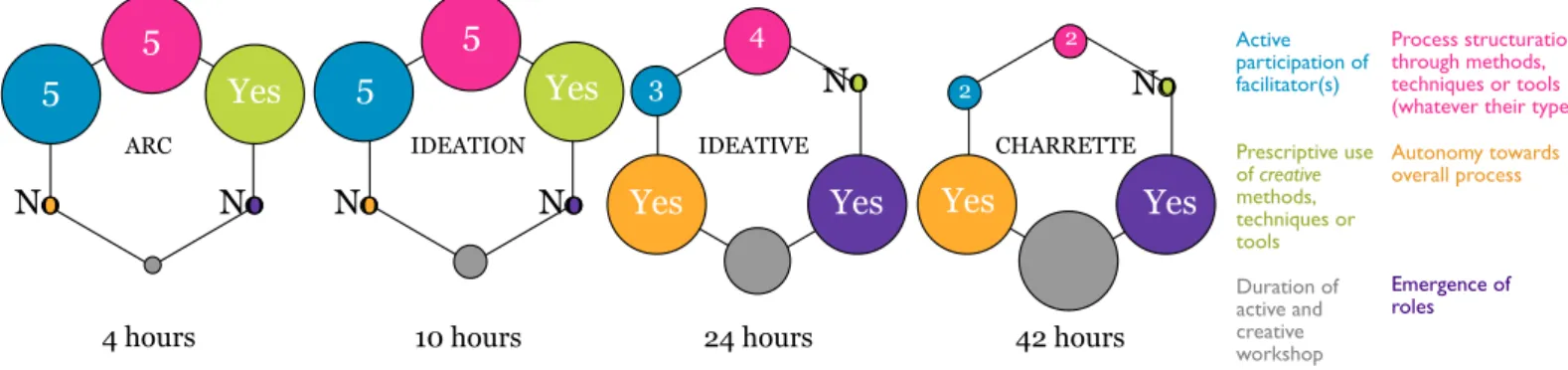
More detailed results (gathering consensus between the three researchers) can be found in Appendix C, while Figure 1 offers a visual formulation of those results. It reveals distinct profiles for each workshop, with ARC and Ideation workshops sharing common features compared to Ideative and the Charrette. Active participation of facilitator(s) Process structuration through methods, techniques or tools (whatever their type) Prescriptive use of creative methods, techniques or tools Emergence of roles Autonomy towards overall process Duration of active and creative workshop 1: really not important > 5: really important
ARC IDEATION IDEATIVE CHARRETTE
5 5 3 2
5 5 4 2
Yes Yes No
No No Yes Yes
No No Yes Yes
4 hours 10 hours 24 hours 42 hours
No
One continuum, two parameters for creative collaboration: time
and regulation
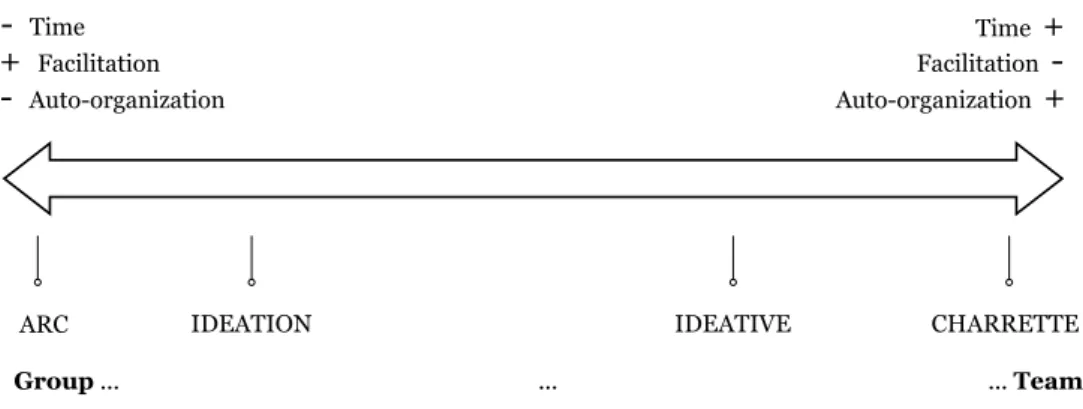
Looking at Figure 1, the four creative workshops we analyze in this paper indeed seem to polarize themselves on a continuum characterized by two different profiles. Table 1 synthesizes those profiles – and how the criteria group inside each of them - while Figure 2 formalizes this “creative continuum”.
Auto-organization Facilitation
Autonomous emergence of roles
Light structuration of the process through methods, techniques or tools
Total autonomy towards the process No prescriptive use of creative methods, techniques or tools
Light structuration by facilitator(s)
No spontaneous emergence of roles Strong structuration of the process through methods, techniques or tools No autonomy towards the overall process Prescription on how and when to use creative methods, techniques or tools Strong structuration by facilitator(s)
Table 1. Synthesis of both profiles and their characteristics.
ARC IDEATION IDEATIVE CHARRETTE
- Time + Facilitation - Auto-organization Time + Facilitation -Auto-organization + Group ... ... ... Team
Figure 2. Visual formulation of the creative continuum.
This “creative continuum” illustrates two open options for organizing a creative workshop as well as the impact those options have on how people will collaborate. On the one hand, short timing and constrained, strong facilitation processes do not allow participants to auto-organize. In these conditions, participants constitute a group rather than a team, since they are invited to offer individual knowledge and creative outputs rather than discussing tasks’ repartition, roles and interdependencies. On the other hand, longer workshops with less active participation of facilitators and more space for autonomous organization open possibilities for participants to get to know each other better and to develop team ownership.
In both cases, interestingly, these creative workshops (whatever their distinct features) are recognized as effective ways to practically stimulate creativity. Qualitative analysis of the verbatim indeed reveals that
participants who took part to highly constrained workshops (in terms of tasks sequences, facilitation, time constraints) found their creativity level incontestably higher than before. One “Ideation” participant for instance explains:
“I amazed myself in terms of what I was able to do in collaboration with others. I discovered I was a creative person, I discovered how to do that and how to transmit that creativity to others” (free translation).
In less constrained environments such as the “Charrette”, comments are rather oriented towards team building and team spirit and paradoxically less towards levels of creativity reached during the workshop, even if those are also considered as good. Ideative finds itself in an intermediary position, participants being autonomous in their use of creative tools thanks to the intense sensitization to creativity they received during two previous days. Worth to underline, though, is that these two profiles of regulation should not be considered as opposite, but rather as complementary ways to awake participants to their creative potential.
CREATIVE WORSHOPS: HOW ABOUT TRANSFERRING THEM
TO THE ECONOMIC WORLD?
After providing tools for comparative analysis of four creative workshops, this paper identified shared essence of such creative settings as well as their differences. A better understanding of key aspects such as time, facilitation and auto-organization helped draw a “creative continuum” that impacts how creativity might be implemented and how participants might collaboratively develop creative behaviors (inside either groups or teams). Next challenge would be now to transfer those workshops to companies: usually organized inside academic environments, this particular way of using creative methods, techniques and tools is indeed not integrated to companies’ and institutions’ daily habits and still too often considered as occasional or “for fun” exercises.
Integration of creativity (its practice, its management) is yet today required at each level of organizations, the current economic situation making it vital for their survival. Creativity is nowadays considered as essential oxygen, enabling them to permanently question their ecosystem and to respond, in an agile way, to continuous changes inside this ecosystem. Change is not to be considered as an obstacle anymore, but rather as a challenge or opportunity to positively evolve inside a competitive market (see Streliski,
2013). As John Howkins, one founding father of the creative economy model, states:
“Creativity is not new and neither are economics, but what is new is the nature and the extent of the relationship between them and how they combine to create extraordinary value and wealth” (2002).
Collaborative by essence, appearing at the interface between knowledge, skills and hierarchy, open and transverse, sometimes dissident, creative workshops surprise by their playful side, consequence of a meeting between collective work and particular tools. Today incompatible with a business culture where innovation is either totally neglected or compartmentalized inside R&D departments, creative workshops call for a new form of management. Tolerance to hybridization, irreverence towards the hierarchy, acceptation of doubts and ambiguity about results that cannot be predicted are some of their inherent aspects, as many potential reasons to discourage organizations to accept and incorporate creativity as a posture. Transfers between creativity and the business world is nevertheless a reality inside well-known companies such as Ubisoft©, Apple© and the “Cirque du Soleil©” as well as inside smaller Belgian SMB’s like “The Smart Company©”. We modestly hope that this paper, illustrating various ways to stimulate creativity, will be added to the accumulating arguments inviting to this transfer.
ACKNOWLEDGMENTS
We would like to deeply thank Mrs. Michelle Hotchin and her team from IwB for their generous welcome during the 2013 Charrette in Dublin, for sharing their thoughts and for offering us access to their workshop as if we were long-term colleagues. We also thank the Belgian National Fund for Scientific Research (F.R.S.-FNRS) as funding resource for C. Elsen.
LIST OF REFERENCES
Carrier, C., Cadieux, L. and Tremblay, M. 2010. “Créativité et génération collective d'opportunités. Quelles techniques pour supporter l'idéation?”, Revue
française de gestion, vol 7, n° 206, pp. 113-127.
de Bono, E. 2007. “How to have creative ideas”, Vermilion Ebury Publishing, Berkeley, 178 p.
Diehl, M., and Stroebe, W. 1987. “Productivity loss in brainstorming groups : toward the solution of a riddle”. Journal of Personality and Social Psychology, 53, pp. 497-509.
Howkins, J. 2002. “The creative economy : How People Make Money from Ideas”, Penguin Group Publishing.
Ingold, T. 2008. “Anthropology is Not Ethnography.” Proceedings of the British Academy 154, pp. 69-92. The British Academy 2008.
Isaksen, S. G., and Lauer, K. J. 2002. “The climate for creativity and change in teams”. Creativity and Innovation Management Journal, 11, pp. 74-86. Isaksen, S.G., and Treffinger, D.J. 2004. ”Celebrating 50 years of reflective
practice: versions of creative problem solving”. Journal of Creative
Behavior, vol. 38, n°2, pp. 75-101.
Kuhn, T.S. 1962. “The structure of scientific revolutions”, U. Chicago Press, 264 p. Latané, B., William, K., and Harkins, S. G. 1979. “Many hands make light the work :
The causes and consequences of social loafing”. Journal of Personality and
Social Psychology, 37, pp. 822-832.
MacKenzie, G. 1998. “Orbiting the giant hairball: a corporate fool’s guide to surviving with grace”. Penguin Group Publishing, New York, 224 p. Mullen, B., Johnson, C., and Salas, E. 1991. “Productivity loss in brainstorming
groups : a meta-analytic integration”. Basic and Applied Social Psychology, 12, pp. 3-23.
Offner, A.K., Kramer, T.J., and Winter, J.P. 1996. “The effects of facilitation, recording, and pauses on group brainstorming”. Small Group Research. 27, pp. 283-298.
Osborn A.F. 1957. “Applied Imagination : Principles and Procedures of Creative Thinking”, New York : Scribner.
Osborn, A.F. 1963. “Applied imagination (2nd ed.)”. New York : Scribner. Paulus, P.B. 2000. “Groups, teams, and creativity: the creative potential of
idea-generating groups”. Applied Psychology: An International Review, vol. 49, n°2, pp. 237-262.
Paulus, P.B., Dzindolet, M. and Kohn, N.W. 2011. “Collaborative Creativity: Group Creativity and Team Innovation” in M. D. Mumford (Ed.), Handbook of organizational creativity, pp. 327-357. New York: Elsevier.
Popper, K.R. 1934. “Logik der Forshung Zur Erkenntnistheorie der modernen Naturwissenschaft”. Mohr Siebeck Eds.
Santanen E.L., Briggs R.O. and De Vreede G.-J. 2004. “Causal relationships in creative problem solving : comparing facilitation interventions for Ideation”,
Journal of Management Information Systems, Spring 2004, Vol. 20, N°4,
pp. 167-197.
Schächter, V. and Taddéi, F. 2010. “La créativité dans la recherché”, Le journal de
l’école de Paris du management, n°83, pp. 29-36.
Sutton, S.E. and Kemp, S.P. 2006. ”Integrating social science and design inquiry though interdisciplinary design Charrettes: an approach to participatory community problem solving”. American Journal of Community Psychology, Springer.
Treffinger D.J. 1995. “Creative Problem Solving : Overview and Educational Implications”, Educational Psychology Review, vol 7, n°3, pp. 301-312. WEB
Byron, K. 2009. “The creative researcher – Tools and techniques to unleash your creativity”. Published online on www.vitae.ac.uk/researcherbooklets
David Kelley at d.school, Stanford: http://dschool.stanford.edu/our-point-of-view/ ESTIA. 2013. http://www.24h.estia.fr/ et
http://24heuresinnovationets.wordpress.com/
APPENDIXES
Appendix A - description grid of the four workshops
WORKSH-OP NAME
PARTICIPANT ORGANISATION GOAL CREATIVE TECHNIQUES and
MILESTONES DESIGN TOOLS NOTES * # * BACKGROU ND * COLLABOR-ATION MODALITY * LENGTH * TIME-FRAME * CONTEXT * EXECUTIVE STAFF * DELIVERABLES *TIME OF DEFINITION *SHARING *PROJECT HOLDER *CREATIVITY *TYPE *STRUCTURE *AUTONOMY *TYPE *STRUCTURE *AUTONOMY ARC * 5 to 7* 3 teams * selected with
the help of the giver - students and professionals, various backgrounds . * relaxed but stimulated participation * 1/2 day
* structured in 7 phases with limited timing - 3 simultaneous workshops on different subjects with shared breakfast and lunch
* separate teams except during lunch times
* 1 facilitator (> active help) per group
* very clear deliverables (2-4 conceptual solutions to the problem + a large variety of ideas + a classification of preferred ideas according to their nature)
* before the workshop (during interview n°1) * shared by whole team * problem to solve is
given (imposed by staff and giver - not met) * explicit reference to creativity and CPS process (participants interested in discovering a method) * CPS (Creative Problem Solving Process). Workshop only about ideation and solving - practical sensitization * 7 phases: introduction;
getting to know each other; creative warm-up; problem presentation; brainstorming (mind-mapping, brainstorming, forced connections, idea box); idea selection; conceptualization * 100% structured * 0% autonomy *mind-mapping, sticky notes, concept sheet, story cubes *Highly structured *Low autonomy * very short in time * possibility for participants to ask questions about the problem and for the giver to reframe it if necessary IDEATION * 14 people, 3 groups * researchers from various backgrounds * stimulated participation * 4 days
* 2 phases: 3 days residential workshop (1 day per technology) ; one-day meeting (one month later)
*2-3 facilitators for all 14 people * 50 «ideas cards» > develop a
few of them (selected by the giver)
* 3 technologies chosen beforehand (new applications for three new technologies) * 1 technology shared
inside each group, each participant tackles each technology inside ever changing groups * givers not met (until the
last day)
* explicit awareness to CPS + practical sensitization
* CPS (Creative Problem Solving Process), explicitly presented (sensitization and education to creativity)
* Workshop: theoretical formation to CPS method and its 5 steps (1 day); workshop on problem reformulation; ideation; evaluation (2 days) with focus on selected technologies; late conceptualization (one month later) of ideas cards selected by the giver (1 day) * 100 % structured * 0% autonomy * final presentation on mood boards * impact of incubation * final ideas to conceptualize: chosen by giver IDEATIVE * 30 Master students, teams of 5 or 6 students * designers, managers, engineers, architects, psychologists * relatively free * 3 days
* 2 phases: 2 days theoretical formation; 24 H workshop * 1 consultant in CPS for the 2
days formation; facilitators, not assigned to specific teams, present only during the 24 H workshop
* very clear deliverable: a 3 minutes presentation using slide show
* at the very beginning of the 24 hours
* shared by all team members * problems definition
defined beforehand by givers (not met) * no explicit reference to
creativity, but implicit goal (because of formation)
* CPS (Creative Problem Solving Process) explicitly presented.
* theoretical and practical formation to CPS and team building (2 days) * 50% structured (3
milestones but no step-by-step procedure) * 100% autonomy (advisors
locally present for short advices) * drawings, texts ... on sticky notes; 3D CAD modeling * 50% structured (formation) * 100% autonomy * very short in time * competition pressure * much more «complete» / robust results THE CHARRETTE * 30 participants in 5 teams * students (designers), community members, professional designers * modalities free of choice * 5 days
* 5 days of workshop structured by milestones and theoretical talks
* team space for the whole workshop, on site dinners (> late working sessions) * 2 Master students, team
leaders (with team-leaders checking)
* 2 advisors (> advices) sessions (punctual)
* very clear deliverables (users scenarios, personas, service map, one video)
* at the beginning of the process
* shared by the whole team
* not imposed (except for the location), but ideas selection facilitated by the whole group * creative social
innovation
* on site visit, street interviews; brainstorming (100 ideas); ideas selection; storyboard; personas; users scenarios, video branding
* team building and getting to know each-other * 50% structured (10
milestones but no step-by-step procedures) * 100% autonomy * drawings, texts ... on sticky notes * not structured 100% autonomy * no explicit reference to CPS... * very strong cohesion and team spirit * interpersonal conflicts * 2 students are team-leaders * slight sense of competition * high pressure
during the last 24 hours *
purposeful-ness (social innovation) * great diversity
Appendix B - analysis grid of the four workshops
Criteria Explanation Scale
Active participation of facilitator(s)
> not considering here the exact definition of his/her roles and tasks, but rather his/her simple presence > only during active and creative moments, not during theoretical nor practical sensitizations
«A facilitator usually is not a part of the group but instead is an outsider who tries to help groups interact in a more efficient manner» Osborn(1957)
Importance of facilitators’ presence
(1 really not important - 2 limited importance - 3 neutral - 4 important - 5 very important)
Tools, Techniques and Methods
> not necessarily linked to creativity: could be anything useful for problem definition, needs’ definition, ideation, …
> do not refer to physical tools such as sharpies, CAD tools, sticky notes, …
Examples: * CPS
* Brainstorming
* field research (interviews, questionnaires, …) * service map * …
Process structuration through methods, techniques and tools (1 really not important - 2 limited importance - 3 neutral - 4 important - 5 very important)
Prescriptive use of creative methods, techniques or
tools * Yes: methods, tools and techniques are imposed and
required through application of pre-defined procedure(s) * No: creative “tool-box”
available for use but not mandatory
Prescriptive use: yes or no
Overall duration of workshop
> active and creative moments only, when participants actively work on project holder’s problem
> does not take into account formations, sensitizations (either theoretical or practical if not related to main problem), experts’ talks, …
Number of hours
Regulation * Roles’ Emergence:
Yes: roles emerge naturally No: roles do not emerge naturally * Autonomy towards overall process
Yes or no
Appendix C – visual formulation of results
Active participation of
facilitator(s) techniques or tools (whatever their type)Process structuration through methods,
Prescriptive use of creative methods, techniques or tools
Emergence of roles Autonomy towards overall process
1: really not important > 5: really important
No Yes No Yes No Yes