HAL Id: hal-01768401
https://hal.archives-ouvertes.fr/hal-01768401
Submitted on 17 Apr 2018
HAL is a multi-disciplinary open access
archive for the deposit and dissemination of
sci-entific research documents, whether they are
pub-lished or not. The documents may come from
teaching and research institutions in France or
abroad, or from public or private research centers.
L’archive ouverte pluridisciplinaire HAL, est
destinée au dépôt et à la diffusion de documents
scientifiques de niveau recherche, publiés ou non,
émanant des établissements d’enseignement et de
recherche français ou étrangers, des laboratoires
publics ou privés.
SHARP: Harmonizing Galaxy and Taverna workflow
provenance
Alban Gaignard, Khalid Belhajjame, Hala Skaf-Molli
To cite this version:
Alban Gaignard, Khalid Belhajjame, Hala Skaf-Molli. SHARP: Harmonizing Galaxy and Taverna
workflow provenance. SeWeBMeDA 2017 : Semantic Web solutions for large-scale BioMedical Data
Analtics, May 2017, Portoroz, Slovenia. �hal-01768401�
SHARP: Harmonizing Galaxy and Taverna
workflow provenance
Alban Gaignard1, Khalid Belhajjame2, and Hala Skaf-Molli3 1
Nantes Academic Hospital, France [email protected]
2 LAMSADE – Paris-Dauphine University, France
3 LS2N – Nantes University, France
Abstract. SHARP is a Linked Data approach for harmonizing cross-workflow provenance. In this demo, we demonstrate SHARP through a real-world omic experiment involving workflow traces generated by Taverna and Galaxy systems. SHARP starts by interlinking provenance traces generated by Galaxy and Taverna workflows and then harmonize the interlinked graphs thanks to OWL and PROV inference rules. The resulting provenance graph can be exploited for answering queries across Galaxy and Taverna workflow runs. Keywords: Reproducibility, Scientific Workflows, Provenance, Prov Con-straints
1
Introduction
Imagine a system that allows scientists to answer queries like Which parameters were used by my colleagues in their workflow that would explain my workflow results !
Answering such queries requires the exploitation of provenances traces generated by different workflow systems. PROV has been adopted by a number of workflow systems for encoding the traces of workflow executions. However, workflow systems extend PROV differently which yields heterogeneity in the generated provenance traces. This heterogeneity diminishes the value of such traces, e.g. when combining and querying provenance traces of different workflow systems.
In this demo, we present SHARP; an approach for interlinking and harmoniz-ing provenance traces of different workflow systems usharmoniz-ing PROV inferences. We demonstrate SHARP through a real-world omic experiment involving workflow traces generated by the Galaxy and Taverna systems.
2
SHARP: Harmonizing multi-PROV Graphs
SHARP exploits the fact that provenance vocabularies used by workflow sys-tems extend the W3C PROV-O ontology. It uses reasoning for harmonizing prove-nance traces thanks to OWL entailment regime and PROV constraints [3]. SHARP identifies three categories of rules of Prov constraints with respect to expressiveness (i) rules that contain only universal variables, (ii) rules that con-tain existential variables, and (iii) rules making use of n-array relations (with n ě 3). SHARP formalizes constraints as tuple-generating dependencies TGDs and equality-generating-dependencies EGD[1], and then implements them as Jena rules.
The following example illustrates usage and generation from derivation rule. The following rule states that if an entity e2was derived from an entity e1, then there
wasDerivedFrompe2, e1q Ñ D a usedpa, e1q, wasGeneratedFrompe2, aq.
The overall provenance harmonization process consists in i) interlinking data artifacts through owl:sameAs property, ii) applying OWL inferences, iii) applying PROV constraints TGDs and EGDs as a set of inference rules. This process terminates because PROV con-straints are known to be weakly acyclic [4].
3
SHARP Demo Scenario
We use a real scientific experiment conducted through two bioinformatics workflows.
Taverna workflow @research-lab Galaxy workflow @sequencing-facility Variant effect prediction VCF file Exon filtering output Merge Alignment sample
1.a.R1 sample1.a.R2
Alignment sample 1.b.R1 sample1.b.R2 Alignment sample 2.R1 sample2.R2 Sort Sort Variant calling GRCh37
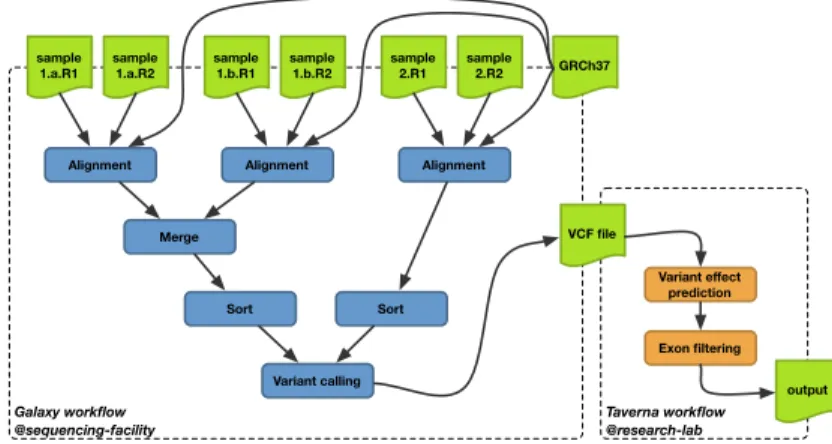
Fig. 3.1: A multi-site genomics workflow, involving Galaxy and Taverna systems.
The first workflow, in blue in Figure 3.1, is implemented in Galaxy [2] and addresses DNA data pre-processing which is loosely coupled to the scientific hypothesis. This work-flow takes as input two DNA sequences from two biological samples s1 and s2, represented in green. The second workflow is implemented with Taverna [5], and highly depends on sci-entific questions. It is generally conducted by life scientists possibly from different research labs and with less computational needs. In the following section, we explain how SHARP interlinks and harmonizes provenances graphs produced by two workflow systems.
4
Implementation
4.1 Galaxy PROV
For now, it is not possible to export provenance from Galaxy workflow environment4
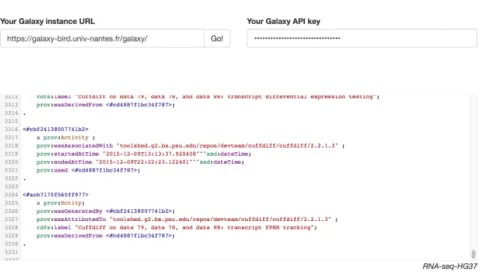
through a standard schema and format. To address this issue and to allow the combina-tion of multiple workflow execucombina-tion traces, we developed a loosely coupled tool aimed at exporting Galaxy user histories into PROV RDF data. This tool results in a command-line interface and a web application which allows users to list and export the content of their Galaxy Workflow histories, as illustrated in Figure 4.1.
Users provide the URL of their Galaxy workflow portal, and their private API key. Then, the tool communicates with the Galaxy API through the HTTP protocol and JSON documents. It can produce as a result RDF PROV triples in the Turtle syntax, or a graphical representation of the PROV sub-graph. The command line interface has been implemented in Java and makes use of the Jersey library for connecting to the REST API.
The command line interface is available as open-source5. The back-end web application
was also implemented in Java. Jetty was used as a standalone web server hosting an HTTP
4
https://usegalaxy.org
5
Fig. 4.1: A web application to export provenance graphs from Galaxy user histories in PROV.
REST API, and a mongoDB database was setup to collect basic usage metrics. The front-end was implemented in HTML and JavaScript (BackboneJS, D3.JS). The web application will be available shortly as open-source in the same repository.
4.2 Multi PROV harmonization
We implemented the PROV harmonization process in a command line tool available as
open-source6. This tool can be used to infer new PROV statements for a single
prove-nance trace by providing an input trace in the Turtle syntax. More interestingly, it can be used to interlink and harmonize cross-workflow provenance traces by specifying multiple provenance traces as input, accompanied with owl:sameAs statements. Finally, based on inferred prov:wasInfluencedBy predicates, cross-workflow data lineage can be visualized.
This tool has been implemented in Java and is supported by Jena7for RDF data
man-agement and reasoning tasks. PROV Constraints8 inference rules have been implemented
in the Jena syntax9. HTML and JavaScript (D3.JS) code templates have been used to
generate harmonized provenance visualization.
The automatic generation of owl:sameAs statements between files based on hashing techniques, as well as a web interface are still under active development. These features should available soon in the same repository.
5
Results
This demonstration shows that SHARP allows to homogenize PROV graphs and achieve unified SPARQL queries across multiple provenance traces. For instance, the following query assembles a data influence graph between multiple workflow execution traces in which some data artifacts play two roles, i) output for a give workflow, and ii) input for other workflows. 6sharp-prov-toolbox: https://github.com/albangaignard/sharp-prov-toolbox 7 Jena: https://jena.apache.org 8 https://www.w3.org/TR/prov-constraints/ 9 https://github.com/albangaignard/sharp-prov-toolbox/blob/master/ SharpProvToolbox/src/main/resources/provRules_all.jena
CONSTRUCT {
?x ?p ?y . ?x rdfs:label ?lx . ?y rdfs:label ?ly } WHERE {
?x ?p ?y .
FILTER (?p IN (prov:wasInfluencedBy)) . ?x rdfs:label ?lx . ?y rdfs:label ?ly }
This query matches prov:wasInfluencedBy properties resulting from harmonization pro-cess. These properties were not initially stated neither in the Taverna nor in the Galaxy provenance traces.
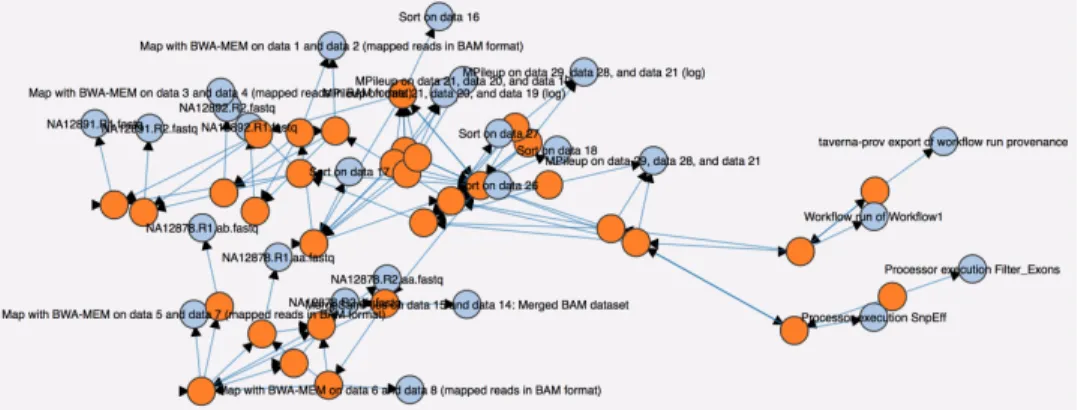
Figure 5.1 shows the resulting data lineage graph associated with the two workflow traces of our motivating use case (Figure 3.1). While the left part of the graphs represents the Galaxy workflow invocation, the right part represents the Taverna one.
Fig. 5.1: prov:wasInfluencedBy properties between Galaxy and Taverna.
6
Conclusions
In this paper, we presented SHARP, a Linked Data approach for harmonizing cross-workflow provenance. The resulting harmonized provenance graph can be exploited to run cross-workflow queries. Our ongoing work includes the automation of owl:sameAs property generation as well as providing a unified web interface. As future works, we will address human-centered interpretation of possibly massive PROV graphs through domain-specific summarization techniques.
References
1. S. Abiteboul, R. Hull, and V. Vianu. Foundations of Databases. Addison-Wesley, 1995. 2. E. Afgan, D. Baker, van den Beek, et al. The galaxy platform for accessible, repro-ducible and collaborative biomedical analyses: 2016 update. Nucleic Acids Research, 44(W1):W3–W10, 2016.
3. J. Cheney, P. Missier, and L. Moreau. Constraints of the provenance data model.
Technical report, 2012.
4. R. Fagin, P. G. Kolaitis, R. J. Miller, and L. Popa. Data exchange: semantics and query answering. Theoretical Computer Science, 336(1):89–124, 2005.
5. K. Wolstencroft, R. Haines, D. Fellows, et al. The taverna workflow suite: designing and executing workflows of web services on the desktop, web or in the cloud. Nucleic Acids Research, 41(Webserver-Issue):557–561, 2013.