HAL Id: hal-00488880
https://hal.univ-brest.fr/hal-00488880
Submitted on 6 Jun 2016
HAL is a multi-disciplinary open access
archive for the deposit and dissemination of
sci-entific research documents, whether they are
pub-lished or not. The documents may come from
teaching and research institutions in France or
abroad, or from public or private research centers.
L’archive ouverte pluridisciplinaire HAL, est
destinée au dépôt et à la diffusion de documents
scientifiques de niveau recherche, publiés ou non,
émanant des établissements d’enseignement et de
recherche français ou étrangers, des laboratoires
publics ou privés.
Influential parameters on electromagnetic properties of
nickel-zinc ferrites for antenna miniaturization
David Souriou, Jean-Luc Mattei, Alexis Chevalier, Patrick Queffelec
To cite this version:
David Souriou, Jean-Luc Mattei, Alexis Chevalier, Patrick Queffelec. Influential parameters on
elec-tromagnetic properties of nickel-zinc ferrites for antenna miniaturization. Journal of Applied Physics,
American Institute of Physics, 2010, 107, pp.09A518. �10.1063/11.3356235�. �hal-00488880�
Influential parameters on electromagnetic properties of nickel–zinc ferrites
for antenna miniaturization
David Souriou,a兲Jean-Luc Mattei, Alexis Chevalier, and Patrick Queffelec
Laboratoire des Sciences et Techniques de l’Information, de la Communication et de la Connaissance (Lab-STICC), UMR CNRS 3192, Université Européenne de Bretagne–U.B.O., 6 avenue Le Gorgeu, CS 93837, 29238 Brest Cedex 3, France
共Presented 20 January 2010; received 27 October 2009; accepted 1 December 2009; published online 6 May 2010兲
Electromagnetic properties of nickel–zinc ferrites based materials make them potential candidates for applications linked to telecommunications. In the present study, nanosized particles of spinel ferrite Ni0.5Zn0.3Co0.2Fe2O4 were prepared by coprecipitation method. An optimized material is
obtained after adequate heat treatment and partial filling of the porosity by epoxy resin. This material lies between ceramic and composite medium 共with porosity close to 40%兲, and shows almost constant complex permeability and permittivity in the frequency range from 0.1–0.7 GHz, and equal to⬃3.5-j0.15 共loss tangent⬃0.04兲 and ⬃4-j0.2 共loss tangent⬃0.02兲, respectively. The refractive index n is close to 3.75. These electromagnetic properties, in particular the low levels of losses, show that this material could be useful to the design of miniaturized antennas in the VHF-uhf 共300–700 MHz兲 range of frequency. © 2010 American Institute of Physics.
关doi:10.1063/1.3356235兴
I. INTRODUCTION
The tremendous development of handheld terminals in the low uhf range 共300–700 MHz兲 asks for antennas of re-duced physical dimension without affecting their electromag-netic performances.1–4 Actually, present antennas are too large to allow satisfactory integration into such devices, and the present techniques used to reduce their size degrade the performances of the antennas.5Materials with low dielectric and magnetic loss tangents are very useful to the design of miniaturized antennas and simultaneously maintaining the electrical dimensions共the electrical length is the product be-tween the geometrical length of the medium with its refrac-tive index兲. Actually, materials that show sufficiently low magnetic and dielectric loss tangents 共tg␦=
⬙
/⬘
and tg␦=⬙
/⬘
⬍5⫻10−2兲 and a refractive index 共n=冑
⬘
⬘
兲large enough, could be useful to the design of antennas with reduced physical dimensions 共
⬘
and ⬘
are real parts of relative permeability and permittivity, respectively, and ⬙
and⬙
are the imaginary parts兲. To achieve low-loss require-ment, the material must have a resonant frequency far from the desired frequency band. Co-substituted NiZn ferrites are promising magnetic materials for radiofrequency applica-tions, i.e., upto 300 MHz.6 Recent studies show results for antenna miniuaturization at lower frequencies.2,3,7However, it is not usual to use spinel ferrites for microwave devices. Our task is concerned with soft magnetic material-spinel fer-rite that would show potentiality to be used in the frequency range 300–0.7 GHz.This paper will show how the electromagnetic properties of the final substrate are influenced––for the chosen composition––by the heat treatment 共calcination and sinter-ing兲 and also by filling of the porosity of the sample.
II. EXPERIMENTAL PROCEDURE
Ni–Zn–Co ferrites nanopowders of composition Ni0.5Zn0.3Co0.2Fe2O4 共labeled J2 powder兲 were prepared via
the conventional coprecipitation method.8
First high purity raw materials, nickel chloride, cobalt chloride, zinc chloride, and iron 共III兲 chloride were taken from their molar solution in accurate stoichometric propor-tions. These solutions were poured into boiling solution of NaOH共0.45 mol/l兲 under stirring 共⬃350 rpm兲. After copre-cipitation, pH is set between 11.5 and 12, which we found to be the optimum pH for stoichometric precipitation. Reaction is continued for 30 min at temperature 100 ° C, the suspen-sion is cooled to ambient temperature and is then centrifuged at 6000 rpm for 13 min after sedimentation. The residue is dried in an electrical oven before to be calcinated 共tempera-ture Tc= 650 or 800 ° C兲 in air for 3 h 共with heating and
cooling rates of 200 ° C/h兲 to obtain a ferrite powder. The average particle size was 25 nm before the calcination stage 共transmission electron microscopy observation兲. The density of the powder is measured by a helium picnometer.
Then this powder was compacted by uniaxial pressing 共applied pressure: 325 MPa兲 into a torroidal shape, chosen for its convenience for electromagnetic characterization by using the coaxial line-based method. The final ferrite body was obtained after sintering in air 共temperature TS= 900 or 1000 ° C兲 for 1 h at a heating rate of 300 °C/h and were subsequently cooled at a cooling rate of 600 ° C/h to room temperature. These temperature profiles were optimized with the help of differential thermal analysis. The density of our samples is determined by measurement of their dimensions 共results shown in Table I兲.
A Hewlett Packard HP 8753ES network analyzer setup was used for the measurements of the sample parameters 共complex permittivity
⬘
-j⬙
兲 and 共complex permeability ⬘
-j⬙
兲 over a wide range of frequencies 共10 MHz–6 GHz兲.a兲Electronic mail: [email protected].
JOURNAL OF APPLIED PHYSICS 107, 09A518共2010兲
0021-8979/2010/107共9兲/09A518/3/$30.00 107, 09A518-1 © 2010 American Institute of Physics
III. RESULTS AND DISCUSSION
A. Influence of the temperature of calcination 1. Calcination of the green body
Real and imaginary parts of permeability and permittiv-ity of two J2 samples共calcinated at TC= 650 ° C and 800 ° C,
respectively兲 show the sensitivity of the electromagnetic properties to the value of TC关Figs.1共a兲and1共b兲兴. The main
result is a drastic decrease in dielectric losses between 650 and 800 ° C. A slight 共10%兲 increase of
⬘
below 1 GHz is associated to a shift of ⬙
to lower frequencies as expected from Snoek’s law.92. Influence on the calcination temperature on sintering
Both J2 samples were sintered at TS= 900 ° C关Figs.2共a兲
and 2共b兲兴. Here two salient results are underlined. First, whatever the value of TC the real permeability of both
samples reaches a same value after sintering. Second, the real permittivity of the sample calcinated at TC= 800 ° C
re-mains unchanged by sintering at TS= 900 ° C, whereas that
of the sample calcinated at TC= 650 ° C is strongly
de-creased.
These experimental data can be roughly understood as follows. For a calcinating process that occurs at TC
= 800 ° C, the sintering process actually starts, then a net-work of necks of matter between grains is achieved.10 This leads to a more heterogeneous grain size distribution. Con-sequently, the resonance peak is broader and the magnetic losses higher at lower frequencies. Owing the aimed appli-cations, TC= 650 ° C is the calcination temperature that will
be held.
B. Influence of the sintering temperature
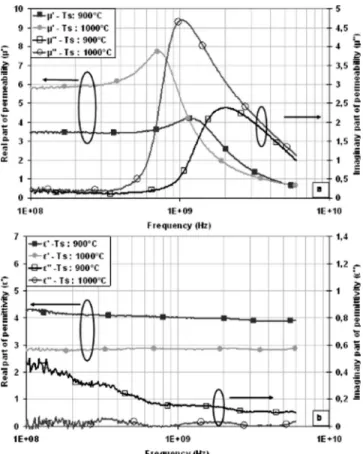
Starting from J2 powder previously calcinated at 650 ° C, two samples were sintered at TS= 900 ° C and TS
= 1000 ° C, respectively. The real part of permeability in-creases with the sintering temperature 关Fig. 3共a兲兴, whereas the maximum of
⬙
shift to low frequency according to Snoek’s law again.9The densification by sintering occurs in three steps as follows: bridge formation between grains, granular rearrangement, and then grain growth.10 The width of the resonance peak is notably increased by high sintering temperature 共1000 °C兲, this can be linked to grain growth. The observed decreases of⬘
and⬙
with increasing TS关Fig. 3共b兲兴 is also a marker of a reduced porosity. Dielectric looses are appreciably reduced when TS= 1000 ° C, due to ashrink-age of porosity that decreases area effects.
Low magnetic losses and satisfactory optical index are then obtained with J2 powder calcinated at TC= 650 ° C and
FIG. 1. Measured permeability共a兲 and permittivity 共b兲 spectra of the calci-nated green body.
FIG. 2. Measured permeability共a兲 and permittivity 共b兲 spectra after calci-nation and sintering共TS= 900 ° C兲.
TABLE I. Samples density as a function of heat treatments共powder density, 5.113 g cm−3兲. Calcination temperature 共°C兲 Sintering temperature 共°C兲 Density 共%兲 650 900 73.12 800 900 57.34 650 1000 87.71
09A518-2 Souriou et al. J. Appl. Phys. 107, 09A518共2010兲
sintered at TS= 900 ° C. However, dielectric losses tg␦⬘
re-main too high for the envisaged applications.
C. Influence of soaking
In order to get a reduced tg␦⬘ the samples are after-wards immersed into a solution of epoxy resin dissolved in acetone and dried. A fraction of voids is filled by the resin, and the global porosity of the sample is lowered共Table II兲. The measured permittivity and permeability are shown on Fig. 4. A noteworthy fall down of
⬙
promotes the so ob-tained material as a suitable one for antenna miniaturization in the frequency range 100–700 MHz.IV. CONCLUSION
Our experiments have shown that electromagnetic prop-erties of ferrites are influenced by several parameters. For a nanometric powder elaborated by coprecipitation, the calci-nation and the sintering temperatures must be chosen so that the final material fits desired electromagnetic requirements for the reduction of antenna size.
The heat treatment submitted to the studied ferrite pow-ders leads to a porous material with high ferrite content that
can be considered to lie in the intermediate state between the sintered ferrite and the composite. Then, we take advantage of the composite character of the obtained ceramic sample to get ferrite with satisfactory permeability and permittivity lev-els at unusual high resonance frequency for soft ferrites.
A striking point in the presented data is the low level of magnetic共and dielectric兲 loss tangents on a wide frequency range, which clearly distinguish our results.
ACKNOWLEDGMENTS
This work was supported by the Agence Nationale pour la Recherche共ANR-NAOMI project兲.
1H. Mosallaei and K. Sarabandi,IEEE Trans. Antennas Propag.52, 1558 共2004兲.
2S. Bae, Y. K.Hong, and A. Lyle,J. Appl. Phys.103, 07E929共2008兲. 3I. Kim, S. Bae, and J. Kim,J. Korean Phys. Soc.52, 127共2008兲. 4K. Buell, H. Mossallaei, and K. Sarabandi,IEEE Trans. Microwave theory
Tech.54, 135共2006兲.
5J. Holopainen, J. Villanen, M. Kyro, C. Icheln, and P. Vainikainen, An-tenna Technology Small AnAn-tennas and Novel Metamaterials, Proceedings of IEEE International Workshop, March 6–8, 2006共unpublished兲, pp.305– 308.
6R. Lebourgeois, J. Ageron, H. Vincent, and J.-P. Ganne, Proceedings of the ICF, Vol. 8, Kyoto共Japan兲 共2000兲, p. 373.
7L. Z. Wu, J. Ding, H. B. Jiang, C. P. Neo, L. F. Chen, and C. K. Ong,J. Appl. Phys.99, 083905共2006兲.
8P. Mathur, A. Thakur, and M. Singh,J. Magn. Magn. Mater.320, 1364 共2008兲.
9A. N. Lagarkov and K. N. Rozanov,J. Magn. Magn. Mater.321, 2082 共2009兲.
10R. Valenzuela, “Magnetic Ceramics”共Cambridge University Press, Cam-bridge, UK, 1994兲.
FIG. 3. Measured permeability共a兲 and permittivity 共b兲 spectra after calci-nation at 650 ° C and sintering.
FIG. 4. Measured permeability共a兲 and permittivity 共b兲 spectra after heat treatment 共TC= 650 ° C , TS= 900 ° C兲 followed by soaking with epoxy resin.
TABLE II. Measured electromagnetic parameters共frequency range 100–700 MHz兲 after soaking with epoxy resin 共amount of filled porosity: 21%兲.
tg␦=⬙/⬘ tg␦=⬙/⬘ 冑⬘⬘ Before soaking 0.043–0.115 0.054–0.067 3.75–3.90 After soaking 0.015–0.046 0.048–0.064 3.64–3.75
09A518-3 Souriou et al. J. Appl. Phys. 107, 09A518共2010兲