HAL Id: hal-02317508
https://hal.archives-ouvertes.fr/hal-02317508
Submitted on 16 Oct 2019
HAL is a multi-disciplinary open access
archive for the deposit and dissemination of
sci-entific research documents, whether they are
pub-lished or not. The documents may come from
teaching and research institutions in France or
abroad, or from public or private research centers.
L’archive ouverte pluridisciplinaire HAL, est
destinée au dépôt et à la diffusion de documents
scientifiques de niveau recherche, publiés ou non,
émanant des établissements d’enseignement et de
recherche français ou étrangers, des laboratoires
publics ou privés.
Study of MIMO Channel Matrices Correlation to
Optimize Resource Allocation Algorithms in
Multi-Users 5G
Malo Manini, Cedric Gueguen, Rodolphe Legouable, Xavier Lagrange
To cite this version:
Malo Manini, Cedric Gueguen, Rodolphe Legouable, Xavier Lagrange. Study of MIMO Channel
Ma-trices Correlation to Optimize Resource Allocation Algorithms in Multi-Users 5G. 12th IFIP Wireless
and Mobile Networking Conference, Sep 2019, Paris, France. �hal-02317508�
HAL Id: hal-02317508
https://hal.archives-ouvertes.fr/hal-02317508
Submitted on 16 Oct 2019
HAL is a multi-disciplinary open access
archive for the deposit and dissemination of
sci-entific research documents, whether they are
pub-lished or not. The documents may come from
teaching and research institutions in France or
abroad, or from public or private research centers.
L’archive ouverte pluridisciplinaire HAL, est
destinée au dépôt et à la diffusion de documents
scientifiques de niveau recherche, publiés ou non,
émanant des établissements d’enseignement et de
recherche français ou étrangers, des laboratoires
publics ou privés.
Study of MIMO Channel Matrices Correlation to
Optimize Resource Allocation Algorithms in
Multi-Users 5G
Malo Manini, Cedric Gueguen, Rodolphe Legouable, Xavier Lagrange
To cite this version:
Malo Manini, Cedric Gueguen, Rodolphe Legouable, Xavier Lagrange. Study of MIMO Channel
Ma-trices Correlation to Optimize Resource Allocation Algorithms in Multi-Users 5G. 12th IFIP Wireless
and Mobile Networking Conference, Sep 2019, Paris, France. �hal-02317508�
Study of MIMO Channel Matrices Correlation to
Optimize Resource Allocation Algorithms in
Multi-Users 5G
Malo Manini, C´edric Gueguen, Rodolphe Legouable, Xavier Lagrange
b-com, University of Rennes1/IRISA, IMT Atlantique/IRISA France
Email: {malo.manini, rodolphe.legouable,}@b-com.com; {cedric.gueguen}@irisa.fr;{xavier.lagrange}@imt-atlantique.fr;
Abstract—Resource allocation is a major research field in wireless networks. The main challenge is to find the most suitable user for each time and frequency resource to reach the quality of service requirements. The necessity to always increase the capacity of wireless networks leads to systems using more and more antennas. Namely, the use of Massive-MIMO (Multiple Input Multiple Output) allows to simultaneously schedule several users on the same frequency resource. This is a new paradigm for resource scheduling. In this context, resource allocation algorithms have to include in their decision mechanism the choice of users association on the same time and frequency resource. A possible strategy, seen in the state of the art, is to base this user grouping on their channel-matrix correlation to minimize the interference level. In this paper we show the limited use of this approach in a system using block diagonal precoder.
Index Terms—5G, Massive-MU-MIMO, Channel correlation, Resources allocation.
I. INTRODUCTION
One of the key technologies for 5G radio transmission is Massive-MIMO (Multiple Input Multiple Output) [1]. Having a larger number of antennas at the base station can significantly improve the link budget by focusing the energy in the chosen direction [2]. Focusing the energy can also be used to serve multiple users (MU) on the same time and frequency resource. This opens the way to conceiving new scheduling algorithms in order to take a real advantage from Massive-MIMO. The objective of this paper is to provide a better understanding of the MU mode in a massive MIMO context by comparing its total system rate with the one given by a traditional single-user (SU) approach.
More precisely, we compare two strategies. In the SU mode, only one user is served on a given time-frequency resource unit. There is no intracell interference. Several users are served by a classical round-robin scheduler. In the MU mode, several users are served on the same time-frequency unit. The total system rate is expected to be higher. However, there is intracell interference, which reduces the bit rate. A standard approach to estimate the interference level is to consider the correlation between the user-channel matrices [3], [4], [5]. Our secondary objective is to check whether the correlation is a good indicator of the total system rate or not.
I
II. SYSTEM DESCRIPTION
We consider one base station (BS) and several user equip-ment (UE) and we study the downlink transmission of one resource block (RB). The channel is assumed to be constant for all sub-carriers within a resource block. We define B as the bandwidth of the resource block, U as the set of all UEs in the cell, I as the set of all UE using simultaneously the same RB, and nt, nrthe number of antennas at the transmitter (BS) and at
the receiver (UE), respectively. The channel between the set of antennas at the BS and the set of antennas at UE i is modelled by complex matrix Hi. The precoding matrix at the BS is
represented by matrix Fi and the digital combining matrix at
UE i is represented by W∗i. The white noise average power is denoted by σN2. Note that the interference from neighbour base stations can be integrated in σN2.
The channel matrix of a UE i is given by Hi[t] ∈ Cnr×nt
and is perfectly known at the eNB. Different models can be used to compute the Hi[t] matrix, such as the ”one-ring”
model [6] or extended Saleh-Valenzuela model [7]. The total number of parallel transmissions that can be made on the same RB by one eNB is given by nt. The maximum number of
transmissions on the same RB to a given UE is min(nt, nr).
The time is considered discrete and ∆t is equivalent to a timeslot. We suppose the coherence time of the channel greater than ∆t and therefore the scheduling time.
1) Transmission model: At a given time, scheduling can be viewed as an indicator function: δi(t) where i is the UE index,
k the RB index and δi(t) ∈ [0, min(nt, nr)] gives the number
of streams on resource k allocated to i. We have the following constraint:
X
i∈U
δi(t) ≤ nt. (1)
The potential number of usable resources is given by nt×K,
where K is number of resource blocks. We assume that there is no limitation regarding the number of RF chains and the processing capacity. To illustrate the previous equation, we can consider a number of UEs equal to nt× K, for example
nt× K = 100. In this case UEs will only have 1 RB among
100 on average per timeslot. It is then safe to say that in most cases, δi(t) = 0.
For the sake of clarity we omit t for this part. We denote the precoding matrix associated to channel Hi as Fi∈ Cnt×δi,k.
The dimension of Fi depends on the number of antennas at
the eNB and the selected streams. The signal transmitted to UE i is :
xi= Fisi (2)
where i ∈ U and si[k] is the δi× 1 transmitted vector of
symbols at subcarrier k. Note that si[k] is null if δi= 0. The
global signal transmitted by the base station is:
X = X
j∈U ,δj>0
Fjsj (3)
At the receiver, the signal is affected by the channel matrix Hi, noise corrupting the received signal n of power σ2 and I
external cell interferences:
yi= HiX
| {z }
signal
+ I + n | {z }
external interf erences+noise
(4)
Due to the fact that we are considering a Multi-User transmission (MU-MIMO) the transmitted signal for other UEs scheduled on the same resource block has to be considered as internal interference: yi = HiFisi | {z } signal + X j6=i,δj>0 HiFjsj+ (I + n) | {z } interf erences+noise (5)
Those internal interferences depend on the precoders Fj
orthogonality to the channel matrix Hi. The signal at the
receiver after combining is finally given by:
zi= Wi∗HiFisi+ Wi∗
X
j6=i,δj>0
HiFjsj+ W∗i(n + I) (6)
where W∗i[k] is the digital combining matrix [8] and (.)∗
the conjugate transpose of a complex matrix.
2) Precoding techniques: Two precoding mechanisms are considered:
a) SVD: A MIMO channel Hi of a user i can be
decomposed using the singular-value decomposition (SVD) as follow:
Hi= UiΣiVi∗ (7)
The optimal precoder in SU-MIMO for i is Fi[2]:
Fi= ViΛ1/2 (8)
where Λ1/2is a diagonal matrix of which the element λiscales
the power transmitted.
b) Block Diagonal precoding [9][10]: In MU-MIMO several users can be scheduled simultaneously on the same resource block. In such condition, users can experience in-terferences from other users. The objective of the Block Diagonal precoder is to eliminate UEs interferences when they are scheduled in a MU-MIMO context. Therefore, all users that are simultaneously scheduled have to be consider in the precoding process.
We define ˜HT
i the concatenation of channel matrices of all
users in I except i: ˜
HTi = [H∗1...H∗i−1H∗i+1...H∗I]∗ (9) where I = card(I). Note that ˜HT
i is a nr× (I − 1) rows and
nt columns complex matrix. We are using the singular-value
decomposition on ˜HT i. ˜ HTi = UiTΣi[V (1) i V (0) i ] ∗ (10) where [Vi(1)Vi(0)] is a nt× nt matrix. V (1) i contains vectors
corresponding to nonzero singular values and Vi(0) contains vectors corresponding to zero singular values.
˜ HTiV˜i(0)= ˜UiΣ˜i[ ˜V (1) i V˜ (0) i ]∗ (11)
The total precoding matrix is given by:
TBD = [ ˜V1(0)V1(1)V˜2(0)V2(1)... ˜VI(0)VI(1)]Λ1/2 (12) where Λ1/2is a diagonal matrix of which the element λ
iscales
the power transmitted.
3) User Equipment throughput: For the MU mode, we consider the Block Diagonal (BD) precoding technique [10] because the BD precoder is focused on interference manage-ment and therefore limits the reduction of the bit rate due to the intracell interference. The bit rate for UE i is given by [11] : Ri= B log2 1nr+ W∗i HiFi (W∗i HiFi)∗ W∗ i (σ21nr+ P j6=i,δj>0 HiFj ( HiFj)∗)Wi (13) where1nr is an identity matrix of size nr.
In the SU mode, δiis non-zero for only one value of i. Thus,
there is no intracell interference and the rate Ciis maximized.
Equation (13) is simplified as: Ci= B log2 1 nr + Wi∗HiFi (Wi∗HiFi)∗ W∗ i (σ21nr)Wi (14) Our objective is to compare the total system rate for MU and SU strategies. With MU, nt/nr are served at the same time.
With SU, only one user is served. Serving nt/nr users is done
by considering nt/nr successive slots. We define ns as the
number of simultaneously scheduled users, where ns≤ nt/nr.
The spectral efficiency gain χ is:
χ = E "ns X i=1 Ri ,ns X i=1 Ci/ns # , (15)
where E is the mathematical expectation. We consider a large set of random deployments of terminals. Thus, Hiis a random
matrix. In the following, for different configurations, we study χ, which is thus our main performance indicator.
In MU-MIMO a good interference management is crucial to fully profit from the technique. As seen in [4] and [3] the channels matrices correlation is commonly used as an indicator for interferences level between UEs. The correlation of two UEs channel matrices indicates the interference level if they are using simultaneously the same resource block. The correlation of two UEs is defined by [12]:
ξ(i, j) = |tr( HiH
∗ j)|
|| Hi||F|| Hj||F
(16) where (.)∗ denotes the conjugate transpose operation and ||.||F the Forbenius norm of a matrix.
III. SIMULATION SET UP
Two user equipment (UE) are considered. The channels of the UEs are mutually independent. A channel for a user i is generated using the extended Saleh-Valenzuela model [7] where the obstructed-line-of-sight (OLOS) parameters are given in table I.
Λ 5 ns Cluster arrival rate λ 1 ns Ray arrival rate Γ 8.7 ns Cluster decay rate γ 4.7 ns Ray decay rate
σ 0.1 rad Intra-cluster angles standard deviation
TABLE I: Channel model parameters, from [7] We consider one sector in a typical 3-sector configuration: the angle between the terminal and the base station is between 0◦and 120◦horizontally and between −45◦and 45◦vertically. We assume that the transmitter has a full knowledge of the channel for each UE. Each antenna settings is tested over an average of 1 million configurations, where each configuration is a new independent set of random variables.
IV. IMPACT OF THE NUMBER OF ANTENNAS ON THE CORRELATION DISTRIBUTION
The number of antennas is a main strength of Massive-MIMO. The more antennas there are, the more precise the spatial separation will be. However, due to technical limita-tions, such as precoding complexity or room space available for mobile devices, the number of antennas is limited. 3GPP fixes the number of antennas at the transmitter and at the re-ceiver in the system evaluation framework. In our performance evaluation, we study different configurations to understand the impact on the correlation. In the following example we show the impact of the number of antennas, at the transmitter nt
and at the receiver nr, on UEs correlation repartition. For each
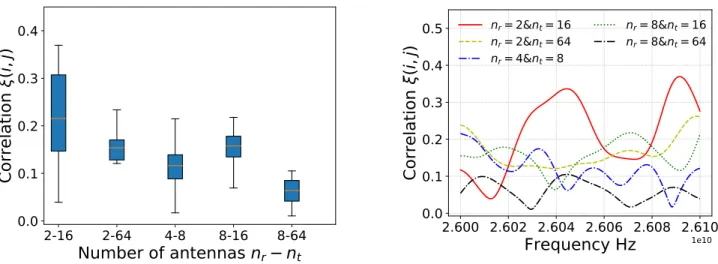
sample we compute the channel correlations of two UEs. Figure 1 shows the empirical PDF of the correlation. The CDF can be easily deduced from the PDF but is not shown due to space constraints. Several observations can be highlighted
Fig. 1: Correlation repartition depending on antenna numbers
Fig. 2: Spectral efficiency gain of MU-MIMO over SU-MIMO
from figure 1. The product of the number of antennas deter-mines the correlation repartition. Two antenna configurations having the same product have a close correlation repartition: configurations nr = 2&nt = 64 and nr = 8&nt = 16
have a nearly similar correlation distribution. Having a greater number of antennas allows the system to have more narrow beams, resulting in a lower average correlation. With nr =
8&nt = 64 there is a larger number of low correlation than
with nr= 2&nt= 16.
V. IMPACT OF THE CORRELATION ON THROUGHPUT
The main objective when designing a resource allocation algorithm is to increase the capacity of the system. To under-stand if the correlation is a good indicator for a scheduling process, we study the correlation impact on throughput. For each sample, we calculate the throughput gain from the MU-MIMO allocation, that is given by 15.
Fig. 3: Correlation over 100 MHz bandwidth at 26GHz
Fig. 4: Correlation over 10λ
Figure 2 shows χ values, computed in (15), for different antenna configurations. Each antenna configuration is repre-sented tree boxes with 0.1, 0.2 and 0.3 correlations. Concern-ing the throughput gain, for example, with nr = 2&nt = 16,
between 0.1 and 0.3 correlations, less than 3% of capacity is lost on average. The Block Diagonal precoding technique is built to withstand the increase of interferences. When the cor-relation increases, even if the spectral efficiency decreases, the precoder is able to contain the degradation. With an antenna configuration nr = 2&nt= 16 at a correlation of 0.2 they may
be more than 10% between the highest and lowest value of throughput. This difference depends on the degree of freedom available in the precoding process. To reduce the deviation the ratio nt
nr should be larger. The main issue in this example,
is the ability to predict the gain. In all configurations there
is an intersection between throughput values, meaning that the same throughput gain can be experienced with different correlation values. Note that in the case of nr = 8&nt = 16
and nr = 4&nt= 8, it is not even profitable to schedule two
UEs at the same time. They will both experience a smaller throughput than if they were scheduled in Single-User mode. VI. MOBILITY IMPACT ON THE CORRELATION BETWEEN
UES
In order to be able to use the correlation as an indicator, the correlation should be stable in frequency and in time when users are moving. The more variable the channel, the more frequent the correlation should be updated. There is thus a feasibility issue: requiring more Channel State Information feedbacks and more CPU resources. As seen in the simulation setup, we are considering two users with independent channel
matrices. The results are computed on one snapshot in each configuration. One user is static during the simulation, while the other user is moving and its channel adjusts accordingly. The purpose of this experiment is to determine if the correla-tion is stable enough to be calculated as often as possible for two UEs during a period of time and over a given bandwidth. Figure 3 shows the correlation evolution between two users depending on the frequency. Over 100 MHz bandwidth, the correlation significantly varies in amplitude but slowly in time. This shows that the variation of phase offset is not negligible over a large bandwidth. However, the rate variation is slow enough and only a few correlation calculations are needed by timeslot. Another variable factor is the displacement over time. Figure 4 shows the correlation evolution when a user moves from its original position. Distance is represented in λ, which is the wavelength, and 10λ at 26 GHz is travelled in roughly 84 ms. We can observe a high variability of the correlation with the distance changes, with a similar amplitude gap compares to figure 3. When the variation in frequency and distance are combined, the correlation stability might not be sufficient for an accurate calculation between scheduling decisions.
VII. CONCLUSION
Correlation is often used in the user selection process as an indicator to maximize the global throughput. In this study, we show the correlation repartition, the relation between correlation and throughput and the mobility impact on the correlation when using a Block Diagonal precoder. The repar-tition of the correlation depends on the product of the number of antennas at the transmitter and at the receiver. A higher product reduces the probability of high correlation values and diversity. The ratio between the number of receive and transmit antennas determines the variability of the throughput gain. A large number of transmitting antennas compared to number of receiver antennas makes the throughput gain more predictable. Finally, the correlation variability quickly changes over frequency and time, when a user is mobile. There is a substantial number of correlation calculations needed over time. As a summary, a user selection process, using Block Diagonal precoding, can barely benefit from a correlation indicator in different configurations, due to high variability with minimum effect on the throughput. MU-MIMO allows more than two users sharing the same resource block. In future works, we will study how a higher number of simultaneously scheduled users impacts the correlation and the corresponding throughput.
REFERENCES
[1] C.-X. Wang, F. Haider, X. Gao, X.-H. You, Y. Yang, D. Yuan, H. Ag-goune, H. Haas, S. Fletcher, and E. Hepsaydir, “Cellular architecture and key technologies for 5g wireless communication networks,” IEEE Communications Magazine, vol. 52, pp. 122–130, Feb. 2014. [2] E. Telatar, “Capacity of Multi-antenna Gaussian Channels: Capacity of
Multi-antenna Gaussian Channels,” European Transactions on Telecom-munications, vol. 10, pp. 585–595, Nov. 1999.
[3] T. Ji, C. Zhou, S. Zhou, and Y. Yao, “Low Complex User Selec-tion Strategies for Multi-User MIMO Downlink Scenario,” in 2007 IEEE Wireless Communications and Networking Conference, (Kowloon, China), pp. 1532–1537, IEEE, 2007.
[4] Z. Li, P. Li, and K. G. Shin, “MU-MIMO downlink scheduling based on users’ correlation and fairness,” in 2014 IEEE 25th Annual International Symposium on Personal, Indoor, and Mobile Radio Communication (PIMRC), (Washington DC, USA), pp. 407–412, IEEE, Sept. 2014. [5] Y. Shimbo, N. Hiruma, H. Suganuma, and F. Maehara, “Control
Overhead Reduction Method Employing Frequency Correlation for MU-MIMO-OFDM THP with User Scheduling,” in 2018 IEEE 87th Vehicular Technology Conference (VTC Spring), (Porto), pp. 1–5, IEEE, June 2018.
[6] D.-S. Shiu, G. J. Foschini, M. J. Gans, and J. M. Kahn, “Fading corre-lation and its effect on the capacity of multielement antenna systems,” IEEE Transactions on communications, vol. 48, no. 3, pp. 502–513, 2000.
[7] C. Gustafson, K. Haneda, S. Wyne, and F. Tufvesson, “On mm-Wave Multipath Clustering and Channel Modeling,” IEEE Transactions on Antennas and Propagation, vol. 62, pp. 1445–1455, Mar. 2014. [8] A. Alkhateeb and R. W. Heath, “Frequency Selective Hybrid Precoding
for Limited Feedback Millimeter Wave Systems,” IEEE Transactions on Communications, vol. 64, pp. 1801–1818, May 2016.
[9] F. Boccardi and H. Huang, “A Near-Optimum Technique using Linear Precoding for the MIMO Broadcast Channel,” in 2007 IEEE Interna-tional Conference on Acoustics, Speech and Signal Processing - ICASSP ’07, (Honolulu, HI), pp. III–17–III–20, IEEE, Apr. 2007.
[10] M. H. A. Khan, K. M. Cho, M. H. Lee, and J.-G. Chung, “A simple block diagonal precoding for multi-user MIMO broadcast channels,” EURASIP Journal on Wireless Communications and Networking, vol. 2014, no. 1, p. 95, 2014.
[11] A. M. A. Abdo, X. Zhao, R. Zhang, Z. Zhou, J. Zhang, Y. Zhang, and I. Memon, “MU-MIMO Downlink Capacity Analysis and Optimum Code Weight Vector Design for 5g Big Data Massive Antenna Millimeter Wave Communication,” Wireless Communications and Mobile Comput-ing, vol. 2018, pp. 1–12, 2018.
[12] N. Czink, B. Bandemer, G. Vazquez-Vilar, L. Jalloul, C. Oestges, and A. Paulraj, “Spatial separation of multi-user MIMO channels,” in Personal, Indoor and Mobile Radio Communications, 2009 IEEE 20th International Symposium on, pp. 1059–1063, IEEE, 2009.
![TABLE I: Channel model parameters, from [7]](https://thumb-eu.123doks.com/thumbv2/123doknet/12255146.320363/5.918.478.809.103.354/table-i-channel-model-parameters-from.webp)