HAL Id: tel-01914122
https://tel.archives-ouvertes.fr/tel-01914122
Submitted on 6 Nov 2018
HAL is a multi-disciplinary open access archive for the deposit and dissemination of sci-entific research documents, whether they are pub-lished or not. The documents may come from teaching and research institutions in France or abroad, or from public or private research centers.
L’archive ouverte pluridisciplinaire HAL, est destinée au dépôt et à la diffusion de documents scientifiques de niveau recherche, publiés ou non, émanant des établissements d’enseignement et de recherche français ou étrangers, des laboratoires publics ou privés.
A trust framework for real-time web communications
Ibrahim Tariq Javed
To cite this version:
Ibrahim Tariq Javed. A trust framework for real-time web communications. Networking and Internet Architecture [cs.NI]. Institut National des Télécommunications, 2018. English. �NNT : 2018TELE0016�. �tel-01914122�
PhD DEGREE IN COMPUTER SCIENCE AND TELECOMMUNICATION
Doctorate jointly delivered by
the Telecom SudParis and University Pierre Marie Curie (UPMC)
Specialty:
Computer Science and Networks
National Thesis Number (NNT):
2018TELE0016
Author:
Ibrahim Tariq JAVED
A Trust Framework for Real-time Web
Communications
Ph.D defense on 4th October, 2018. Committee in charge:
Thesis Director Noel Crespi Telecom SudParis
Jury President & Examiner Joaquin GARCIA-ALFARO Telecom SudParis, France
Reviewer Jeaseung SONG Sejong University, South Korea
Reviewer Gyu Myoung LEE Liverpool John Moores University, United Kingdom
Examiner Rami LANGAR University Paris-Est-Marne-La-Vallée, France
Examiner Joaquin GARCIA-ALFARO Telecom SudParis, France
Dedication
To my honorable mother Iram Tariq
Life doesn’t come with a manual. It comes with a mother. I dedicate this work as a token of my deep love for her. Thank you for all your support and prayers.
To my respected father Tariq Javed
I am especially thankful for your love, your understanding and your continuous support. Thanks for always believing in me.
To my beloved wife Bakhtawar Shahid
I am particularly in debt for your unconditional trust and sincere love. Thanks for always standing by my side and for the fun moments I have
shared with you.
Dedication
Acknowledgment
First and foremost, I would like to thank my God for giving me the strength, knowledge, ability and opportunity to undertake this research and complete it satis-factorily. Without His blessings, this achievement would not have been possible.
I would like to thank my thesis director Prof Noel Crespi, who gave me the op-portunity to do this research and provided me all the support and freedom one could wish for. I would like to thank him for all his help, suggestions and encouragement. More thanks goes to Khalifa Toumi who was mentoring me for the last two years of my P.h.D. We have discussed a lot and I really appreciate as well as enjoy the time working with him. His constructive remarks helped me to build my personal point of view about trust management.
My profound love, respect and thanks goes to my family, my mother Iram Tariq, my father Tariq Javed, my sisters Eman Tariq and Ahlam Tariq, and my wife Bakhtawar Shahid. They have always boosted me with encouragement to achieve this new milestone of my life. I hope they find here the expression of my deep grati-tude and appreciation.
Lastly, many thanks to all my friends and colleagues who supported me during my PhD.
Acknowledgment
Abstract
Abstract
Real-time web conversational services allow users to have audio and video calls over
the Internet. Over-The-Top operators such as Google and Facebook offer
cost-effective communication services with advanced conversational features. With the introduction of WebRTC standard, any website or web application can now have built-in communication capabilities. WebRTC technology is expected to boost Voice-Over-IP by making it more robust, flexible and accessible. Telco operators intend to use the underlying technology to offer communication services to their subscribers over the web. The web-centric communication platforms aims to offer modern meth-ods of contacting and communicating over the web.
However, web operators are unable to ensure the trustworthiness of their sub-scribers, since identities are based on self-asserted user profiles and credentials. Thus, they remain exposed to many social threats in which the context between communi-cating parties is manipulated. An attacker usually misrepresents himself to convey false information to the targeted victim. Typical social threats include phishing, spam, fraudulent telemarketing and unlawful content distribution. To ensure user security over communication networks, trust between communicating parties needs to be established. Communicating participants should be able to verify each other’s identity to be sure of whom they are talking to. However, authentication alone can-not guarantee the trustworthiness of a caller. New methods of estimating caller’s reputation should also be built in web calling services.
In this thesis, we present a novel trust framework that provides information about
the trustworthiness of callers in web communication networks. Our approach is
organized in four parts. Firstly, we describe the notion of trust in real-time web communication services. A trust model approach is presented to formally introduce the trust computation parameters and relationships in a communication system.
Secondly, we detail the mechanism of identity provisioning that allows com-municating participants to verify each other’s identity in a Peer-to-Peer fashion. The choice of authentication protocol highly impacts user privacy. We showed how OpenID Connect used for Single-Sign-On purposes can be adopted for provisioning identities while preserving user privacy.
Thirdly, a trust computational model is proposed to measure the trustworthiness of callers in a communication network. The legitimacy and genuineness of a caller’s identity is computed using recommendations from members of the network. On the other hand, the popularity of a caller is estimated by analyzing its behavior in the network. Each subscriber will be able to visualize the computed trust of other members before initiating or accepting a call request.
Lastly, the reputation of a caller is used to combat nuisance calls generated over
communication networks. Nuisance calls are described as unsolicited bulk spam
phone calls generated for marketing and deceptive purposes. Caller’s reputation is computed using the diversity of outgoing calls, call duration, recommendations from
Abstract
called participants, reciprocity and repetitive nature of calls. The reputation is used to differentiate between legitimate and nuisance calls generated over the network.
Keywords: Trust Computation, Real-time Web Communication, WebRTC, Spam Over Internet Telephony.
Abstract
Résumé:
Les services de conversation Web en temps réel permettent aux utilisateurs d’avoir des appels audio et vidéo et de transférer directement des données sur Internet. Les opérateurs OTT (OTT) tels que Google, Skype et WhatsApp proposent des services de communication économiques avec des fonctionnalités de conversation évoluées. Avec l’introduction de la norme de Web Real Time Communication (WebRTC), n’importe quelle page Web peut désormais offrir des services d’appel. WebRTC est utilisé comme technologie sous-jacente pour déployer de nouvelles plateformes de communication centrées sur le Web. Ces plates-formes visent à offrir de nouvelles méthodes modernes de contact et de communication sur le web. Contrairement aux réseaux de télécommunication traditionnels, les identités sur le Web sont basées sur des profils d’utilisateur et des informations d’identification auto-affirmés. Par con-séquent, les opérateurs Web sont incapables d’assurer la fiabilité de leurs abonnés. Les services de communication Web restent exposés à des menaces dans lesquelles le contexte social entre les parties communicantes est manipulé. Un attaquant se définit comme une entité de confiance pour transmettre de fausses informations à l’utilisateur ciblé. Les menaces typiques contre le contexte social comprennent la fausse représentation d’identité, le hameçonnage, le spam et la distribution illégale de contenu. Afin d’assurer la sécurité sur les services de communication Web, la con-fiance entre les parties communicantes doit être établie. La première étape consiste à permettre aux utilisateurs d’identifier leurs participants communicants afin de savoir avec qui ils parlent. Cependant, l’authentification seule ne peut garantir la fiabilité d’un appelant. De nouvelles méthodes d’estimation de la réputation de l’appelant devraient également être intégrées dans les services d’appel Web. Par conséquent, dans cette thèse, nous présentons un nouveau cadre de confiance qui fournit des infor-mations sur la fiabilité des appelants dans les réseaux de communication Web. Notre approche est organisée en quatre parties. Premièrement, nous décrivons la notion de confiance dans la communication web en temps réel. Un modèle de confiance est présenté pour identifier les relations de confiance nécessaires entre les entités d’un système de communication. Les paramètres requis pour calculer la confiance dans les services de communication Web sont officiellement introduits. Deuxièmement, nous montrons comment les protocoles Single-Sign-On (SSO) peuvent être utilisés pour authentifier les utilisateurs d’une manière Peer-to-Peer (P2P) sans dépendre de leur fournisseur de service. Nous présentons une comparaison entre trois protocoles d’authentification appropriés (OAuth, BrowserID, OpenID Connect). La comparai-son montre que OpenID Connect est le meilleur candidat en termes de confidentialité des utilisateurs. Troisièmement, un modèle de calcul de confiance est proposé pour mesurer la fiabilité des appelants dans un réseau de communication. La légitimité et l’authenticité d’un appelant sont calculées à l’aide de recommandations, tandis que la popularité d’un appelant est estimée en utilisant son comportement de com-munication. Un abonné d’un service de communication sera capable de visualiser
Abstract
la confiance calculée d’autres membres avant d’initier ou d’accepter une demande d’appel. Enfin, la réputation d’un appelant est utilisée pour lutter contre les appels nuisibles générés sur les réseaux de communication. Les appels de nuisance sont décrits comme des appels de spam non sollicités en masse générés sur un réseau de communication à des fins de marketing et de tromperie. Les enregistrements de don-nées d’appel et les commentaires reçus par les parties communicantes sont utilisés pour déterminer la réputation de l’appelant. La réputation évaluée est utilisée pour différencier les spammeurs et les appelants légitimes du réseau.
Abstract
Dedication
Thesis Publications
Journal papers
• Ibrahim Tariq Javed, Rebecca Copeland, Noel Crespi,..., Ricardo Lopes Pereira, "Cross-Domain Identity and Discovery Framework for Web Calling Services", Springer Annals of Telecommunication Journal, June 2017.
• Ibrahim Tariq Javed, Khalifa Toumi and Noel Crespi, " TrustCall: A Trust Computation Model for Web Conversational Services ", in IEEE Access, vol. 5, pp. 24376-24388, 2017.
Conference papers
• Ibrahim Tariq Javed, Khalifa Toumi, Noel Crespi," N-Combat: A Nuisance Call Combating Framework for Internet Telephony ", IEEE TrustCom 2018, (Accepted).
• Ibrahim Tariq Javed, Khalifa Toumi, Noel Crespi " ProtectCall: Call Protec-tion based on User ReputaProtec-tion ", IEEE TrustCom 2017, 1-4 August, Sydney Australia.
• Ibrahim Tariq Javed, Khalifa Toumi, Noel Crespi, A. Mohammadinejad " Br2Br: A Vector-based Trust Framework for WebRTC Calling Services ", IEEE HPCC 2016, 12-14 December, Sydney Australia.
• Ibrahim Tariq Javed, Khalifa Toumi, Noel Crespi, " Browser-to-Browser Au-thentication and Trust Relationships for WebRTC ", The Tenth International Conference on Mobile Ubiquitous Computing, Systems, Services and Technolo-gies UBICOMM, October 9 - 13, 2016, Venice, Italy. [Best Paper Award] • Ibrahim Tariq Javed, Rebecca Copeland, Noel Crespi,..., Nuno Santo, " Global
Identity and Reachability Framework for Interoperable P2P Communication Services " 19th International ICIN Conference - Innovations in Clouds, Internet and Networks - March 1-3, 2016, Paris, France.
Standardization
• Rebecca Copeland, Keven Corre, Ingo Friese, Saad El Jaouhari, Ibrahim Tariq Javed, Noel Crespi, Ahmad Bouabdallah, Simon Becot, " Requirements for Trust and Privacy in WebRTC Peer-to-peer Authentication ", IETF Internet Draft, Sep 2016.
Contents
I Introduction 29
II State of the Art: 41
1 Background and Literature Review 43
1.1 Introduction . . . 44
1.2 Real-Time Web Communication Services . . . 44
1.2.1 Telecommunication Architectures . . . 45
1.2.2 WebRTC standard . . . 47
1.2.3 Web-Centric Communication Platforms . . . 49
1.2.4 Identity Management . . . 51
1.3 Threat Taxonomy for Web Communication . . . 53
1.3.1 Threats Against Availability . . . 54
1.3.2 Threats Against Confidentiality . . . 54
1.3.3 Threats Against Integrity . . . 55
1.3.4 Threats Against Social Context . . . 55
1.3.5 WebRTC Security Considerations . . . 56
1.4 Trust Management . . . 57
1.4.1 The notion of Trust . . . 57
1.4.2 Trust System Classification . . . 58
1.4.3 Trust Computation in Online Applications . . . 59
1.4.4 Trust in Real-Time Web Communications . . . 62
1.5 Conclusion . . . 63
III Trust Framework for Real-Time Web Communications 65
2 Trust Model for WebRTC 67
2.1 Introduction . . . 68
2.2 WebRTC Security Architecture . . . 68
2.3 Br2Br: A Vector based Trust Framework . . . 70
2.4 Trust Evaluation Parameters . . . 74
2.4.1 Experience . . . 74
2.4.2 Identification . . . 76
2.5 Trust Relationships . . . 82
2.6 User Scenario . . . 86
2.7 Conclusion . . . 88
3 Identity Provisioning in WebRTC 89
3.1 Introduction . . . 90
3.2 WebRTC Call Model . . . 90
3.3 Authentication in WebRTC . . . 92
3.3.1 Requirements for User Identification . . . 94
3.4 SSO Authentication protocols . . . 95
3.4.1 BrowserID . . . 95
3.4.2 OAuth . . . 96
3.4.3 OIDC . . . 97
3.5 Identity Provisioning using SSO Protocols . . . 98
3.5.1 BrowserID . . . 98
3.5.2 OAuth . . . 99
3.5.3 OIDC . . . 100
3.5.4 Comparison . . . 101
3.6 Conclusion . . . 103
4 Trust Computational Model 105
4.1 Introduction . . . 106 4.2 Related Work . . . 106 4.3 Threat Taxonomy . . . 108 4.4 TrustCall Model . . . 110 4.4.1 Authenticity Trust . . . 112 4.4.2 Behavioral Trust . . . 116
4.5 Experiments and Results . . . 119
4.5.1 Experimental Setup . . . 120
4.5.2 Performance Evaluation of Authenticity Trust . . . 121
4.5.3 Performance Evaluation of Behavioral Trust . . . 126
4.5.4 Effectiveness of TrustCall . . . 128
4.6 Conclusion . . . 130
5 Combating Nuisance Calls 133
5.1 Introduction . . . 134
5.2 Related Work . . . 134
5.3 Nuisance Call Model . . . 136
5.4 Nuisance Call Combating Framework . . . 138
5.4.1 Call Data Record . . . 138
5.4.2 Reputation Module . . . 139
5.4.3 Watchdog . . . 142
5.4.4 Call Service Controller . . . 142
5.5 Experimentation and Results . . . 143
5.5.1 Network generation . . . 143
5.5.2 N-Combat Performance . . . 144
5.5.3 Comparison . . . 148
5.6 Conclusion . . . 149
IV Conclusion 151
List of Figures
1 Thesis Plan . . . 36
1.1 Comparison of Telecommunication models . . . 45
1.2 Threat Taxonomy . . . 53
1.3 Trust system Classification . . . 58
2.1 WebRTC Security Architecture . . . 69
2.2 User identification in WebRTC Call Model . . . 70
2.3 WebRTC Trust Model . . . 71
2.4 Set of Behaviors . . . 75
2.5 Oldest Interval Impact . . . 76
2.6 Identification Scenario . . . 77
2.7 Trust Relationships in WebRTC . . . 82
2.8 User Scenario Example . . . 86
2.9 Bob and Charlie Trust Representation . . . 87
2.10 Dynamic Trust Evaluation for " Web2Call " . . . 88
3.1 WebRTC Communication Model . . . 91
3.2 End-to-End Authentication Flow Diagram . . . 92
3.3 BrowserID Authentication Overview . . . 96
3.4 OAuth Authorization Overview . . . 97
3.5 OIDC Authentication Overview . . . 98
4.1 TrustCall Architecture . . . 110
4.2 Trust computation error in the presence of traitors . . . 122
4.3 Trust computation error in the presence of Sybil Attack . . . 123
4.4 Trust computation error in the presence of collusive grouping . . . 124
4.5 Performance of TrustCall in the presence of malicious peers . . . 126
4.6 Mean degree of the network . . . 127
4.7 Mean talk time of the network . . . 127
4.8 Performance Comparison: User Satisfaction in Non-Collusive Network 129
4.9 User Satisfaction in Collusive Network . . . 130
4.10 User Satisfaction under Sybil attacks . . . 131
5.1 Functional Architecture of N-Combat . . . 138
5.2 Caller’s neighborhood in communication network . . . 140
5.4 Impact of Spam reports . . . 145
5.5 Affect of reputation threshold . . . 145
5.6 Detection accuracy with increasing time . . . 146
5.7 Detection accuracy of different types of callers . . . 146
5.8 Performance Comparison using False Positive Rate . . . 148
Part I
" The beginning is the most important part of the work. " Plato, The Republic
Background and Motivation
Telecom operators that offer traditional voice telephony services are unable to compete with the web-based Over-The-Top (OTT) service providers. OTT communication services use the Internet infrastructure to provide Voice-over-the-Internet-Protocol (VoIP) services to their sub-scribers. For instance, Skype being one of the most prominent OTT service provider offers free calling between its subscribers and low-cost calling services to non-subscribers. Skype has more than 300 million monthly active users who spent nearly 3 billion minutes per day commu-nicating [SKY03]. Whatsapp is an another popular OTT communication application that allows its subscribers to send and receive voice/video calls, texts, photos, videos, files, and location without paying for the service. OTT communication applications are platform and device inde-pendent allowing subscribers to communicate using different devices and operating systems.
The ever growing market of VoIP call services are expected to in-crease to US $194.5 billion [Per]. With the introduction of Web Real-Time Communication (WebRTC) standard, developers can now embed VoIP capabilities into their websites or web applications. WebRTC al-lows making phone calls, video calls, text chats and file transfers, directly through web browsers or mobile applications. WebRTC standard is ex-pected to boost VoIP into novel communication platforms that will in-troduce new modern methods of contacting and communicating over the web. It will allow VoIP market to grow faster in terms of subscribers, rev-enues and traffic. Telecom operators have started investing into the web paradigm to compete with existing OTT web operators. They intend to develop novel web-centric communication platforms using the underlying Peer-to-Peer (P2P) WebRTC technology to deploy their services. These platforms aim to provide features that current OTT service providers do not offer such as cross-domain interoperability, identity portability, enhanced security and Quality-of-Service (QoS) beyond best effort.
The web-centric communication platforms face two technical chal-lenges related to identity management. The first challenge is user dis-covery which involves an efficient identity resolution system that maps user identities to the currently available web address of user’s device. The second challenge is to ensure the trustworthiness of user identities. In traditional communication networks user identities are considered to be trustworthy, since a subscriber has to proof its identity in person when registering to a service. User’s identity is always linked to a secure element such as SIM card or a fixed line identifier. Malicious activities can easily be tracked down by the operator. Regulatory authorities can take necessary actions against malicious callers to secure communication networks. However, identities are managed quite differently by web op-erators. OTT operators allow anyone to access their services globally by creating a user profile with self asserted user information. The user pro-file is managed and maintained by the service provider in a centralized manner.
Web communication services remain exposed to several social secu-rity threats in which the context between communicating participants is manipulated. Typical threats agaisnt social context include identity mis-representation, phishing and spam. Identity misrepresentation facilitates an attacker to present fraudulent information, such as a false name, or-ganization, email address, or presence information. Phishing is the most common way to illegally obtain somebody’s personal information such as password, bank account number, credit card information over a commu-nication network. Moreover, the free of cost web commucommu-nication services have attracted telemarketers to generate spam calls. Spam calls can be manually or automatically generated bulk phone calls for marketing and advertisement purposes. Voice spam is considered to be much more dis-ruptive in nature than email or social spam as they require immediate response from the recipient.
WebRTC architecture allows communicating participants to validate user identity during a call. This is facilitated by the use of third party independent Identity Provider (IdP). The use of IdP allows communi-cating participants to identify each other independent from their ser-vice. Identity provisioning is the generation, exchange and verification of identity assertions between communicating participants. Efficient and
secure authentication mechanisms are required for this purpose of iden-itfing provisioning. However, authentication alone cannot guarantee the trustworthiness of callers in a communication network. New methods to compute caller’s reputation should also be built in web calling services. The information about trustworthiness of callers will enhance user se-curity by protecting them from different social sese-curity threats present over communication networks.
Thesis objectives and contributions
In this subsection, we present the main objectives of this thesis. To address each objective we provide one or more contributions. The main aim of this thesis is to design a novel trust framework for real-time web communication services. The framework aims to provide information about trust in a communicating party. The main objectives are as fol-lows:
• To define the notion of trust in real-time web communication. The aim is to provide a formal definition of trust, identify the required trust relationships and specify necessary parameters required to compute trust in web communication services.
• To securely authenticate communicating participants in a privacy enabled manner. The aim is to allow communicating participants to securely verify each other’s identity while preserving their privacy.
• To design a trust computational model that is able to estimate the trustworthiness of callers over the network. The aim is to com-pute caller’s reputation by analyzing its behavior and information provided by other members of the network.
• To use caller’s reputation to combat nuisance calls over communi-cation network. The aim is to compute callers reputation in order to differentiate between nuisance and legitimate call.
Our approach to design the trust framework is organized into four major parts. We discuss the major contributions in this thesis as follows:
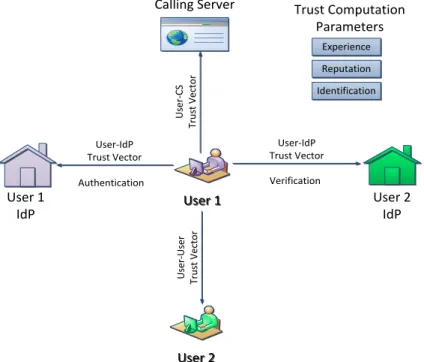
First Contribution: In our first contribution, we present a vector based trust model for representing trust in WebRTC security architec-ture. The model formalizes the notion of trust, distrust and mistrust. A trust vector is used to represent trust relationships between a truster and trustee. The model defines three trust relationships in real-time web communications. The first vector is used represent trust between user and its service provider. The second vector represents trust be-tween user and identity provider whereas third vector represents trust between communicating participants. In order to compute trust, the model defines three parameters namely experience, reputation and iden-tification. The experience parameter is based on the past performance of the trustee in a given context over a specified period of time. The iden-tification parameter determines the strength in authentication process of the communicating participant. Whereas the reputation parameter is the weighted aggregate of the average recommendation received about a trustee.
Second Contribution: Subscribers of communication services want to be certain that they are speaking to the person that he/she claims to be. For this purpose, communicating participants should be able to verify each other’s identity before establishing a communication session. Identity provisioning is the generation, exchange and verification of iden-tity assertions between communication participants. RTCWEB working group propose the use of existing SSO protocols for identity provision-ing. The selection of a particular authentication protocol profoundly affect the overall security and privacy of user identities. In this contri-bution, we propose the use of OpenID Connect (OIDC). We compared OIDC with OAuth and Browserid in terms of privacy properties such as anonymity, unlinkability, audience control etc. The comparison shows that OIDC is the best candidate in terms of user privacy for the exchange of identity assertions between communicating participants.
Third Contribution A trust computational model is proposed to compute the reputation of callers over web conversational services. The trust model is comprised of three components namely, information col-lection, trust computation and trust dissemination. The data is collected using recommendations from other members of the network and call data records. The reputation of the caller is determined by evaluating
ticity and behavioral trust. Authenticity trust describes the legitimacy of a caller by collecting recommendations from other members of the net-work, whereas behavioral trust determines the caller’s popularity based on its communication behavior. The trust dissemination unit allows any user to visualize the computed trust of other members of the network be-fore initiating or accepting a call request. A network of communicating peers is simulated to test the feasibility and effectiveness of our proposed trust model. We compare the performance of our model with the popular recommendation based trust model PeerTrust. The comparison shows that TrustCall performs better in terms of user satisfaction and trust computational error.
Fourth Contribution: In our fourth contribution, we propose a nui-sance call combating mechanism to effectively mitigate manually and au-tomatically generated nuisance calls over communication networks. The caller’s reputation is computed using total call duration, out-degree, reci-procity and repetitive nature of calls, feedback and the reliability of com-municating participants. To address the dynamic behavior of callers, the concept of a dual time window is used. White washing allows spammers to shed their bad reputation and re-enter the network with a new identity. Therefore, a watchdog mechanism is proposed to combat whitewashing attacks in communication services. We evaluate the performance of our proposed solution in the presence of four types of callers namely ordinary, specific, telemarketers and auto-dialers. We compare our approach with two existing spam combating models namely Progressive Multi Gray-leveling (PMG) and Discrete Event System Specification (DEVS). Our approach is able to detect spammers while having a very low false neg-ative rate when compared to existing threshold based spam detection methods.
Figure 1 summarizes our thesis plan. The organization and content of each chapter are as follows:
Chapter 1: This chapter presents the literature review on real-time web communication and trust management. The chapter’s introduction is presented in Section 1.1. Section 1.2 presents a comparison of telco and web operated communication services. This section also introduces WebRTC standard and novel web-centric communication platforms
be-General Introduction
Literature Review
Contributions
Conclusion
Web Real-Time CommunicationsTrust and Identity Management
A vector based trust model
Trust computational model
Combating Spam Calls
Chapter 1
Identity provisioning for WebRTC
Chapter 2
Chapter 3
Chapter 4
Chapter 5
Figure 1: Thesis Plan
ing deployed. Section 1.3 presents the threat taxonomy for real-time web communication applications. The threat taxonomy include threats against availability, confidentiality, integrity and social context. This state of the art motivates the use trust to combat social security threats. Therefore, Section 1.4 presents the literature review for the computation of trust in online applications. It also presents the challenges for trust computation in real-time web communication.
Chapter 2: This chapter presents a trust model "Br2Br" to define the notion of trust in WebRTC architecture. The chapter is structured as follows: Section 2.1 presents the introduction. Section 2.2 describes the WebRTC security architecture presented by RTCWEB working group. The vector based trust model " Br2Br " is presented in Section 2.3. The parameters used for trust evaluation are introduced and formalized in Section 2.4. Three trust relationships of a user in WebRTC are identified in Section 2.5. Section 2.6 presents a user scenario utilizing our trust model. Finally, in Section 2.7 we provide our conclusion for this chapter.
Chapter 3: This chapter studies the WebRTC call model in detail and presents a comparison between suitable authentication protocols for
user identification. The chapter is structured as follows: Section 3.1 presents the introduction of the chapter. Section 3.2 gives a brief intro-duction of WebRTC call model and Section 3.3 explains the process of user identification in P2P fashion. Section 3.4 describes the architecture of three SSO authentication protocols namely OAuth, BrowserID and OpenID Connect. Section 3.5 presents a comparison between the three authentication protocols in terms of user privacy when used for WebRTC call model. The chapter concludes with Section 3.6.
Chapter 4: In this chapter, a novel trust computational model "TrustCall " is introduced. The chapter is structured as follows: the introduction is present in Section 4.1 the related work is described in Section 4.2. A threat taxonomy for real-time web conversational ser-vices is presented in Section 4.3. The three components of ’TrustCall ’ model: information collection, trust computation and trust usage are de-scribed in Section 4.4. In Section 4.5, various experiments are conducted to prove the feasibility and effectiveness of the TrustCall model. Finally the conclusion is provided in Section 4.6
Chapter 5: In this chapter, a nuisance call combating framework "N-Combat " is introduced to mitigate automatically and manually generated spam calls. The chapter is structured as follows: Section 5.1 presents the introduction of chapter. The related work is provided in Section 5.2 and the nuisance call detection model is described in Section 5.3. The framework with the details of its components is presented in Section 5.4. In Section 5.5, experiments are conducted to prove the feasibility and robustness of our proposed framework. Finally, we offer our conclusions and recommendations for future work in Section 5.6.
Overview of my Publications
During this thesis 7 papers (5 conferences and 2 Journals) were pub-lished in well reputed conferences and journals. The author is listed as the first author in all the papers mentioned. The author also contributed to IETF Internet draft titled as " Requirements for Trust and Privacy in WebRTC Peer-to-Peer Authentication " published on September 26,
2016.
The title of paper I is " Global Identity and Reachability Framework for Interoperable P2P Communication Services ". The paper was pub-lished in the proceeding of 19th International Innovations in Clouds, In-ternet and Networks (ICIN) 2016 held on March 1-3, 2016, Paris, France. The paper is a joint contribution with partners of H2020 EU reTHINK project partners. This paper consists of an initial prototype of a web-based global identity and reachability framework that allow users of a specific domain to discover, locate and identify communication partici-pants from different domains.
The title of paper II is " Browser-to-Browser Authentication and Trust Relationships for WebRTC ". The paper was published in the 10th International Conference on Mobile Ubiquitous Computing, Sys-tems, Services and Technologies (UBICOMM) held on October 9-13, 2016, Venice, Italy. This paper details the WebRTC identity architec-ture and how identity provisioning can be conducted in an efficient and secure manner. The paper received Best Paper Award in the confer-ence.
The title of paper III is " Br2Br: A Vector-based Trust Framework for WebRTC Calling Services ". The paper was published in the proceeding of IEEE High Performance Computing and Communications (HPCC) 2016 held on 12-14 December, Sydney Australia. The conference is ranked B according to CORE ranking 2018. The paper consist of a trust framework presenting different trust relationships and trust parameters that can be used to compute trust.
The title of paper IV is " Cross-Domain Identity and Discovery Frame-work for Web Calling Services " published in Springer Annals of Telecom-munication Journal, June 2017. The paper provides an cross-domain identity and reachability framework for web communication platforms. The identity framework allows global discovery; cross-domain interoper-ability and identity portinteroper-ability which current identity management sys-tems do not offer. The Journal has an impact factor of 1.412.
The title of paper V is " ProtectCall: Call Protection based on User Reputation ". This paper was published in the proceeding of IEEE Trust-Com 2017 held on 1-4 August, Sydney Australia. The conference is ranked A according to CORE 2018. The paper proposes three
eters namely authenticity, credibility and popularity to compute trust between communicating peers in web communication service.
The title of paper VI is " TrustCall: A Trust Computation Model for Web Conversational Services " published in IEEE Access, vol. 5, pp. 24376-24388, 2017. This paper consists of a trust computation model for web conversational services. IEEE Access Journal received an impact factor of 3.244 in the 2016 JCR release. It is an award-winning, multidisciplinary, all-electronic archival journal.
The title of paper VII is " N-Combat: A Nuisance Call Combating Framework for Internet Telephony ". This paper is published in the proceeding of IEEE Trustcom 2018. The paper provides solution to mitigate spam calls by using caller’s reputation. The conference is ranked A by the Computing Research and Education Association of Australasia.
Project Contribution
The work in this thesis has been performed as a part of European Union’s Horizon 2020 research and innovation project titled as " re-THINK Trustful hyper-linked entities in dynamic networks ". The work is performed under grant agreement No 645342 by a consortium of 3 global telecom, 2 SMEs, 2 Universities and 2 leading research insti-tutes. The partners include Orange, Deutsche telekom, Portugal Tele-com, EuresTele-com, Quobis, Apizee, IMT, TU Berlin, Fokus Frauhofer and INESCID.
The main goal of the reTHINK project was to design and prototype a new, non telecom centric, but web-centric P2P service architecture. A novel communication platform is proposed that provides solutions to manage real-time communication capabilities over the open Internet. The platform allows telecom operators to deploy their communication services over the web in order to compete with existing OTT services. It facilitates cross-domain interoperability by allowing subscribers of differ-ent domains to communicate with each other. The framework decouples authentication from the service providers by using third party indepen-dent iindepen-dentity providers. A trust engine component is introduced to make sure conversation can take place at the right level of confidence. The trust engine provides information about trust in a communication party.
The contributions of this thesis were used as part of developing the trust engine.
Part II
Chapter 1
Background and Literature Review
" An efficient telecommunications network is the foundation upon which an information society is built." Talal Abu-Ghazaleh
Contents
1.1 Introduction . . . 44 1.2 Real-Time Web Communication Services . . . 44 1.2.1 Telecommunication Architectures . . . 45 1.2.2 WebRTC standard . . . 47 1.2.3 Web-Centric Communication Platforms . . . 49 1.2.4 Identity Management . . . 51 1.3 Threat Taxonomy for Web Communication . . . 53 1.3.1 Threats Against Availability . . . 54 1.3.2 Threats Against Confidentiality . . . 54 1.3.3 Threats Against Integrity . . . 55 1.3.4 Threats Against Social Context . . . 55 1.3.5 WebRTC Security Considerations . . . 56 1.4 Trust Management . . . 57 1.4.1 The notion of Trust . . . 57 1.4.2 Trust System Classification . . . 58 1.4.3 Trust Computation in Online Applications . . . 59 1.4.4 Trust in Real-Time Web Communications . . . 62 1.5 Conclusion . . . 63
Background and Literature Review
1.1
Introduction
Web communication applications allow users to have voice/video calls, web conferencing, and direct data transfers in a real-time fashion. OTT operators such as Google, Microsoft and Facebook offer communication services that are globally accessible and cost-effective. Over the past few years enterprise and personal communication have shifted from tradi-tional dedicated networks towards VoIP platforms. VoIP is cloud-based technology that allows calls to be sent over digital data using Inter-net. VoIP offers simpler and cost effective technology than traditional phone services. Majority of people and businesses have switched to VoIP in order to save money and use enhanced calling features. Moreover with the introduction of WebRTC standard any website can now pro-vide voice/pro-video calling and file sharing facilities. Thus WebRTC acts as an modern catalyst for VoIP that will allow web communication services to become more robust, user friendly, and flexible.
In this chapter, we present our literature review on real-time web communication services. We detail OTT services, WebRTC standard and emerging web-centric communication platforms. We also list the major security threats present over VoIP communication services. This includes threats against availability, confidentiality, integrity and social context. In this thesis, we particularly focus on combating social security threats by computing trust. For this purpose we present the major concepts of trust management. We also detail the challenges for trust computation in web communication services.
1.2
Real-Time Web Communication Services
Web communication applications allow users to have real-time voice/video calls, web conferencing, and direct data transfers over the Internet. In this section, we compare web communication services with traditional telephony services. We present the major advantages and disadvantages of OTT communication services. We also introduce the WebRTC stan-dard and emerging communication platforms using the underlying tech-nology.
1.2 Real-Time Web Communication Services
Telco Federated Model Walled Garden Model
Limited innovation, not flexible enough Much more competitive and agile
Access controlled communication services Not constrained by standards
Geographically constrained Globally available services
Reliable service with guaranteed QoS Best effort service
Identity portability between service providers
No portability of identity or user data
Well defined standards to enable universal interoperability
Can't interoperate with users from other domains
Figure 1.1: Comparison of Telecommunication models
1.2.1 Telecommunication Architectures
Traditional operator-enabled services such as voice telephony are loos-ing their significance due to the presence of web communication ser-vices [BBC+15a]. VoIP have transformed the traditional well-established services and business models of telecommunication providers. VoIP is a group of technologies that makes communication possible over data net-works [KP09]. The transmission of data is conducted over a general purpose packet switched network instead of the traditional dedicated circuit-switched network. Currently, telecommunication architectures can be categorized into Telco-Federated Model or on a Walled-Garden Distribution Model. The main features of both models are summarized in Figure 1.1.
• Telco-Federated Model: Telco operators follow a vertical service distribution model in which services are bundled together with iden-tity management, application platform and network access. Com-munication services are tightly bound to their access network which is deployed over a specified geographical area under the enforce-ment of regulation bodies. However, Telco-Federated Model offer
Background and Literature Review
reliable communication services by managing guaranteed QoS. The well defined standards also allow universal interoperability between different service providers. It further facilitates identity portability where users can switch their service provider without losing their identity.
• Walled-Garden Model: Web communication services such as Whatsapp and Skype follow a private walled garden approach. These services create their own communication standards and protocols which results in silos of users. Users of a particular service provider are restricted to only communicate with subscribers of their own domain. This results in the creation of isolated communication plat-forms over the web. This model relying on loosely coupled appli-cations, device-side platforms and data-centers. This allows devel-opers to create innovative and competitive communication services with global reachability and non-standardized interfaces. The ser-vice delivery of these model is unregulated and relies on best-effort delivery.
Over-the-top (OTT) is a general term that refers to services that a subscriber use which operates on top of a network. OTT communication services use the VoIP technology to deliver traffic over Internet. They allow subscribers to communicate by making audio/video calls or sending instant messages. In addition they provide services such as watching videos, play games and advertising. These services are highly accessible to users as their applications can be operated over different hardware and software platforms. OTT operators use Internet infrastructure to provide their services. They only have to invest in the development and maintenance of their applications/websites. Therefore, OTT services are usually provided for free to their subscriber. However they may use advertisements or payed for value added services to generate revenue. Some examples of OTT service providers are as follows:
1. Skype: Skype [SKY03] is regarded as an IP telephony service that provide free calling from Skype to Skype and low cost calling from Skype to Public Switched Telephone Network (PSTN). Skype has more than 300 million monthly active users of Skype. It is available
1.2 Real-Time Web Communication Services
on different platforms such as Windows, Linux, MacOS, Android etc.
2. WeChat: WeChat [WEC11] is a application and a website which allows mobile text and voice communications services. In January 2017, Wechat had 846 million monthly active users. In addition to making free calls and sending free messages, users of WeChat’s services may play games, send money, make video calls, order food, read the news, book a doctor appointment and many other things.
3. Facebook Messenger: Facebook [FAC04] was initially started as a social networking website. Currently, Facebook provides a unique platform that allow people to communicate with each other by send-ing messages and maksend-ing calls. In January 2017, there were around 1,871 billion monthly active users of Facebook.
4. Whatsapp: WhatsApp [WHA09] was founded as a cross-platform mobile messaging company and is now operating as a subsidiary of Facebook. Whatsapp offers simple, secure, reliable messaging and calling services. In January 2017, there were nearly 1 billion of monthly active users of Whatsapp in over 180 countries.
5. Viber: Viber [VIB10]is the name of application for making free voice and video calls as well as sending free text and voice messages over the Internet. In January 2017, there were nearly 247 million monthly active users of Viber. Viber application provides its users with a possibility to communicate within the platform as well as making calls to any fixed/mobile telephony numbers all over the world.
1.2.2 WebRTC standard
WebRTC [BBJ+16] is an open source web-based application technology that allows exchange of media and data in a real-time fashion. We-bRTC allows browsers and mobile applications to have voice/video calls, chats and P2P file transfers without the installation of any plugins. We-bRTC communication is directly controlled by web server using simple JavaScript APIs. With the introduction of WebRTC, any Hypertext
Background and Literature Review
Markup Language (HTML) compatible mobile device can now be used to communicate ubiquitously. Any website can now provide their own communication features without the need to install Skype client or load Flash plugins.
WebRTC is currently being standardized by the combined effort of Internet Engineering Task Force (IETF) and World Wide Web Consor-tium (W3C). RTCWEB Working Group [RTC] in IETF is responsible for developing the protocols for real-time communication. Whereas, WE-BRTC Working Group [WEBb] in W3C defines the APIs required by the JavaScript web applications. Most widely used web browsers such as Google Chrome, Mozilla Firefox and Opera are now supporting We-bRTC.
WebRTC offers new capabilities that existing web-based communica-tion systems do not provide [JB12]. Some of them are listed as follows:
1. Platform independence: WebRTC allow developers to create applications that can function across different operating systems, browsers and devices.
2. Secure media: Mandatory use of encryption for voice and video transfer makes the media channel secure.
3. Enhanced quality: Built in voice and video codecs enables inter-operability and avoids the need to download codecs.
4. Reliable session establishment: The load on server is reduced by establishing direct media connection in order to have better qual-ity connection.
5. Adaptive to network conditions: It provides feedback about network conditions.
6. Interoperability with VoIP systems: Existing VoIP can inter-work with WebRTC using standard protocols.
7. Signaling is not standardized: Developers are free to choose their own signaling mechanism for their communication application.
WebRTC breaths new life into VoIP communication services. It allows widespread adoption of VoIP by allowing it to exist inside web browsers
1.2 Real-Time Web Communication Services
and web applications. With WebRTC web developers can make VoIP capabilities right into their website and web-based applications.
1.2.3 Web-Centric Communication Platforms
In order to compete with existing OTT players such as Google, Face-book and Whatsapp, telecommunication operators must resolve their current limitations [BCT+13]. They should renew the key aspects of their operational structure that includes signaling, identity management and QoS management. This cannot be achieved with existing Telco op-erated infrastructure such as IMS. Therefore, a new generation of web-centric communication framework is required to renew the architecture of telecommunication services. The new communication platform should follow target service distribution model in which identity management, signaling and network management are decoupled from each other. The architecture should be without standardized interconnection interfaces. The framework should also facilitate interoperability between different service providers allowing subscribers of different domains to communi-cate freely.
In [BBC+15a] different challenges for the development and deploy-ment of renewed web-based Telco architecture are explained. The three major challenges are listed as follows:
1. Trustworthy Identity Framework: The first challenge is the development and deployment of a trustworthy identity framework. This requires removing identity management from the signaling plane by using IdPs to authenticate and verify user identities. The user identities should be globally searchable, cross domain inter-operable and portable.
2. Reliable real-time platforms: The second challenge is to de-velop and deploy a platform that offers integrated communication as a feature over the web. The platform should be web developer friendly by using widely available and adopted technologies such as JavaScript and HTML5. The framework should also rely on Software-as-a-Service (SaaS) approach to avoid the developers from the additional burden of managing and maintaining various opera-tions.
Background and Literature Review
3. End-to-end network QoS: The third challenge is to offer QoS that is beyond the Internet best effort approach. The best effort delivery is not sufficient for future communication services over the web.
The European founded reTHINK project [retc] describes a new com-munication framework providing solutions to manage real-time commu-nication capabilities over the open Internet. The project involves three major telecom operator: Orange, Deutsche telecom and Portugal tele-com. reTHINK framework uses the underlying WebRTC technology to facilitate P2P communication in a secure and efficient manner [RETb]. reTHINK framework applies to set of use cases [RETa], such as machine-to-machine communication for Internet of Things, OTT services for au-dio/video chats and smart homes. It allows Telco operators to compete with large OTT web companies by de-perimetrising their communica-tion services. It introduces interoperability between service providers, ecosystem-agnostic development environment, decentralized service de-livery and establishes user control over its data and privacy. Some of the main features of reTHINK framework includes:
• Decentralized session control: A module of software is dynam-ically deployed in end user devices to execute session control and media flow management in a peer to peer manner.
• Global reachability with de-perimeterised services: The web-centric platform allows services to be accessed globally
• Non-service-bound identities: User identities are decoupled from the services by allowing the use of trusted third party identity providers.
• Measuring confidence level of identities: Service present in-formation about trust in user identities.
• Cross domain interoperability: Users across domains are able search and contact each other.
• QoS beyond best effort: The framework offers managed quality of service for reliable and efficient service delivery.
1.2 Real-Time Web Communication Services
1.2.4 Identity Management
In this subsection we define the basic concepts related to user identi-ties. We compare the identities management of traditional telephony network with web communication services. We also list the challenges for a trustworthy identity management for future web-centric communi-cation platforms.
Identity is an instrument used by an entity in order to provide in-formation about itself to the system. An identity is always associated with an entity or generally formed by an unique identifier. A User is an entity that uses a service furnished by a service provider. Identifier is used to prove ownership of the identity, through credentials which allows a system to make decisions about the associated entity. An identifier is a exclusive index for an identity which is always unique to the system. A Credential is used to prove an identity to a system. Credentials ensure a system that an entity truly has the right to use a particular identity.
Identity Management (IdM) is used to manage user identities and control entities access to system resources [SG09]. It provides informa-tion about user profile, service features and access policies [SDS10]. It allows the right user to access the right resources at the right time and for the right purpose. IdM systems allows to establish trust between en-tities such as users, applications, services and devices. Identity Provider is an entity that controls user’s credentials and provides authentication services. Identity Provider can be part of the service provider or indepen-dent entity. Iindepen-dentity Provider manages user iindepen-dentities, their authentica-tion, authorization and the profile related to their identities [JFH+05].
In traditional telephony world, identities are linked to a publicly known phone numbers that follows international standardized rules. Phone numbers are structured by country, operator and user in order to main-tain unique global identification. Identities in traditionally telecommuni-cation services are considered trustworthy as they are based on a secure element such as a SIM card or fixed line phone numbers. User identi-ties in telephony networks are not only used for identification but also for routing purposes. Identities are unique and owned by the service provider. However, number portability across different service providers can be achieved through mutual agreements. Communicating partici-pants trust their own service provider while service providers trust each
Background and Literature Review
other in order to facilitate interoperability.
The situation drastically changes over web communication services since identities over web is simply a combination of user profile and cre-dentials. A user profile is associated with the identity which is stored in a centralized directory. OTT services have service specific formats and authentication procedures which are only applicable within their own administrative domains. This has led to isolated communication plat-forms dominated by some big players such as Google or Facebook. The abundance of independent services have resulted in multiple unrelated identities of one person over the web. Single Sign On (SSO) solutions relieve the strain on users of managing and maintaining different iden-tities. SSO systems allow users to login to one service which acts as login to another. User authentication is decoupled form the service and delegated to a third-party IdP.
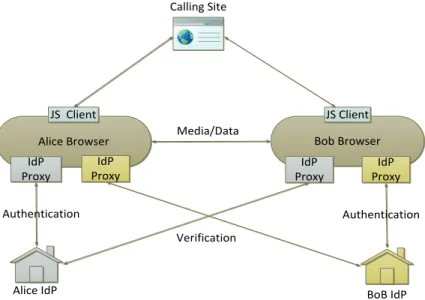
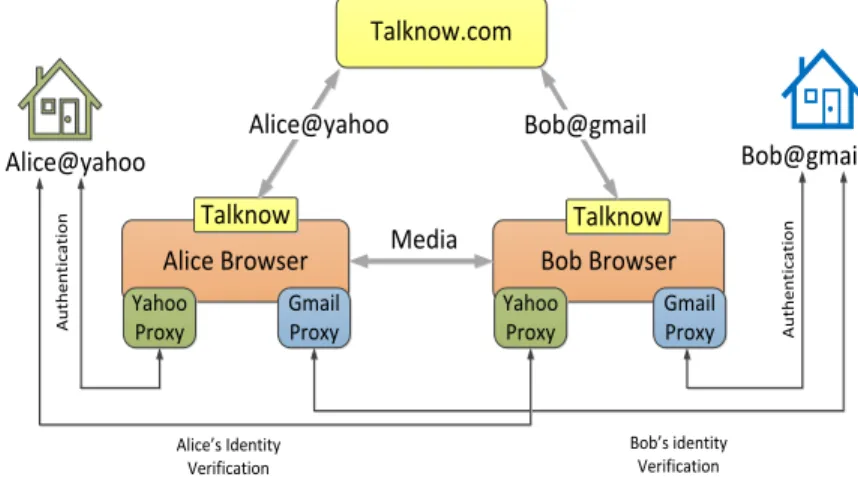
Potential adopters of the WebRTC standard face two technical chal-lenges related to user identities: i) user discovery and ii) identity pro-visioning. User discovery involves an efficient identity resolution system that maps user identities to the currently available web address of user’s device. This is essential in order to establish a communication session for the exchange of media. However, before establishing a connection it is necessary to ensure that users know who they are talking to. For this purpose, WebRTC architecture facilities end-to-end peer authenti-cation using IdP. IdP can be managed by the CSP itself or delegated to a trusted third party. Identity provisioning in WebRTC standard in-volves the retrieval, delivery and verification of identities between com-municating participants. WebRTC proposes the use of SSO protocols for the purpose of identity provisioning such as BrowserID [BA13] and OAuth [Har]. However, SSO protocols are designed for service client authentication. Therefor they require certain modifications in order to facilitate P2P authentication between communicating participants.
One of the main challenge for future web-centric communication plat-form is the development of a trustworthy identity framework. For future web communication services user identities should be trustworthy and identifiable across different domains. The main challenges of a trustwor-thy global web identity framework are as follows:
1. Cross domain inter-operable: Subscribers of different domains
1.3 Threat Taxonomy for Web Communication Threat Taxonomy Threats against Integrity Threats Against Social Context Threats Against Confidentiality Threats Against Availability Call Flooding Malformed Messages Spoofed Messages
Call Hijacking Eavesdropping media
Call pattern tracking Reconstruction Call rerouting Media injection Identity Misrepresentation Spam Phishing Unwanted contact
Figure 1.2: Threat Taxonomy
should able to search, identify and communicate with users of other domains.
2. Identity decoupled from service providers: Identities should be decoupled from the service by using third party IdPs.
3. Identity portability: Users are able to migrate between different service providers without losing their identity information
4. Trust-enhanced identity: Beyond user authentication, commu-nication between communicating participants require trust which should be computed and displayed to users.
1.3
Threat Taxonomy for Web Communication
In this section we present the threat taxonomy of real-time web com-munication service. The taxonomy defines potential security threats to VoIP deployments, services, and end users. We categorize the security threats into four major categorizes: 1) threats against availability, 2) threats against confidentiality, 3) threats against integrity and 4) threats
Background and Literature Review
against social context as shown in Figure 1.2. Each of them are described as follows:
1.3.1 Threats Against Availability
Threats against availability aims at service interruption that are typically in the form of Denial of Service (DoS) attacks. Communication services are supposed to be available for user when it needs it. DoS attack is an attack on the network or device denying it of a service or connectivity. The typical threats against availability include:
1. Call Flooding: A heavy flood of signals or media traffic is generated in order to drop the performance of the communication system.
2. Malformed Messages: Protocol message with wrong syntax are transmitted to the target server or client.
3. Spoofed Messages: Fake spoofed messages are inserted into a com-munication session in order to suspend the service.
4. Call Hijacking: In call hijacking the control of transactions such as registration, call setup or media flow between a user and the network is attained.
1.3.2 Threats Against Confidentiality
Threats against confidentiality include unauthorized means of capturing user information such as media, credentials, identities and call patterns. Confidentiality implies that the user information is protected from unau-thorized access. The most popular types of confidentiality threats are:
1. Eavesdropping: Eavesdropping include sniffing of the entire signal-ing or media traffic between two or more users.
2. Call pattern tracking: The traffic between different users are ana-lyzed in order to know who is communicating with who, and when.
3. Reconstruction: The conversation including voice, video or text be-tween communicating parties is collected, manipulated and recon-structed without their consent.
1.3 Threat Taxonomy for Web Communication
1.3.3 Threats Against Integrity
Threats against integrity includes the capturing and altering of signaling or media messages. The alteration include deletion, injection or replace-ment of certain information in the established communication session. Integrity implies that user information remains unaltered by any unau-thorized access. Threats against integrity include:
1. Call rerouting: The messages are intercepted in the middle of com-munication path in order to alter the protocol message and reroute the call.
2. Media injection: The media traffic is intercepted in the middle of communication to alter, inject unauthorized media and delete cer-tain media information.
1.3.4 Threats Against Social Context
Threat against social context is the manipulation of the social context between communicating parties. This manipulation allows an attacker to misrepresent himself and convey fraudulent information. The typical threats against social context are as follows:
1. Identity Misrepresentation: Identity misrepresentation is the inten-tional presentation of a false identity. Identity misrepresentation may include false information such as false name, profession, orga-nization, number and email address.
2. Spam: Spam over communication networks are bulk of unsolicited prerecorded automatically dialed voice or video messages transmit-ted for marketing and advertisement purposes.
3. Fraudulent Telemarketing: Communication networks are used to commit frauds by advertising customers to buy products or services.
4. Phishing: Phishing is an illegal attempt to obtain target’s personal information such as user-name, password, bank account number, credit card information over the communication session.
5. Unwanted communication: Unwanted communication includes cases of harassment, extortion and unlawful content distribution.
Background and Literature Review
1.3.5 WebRTC Security Considerations
WebRTC has big advantage over existing VoIP services in terms of en-suring security. WebRTC has a strong focus on secure communication and thus is currently regarded as one of the most secure VoIP solu-tions [Weba]. WebRTC enforces important security concepts in all main area [Res16]. Most importantly, it mandates the use of encryption for communication which most existing VoIP services do not. Thus, users of WebRTC enabled applications are assured the safety and privacy of their data. These security consideration are detailed in the IETF Inter-net draft [Res15]. We briefly describe the major security considerations of WebRTC standard:
1. Installation risk: WebRTC technology is installed as part of down-loading a suitable WebRTC compatible browser. WebRTC requires no setup, installation or plugins to operate. Thus, there is no risk of installation of malware or viruses when used for communication.
2. Signaling traffic protection: WebRTC does not specify any partic-ular signaling protocol that is used to establish media and data channels. It allows the developer to choose the signaling protocol for the application. If the signaling channel is compromised, an attacker could interfere with the session. Therefore, securing the signaling channel by choosing an appropriate protocol is crucial for WebRTC applications.
3. Media traffic protection: Eavesdropping is a major security risk which allows an attacker to intercept media. In WebRTC, en-cryption is enforced on all components of the communication sys-tem. Media is encrypted using Secure Real-time Transport Protocol (SRTP) while data streams are encrypted using Datagram Trans-port Layer Security (DTLS).
4. Access to local resources: The browser can access local resources including camera, microphone and files. This allows web applica-tions to record video or audio without user’s knowledge. Therefore, in WebRTC application a browser is always required to verify user consent before providing application the access to user’s microphone or camera.
1.4 Trust Management
5. P2P authentication: WebRTC defines an alternative approach for user authentication. It allows communicating participants to au-thenticate each other without relying on the service provider. This is done using independent Identity Provider (IdP). Users can au-thenticate themselves to the IdP and use the identity assertions generated by the IdP to identify themselves to their communicating participant.
Until now, most VoIP services provide communication services with-out encryption. But as WebRTC forbids unencrypted communication, users can be assured that their data remains safe and private. Therefore, WebRTC is considered to be a secure VOIP solution. Although WebRTC facilitate P2P authentication it will still be exposed to threat against so-cial context. Authentication alone cannot guarantee the trustworthiness of communication participant. To combat social context trust in each communicating participant needs to be communicating. Therefore, in this thesis we present solutions to establish trust between communicat-ing participants.
1.4
Trust Management
Trust is used to cope with uncertainty about the intentions of other agents. Trust management systems are used to compute trust so that two agents can build trust relationship in a particular situation. We focus on establishing trust between communicating participants in real-time web communication services. In order to understand how trust is being computed we present the general definition of trust.
We also list the challenges for developing a trust computation.
1.4.1 The notion of Trust
Trust exhibits in many different forms, thus it remains very challenging to define it clearly and precisely. The term trust is being used in variety of meaning. It is widely acknowledged that trust is complex and multidi-mensional. The concept of trust has been studied in many areas such as psychology, sociology, philosophy, history, law, business and economics.
Background and Literature Review
Trust information
collection Trust Evalutation Trust Dissemination
Attitudes Behaviors Experiences
Graph based
Interaction
based Hybrid
Visulisation Recommednation
Figure 1.3: Trust system Classification
We find several definitions of trust in literature. Some of them are cited as follows:
1. According to the Oxford dictionary [OXF84], " Trust is a firm belief in the reliability, truth, ability, or strength of someone or something ".
2. Researchers in [MDS95] suggest that " Trust can be viewed as an attribute of risk-taking behavior ".
3. Deutsch [Deu73] defined trust as " The confidence that an individual will find what is desired from another, rather than what is feared ".
4. Grandison and Sloman [GS00] proposed trust to be defined as " The firm belief in the competence of an entity to act dependably, securely and reliably within a specified context ".
5. Chang et al. [CHD05] has specified that trust is " The belief the trusting agent has in the trusted agent’s willingness and capability to deliver a mutually agreed service in a given context and in a given time slot ".
1.4.2 Trust System Classification
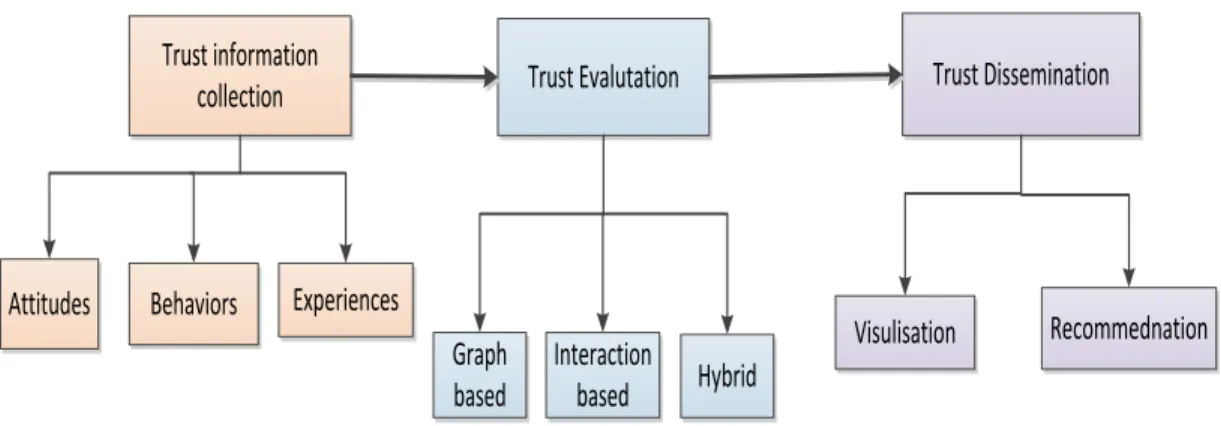
A trust system is largely composed of three major components: Trust Information Collection, Trust Evaluation and Trust Dissemination as shown in Figure 1.3.
1.4 Trust Management
1. Trust Information Collection: The information regarding trust can be extracted from attitudes, experiences and behaviors. Atti-tudes are generally positive or negative belief of an individual and is derived from user’s interactions. Experiences describe the per-ception of an individual which they create while interacting with each other. Whereas, behaviors are patterns of interactions which describe the manner in which a particular entity conducts itself.
2. Trust Evaluation: Trust computation models can be categorized into network-based or interaction-based trust models. Network-based trust models are Network-based on the concepts of Friend-of-A-Friend (FoAF) where trust is considered to be transitive in nature. Various techniques are then used to transverse the network and determine trust between two entities. On the other hand, interaction-based trust model capture actual interactions between users. They are ap-plied to networks where volume, frequency and type of interaction are useful in computing trust. Models that use both interactions and social network structure are hybrid trust models.
3. Trust Dissemination: Trust can be disseminated by visualization techniques or providing recommendation. Many visualization tools are used to represent the trust value between two entities. Systems can also use the computed trust to generate personal recommenda-tions for users.
1.4.3 Trust Computation in Online Applications
In literature, trust has been applied to various on-line applications. We detail the trust literature in three major on-line applications such as social network, e-commerce and P2P Networks.
Trust in Social Networks
Social network applications allow individuals to disseminate information and connect with their friends, families, governments and enterprises. Privacy remains a major concern for social network users. Therefore, the level of trust that users have with each other critically important in social network applications. In social networks the concept of FoAF is