HAL Id: hal-01221330
https://hal.archives-ouvertes.fr/hal-01221330
Submitted on 28 Oct 2015
HAL is a multi-disciplinary open access
archive for the deposit and dissemination of
sci-entific research documents, whether they are
pub-lished or not. The documents may come from
teaching and research institutions in France or
abroad, or from public or private research centers.
L’archive ouverte pluridisciplinaire HAL, est
destinée au dépôt et à la diffusion de documents
scientifiques de niveau recherche, publiés ou non,
émanant des établissements d’enseignement et de
recherche français ou étrangers, des laboratoires
publics ou privés.
A new coding scheme for discrete memoryless MACs
with common rate-limited feedback
Selma Belhadj Amor
To cite this version:
Selma Belhadj Amor. A new coding scheme for discrete memoryless MACs with common rate-limited
feedback. 2015 European Conference on Networks and Communications (EuCNC), Jun 2015, Paris,
France. pp.72 - 76, �10.1109/EuCNC.2015.7194043�. �hal-01221330�
A New Coding Scheme for Discrete Memoryless
MACs with Common Rate-Limited Feedback
Selma Belhadj Amor
Telecom ParisTech, Paris, France [email protected]
Abstract—We propose a new coding scheme for the dis-crete memoryless two-user multi-access channel (MAC) with rate-limited feedback. Our scheme combines ideas from the Venkataramanan-Pradhan scheme for perfect feedback with ideas from the Shaviv-Steinberg scheme for rate-limited feedback. Our achievable region includes the Shaviv-Steinberg achiev-able region and this inclusion can be strict. For general MACs and for sufficiently large feedback rates, our scheme outperforms the Shaviv-Steinberg scheme as it achieves the same rate region as the Venkataramanan-Pradhan scheme for perfect feedback (which cannot be achieved by the Shaviv-Steinberg scheme). Furthermore, we numerically evaluate our achievable region with a specific (Gaussian) choice of random variables for the memoryless two-user Gaussian MAC. Our simulation results show that for some parameters of the Gaussian MAC and the feedback rate, our scheme achieves a strictly larger sum-rate than the Shaviv-Steinberg scheme.
I. INTRODUCTION
Gaarder & Wolf [1] showed that perfect instantaneous output-feedback1 can increase the capacity of the two-user
memoryless multiple-access channel (MAC) by enabling co-operation between the transmitters. The capacity region for general MACs with feedback is still unknown even for only two users. (A notable exception being Ozarow’s capacity result for the two-user Gaussian MAC with perfect feedback [2].)
The Gaarder-Wolf scheme has been extended by Cover & Leung [3] who introduced the ideas of block-Markov coding and superposition coding. Specifically, in the Cover-Leung scheme, in each block b, the transmitters send independent fresh data superposed on common update information belong-ing to the previous block (b 1). After observbelong-ing the outputs in block b, the receiver creates a list of all possible pairs of block-b fresh data that is compatible (jointly typical) with these outputs. It also decodes the common update information. This common update information describes resolution information that allows the receiver to resolve its block-(b 1) list, and thus to identify the fresh data that was sent in block (b 1). In order to be able to compute and send the block-b common update information, the transmitters have to decode each other’s fresh data sent in block (b 1) and calculate the receiver’s block-(b 1) list. They perform these tasks using their block-(b 1) input signals and the block-(b 1)feedback signals. (In case of perfect feedback, the latters correspond to the
1By perfect instantaneous output-feedback we refer to a model where each
transmitter observes all previous channel outputs before it has to produce the next input. We henceforth refer to it also as perfect feedback.
receiver’s channel outputs.) For some MACs with perfect feedback the presented Cover-Leung scheme is optimal and achieves capacity [4]. For others, for example for the Gaussian MAC [2], it is strictly suboptimal [2], [5], [6].
The Cover-Leung scheme has been improved by relaxing the requirement that after the transmission of each block, the transmitters have to decode each other’s fresh data sent in this block [5], [6]. Instead, the decoding at the transmitters (and also at the receivers) is delayed, allowing the transmitters to gain more information about each other’s message before decoding. This results in less stringent rate-constraints as compared to the original Cover-Leung scheme. To implement this idea, Bross & Lapidoth [5] proposed to append to each block a two-way transmitters-exchange phase and to delay the transmitters’ decoding thereafter. Venkataramanan & Pradhan [6] suggested to delay the transmitters decoding of the fresh data by an entire block. In their scheme, in each block b the transmitters send two sorts of resolution information, common receiver-side resolution information to resolve the receiver’s uncertainty about the block-(b 2) fresh data, and correlated transmitters-side resolution information to resolve each transmitter’s uncertainty about the other transmitter’s block-(b 1)fresh data.
Coding schemes were also presented for the MAC with generalized, noisy, or rate-limited2 feedback. Carleial [7]
pro-posed a coding scheme for general discrete memoryless MACs with generalized feedback, which combines the Cover-Leung scheme with an optimal nofeedback scheme through rate-splitting. Lapidoth & Wigger [8] proposed a scheme for the two-user Gaussian MAC with noisy feedback. Their scheme can be viewed as a robustification of Ozarow’s capacity-achieving perfect-feedback scheme [2] to noisy feedback.
The main focus of this paper is on rate-limited feedback. For this model, Shaviv & Steinberg [9] proposed a coding scheme based on Carleial’s extension of the Cover-Leung scheme and on Heegard-Berger source coding [10] to communicate over the feedback links. For sufficiently large feedback rates their scheme achieves Cover & Leung’s achievable region for perfect feedback [3] (which in this case coincides with Carleial’s achievable region).
In this paper, we propose a coding scheme for the
two-2While for generalized [7] or noisy feedback the feedback signals are
“passively” produced in a memoryless way from the channel inputs and outputs, in the model for rate-limited feedback the receiver can actively code over the feedback links.
user discrete memoryless MAC with common rate-limited feedback. Our coding scheme is based on the Venkataramanan-Pradhan scheme and on Heegard-Berger source coding [10] over the feedback links. Our new region includes the Shaviv-Steinberg achievable region and this inclusion can be strict. For sufficiently large feedback rates, our achievable region coin-cides with the Venkataramanan-Pradhan achievable region.
II. CHANNELMODEL
We consider the two-user discrete memoryless MAC with rate-limited feedback. The setup is characterized by the triple of finite alphabets (X1,X2,Y), the conditional probability
distribution PY|X1X2, and a nonnegative feedback rate Rfb.
At each time t 2 N, if x1,t 2 X1 and x2,t 2 X2 denote the
signals sent by Transmitters 1 and 2, the receiver observes the channel output yt2 Y with probability PY|X1X2(yt|x1,t, x2,t).
The goal of communication is that Transmitters 1 and 2 convey the independent messages M1and M2to the common
receiver. The messages M1 and M2 are uniformly distributed
over M1 = {1, . . . , b2nR1c} and M2 = {1, . . . , b2nR2c},
where R1 and R2 are the rates of transmission and n is the
blocklength.
We assume common rate-limited feedback from the receiver to both transmitters. Specifically, upon observing Yt, the
re-ceiver can send a feedback signal Ft2 Ftto both transmitters
where Ft denotes the finite alphabet of Ft. The feedback
signals F1, . . . , Fn are of the form
Ft= t(n)(Y1, . . . , Yt) , t2 {1, . . . , n}, (1)
for some feedback-encoding functions (n)
t :Yt ! Ft. It is
assumed that both transmitters receive the feedback signals perfectly whenever the former satisfy the rate constraint on the feedback links:
|F1| ⇥ . . . ⇥ |Fn| 2nRfb. (2)
(The present feedback rate constraint is rather weak. One could imagine a stronger constraint where each sample Ft has to
satisfy H(Ft) Rfb. It can be easily shown that the two
definitions are equivalent in terms of achievable rates.) Notice that here the alphabets F1, . . . ,Fn are design parameters of
the coding scheme.
Transmitter i’s channel input at time t, Xi,t,for i 2 {1, 2},
can depend on Message Mi and the prior feedback signals
F1, . . . , Ft 1:
Xi,t= '(n)i,t(Mi, F1, . . . , Ft 1), t2 {1, . . . , n}, (3)
for some encoding functions of the form '(n)
i,t :Mi⇥ F1⇥
· · · ⇥ Ft 1! Xi.
The receiver bases its guess of its desired messages on the output sequence Y1, . . . , Yn. That is, it produces
( ˆM1, ˆM2) = (n)(Y1, . . . , Yn),
for a decoding function (n):
Yn
! M1⇥ M2. There is an
error in the communication whenever ( ˆM1, ˆM2)6= (M1, M2).
The average probability of error is thus
Pe(n), Pr⇥( ˆM1, ˆM2)6= (M1, M2)⇤. (4)
We say that a rate pair (R1, R2) is achievable over
the MAC with common rate-limited feedback if there exists a sequence of encoding and decoding functions {{'(n)1,t}nt=1,{'
(n)
2,t}nt=1, (n)}1n=1 as described above, a
se-quence of feedback alphabets {Ft}nt=1 satisfying (2), and
feedback-encoding functions of the form (1) such that P(n) e
tends to zero as the blocklength n tends to infinity.
When Rfb= 0, the feedback signals have to be deterministic
and the setup is equivalent to a setup without feedback. When Rfb log2|Y|, the setup is equivalent to perfect-feedback.
III. ACHIEVABLEREGION
Theorem 1 (Achievable Region). Let W, U1, U2,
V1, V2, Y12, Y1, and Y2 be arbitrary finite sets.
Also, let (W, V1, V2, U1, U2, X1, X2, Y, Y12, Y1, Y2)
and ( ˜W , ˜V1, ˜V2, ˜U1, ˜U2, ˜X1, ˜X2, ˜Y , ˜Y12, ˜Y1, ˜Y2) be two
correlated random tuples over the product alphabets W ⇥ U1⇥ U2⇥ V1⇥ V2⇥ X1⇥ X2⇥ Y ⇥ Y12⇥ Y1⇥ Y2
satisfying the following two conditions:
1) The joint distributions of the two tuples coincide: PW U1U2V1V2X1X2Y Y12Y1Y2 = PW ˜˜U1U˜2V˜1V˜2X˜1X˜2Y ˜˜Y12Y˜1Y˜2,
(5) and each of them factors as
PW U1U2V1V2X1X2Y Y12Y1Y2
= PWPV1V2PU1|W V1PU2|W V2
·PX1|W U1V1PX2|W U2V2PY|X1X2
·PY12|Y WPY2|W Y Y12PY1|W Y Y12 (6)
where PY|X1X2 describes the channel law of our MAC.
2) Defining ˜S , ( ˜W , ˜V1, ˜V2, ˜Y12), the joint distribution
over both tuples factors as
PW U1U2V1V2X1X2Y Y12Y1Y2S ˜˜U1U˜2X˜1X˜2Y ˜˜Y1Y˜2
= PS ˜˜U1U˜2X˜1X˜2Y ˜˜Y1Y˜2PV1| ˜S ˜U1PV2| ˜S ˜U2
·PW U1U2X1X2Y12Y1Y2Y|V1V2. (7)
All nonnegative rate pairs (R1, R2) satisfying
Con-straints (8) on top of next page are achievable.
Remark 1. Using time-sharing, it can be shown that also the convex hull of the region described in Theorem 1 is achievable. Remark 2. When choosing V1 = V2 = Y12 = Y1 = Y2 =
W = ;, U1 = X1, and U2 = X2, the achievable region in
Theorem 1 reduces to the nofeedback capacity region. When Rf b log2|Y|, Constraint (8a) is always satisfied.
In this case, we can choose Y = Y12 and Y1 = Y2 =; to
mimic the setup with perfect feedback. If now we specialize the achievable region in Theorem 1 to the choices U1 = X1
and U2= X2, we recover the achievable region of
Venkatara-manan & Pradhan for perfect feedback [6].
Finally, when choosing V1= V2=;, the tilded and the
non-tilded tuples become independent and the achievable region in Theorem 1 specializes to the set of all rate pairs (R1, R2)
satisfying
Rfb max
Rfb max I(Y12; Y|W X1), I(Y12; Y|W X2) + I(Y ; Y1|Y12X1W ) + I(Y ; Y2|Y12X2W ) (8a)
R1 I(X1; Y|SU1U2X2)
+ min{I(U1; Y2Y12| ˜S ˜Y2U˜2X˜2W V2U2X2), I(W ; Y| ˜W ˜Y ) + I(U1; Y|W V1V2U2) + I(V1; Y| ˜Y ˜S ˜Y1Y˜2U˜2W V2)}(8b)
R2 I(X2; Y|SU1U2X1)
+ min{I(U2; Y1Y12| ˜S ˜Y1U˜1X˜1W V1U1X1), I(W ; Y| ˜W ˜Y ) + I(U2; Y|W V1V2U1) + I(V2; Y| ˜Y ˜S ˜Y1Y˜2U˜1W V1)} (8c)
R1+ R2 I(X1X2; Y|SU1U2) + I(W ; Y| ˜W ˜Y ) + I(U1U2; Y|W V1V2) + I(V1V2; Y| ˜Y ˜S ˜Y1Y˜2W ) (8d)
R1+ R2 I(X1X2; Y|SU1U2)
+ min{I(U2; Y1Y12| ˜S ˜Y1U˜1X˜1W V1U1X1), I(W ; Y| ˜W ˜Y ) + I(U2; Y|W V1V2U1) + I(V2; Y| ˜Y ˜S ˜Y1Y˜2U˜1W V1)}
+ min{I(U1; Y2Y12| ˜S ˜Y2U˜2X˜2W V2U2X2), I(W ; Y| ˜W ˜Y ) + I(U1; Y|W V1V2U2) + I(V1; Y| ˜Y ˜S ˜Y1Y˜2U˜2W V2)} (8e)
+I(Y ; Y1|Y12X1W ) + I(Y ; Y2|Y12X2W ) (9a)
R1 I(X1; Y|W U1X2) + min{I(U1; Y|W U2)
+I(W ; Y ), I(U1; Y2Y12|W X2)} (9b)
R2 I(X2; Y|W U2X1) + min{I(U2; Y|W U1)
+I(W ; Y ), I(U2; Y1Y12|W X1)} (9c)
R1+ R2 I(X1X2; Y|W U1U2) + min{I(U2; Y|W U1)
+I(W ; Y ), I(U2; Y1Y12|W X1)}
+ min{I(U1; Y|W U2) + I(W ; Y ),
I(U1; Y2Y12|W X2)} (9d)
R1+ R2 I(X1X2; Y ) (9e)
where now PW U1U2X1X2Y Y12Y1Y2 factors as
PW U1U2X1X2Y Y12Y1Y2
= PWPU1|WPU2|WPX1|U1WPX2|U2WPY|X1X2
·PY12|Y WPY1|Y W Y12PY2|Y W Y12. (10)
This region contains the achievable region by Shaviv & Steinberg [9].
IV. OUTLINE OFCODINGSCHEME
Let W, U1, U2, V1, V2, X1, X2, Y, Y12, Y1, Y2, ˜W , ˜U1, ˜U2, ˜V1,
˜
V2, ˜X1, ˜X2, ˜Y , ˜Y12, ˜Y1, ˜Y2 be as defined in Theorem 1 so that
they satisfy (5)–(7). Fix a nonnegative rate pair (R1, R2)that
satisfies rate constraints (8) with strict inequalities. Using for example Fourier-Motzkin Elimination, it can be shown that there must exist rates R0
1 > 0, R02 > 0 so that they satisfy
R1> R01 and R2> R02 and the following nine conditions
Rfb > max I(Y12; Y|W X1), I(Y12; Y|W X2)
+ X i2{1,2} I(Y ; Yi|Y12XiW ), (11a) R1 R01 < I(X1; Y|SU1U2X2) (11b) R2 R02 < I(X2; Y|SU1U2X1) (11c) R1 R01+R2 R02< I(X1X2; Y|SU1U2) (11d) R10 < I(U1; Y2Y12| ˜S ˜Y2U˜2X˜2W V2U2X2)(11e) R20 < I(U2; Y1Y12| ˜S ˜Y1U˜1X˜1W V1U1X1) (11f) R01 < I(W ; Y| ˜W ˜Y ) + I(U1; Y|W V1V2U2) +I(V1; Y| ˜Y ˜S ˜Y1Y˜2U˜2W V2) (11g) R02 < I(W ; Y| ˜W ˜Y ) + I(U2; Y|W V1V2U1) +I(V2; Y| ˜Y ˜S ˜Y1Y˜2U˜1W V1) (11h) R01+ R20 < I(W ; Y| ˜W ˜Y ) + I(U1U2; Y|W V1V2) +I(V1V2; Y| ˜Y ˜S ˜Y1Y˜2W ). (11i)
Fix also a constant R0 satisfying:
R0< I(W ; Y| ˜W , ˜Y ). (12)
We briefly describe a random code construction for which the average probability of error (averaged over codebooks, messages, and channel realizations) can be shown to tend to 0. A deterministic coding scheme achieving the same rates can then be obtained via standard arguments.
Our coding scheme is based on block-Markov and super-position coding, rate-splitting, sliding-window decoding, and Heegard-Berger coding on the feedback links. It extends over B + 2 blocks. For each i 2 {1, 2}, split Message Mi into
B submessages (m(1) i , . . . , m
(B)
i ) each of rate Ri/B. For
b 2 {1, . . . , B}, split each of these submessages into a pair (ji(b), k
(b)
i )of rates R0i/Band (Ri R0i)/B, respectively. For
blocks b 2 {B + 1, B + 2}, set j(b) 1 = k (b) 1 = j (b) 2 = k (b) 2 = 1.
For each block b 2 {1, . . . , B + 2}, at Transmitter i, for i2 {1, 2}, the j-message (ji(b))is transmitted using a feedback scheme and is going to be decoded at the other transmitter and the k-message (k(b)
i )is transmitted without using the feedback
and is decoded only at the receiver.
For each block b 2 {1, . . . , B + 2}, Transmitter i, for i 2 {1, 2}, sends x(b)i (k (b) i |u (b) i (j (b) i |v (b) i , w(b))). The choice of the sequences u(b) i , v (b)
i , and w(b)is explained next.
After each block b, the receiver compresses the channel outputs y(b) it observed for this block into (y(b)
12, y (b) 1 , y
(b) 2 )
using Heegard-Berger coding [10]. The receiver uses the feed-back links only once to send the same message M(b)
fb which—
as shortly explained ahead at the end of this section—is the triple (r(b)
12, r (b) 1 , r
(b)
2 ), indices of bins containing the quantized
output sequences y(b) 12, y (b) 1 , and y (b) 2 . Upon receiving M (b) fb ,
Transmitter i, for i 2 {1, 2}, reconstructs the sequence y(b) 12
by looking for a codeword y(b)
12 in bin r (b)
12 jointly typical with
(w(b), x(b)
i ). Then, it looks for a codeword y (b)
i in bin r (b) i
jointly typical with (w(b), x(b) i , y
(b) 12).
For a given block b, the messages j(b) 1 and j
(b)
2 are at first
transmitted using the u(b) 1 - and u
(b)
In contrast to the schemes by Cover & Leung [3] or by Carleial [7], the transmitters do not immediately decode each-other submessages j(b)
1 or j (b)
2 after learning the (y (b) 12, y (b) 1 , y (b) 2 )
signals of block b. Instead, they wait for another block, where they exchange information helping them in the decoding. Specifically, at the end of each block b 2 {1, . . . , B +1}, each Transmitter i computes transmitter-side resolution information v(b+1)i as a (randomized) function of its block-b codeword u(b)i and some common information s(b) which is known to both
transmitters. (The common information s(b) consists of the
w(b), v(b) 1 , v
(b) 2 , y
(b)
12 sequences; the former three are explained
in the sequel.) The resolution information v(b+1)
i is then sent
in block b+1. The initial sequences (v(1) 1 , v
(1)
2 )are drawn i.i.d.
according to PV1V2 and are known to everyone. In each block
b2 {1, . . . , B + 2}, the sequences (v(b)1 , v (b)
2 )are correlated,
which makes that sending them can be more efficient than sending independent data. (In particular, Condition (7) ensures that they have i.i.d. joint distribution PV1V2.)
After reception of y(b+1), the receiver creates a list of the
most likely (j(b) 1 , j
(b)
2 )message pairs based on y(b)and y(b+1)
(and all the information that it has for blocks b and b + 1). Upon observing the feedback outputs in block b + 1, Trans-mitter i, for i 2 {1, 2}, uses the sequences y(b)
12, y (b) i , y (b+1) 12 , and y(b+1)
i (and all the information that it has for blocks
b and b + 1) to estimate the decoder’s list of highly-likely message-pairs (j(b)
1 , j (b)
2 ). At the same time, it also estimates
the other transmitter’s v(b+1)-sequence and decodes the other
transmitter’s message j(b). (Notice that at this point, the
receiver is hindered compared to the transmitters as it does know any of the v(b+1)-sequences.) Conditions (11e) and (11f)
ensure that each transmitter decodes the other transmitter’s v(b+1)-sequences correctly with high probability. Therefore,
besides having an estimate of the decoder’s list, Transmitter i also has an estimate of the position of the correct message pair therein. Let the index (b+2)
i describe this position. If there is
no such index or if it exceeds b2nR0c, then the index (b+2)
i
is chosen uniformly at random from the set {1, . . . , b2nR0c}.
If the feedback information and the j-messages were decoded correctly, with high probability we have (b+2)
1 = (b+2) 2 . We
abuse notation and call this index (b+2). The two transmitters
send this index jointly in block b + 2 using a cooperation sequence w(b+2)that plays the role of receiver-side resolution
information. For blocks b 2 {1, 2}, it is fixed and known to everyone.
Upon receiving y(b+2), the receiver decodes the w(b+2)
codeword and the index (b+2) based on w(b+1), y(b+1), and
y(b+2), and uses (b+2) to identify the correct message-pair
(j1(b), j (b)
2 )within its list. Condition (12) ensures that w(b+2)
can be correctly decoded at the receiver. The receiver’s list for block b can be resolved by w(b+2) with high probability
if Conditions (11g)-(11i) are satisfied. Thereafter, the receiver also decodes with high probability the messages k(b)
1 and k (b) 2 , encoded in the x(b) 1 - and x (b) 2 -codewords, based on y(b) if
Conditions (11b)-(11d) are true.
To compress y(b) at the end of block b 2 {1, . . . , B + 1},
the receiver looks for a sequence y(b)
12 jointly typical with y(b)
and the decoded sequence w(b). Then, for i 2 {1, 2}, it looks
for a sequence y(b)
i jointly typical with (y (b) 12, y(b), w(b)). Let r(b)12, r (b) 1 , r (b)
2 denote the indices of the bins containing y (b) 12,
y(b)1 , and y(b)
2 , respectively. The Heegard-Berger coding [10]
and Constraint (11a) ensure that with high probability, Trans-mitter i can reconstruct (y(b)
12, y (b)
i ), for i 2 {1, 2}.
V. EXAMPLE:THEGAUSSIANMAC
Consider a memoryless Gaussian MAC with symmetric input-power constraint P . The channel output is Y = X1+
X2+Z, where Z is zero-mean Gaussian with variance 2> 0.
It can be shown that our coding scheme in Section IV and Theorem 1 in Section III hold also for this Gaussian MAC.
Inspired by [6], we propose the following choices. Let ↵, > 0such that ↵ + < 1, ✓ 2 [0, 1], and 12, 1, 2> 0.
Also, let 2 [ 1, 1] so that
2+ 2 P ✓↵
12+ P ↵✓ + 2P (1 ✓)
. (13)
Now, let W , A1, A2, IX1, IX2, ˜W, ˜A1, ˜A2, ˜IX1, and ˜IX2 be
independent zero-mean standard Gaussians, and independent thereof and independent of each other, let Z12, ˜Z12 be
zero-mean Gaussians of same variance 2
12, Z1, ˜Z1 be zero-mean
Gaussians of same variance 2
1, and Z2, ˜Z2 be zero-mean
Gaussians of same variance 2
2, and let ( ˜V1, ˜V2)be a centered
bivariate Gaussian of covariance matrix ✓ 1 1 ◆ . Define for i 2 {1, 2}, ˜ Ui,p↵ ˜Ai+ p ˜ Vi+ p 1 ↵ W ,˜ (14) ˜ Xi, p P (1 ✓) ˜IXi+ p P ✓ ˜Ui, (15) ˜ Yi, ˜Y + ˜Zi, (16) ˜ Y12, ˜Y + ˜Z12. (17) Furthermore, define V1, ⇠1 ⇣ ˜ U1 p ˜ V1 p (1 ↵ ) ˜W⌘/p↵ + ⇠2f ( ˜S) (18a) V2, ⇠1 ⇣ ˜ U2 p ˜ V2 p (1 ↵ ) ˜W⌘/p↵ ⇠2f ( ˜S)(18b)
where the function f is chosen as
f ( ˜S) = f ( ˜W , ˜V1, ˜V2, ˜Y12) , Y˜12 p ✓P ( ˜V1+ ˜V2) 2 p (1 ↵ )✓P ˜W p 2 + 2 12+ 2P ↵✓ + 2P (1 ✓) (19)
and where ⇠1, ⇠22 R are chosen to satisfy
1 = ⇠21+ ⇠22+ 2⇠1⇠2 s P ✓↵ 2+ 2 12+ 2P ↵✓ + 2P (1 ✓) , (20a) = 2⇠1⇠2 s P ✓↵ 2+ 2 12+ 2P ↵✓ + 2P (1 ✓) ⇠22. (20b)
(Condition (13) ensures that such real ⇠1 and ⇠2 exist. In
general, there are four possible choices for ⇠1, ⇠2. The specific
choice of ⇠1, ⇠2 does not show up in the rate-constraints (25)
and does not change the set of achievable rates.) For these choices define for i 2 {1, 2},
Ui,p↵Ai+
p Vi+
p
Rf C ✓ 2 2 12 + P2 12 P ✓ 2 12 ✓ 1 ↵ + 2✓ 2 (1 (1 ↵ )✓) ◆◆ + 2 X i=1 C 2 12 2 i 2(1 (1 ↵ )✓) + P (1 (1 ↵ )✓)2 2✓2 2 ( 2+ 2 12) (1 (1 ↵ )✓) + P ((1 (1 ↵ )✓)2 2✓2 2) ! (25a) R1 C ✓P (1 ✓) 2 ◆ + min ⇢ C 0 @ P ✓↵ 2+ 212 22 2 12+ 22 + P (1 ✓) + 2 P ✓ (1 + ) 12 22 2 12+ 22 + 2+ P (1 ✓) + P ↵✓ 1 A , C✓ ↵P ✓ 2P (1 ✓) + 2 ◆ +C ✓ 4P ✓(1 ↵ ) 2+ 2P (1 ✓) + 2P ✓(↵ + (1 + )) ◆ + C ✓ P ✓(2P (1 ✓) + 2)(1 + ) (2↵P ✓ + 2P (1 ✓) + 2)( 2+ 2P (1 ✓) + ↵P ✓) ◆ , (25b) R2 C ✓ P (1 ✓) 2 ◆ + min ⇢ C 0 @ P ✓↵ 2+ 212 21 2 12+ 21 + P (1 ✓) + 2 P ✓ (1 + ) 12 12 2 12+ 21 + 2+ P (1 ✓) + P ↵✓ 1 A , C ✓ ↵P ✓ 2P (1 ✓) + 2 ◆ +C ✓ 4P ✓(1 ↵ ) 2+ 2P (1 ✓) + 2P ✓(↵ + (1 + )) ◆ + C ✓ P ✓(2P (1 ✓) + 2)(1 + ) (2↵P ✓ + 2P (1 ✓) + 2)( 2+ 2P (1 ✓) + ↵P ✓) ◆ , (25c) R1+ R2 C ✓2P (1 ✓) 2 ◆ + C ✓2P ✓(2 ↵ (1 )) 2P (1 ✓) + 2 ◆ , (25d) R1+ R2 C ✓2P (1 ✓) 2 ◆ + 2 X i=1 min ⇢ C 0 @ P ✓↵ 2+ 212 2i 2 12+ i2 + P (1 ✓) + 2 P ✓ (1 + ) 12 2i 2 12+ 2i + 2+ P (1 ✓) + P ↵✓ 1 A , C✓ ↵✓P 2P (1 ✓) + 2 ◆ +C ✓ 4P ✓(1 ↵ ) 2+ 2P (1 ✓) + 2P ✓(↵ + (1 + )) ◆ + C ✓ P ✓(2P (1 ✓) + 2)(1 + ) (2↵P ✓ + 2P (1 ✓) + 2)( 2+ 2P (1 ✓) + ↵P ✓) ◆ , (25e)
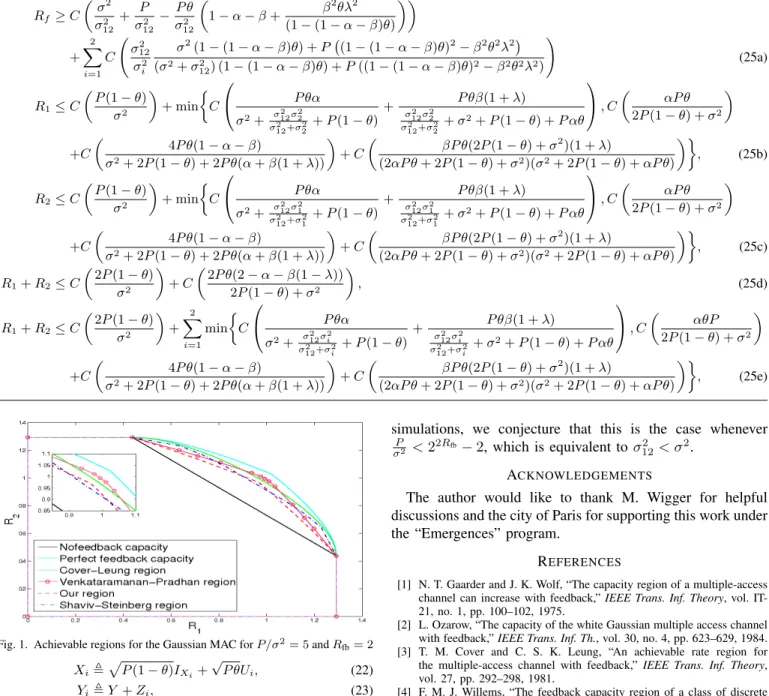
Fig. 1. Achievable regions for the Gaussian MAC for P/ 2= 5and R fb= 2 Xi, p P (1 ✓)IXi+ p P ✓Ui, (22) Yi, Y + Zi, (23) Y12, Y + Z12. (24)
Substituting the above choice into the rate-constraints of Theorem 1, we obtain that all nonnegative rate pairs (R1, R2)
satisfying Constraints (25) on top of this page are achievable. In (25) we use the notation C(x),1
2log(1 + x).
Figure 1 compares the achievable region in (25), to the nofeedback capacity region, the perfect feedback capac-ity region [2], the Cover-Leung [3] and Venkataramanan-Pradhan [6] regions for perfect feedback, and to the Shaviv-Steinberg region with rate-limited feedback [9].
For the sake of simplicity we restrict to the case where only common feedback is present (Y1 = Y2 = ;, 12, 22 ! 1)
which reduces to Wyner-Ziv coding [11] over the feedback links. In this case, we need to have 2
12
2
+P
22Rfb 1 and we
see that our scheme is strictly better in terms of sum-rate than the Shaviv-Steinberg scheme. In fact, based on extensive
simulations, we conjecture that this is the case whenever
P
2 < 22Rfb 2, which is equivalent to 212< 2.
ACKNOWLEDGEMENTS
The author would like to thank M. Wigger for helpful discussions and the city of Paris for supporting this work under the “Emergences” program.
REFERENCES
[1] N. T. Gaarder and J. K. Wolf, “The capacity region of a multiple-access channel can increase with feedback,” IEEE Trans. Inf. Theory, vol. IT-21, no. 1, pp. 100–102, 1975.
[2] L. Ozarow, “The capacity of the white Gaussian multiple access channel with feedback,” IEEE Trans. Inf. Th., vol. 30, no. 4, pp. 623–629, 1984. [3] T. M. Cover and C. S. K. Leung, “An achievable rate region for the multiple-access channel with feedback,” IEEE Trans. Inf. Theory, vol. 27, pp. 292–298, 1981.
[4] F. M. J. Willems, “The feedback capacity region of a class of discrete memoryless multiple-access channels,” IEEE Trans. Inf. Theory, vol. IT-28, no. 1, pp. 93–95, 1982.
[5] S. I. Bross and A. Lapidoth, “An improved achievable region for the discrete memoryless two-user multiple-access channel with noiseless feedback,” IEEE Trans. Inf. Theory, vol. 51, no. 3, pp. 811–833, 2005. [6] R. Venkataramanan and S. S. Pradhan, “A new achievable rate region for the multiple-access channel with noiseless feedback”, IEEE Trans. Inf. Theory, vol. 57, no. 12, pp. 8038–8054, 2011.
[7] A. B. Carleial, “Multiple-access channels with different generalized feedback signals,” IEEE Trans. Inf. Theory, vol. 28, pp. 841–850, 1982. [8] A. Lapidoth and M. Wigger, “On the AWGN MAC with imperfect feedback,” IEEE Trans. Inf. Theory, vol. 56, no. 11, pp. 5432–5476, 2010.
[9] D. Shaviv and Y. Steinberg, “On the multiple-access channel with common rate-limited feedback,” IEEE Trans. Inf. Theory, vol. 59, no. 6, pp. 3780–3795, 2013.
[10] C. Heegard and T. Berger, “Rate-distorsion when side-information may be absent,” IEEE Trans. Inf. Theory, vol. 31, no. 6, pp. 727–734, 1985. [11] A. D. Wyner and J. Ziv, “The rate-distortion function for source coding with side information at the decoder,” IEEE Trans. Inf. Theory, vol. 22, pp. 1–10, 1976.