HAL Id: hal-02024409
https://hal.insa-toulouse.fr/hal-02024409
Submitted on 15 Mar 2019HAL is a multi-disciplinary open access
archive for the deposit and dissemination of sci-entific research documents, whether they are pub-lished or not. The documents may come from teaching and research institutions in France or abroad, or from public or private research centers.
L’archive ouverte pluridisciplinaire HAL, est destinée au dépôt et à la diffusion de documents scientifiques de niveau recherche, publiés ou non, émanant des établissements d’enseignement et de recherche français ou étrangers, des laboratoires publics ou privés.
An aeronautics and space-oriented research group
Bruno Castanié
To cite this version:
Bruno Castanié. An aeronautics and space-oriented research group. JEC Composites Magazine, JEC Group, 2018, pp.41-47. �hal-02024409�
The Clément Ader Institute’s (ICA) Composite Materials and Structures research
group (UMR CNRS 5312) was set up in 2010 after the Institute was created by decree
in July 2009. The group conducts transversal research on materials, processes and
structures, with a strong focus on numerical and experimental aspects.
An aeronautics and
space-oriented research group
research
bruno CasTanié,
Full Professor, Head of Composite Group INSA – Institut National des Sciences Appliquées Institut Clément Ader
T
he ICA works in a wide range of re-search fields, targeting applications in the aeronautics and space sectors, as well as transportation and energy.Materials and processes
Understanding and modelling thermoki-netic and thermomechanical phenomena in manufacturing processes
The group’s material and process research activities focus on the characterization and modelling of:
- the polymerization kinetics of organic matrices (thermoset and thermoplas-tic) and inorganic matrices;
- the thermomechanical degradation kinetics of matrices, reinforcements and the fibre-matrix interface, together with their impact on the properties of materials;
- the crystallization of thermoplastic polymers (morphology and kinetics) and the influence of reinforcements and fillers on crystallization.
The purpose of this research is to gain a better understanding of the physico-chemical phenomena governing the use of composites in order to optimize the po-lymerization/crystallization conditions of matrices during the manufacture and
pro-cesses and determining the material pa-rameters related to the permeability and compressibility of woven reinforcements. The variability of reinforcements and its effect on their permeability are among the main topics considered from an experi-mental and numerical point of view. Resin flow is studied in various config-urations, such as woven, knitted or mat preforms for thermoset and thermoplas-tic organic/inorganic matrices. This work cessing of prepregs and composites. This
work focuses mainly on high-performance aeronautical matrices, such as Class 180 epoxy resins or thermostable PEEK and PPS matrices.
Study and modelling
of resin flow in fibrous reinforcements
The group’s work on resin flow in fibrous reinforcements focuses on modelling resin flow in liquid composite moulding
pro-FEATURE AEROSPACE
Featur
e Aer
ospac
e
generally aims at predicting mould filling times and/or resin front kinetics and opti-mizing them according to the polymeriza-tion cycles of resins.
Multiphysics analysis and functionali-zation of composite materials
To propose reliable numerical models, test benches were developed/adapted to determine the anisotropic thermal con-ductivity of composite materials by inverse analysis. This work, carried out in collab-oration with ICA’s Measurement research group, is based on original approaches us-ing non-contact measurement by infrared thermography. The other part of the work, related to thermal and electrical proper-ties, consists in preparing and character-izing functionalized matrices in order to improve the properties of composites. As the aim is to meet the needs of the aero-space industry regarding conductivity is-sues, the studies focus on thermoset and thermoplastic matrices functionalized by nanometric particles. On the thermal side, a hybrid composite material consisting of a polymer matrix doped with micro- and na-noparticles and reinforced with long pitch carbon fibres was developed in order to significantly increase thermal conductivi-ty. On the electrical side, another example is the design of a thermoplastic PEEK/car-bon fibre/carPEEK/car-bon nanotube (CNT) matrix composite without compatibilizing agents. The goal is to produce a PEEK/carbon laminate with through-the-thickness elec-trical properties, enhanced by the incorpo-ration of CNT.
More generally, these efforts are part of the functionalization of materials using a na-noscale phase, particularly via an aligned carbon nanotube forest, which is intend-ed to improve the impact response or the thermal or electrical conductivity through the thickness of composite materials. Work is currently underway to integrate nanotube mats grown either on a substrate or directly on carbon fabrics, or by liquid or pre-impregnated processes.
The research work then consists in char-acterizing the processing properties, the microstructure and the different interface scales, and determining the mechanical
properties of the composite over a broad spectrum of stresses (static and dynamic). Modelling thermal and electrical transfers in functionalized matrices requires the use of models at the microscopic scale. This work aims to improve the understanding of size, dispersion and orientation effects in order to optimize the morphologies of composites and to enhance homogenized approaches.
In processes using radiating sources (in-frared emitters), the prediction of thermal fields requires the development of ad-vanced numerical models taking radiation heat exchange into account.
The research work thus led to the develop-ment of radiative transfer modelling using ray throw approaches. Initially developed for packaging applications, the models were progressively improved and adapted to composite applications (epoxy curing and preform heating in a stamping pro-cess).
Processes and structures
Understanding and modelling variabili-ty sources in composite structures
Various sources of variability within com-posite structures were analysed, in particular with regard to the measurement of spatial variations of “topological” quantities and material quantities. These include spatial var-iations in ply thicknesses, strand orientations or the matrix ratio, during and after the man-ufacturing process. A mathematical model-ling of these spatial variations was proposed based on statistical studies of the different parameters that control these mathematical laws. Three examples of applications associ-ated with these developments are particular-ly noteworthy:
- Prediction of residual curing strains of a laminated plate generated by “topological” variabilities;
- Prediction of the stiffness dispersion of a composite beam in 3-point bending;
- Prediction of the localization variability
FEATURE AEROSPACE
research
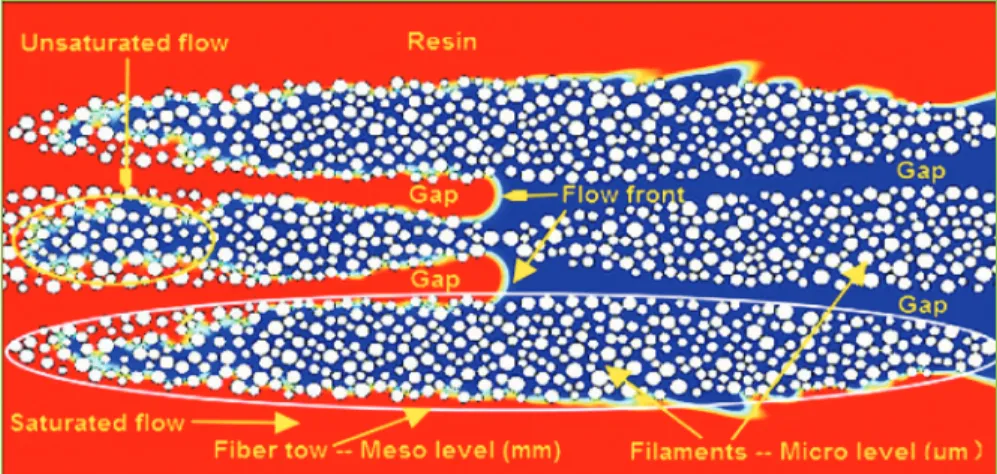
Fig. 2: Simulation of resin flow in a 3D reinforcement at different scales
An aeronautics and space-oriented research group
Featur
e Aer
ospac
e
of a laminated plate’s failure zones under complex stresses (technological evalua-tors).
Analysis and modelling of shape defects generated during the manufacture of composite structures
During the manufacture of laminated com-posite structures, many physicochemical and thermomechanical phenomena are at work and can produce unwanted deformations of the resulting parts.
A thermochemical modelling of the polym-erization process was conducted to predict, among other things, overshoots during the polymerization of a thermoset resin for a thick composite.
On another level, a semi-empirical thermo-mechanical spring-back model was devel-oped and recently applied to a large part: the A350 rib in the framework of CORAC – these two studies are used to predict the spring-back of bonded stiffeners.
Analysing the links between manufactur-ing/machining parameters and mechani-cal strength
When machining composite materials, the main problem is the choice of criteria for the qualification of machined surfaces. The cur-rent industrial criteria (for example, the av-erage roughness Ra, Rp, etc.) do not appear to be relevant for composites. In this context, it is interesting to study the influence of the microstructure (such as the presence of ther-moplastic nodules between the plies) and the conditions in which the composite is manu-factured and cured on machining quality. In particular, the surface defects and the ex-tent of delamination during machining (drill-ing and mill(drill-ing) were analysed. In addition, the influence of processes (drilling or trim-ming) on the defects and the mechanical re-sistance under static or fatigue conditions is studied. New machining quality indicators, such as the bearing surface, were proposed and their links with the mechanical resist-ance were established.
Composites machining
The anisotropic and highly abrasive nature of reinforcements, together with the het-erogeneity of composite structures, makes machining delicate. Moreover, for economic reasons, one-shot drilling of hybrid mate-rials (composite/aluminium, composite/ titanium, etc.) is a very complex machining operation that damages the materials. As a result, the ICA studies on the machining of composite materials and multi-materials [2]
mainly focus on:
-the understanding of surface creation mechanisms in relation to material re-moval processes (orthogonal cutting, drill, bit and orbital drilling, and high-pressure abrasive water jet cutting);
-in situ measurement of the drilling tem-perature by instrumentation at the core of cutting tools using Bragg grating optical fibres;
-the analysis of machined surfaces to im-prove the life of bolted structures;
-analytical and numerical modelling of the conditions in which delamination appears at the exit of the hole (drill and bit), taking thermomechanical phenomena into account;
-multiscale modelling of material removal mechanisms and induced defects.
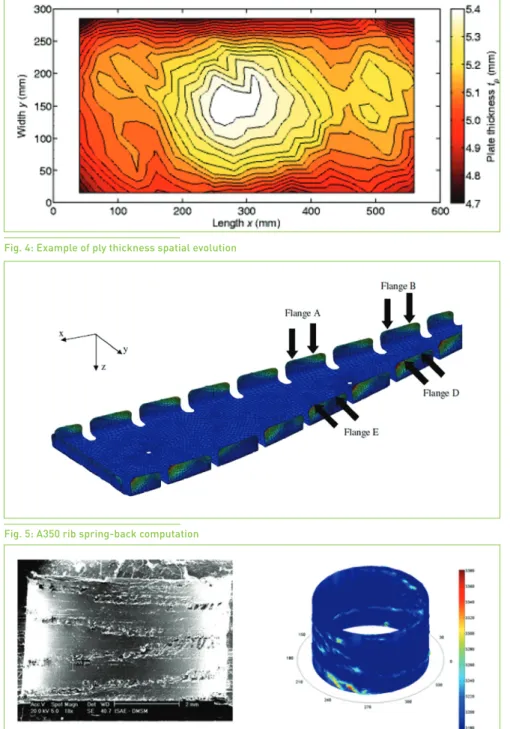
Fig. 4: Example of ply thickness spatial evolution
Fig. 5: A350 rib spring-back computation
Structures and modelling strategies
Short fibre injection
The ICA has been working on the de-velopment and validation of solutions for injected polymer materials, with their properties induced by the injection process. A behaviour law with damage (CDM) was proposed, which takes the microstructural parameters related to the process into account and is “imple-mentable” in an industrial finite element code.
Its applications are dedicated to the di-mensioning of composite parts injected with PEEK thermoplastic matrices rein-forced with short carbon fibres, e.g., the calculation of a helicopter door hinge. The ICA has also been working on the injection of PEEK resin reinforced with carbon fibres as part of industrial projects and/or PhD theses. Some out-comes of these projects are already in use.
As an extension of these studies, work is underway on the recycling of carbon fibres to re-use them in various forms (mats, short fibre granules) in thermo-plastic matrices.
This work contributes to the creation of an industrial recycling sector in the Oc-citanie Region.
Modelling strategies
For the past twenty years, the research of ICA professors has specifically focused on the development of strategies to model the damage and fracture scenarios of compos-ite structures. Three main strategies were developed [3].
The first one is the Diffuse Damage Model (DDM), which combines the continuum damage mechanics laws for mechanical
damage with cohesive zones. Due to the general nature of implementable laws, the DDM can be applied to many standard materials and problems, such as impact for example. It was recently used to size CFRP or SiC-SiC junctions. It is also interesting for bearing issues.
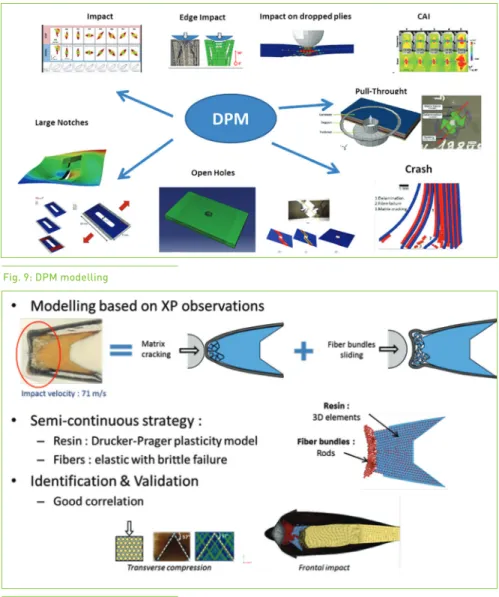
The second strategy is the Discrete Ply Model (DPM), which is based on a mesh that follows the orientations of the uni-directional plies, on cohesive zones, on a fragile rupture in matrix cracking driven by the adjacent volume elements and on a fibre break taking strain energy release rates into account. It has the advantage of being based on only 13 mechanical param-eters, which can be obtained easily. It was successfully applied first to out-of-plane problems such as low-velocity/low-ener-gy impact, edge impact, compression after impact or pull-through. Initially developed for out-of-plane problems, the discrete character of the model proved relevant to model splitting, thus making it possible to deal with problems such as hole failure, scale effects and large cuts under complex stress.
The third strategy is based on semi-contin-uous modelling used for frontal or razing impact problems on helicopter blades. Bars are used to model the fibres and vol-umes (for solid glass/epoxy UD) or plates (for woven plies) to model the resin. Spe-cific elements are developed (i) to find the static characteristics and (ii) to model the damage observed at the strand scale. Specific cohesive elements were recently developed, together with approaches to recover the bending stiffness of a fabric considering the actual weaving geometry. These models have reached a high level of confidence and are now validated for certi-fication purposes.
In general, these modelling strategies and other, more specific ones were developed and used to respond to many application problems covering the whole field of com-posite structures:
- Impact and residual behaviour after impact, damage tolerance, large cuts, shields;
- Crash modelling, energy absorption mechanisms;
- Fatigue;
- Sandwich structures: nonlinear analy-sis, impact, inserts, modelling of foam or honeycomb cores;
- Junctions, Z-pinning, stitching;
- Structural details: unfolding, stiffener debonding, post-buckling;
- Repairs;
- Optimization of composite structures. Wood-based eco-structures
An emerging topic in the group is the study of new wood-based structures. Sandwich structures using birch/poplar/ okoumé plywood cores and aluminium, fibreglass, flax or carbon skins were man-ufactured and studied experimentally and numerically under static loading, impact and compression after impact. These struc-tures showed very interesting specific and economic characteristics and studies will now focus on assembly and crash issues.
Experimental methods and means
Complex loading
The Institute uses a modular multiaxial
FEATURE AEROSPACE
research
Fig. 7: Chip formation analysis (left) during CFRP/Ti multi-material drilling (simulation on the right)
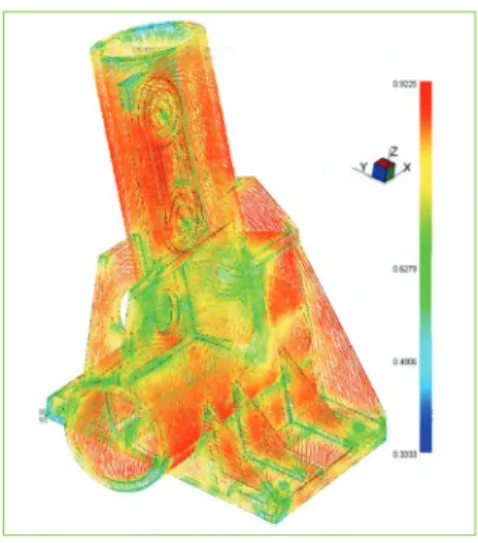
Fig. 8: Simulation of short fibre injection in a complex part (aircraft fitting)
An aeronautics and space-oriented research group
Featur
e Aer
ospac
e
beam frame supporting multi-instrument-ed technology evaluators. This frame is a quadripod used to apply loading (six com-ponents) to a specimen with dimensions typically of the order of 600 mm by 450 mm for a thickness up to 15 mm. This tool is used, for example, for the experimen-tal evaluation of the complex static stress behaviour of a 16-step elliptical step-lap repair. An Astrid ANR project entitled BLAST is underway to extend the tech-nology evaluator concept to situations of blast vulnerability of composite fuselages and to analyse the over-protective behav-iour of light armoured floors, considering the manufacturing conditions.
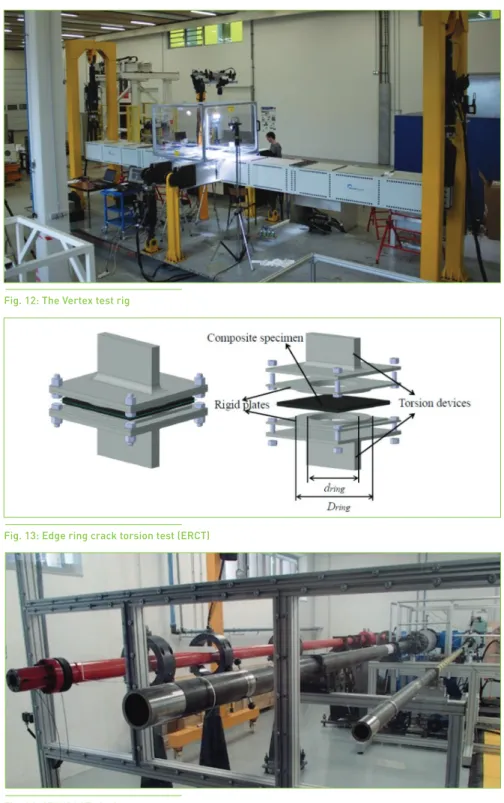
As part of the Vertex collaborative pro-ject, funded by ANR [4] and led by the
ICA, a test bench reproducing the stresses (tensile, compression, shear and internal pressure) and the boundary conditions of aeronautical composite structures was developed. The stresses can reach sever-al thousands of N/mm for a pressure of 1.6 bar with a zone of interest of 400x400 mm². A specific measurement methodolo-gy was developed in collaboration with the ICA MICS group. A cluster of six cameras is used for near-field and far-field measure-ments, coupled with a so-called FE-DIC method. The regularization of the finite element optical measurement field allows an improved test/calculation dialogue by direct export of nodal displacements (translations and/or rotations) to the fi-nite element models.
Measuring methods and specific tests
As part of the “Strategic Thematic Ac-tions” (ATS) IDEX UNITI Initiatives for Excellence projects, the WAALS project for “Wide analysis of interactions between polymer links and structural loads” fo-cuses on the in-depth investigation of an adhesive placed between two composite substrates: epoxy matrix and long carbon fibres. WAALS is led by the ICA and in-volves detecting the presence of altered zones within an adhesive that is free of defects detectable by CND techniques and whose interfaces are functionalized by low-pressure plasmas. A first family of markers was chosen for X-ray detection within the adhesive. A second family was used to introduce local warm-ups by
Fig. 9: DPM modelling
Fig. 10: Semi-continuous modelling for frontal impact of rotor blades
Fig. 11: Analysis of wood-based structures
netic induction to induce localized stress. A reference numerical model was used for a comparison with the measurements relat-ed to the particle displacements observrelat-ed by X-ray associated with the altered areas in the adhesive. It was established that the perimeter of a mechanical weakening zone and its abatement factors with respect to a reference value can be detected.
Another work focuses on the continuous monitoring of composite structures at dif-ferent scales throughout their life cycle. The structures and, when possible, their tools and means of production, are instru-mented to determine the influence of the various process parameters and materials and the associated variabilities. Bragg op-tical fibre was used to study residual curing stresses in the current or singular zone of composite parts and to investigate tool-part interactions through work for several PhD theses considering different manufac-turing (autoclave, filament winding, etc.) and machining (drilling) processes. An infrared thermography analysis meth-od was developed to measure energy res-titution rates during compression of the carbon plies, among other things. This method was patented and is the subject of a dissemination action via TTT (Toulouse Tech Transfer).
Many tests were developed as part of re-cent research work, including an experi-mental delamination propagation method in Mode I and II under gigacyclic fatigue that is based on the structural resonance of the specimen and allows the use of fre-quencies up to 400 Hz. An original Mode III measurement method (edge ring crack torsion test, ERCT) was proposed and ex-tended to the study of mixed modes I + II + III.
For staircase repairs of carbon/epoxy composite primary structures by struc-tural bonding, the conditions of use of the infrared thermography technique were evaluated. This situation is not usual given the subtle nature of the thermal behaviour difference between the constituent parts of the assembly zone (parent part and carbon-epoxy patch), which constitutes the main problem when capturing the response. As part of a collaboration with ENI Tarbes’ industrial engineering
labo-ratory, an original experimental procedure was developed, allowing numerical model-ling physically consistent with the thermal problem and demonstrating good agree-ment between the measured and calculat-ed temperature fields. This work proposes and opens up ways to modify the intrinsic thermal properties of a joint using
addi-tives with an infrared signature that makes it possible to identify the staircase area and its geometrical defects more clearly.
Dynamic testing
The Clement Ader Institute, in partner-ship with Airbus and IRT Saint Exupéry, developed the STIMPACT dynamic
test-FEATURE AEROSPACE
research
Fig. 12: The Vertex test rig
Fig. 13: Edge ring crack torsion test (ERCT)
An aeronautics and space-oriented research group
Featur
e Aer
ospac
e
ing platform on its premises. The platform is equipped with three gas guns covering a wide range of impacts up to 500 g and 800 m/s [5]. The institute also has several
drop towers up to 5000 J. A new machine owned by Airbus Central R&T is currently being installed for dynamic material test-ing and crash tests up to 35,000 J on struc-tural parts. More information: www.institut-clement-ader.org References [1] http://www.institut-clement-ader.org/ publications.php?eq=msc [2] R. Zitoune, K. Krishnaraj and J.P. Davim.
Developments in Machining of Aerospace Materials. Journal of Machining and Forming Technologies. 4(3/4) 140p. Ed. Nova Publishers [3]S. Abrate, B. Castanié and Y. Rajapakse.
Recent advances in dynamic failure of composite and sandwich structures. Ed. Springer, 2012 [4] http://www.institut-clement-ader.org/ vertex/ [5] http://www.cnrs.fr/insis/recherche/ docs-actualites/2017/03/inauguration-stim-pact-ica.pdf
Focus
The Composite Materials and Structures (MSC) research group was set up in 2010 following the creation of the Clément Ader Institute by decree in July 2009. Its presence in the structure of the Clément Ader Institute results from the history of contributions by professors Daniel Gay and Jean-Jacques Barrau since the 1980s, and from the need and the will to highlight the specificities of research on composite structures and materials. Today, the group comprises 28 permanent members from all the funding members of the Clément Ader Institute (Paul Sabatier University, INSA Toulouse, Institut Mines Telecom Albi-Carmaux and ISAE-Supaéro) and from ICAM. The group currently has 44 doctoral students. Its field of research covers all areas and scales of composite structures, from the study of constituent materials and their development to structural issues. One of the group’s specificities is the strong links developed with the aerospace industry over the years. Recent statistics show that 62% of the subjects treated are related to aeronautical issues and 50% are directly funded by the industry – from very small businesses to large industrial groups. The quality of ICA’s research was recognized by the CNRS at the beginning of 2016 and ICA is now part of the UMR CNRS 5312 joint research unit. The MSC group is developing many partnerships, both nationally and internationally, and has been in-volved in many French and European collaborative projects. Among its 100 most recent publications [1], 23% were co-signed with French