HAL Id: hal-01401706
https://hal.inria.fr/hal-01401706
Submitted on 5 Dec 2016
HAL is a multi-disciplinary open access
archive for the deposit and dissemination of
sci-entific research documents, whether they are
pub-lished or not. The documents may come from
teaching and research institutions in France or
abroad, or from public or private research centers.
L’archive ouverte pluridisciplinaire HAL, est
destinée au dépôt et à la diffusion de documents
scientifiques de niveau recherche, publiés ou non,
émanant des établissements d’enseignement et de
recherche français ou étrangers, des laboratoires
publics ou privés.
Reconf-Pack: A Simulator for Reconfigurable
Battery-Powered Real-Time Systems
Aymen Gammoudi, Adel Benzina, Mohamed Khalgui, Daniel Chillet, Aicha
Goubaa
To cite this version:
Aymen Gammoudi, Adel Benzina, Mohamed Khalgui, Daniel Chillet, Aicha Goubaa. Reconf-Pack:
A Simulator for Reconfigurable Battery-Powered Real-Time Systems. 30th European Simulation and
Modelling Conference, Oct 2016, Las Palmas, Spain. �hal-01401706�
Reconf-Pack : A Simulator for Reconfigurable Battery-Powered Real-Time Systems
Aymen Gammoudi LISI Lab, INSAT Tunisia Polytechnic School University of Carthage, Tunisia
IRISA Lab, ENSSAT University of Rennes1, France
Adel Benzina LISI Lab, INSAT Tunisia Polytechnic School University of Carthage, Tunisia
Mohamed Khalgui LISI Lab, INSAT University of Carthage, Tunisia
SystemsControl Lab Xidian University, China [email protected] Daniel Chillet
IRISA Lab, ENSSAT University of Rennes1, France
Aicha Goubaa LISI Lab, INSAT University of Carthage, Tunisia
KEYWORDS
Embedded system; Real-time and low-power scheduling; Reconfiguration; OS software optimization; Simulation.
ABSTRACT
This paper addresses the management of independent periodic OS tasks running on battery-powered real-time systems which can change their parameters at run-time for each reconfiguration scenario. A reconfiguration is assumed to be any run-time automatic addition, re-moval, or also update of software tasks according to external events or also user requirements. After any sce-nario, the system can become not feasible and can also lead to a shortage of energy before the next recharge. To resolve these problems, we propose a dynamic strat-egy to be applied at run-time based on grouping tasks in packs. This strategy o↵ers five di↵erent solutions to ensure the system remains up until the next battery recharge while remaining feasible. In this context, we present, in this paper, a new simulator Reconf-Pack for analyzing a reconfiguration and applying the proposed strategy for real-time systems. It is based upon another tool Task-Generator which generates random tasks. Ac-cording to the state of the system after a reconfiguration, Reconf-Pack calculates dynamically a deterministic so-lution. Moreover, it compares our pack-based solutions to related works.
Introduction
Nowadays, in academy and manufacturing industry, many research works have been made dealing with real-time scheduling of embedded systems. In these systems, the correctness of functions depends not upon only the results of computation but also on the times at which they are produced Gharsellaoui et al. (2012). The new generations of these systems are addressing today new criteria such as flexibility and agility Gharsellaoui and
Ahmed (2014). To reduce their cost, these systems have to be changed and adapted to their environment with-out any disturbance Brennan et al. (2001). This paper aims to study the influence of the reconfiguration for adaptive real-time systems. A reconfiguration scenario means the addition, removal or update of software tasks in order to save the whole system on the occurrence of hardware/software faults. In the literature, two recon-figuration policies exist, (i) static reconrecon-figurations Allen et al. (1998) to be generally applied o✏ine and (ii) dy-namic reconfigurations that can be applied at run-time. We generally define two solutions for the second case: Manual reconfigurations Rooker et al. (2007) to be ap-plied by users at run-time and automatic reconfigura-tions Khalgui et al. (2011) which are generally handled by software autonomous agents Khalgui (2010). We are interested in this paper in dynamic reconfigurations and assume that the system executes n real-time tasks ini-tially feasible towards real-time scheduling. We also assume that the system battery is recharged periodi-cally with a recharge period RP. Such a system may face several scenarios: (i) Increased power consumption that, in the worst case, may surpass the available en-ergy budget, (ii) Increased computing demand, which may lead to the violation of real-time constraints, and (iii) Increased memory demand, potentially exceeding the provided memory capacity. Several research studies Wang et al. (2014) and Wang et al. (2011) have focused on resolving these problems. The authors o↵er di↵erent solutions that are mainly based on the modification of the periods (Ti) or the WCETs (Ci) of software tasks in order to ensure that the system will run correctly until the next battery recharge after each reconfigura-tion scenario and to satisfy the real-time feasibility and memory constraints. We also proposed in a previous paper Gammoudi et al. (2015) a methodological strat-egy, according to the system and battery state, that proposes quantitative techniques to modify periods, re-duce execution times of tasks or remove some of them
to ensure real-time feasibility, avoiding memory over-flow and ensuring a rational use of remaining energy until the next recharge. The general goal of this pa-per is to evaluate the di↵erent approaches and show the gain for each execution theory. Therefore, we developed the tool Reconf-Pack to support and evaluate these ap-proaches that we apply to a running example. We com-pare our approach in Gammoudi et al. (2015) with the approach proposed in Wang et al. (2014) using the same case study. After the execution of Reconf-Pack, we no-tice that our strategy Gammoudi et al. (2015) has a lower cost in terms of delay than Wang et al. (2014). To generalize the performance evaluation of our strategy, another tool called Task-Generator has been developed to generate random systems and to randomly plan re-configuration scenarios. The organization of this paper is as follows. Section 2 presents well known concepts in a real-time embedded systems. Section 3 gives a use-ful background. We detail the di↵erent solutions Gam-moudi et al. (2015) in Section 4. Section 5 shows the Reconf-Pack tool and presents the case study. In Section 6 we present the performance evaluation of the com-pared techniques through Reconf-Pack. We conclude and present our future work in Section 7.
Fundamental Concepts
In this section we recall known concepts for real-time embedded systems that are useful to present our propo-sition.
Known Concepts in the EDF and RM Theory A hard real-time system comprises a set of n indepen-dent real-time tasks ⌧1, ⌧2, ..., ⌧n. Each task consists of an infinite or finite stream of jobs or requests which must be completed before their deadlines. A uniproces-sor system can only execute one process at a time and must switch between processes, for this reason context switching will add more time to the overall execution time when preemption is used. According to Liu and Layland (1973), we present the following well-known concepts in the theory of real-time scheduling: A pe-riodic task ⌧i (Ci, Ti, Di, M Fi) is an infinite collection of jobs that have their request times constrained by a regular interarrival time Ti, a worst case execution time (WCET) Ci, a relative deadline Diand a memory foot-print M Fi. A real-time scheduling problem is said feasi-ble if there is at least one scheduling policy afeasi-ble to meet the deadlines of all the tasks. A task is valid with a given scheduling policy if and only if no job of this task misses its deadline.
EDF is the earliest deadline First policy for scheduling real-time tasks. EDF schedules tasks according to their deadlines: The task with the shortest deadline has the highest priority. Let U =Pni=1 Ci
Ti be the processor
uti-lization factor. In the case of synchronous, independent
and periodic tasks such that their deadlines are equal to their periods, U 1 is a necessary and sufficient condi-tion for this set of tasks to be feasible according to the EDF-based scheduling.
RM is the rate monotonic policy for scheduling real-time tasks. RM schedules tasks according to their peri-ods: The task with the shortest period has the highest priority. A sufficient condition for a set of n tasks to be feasible according to the RM scheduling algorithm U = Pni=1 CTii n(2
1
n 1) Liu and Layland (1973).
We use as a notation for this real-time feasibility anal-ysis : U = Pni=1 CTii ↵policy,where ↵policy=1 for EDF
scheduling and ↵policy=n(2n1 1) for RM scheduling.
Energy Model
We consider the following energy model as described in Wang et al. (2014) and Gammoudi et al. (2015). Each rechargeable embedded system is characterized by i) A quantity of energy available at full recharge Emax, ii) An energy available at time t : E(t), iii) A recharge period RP and iv) A time remaining until the next recharge t. The power consumption P is proportional to the processor utilization U Shin and Choi (1999). Then the power consumption is calculated by:
P = k.U2= k.(Pni=1 CTii)
2 (1)
We assume in this paper that k = 1. To ensure that the system will run correctly until the next recharge, it is necessary that at time t:
P (t). t E(t) (2) where P (t) is the power consumption at t, that means P (t) E(t)t . We define Plimit(t)= E(t)t . After each reconfiguration scenario, we have to ensure that P (t)Plimit(t): This is the Energy Constraint.
Memory Model
We suppose that the memory model in a real-time em-bedded system is characterized by a memory size M S. Each task occupies at run-time M Fi amount of mem-ory. After each reconfiguration scenario, we must ensure that: Pni=1M Fi< M S. This is the memory constraint. Problem Position
We suppose that the system Sys is initially composed of n tasks and assume that Sys(t0) is feasible. A system is feasible if and only if it satisfies the three constraints (real-time, energy and memory constraints). We assume in the following that the system Sys is dynamically re-configured at run-time at t1 such that its new implemen-tation of tasks is Sys(t1) = {⌧1, ⌧1, ..., ⌧n⌧n+1, ..., ⌧m}. The subset {⌧n+1, ..., ⌧m} is added to the initial imple-mentation {⌧1, ⌧2, ..., ⌧n}. To ensure that the system
will run correctly after this reconfiguration scenario, at a particular time, it is necessary to check whether the new configuration satisfies the following constraints:
1. Real-time scheduling feasibility constraint, Sys must verify:
U =Pmi=1Ci
Ti ↵policy
.
2. Energy constraint, Sys must verify: P (t) Plimit(t) 3. Memory constraint, Sys must verify:
Pm
i=1M Fi< M S
After each reconfiguration scenario, one or more of these constraints can be violated. We have to find the suit-able solution to bring back the system to the feasibility conditions.
Background
We define in this section a brief summary about di↵er-ent approaches proposed by Wang et al. in Wang et al. (2014) and Wang et al. (2011). We present also the strategy presented by the authors in Gammoudi et al. (2015). This study is necessary to show the interest of the approach in Gammoudi et al. (2015) compared to Wang et al. (2014). Wang et al. in Wang et al. (2011),Wang et al. (2014), present a simple run-time strategy to ensure that the system runs correctly after any reconfiguration scenario. They propose to modify the tasks period Ti, assigning a single value to all tasks which is not reasonable in practice. Another solution proposed is to reduce WCETs Ci of all tasks. These solutions are interesting, but the main disadvantage is that it is not acceptable for a real-time system to change the period of tasks more than a certain limit according to user requirements. To improve these solutions and implement more suitable values, we propose in a previ-ous paper Gammoudi et al. (2015) a new strategy based on the definition of packs of tasks and the management of their parameters. We propose to group the tasks that have “similar” periods in several packs, denoted P k, by assigning a unique new period TN ew to all tasks of the first pack P k1. Moreover all new periods a↵ected to pack P kj are multiples of TN ew, the period a↵ected to tasks belonging to pack P k1. We have only to compute in this case the suitable TN ew. This solution controls the complexity of the problem. We compare this strat-egy in Gammoudi et al. (2015) to Wang et al. (2014) and Wang et al. (2011) and show that the cost of delaying tasks is significantly improved.
Pack Oriented Solutions for Feasible Adaptive Real-Time Systems
We present in this section the di↵erent solutions and the proposed strategy detailed in Gammoudi et al. (2015). As explained in Section 3, we consider that each time a new period TN ewis a↵ected to a task that has originally a period Ti, the cost is a delay penalty for this task of TN ew - Ti. This is applicable for tasks of pack P k1. For other packs P kj, the new period is j⇤TN ew. So the cost for each task of the system is: (TN ew-(Ti mod TN ew)) mod TN ew. The total cost for the approach is the sum of all these costs.
To ensure that the system is feasible after each reconfig-uration scenario, we present the following five solutions detailed and justified in Gammoudi et al. (2015). For each solution we adjust the new period TN ewor the new WCET CN ew to fulfill the real-time or the energy con-straints. For each solution the value of TN ew or CN ew is calculated by minimizing the total cost of the solution in terms of delaying tasks.
Solution A: Modification of Periods under Real-Time Scheduling Constraint:
In order to respect the real-time scheduling constraint according to a scheduling policy “↵policy”: Pmi=1CTii
↵policy. We propose to extend Ti the period of task ⌧i as a multiple of TN ew RT : TN ew RT = & P P k1Ci+ P P k2 Ci 2 +...+ P P kj Ci j ↵policy ' (3) where TN ew
RT is the new period a↵ected to the tasks of pack P k1, j⇤ TN ew
RT to tasks of P kj in order to respect the real-time scheduling (RT ).
Solution B: Modification of WCETs under Real-Time Scheduling Constraint:
To ensure that the system is feasible after any recon-figuration scenario, we propose to reduce WCETs Ci of tasks as multiples of:
CN ew RT = $ ↵policy P P k1 1 Ti+ P P k2 2 Ti+...+ P P kj j Ti % (4) We assign CN ew RT to tasks of P k1, j⇤ CRTN ew to tasks of P kj. After the modification of the WCETs, the pro-cessor utilization of tasks is reduced and can satisfy the real-time scheduling (RT ).
Solution C: Modification of Periods under En-ergy Constraint:
If the system risks a fatal increase in energy consump-tion, it is necessary that the current power P (t) = k.U2
should be less than the critical power Plimit. To resolve this problem, we propose to extend the periods of tasks as follows: TN ew Eg = & P P k1Ci+ P P k2 Ci 2 +...+ P P kj Ci j pPlimit(t) k ' (5) where TN ew
Eg is the new period assigned to the tasks of P k1 to satisfy the energy constraint (Eg), j⇤ TN ew
Eg is the period assigned to the tasks of P kj.
Solution D: Modification of WCETs under En-ergy Constraint:
The extended WCET Ci of task ⌧iis multiple of CN ew Eg : CN ew Eg = $ p Plimit(t) k (P P k1 1 Ti+ P P k2 2 Ti+...+ P P kj j Ti) % (6) We assign CN ew
Eg to the tasks of P k1, j⇤ CEgN ew to the tasks of P kj. After the modification of the WCETs, the processor utilization of tasks is reduced and can respect the energy constraint (Eg).
Solution E: Removal Of Tasks
This solution proposes the removal of less important tasks according to an importance factor Ii defined in Gammoudi et al. (2015) in order to minimize the en-ergy consumption.
Operating Mode
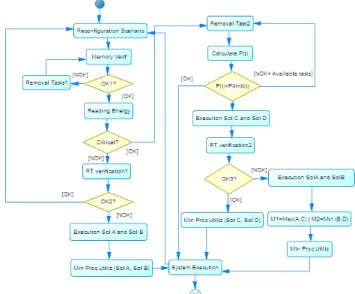
In this subsection, we present the operating mode of a system after any reconfiguration scenario. We explain here how the system is able to be adapted after any reconfiguration scenario. To satisfy the memory, real-time and energy constraints after any reconfiguration scenario, the system should start by checking the mem-ory availability. If this constraint is respected, then the energy and also the real-time constraints have to be checked. If one or more constraints are violated, this program ensures a deterministic choice between the so-lutions A, B, C, D and E. To understand these steps, Figure 1 explains this strategy after a reconfiguration scenario.
Case Study
We present in this section a case study through which we test the quality of the proposed solutions in Gam-moudi et al. (2015) by comparing them to Wang et al. (2014) and Wang et al. (2011). Table 1 presents the same 50 tasks presented in Wang et al. (2014) and we apply the defined approach in Gammoudi et al. (2015) in order to show the gain. Reconf-Pack implements all the
Figure 1: Decision strategy.
Figure 2: Reconf-Pack main interface.
tasks and executes the di↵erent reconfiguration scenar-ios. If the system violates one or more constraints, then Reconf-Pack applies the solutions proposed by Wang et al. Wang et al. (2014) and applies the defined strategy in Gammoudi et al. (2015). In addition, we intend to develop Reconf-Pack which is an open source environ-ment that supports and performs required comparisons to related work. We implement in Figure 2 these tasks in order to verify the system feasibility: The real-time, energy and memory constraints are satisfied.
Reconfiguration 1:
At a particular time, the system undergoes the first re-configuration by adding 10 tasks that are presented in Table 2:
After the first reconfiguration, we notice that the three constraints are satisfied (U = 0.942 1, P = 0.888 1.667 and M = 216 450).
Table 1: Initial tasks Task Ci Ti M F i Task Ci Ti M F i A1 3 500 2 F 1 3 900 2 A2 4 500 6 F 2 4 920 6 A3 5 720 3 F 3 3 940 3 A4 6 740 4 F 4 2 50 4 A5 7 760 3 F 5 3 980 3 B1 3 780 2 G1 4 980 2 B2 4 500 6 G2 5 800 6 B3 5 660 3 G3 6 50 3 B4 6 100 4 G4 4 700 4 B5 4 740 3 G5 8 680 3 C1 3 600 2 H1 4 700 2 C2 4 620 6 H2 5 720 6 C3 5 740 3 H3 6 50 3 C4 6 680 4 H4 4 760 4 C5 7 680 3 H5 8 780 3 D1 3 700 2 I1 4 800 2 D2 4 50 6 I2 6 840 6 D3 5 740 3 I3 6 50 3 D4 6 760 4 I4 7 860 4 D5 7 780 3 I5 8 880 3 E1 3 800 2 J1 4 900 2 E2 4 820 6 J2 5 920 6 E3 5 840 3 J3 3 940 3 E4 6 860 4 J4 3 100 4 E5 3 900 3 J5 4 980 3
Table 2: Reconfiguration 1: added tasks
Task Ci Ti M F i Task Ci Ti M F i AA1 3 205 2 AB1 3 215 2 AA2 7 245 6 AB2 5 235 6 AA3 4 215 3 AB3 6 245 3 AA4 7 255 4 AB4 6 235 4 AA5 5 225 3 AB5 4 225 3 Reconfiguration 2:
At a particular time, the system undergoes the second reconfiguration by adding of 10 tasks that are presented in Table 3:
After this reconfiguration scenario, the real-time constraint is not satisfied because U is greater than 1 (U = 1.185 1, P = 1.402 1.667 and M = 252 450). So, to correct this, we explore the solution A and the solution B detailed in Gammoudi et al. (2015).
If we apply solution A: After the modification of the periods Ti, the processor utilization is reduced and can satisfy the real-time scheduling: U= 0,99. Figure 3 illustrates the considered system of 70 tasks after
chang-Table 3: Reconfiguration 2: added tasks
Task Ci Ti M F i Task Ci Ti M F i AC1 8 225 2 AD1 7 205 2 AC2 4 245 6 AD2 5 245 6 AC3 7 215 3 AD3 4 235 3 AC4 3 225 4 AD4 5 255 4 AC5 6 205 3 AD5 6 255 3
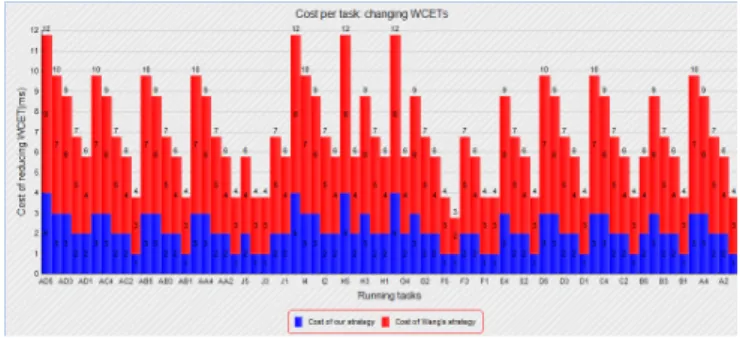
ing periods by our solution A in Gammoudi et al. (2015) and by the proposed solution in Wang et al. (2014). Both solutions provide a change on the period of tasks. We define the cost of a solution as the total delay in-troduced to all periods. To evaluate the performance of our solution compared to the approaches in Wang et al. (2014), we present the following curves (Figure 3): The curve in blue is our solution and in red color is when applying the solution presented in Wang et al. (2014).
Figure 3: Cost of modification of periods Ti compared with Wang et al. (2014).
We know that the cost is a delay penalty for a task i of TN ew - Ti. Therefore, the total cost for each approach is the sum of all these costs. After the execution of our strategy in Gammoudi et al. (2015), we note that the total cost is equal to 6940ms, but the total cost by using the second strategy proposed by Wang et al. (2014) is equal to 23036ms. Then, our solution is better than the solution presented in Wang et al. (2014). The introduced delay is only 30% (230366940 ⇤ 100 ' 30%) of the introduced delay by Wang et al. (2014).
If we apply solution B: After the modification of the WCETs Ci, the processor utilization is reduced and can satisfy the real-time scheduling: U= 0,636. Accord-ing to Figure 4, we can notice that our solution is less costly also in case B than the Wang strategy in Wang et al. (2014).
Figure 4: Cost of modification of WCETs Ci (solution B ).
The total cost of our strategy is equal to 154ms but the total cost by using the second strategy defined in Wang
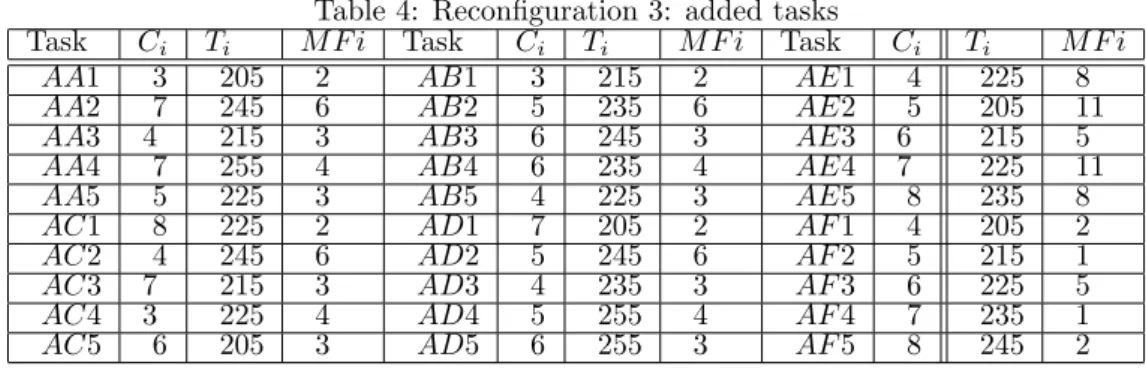
Table 4: Reconfiguration 3: added tasks
Task Ci Ti M F i Task Ci Ti M F i Task Ci Ti M F i AA1 3 205 2 AB1 3 215 2 AE1 4 225 8 AA2 7 245 6 AB2 5 235 6 AE2 5 205 11 AA3 4 215 3 AB3 6 245 3 AE3 6 215 5 AA4 7 255 4 AB4 6 235 4 AE4 7 225 11 AA5 5 225 3 AB5 4 225 3 AE5 8 235 8 AC1 8 225 2 AD1 7 205 2 AF 1 4 205 2 AC2 4 245 6 AD2 5 245 6 AF 2 5 215 1 AC3 7 215 3 AD3 4 235 3 AF 3 6 225 5 AC4 3 225 4 AD4 5 255 4 AF 4 7 235 1 AC5 6 205 3 AD5 6 255 3 AF 5 8 245 2
et al. (2014) is equal to 326ms. Then, our solution is better than the solution presented in Wang et al. (2014): The introduced delay is reduced to 45%. Let us take the same system described previously (Table 1). We stress the energy constraint in the following. We assume that : Plimit = 1,67 Watt. The system is initially feasible.
Reconfiguration 3:
At a particular time, the system undergoes a reconfig-uration by adding 30 tasks that are presented in the Table 4:
We notice that the value of U is greater than 1 and the value of P is greater than Plimit (Figure 5). The sys-tem is then no more feasible after this reconfiguration. Moreover, in this case it consumes all the available en-ergy before the next battery recharge. We focus on the energy constraint and we execute solutions C and D to ensure that the system will run correctly until the next recharge.
If we apply solution C: After the modification of the periods of tasks Ti, the power consumption of the sys-tem is reduced and can satisfy the energy constraint: P= 1,601 Watt. If we apply solution D: After
Figure 5: System1’s properties after the reconfiguration. the modification of the WCETs of tasks Ci, the power
consumption of the system is reduced and can satisfy the energy constraint: P= 0,604 Watt. Periodically recharged systems have not been studied in Wang et al. (2014).
Performance Evaluation
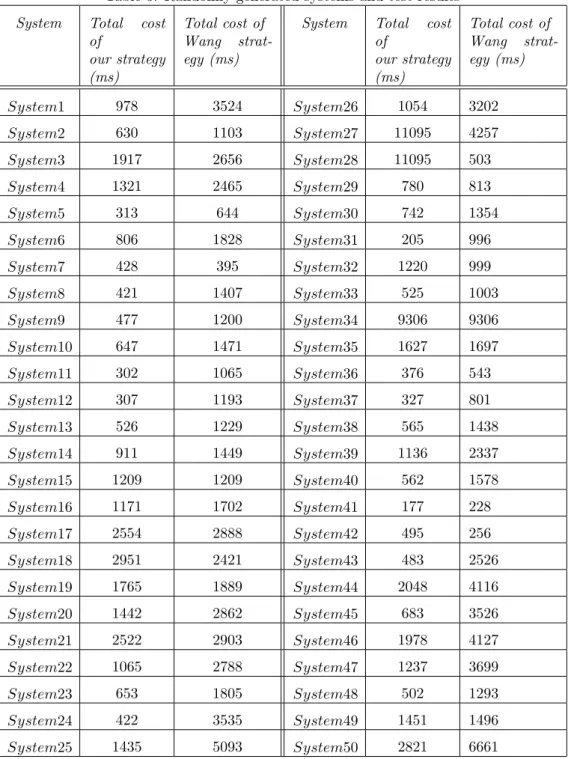
We presented in Section 5, the Reconf-Pack tool that im-plements the same case study in Wang et al. (2014) using two di↵erent theories and we showed that our strategy introduces less delay than the strategy detailed in Wang et al. (2014). Now, in order to generalize the perfor-mance evaluation of our strategy in Gammoudi et al. (2015), another tool called Task-Generator (Figure 6) has been developed to generate random systems and to randomly plan reconfiguration scenarios. We use then Reconf-Pack to apply for each system both strategies. Table 5 summarizes the test set of 50 systems generated by Task-Generator. The second column is the total de-lay cost when we apply our strategy in Gammoudi et al. (2015) and the third column is the total delay cost when applying the solution presented in Wang et al. (2014).
Figure 6: Random task generator.
According to Table 5, our strategy introduces less delay in 88% of randomly generated tests. Moreover, the aver-age delay introduced by our strategy to keep the system feasible and up until the next recharge is only 55% of the average delay introduced by Wang’s strategy.
Table 5: Randomly generated systems and test results System Total cost
of our strategy (ms) Total cost of Wang strat-egy (ms)
System Total cost of our strategy (ms) Total cost of Wang strat-egy (ms) System1 978 3524 System26 1054 3202 System2 630 1103 System27 11095 4257 System3 1917 2656 System28 11095 503 System4 1321 2465 System29 780 813 System5 313 644 System30 742 1354 System6 806 1828 System31 205 996 System7 428 395 System32 1220 999 System8 421 1407 System33 525 1003 System9 477 1200 System34 9306 9306 System10 647 1471 System35 1627 1697 System11 302 1065 System36 376 543 System12 307 1193 System37 327 801 System13 526 1229 System38 565 1438 System14 911 1449 System39 1136 2337 System15 1209 1209 System40 562 1578 System16 1171 1702 System41 177 228 System17 2554 2888 System42 495 256 System18 2951 2421 System43 483 2526 System19 1765 1889 System44 2048 4116 System20 1442 2862 System45 683 3526 System21 2522 2903 System46 1978 4127 System22 1065 2788 System47 1237 3699 System23 653 1805 System48 502 1293 System24 422 3535 System49 1451 1496 System25 1435 5093 System50 2821 6661
Conclusion
In this paper, we study the functional feasibility in an architecture powered by a battery. We are interested in the tasks scheduling after reconfiguration scenarios. To ensure that the system is feasible after any recon-figuration scenario and does not consume its battery before the next recharge, we propose a strategy based on grouping tasks in packs presented in Gammoudi et al. (2015). We developed two tools Reconf-Pack and Task-Generator to evaluate our solution and compare it to the solution in Wang et al. (2014). We show very interesting gains in terms of minimizing the introduced delay to task periods to keep the system feasible and up till the next recharge. We are planning to develop Reconf-Pack and Task-Generator open source tools to support and perform required comparisons to other re-lated work. Thanks to these two tools, we make auto-matic and autonomous simulations. In our future work, we are interested in improving on ameliorating the strat-egy and generalizing it to multi-core real-time embedded systems.
REFERENCES
Allen R.; Douence R.; and Garlan D., 1998. Speci-fying and analyzing dynamic software architectures. In Fundamental Approaches to Software Engineering. Springer, 21–37.
Brennan R.W.; Fletcher M.; and Norrie D.H., 2001. A holonic approach to reconfiguring real-time distributed control systems. In Multi-Agent systems and applica-tions II. Springer, 323–335.
Gammoudi A.; Benzina A.; Khalgui M.; and Chillet D., 2015. New Pack Oriented Solutions for Energy-Aware Feasible Adaptive Real-Time Systems. In Intel-ligent Software Methodologies, Tools and Techniques. Springer, 73–86.
Gharsellaoui H. and Ahmed S.B., 2014. Real-Time Re-configurable Scheduling of Sporadic Tasks. In Software Technologies: 8th International Joint Conference, IC-SOFT 2013, Reykjavik, Iceland, July 29-31, 2013, Re-vised Selected Papers. Springer, vol. 457, 24.
Gharsellaoui H.; Khalgui M.; and Ahmed S.B., 2012. New Optimal Solutions for Real-Time Reconfigurable Periodic Asynchronous Operating System Tasks with Minimizations of Response Time. In International Journal of System Dynamics Applications (IJSDA). IGI Global, vol. 1, 88–131.
Khalgui M., 2010. NCES-based modelling and CTL-based verification of reconfigurable embedded control systems. In Computers in Industry. Elsevier, vol. 61, 198–212.
Khalgui M.; Mosbahi O.; Li Z.; and Hanisch H.M., 2011. Reconfigurable multiagent embedded control systems: From modeling to implementation. In Computers, IEEE Transactions on. IEEE, vol. 60, 538–551. Liu C.L. and Layland J.W., 1973. Scheduling
algo-rithms for multiprogramming in a hard-real-time en-vironment. In Journal of the ACM (JACM). ACM, vol. 20, 46–61.
Rooker M.N.; S¨under C.; Strasser T.; Zoitl A.; Hummer O.; and Ebenhofer G., 2007. Zero Downtime Reconfig-uration of Distributed Automation Systems: The ep-silonCEDAC Approach. In HoloMAS. Springer, 326– 337.
Shin Y. and Choi K., 1999. Power conscious fixed pri-ority scheduling for hard real-time systems. In De-sign Automation Conference, 1999. Proceedings. 36th. IEEE, 134–139.
Wang X.; Khalgui M.; and Z.Li, 2011. DYNAMIC LOW POWER RECONFIGURATIONS OF REAL-TIME EMBEDDED SYSTEMS. In Proc. 1st Pervas. Em-bedded Comput. Commu.Syst, Portugal. 6.
Wang X.; Khemaissia I.; Khalgui M.; and Z.Li, 2014. Dynamic Low-Power Reconfiguration of Real-Time Systems With Periodic and Probabilistic Tasks. In Automation Science and Engineering, IEEE Trans-actions. vol. 258-271.