Transit time during the interparticle percolation process
Franck Lominé*
Research Institute of Civil Engineering and Mechanics, UMR CNRS 6183, University of Nantes, 58 rue Michel Ange, BP 420-44606, Saint-Nazaire, Cedex, France
Luc Oger†
Institut de Physique de Rennes, UMR CNRS-UR1 6251, Université de Rennes 1, 263 Avenue du Général Leclerc-35042 Rennes Cedex, France
共Received 10 January 2010; revised manuscript received 24 August 2010; published 6 October 2010兲 A numerical investigation of jamming effect during the spontaneous interparticle percolation process of small beads through an unconsolidated porous media has been performed. The size ratio between the moving beads and the ones building up the porous medium was chosen larger than the geometrical trapping threshold: c=共
2
冑3− 1兲
−1= 6.464. . .. In this paper, we used the discrete element method algorithm to study the rebounds of particles on the top of the porous medium and the transit times of an assembly of particles through it. Several parameters such as the number of injected particles, the size ratio between beads, and the energy restitution coefficient are investigated. This study leads to give some important results of the evolution of the transit time versus the contiguous volume occupied by the percolating particles.
DOI:10.1103/PhysRevE.82.041301 PACS number共s兲: 45.70.⫺n, 83.80.Fg, 81.05.Rm, 02.70.Ns
I. INTRODUCTION
The segregation, which can occur during the handling of a granular material, is an important problem. Due to external forces, a granular assembly can be subjected to grain reorga-nizations. Then, inhomogeneous spatial distribution of grains can be observed due to differences in grains properties. In this paper, we focus our attention on grains with different sizes. The well known example of size segregation is the “Brazil Nuts problem”关1兴. Our work, presented in this paper, is related to size segregation of grains under the gravity ef-fect. For this study, we observe the interparticle percolation process of particles through a packing of larger spheres. Pre-vious experiments 关2,3兴 shown that collective effects can lead to behavior differences compared to cases when only one particle travels inside the packing of larger spheres 关4–7兴. These previous experiments and numerical simula-tions put in evidence that these collective effects are mainly governed by the size of the grain species and by the number of percolating grains. In other words, these collective effects, on the transit time关2兴 and on the dispersion of particles 关3兴, result essentially in jamming effects during the flow of the small particles through the porous structure of larger spheres. We are agreeing with the new improved definition of jam-ming made by关8兴 as the jammed states is defined as stable
equilibrium states, where small load increments cause only small displacements, and large unrestricted particle motions will not occur. First, we present our numerical program,
based on discrete element method, to perform the study of the spontaneous interparticle percolation phenomenon. In a second part, results are presented and analyzed by consider-ing separately the penetration of the particle blob in the po-rous medium, and its flow through the entire packing of larger spheres.
II. NUMERICAL SETUP
In this section, we present the set-up that we developed and used to study the flow of a group of particles through a packing made with static larger spheres. It is directly inspired from the experimental set-up used by Lomine and Oger关3兴. The algorithm that we chose and developed is based on Dis-crete Element Method of soft spheres 关known as molecular dynamics 共MD兲兴 and it runs as follow. The static part of the simulation 共i.e., the two sphere packings兲 is created with a numerical gravity like deposition which is performed with the Powell’s algorithm 关3,9兴. A small packing of spheres, with diameter d, is generated and placed above another pack-ing of larger spheres 共D兲 which constitute the porous me-dium. The distance which separates the two packings is set to one diameter of larger spheres. Both packings are stable and isotropic. The Powell’s algorithm can let us adjust the poros-ity to a desired value which was set to 0.4 in order to be consistent with the experimental set-up previously used关3兴. To avoid limited size effects, the porous medium is consid-ered as infinite in transverse directions. This is realized by using a periodic construction algorithm.
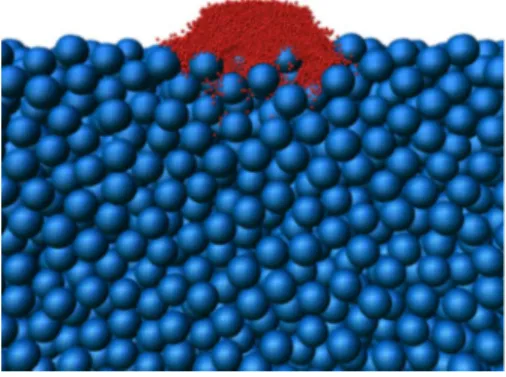
The dynamic part of the simulation is performed with a molecular dynamics of soft sphere model关10兴. During colli-sions, particles are allowed to slightly overlap each other. The value ␦ of this overlap permits to calculate interaction forces, for a pair of colliding particles, through the use of a force model. In this work we use the widely sprayed “linear spring dashpot” model 关3,11,12兴 to calculate normal force and the Cundall and Strack model 关3,10兴 for the tangential force. Time integration of particle positions is achieved with an implementation of the Verlet algorithm 关13兴. For effi-ciency, collision detection is made with the use of cells and a doubly linked-list 关3兴 and all parts of the algorithm are par-allelized using MPI. More details, about our simulation pro-gram can be found in Ref. 关3兴. To illustrate this model, a snapshot, taken from a simulation of flow of 20 000 par-ticles, is presented in Fig.1.
Our numerical model has been validated with confronta-tion with numerous experimental results关2,3,14兴. The use of numerical simulation in conjunction with our previous ex-perimental studies let us observe interparticle percolation phenomenon and the jamming effect during such flow through porous material. We present now, in the next section, the results of this study.
III. RESULTS
First when particles are launched on top of the porous medium, a quantity of them rebounces on the upper packing surface. Indeed according to the presence of a pore or not under the small particles, the time needed by a particle to enter in the porous medium can vary. Moreover, due to the presence of other particles, some particles cannot enter in the porous space since pores are already filled with other par-ticles. These effects can lead to a penetration delay that has been experimentally and numerically observed关3兴.
Second, during the crossing of the first grain layers of the packing of larger spheres, we observe a transitional regime with velocity thermalizations 共defined as granular tempera-ture freezing兲. This regime was put in evidence by Lomine and Oger关3兴. Indeed, in dilute granular flow, the fluctuation of grains velocities is quantified by the measure of so-called granular temperature: higher the temperature is, higher the velocities of the grains are, and by opposition the decrease of the velocities can be modeled as a freezing.
It is interesting to point out that two very different behav-iors for the moving particles 共fast horizontal displacement when the packing fraction is small in one hand, slow global displacement when the packing fraction is high兲 can generate very similar effects: a slow vertical falling velocity. In other words, they lead to similar results: a loss of kinetic energy.
Overall, we can observe two distinct phases during the interparticle percolation phenomenon. The first one is how particles penetrate in the medium, and the second one is how they flow in it. Moreover it is essential to ask which coupling can appear between them?
Numerically, it is possible to avoid taking into account these external rebounds of the moving particles, before en-tering in the porous medium, during the flow property deter-mination共like the mean transit time for example兲. This leads
to the ability to separate the influence of the rebound phase on global flow properties, what is almost impossible experi-mentally.
The following section presents our numerical results and is divided as follow: first, we present and analyze results about the jamming, which occur during the entrance of par-ticles in the porous medium, then we study its influence on the flow of particles in the underneath grain layers. All these effects will be analyzed in term of their influence on transit times.
A. Jamming during entrance of particles in the porous medium
In this part we are looking for how particles enter in the porous structure. First, we can see that the porous medium is perfectly homogeneous along the vertical axis almost up to the last layer of large particles共Fig.2兲. The packing fraction fluctuation is only observed in a D thickness which permit us to define the entrance zone as this order of length. We define
tinitas the time for a particle to pass through the first larger
grain layer at height hinitfrom the top of the porous medium
共Fig.2兲. We can obtain this time for every particle. For ex-ample, Fig. 3 shows probability distribution function of times tinitfor a launch of different numbers of particles with N = 500, N = 5000 and N = 8000 for D/d=16.
It illustrates clearly the fact that, when the number of particles injected in the porous medium increases, the tail of the probability distribution function of times tinitis larger. In
other words, the more particles are injected in the porous FIG. 1. 共Color online兲 Snapshot of flow of 20 000 small
par-ticles through a porous medium. Note that, for convenience, only half system is represented.
45 46 47 48 49 50 z/D 0 0.1 0.2 0.3 0.4 0.5 0.6 ϕ hinit D
FIG. 2. Packing fraction profile of the packing of spheres of diameter D. The height hinit, which permits to define tinitis also represented. 0 2 4 6 8 10 12 14 16 18 20 tinit/√2D/g 0 0.05 0.1 0.15 p df (%) N = 500 N = 5000 N = 8000
FIG. 3. Distributions of times tinitfor launches of different
medium, the more they have difficulties to pass the first layer of grains. This can be easily understood as a consequence of a jamming effect due to the limited pore volume immediately accessible for the flowing particles under their falling zone 共also visible in Fig.1兲. Moreover, we can already notice that the more probable value of tinit/
冑
2D/g is close to a value of2 with a decreasing probability when the amount of particle increases. In such case, the mean value of tinit/
冑
2D/gin-creases. The normalization term is linked to the classical free fall over one large bead height 共1/
冑
2D/g兲. So, this more probable value corresponds to the free fall time over a dis-tance of 2D, integrating the disdis-tance between the two initial packing position and the first grain thickness. Let’s look at each effect separately. Indeed, this jamming effect during entrance is made of two contributions, as already mentioned: rebounds of particles on the top surface of the porous me-dium and their penetration in the porous meme-dium.Several parameters can influence the way particles pen-etrate in the packing of larger spheres. First, we made a series of numerical simulations to determine how the mean time 具tinit典 is influenced by the volume of falling particles.
This volume depends on two parameters that can be indepen-dently set in our simulations: the number N of percolating particles and the size ratio D/d.
Instead of considering the number of particles N or the size ratio D/d, it can be convenient to cast in term of injected volume or in a better way in term of filled pores. That is why, we have defined a dimensionless value Np 关2兴, which can
link the number of falling particles and the large pore size,
Np
冉
N, d D冊
= N4 3冉
d 2冊
3 ⌽RCPD3 12共冑
2 − 2⍀兲 ⬇ 31.5N冉
d D冊
3 , 共1兲where⌽RCP= 0.64 is the random close packing limit and⍀ = 3 arccos共1/3兲−is the solid angle of the tetrahedron com-posed by four spheres of diameter D. The interstitial volume of this tetrahedron corresponds to the minimal accessible one for the percolating particles of diameter d; in practice the size distribution of these volumes starts at this value and can reach a size up to the volume of the sphere D, but the shape of this distribution is always similar for all disordered pack-ings关15兴. The upper part of Eq. 共1兲 represents the volume of small particles injected in the porous structure and the lower part is an estimation of the accessible volume of the smallest pore of the porous medium. The parameter Npis then useful
to analyze phenomenon in term of number of contiguous filled pores关3兴. We can notice that it is possible to use this defined parameter Np when both N and d/D vary. In the
following simulations, only one parameter influence will be studied at a time. To clarify situations between varying N and varying d/D, we use the notation Np共N,
d0
D0兲=Np
N
when deal-ing with Npat a fixed size ratio d0/D0. In a same manner, the
notation Np共N0, d D兲=Np
d/D
will be adopted with fixed number of particles N0and varying d/D.
1. Effect of the number of particles
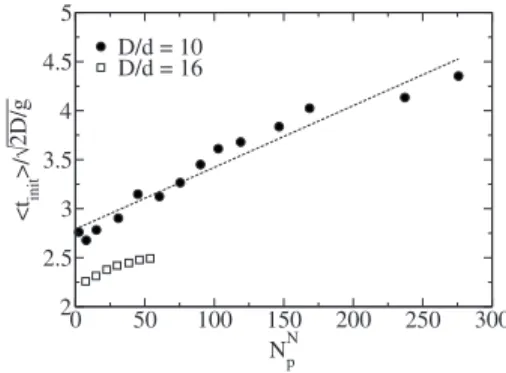
Figure 4 shows dependency of the dimensionless mean time具t˜init典=具tinit典/
冑
2D/g with NpN
for several simulations and for two values of size ratio D/d. Figure 4 illustrates that 具t˜init典 increases with Np
N
, i.e.: with the number of particles falling down at the same time. For small values of Np
N
,具tinit典
is close to the value of the time for falling over a distance of 2D. As the number of injected particles increases, 具tinit典
al-most increases linearly with Np N
. We can also observed in Fig. 4 that these values increase when the size ratio D/d decreases. A series of simulations with various ratio D/d have been performed and results are analyzed in the follow-ing section through the parameter Np
d/D
.
2. Influence of the size ratio DÕ d
To characterize more precisely the dependency of the di-mensionless 具t˜init典 on D/d previously observed in Fig.4, let
us consider Fig.5which presents results obtained for various values of size ratio expressed in termed of volume with the parameter Np
d/D
. Figure5shows that dimensionless具t˜init典
in-creases proportionally with Np d/D
. Indeed, for small Np d/D共i.e.,
for small d/D兲, particles can more easily pass through the first grain layer. Moreover as observed previously, Fig. 5 confirms that the dimensionless 具tinit典 is more important
when the number of particles共N兲 is higher.
0 50 100 150 200 250 300 NpN 2 2.5 3 3.5 4 4.5 <tinit >/ √2D/g D/d = 10 D/d = 16
FIG. 4. Evolution of mean time 具tinit典 for different number of
particles. This evolution is given in terms of number of filled pores via the parameter NpN. A linear adjustment is also represented.
0 100 200 300 400 Npd/D 2 3 4 5 6 7 8 <tinit >/ √2D/g N = 1 000 N = 2 000 N = 5 000
FIG. 5. Dependency of mean tinit with Npd/D for N = 1000, N
3. Effect of energy dissipation
During spontaneous interparticle percolation phenom-enon, the particles moved due to collisions which facilitate more or less the appearance of jamming effects during the entrance phase. A physical parameter that can control their ability to stay in dense region or to move to less dense region is the energy restitution coefficient of a collision. Dispersion of particles due to collisions during the flow was investigated in previous work 关3兴. Here we are only interested in the effect which occurs between the launch of particles and their initial crossing down to the height hinit. Due to the fact that
we only consider here the first large grain layer, collisions that can affect the mean time具tinit典 are the collisions of
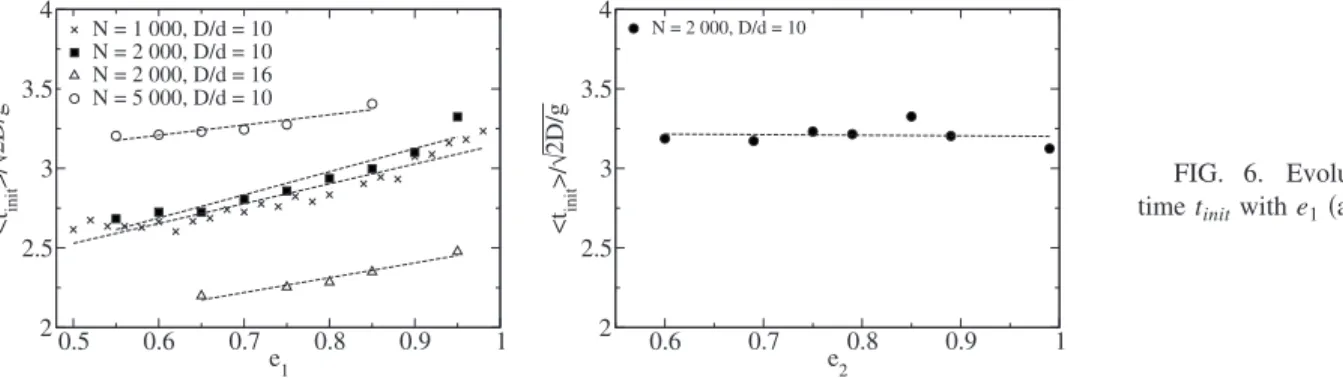
par-ticles on the upper porous medium surface. Here, two tution coefficients can be defined. The first one is the resti-tution coefficient which characterizes a collision between a small moving bead and a large immobile bead. The second one is the restitution coefficient that characterizes a collision between two percolating moving particles. These two resti-tution coefficients will be respectively denoted e1 and e2 in the rest of this paper. In order to analyze influence of energy restitution on jamming effects during fall of particles, a se-ries of simulations with various e1 and e2 has been carried out.
Dependency of 具t˜init典 on e1 and e2 are presented respec-tively in Fig. 6共a兲and Fig.6共b兲. Figure 6共a兲 shows that the mean time needed to penetrate in the porous medium in-creases with e1. This time increases when energy dissipation decreases. This result is due to higher rebounds of particles on the porous medium surface with less energy dissipation. The particles need more time to dissipate their kinematics energy in order to enter in pore holes. As several particles try to enter at the same time in the porous structure through the same pore, an increase of the number of falling particles leads to a penetration time delay as we have observed previ-ously. This can also be observed in Fig.6共a兲.
Figure6共b兲shows that the mean time具t˜init典 does not truly
depend on the restitution coefficient e2. So energy dissipation during entrance of the particle blob in the porous structure is mainly due to rebounds of particle on the porous medium surface made with larger spheres. This observation confirms that the freezing of the granular temperature at the entrance of the porous medium observed in other experimental analy-sis does not contribute to slow down the initial transit time. But this behavior can play an important role for the rest of the flow as the falling particles would have less energy for continuing to fall.
All results presented here show that the time needed to enter in the porous medium can vary according to the many parameters that govern experiments of interparticle percola-tion of small particles through a packing of larger spheres. Indeed, we have seen that the mean time for crossing the first grain layer depends on the number of particles, the size ratio and the energy restitution coefficients.
B. Effect of jamming on percolation process
After these considerations, we are going to analyze the effect of these parameters on the mean transit time of the blob of particles through the entire packing of height H. To bypass the entrance phase jamming phenomenon, we will use a definition of transit time that does not take into account the time needed to penetrate in the porous space. We call tinit i
the time for a particle i to cross the first layer and tithe time required to reach the output of the porous media. The mean transit time, with previous remark, is then given by
具t쐓典 =
兺
i=1 N 共ti − tinit i 兲 N . 共2兲We can notice that such calculation cannot be done experi-mentally with the experimental set-up presented in Ref. 关3兴.
1. Effect of the number of particles
Jamming in interparticle percolation phenomenon de-pends on the number of particles falling down. Lomine and Oger关2兴 have experimentally shown existence of three flow regimes according to the number of particles falling down
0 50 100 150 200 250 300 N p N 33 34 35 36 37 38 dimensionless time <t*>/√2D/g <t>/√2D/g
FIG. 7. Evolution of dimensionless times: 具t典 共global兲 and 具t쐓典 共corrected兲 with Np
Nwith fixed value of D/d=10.
0.5 0.6 0.7 0.8 0.9 1 e1 2 2.5 3 3.5 4 <tinit >/ √ 2D/g N = 1 000, D/d = 10 N = 2 000, D/d = 10 N = 2 000, D/d = 16 N = 5 000, D/d = 10 0.6 0.7 0.8 0.9 1 e2 2 2.5 3 3.5 4 <tinit >/ √ 2D/g N = 2 000, D/d = 10
FIG. 6. Evolution of mean time tinitwith e1共a兲 and e2共b兲.
through the porous media. In the first one, they observed that the mean transit time decreases when the number of falling particles grows. As NpN increases, the particles loose more and more energy by collisions with their very close neigh-bors. Then, the particles are mainly falling down directly in the lower pore structure, without bouncing around. As the number of small beads increases further, an equilibrium be-tween the direct falling process and the interparticle collision events is obtained. In this steady gravity regime, the mean transit time is quite independent of Np
N
. If we continue to increase the number of falling beads, they observed a third regime in which the particle velocities slow down due to the crossing of a large number of particles simultaneously through the same pore. In fact, this flow regime, where jam-ming occurs, can be divided into two subregimes. First, the dependency of the slowdown on Np
N
is important. This be-havior reflects a beginning of a jamming effect of pores lo-cated in the flow zone as noted previously. Then, the jam-ming effect grows with Np
N
and the increase of the mean transit time with Np
N
is less important due to accumulation of particles in connecting pores. In this study, we have deter-mined the mean time transit 具t쐓典 for a series of simulations with different number of particles. The results obtained are presented in Fig.7. This shows that our simulation model is able to reproduce the different flow regimes observed experi-mentally. Moreover these flow regimes can also be observed even if we make abstraction of the time needed by the par-ticle blob to penetrate the porous structure.
2. Effect of the size ratio DÕ d
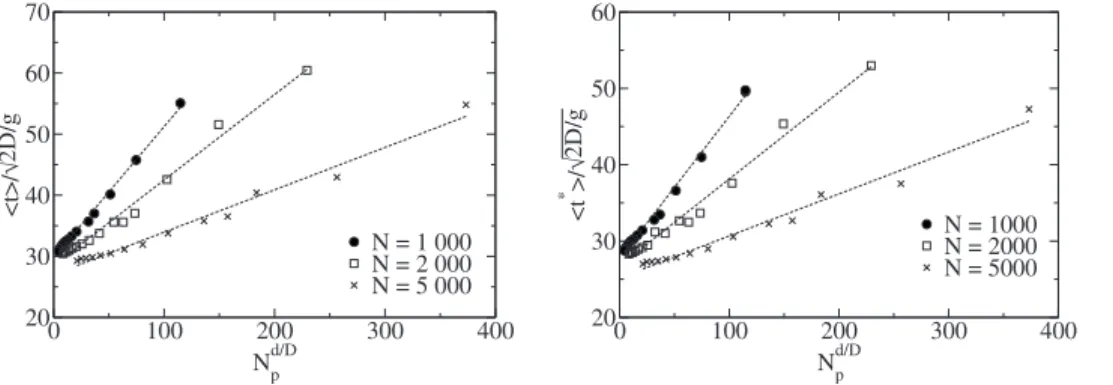
Figure 8 presents the dependency of the dimensionless mean transit time on Np
d/D
for three numbers N of particles. Figure8共a兲reveals a linear relation between the mean transit
time of the particle blob and Np d/D
. The Fig. 8共b兲 illustrates the dependency of 具t쐓典 on Npd/D. By making comparison be-tween the Figs.8共a兲and8共b兲, we can deduce that the mean transit time of the particle blob to flow inside the porous medium is proportional to Npd/D even without the entrance phase effect. Indeed, as seen previously in Fig. 5,具tinit典
in-creases proportionally with Np d/D
. These linear dependencies with Np
d/D
confirm the linear dependency with Np d/D
of the global mean transit time observed in Fig.8共a兲
3. Effect of energy dissipation
We have seen in Sec. III A that the mean time 具tinit典
mainly depends on the restitution coefficient e1, which char-acterized a collision between a moving particle and a sphere of the porous medium. Figures 9共a兲 and 9共b兲 presents, re-spectively, evolution of the velocities H/具t典 and H/具t쐓典 with 共1−e1兲1/4. In both graphs, we observed a linear relation. The theoretical study of Wilkinson and Edwards 关16兴, based on the analyze of Brownian motion for the case of a single particle flow, reported the same relation between the mean velocity of the flow and共1−e1兲1/4. Results presented in Figs. 9共a兲 and 9共b兲 confirm this fact also when several particles flow at the same time in the porous structure. We have ne-glected to draw the same curves with e2as no dependency is observed.
IV. CONCLUSION
In this paper, we have investigated jamming effects which can occur when a packing of small particles flows through a porous medium made of larger spheres. Jamming effects can first arise during the penetration of particles into the porous medium, and second during their flow inside it. We have also
0 100 200 300 400 Npd/D 20 30 40 50 60 <t>/ √ 2D/g N = 1 000 N = 2 000 N = 5 000 0 100 200 300 400 Npd/D 20 30 40 50 <t * >/ √ 2D/g N = 1000 N = 2000 N = 5000
FIG. 8. Evolutions of mean times具t典 共a兲 and 具t쐓典 共b兲 with Ndp/D for N = 1000, N = 2000 and N = 5000. Linear adjustments in dashed line are also represented.
0.4 0.5 0.6 0.7 0.8 (1-e 1) 1/4 10 15 20 25 30 H/<t> √ 2gD N = 1000 N = 2000 N = 5000 0.4 0.5 0.6 0.7 0.8 (1-e 1) 1/4 10 15 20 25 30 H/<t*> √ 2gD N = 1000 N = 2000
N = 5000 FIG. 9. Dimensionless
veloci-ties of a blob of particles with the restitution coefficient e1 for D/d = 10 and for N = 1000 共NNp⬇31兲, N = 2000 共NpN⬇60兲 and N=5000 共NNp⬇146兲. Linear adjustments
shown that the mean transit time具tinit典 of particles to cross
the first grain layer increases linearly with the parameter Np
共Np N
and Np
d/D兲. This analysis of the influence of the number
of particles demonstrates the existence of jamming effect during the penetration of the particle blob, and the presence of collective effects during the flow inside the porous space. These last ones can also result in jamming effect leading to a nondependency on Np of the mean transit time, for a large
number of particles. As observed by Lomine and Oger关2兴, in such flow regime, some pores are fully occupied by smallest particles and no flow toward the pores of the underneath grain layer can take place until these ones are vacated. In this work, an analysis of the influence of size ratio D/d revealed that the mean transit time 具t典 and the mean time 具tinit典 are
proportional to the ratio共d/D兲3. These evolutions are due to
jamming effect coming from the volume occupied by the small particles. An increase of the ratio between the volume of small particle blob and the pore volume lead to an in-crease of the penetration time as well as an inin-crease of the time required to percolate through the packing of large spheres. Energy dissipation influence on transit time has also been investigated. It has been pointed out that the restitution coefficient of collisions, between the small particles and the larger spheres of the porous medium, is the only one which has influence on the particles penetration inside the porous medium. When the energy dissipation due to rebounds of particles on the surface of the porous medium decreases, particles needs more time to enter in the porous structure. Moreover, this study shows that the mean transit time of a blob of particles evolves linearly with共1−e1兲1/4.
关1兴 A. Rosato, K. J. Strandburg, F. Prinz, and R. H. Swendsen, Phys. Rev. Lett. 58, 1038共1987兲.
关2兴 F. Lominé and L. Oger,J. Stat. Mech.: Theory Exp. 共 2006兲 P07019.
关3兴 F. Lominé and L. Oger,Phys. Rev. E 79, 051307共2009兲. 关4兴 J. Bridgwater and N. D. Ingram, Trans. Inst. Chem. Eng. 49,
163共1971兲.
关5兴 J. Masliyah and J. Bridgwater, Trans. Inst. Chem. Eng. 52, 31 共1974兲.
关6兴 J. Bridgwater,Powder Technol. 15, 215共1976兲.
关7兴 I. Ippolito, L. Samson, and J. P. Hulin,Eur. Phys. J. E 3, 227 共2000兲.
关8兴 K. Bagi,Granular Matter 9, 109共2007兲. 关9兴 M. J. Powell,Powder Technol. 25, 45共1980兲.
关10兴 P. A. Cundall and O. D. L. Strack, Geotechnique 29, 47 共1979兲.
关11兴 L. Oger, S. Savage, D. Corriveau, and M. Sayed,Mech. Mater.
27, 189共1998兲.
关12兴 L. E. Silbert, D. Ertas, G. S. Grest, T. C. Halsey, D. Levine, and S. J. Plimpton,Phys. Rev. E 64, 051302共2001兲. 关13兴 L. Verlet,Phys. Rev. 159, 98共1967兲.
关14兴 L. Oger and F. Lominé, in Powders and Grains, edited by R. Garcia-Rojo, H. J. Herrmann, and S. McNamara 共Taylor & Francis Group, New York, 2005兲, Vol. 1, pp. 57–61.
关15兴 H. J. Frost and R. Raj,J. Am. Ceram. Soc. 65, C19共1982兲. 关16兴 D. R. Wilkinson and S. F. Edwards,Proc. R. Soc. London, Ser.