RECENT ADVANCES IN MACROMOLECULAR DESIGN VIA COBALT-MEDIATED RADICAL POLYMERIZATION.
Debuigne Antoine, Hurtgen Marie, Piette Yasmine, Thomassin Jean-Michel, Jérôme Christine, Detrembleur Christophe.
Center for Education and Research on Macromolecules, University of Liege, Sart-Tilman, Bat B6A, 4000, Liege, Belgium. [email protected]
Introduction
Nowadays, controlled radical polymerization (CRP) is a technique of choice for the preparation of a wide range of novel polymeric materials with well-defined molecular parameters. Metallic species have deeply marked this field of research as assessed by the development of atom transfer radical polymerization (ATRP).1,2 Besides this very successful system, another metal assisted CRP technique is emerging, i.e. organometallic-mediated radical polymerization (OMRP).3 In contrast to ATRP, OMRP involves the reversible formation of a covalent bond between a metal and the polymer chains, which strongly decreases the extent of termination reactions and leads to polymers with predictable molecular weights. Although many transition metals have shown ability to mediate the polymerization of vinyl monomers, 3 OMRP based on cobalt, namely the cobalt-mediated radical polymerization (CMRP), is the most efficient and versatile one.4 For example, the polymerization of important and quite challenging monomers like vinyl acetate (VAc), N-vinylpyrrolidone (NVP) and acrylonitrile (AN) can be properly controlled by bis(acetylacetonato)cobalt(II) (Co(acac)2).4
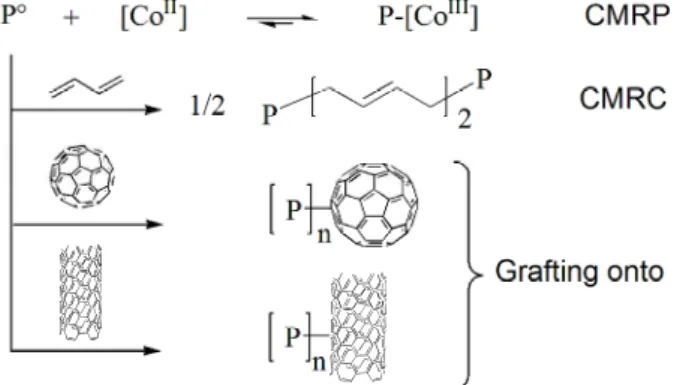
Figure 1. General scheme for cobalt-mediated radical polymerization and subsequent radical coupling or grafting reactions.
This communication will focuse on recent progress in the field of CMRP. First, the extension of this system to other important monomers, like acrylates5 and vinyl chloride (VC), will be discussed. Then, principles and synthetic opportunities offered by a radical coupling reaction (CMRC)6-8 of polymers formed by CMRP will be presented. Finally, macromolecular engineering progress of CMRP, particularly for the synthesis of grafted fullerenes9 and carbon nanotubes10, will be presented as well as the potential applications of these materials.
Experimental
General procedure for CMRP. Co(acac)2 and 2,2’-azo-bis(4-methoxy-2,4-dimethyl valeronitrile) (V-70) were introduced in a reactor or glass vessel, purged by three vacuum-argon cycles, followed by subsequent addition of distilled and degassed monomers, and solvent if any. The reaction flask was then
placed in an oil bath or an ice bath depending on the polymerization temperature. The monomer consumption was monitored by gravimetric measurements or by NMR analysis. A preformed alkyl cobalt(III), i.e. ([Co(acac)2-(CH(OCOCH3)-CH2)<4-R0], was also used as initiator.
General procedure for the radical coupling (CMRC) and the grafting of polymers onto fullerenes and nanotubes. Under inert atmosphere, a 100 fold excess of diene compared to the cobalt was added to a well-defined polymer formed by CMRP as described above. The medium was stirred for 2h at room temperature. For the preparation of the carbon nanobjects by « grafting onto », a degassed solution fullerene in 1,2,4-trichlorobenzene was added to the CMRP polymer precursor whereas a methanolic solution of the polymer capped by the cobalt was added to carbon nanotubes under argon.
Result and Discussion
Recently, we have demonstrated the possibility to control the n-butyl acrylate (nBuA) homopolymerization until high molar masses using Co(acac)2 as controlling agent. Due to the weakness of the poly(acrylate)-cobalt bond, the polymerization was performed at 0°C and required an excess of cobalt compared to the propagating chains. Moreover, the homopolymerization of VC was also investigated in the presence of Co(acac)2 as well as the copolymerization of VC with VAc. Conditions for the synthesis of novel block and statistical copolymers containing PVC will be described.
The addition of conjugated unsaturated derivatives, like dienes, fullerenes and carbon nanotubes, onto (co)polymers preformed by CMRP has also been investigated (Fig. 1). Similarities and differences between these radical addition processes will be discussed as well as the potential application of the resulting materials for photodynamic therapy (PDT) and electromagnetic intereference (EMI) shielding. Conclusions.
In the light of these recent advances and previous achievements, CMRP appears today as a mature technique able to provide original polymer materials that should contribute to further progress in a broad range of applications.
Acknowledgements.
The authors are grateful to the “Fonds National de la Recherche Scientifique” (FRS-FNRS), to Solvay SA (Solvin) and to the “Belgian Science Policy” in the frame of the “Interuniversity Attraction Poles Programme (PAI VI/27)–Functional Supramolecular Systems” for financial support.
References
(1) Ouchi, M.; Terashima, T.; Sawamoto, M. Chem. Rev. 2009, 109, 4963-5050. (2) Lena, F.; Matyjaszewski, K. Progr. Polym. Sci. 2010, 959–1021.
(3) Hurtgen, M.; Detrembleur, C.; Jerome, C.; Debuigne, A. Polym. Rev. 2011, submitted.
(4) Debuigne, A.; Poli, R.; Jerome, C.; Jerome, R.; Detrembleur, C. Prog. Polym. Sci. 2009, 34, 211-239. (5) Hurtgen, M.; Debuigne, A.; Jerome, C.; Detrembleur, C., Macromolecules 2010, 43, 886-894. (6) Debuigne, A.; Jerome, C.; Detrembleur, C. Angew. Chem., Int. Ed. 2009, 48, 1422-1424.
(7) Debuigne, A.; Poli, R.; De Winter, J.; Laurent, P.; Gerbaux, P.; Dubois, P.; Wathelet, J.-P.; Jerome, C.; Detrembleur, C. Chem.-Eur. J. 2010, 16, 1799-1811.
(8) Debuigne, A.; Poli, R.; De Winter, J.; Laurent, P.; Gerbaux, P.; Wathelet, J.-P.; Jerome, C.; Detrembleur, C. Macromolecules 2010, 43, 2801-2813.
(9) Hurtgen, M.; Debuigne, A.; Mouithys-Mickalad, A.; Jerome, R.; Jerome, C.; Detrembleur, C. Chem.-Asian J. 2010, 5, 859-868.
(10) Thomassin, J.-M.; Molenberg, I.; Huynen, I.; Debuigne, A.; Alexandre, M.; Jerome, C.; Detrembleur, C. Chem. Commun. 2010, 46, 3330-3332.