Département d’Astrophysique,
Université de Liège
Géophysique et Océanographie
Faculté des Sciences
Groupe d’AstroPhysique des
STAR Institute
Hautes Énergies (GAPHE)
Abundance determination in massive stars:
challenges for mixing processes
Thesis for the Degree of
Philosophiæ Doctor
Constantin Cazorla
Jury:
Dr. Yaël Nazé (supervisor)
University of Liège
Dr. Thierry Morel (co-supervisor)
University of Liège
Pr. Marc-Antoine Dupret
University of Liège
Dr. Sylvia Ekström
Observatory of Geneva
Dr. Yves Frémat
Royal Observatory of Belgium
Pr. Éric Gosset
University of Liège
Dr. Fabrice Martins
University of Montpellier
Pr. Gregor Rauw
University of Liège
v
Abstract:
Massive stars, the most luminous stars, are the true “cosmic engines” of
our Universe. They eject large quantity of material throughout their life,
which strongly influences their evolutionary path as well as their environment.
An important feature of massive stars is their high rotational velocities
that are either acquired at birth or due to the influence of a companion.
Rotation is believed to transport nitrogen-rich and carbon/oxygen-poor
material generated in the stellar core through the CNO cycle, to the surface.
A way to test the efficiency of rotational mixing is to study the chemical
composition at the surface of stars, in particular the fastest rotators.
The incentive for this study was the discovery, in the context of the
VLT-FLAMES Survey of Massive Stars, of fast rotators exhibiting an unenriched
nitrogen composition at their surface, contrary to predictions from single-star
evolutionary models including rotation. However, their multiplicity may
affect this conclusion, since both rotation and abundances can change as a
result of binary interactions. In this work, we combined, for the first time, a
detailed surface abundance analysis with a radial-velocity study to quantify
the importance of binary effects. This work was conducted for a sample of
40 bright, OB fast rotators in our Galaxy. Statistical tests and period-search
techniques revealed that ≥ 40% of our targets whose multiplicity status
can be probed, are binary or binary candidates. We derived the projected
rotational velocity of our targets and model atmosphere codes were then
used to derive stellar parameters and surface abundances of all sample stars.
This abundance study revealed a correlation between the helium and nitrogen
abundances of our targets, which is predicted by the rotational mixing theory.
Finally, we compared our results to predictions of single-star evolutionary
models. We found that 10 – 20% of our 40 targets exhibit no enhancement of
the [N/O] abundance ratio, in line with results of the VLT-FLAMES Survey
of Massive Stars. The properties of only half of our sample are explained
by such models, and surprisingly we also uncovered a quite common large
abundance of helium at the surface of our targets. Modifying the diffusion
coefficient in single-star models and models of non-rotating mergers did
not reproduce simultaneously both the observed helium abundances and the
[N/O] abundance ratios. Binary models considering a mass-transfer episode
can, however, reproduce the [N/O] values of the majority of our targets and
even the helium abundances of some of the most helium-enriched targets,
but they cannot explain stars displaying little helium enrichment but high
vi
[N/O] values. In conclusion, we found that not every feature of massive stars
can be explained by models, suggesting that they lack a physical ingredient
and thus require further improvements.
The second part of this thesis aimed at improving our knowledge of the X-ray
emission of early B-type stars. We studied 11 such stars at high resolution
thanks to two X-ray facilities, XMM-Newton and Chandra, doubling the
number of B-stars analysed at high resolution. In many aspects, our study
confirmed previous ones: early B-stars display rather narrow and unshifted
lines arising from a warm (of typically 0.2 – 0.6 keV) plasma located at a few
stellar radii over the stellar surface. We also found that abundances derived in
the X-ray domain are in fair agreement with photospheric ones derived in the
optical domain. Furthermore, most early B-stars are moderately bright X-ray
emitters – though we also unexpectedly found that this X-ray emission varies,
on short and/or long timescales, for half of our sample. A few stars display
peculiar features: the presence of a very hot (1.6 – 4.4 keV) component and
strong variations. These features suggest that the recorded X-ray emission
may not be entirely linked to the B-stars, but could be contaminated by
emission from a companion or an interaction with it. Indeed, in one case,
HD 79351, a flare was detected, of a luminosity compatible with those from
PMS stars, and which could be associated to its companion. Finally, the
data used also led to the discovery of the second case of X-ray pulsations
associated to — Cephei activity.
Résumé :
Les étoiles massives, qui sont les étoiles les plus lumineuses, sont les véritables
“moteurs cosmiques” de notre Univers. Elles éjectent de grandes quantités
de matière au cours de leur vie, ce qui influence fortement leur évolution
ainsi que leur environnement. Une caractéristique importante de ces étoiles
massives est leur vitesse de rotation élevée qu’elles acquièrent à leur naissance
ou suite à l’influence d’un compagnon. Cette rotation est censée induire
un transport de la matière riche en azote et pauvre en carbone/oxygène,
créée au coeur des étoiles massives au travers du cycle CNO, à leur surface.
Une façon de tester l’efficacité d’un tel mélange rotationnel est d’étudier la
composition chimique à la surface d’étoiles, en particulier celles présentant
la rotation la plus rapide.
La motivation de cette étude était la découverte, dans le contexte du projet
VLT-FLAMES Survey of Massive Stars, de rotateurs rapides montrant une
composition chimique non-enrichie en azote à leur surface, contrairement
à ce qui est prédit par les modèles d’évolution d’étoiles isolées considérant
la rotation de ces étoiles. Cependant, leur multiplicité peut affecter cette
conclusion, du fait que la rotation et les abundances peuvent être modifiées
à la suite d’interactions au sein de systèmes binaires. Dans ce travail, nous
avons combiné, pour la première fois, une analyse détaillée des abondances de
surface avec une étude des vitesses radiales pour quantifier l’importance des
effets de binarité. Ce travail a été réalisé pour un échantillon de 40 rotateurs
rapides brillants, de type spectraux OB et faisant partie de notre Galaxie.
Des tests statistiques ainsi que des techniques de recherche de périodes ont
révélé que ≥ 40% de nos cibles dont la multiplicité a pu être déterminée
sont des binaires ou des candidats binaires. Nous avons déterminé la vitesse
de rotation projetée de nos cibles. Des codes de modèles d’atmosphère
ont ensuite été utilisés pour déterminer les paramètres stellaires ainsi que
les abondances de surface des étoiles de notre échantillon. L’étude des
abondances a révélé une correlation entre les abondances d’hélium et d’azote
de nos cibles, comme prédit par la théorie du mélange rotationnel. Enfin,
nous avons comparé nos résultats avec les prédictions de modèles d’évolution
d’étoiles isolées. Nous avons trouvé que 10 – 20% de nos 40 cibles ne
montre pas d’élévation du rapport d’abondance [N/O], en accord avec les
résultats du VLT-FLAMES Survey of Massive Stars. Seule la moitié des
étoiles de notre échantillon ont leur propriétés expliquées par ces modèles,
viii
et, étonnamment, une importante abondance d’hélium a fréquemment été
trouvée à la surface de nos cibles. La modification du coefficient de diffusion
dans les modèles d’étoiles isolées ainsi que les modèles résultant de la fusion
de deux étoiles n’ont pas permis de reproduire simultanément les abondances
d’hélium et les rapports d’abondance [N/O] observés. Les modèles d’étoiles
binaires considérant un épisode de transfert de masse peuvent, cependant,
reproduire les valeurs du rapport [N/O] de la majorité de nos cibles et même
les abondances d’hélium de certaines étoiles qui présentent le plus important
enrichissement en hélium, mais ils ne peuvent pas expliquer le fait que
des étoiles présentent un faible enrichissement en hélium mais des rapports
[N/O] élevés. En conclusion, nous avons trouvé que l’ensemble des propriétés
des étoiles massives ne peut pas être expliqué par les modèles d’évolution
actuels, ce qui suggère qu’un ingrédient physique nécessite d’y être intégré,
nécessitant donc un développement supplémentaire.
La seconde partie de cette thèse avait pour but d’améliorer notre connaissance
sur l’émission X d’étoiles de type spectral B précoces. Nous avons étudié 11
de ces étoiles grâce à deux télescopes (XMM-Newton et Chandra) permettant
l’acquisition de données de haute résolution, ce qui a permis de doubler le
nombre d’étoiles B étudiées à haute résolution. À bien des égards, notre étude
a confirmé plusieurs études antérieures: les étoiles B précoces présentent des
raies non décalées et plutôt étroites, qui sont créées par un plasma chaud (à
typiquement 0.2 – 0.6 keV) localisé à plusieurs rayons stellaires à partir de
la surface. Nous avons aussi trouvé que les abondances déterminées dans
le domaine des rayons X sont en bon accord avec celles déterminées pour
la photosphère dans le domaine visible. De plus, la plupart des étoiles B
précoces sont des émetteurs de rayons X modérément brillantes – bien que
nous ayons trouvé de manière inattendue une variation de cette émission
X sur de courtes et/ou longues périodes de temps pour la moitié de notre
échantillon. Certains objets montrent des propriétés particulières: la présence
d’une composante très chaude (de 1.6 – 4.4 keV) et de fortes variations de
l’émission X. Ces propriétés suggèrent que l’émission X observée peut ne pas
être entièrement liée à l’étoile B, mais peut être contaminée par de l’émission
par un compagnon ou une interaction avec celui-ci. En effet, dans le cas de
HD 79351, une éruption stellaire a été détectée, avec une luminosité en accord
avec celles des éruptions d’étoiles pré-séquence principale : le changement de
luminosité est donc peut-être lié à son compagnon. Finalement, les données
que nous avons utilisées ont aussi mené à la découverte d’un second cas de
pulsations X associées à une activité — Cephei.
List of Papers
Referred publications related to the thesis:
I Cazorla, C., Morel, T., Nazé, Y., Rauw, G., Semaan, T., Daflon, S.,
Oey, M. S., 2017a,
Chemical abundances of fast-rotating massive stars. I. Description of
the methods and individual results
A&A, 603, A56
II Cazorla, C., Nazé, Y., Morel, T., Georgy, G., Godart, M., Langer, N.,
2017b,
Chemical abundances of fast-rotating massive stars. II. Interpretation
and comparison with evolutionary models
A&A, accepted
III Cazorla, C. & Nazé, Y., 2017c,
B-stars seen at high resolution by XMM-Newton
A&A, submitted
Unreferred publications not related to the thesis:
I Proceedings following the IAU Symposium 307 (Geneva, 23rd – 27th June
2014): New windows on massive stars: asteroseismology, interferometry,
and spectropolarimetry,
Cazorla, C., Morel, T., Nazé, Y., Rauw, G., 2015,
Chemical abundances of fast-rotating OB stars,
G. Meynet, C. Georgy, J.H. Groh & Ph. Stee, eds., 307, 94
II Poster exhibiting results obtained in the X-ray domain with
XMM-Newton, during the X-ray Universe 2017 Symposium (Rome, 6th – 9th
June 2017)
Nazé, Y., Cazorla, C., Rauw, G., Morel, T., 2017,
A legacy survey of early B-stars using the RGS
xii
Referred publications not related to the thesis:
I Cazorla, C., Nazé, Y., Rauw, G., 2014,
Wind collisions in three massive stars of Cygnus OB2
A&A, 561, A92
II Nazé, Y., Rauw, G., Cazorla, C., 2017,
fi
Aqr is another “ Cas object
Contents
Abstract
v
List of Papers
xi
List of Abbreviations
xv
List of Tables
xix
List of Figures
xxi
1 Background and motivation
1
1.1 General context
. . . .
2
1.1.1 Massive stars
. . . .
2
1.1.2 Stellar rotation
. . . .
4
1.1.2.1 Stellar shape and critical velocities
. . . . .
6
1.1.2.2 Gravity darkening effect
. . . .
9
1.1.2.3 Transport of angular momentum and
chem-ical elements
. . . 16
1.1.3 Multiplicity
. . . 23
1.1.4 X-rays from massive stars
. . . 24
1.2 Thesis outline
. . . 27
1.2.1 Rationale of the study
. . . 27
2 Optical study
31
2.1 Derivation of abundances
. . . 32
2.1.1 Methods and tools
. . . 32
2.1.1.1 Projected rotational velocity
. . . 32
2.1.1.2 Turbulence broadening
. . . 33
2.1.1.3 Atmospheric parameters and He, CNO
abundances
. . . 34
2.1.2 Published paper
. . . 40
2.1.2.1 Complementary information
. . . 98
2.2 Comparison with evolutionary models
. . . 106
2.2.1 Stellar models
. . . 106
2.2.2 Published paper
. . . 113
2.2.2.1 Complementary information
. . . 137
3 X-ray study
141
3.1 Used X-ray facilities
. . . 142
xiv
Contents
3.2 Some X-ray properties of stars
. . . 144
3.3 Published paper
. . . 147
4 Conclusions and Perspectives
163
5 Acknowledgements
169
Bibliography
171
List of Abbreviations
ACIS Advanced CCD Imaging Spectrometer
ALI
Accelerated Lambda Iteration
ATHENA/X-IFU Advanced Telescope for High-ENergy
Astrophysics/X-ray Integral Field Unit
BONNSAI BONN Stellar Astrophysics Interface
CCD Charge-Coupled Device
CLÉS Code Liégeois d’Évolution Stellaire
CMFGEN CoMoving Frame GENeral
CPU Central Processing Unit
ELT
Extremely Large Telescope
EPIC European Photon Imaging Camera
ESA
European Space Agency
eV
Electron-Volt
EW
Equivalent Width
FASTWIND Fast Analysis of STellar atmospheres with WINDs
FIP
First Ionisation Potential
FLAMES Fibre Large Array Multi-Element Spectrograph
FWHM Full-Width at Half Maximum
GSF
Goldreich-Schubert-Fricke
HEG High Energy Grating
HETGS High Energy Transmission Grating Spectrometer
HMXB High Mass X-ray Binary
xvi
Contents
HRC High Resolution Camera
HRI
High Resolution Imager
HR
Hertzsprung-Russell
LBV Luminous Blue Variable
LETGS Low Energy Transmission Grating Spectrometer
LMC Large Magellanic Cloud
LOSP Liège Orbital Solution Package
MCWS Magnetically-Confined Wind Shock
MC
Magellanic Cloud
MEG Medium Energy Grating
MESA Modules for Experiments in Stellar Astrophysics
MiMeS Magnetism in Massive Stars
MOS Metal Oxide Semi-conductor
MS
Main Sequence
NASA National Aeronautics and Space Administration
NLTE Non-Local Thermodynamic Equilibrium
NS
Neutron Star
OM
Optical Monitor
PMS Pre-Main Sequence
PoWR Potsdam Wolf-Rayet
PSPC Position Sensitive Proportional Counters
RASS ROSAT All Sky Survey
Contents
xvii
RGA Reflection Grating Array
RGS Reflection Grating Spectrometer
RLOF Roche-Lobe Overflow
RV
Radial Velocity
SB1
Single-lined Spectroscopic Binary
SB2
Double-lined Spectroscopic Binary
sdO
Subdwarf O star
UV
UltraViolet
VLT
Very Large Telescope
WFC Wide Field Camera
WR
Wolf-Rayet
XMM-Newton X-ray Multi-Mirror Mission-Newton
XRT X-Ray-Telescope
List of Tables
1.1 Predicted Eddington factor for MS stars (for a core hydrogen
mass fraction of 0.30) at the middle of the MS phase and
the first critical velocity as a function of the initial stellar mass
9
1.2 Galactic fast-rotating stars whose surface CNO abundances
had been studied prior to our work
. . . 29
2.1 Differences in atmospheric parameters and He, CNO
abun-dances found for HD 163892 when the broadening of
DE-TAIL/SURFACE spectra is not only due to the stellar rotation
(and microturbulence), but also to macroturbulence
. . . 35
2.2 Changes in the atmospheric parameters and surface
abun-dances when HD 163892 is analysed with Kurucz models
using a helium abundance twice solar
. . . 100
2.3 Impact of the uncertainty in effective temperature on CNO
abundances
. . . 102
2.4 Tentative orbital solutions, presented for completeness,
ob-tained with the LOSP program for two stars of our sample
. 104
2.5 Information on the X-ray emission for our targets
. . . 105
2.6 Rotating single stellar models, starting from 2000
. . . 108
2.7 Comparison between the observed helium abundance and
[N/O] abundance ratios with predicted values by BONNSAI,
as a function of input parameters
. . . 138
3.1 List of our studied X-ray emitters
. . . 147
List of Figures
1.1 HR diagram
. . . .
3
1.2 Illustration of the energy transport processes at work in
solar-type and more massive stars
. . . .
3
1.3 CNO cycle
. . . .
4
1.4 Illustration of the projected rotational velocity
. . . .
6
1.5 Probability density of equatorial and projected rotational
velocities for 496 stars with spectral types O9.5 – B8
. . . .
6
1.6 Illustration of the stellar distorsion of a rotating star as a
function of the Ê ratio
. . . 10
1.7 Illustration of v
crit,1as a function of the stellar masses, for
different Z
. . . 11
1.8 Predicted v sin i as a function of log g
. . . 11
1.9 Derived v sin i as a function of the log g
polarfor field and
cluster stars
. . . 12
1.10 Illustration of the variation in T
effover the surface of a
rotating star as a function of ◊
. . . 13
1.11 Near-infrared intensity image of Altair
. . . 13
1.12 Illustration of the rotational broadening of a line profile.
Im-pact of the rotational velocity on line profiles. Line widths of
the He I 4471 line profile predicted for a B2-type spherical or
flattened star as a function of v sin i/v
crit,1. . . 14
1.13 Variation of the luminosity as a function of the Ê ratio for
several stellar masses
. . . 15
1.14 Illustration of the meridional circulation within a 20 M
§rotating star with an initial rotational velocity of 300 km s
≠117
1.15 Illustration of the differential rotation
. . . 19
1.16 Comparison of the diffusion coefficients in a 20 M
§rotating
star with an initial rotational velocity of 300 km s
≠1at the
beginning of the MS phase
. . . 20
1.17 Surface nitrogen abundance at the middle and at the end of
the MS phase as a function of the initial stellar mass
. . . . 22
1.18 Schematic evolution of a massive close binary system
. . . . 25
1.19 Nitrogen abundance as a function of the projected rotational
velocity for stars with log g Ø 3.20 dex in extended regions
xxii
List of Figures
2.1 Illustration of the way the projected rotational velocity was
estimated, for HD 93521, with the He I 6678 line profile
. . 33
2.2 Illustration of the variation of the EW of some Si III line
profiles as a function of ›
. . . 35
2.3 Illustration of the broadening of the wings of H“ with log g
. 39
2.4 Illustration of the curve of growth: evolution of the EW as a
function of the number of absorbing atoms
. . . 40
2.5 Predicted distribution of v sin i for MS massive stars
assum-ing the binary properties of Sana et al. (2012)
. . . 99
2.6 Illustration of the determination of v sin i and v
macof HD
93521 thanks to spectral synthesis, using the He I 4921 line
100
2.7 Grid of synthetic spectra used to derive the atmospheric
parameters and helium abundance for the cooler stars
. . . . 101
2.9 Fourier periodogram derived from the RVs of HD 28446A.
Phase diagram of the RV values of HD 28446A folded with
a 3.37730 d period
. . . 103
2.10 Fourier periodiogram derived from the RVs of HD 41161.
Phase diagram of the RV values of HD 41161 folded on a
3.26594 days period
. . . 104
2.11 Difference between our parameter estimates and those found
by Martins et al. (2015a,b) as a function of the difference in
temperature
. . . 106
2.12 Difference between our parameter estimates and those found
by Martins et al. (2015a,b) as a function of the difference in
surface gravity
. . . 107
2.13 Difference between our [N/O] abundance ratio estimates and
those found by Martins et al. (2015a,b) as a function of the
difference in [N/C]
. . . 109
2.14 Histograms of the differences between our results and those
derived by Martins et al. (2015a,b), normalised by the errors
110
2.15 Predicted v sin i as a function of log g
Cby the Geneva and
Bonn models
. . . 111
2.16 Difference between the predicted [N/O] abundance ratios
by BONNSAI when first and second sets and first and third
sets of input parameters are used as a function of difference
1
Background and
motivation
The first chapter introduces massive stars, some of their properties, as well
as the rationale for this thesis.
2
1. Background and motivation
1.1
General context
1.1.1
Massive stars
Massive stars are stars whose mass is greater than 8 solar masses and with
spectral types O and early-B when on the main sequence. They are therefore
situated in the upper left part of the Hertzsprung-Russell (HR) diagram, as
shown in Fig.
1.1
. These massive stars are the true “cosmic engines” of our
Universe. These stars are the most luminous ones and are able to ionise the
interstellar medium. They eject large quantities of material in the interstellar
medium throughout their life (through a clumped stellar wind) following the
action of their strong ultraviolet (UV) radiation. Such winds modify their
evolutionary path, shape the interstellar medium, trigger or halt neighbouring
stellar formation, and largely contribute to the chemical enrichment of their
surroundings. Their mass-loss rates amount to ƒ 10
≠6M
§
yr
≠1for O-type
star on the main-sequence (MS,
Martins et al. 2004
) with wind velocities of
several thousands km s
≠1, and up to 10
≠4M
§
yr
≠1for short-lived luminous
blue variable (LBV) stages (
Vink & de Koter 2002
;
Smith et al. 2004
;
de
Koter 2006
;
Groh et al. 2009
). Massive stars finally explode in supernovae,
this phenomenon having a large impact on their surroundings. For all these
reasons, it is essential to get an in-depth comprehension of massive stars.
This work is aimed at modestly contributing to a better understanding of
these fascinating objects.
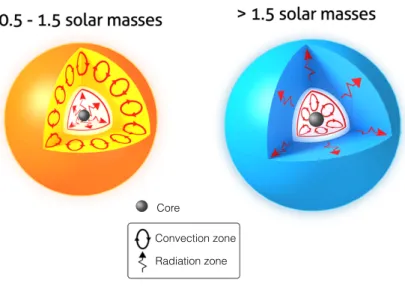
Massive stars have a different internal structure than that of solar-type stars,
as illustrated in Fig.
1.2
. Stars similar to the Sun have, from the core to the
surface, first a radiative zone and then a convective envelope. The situation
is opposite for massive stars as they have a convective zone near their core
and a radiative envelope. A thin convective zone due to opacity peaks linked
with iron and helium ionisations is also present in the outer layers of some
very luminous massive MS stars, but it contains a negligible amount of mass
(
Iglesias et al. 1992
;
Stothers & Chin 1993
;
Iglesias & Rogers 1996
;
Cantiello
et al. 2009
). Matter in the outer layers is therefore not mixed except if some
additional process takes place.
Massive stars burn their central hydrogen content through the CNO cycle
(Fig.
1.3
). Stars whose mass does not exceed ≥ 40 M
§experience the
CNO-I cycle, which starts by converting atoms of
121.1. General context
3
Figure 1.1: HR diagram. OB stars are highlighted with the red rectangle. Source:
Astronomy magazine c .
Core
Convection zone Radiation zone
Figure 1.2: Illustration of the energy transport processes at work in solar-type
(left) and massive stars (right). Source: adapted from
http://www.sun.org/
images/heat-transfer-in-stars
4
1. Background and motivation
17
8
O
17
9
F
16
8
O
(p, )13
6
C
13
7
N
12
6
C
15
7
N
15
8
O
(p, )
Y]YdY W bU SdY14
7
N
(p, )
Ud b TeSdY18
9
F
18
8
O
(p, )
19
9
F
(p, )
( + )(p, )
( + ) ( + ) (p, )(p, )
( + ) (p, )(p, )
I
II
III
IV
(p, )
(p, )
DU'D SiSU CW'8 SiSU :D SiS U +1ED SiS U +2ED SiS U(p, )
Figure 1.3: CNO cycle. The part of the diagram highlighted in gray shows the
CN- and ON-cycles. Carbon and nitrogen, oxygen-17 and nitrogen, and oxygen-18
and nitrogen are the catalysts for the CN,
17ON, and
18ON cycles, respectively.
The different branches of the CNO cycle are indicated by the roman numbers.
The limiting reaction that follows is the source of an excess of nitrogen and
a depletion of carbon in the stellar core. This cycle is also called the CN
cycle because it does not involve a stable isotope of oxygen. Heavier stars go
even further by entering into the ON cycles (also called CNO-II & III cycles),
in which the atoms of
168
O are slowly destroyed to produce
147N atoms. The
number of atoms of
126
C can be considered as constant in these cycles, but
it also leads to a nitrogen excess in the core.
1.1.2
Stellar rotation
Understandably, the first star that has been studied by astronomers is the
Sun. Thomas Harriot was probably the first European to notice the presence
of spots at the surface of the Sun, as demonstrated by drawings from 8th
December 1610 found in his notebook. Johannes Fabricius was the first to
observe the motion of sunspots on the solar surface and to publish these
1.1. General context
5
observations, in De Maculis in Sole Observatis, et Apparente earum cum
Sole Conversione Narratio, 1611. His findings were in disagreement with
the views of Christopher Scheiner, who proposed that the spots might be
small planets revolving around the Sun. Galileo Galilei confirmed in 1612
the discovery of Fabricius, by noticing a change in the size and shape of
sunspots as they move towards the solar equator, which is incompatible
with the view of Scheiner, and that proves that the Sun is rather a rotating
object. The Sun is not the only star to rotate, of course. In this context,
it is important to note the high rotational velocities of massive stars. They
are characterised by projected rotational velocities, v sin i (where v is the
stellar rotational velocity at the equator and i the angle between the line of
sight and the rotation axis; see Fig.
1.4
), typically a hundred times the Sun’s
value (Fig. 1.5). Such fast rotation can be acquired at birth, as a result
of their formation in molecular clouds under the action of gravity. The size
r
of these clouds is drastically reduced during the collapse (from typically
a few parsecs to a few solar radii), which implies a severe increase of their
angular velocity
according to the angular momentum conservation law
r
2= constant – it has nevertheless to be noted that a significant amount
of angular momentum is lost during the stellar formation process though
interactions with the accretion disk. Fast rotation can also develop during
the stellar evolution when a star interacts with its companion (see Sect.
1.1.3
). The importance of rotation on the evolution of massive stars is now
considered to be comparable to that of stellar winds, influencing all aspects
of stellar evolution models (
Meynet & Maeder
,
2000
). The next subsections
briefly present these consequences.
6
1. Background and motivation
Rotation axis Equatori
v
v sin i
Rotation axis Equatori
v
v sin i
Figure 1.4: Illustration of the
pro-jected rotational velocity.
Source:
adapted from
https://en.wikipedia.
org/wiki/Stellar_rotation
B. Impact on the early chemical evolution
of galaxies 55
C. The carbon-enhanced metal-poor stars 58
D. The chemical anomalies in globular clusters 58
XIII. Conclusions 59
I. INTRODUCTION
It may be surprising that we emphasize the need of ac-counting for the effects of rotation in stellar evolution, since in practice all stars are rotating around their axis. However, it must be recalled that the so-called ‘‘standard theory’’ of stellar evolution generally ignores the effects of stellar rota-tion and treats the stars as nonrotating bodies, despite the fact that stars more massive than about 1:5M!rotate fast on the average (Fig.1).
Recent progresses in astrophysical observations, particu-larly in high resolution spectroscopy and in asteroseismology, show many significant deviations from the standard models, for example, the many large nitrogen enrichments resulting from mixing in massive stars (Sec.VII). These observations show the need to also account for the various effects of rotation in stellar modeling. All model outputs are finally modified by the proper account of rotation: the stellar lumi-nosities and radii, the lifetimes, the chemical abundances at the surface, the helioseismology and asteroseismology re-sponses, the nature of supernova explosions, the amounts of nucleosynthetic products, the nature of the final remnants, etc.
For practical purposes, it is often convenient to distinguish four main groups of rotational effects in stellar physics.
(1) The equilibrium configuration of rotating stars: It results from the centrifugal force on the stellar equilibrium. The equipotentials are modified and, in particular, the shape of the stellar surface, which affects the surface Teff and
gravity distributions.
(2) The effects of rotation on mass loss or accretion: In fast-rotating stars, the isotropy of mass loss (or accretion when present) is destroyed and anisotropies appear and are effectively observed.
(3) The rotational mixing: The internal distortion induces circulation currents which transport the elements and angular momentum, while differential rotation may produce several instabilities which also contribute to the transport processes. (4) The interactions with magnetic field: The presence of an internal magnetic field may produce an internal coupling of rotation, leading to solid body rotation, while external fields produce some magnetic braking. A major uncertainty concerns the existence of a dynamo in radiative regions with differential rotation. We examine some properties of such a dynamo.
The above distinction is evidently a simplification since the various effects are related. For example, it is the modification of the internal equilibrium structure which drives the mixing. In turn, the mixing modifies the internal distribution of the elements and this also influences the equilibrium structure.
In this review, we focus on the rotational effects in the main sequence (MS) and post-MS phases, i.e., in the nuclear phases. The effects of rotation in star formation are also a most important chapter of astrophysics, but they would de-serve another specific review. We consider here the case of single stars, the many effects of rotation in relation with tidal interactions in binaries are also beyond the scope of this review. Most of the effects discussed here in the case of single stars evidently have their counterparts in binaries, however their modeling is still in its infancy.
Recent reviews on the observational and theoretical as-pects of stellar rotation are given in IAU symposium 215 (Maeder and Eenens, 2004) and the theoretical aspects have recently been extensively reviewed (Maeder, 2009).
II. THE MECHANICAL AND THERMAL EQUILIBRIUM OF ROTATING STARS
The equilibrium and stability configurations of rotating stars were reviewed long ago (Lebovitz, 1967). In practice, except for stars with little internal density contrast, such as white dwarfs or neutron stars, the approximation of the Roche model is acceptable. It assumes that the effective gravity results from the matter centrally condensed, in addition to the effect of the centrifugal force. For all stellar masses, the rotational energy of the Roche model represents at most about 1% of the absolute value of the potential energy.
The properties of rotating stars depend on the distribution of the angular velocity !ðrÞ inside the stars. The simplest case is that of solid body rotation, i.e., !¼ const, while more elaborate models include differential rotation.
A. The mechanical equilibrium for uniform rotation
We first consider the case of a constant angular velocity ! in the Roche model in hydrostatic equilibrium. The gradient of pressure P is given by 1 %rP ¼ % ~r" þ~ 1 2! 2rðr sin#Þ~ 2; (1)
% is the local density, " is the gravitational potential, which is unmodified by rotation in the Roche approximation and which gives the gravitational acceleration ~g¼ % ~r" ¼ %ðGMr=r2Þ~r=r, r being the distance to the center. The
FIG. 1. Probability density by km s%1of rotation velocities for
496 stars with types O9.5 to B8, i.e., masses between about 3M!
and 20M!. FromHuang and Gies, 2006a.
26 Andre´ Maeder and Georges Meynet: Rotating massive stars: From first stars to . . .
Rev. Mod. Phys., Vol. 84, No. 1, January–March 2012
Figure 1.5: Probability density of
rota-tional velocities for 496 stars with
spec-tral types O9.5–B8 (
Maeder & Meynet
2012
, with data from
Huang & Gies
2006
). For comparison, the Sun’s
rota-tional velocity is ≥ 2 km s
≠1.
1.1.2.1
Stellar shape and critical velocities
In the Roche approximation, in which the mass inside an isobar can be
considered as point-like, the total potential  is the sum of the gravitational
„
and the centrifugal ‰ potentials:
Â
(r, ◊) = ≠
GM
rr
¸ ˚˙ ˝
„≠
1
2
2r
2sin
2(◊)
¸
˚˙
˝
‰,
where r is the distance to the stellar centre, ◊ the colatitude, M
rthe mass
inside the radius r, and
is the angular velocity. The stellar surface is an
equipotential Â(r, ◊) = constant.
At the pole, r = R
p, ◊=0, and one can write
Â
(R
p,
0) = ≠
GM
R
p1.1. General context
7
to the constant of the equipotential at the stellar surface. Thus, one has
GM
R
p=
GM
rr
+
1
2
2r
2sin
2(◊)
(1.1)
Because of rotation, the effective gravity is thus modified:
˛g
eff= ˛g
grav+ ˛g
cent.
In spherical coordinates, the centrifugal and gravitational acceleration can
be expressed as
˛g
cent=
2r
sin(◊)[sin(◊)˛e
r+ cos(◊)˛e
◊];
˛g
grav= ≠
GM
r
2e
˛
r,
so that the effective gravity becomes
˛g
eff=
3
≠
GM
r
2+
2r
sin
2(◊)
4
˛
e
r+
2r
sin(◊) cos(◊)˛e
◊,
the modulus of ˛g
effbeing
g
eff( , ◊) =
Û3
≠
GM
r
2+
2r
sin
2(◊)
4
2+ (
2r
sin(◊) cos(◊))
2(1.2)
One can define the critical, or break-up, angular velocity
crit, which is
reached when the modulus of the centrifugal acceleration ˛g
centbecomes
equal to the modulus of the gravitational acceleration ˛g
gravat the equator.
In this case, g
eff= 0 at the equator (for which ◊ = fi/2), so from Eq.
1.2
one obtains
2
crit
=
R
GM
3E,crit
(1.3)
where R
E,critis the equatorial radius at critical velocity. Evaluating the Eq.
1.1
at the equator and introducing the expression of the critical angular
velocity leads to
R
E,critR
P,crit=
3
2
.
(1.4)
This means that, at critical velocity, the equatorial radius is 1.5 times larger
than the polar one. The stellar shape for different angular velocities is
8
1. Background and motivation
illustrated in Fig.
1.6
. The stellar distorsion was investigated in some
interferometric studies, through the estimation of the R
E/R
Pratio. For
example, for the fast-rotating star Achernar (– Eri; B6Vpe,
Levenhagen &
Leister 2006
; v sin i ƒ 207 km s
≠1,
Yudin 2001
), the measurements yield
R
E/R
P≥ 1.4 – 1.5 (
Carciofi et al.
,
2008
), in agreement with the Roche
model with Ê = /
crit= 0.992.
One can now define with Eqs.
1.3
and
1.4
the first critical velocity:
v
crit,12=
2critR
2E,crit=
GM
R
E,crit=
2
3
GM
R
P,crit.
(1.5)
This relation is valid under the Roche approximation (thus for solid body
rotation). Figure
1.7
illustrates the variation of v
crit,1as a function of the
initial stellar mass, for different metallicities.
Rotation is, however, not the only important physical ingredient. The
radiation pressure also plays a significant role inside massive stars by
coun-terbalancing the gravity. In this context, it can be shown that the validity
domain of Eq.
1.5
is limited to
Edd<
0.639, where
Eddis the local
Eddington factor at the surface of a rotating star. It typically describes the
anisotropy of a radiation field, and is defined by
Edd
( , ◊) =
Ÿ
( , ◊)L(P )
4ficGM
1
1 ≠
22fiG¯flM
2 ,
(1.6)
where Ÿ( , ◊) is the electron scattering opacity, c the celerity, and ¯fl
Mthe
average stellar density. The first critical velocity does not depend on the
Eddington factor. This is due to the fact that as rotation increases, the
effective gravity at the equator decreases, thus, thanks to the von Zeipel
theorem, its effective temperature at the equator decreases accordingly,
keeping the radiation pressure negligible. However, the above expression
of the first critical velocity is no longer valid for stars with high radiation
pressure. For
Edd>
0.639, one defines the second critical velocity as:
v
crit,22=
3
2
R
GM
P,crit3R
2E
(Ê)
V
1 ≠
Õ(Ê)
.
with V
Õ(Ê) = V (Ê)/#4/(3fiR
3P,crit
)$, where V (Ê) is the total stellar volume.
The critical velocity decreases as
increases, so that a star with intense
radiation can rotate at its break-up velocity even if its rotational velocity is
low. Table
1.1
provides the Eddington factor for stars at the middle of the
1.1. General context
9
Table 1.1: Predicted Eddington factor for MS stars (for a core hydrogen mass
fraction X
cof 0.30) at the middle of the MS phase (
mid) and the first critical
velocity v
crit,1as a function of the initial stellar mass. Source:
Maeder
(
2009b
).
Initial M
midv
crit,1[M
§]
[km s
≠1]
120
0.544
711
85
0.436
646
60
0.343
623
40
0.239
586
25
0.136
536
20
0.098
513
15
0.060
487
12
0.039
466
9
0.021
439
MS phase, as well as the first critical velocity v
crit,1, as a function of the
initial stellar mass.
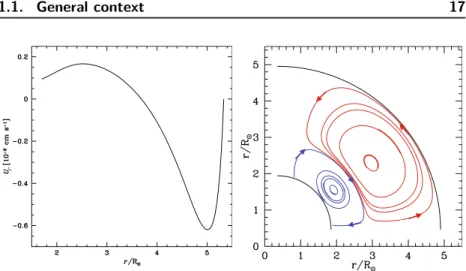
Evolution of the rotational velocity. Single-star models predict a
de-crease of the rotational velocity of a rotating star during its MS evolution,
as shown in Fig.
1.8
(see an example of observations in Fig.
1.9
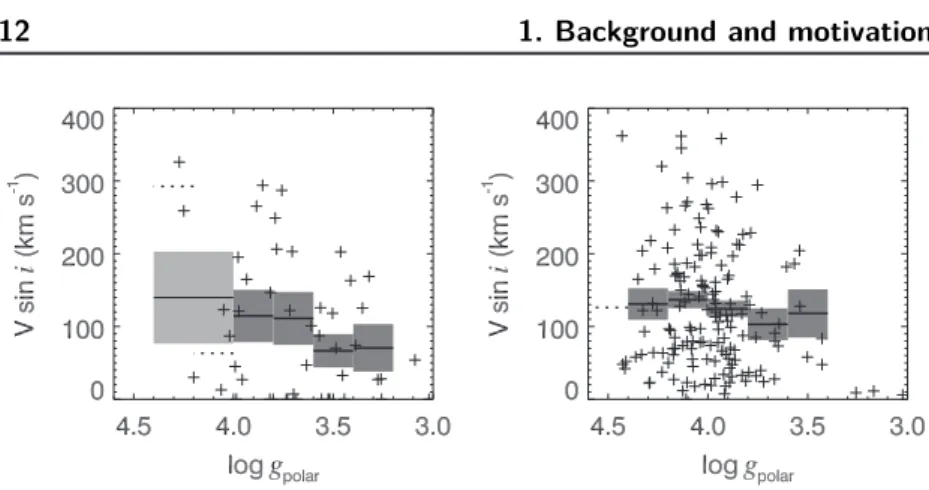
). This is
due to the loss of angular momentum by stellar winds and the increase of
the radius during the stellar evolution. Note, however, that the predicted
rotational velocity in the models of
Brott et al.
(
2011
) for stellar masses
M
. 20 M
§does not drastically change during the MS phase. This is due to
a competition of two effects: the increase of the rotational velocity thanks to
the transport of angular momentum to the surface, and the decrease of the
rotational velocity due to envelope expansion. This different behaviour in the
evolution of the stellar rotational velocity, compared to the Geneva models,
comes from the very different treatment of rotation, as the Geneva models
consider a less strong coupling between the stellar core and the envelope,
so that the spin-down by stellar winds is more effective (see Sect.
2.2.1
for
further comparisons between these two types of models).
1.1.2.2
Gravity darkening effect
The stellar deformation due to rotation induces a higher effective gravity
and a larger temperature at the stellar poles, hence a higher radiative flux
10
1. Background and motivation
2.1 Equilibrium Configurations
23
Fig. 2.2 The shape R(
ϑ) of a rotating star in one quadrant. A 20 M star with Z = 0.02 on the
ZAMS is considered with various ratios
ω = Ω/Ω
crit
of the angular velocity to the critical value
at the surface. One barely notices the small decrease of the polar radii for higher rotation velocities
(cf. Fig. 2.7). Courtesy of S. Ekstr¨om
Fig. 2.3 The variation of the ratio R
e
/R
p
of the equatorial to the polar radius as a function of the
rotation parameter
ω in the Roche model
g
eff
=
R
GM
2
(
ϑ
)
+
Ω
2
R(
ϑ
) sin
2
ϑ
e
r
+
Ω
2
R(
ϑ
) sin
ϑ
cos
ϑ
e
ϑ
.
(2.11)
The gravity vector is not parallel to the vector radius as shown in Fig. 2.1. The
modulus g
eff
=
|g
eff
| of the effective gravity is
Figure 1.6: The centrifugal forces triggered by rotation affect the stellar shape,
since their effect is to increase the equatorial radius, while slightly decreasing the
polar one (e.g.,
Collins 1963
;
Domiciano de Souza et al. 2003
). Illustration of the
distorsion of a rotating star of 20 M
§on the zero age main sequence (ZAMS),
with Z = 0.020, as a function of the /
critratio. Source:
Maeder
(
2009b
).
(gravity darkening effect; Fig.
1.10
). A confirmation of this effect is given
by the observation of Altair, whose projected rotational velocity is ≥ 240
km s
≠1and for which the ratio between its polar and equatorial effective
temperatures is 1.23 – 1.27 (Fig.
1.11
,
Monnier et al. 2007
). Equation
1.2
shows that the effective gravity varies over the stellar surface. Since the
von Zeipel theorem provides a relation between the radiative flux (hence the
effective temperature) and the effective gravity, the effective temperature
will follow
T
eff( , ◊) =
3
L
4fi‡GM
ú4
1 4(g
eff)
14,
(1.7)
with
M
ú= M
3
1 ≠
2fiG¯fl
2 M4
,
where ‡ is the Stefan-Boltzmann constant. Note that another formulation
has been proposed by
Espinosa Lara & Rieutord
(
2011
), which implies a less
1.1. General context
11
S. Ekström et al.: Origin of Be stars
473
Fig. 10. Relation between /
critand
=
/
critobtained in the
frame of the Roche model. The continuous line is obtained assuming
R
p,crit/
R
p= 1 (see text and Eqs. (9) and (11)). The dot-dashed lines
show the relations for the Z = 0.020 models with 1 and 60 M using
Eq. (8). The dotted line is the line of slope 1.
Fig. 11. Variations in the critical equatorial velocity on the ZAMS as a
function of the initial mass, for various metallicities.
3.3. Relations between /
crit
and /
crit
The relations between /
crit
and /
crit
obtained in the frame
of the Roche model (see Eq. (11)) for the 1 and 60 M stellar
models at Z = 0.02 are shown in Fig. 10. In case we suppose that
the polar radius remains constant (R
p,crit
/
R
p
= 1), then Eq. (9)
can be used and one obtains a unique relation between /
crit
and /
crit
, independent of the mass, metallicity, and
evolution-ary stage considered (continuous line). One sees that the values
of /
crit
are lower than that of /
crit
by at most ⇠25%. At the
two extremes, the ratios are of course equal.
3.4. Velocities on the ZAMS:
crit
,
Table 1 gives the angular velocity, the period, the polar radius,
and the equatorial velocity at the critical limit on the ZAMS for
the various models. Let us note that, for obtaining the value of
crit
or of whatever quantities at the critical limit, it is
neces-sary to compute models at the critical limit. Here we have
com-puted models very near, but not exactly at, the critical limit,
since at that point numerical singularities are encountered. As
explained in Sect. 2.2, using Eq. (9) we could have estimated
Table 1. Angular velocity, rotational period, polar radius, and equatorial
velocity at the critical limit on the ZAMS (solid body rotation).
M
Z
critP
critR
p,crit critM
s
1h
R
km s
11
0
4.9E 04
3.6
0.8
400
1
10
54.9E 04
3.6
0.8
400
1
0.002
4.6E 04
3.8
0.8
390
1
0.020
4.6E 04
3.8
0.8
395
3
0
5.3E 04
3.3
1.1
595
3
10
55.1E 04
3.4
1.1
585
3
0.002
3.4E 04
5.1
1.4
515
3
0.020
2.2E 04
8.1
2.0
440
9
0
6.5E 04
2.7
1.4
920
9
10
53.5E 04
4.9
2.0
750
9
0.002
2.2E 04
8.1
2.8
635
9
0.020
1.5E 04
11.7
3.6
560
20
0
7.3E 04
2.4
1.6
1245
20
10
52.5E 04
7.0
3.3
870
20
0.002
1.6E 04
11.1
4.6
745
20
0.020
1.2E 04
15.2
5.6
670
60
0
4.6E 04
3.8
3.2
1540
60
10
51.7E 04
10.6
6.4
1095
60
0.002
1.0E 04
16.9
8.7
935
60
0.020
7.0E 05
24.9
11.3
820
Fig. 12. Variations in the surface equatorial velocity on the ZAMS as a
function of initial rotation rate
=
/
critfor various metallicities and
masses. The coding for Z is the same as in Fig. 11.
crit
from whatever model was computed with a lower initial
ve-locity. Doing this for the whole range of initial masses,
metallic-ities and velocmetallic-ities, we would have obtained values within 10%
of those shown in Table 1. For the models between 3 and 20 M ,
the error would always be inferior to 3.5% because in this mass
range, R
p
( )/R
p
(0) remains very near 1 (see Fig. 2) and Eq. (9)
is a good approximation of Eq. (8). For the 1 and 60 M , the
er-rors would be larger, amounting to a maximum of 9.3 and 6.7%
respectively, showing the need to use instead Eq. (8) if
1.
In general the error decreases drastically when
increases, so
to obtain the values given in Table 1, we have used our faster
rotating model, deriving the value of
crit
(using Eq. (9)) with
an error less than 0.001%. The critical period, P
crit
is then
sim-ply given by P
crit
= 2⇡/
crit
. The polar radius is obtained
Figure 1.7: Illustration of the first critical velocity as a function of the initial stellar
mass, for different metallicities. Source:
Ekström et al.
(
2008b
).
log g [dex]3.6 3.4 3.2 3 3.8 4 4.2 v sin i [km s − 1] 100 150 200 250 300 350 400 M/M⊙= 15, vZAMS= 400 km s−1 M/M⊙= 20, vZAMS= 421 km s−1 M/M⊙= 25, vZAMS= 441 km s−1 M/M⊙= 32, vZAMS= 614 km s−1 M/M⊙= 40, vZAMS= 647 km s−1 M/M⊙= 60, vZAMS= 714 km s−1 log g [dex]3.6 3.4 3.2 3 3.8 4 4.2 M/M⊙= 15, vZAMS= 379 km s−1 M/M⊙= 20, vZAMS= 376 km s−1 M/M⊙= 25, vZAMS= 374 km s−1 M/M⊙= 30, vZAMS= 372 km s−1 M/M⊙= 40, vZAMS= 367 km s−1 M/M⊙= 60, vZAMS= 361 km s−1
Figure 1.8: Predicted projected rotational velocity as a function of the surface
gravity by
Georgy et al.
(
2013a
) and private comm. with Dr Georgy (left) and
Brott et al.
(
2011
, right). We assume i = 70
¶as fast rotators are preferentially
12
1. Background and motivation
610
HUANG, GIES, & McSWAIN
Vol. 722
Figure 5. Scatter plots of V sin i as a function of log g
polarfor the field (left column) and cluster samples (right column) and for three mass ranges: 2 < M/M
⊙<
4 (top), 4
M/M
⊙<
8 (middle), and M/M
⊙8 (bottom). The solid horizontal lines indicate the mean V sin i of each bin containing six or more stars, while
dotted lines indicate the same for the bins containing fewer. Shaded areas illustrate the standard deviation of the mean for each bin.
matched pairs have similar mean V sin i (within one standard
deviation) except for one set with 3.6 < log g
polar<
3.8 in the
mid-mass subgroup. Note, however, that the number of field B
stars in the high-mass group (>8 M
⊙) is small (a total of only
46 field B stars), and a larger sample would help establish the
details of the spin-down for this group. These results are very
similar to our previous findings (Huang & Gies
2008
), which
were based on a smaller sample of field stars. Thus, since the
spin-down trends appear to be similar in the field and cluster
stars and since the field stars tend to be more evolved (lower
log g
polar), we again conclude that the lower rotation rates of
the field stars are primarily the result of evolutionary spin-down
changes.
In contrast to our results, Wolff et al. (
2007
) did not detect a
significant evolutionary change in stellar rotation among their
sample of stars, and they concluded that differences in initial
conditions and mass densities of star-forming regions are key
to explaining the differences in rotational properties. Wolff
et al. (
2007
) compared rotational properties of B0–B3 stars
(corresponding to an approximate mass range of 6–12 M
⊙) in
young and old clusters and associations in both low-density (ρ <
1 M
⊙pc
−3) and high-density (ρ > 1 M
⊙