!
"# $$$%& $ ' $% () ' *#+ $)% ) % , -$. /$0 1!
%$%2
30 /4)
05$
/+# 6
/#% 07/#
6
" / 8 09 : $ ; *!"
# $
%&
!""!#!""$ 1/ # /2/#/#%< +)9 = = = = = = = = = = = = = = = = = = = = = = . % & % < # #= = = = = = = = = = = = = = = = = = = = = = = = = = = = = = ' ( ) * / $ /#/#%$ 56$)# $ = = = = = = = = = = = = = = = = = = = = 00> + , - . #/ < +)1/ /#%<) # 9 6/ = = = = = = = = = = = = = = = = = = = = = 0. 0 1 &2 ) 3 ( - & /# 9 ? 6 /#%: )#/= = = = = = = = = = = = = = = = = = = = 0., & 4 @ % (/ /#%: $ A/# = = = = = = = = = = = = = = = = = = = = = = = 5 6 - 7 3/B /4)= = = = = = = = = = = = = = = = = = = = = = = = = = = = = = = & 6 6 ) 0@ % 4 # /= = = = = = = = = = = = = = = = = = = = = = = 000C + 5 6 6 6 6 & 5 7 / %/5$/+# 6 /#%1/$/ # /= = = = = = = = = = = = = = = = = = = = D % % 6 % & ? #/#%E / # = = = = = = = = = = = = = = = = = = = = = = = = = = = = 000D, F %$ % $ $/# /#: 5 # 9 # 1/ 5/#% # 5 /#% /#9 $/ $ #$ /6$6/ /#4/$ # $ 0F /#4/$ # $ + #$ / /% 2 $ +/ /#$ 6 + % $ G: +#6 % H I:F"1I $ /# $ # 6/ 5 6 $ 5! $ /# 5 /6 #6 5 ! I5 $ G? #% /$ #/ % /@ 6 6 56 #$ ' H ? @5! $ /#56 #6 : 6 ! $ *#+ $ /#% $ G1 #/ $) ? /#J/ % ' H0E / /$ $ / $ /#4/$ # $ #/#6/ $0 # 6$ #6+ # $ 6 %# /+/ /2 /$$ # $$KLL 0/$ 0 0/602 L@: 2L1 ' L L 6 %# L 6 %# 0$Bringing Science into Schools through
Astronomy. Project ASTRO, Tucson.
Caroline Barban
1and Herv´e Dole
21
Instituut voor Sterrenkunde, Katholieke Universiteit Leuven, Celestijnenlaan 200 B, 3001 Leuven, Belgium
2
Institut d’Astrophysique Spatiale, bˆat. 121, Universit´e Paris Sud 11, 91405 Orsay, France
Abstract:
We report our experience in bringing science into US and French classrooms. We participated in the US scientific educational program Project ASTRO. It is based on a partnership between a school teacher and an astronomer. They together design and realize simple and interesting scientific activities for the children to learn and enjoy science. We present four hands-on activities we realized in a 4th-grade class (10 yr-old kids) in Tucson (USA) in 2002-2003. Among the covered topics were: the Solar System, the Sun (helioseismology) and the Galaxies. We also present a similar experience done in two classrooms in 2005, in Chˆatenay-Malabry (France) in partnership with an amateur astronomy association (Aph´elie), and discuss future activities. This is a pleasant and rewarding activity, extremely well appreciated by the children and the school teachers. It furthermore promotes already at a young age the excitement of science, and provides concrete examples of the scientific methodology.
1
Introduction
Many astrophysicists worldwide have experienced the joy of talking about the physical Universe and their fascinating work to the public, in conferences or in schools. They might have then felt the enthusiasm and the great demand from children, their teachers and parents to talk about science. The scientific education, an important cornerstone in modern societies, faces, nevertheless, several difficulties in practice despite national requirements for science classes. The difficulties to teach science in schools (for students younger than 17) are sometimes related to the teachers’ lack of confidence in their own expertise. Science might appear complex, too conceptual and not enough concrete to some teachers and students. The lack of motivation might also be an issue. There is thus a clear need to bring science in the classroom, so that more teachers and students can enjoy it. We describe our involvement in different educational programs in the USA and in France to promote science among teachers and students.
2
Project ASTRO, Tucson
Project ASTRO1
was developed in 1994 by the Astronomical Society of the Pacific. The goal of this program is to improve science education in the classroom from the first year of
1
http://www.astrosociety.org/education/astro/project astro.html
elementary school to the last year of high school (6 to 17 yr-old). Project ASTRO is based on a partnership between a teacher and an astronomer. The astronomer commits to visiting the teacher’s classroom at least four times during the school year. The main focus of Project ASTRO is hands-on activities related to astronomy that put students in the position of acting like scientists. Each year about 1000 partnerships bring science through astronomy to ∼100,000 students over 12 project ASTRO sites across the USA.
We were part of Project ASTRO in Tucson2
during the 2002-2003 school year. We were paired with a 4th grade teacher (10 yr-old kids) at the Sewell Elementary School in Tucson (Arizona, USA). The topics of the activities were chosen in consultation with the teacher. We designed ourselves these activities, but extensively used existing material from the book3
“The Universe at your fingertips”, and were inspired by some NASA Education web sites. We decided to focus on a few simple concepts only in each one-hour visit. The typical visit starts with an introductory 10-minute slide show, and is followed by 40 minutes of hands-on activity. The last 10 minutes are used for a debriefing and questions. We put online4
all our material. • First visit: ”Who is an astronomer”
Our first visit to the classroom is dedicated to talk about who an astronomer is and what an astronomer does. We first ask the children to draw what they think an astronomer is, and then we use the drawings to address the misconceptions they might have about this special job. It is a good opportunity to mention that an astronomer, thus a scientist, is not always an old man! We also tell the students that an astronomer does not work every night by looking the sky with the eyes on a telescope. We introduce them to the concept that observation, careful analysis, modeling, theory and simulation complement each other and are required to address a scientific question.
• Second visit: ”The Solar System”
The goal of this activity is to learn the different planets of our Solar System and the relative sizes of the planets. Each kid makes a sphere of the proper diameter with clay. We then put together this clay Solar System, describe each Planet’s average temperature and emphasize the diversity of planet sizes (Fig. 1). We also explore the physical differences between gaseous vs telluric planets, and discuss the differences between the Planets, the Sun and the stars.
• Third visit: ”The Music of the Sun”
This activity, dealing with the Sun and helioseismology, illustrates that we can get informations about the interior of an object by ”listening” to it. The students have to probe three “mystery boxes”. We ask them to shake each box to study its content. They estimate if the content is light or heavy, composed of small or large pieces, in small or large number. They write their observations in a table. We put rice, small rocks, and a tennis ball in each box, respectively. We then explain that helioseismology uses the Sun’s vibrations (like music) to probe its interior. This activity shows that it is possible to talk about complex subjects in a simple way (Fig. 2). The last part is an illustration of the Doppler shift (also used in helioseismology): listening to the sound emitted by an object allows one to determine if it is moving or not. We use a bell for this purpose. We first introduce them to the bell’s sound when it is still, but also when it is rapidly spinning – the beating effect is then easily heard. Then the students close their eyes, and we ask them to guess, while listening the sound, if the bell is spinning or not.
2
http://www.noao.edu/education/astro/ It is managed in Tucson by the Education and Outreach depart-ment of the NOAO (National Optical Astronomy Observatory).
3
http://www.astrosociety.org/education/astro/astropubs/astropubs.html 4
Figure 1: Solar System activity: comparison of the Planet’s sizes.
Figure 2: Helioseismology activity: probing the mystery boxes.
Figure 3: Galaxy activity: classifying the galaxies in the Hubble Deep Field.
• Fourth visit: ”The Galaxies”
The goal of this activity is to have the children realize the diversity of the galaxies and their incredible quantity. Using images of the famous Hubble Deep Field, the students sort the bright sources in the images by shape and color. They separate foreground stars from far-away galaxies, and get to realize that the galaxies have various shapes and colors, mainly due to their different content and evolution stage (Fig. 3). Then, on a small image cell, they have to count the galaxies. With the appropriate provided number to multiply with, they have an estimate (lower limit) of the number of visible galaxies in the universe. Classifying the galaxies was a success, but the counting part proved to be too complicated for this level, since orders of magnitude and powers of ten are not well understood.
3
Our Other Experiences in France
There are many other ways to bring science into schools. As members of the amateur astronomy association Aph´elie5
(near Paris, France), we are used to receiving lots of requests from schools
to come and talk about astronomy. In May 2005, we visited two classrooms6
in two of Chˆatenay-Malabry’s schools located in socially disfavored areas. The level is CE2 and CM2 (8 and 10 yr-old, respectively). We wanted to apply the concept of a Project ASTRO visit. We choose
to try “the Venus topography box” activity from the Project ASTRO book3
, in agreement with the teachers. The goal is to show how scientists get information about the surface of a planet hidden by a thick atmosphere (this could also apply to Titan). After an overview of the Solar System, we tell the children that ESA wants to send a spacecraft to Venus and needs their help to choose the best landing site. The surface is modeled inside a shoe box, hidden
5
http://www.astrosurf.com/aphelie 6
http://lully.as.arizona.edu/∼hdole/vulgarisation/ecoles/
Figure 4: Venus topography box activity: probing the hidden surface.
Figure 5: Venus topography box activity: at the end, comparing the measurements (color map) and the real Planet surface model. by a cover. By probing the holes with a color-encoded stick, the students draw a topographic map of the modeled Venus surface (Fig. 4 & 5). Fig. 5 shows the model crater (top left) and the beautiful result, the crater appearing in pink-orange in the topographic map (lower right). We then asked each student to present in front of the class their best landing site, if any. This activity is very interesting because it deals with different concepts: variety in the Solar System, thick atmospheres, remote information gathering (e.g radar technique), contour map. During this activity the students really act like scientists by getting the data, and then analyzing, interpreting and presenting them.
4
Conclusion
Some professional astrophysical institutions are also involved in bringing science into the
class-rooms through specific educational programs for the teachers, like the Observatoire de Paris7
(dedicated workshops, summer schools, observations, ...) or the Universit´e Paris Sud 11. There are also many successful programs like “la main `a la pˆate8
”, Hands-On-Universe8
, or the CLEA8 , among others.
Finally, we want to emphasize that visiting schools, discussing with the teachers, interacting with the students, and designing such educational projects is a rewarding, interesting and very useful activity. Astronomy is a very efficient way to teach science. Furthermore this is less time-consuming that one might think. We warmly recommend that our colleagues try to be involved in such activities, on their own or by joining an existing program in their country.
Acknowledgments
Thanks to Connie Walker (NOAO), Project ASTRO (ASP), Pam Williams (Sewell Elementary), GONG/National Solar Observatory, MIPS/Steward Observatory/University of Arizona. We also warmly thank Marc Bottineau (for the 15 boxes !) and the Aph´elie members involved in this activity, Fabrice Krot and the Maison des Sciences de Chˆatenay-Malabry, as well as S´ebastien Vilain-Derouen (´ecole ´el´ementaire T. Masaryk) and Claude Mallet (´ecole ´el´ementaire L. De Vinci).
7
http://www.obspm.fr/∼webufe 8
http://www.lamap.fr/ – http://www.handsonuniverse.org/ and http://fhou.cicrp.jussieu.fr/ – http://www.ac-nice.fr/clea/
Educational Projects at ESO
Henri M.J. Boffin
Public Affairs Dept., European Southern Observatory, Karl-Schwarzschild-str. 2, 85748 Garching, Germany
Abstract:
ESO’s public outreach activities comprise communication and media activities, educational projects and targeted events, addressing well-defined audiences. In 2004, one major activity stands out both in terms of visibility and in covering all of the above areas: the Venus Transit 2004 Public Science Discovery Programme. This very successful programme comprised the development of an extensive set of teaching materials for schools, a web-based information and reporting system, observational activities on the day of the transit as well as a video contest and a final event in Paris in November.
1
Introduction
In order to understand the latest reports on new and exciting discoveries, put them into context and then, hopefully, continue to support research, it is essential that the public has some basic scientific knowledge. It is therefore quite alarming to discover for example that only about a third of US adults are aware and accept the idea that “the universe began with a huge explosion” (NSB, 2000; quoted by Miller, 2004). As worrying is the fact that the same study reveals that only half of US adults know that the Earth rotates around the Sun once in a year. And the situation does not look better in Europe since a comparative study with Britain in 1988 found this ratio to be only one third (Miller, 2004). At a time when science is becoming more and more ubiquitous in our modern society, more and more affecting our daily lives, such reports cannot but raise a lot of concern. This appears even more critical in the framework of the Lisbon strategy devised by the leaders of the European Union in order to make Europe a knowledge-based society by 2010. This goal can only be achieved if the new generations become more and more scientifically literate and if science can attract many students, who will become the much needed scientists of tomorrow.
At the same time, however, that there is a well-documented and widespread public interest in science there is a clear disinterest in science learning! The ROSE survey has, for example, shown that to the question “I would like to have as much science as possible in school”, the answer, in European countries (but also in Japan), was clearly not very encouraging (Schreiner & Sjoeberg, 2004). This is complemented by a worrisome decline in science teachers. Between 1993 and 1998, the number of new science teachers in the UK fell from 553 to 181 per year. And this is just one example.
2
An ensemble of activities
There is thus no doubt that a dedicated effort to improve science education in Europe’s pri-mary and secondary schools is crucially important. The subject of Astronomy and Astrophysics plays an increasingly important role therein. Indeed, this particular field of basic science is very attractive to young people and its interdisciplinary dimension makes it an ideal tool to address many topics in schools. ESO, the European Organisation for Astronomical Research in the Southern Hemisphere, has since many years undertaken, often in association with other Euro-pean organisations, to address these issues. ESO has for example played a most fundamental role in the setting-up of the European Association for Astronomy Education (EAAE), a net-work of teachers, and has since more than a decade successfully participated to the calls of the European Commission for the Science Weeks. Initial programmes were often collaborations with the EAAE, as well as with CERN and ESA, while in the last years, most educational programmes, except for the more astronomically oriented Venus Transit 2004, were performed in the framework of EIROforum, a partnership of seven of Europe’s major intergovernmental research organisations (CERN, EFDA, EMBL, ESA, ESO, ESRF, and ILL), that was created in 2002. One of these programmes is the very successful “Physics on Stage” concept that is directed towards science teachers and pupils in Europe’s secondary schools. The project seeks to improve the quality of teaching and to find new ways of stimulating pupils to take an interest in science. It aims to facilitate the exchange of good practice and innovative ideas among Europe’s science teachers and to provide a forum for a broad debate among educators, administrators and policy-makers about the key problems in science education. The “Physics on Stage” programmes have now been extended to encompass all sciences and are organised through the EIROforum partnership in the “Science on Stage” festivals, the first one being organised at CERN in November 2005, the next one in Grenoble in Spring 2007.
The “Physics on Stage” and “Science on Stage” are by far not the only educational projects done by ESO. Many projects were done in collaboration with the EAAE - thereby ensuring that the programmes are most suited to teachers - and are presented further in this volume (see F. Wagner’s contribution). To make things more formal, in 2001 it was decided to set up an Educational Office within ESO. One of its first task was to conduct a survey of the specific needs for astronomy education in Europe’s high-schools (Bacher, 2002). Another was to publish, in collaboration with ESA, four comprehensive astronomy exercises that allow high-schools students to gain exciting hands-on experience in astronomy by making realistic calculations based on data obtained by the Very Large Telescope and the Hubble Space Telescope. Two more exercises - on measuring the acceleration of the Universe based on supernovae data and on Trans-Neptunian Objects - are in preparation. ESO also recently embarked upon another ambitious teaching project, in connection with the intercontinental ALMA observatory. The new project, the “ALMA Interdisciplinary Teaching Project”, aims at developing and producing ALMA-related educational material at the secondary level. A brainstorming meeting with teachers and scientists took place to specify the format and the content. A list of 30 key topics was established, with teachers volunteering to work on most of them. It is planned to have a useful version of the Educational toolkit ready by the end of the summer of 2006.
3
The VT-2004 Science Discovery Programme
The Venus Transit 2004 (VT-2004) programme is another successful programme established through a major organisational effort by ESO, in collaboration with the EAAE, the Institut de M´ecanique C´eleste et de Calcul des Eph´em´erides (IMCCE) and the Observatoire de Paris in
France, as well as the Astronomical Institute of the Academy of Sciences of the Czech Republic. It profited from substantial support of the European Commission within the framework of the European Science and Technology Week. The main idea of this highly innovative, educational programme was to take advantage of this extraordinary and rare celestial event to expose the wide public – in a well-considered, interactive and exciting way – to a number of fundamental issues at the crucial interface between society and basic science.
The programme established wide international networks of individuals, including school teachers and their students, amateur astronomers and interested laypeople, as well as educa-tional institutions like astronomical observatories, planetaria, science centres, etc. It went to great lengths to encourage real-time measurements from which one of the most fundamental astronomical parameters could be determined, the distance from the Earth to the Sun. In order to promote the Venus transit and provide information about the opportunities for par-ticipation in the various countries and geographical regions, VT-2004 “National Nodes” were established in many places and as such constituted the main contact points for the media in the corresponding countries and regions. VT-2004 moreover promoted web-encounters and inter-national collaboration throughout Europe as well as in Africa and Asia, stimulating visual and photographic observations of this rare celestial event, with related debates via the Internet. During the preparatory phase, highly useful meetings were held between the organisers and school teachers (Luxembourg, January 2004), media representatives (Germany, March 2004), and amateur astronomers (Czech Republic, May 2004), respectively, which greatly contributed to the shaping of the various activities so that they optimally responded to the expectations and needs of different communities.
On the day of the transit itself, the best images available, via dedicated links to the foremost observatories and from numerous websites set up by observers in many different countries, were selected and displayed at the ‘VT-2004 Central Display’ page with live comments by a team of professional astronomers in the ‘VT-2004 Control Room’ at the ESO headquarters in Garching. Judging from the number of registered hits, there is no doubt that the VT-2004 web site may be qualified as resoundingly successful. During the 8-hour interval around the transit period, there were no less than 55 million hits on the VT-2004 website and 1.75 terabytes of data were delivered. This would have brought most servers to their knees, but thanks to foresight and good preparation, the VT-2004 website with its hundreds of Akamai mirrors did not suffer the fate of several other sites – including some by major organisations – which collapsed under the load, as was reported in the news. In fact, at the moment of the transit, the VT-2004 website received almost exactly as many hits as the official website of the Athens Olympic Games and it was one of the 6000 most visited websites worldwide.
As a unique aspect of the VT-2004 programme, and never before attempted on this scale, the ‘VT-2004 Observing Campaign’ was launched with the goal of a real-time measurement of the Astronomical Unit. This sub-programme was carefully organized to re-enact the historical determination of the AU by means of accurate timings of the four moments of contact between Venus’ black circle and the border of the solar disc. The preparations paid off and this complex project generally went very well. A large number of groups of observers registered in the months and days before the transit; by the stipulated deadline on July 10, 2004, no less than 4509 contact timings had been received from 1549 registered observing teams. While most of these were located in Europe where the observing conditions were particularly good, there were also data from teams on all other continents except Antarctica. Following extensive analysis of this large material by staff members of the Institut de M´ecanique C´eleste et de Calcul des Eph´em´erides, the final result of the VT-2004 Observing Campaign to determine the distance from the Earth to the Sun was published in late 2004: 1 Astronomical Unit = 149 608 708 ±
11 835 km, i.e., only 10 838 km larger than the ‘true’ value!
In addition to the many activities around the Venus Transit itself, the organisers also aimed at evaluating in gross terms the sociological impact of such a very rare astronomical event and the way it was perceived in different countries. This programme indeed provided a rare field test for the execution of large-scale public activities relating to a particular, scientific event with strong operational constraints (including the requirement to act in real-time as the scientific event progresses). The organisers were therefore keen to gather valuable experience for possible future continent-wide activities involving the same mechanisms and carried out under similar conditions. A thorough post-event evaluation was therefore incorporated as an important ele-ment of the VT-2004 programme. Thus, on November 5-7, 2004, a follow-up conference took place at the French Ministry of Research in Paris, entitled the ‘Venus Transit Experience’. It brought together more than 150 persons closely connected to the VT-2004 programme in var-ious functions, as organisers, specialists, educators, students, observers, participants, etc. The major goal was to sum up the vast experience gained through this exceptional public science discovery programme and to evaluate its many components and overall public impact. On the second day of the conference, detailed reports about the circumstances and impact of the Venus transit were given by experts operating in different surroundings, e.g. in primary and secondary schools, at the media and among amateur astronomers. National Committees from about 25 countries, either orally or by posters, documented comprehensively the individual approaches taken in different regions and cultural environments and reported many useful ‘lessons learned’ within the unique VT-2004 pilot project. These presentations clearly demonstrated the eminent success of the entire effort but also served to identify some technical and organisational short-comings – as was to be expected in a complex and ambitious pilot project like this. However, the overall impression was thoroughly positive and much experience has been gained that will become extremely useful for any future projects of this kind. Most of the presentations given at this conference are now available on the web at: www.vt-2004.org/FinalEvent/.
While the Venus transit is now over, the VT-2004 programme is still very much alive on the Web. From the outset of the project, and given its all-European dimension, it was de-cided that the Internet would be the main vector of interaction, with a central website at http://www.vt-2004.org. Altogether, there are about 20,000 web pages and over 2.6 GB – not counting the numerous comprehensive National Nodes web sites in many languages – which offer insights into the many interesting facets of this celestial phenomenon and which will remain a rich source of information and stimulation for years to come. Faithful to its high goals, the trailblazing VT-2004 programme successfully developed into a true encounter between Science and Society and will most certainly serve as a most effective and useful guide for future projects, thereby helping addressing the issues raised at the beginning of this article.
References
Bacher, A , 2002, in Astronomy Communication, A. Heck and C. Madsen (eds.), Astro-physics and Space Science Library 290, 189
Miller, J.D. 2004, Public Understand. Sci. 13, 273
National Science Board 2000, Science and Engineering Indicators – 2000, Washington: U.S. Governement Printing Office (NSB 2000)
Schreiner, C., & Sjøberg, S. et al. 2004, Relevance of Science Education,
A network dedicated to sciences dissemination:
Scit´
e
Marie Botman and the Scit´e network
Atout Sciences, University of Namur, Belgium
Abstract:
The activities of the network Scit´e are destined for the schools and the general public and in-clude laboratories visits, training periods, seminars, conferences, adult courses specially designed for teachers, etc. Since 2002, collaborations between universities and enterprises are enhanced and devel-oped to bring to light the variety of jobs linked to science and the multi-disciplinary process leading to industrial application of scientific findings. Activities will include, enterprises visits preparation of CD and video support presenting “passionate” jobs, and the set up of interactive workshops for students. Systematic relations and interactions with scientific as well as global media are established and formalised. Activities enhancing such interactions include the development of media-universities interface assuring the quality and the adequacy of scientific information transfer and vulgarisation. Based on the wide expertise accumulated through recent projects, Scit´e Network develop innovative activities involving a wide range of actors: universities, enterprises, media, schools, general public
1
Introduction
Since 2000, French-speaking Belgian universities mobilized themselves for the dissemination of sciences through the creation of specific units. Their main objective was to be more efficient. Various activities for science dissemination were indeed already organised by several associa-tions and instituassocia-tions, including the universities. In order to valorise existing initiatives while stimulating projects at a higher level, the deans of the 5 faculties of sciences decided to create a network gathering the groups existing in each university: “Atoutsciences” (FUNDP, Namur), “ScienceInfuse” (UCL, Louvain-la-Neuve), “Inforsciences” (ULB, Bruxelles), “R´ejouisciences” (ULg, Li`ege) and the “Centre de Didactique des Sciences” (UMH, Mons). This network is known as “Scit´e, catalyseur des sciences” (Scit´e, catalyst for sciences):
• Sci for Science,
• “Cit´e “is the french for “City”, because science dissemination makes part of the citizenship expected from universities,
• “Catalyseur”, because the network acts as a catalyst for sciences dissemination.
The constitution of such a network was made possible thanks to the financial support of: • the French community government that launched the “Printemps des sciences”,
• the R´egion wallonne (DGTRE) supporting directly the activities of the network.
2
Printemps des sciences
This scientific vulgarization event is a week for sciences in spring, organised each year, around a single theme : water (2001), energy (2002), communication (2003), measurement (2004). It addresses a wide range of target people:
• children of nursery and primary schools, because it is a mistake to believe that children are unable to acquire scientific knowledge. Allowing them to approach scientific subjects in a realistic way, should help the development of the scientific approach.
• teenagers of the secondary schools, who remain however a specific public.
• teachers, who can, through the event, have access to scientific demonstrations that are not available at school.
• all adults (we all are laymen in the front of nowadays whole sciences) during the week-end. • professors of high schools, for discussions about scientific dissemination, vulgarization,
popularization methods.
The event is organised at the level of the whole Belgian French community. Locally, each uni-versity organises independent activities in collaboration with actors close to its own activities.
3
Common projects
In order to provide both a better perception of sciences for teachers, general public and journal-ists, and a concrete approach of scientific professions amongst the youth, the network organises two other main common projects: “Sciences au quotidien” (sciences for everyday life) that presents most useful aspects of science for daily life, while creating the need of a scientific approach. A class studies a daily life object, in collaboration with scientists of the university and relevant companies; visits of high technology companies.
4
Working in a network
It is important to notice that the constitution of the network allows each university to keep its own identity (accounting for previous activities and expertise), while organizing common activities. In order to set up an effective and efficient network, it appeared necessary to:
• account for constraints and opportunities in each institution, • share experiences,
• set up common projects, • maintain dialogue.
Such a network enables then to develop both a “proximity science” and a structured ap-proach within the French community. This kind of collaboration could also be extended at the European level.
5
Conclusions
The network Scit´e fits perfectly within the thematic “sciences and society”. Indeed it focuses on the development of new activities of scientific vulgarisation while reinforcing and creat-ing links between all producers and consumers of scientific information (universities, schools, enterprises, media, general public). Through the activities of vulgarisation, sciences and tech-nology will become more accessible to all, thereby responding to the main bottleneck on the way to a European knowledge-based society. However, reaching such a goal implies necessarily the development of a European network working in synergy with local, regional and national initiatives. The network wish to develop such a horizontal integration and partnership at all levels. This colloborations will largely contribute to trigger a major momentum to give access to the knowledge-based society to all European citizens.
Imagine all the students
. . . living zero-G
H. Caps
1and H. Decauwer
21GRASP - Departement of Physics, University of Li`ege, B4000 Li`ege, Belgium
2ATI - Departement of Astrophysics, University of Li`ege, B4000 Li`ege, Belgium
Abstract:
Microgravity and spatial activities appear as very attractive topics for many pupils. In order to convert this naive curiosity into a real interest in physical sciences, we offer our students the opportunity to experience zero-g environment. We propose them to take part to one of the Student Parabolic Flight Campaigns organized by ESA. This begins with finding an experiment to be conducted in microgravity environment and ends up with the results analysis in the lab. Between both steps, they build their own experimental rack, take part to international meetings preparing the flights, give some hypothesis on the future observations. . . and verify them in zero-g !
1
Introduction
For many years, the interest for students into experimental sciences, and particularly physics, has been continuously decreasing. Different reasons can be proposed for that, one being that a large part of the physical community uses computers for ‘virtual experiments’ rather than real experimentation. Another reason may also come from the fact that most of the physical lectures are theoretical ones and, therefore, students are not familiar with experimental works. While students are able to discuss theoretical concepts they are generally unable to describe an experiment allowing to evidence them.
Thinking that physics, as every exact science, needs high-level experimentations in order to progress, we now proposed our student to performed an experiment by themselves during their last year in physics at University of Li`ege. The idea is to ask the student, by groups of four, to propose an experiment to be performed in one the department labs. In this paper, we report the issue proposed at GRASP (Group for Research and Applications in Statistical Physics). The particularity of our laboratory is to help students in performing their experiment in a microgravity environment (realized on board of an aircraft). We have indeed noticed that the possibility of feeling zero-G is a very attractive and motivating perspective for pupils. Here-below, we expose the different steps to be followed in order to flight. This includes looking for an experiment, passing selective tests from ESA, preparing the experimental rack, performing the experiment on board and, eventually, coming back to the lab for results analysis. As mentioned in the last section, in case of concluding results, scientific paper can be written.
The paper is organized as follows. Each section corresponds to one of the main step of a project. Next section exposes the experiment choice as well as the way the experimental setup
is built. Section III presents the flight itself, while Section IV illustrates results interpretation. A summary is given in Section V.
2
Preparing the experiment
The choice of the experiment to be performed results from a discussion between student teams and lab members. This step is necessary because at this stage of formation, students do not have in mind what is doable in practice and what is pure theoretical point of view. Moreover, researchers of the lab take part to professional campaigns of experimentation in micro-gravity. They are thus able to prevent the students for going in a direction that would only lead to deception.
Students are then asked to write a proposal and submit it to an ESA commission. In case the project fits ESA interests and appears as well fitted for micro-gravity, the young team can start building the flying machine ! Drawing plans is the first and generally the apparently fastest step. Screwing, gluing and hammering is an hard job but one of the most amazing task. This is actually the first time students can build an experimental setup by their own. Figure 1 shows one of our students starting from zero and ending up with a safety visit validating the experiment. Time delay between the first and last images is typically two months.
Figure 1: (First row) Starting from scratch but with fournitures and help, students are able to come up with an experimental rack. (Bottom row) This setup is approved as ESA conform.
3
Performing
As soon as they apply, students have in mind the final deadline, that of the flights. These take place at Bordeaux (France) under control of Novespace. On board of an Airbus A300 [see Fig. 2 (left)] all experimental racks are well fixed in place of seats. Front and rear areas are left with seats for landing and taking off. During the flight, students have to make all possible to make the experiment going the right way and. . . not to be sick.
Figure 2: The flight finally takes place.
Flights span over two days. Each of these, two of the four students are with the experiment. This way, all students have the opportunity to flight in a non over-crowded aircraft. This is also more convenient to adapt the setup if something went wrong with the expeirment the first day. Each day is composed of 31 parabolas allowing each for 22 sec of microgravity. Once again, the experiment choice is important in order to have a phenomenon fitting in this small time.
4
Scientific results
Once they come back to the lab, students have to analyze the results. As for the other parts of the project, researchers help them in this task. A brief report is required by the department, while an oral presentation is proposed to other students which were not involved in the project. In most cases, the experiment that has been achieved is quite new and related to up-to-date research. This allows us to go further in education and help the team to write a real scientific paper. This paper is then submitted to physical community for publication in a high-level journal. Figure 3 shows a typical result obtained during one of such student campaign. This experiment was related to the behavior of an aqueous foam under micro-gravity. Since gravitational forces were absent, only capillarity ones act. Therefore, the liquid located under the foam in Earth was able to reach the top of the foam. A curve giving the rising of the liquid as a function of time is also presented in this figure. It should be noted that the results obtained with this experiment were the first experimental proof of a theory proposed a few years before. Even this case is particularly excellent, each team benefits of the same help and new ideas are proposed. 0 0.5 1 1.5 2 2.5 0 1 2 3 4 5 Front position [cm] Time [s] Rigid-interfaces 5% Mobile-interfaces 5%
Figure 3: (Left) A two-dimensional aqueous foam under Earth condition. (Right) The same foam in microgravity conditions. The liquid is invading the foam from bottom to top, due to capillary forces. (Middle) Position of the liquid as a function of time.
5
Conclusions
Micro-gravity experimentation, as proposed by ESA under “Parabolic Flight Campaigns” is a really motivating activity for students. On the side of researchers, these constitute an oppor-tunity for attracting pupils to experimental research. Such project is an unbelievable activity allowing to show a whole research job, from thinking of an experiment until publishing the results.
Acknowledgements
HD is grateful to FRIA (Brussels, Belgium) for financial support. HC benefits an FNRS (Brussels, Belgium) grant. This work has been supported by financial contributions from Faculty of Sciences at University of Lige. ESA is also acknowledged for flights facility.
References
www.grasp.phys.ulg.ac.be
www.estec.esa.nl/outreach/parabolic
H. Caps, H. Decauwer, M.-L. Chevalier, G. Soyez, M. Ausloos and N. Vandewalle, Eur. Phys. J. B 33, 115 (2003).
H. Caps, S.J. Cox, H. Decauwer, D. Weaire and N. Vandewalle, Colloids and Surf. A 261, 131 (2005).
S.J. Cox and G. Verbist, Microgravity Science and Technology XIV/4, 45 (2003). S.J. Cox, D. Weaire and G. Verbist., Eur. Phys. J. B 40, 119 (2004).
La main `
a la pˆ
ate
∗
: a French endeavour to
renovate science education in primary schools
E. Di Folco
1and P. L´ena
21Observatoire de Paris, France 2Acad´emie des Sciences, France
Abstract:
Since almost 10 years, the French operation La main `a la pˆate has developed a broad network of teachers, trainers and scientists not only in France but through world-wide collaborations to reconcile children and teachers with science. Inquiry-based science teaching has proven to be highly efficient in revitalizing science education in primary schools. Focussing on interdisciplinary activities -including physics and astronomy, several exciting projects have been developed, which involve hundreds of schools at international scale and propose simple scientific activities for young pupils. Two ongoing projects, Europe of discoveries and In the footsteps of Eratosthenes will be presented as well as the renewed teaching method based on the process of investigation and the fundamental questioning attitude.
1
Introduction
Launched in 1996, the French La main `a la pˆate operation has undertaken to renovate and
revitalize the teaching of science in primary schools. Supported by the Acad´emie des sciences, and in close collaboration with the Ministry of Education, it has developed a new approach of science education, that has been recently integrated in national French curricula. In 2004, it was shown that more than 35 % of children really practice science in their classroom, whereas there were only 3 % when the operation was started, thus demonstrating the efficiency of the effort undertaken.
2
Inquiry-based science teaching
The program is based on 10 principles, which focus on developing the questioning attitude of children when they face a concrete experiment. The proposed activities, based on exper-imentation and observation of facts, encourage teachers to accompany the pupils in building their own knowledge. The minimum time to be dedicated represents about 2h/week during more than 6 months. A progressive and interdisciplinary approach of science is favored in a
close collaboration between pupils and teachers. Instead of accumulating large amounts of knowledge, teachers are encouraged to make the children appropriate the scientific concepts and experimental techniques through their own process of investigation.
Learning by doing is the leitmotiv of the pedagogical approach, based on the personal investigation, that helps pupils develop cognitive processes as well as the sense of curiosity and creativity. In front of new and unexpected concrete situations, they are invited to reason, argue and question the nature itself, thus building up a new relationship to the sensitive world and to the ”truth”. Inquiry-based activities allow them to acquire new communication skills, through open debates in the classrooms, and with the teacher. Instead of the classical schemes of memorization and concentration of scientific concepts or formulas, the proposed methodology insists on the appropriation of knowledge through the individual investigation and questioning attitude, leading the children to learn by experimenting in partnership with the teacher.
3
A world-wide initiative
Initially tested in 3,000 classrooms in France, the program has been extended to more than 10,000 classrooms, linked to 14 local pilot centers that mutualize resources, coordinate the activities and eventually propose to support the teachers in their school. In parallel to this national enlargement, there has been a constant and progressive extension of the interest for the renovation of science education world-wide. Similar national initiatives have been developed in China, Columbia or Chile, inspired by the well experienced operations Hands on physics in the United States and La main `a la pˆate in France.
Besides, a tens of countries can be considered as direct collaborators of La main `a la pˆate, im-plying regular exchanges of material and know-how (bilateral translations of locally developed activities, short-time training of teachers or exchange of pedagogical material). Such partner-ships are very active in Afghanistan, Argentina, Brazil, Cambodia, Chile, China, Columbia, Egypt, Malaysia, Morocco, Mexico, Senegal, Slovaquia and Romand Switzerland, often initi-ated through the support of national academies. Mirror websites have also been creiniti-ated in Chinese, Arabic, Spanish and Portuguese. In addition, there are more than 20 partner coun-tries directly involved in built-in activities available through the web site (in various languages) and who participate to international projects led by the French team.
4
Interdisciplinary projects
We will present two of these international scientific projects, that aim at encouraging collabora-tions between classrooms beyond the national frontiers, taking advantage of their geographical or cultural differences. Astronomy can play a major role in such projects because it is a fas-cinating field where physics, mathematics, technology, computer science, chemistry and even biology meet together. It offers a unique opportunity to propose interdisciplinary activities in an integrated teaching, that allows pupils to reinforce their knowledge in various fields and practice exciting science at the same time.
The first initiative, called Europe of discoveries, aims at introducing scientific discoveries to European pupils, that can lead to developments and experimentations in the classrooms. Volta’s battery or Galilee’s telescope are excellent examples of possible technological develop-ments inscribed in a well-known national historical context. The project usually starts from an historical observation or question raised by the famous scientist, which led to a major discov-ery and has to be reproduced, step by step, by the pupils with basic and affordable material.
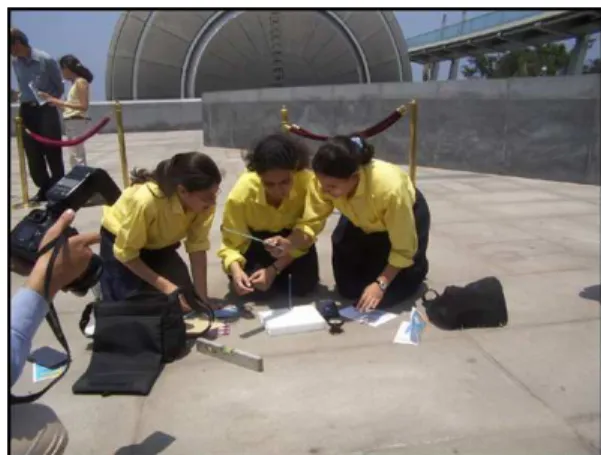
Figure 1: Summer solstice measurement of the circumference of the Earth by Egyptian pupils in front of the new Great Library of Alexandria.
Figure 2: Intensive debate after experimen-tations: the questioning attitude as a key-point of the La Main `a la pˆate approach. In the case of Galilee’s telescope, the starting point can be his observations of mountains on the moon or of sunspots through his instrument. During the activities, the children do not only learn the scientist’s discovery or play with lenses and telescopes: they face unexpected situations and problems for which they have to find a solution through experimentations and debates in a team-working spirit. How to align the lenses and maintain them in a tube ? How to stabilize the instrument to allow continuous observations ? Why do the images of the moon or stars move behind the ocular ? Do the sunspots really belong to the sun or are they dirty spots on the lens ? They build hypotheses, that they have to test through new experiments (which are defined with help of their teacher) and thus explore their own path before converging toward a solution. Every step of the reasoning and experimentation is written on the notebook to register the progressive approach of each group and improve the mastering of written and oral language. Once completed, the project is summarized and presented to other classrooms to allow children to appropriate the new scientific concepts, acquire communication skills and share experiences.
The second initiative, started in 2000, is well designed for international collaborations since it aims at sizing the Earth thanks to the very simple and well-know method discovered 22 centuries ago by the ancient Greek Eratosthenes. Since the beginning, the project has gathered hundreds of schools world-wide, which have followed month after month the evolution of the shadow of a stick, planted vertically in the ground. The pupils discovered that, by comparing their measurement of the shadow at solar noon with that of a partner located at a different latitude, it is possible to measure the size of our planet with a remarkable precision without moving away from their school ! The interdisciplinary activities are very appreciated by children who can practice technology, mathematics and physics together with history and geography. They discover and experiment the relationship between shadows and light, observe the daily path of the sun in the sky and the associated evolution of shadows, learn the solar noon, experiment that the Earth is really round. They build they own instrument (a vertical stick) and learn how to install and tune it, they measure angles and compute circuferences. The project can also provide a good opportunity to learn about old civilizations, historical and geographical notions (like the latitude and longitude). Finally, the use of new technologies (to report their measurements) is highly motivating and very helpful for exchanges and comparisons with other partners from other countries, through a dedicated website, that mutualize all the measurements of the year. The website, developed by the La main `a la pˆate team, provides all the pedagogical material to
help teachers setting up the activities in their school. This includes: a multilingual description of activities guidelines, scientific documentation for teachers, dedicated web tools, e-postcards facilities to contact other partners from other countries, follow-up of the classrooms involved in the project. On the summer solstice, when the historical measurement was performed, an international event is organized, consisting of synchronous measurements at solar noon from various schools including egyptian classrooms from Alexandria and Aswan, near the historical site of Syena. The project, although quite long and strongly constrained by meteorological conditions, has proven to be a motivating adventure, where even pupils experiencing difficulties at school can find a role in a team, express their own point of view and finally change their relationship to the teaching.
5
A partnership with the teachers
In order to assist teachers in setting up the experimental activities, a partnership is proposed in various ways. Two broad networks of pedagogical trainers and engineers and scientists has been created, who can be contacted via the main website. Teachers can ask questions related to scientific concepts, technological problems or teaching methods and share with other partners their own experience and difficulties or pedagogical advices. They are also invited to report their activities and propose locally developed projects. Workshops and short time training are organized, where teachers are placed in the same pedagogical situation as children. Without any scientific background, they have to face new situations, build experiments, argue, make hypotheses, draw conclusions and finally learn the scientific investigation process .
Teachers can find large amounts of resources on the main website (http://www.lamap.fr), that offers not only an extensive description of experimental activities but also scientific docu-mentation written by specialists and the complete set of exchanges with scientists and trainers. An international website (http:www.mapmonde.org) has been recently developed, that proposes comparable resources in various languages and links towards international projects. Five major projects will be organized in 2005-2006 : Marco Polo on the road of knowledge, Living with the Sun and Hygiene and beauty in the roman world (in addition to the already mentioned In the footsteps of Eratosthenes and Europe of discoveries), that have been based on an in-terdisciplinary and fully integrated approach. The new methodology, which is encouraged by the La main `a la pˆate program does not only help to make science more attractive, it has also deeply changed the relationship between teachers and pupils and has successfully renovated the manner of teaching science in thousands of primary schools.
References
L’Europe des d´ecouvertes, sous la direction de D. Jasmin, Editions Le pommier, Fondation des Treilles, 2004 (livre- c´ed´erom)
Sur les pas d’Eratosth`ene, Mesurer la Terre est un jeu d’enfants, H. Farges, E. Di Folco, M. Hibon-Hartman, Editions Le pommier, 2002 (livre- c´ed´erom)
Astronomy and astrophysics in Koˇ
sice
∗
R. G´alis
1and P. Kaˇ
nuk
21Faculty of Sciences, University of P. J. ˇSaf´arik, Moyzesova 16, 041 54 Koˇsice, Slovakia, e-mail: [email protected]
2The Free-time Centre Domino, Popradsk´a 86, 040 11 Koˇsice, Slovakia,
e-mail: [email protected]
Abstract:
Astronomical education of young people has very long history in the Department of planetarium and observatory of the Free-time Centre in Koˇsice. The Club of young astronomers “Pallas” has already brought up three generation of young people. Activities of this club gained new dimension through collaboration with Faculty of Sciences, P. J. ˇSaf´arik University in Koˇsice mainly with Depart-ment of theoretic physics and astrophysics. Many attractive and interesting events like observations of Solar and Lunar eclipses, Venus transit, Virtual university, Hubble 15th Anniversary, With telescope on the road invited hundreds and hundreds young people to astronomy, science and wish to learn about world surrounding us.
1
Introduction
It is very well known that interest of young people for physics as well as science systematically decreases in this commercial oriented world. Astronomy and astrophysics have special position in the science field. There is very close relationship between man and the universe: everybody who is born, lives and also dies under the sky, so everybody is a part of the universe. If we use this relationship astronomy can work as an attractor - tool that tightens young people to physics, science and the wish to learn about the world surrounding us. Such aim is not easy for astronomy and therefore it is necessary to join efforts of many organisations of various types. In this paper we would like to present one special and probably the remarkable type of such cooperation that was born in Koˇsice, Slovakia.
Koˇsice is the second largest city in Slovakia. You can find this city with rich history in eastern part of the Slovak Republic. The first written mention of the suburb can be dated back to the year 1230. Due to its advantageous business and strategic position the City of Koˇsice grew quickly. Koˇsice has the oldest coat-of-arms from among all cities in Europe. Nowadays Koˇsice is a modern European town.
The astronomy has a long tradition in Koˇsice where young people, scholars, students and all persons interested in astronomy can visit two planetariums what is the Slovak rarity. The
first and older one occurs downtown in Slovak Technical Museum. The second planetarium you can find together with observatory in the Free-time Centre Domino. By the way it is a rare occasion to find observatory and planetarium in such facility.
2
The Free-time Centre Domino
The Free-time Centre Domino is an organisation mainly oriented on spare time activities of young people. Scholars and students come to our Centre to spend their free time actively in many clubs: dancing (modern, country as well as folklore), musical (brass bands, rock and pop bands), art, ceramic, photographic, dramatic, scenic, theatrical, scientific, computer and of course astronomical ones. Besides these regular club activities the Free-time Centre organises many special cultural, sporting and educational events and interesting camps during the holidays. Another part of the centre activities represents shows in planetarium and night sky observations in the observatory for groups of scholars and students as well as for all visitors and amateur astronomers.
Astronomical education of young people has a long-term tradition in the Department of planetarium and observatory of Free-time Centre. The Club of young astronomers “Pallas” is one of the best successful interest groups in the Centre; it has already brought up three gener-ation of young people. Main activities of this club are connected with observgener-ations of the sky: from solar and moon eclipses, through planets, asteroids, comets, showers, to binaries and deep sky objects like nebulas, star clusters and galaxies. Some members of Pallas club are strongly interested in photography - art to immortalize the beauty of the night sky on photographic films and recently on CCD chips of their digital cameras. Activities of this club as well as whole observatory and planetarium department gained new dimension through collaboration with Faculty of Sciences, P. J. ˇSaf´arik University in Koˇsice mainly with Department of theoretic physics and astrophysics.
3
Pavol Jozef ˇ
Saf´
arik University
Pavol Jozef ˇSaf´arik University was established in 1959 as the second university in Slovakia, but the tradition of higher education in Koˇsice goes back to the year 1657, when the bishop Benedict Kishdy founded the “Academia Cassoviensis” by the Memorandum of “Studium Universale”. Later, the university was changed into a royal university and then to the Law Academy which operated until 1921. Old University traditions were renewed by foundation of Pavol Jozef ˇ
Saf´arik University in Koˇsice which consisted of Faculty of Medicine in Koˇsice and Faculty of Philosophy in Preˇsov. The new University has enlarged by new faculties: 1963 - Faculty of Science, 1973 - Faculty of Law and in 1998 - Faculty of Public Administration.
The key mission of Faculty of sciences is to provide higher education based on the newest scientific findings in a wide international context, following the European trends and goals. Faculty of Science prepares experts in natural sciences, mathematics, informatics and teachers. The graduates of our Faculty have a very good reputation all over the world. One part of our faculty - Institute of Physics coordinates education of physics for students of Physics teacher branch and education for student of physics branches: Condensed matter physics (specializa-tion: magnetism, physics of metals, low temperature physics), Physical engineering of materials, Nuclear physics, Biophysics and chemical physics and recently Astronomy and astrophysics.
Astronomy and astrophysics (as a part of Department of theoretic physics and astrophysics) has not long history (the first student of this branch graduated in 2000), but it has a perspective
to become the best educational institution in this branch in Slovakia (and probably in larger European territory) due to the study conditions that are offered to our students. The very im-portant role plays our very close cooperation with other institutions, mainly with Astronomical institute of Slovak Academy of Sciences in Tatransk´a Lomnica. This cooperation assure the high quality of presented information in educational branch as well as the significant scientific research. Our colleagues from Astronomical institute give lectures from various astronomical branches like the physics of the Sun, Interplanetary matter and interacting binaries, admit diploma thesis for our students; some lectures are realised directly in the Astronomical insti-tute. Another promising cooperation rises with Kolonica Observatory, equipped by the largest telescope in Slovakia (diameter of primary mirror 1 m).
4
Cooperation
Our goal is to attract more young people into astrophysics. We try to exercise an influence on university students - young people, who are mostly decided to do their scientific careers. We realise that it is necessary to start the popularisation of astrophysics (and physics at all) from scholars to students. In this field the Free-time Centre has quite strong position. In 2000 the agreement about cooperation between the Free-time Centre Domino and Faculty of Sciences, P. J. ˇSaf´arik University was signed up.
The main goal of this cooperation is to aggregate forces to enhance achieved results in educational process and popularisation of astronomy, natural sciences and science at all. On one side scholars and students - members of astronomical clubs in the Free-time Centre have chance to work with scientists on particular scientific problems using professional equipment, what is very attractive for them. Some former members of astronomical clubs are now students of astronomy and astrophysics in our faculty. On the other side our university students use equipment of observatory and planetarium during their special lectures (Elements of Astronomy and Astrophysics, Astronomical equipments, etc.) or during preparation of their Diplomas (Reduction of long-term observation of solar photosphere - V. Kozarov´a, From the life of stars - K. Meˇnuchov´a, Short history of the Universe - M. Panˇciˇsin - new shows in the planetarium for scholars and students). Students of Physics teacher branch can achieve the first educational experiences during leadership of clubs in the Free-time Centre. Preparation and organisation of conferences, public presentations and special astronomical events represent additional part of our collaboration.
One of our great astronomical events, which was realised in the frame of our cooperation was Venus transit 2004. Faculty of Sciences started to operate the optical network in the Free-time Centre during 2003. In the frame of so called “Virtual University” (the faculty’s project of utilisation of optical network for educational purpose - e.g. for propagation of educational presentations) was observation of this event (using video camera mounted on the telescope in observatory of the Free-time Centre) propagated as the live transmission in Internet. So besides hundreds of scholars, students and people interested in this event which came to the Free-time Centre next thousands had possibility to see this unique astronomical presentation in Internet. Moreover, the videoconference was established, so people interested in this event could directly communicate with professional astronomers. This observation had besides the propagation character also scientific importance: our young astronomers were involved into the ESO project of astronomical unit measurement.
Another very successful common event was celebration of the 15-th anniversary of launching of Hubble space telescope in April of this year. This event was organised in cooperation with European space agency. The Faculty of sciences purchased new equipment for planetarium this
year. We cooperate during preparation and organisation of conference for teachers of physics in Koˇsice region, competitions, expeditions and camps for young people interested in astronomy and astrophysics.
5
Conclusions
We are going to prepare another public observations of special astronomical events like solar eclipses in October 2005 and March 2006 and many others. So we can proudly say that our cooperation brought the first results and we hope that the cooperation will continue successfully in the future. We hope that it can be inspired and useful for the colleagues in the Europe.
Acknowledgements
This work was supported by the EAS travel grant and the VEGA grant 4015/4.
Stars in the eyes, birth of a vocation ?
Ya¨el Naz´e
∗Institut d’Astrophysique, Universit´e de Li`ege, Belgium
Abstract:
It is generally difficult to interest people to sciences, especially physics. However, astronomy has a great power of fascination, and can thus be used to attract people into the scientific world. Here in Li`ege, we are trying to develop several different aspects of astro-education: they will be detailed in this paper. For example, we organize interactive activities for primary schools, and also help high school students to consider a scientific career. Our undergraduate students also benefit from our experience: for example, they have the possibility to observe at a real observatory, they can train at ESA facilities,... The general public is also invited to discover astronomy and, through it, physics, thanks to several specific events. Finally, media, the links between the public and the researchers, are not forgotten: our astro-news service was specifically created for this purpose.
1
Introduction
One may wonder why use astronomy to attract people into sciences. In fact, astronomy is an old physical science that has always fascinated the human being: it is therefore one of the best tools to interest people to sciences, especially for formal education purposes. Astronomy benefits from multiple advantages. First, it is a multidisciplinary domain: astronomy can help to increase people’s awareness in physics, new technologies, history, biology, and even philosophy! In addition, it is by itself very attractive: apart from a deep fascination it has always exerted since ancient times, astronomy also presents beautiful pictures, new discoveries every day, big technological challenges (like building a 100m telescope) and human adventures (like landing on the Moon or going to Mars). Finally, it triggers easily the scientific curiosity since it is linked to timeless questions, e.g. is Earth the only planet?, how big is the Universe?, are we alone?, what will be the fate of the world?,...
So astronomy potentially interests everybody and we should therefore target everybody in our astronomical dissemination projects. We have then tried, here in Li`ege, to do so by organizing a wide range of activities regarding astronomy. I’ll now present a few of them.
2
De 7 `
a 77 ans: Schools and General Public
All year long, there are many opportunities to attract people’s attention towards sciences by means of astronomy. Here are a few examples.
A first possibility is to join a science fair. In southern Belgium, the science network ‘Scit´e’ organizes each year such a science fair, called ‘Printemps des sciences’, lasting 7 days. Schools (primary and secondary alike) are invited during the week, while families come to visit during the week-end. Each year, a different theme is chosen. Since astronomy is multidisciplinary, it is rather easy to make an astronomical exhibition while strictly focusing on the chosen theme: for example, in 2005, the theme was ‘the town’, and we have then explained the problem of light pollution and talked about the links between astronomy and sustainable development, a very fashionable topic at the moment.
Events only related to astronomy are always a big success, especially since many different activities can be organized.
As you all know, bigger is better, i.e. big experiments always impress people a lot, and being impressed may then trigger a new interest for sciences. astronomy is the ideal labora-tory for impressive experiments. For example, the Foucault pendulum. Regularly, the Li`ege astronomers, amateurs and professionals together, gather in a no longer active church in the city’s center. There, they invite the schools and the general public to come during 2 weeks while trying to prove that the Earth is rotating. Another unforgetable experience linked to astronomy is a planetarium session. In the old Observatory of Cointe, astronomers from Li`ege are giving planetarium shows to primary and secondary school students. There, in agreement with the official learning program, the students learn about celestial motions from different points of view (e.g. as situated on Earth or from outer space). They discover by themselves how the Earth moves in space, and can then deduce what this motion induces: seasons, day and night alternance,... Finally, seeing the ‘real sky’ through a telescope keeps a lot of appeal even in a high-tech era. That’s why we are offering a few observing sessions each year, either during the day (for the Sun) or at the beginning of the night (when children are not yet confined to their bed, so the whole family can come). Since the weather is not always good (especially in Belgium), the best thing to do is to organize such sessions as a complement to another (indoor) event like conferences or worskhops: the observations then constitute the ‘cerise sur le gˆateau’. Each year, at least one ‘hot topic’ related to astronomy arises in the media like e.g. Venus transit in 2004 and Huygens landing in 2005. At that time, everybody, at school as well as at home, is talking about it: from our point of view, this is a perfect opportunity to organize an ‘astro day’ ! Be assured that it will attract a lot of schools (teachers have to talk about current events but know little - if not nothing - about astronomy), the public at large, and also... the media.
If punctual events are interesting, one should not forget loger-term education. In this context, we have recently built in the woods surrounding the university an attraction called ‘Piste des plan`etes’ (Planet Walk): it is a one-km walk with a scaled Solar system along it. Contrary to what is usually done, we have decided to keep the same scale for sizes and distances. With this enjoyable walk, perfect for a sunday afternoon, people can therefore learn about the actual dimensions of the Universe, and see how small and fragile the Earth is.
For primary schools in particular, we also organize specific activities called ‘astro lessons’, with small conferences on the current ‘hot topic’, and/or astro workshops for e.g. building a mobile sky chart. Questions and answers sessions are always very much appreciated at that age, but be aware that it can be difficult to reply to apparently ‘simple’ questions (e.g. why is the Earth round?) in simple terms.
Finally, we also regularly welcome students from the last year of high school at the Institute, for one day to one week. According to the length of their stay, we propose different activities: discussions with professional astronomers to see the diversity of topics in astronomy and how real astronomers work (e.g. not with the eye glued to the eyepiece like in the nineteenth