COMPLEX SCALING M E T H O D FOR MOLECULES IN INTENSE
LASER FIELDS
by
Effat Dehghanian
A Thesis submitted to the Department of Chemistry in partial fulfillment of the requirement for the degree of
Doctor of Philosophy (Ph.D)
THE FACULTY OF SCIENCE UNIVERSITY OF SHERBROOKE
1*1
Library and Archives Canada Published Heritage Branch 395 Wellington Street Ottawa ON K1A 0N4 Canada Bibliotheque et Archives Canada Direction du Patrimoine de I'edition 395, rue Wellington OttawaONK1A0N4 CanadaYour file Votre reference ISBN: 978-0-494-75053-7 Our file Notre r6f6rence ISBN: 978-0-494-75053-7
NOTICE: AVIS:
The author has granted a
non-exclusive license allowing Library and Archives Canada to reproduce, publish, archive, preserve, conserve, communicate to the public by
telecommunication or on the Internet, loan, distribute and sell theses
worldwide, for commercial or non-commercial purposes, in microform, paper, electronic and/or any other formats.
L'auteur a accorde une licence non exclusive permettant a la Bibliotheque et Archives Canada de reproduire, publier, archiver, sauvegarder, conserver, transmettre au public par telecommunication ou par I'Internet, preter, distribuer et vendre des theses partout dans le monde, a des fins commerciales ou autres, sur support microforme, papier, electronique et/ou autres formats.
The author retains copyright ownership and moral rights in this thesis. Neither the thesis nor substantial extracts from it may be printed or otherwise reproduced without the author's permission.
L'auteur conserve la propriete du droit d'auteur et des droits moraux qui protege cette these. Ni la these ni des extraits substantiels de celle-ci ne doivent etre imprimes ou autrement
reproduits sans son autorisation.
In compliance with the Canadian Privacy Act some supporting forms may have been removed from this thesis.
Conformement a la loi canadienne sur la protection de la vie privee, quelques formulaires secondaires ont ete enleves de cette these.
While these forms may be included in the document page count, their removal does not represent any loss of content from the thesis.
Bien que ces formulaires aient inclus dans la pagination, il n'y aura aucun contenu manquant.
1*1
Canada
M E T H O D E D E DILATATION C O M P L E X E P O U R LES
MOLECULES E N C H A M P LASER I N T E N S E
par
Effat Dehghanian
These presentee au Departement de Chimie en vue
de I'obtention du grade de docteur es sciences (Ph.D.)
FACULTE DES SCIENCES
UNIVERSITE DE SHERBROOKE
Le7fevrier2011
lejury a accepte la these de Madame Effat Dehghanian
dans sa version finale.
Membres du jury
Professeur Andre D. Bandrauk
Directeur de recherche
Departement de chimie
Professeur Serge Lacelle
Membre
Departement de chimie
Professeur Thanh-Tung Nguyen-Dang
Membre externe
Universite de Laval, Departement de chimie
Professeur Patrick Ayotte
President-rapporteur
Departement de chimie
Sommaire
Ce travail se divise en deux parties. Dans la premiere partie, nous demontrons une nouvelle methode de calcul Ab-initio pour deux electrons correles en 3D pour les systemes diatomiques, en part Nous avons utilise la methode spectrale numerique du type interaction de configuration (CI, Configuration Interaction) pour resoudre I'equation de Schrodinger stationnaire (SSE, Sta-tionary Schrodinger Equation) via une expansion de la fonction d'onde bielectronique sur une base associee aux polynomes de Laguerre et aux fonctions de Legendre. Nous avons utilise la methode de 'scaling' dans le plan complexe pour effectuer l'expansion des fonctions de base de sorte a decrire la decomposition des etats de resonance correctement. Une fois I'equation de Schrodinger resolue, nous avons ete en mesure de calculer l'energie de l'etat fondamental, des etats excites et doublement excites ainsi que les moments dipolaire de transition. L'exactitude des resultats obtenus demontrent l'efflcacite de notre methode numerique et de l'expansion de la fonction d'onde. Ensuite, nous avons resolu I'equation de Schrodinger dependante du temps (TDSE, Time-Dependent Schrodinger Equation) en utilisant la methode Runge-Kutta d'ordre eleve sur une grille adaptative. Dans le cas de I'equation de Schrodinger dependante du temps, le 'scaling' dans le plan complexe des fonctions de bases previent aussi la reflexion de la fonction d'onde durant la propagation temporelle, ce qui implique qu'une expansion sur une plus petite base s'avere suffisante pour etudier les phenomenes physiques. Les resultats preliminaires pour l'ionisation totale demontrent une tres bonne exactitude. Nous avons utilise notre algorithme du type CI pour la solution de I'equation de Schrodinger stationnaire et dependante du temps sur deux molecules diatomiques, un cas symetrique (H2) et un cas asymetrique (HeH+), dans
un code FORTRAN77. Notre algorithme a ete largement optimise et la methode OpenMP a ete utilise pour le rendre parallele, ce qui le rend tres efficace.
les probabilites d'ionisation simple (SI, Single Ionisation) et d'ionisation double (DI, Double Ion-isation). Nos resultats pour les probabilites d'ionisation et d'excitation (a 800nm et 400nm) en fonction de la distance interucleaire R montrent une forte evidence d'ionisation exaltee (EI, Enhanced Ionization), pour l'ionisation simple et double, ainsi que d'excitation exaltee (EE, En-hanced Excitation), pour I'excitation simple et double, pour les systemes diatomiques (H2 et
HeH+) lorsque la distance intranucleaire R augmente par rapport a la distance d'equilibre Re.
L'exaltation de ces processus moleculaires demontrent un maximum pour une distance critique
Rc, qui peut etre predite par de simples modeles electrostatique et de recollision. Nous avons
ensuite calcule les spectres d'harmoniques d'ordre eleve moleculaire (MHOHG, Molecular High Order Harmonic Generation) pour H2 soumis a des impulsions laser de differentes intensites pour
ainsi confirmer la loi de coupure.
Dans la deuxieme partie, nous derivons un nouveau schema d'integration base sur la decomposition exponentielle de I'operateur d'evolution temporelle. Nous avons montre que pour eviter des pas de temps negatifs, l'utilisation de pas de temps dans le plan complexe a ± ib, avec partie reelle positive a > 0, peut fournir des fonctions d'ondes avec une tres bonne exactitude et un ordre d'efHcacite eleve pour les petites erreurs. II faut noter que ces nouveaux operateurs S3' , S'3,
S'4 sont obtenus par combinaison d'operateur d'ordre inferieur S2 ' avec pas de temps complexes
7 = a ± i 6 et a > 0. Ceci suggere que ces operateurs d'ordre inferieur avec pas de temps complexes sont des generateurs de base pour des integratcurs cxponentiels avec degre d'exactitude elevee.
Abstract
This work consists of two parts: In the first part we report new full 3D correlated two-electron ab-initio calculations for diatomic systems including the symmetric molecular hydrogen H2 and
its extension to nonsymmetric molecule HeH+. We use a numerical spectral method of
config-uration interaction (CI) type to solve stationary Schrodinger equations (SSE) via expansion of two-electron wave function on basis of associated Laguerre polynomials and Legendre functions. We use the complex scaling method for our basis function expansion in order to describe the decaying behavior of resonance states correctly. From solving SSE, we have been able to compute the energy levels for the ground state, many high lying excited states, double excited states, and transition dipole moments. The accuracy of our results shows the efficiency of our numerical method and the wave function expansion. Then, we solve time-dependent Schrodinger equations (TDSE) by using high-order Runge-Kutta method with adaptative step size. In the case of TDSE the complex scaling of the basis functions also prevents the reflection of the wave function during time propagation, so a smaller basis expansion is sufficient to study the physical phenomena. The preliminary results for total ionization show very good accuracy. We have implemented our CI based algorithm for the solution of SSE's and TDSE's for diatomic molecules, the symmetric case (H2) and the nonsymmetric case (HeH+), based on FORTRAN77. Our algorithm is highly
optimized and also we parallelized it with OPENMP method, so it is very efficient.
Then, by having final two-electron wave functions of diatomic molecules at the end of laser pulse and the corresponding eigenvalues and eigenfunctions of one-electron systems in hand we used projection methods to compute single (SI) and double (DI) ionization probabilities at the end of laser pulse. Our results for ionization and excitation probabilities (at 800 nm and 400 nm) show a strong evidence of enhanced ionization (EI), in both single and double ionization, as well
from simple electrostatic and recollision models. We also computed the molecular high-order harmonic spectra, MHOHG, for H2 at different laser intensities confirming the spectra satisfy a
cut-off law.
In the second part we have derived new integration schemes based on exponential decomposition of evolution operators. We have shown that in order to avoid negative time steps, complex time steps a ± ib with positive real part a > 0 can give very accurate wave functions with high order efficiency for small errors. Of note is that the new operators S3 ' , S3, S'4 have all been obtained
from combinations of lower order S2' with complex time step 7 = a ± ib and a > 0. This
suggests that these low order operators with complex time steps are basic generators of higher order accuracy exponential integrators.
Acknowledgements
First, I would like to express my sincere gratitude to my supervisor Prof. A. D. Bandrauk for giving me the opportunity to work in his group as a student under his supervision, for his help, scientific guidance and worthwhile discussions through the course of this research. It has been privilege and pleasure to learn from him. I would like also to express my deep appreciation for all of his supports not only in my study but also in different aspects of my personal life.
I wish to express my many thanks to Dr. G. L. Kamta for his advices and many fruitful scientific discussions.
My warm thanks to Dr. H. Lu for his kind helps and scientific discussions.
I am very thankful to Mrs. Maria Ignatow Bandrauk for her supports and being very friendly during my study at University of Sherbrooke.
My thanks to jury members for the corrections on my manuscript.
I wish to convey my appreciation to the members of Laboratory of Theoretical Chemistry at University of Sherbrooke for their helps in any occasion that I needed: Dr. S Chelkowski, Dr. Catherine Lefebvre, Dr. Emmanuel Fowe Penka, Dr. Deyana Tchitchekova, Dr. Samira Barmaki, Dr. Kaijun Yuan, Dr. Xue Bin, Dr. Marie Becher. I have been fortunate to work with you all in a group.
I also thank the Natural Sciences and Engineering Research Council (NSERC) of Canada for the financial support and the Reseau quebecois de calcul de haute performance (RQCHP) for access to their high performance supercomputers.
Finally, this work would never had been possible without my wonderful family: my parents, my husband, my brother and sisters and little Arvin. They have been always there for me when I
Table of contents
Sommaire iii
Abstract v
Acknowledgements vii
Table of contents viii
Abbreviations xiii
List of Tables xiv
List of Figures x x
Introduction 1
1 Concepts in laser-matter interaction 6
1.1 Introduction 6
1.2 Classical description of the electromagnetic field 6
1.3 Classical description of charged particle in the laser field 7
1.5 The Hamiltonian operator 9
1.6 Born-Oppenheimer approximation 10
1.7 The Hamiltonian operator in field 11
2 Solution of the time independent Schrodinger equations for diatomic molecules:
homonuclear (H2) and hetronuclear (HeH+) cases 13
2.1 Prolate-spheroidal coordinates 17
2.2 The basis expansion for the wave function 18
2.2.1 The one electron wave function 18
2.2.2 The two-electron molecular wave function 20
2.3 Solving stationary Schrodinger equations (SSE) 22
2.4 Gauss-Laguerre quadrature method 30
2.5 Gauss-Legendre quadrature 32
2.6 Complex scaling 33
2.6.1 Application of complex scaling for the resonance states 33 2.6.2 Application of complex scaling in avoiding reflection of the wave function
2.7 Numerical solution of generalized eigenvalue problem for H2 40
2.8 Potential curves of H2 48
2.9 Non-autoionizing doubly excited states of H2: the Yl~ symmetry 48
2.10 Transition dipole moments 52
2.11 Numerical solution of the SSE for HeH+ 64
2.12 Potential curves and transition dipole moments of HeH+ 65
3 Solution of the time dependent Schrodinger equations for diatomic molecules:
homonuclear (H2) and heteronuclear ( H e H+) cases 68
3.1 Solving the time-dependent Schrodinger equations TDSE 70
3.2 Gauge invariance of Schrodinger equation 74
3.3 High-order Runge-Kutta integration methods 76
3.4 Embedded Runge-Kutta integration method 77
3.5 Calculation of single and double ionization of H2 and HeH+ 78
3.6 Mechanism of single and double ionization of H2 82
3.7 Ionization results and Rabi oscillations 84
4.1 Quasistatic models and Keldysh method for approximation of intensity for
ioniza-tion of atoms 90
4.2 One electron diatomic molecules 91
4.2.1 Symmetric H j 91
4.2.2 Non-symmetric molecule HeH2+ 94
4.3 Polyatomic molecules 98
4.3.1 Enhanced ionization for 3D H3+ 99
4.4 Symmetric molecule H2 101
4.4.1 w0=0.057 a.u. and I=1014 W/cm2, ncyde-A (4 cycles laser pulse) 101
4.4.2 w0=0.057 a.u. and 1= 5 x 10¹³ W/cm2, nc„c,e=4 102
4.4.3 w0=0.057 a.u. and I=1014 W/cm2, nc y d e=6 105
4.4.4 < J0= 0 . 1 1 4 a.u. and 1=2 x 10¹³ W/cm2, 1014, nc y d e=4 105
4.5 Estimation of Rc for H2 I l l
4.6 Non-symmetric molecule HeH+ 113
4.7 Analytical derivation of Rc for HeH+ 124
5 Molecular high order harmonics generation of H2 128
5.1 Classical three-step rescattering model for HHG 129
5.2 Gauges for representation of high-order harmonic generation 131
5.3 Numerical calculation of MHOHG spectra of H2 from 3-D TDSE 133
5.4 MHOHG spectra of H2 for different intensities at Re 136
6 Complex integration steps in decomposition of
quantum exponential evolution operators 144
6.1 Introduction 145
6.2 Complex time decomposition of TDSE's 146
6.3 Comparison of numerical integrators 150
6.4 Conclusion 155
Conclusion 158
Appendix A Enhanced ionization of the H2 molecule driven by
intense ultrashort laser pulses 161
Abbreviations
SSE Stationary Schrodinger EquationT D S E Time-Dependent Schrodinger Equation
F T Fourier Transform
CREI Charge-Resonance Enhanced Ionization EI Enhanced Ionization EE Enhanced Excitation SI Single Ionization DI Double Ionization SE Single Excitation D E Double Excitation C P E Carrier Envelope Phase
HHG High-Order Harmonic generation
List of Tables
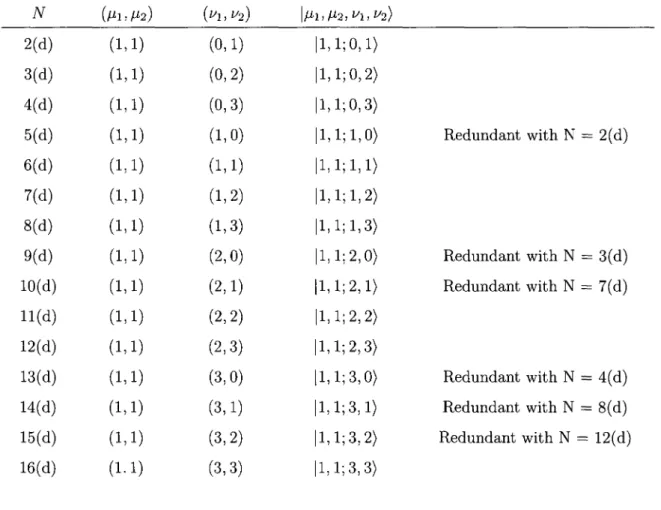
1 Redundancy in the basis expansion [2.16] 44
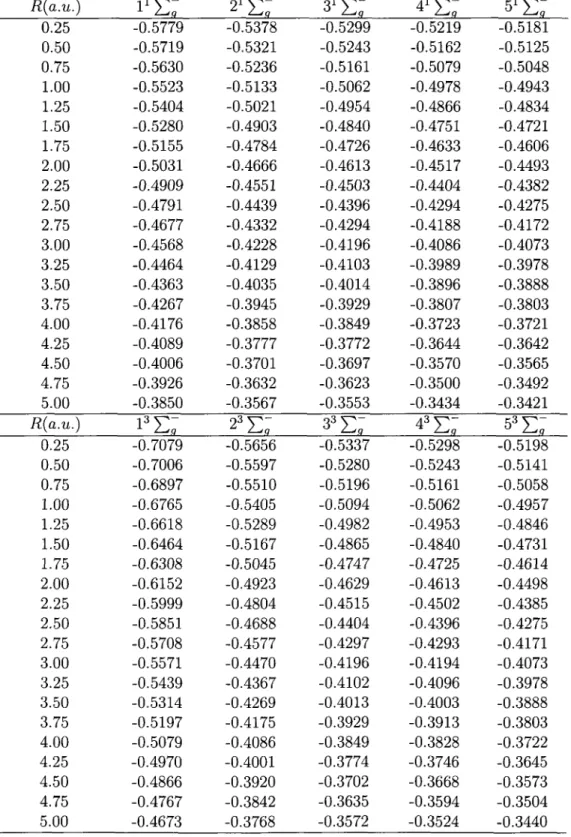
2 Electronic energies (in a.u.) for the 1,s ^ ~ of H2 53
3 Electronic energies (in a.u.) for the 1,s ^2~ of H2 54
4 X1 Y^t ~n ]C« transition moments of H2 59
5 Butcher tableau 77
6 Extended Butcher tableau for adaptive method 78
List of Figures
1 Spheroidal coordinates £, n 18
2 Schematic representation of diatomic molecules in coordinate system 23
3 Demonstration of the ECS coordinate transformation 38
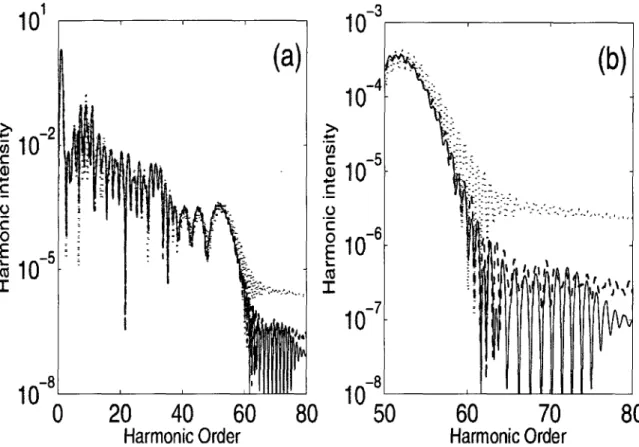
4 High harmonic spectra from the interaction of the hydrogen atom with an intense linearly polarized 3 cycle laser pulse at E0 = 0.1 a.u. and u = 0.057 a.u. shown is a
comparison between the results obtained from the unrestricted reference calculation (solid black line) and calculations using the ECS (red dashed line) and the masking
function (blue dotted line) as absorbers. The results are from (67) 39
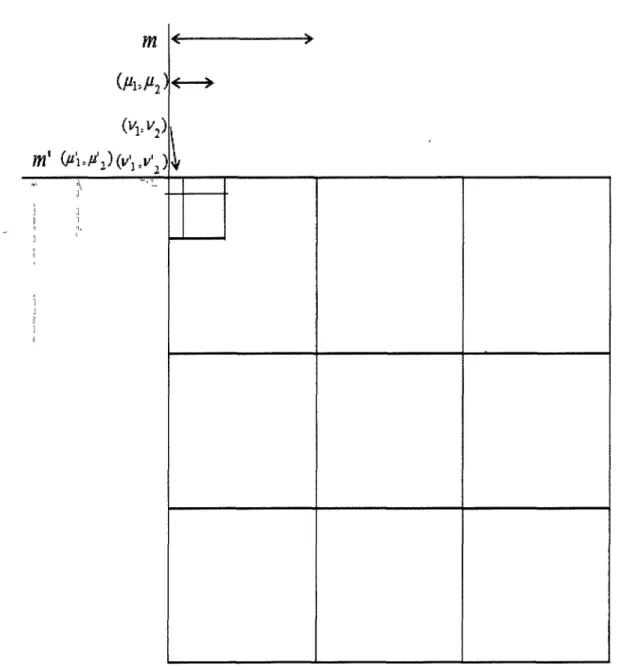
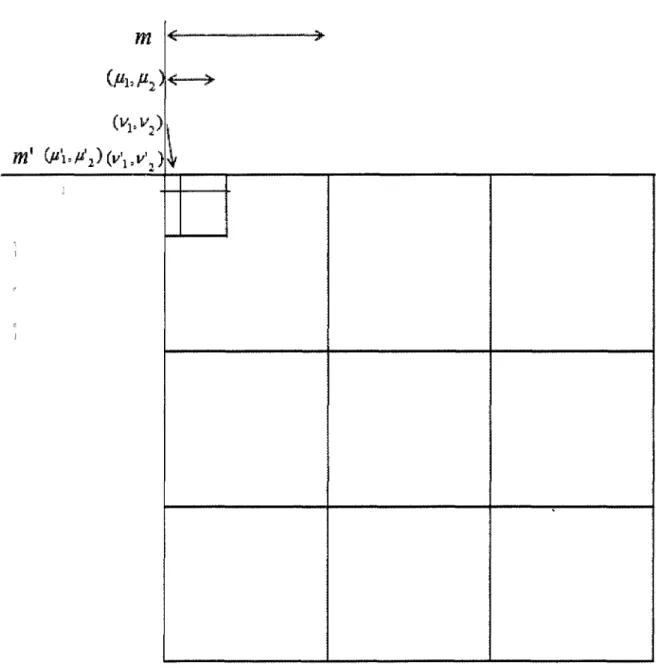
5 The structure of the overlap matrix (S) and the Hamiltonian matrix Ho 42
6 The structure of the matrix (Uc) and the Hamiltonian matrix H = H0 + Uc. . . . 43
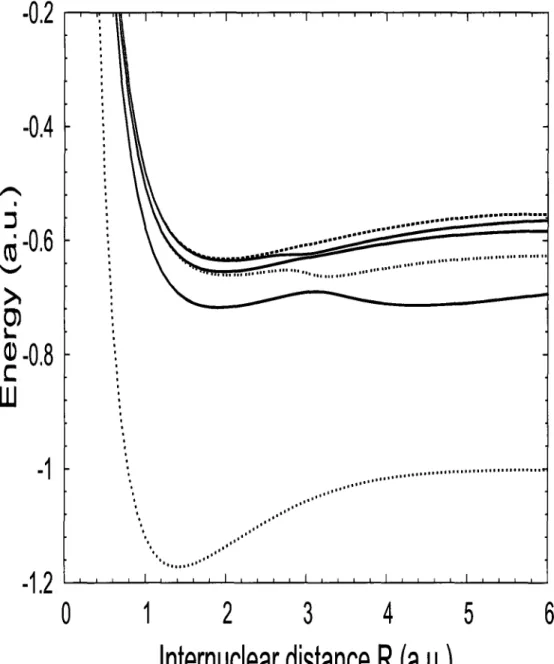
7 Potential energy curves of H2 as functions of internuclear distance. The figure
shows the six lowest *E+ states 49
8 Electronic energies (in atomic unit) for the lowest non-autoionizing doubly excited
states (1'3Sg") of H2 as functions of internuclear distance 50
9 Electronic energies (in atomic unit) for the lowest non-autoionizing doubly excited
11 X1 Yt —n J2Z (n = 3 — 6) transition moments of H2, W in parenthesis refers to
the results from ref (77). The basis set parameters are mmax = 3, \i\max = 6, [i2max
= 6, ulmax = 10, v2max = 10, P = 0.2, and 0 = 0 58
12 Potential curves for the six lowest I S states of HeH+, including the nuclear
repul-sion 66
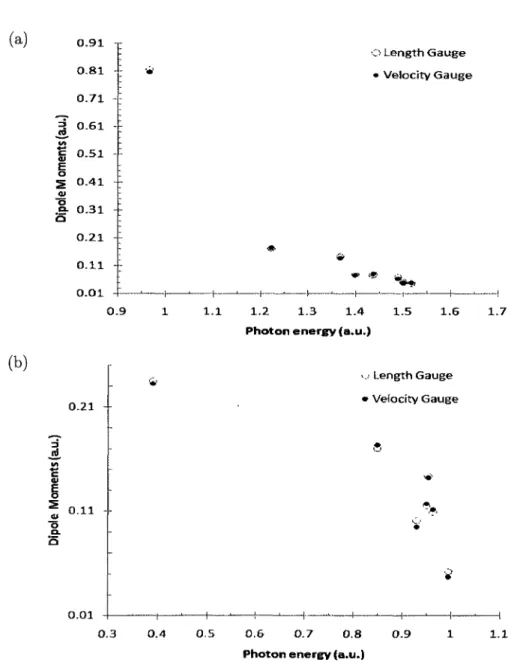
13 The absolute value of electronic transition dipole moments of HeH+ for: a) the
equilibrium internuclear distance R = 1.45 a.u.; and b) R = 5 a.u 67
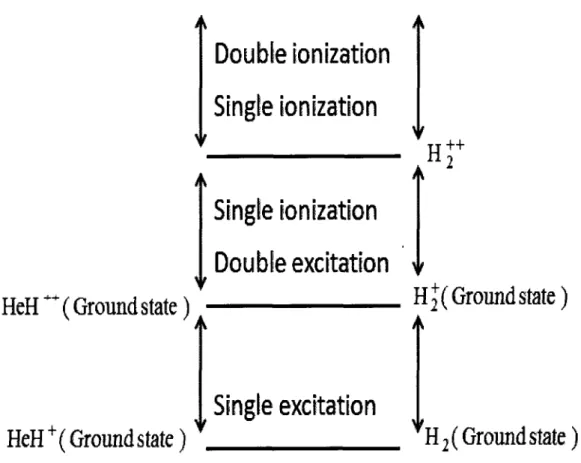
14 The schematic representation of energy levels of single and double excited states and single and double ionization states of H2 (on the right side) and HeH+ (on the
left side) 82
15 Ionization yield as a function of the laser (peak) intensity for two different photon frequencies (10 eV (circles, 14.88 fs) and 6.2 eV (squares, 16.68 fs)). According to LOPT, the slope of the yield curve should be proportional to the number of photons needed for ionization, if plotted on a log-log scale. A slope of 2.0 for 10.0
eV and 2.98 for 6.2 eV is found 85
16 Rabi oscillation of two states; dash - blue: X1 ]T^", solid - red: B1 ]T+ 86
17 Experimental results for ionization signal of H j as a function in internuclear
dis-tance R, taken from (104) 89
18 Summation of Coulomb potential and static field EQ, potentials of H j , taken from
(107) • 92
19 Summation of Coulomb and static field (F), F is equal to the maximum electric field E0 at the peak of laser pulse, potentials of HeH2+, taken from (110), K, = 0
on the left and K = n on the right 95
21 Total (PTI), single (Psi) and double (PDI) ionization probabilities in, Velocity Gauge (V) and Length Gauge (L) for H2 by a 4 cycle laser pulse and intensity
I=1014 W/cm2 at w0=0.057 a.u. for the following basis set parameters: mmax=3,
Mim a i=6, M2max=6\ J/imax=15, v2max=Vb. Refer to the Equations 3.33, 3.24, 3.25
for definitions of these probabilities 103
22 Total (PTE), single (PSE) and double (PDE) excitation probabilities in, Velocity
Gauge (V) and Length Gauge (L) for H2 by a 4 cycle laser pulse and intensity I=1014
W/cm2 at w0=0.057 a.u. for the following basis set parameters: mmax=3, Aiimax=6,
Ai2mQx==6, i>imax=15, v2max=Yd. Refer to Equations 3.33, 3.34 for definitions of these
probabilities 104
23 a) Total (PTI), single (Psi) and double (PDI) ionization probabilities, and b) To-tal (PTE), single (PSE) a nd double (PDE) excitation probabilities of H2 by a 4
cycle laser pulse and intensity 1=5 x 10¹³ W/cm2 at w0=0.057 a.u. Refer to
Equations 3.33, 3.24, 3.25 for definitions of ionization probabilities and
Equa-tions 3.33, 3.34 for definiEqua-tions of excitation probabilities 106
24 Total (PTI), single (Psi) and double (PDI) ionization probabilities of H2 by 4
and 6 cycle laser pulses and intensity I=1014 W/cm2 at co0—0.057 a.u. Refer to
Equations 3.33, 3.24, 3.25 for definitions of these probabilities 107
25 Total (PTE), single (PSE) and double (PDE) excitation probabilities of H2 by 4
and 6 cycle laser pulses and intensity I=1014 W/cm2 at w0=0.057 a.u. Refer to
Equations 3.33, 3.34 for definitions of these probabilities 108
to-27 a) Total (PTI), single (Psi) and double (PDI) ionization probabilities, and b) Total (PTE), single (PSE) and double (PDE) excitation probabilities of H2 by
a 4 cycle laser pulse and intensity / = 2 x 10¹³ at o;0=0.114 a.u. Refer to
Equations 3.33, 3.24, 3.25 for definitions of ionization probabilities and
Equa-tions 3.33, 3.34 for definiEqua-tions of excitation probabilities 110
28 a) Total (PTI), single (Psi) and double (PDI) ionization probabilities, and b) To-tal (PTE), single (PSE) a nd double (PDE) excitation probabilities of HeH+ by a 3
cycle laser pulse and intensity I=1014 W/cm2 at X J0= 0 . 1 1 4 a.u. for the following
basis set parameters: mmax=3, /^imaa;=6, /^2maa;=6, Vimax=lQ, ^2ma*=10. Refer to
Equations 3.33, 3.24 and 3.25 for definitions of ionization probabilities and
Equa-tions 3.33 and 3.34 for definiEqua-tions of excitation probabilities 115
29 a) Total (PTI), single (Psi) and double (PDI) ionization probabilities, and b) Total (PTE), single (PSE) and double (PDE) excitation probabilities of HeH+ by a 3
cycle laser pulse and intensity I=1014 W/cm2 at wo=G\114 a.u. for the following
basis set parameters: mmax=3, /xlmaa.=6, n2max=6, vlmax=l, v2max=l. Refer to
Equations 3.33 and 3.24, 3.25 for the definitions of ionization probabilities and
Equations 3.33 and 3.34 for the definitions of excitation probabilities 116
30 a) Total (PTI), single (Psi) and double (PDI) ionization probabilities, and b)
To-tal (PTE), single (PSE) and double (PDE) excitation probabilities of HeH+ by a
3 cycle laser pulse and intensity 1=3 x 10¹⁴ W/cm2 at Wo=0.114 a.u. Refer to
Equations 3.33, 3.24 and 3.25 for definitions of ionization probabilities and
Equa-tions 3.33 and 3.34 for definiEqua-tions of excitation probabilities 117
31 a) Total (PTI), single (Psi) and double (PDI) ionization probabilities, and b) To-tal (PTE), single (PSE) and double (PDE) excitation probabilities of HeH+ by a
3 cycle laser pulse and intensity 1=5 x 10¹⁴ W/cm2 at Wo=0.114 a.u. Refer to
Equations 3.33, 3.24 and 3.25 for definitions of ionization probabilities and
32 a) Total (PTI), single (Psi) and double (PDI) ionization probabilities, and b) To-tal (PTE), single (PSE) and double (PDE) excitation probabilities of H e H+ by a
3 cycle laser pulse and intensity 1=8 x 10¹⁴ W / c m2 at C J0= 0 . 1 1 4 a.u. Refer to Equations 3.33 and 3.24, 3.25 for definitions of ionization probabilities and
Equa-tions 3.33 and 3.34 for definiEqua-tions of excitation probabilities 119
33 a) Total (PTI), single (Psi) and double (PDI) ionization probabilities, and b) To-tal (PTE), single (PSE) and double (PDE) excitation probabilities of H e H+ by
a 3 cycle laser pulse and intensity 1= 1015 W / c m2 at wo=0.114 a.u. Refer to
Equations 3.33, 3.24 and 3.25 for definitions of ionization probabilities and
Equa-tions 3.33 and 3.34 for definiEqua-tions of excitation probabilities 120
34 Intensity dependence of critical internuclear distance Rc 121
35 a) Total (PTI), single (Psi) and double (PDI) ionization probabilities, and b) To-tal (PTE), single (PSE) and double (PDE) excitation probabilities of H e H+ by
a 3 cycle laser pulse and intensity 1= 1015 W / c m2 at C J0= 0 . 0 5 7 a.u. Refer to
Equations 3.33, 3.24 and 3.25 for definitions of ionization probabilities and
Equa-tions 3.33 and 3.34 for definiEqua-tions of excitation probabilities 122
36 (a) E(t,/c) for C E P s K = 0 and K = n, and peak intensity 8 x 10¹⁴ 123
37 The two possible configurations in which H e H+ can be aligned relative to a static
electric F. T h e direction of the permanent dipole D of the molecule is also shown:
39 a) Total (PTE), single (PSE) a nd b) double (PDE) excitation probabilities of HeH+
by a 3 cycle laser pulse and intensity 1=8 x 10¹⁴ W/cm2 at w0=0.114 a.u. for two
different phases: re = 0 and re = IT. Refer to Equations 3.33 and 3.34 for definitions
of these probabilities 126
40 Schematic representation of high-harmonic generation (HHG) 129
41 Harmonic spectrum obtained from: (a) dipole acceleration log [5^(u;)]; (b) dipole velocity log [S^w)] for H2 at Re = 1.4 a.u. with laser peak intensity 1= 1014 W/cm2
and o;0=0.057 a.u. for 6 cycle laser pulse 138
42 Harmonic spectrum obtained from: (a) dipole acceleration log [S^w)]; (b) dipole velocity log [Si(cj)] for H2 at Re = 1.4 a.u. with laser peak intensity 1= 2 x 10¹⁴
W/cm2 and w0=0.057 a.u. for 6 cycle laser pulse 139
43 Harmonic spectrum obtained from: (a) dipole acceleration log [S^w)]; (b) dipole velocity log [^(w)] for H2 at Re = 1.4 a.u. with laser peak intensity 1= 3 x 10¹⁴
W/cm2 and Wo=0.057 a.u. for 6 cycle laser pulse 141
44 Harmonic spectrum obtained from: (a) dipole acceleration log [S^w)]; (b) dipole velocity log [S^u)] for H2 at Re = 1.4 a.u. with laser peak intensity 1= 4 x 10¹⁴
W/cm2 and o;0=0.057 a.u. for 6 cycle laser pulse 142
45 Harmonic spectrum obtained from: (a) dipole acceleration log [SJ(CJ)]; (b) dipole
velocity log [5i(w)] for H2 at Re = 1.4 a.u. with laser peak intensity 1 = 5 x 10¹⁴
Introduction
Since the invention of the laser in 1960 (1), scientists were able to use it to easily produce very intense light and probe the various states of matter. Due to fast technological advances of ultra-short laser pulses the femtosecond laser pulses are now widely available and the major effort is now to develop attosecond pulses (2). The observation (3) and theoretical interpretation (4, 5) of multi photon ionization (MPI) of atoms (6) was one of the first results of this new field of research. This experimental work was supported and encouraged by theoretical work and lowest-order perturbation theory (LOPT) (6). In 1979, measuring the electron kinetic energy (KE) spectra showed that some of the electrons had absorbed more than the minimum number of photons required to ionize (7). The phenomenon of above threshold ionization (ATI) was appeared, and with help of the theoreticians, a good understanding of this phenomenon was achieved (8).
After the invention of MPI, some questions were raised concerning another characteristic quan-tum effect namely tunneling behavior. Keldysh in his pioneering theoretical paper had already addressed this matter. His work also supplied a good idea about what combination of laser param-eters was desirable in order to experimentally observe tunnel ionization (9), i.e., long wavelengths, high intensity, and a small ionization potential. Latter the phenomenon of barrier-suppression ionization (BSI) as an extension to tunnel ionization was observed by Augst et al. (10).
For molecular case, most of the phenomena for atomic systems in intense laser were observed. Some instances are the first observation of MPI for diatomic H2 (11) at the beginning of the
1970's, the first ATI spectra of H2 by Cornaggia et al. (12), and the first tunnel ionization
of a diatomic molecule by Dietrich and Corkum (13) and Chin et al. (14). Nevertheless, the response of molecules to intense laser fields can be significantly different from that of atoms. The
peak at some critical internuclear separation Re, then decreases to atomic ionization rates for R-values beyond Rc. EI has been predicted for symmetric one-electron molecules and confirmed
theoretically and experimentally (15, 16, 17, 18).
Understanding the dynamics of small molecules in intense laser fields has advanced dramatically. Small diatomic symmetric molecules like H2 and nonsymmetric molecules like HeH+ can be used
as model systems for interpreting the mechanism of molecular processes. H2 is easily obtainable
experimentally and is the simplest of many electrons molecule for which the Schrodinger equation cannot be solved analytically. Thus, it can be used to study various molecular phenomena in intense laser fields. Despite its simplicity there is a few exact full dimension numerical treatments of behavior of H2 in intense laser fields (19, 20).
Due to the presence of the nuclear motion, molecular processes are more complex than atomic ones. It reveals itself through vibrations, rotations, and the possibility of dissociation. Besides, the theoretical treatment demands the ability to describe the (correlated) electronic continuum of the molecular systems. It is still a non-trivial problem (20). Correlation energy makes a small but very important contribution to the total energy of an electronic system. Among the traditional methods used to study electronic correlation are coupled clusters (CC), configuration interaction (CI) and manybody perturbation theory (MBPT) in quantum chemistry, and density functional theory (DFT) in solid state physics and quantum chemistry. Due to the shortness of current pulses, molecules can be examined by theoretical approaches dealing with solving time-dependent Schrodeinger equation (TDSE). Many theoretical approaches dealing with solving TDSE exist to study the nonlinear nonperturbative interaction of laser with molecules (21). The popular ones are the low frequency methods, the lowest order perturbation theory (LOPT), the Floquet theory, the R-matrix Floquet theory, and direct numerical integration of the TDSE. The low frequency methods and the Floquet and R-matrix Floquet methods are based on the assumption that the Hamiltonian of the system in the laser field is periodic in time. Although this is not true for a few cycle laser pulses, it is possible to incorporate pulse shape effects in to the Floquet and R-matrix Floquet methods, which are in fact nonperturbative methods. The LOPT is suitable
when a low intensity laser pulse is used (lower than 1013 W/cm2). It has been shown (22) that
the direct numerical integration of TDSE is the most practical method for obtaining accurate and realistic information about multiphoton processes. The advantage of direct numerical integration of the TDSE is that there are no restrictions about the shape, the intensity and the frequency of laser pulses. Its disadvantage is that for beyond one-electron systems it is computationally expensive and even by using supercomputers until recently it was impossible to solve TDSE without approximation.
One approximation which is commonly used for the solution of TDSE for the two-electron systems (and more) is to reduce the dimensionality of the system from 3D to ID or 2D, as a result, one can reduce the computational time and memory. The single active electron (SAE) approximation model also reduces the computational effort and the complexity of the problem by allowing just one electron to be active and absorb energy, the other electrons are frozen at the core (23). SAE methods model screening of the outer electron by the inner ones successfully, but they cannot model two-electron phenomena like double ionization that arise from electron-electron interaction. Other methods dealing with solution of the TDSE for many electron systems in an intense laser field which reduce the dimensionality of the problem are the time-dependent Hartree-Fock approximation (TDHF), multi-configuration Hartree-Hartree-Fock (MCHF), the density functional theory (DFT) and others (24). The above mentioned approximations for integrating TDSE's have attracted many considerations in interaction of two-electron systems with lasers, but the most reliable approach is the direct numerical integration in full 3D and without any approximation. Little work has been devoted for this aim for diatomic molecular systems H2 and HeH+.
There are basically two types of method to solve numerically the TDSE: grid (25) and spectral
methods (26, 27, 28). Schematically, grid methods consist in time propagating the total wave
scheme (29). Several choices of basis set for the wave function expansion have appeared in the literature. Each of them has its own advantage and inconvenience, which may be either technical or related to the suitability for describing specific states of the system under interest: explicitly correlated (geminal) methods and CI approaches.
In the first part of this work we present a spectral method of configuration-interaction (CI) type for a three-dimensional H2 molecule which combines the complex basis function method with an
ap-propriate expansion of the molecular wave function as a linear combination of (anti-symmetrized) products of one-electron diatomic wave function. We build up our one-electron diatomic wave function in a basis of products of Laguerre functions of the electron radial coordinates and Legen-dre polynomials of the angular coordinates. We solve stationary Schrodinger equation (SSE) via our parallelized algorithm. Thus, we obtain eigenvalues and eigenfunctions for the H2 molecule
and more importantly the initial wave function for TDSE. Then, we solve the TDSE's via another parallel algorithm of time-integration method. By having the final wave function we compute the total ionization (TI) and single (SE) and total excitation (TE) probabilities at the end of laser pulse
Furthermore, we extend our work to compute single (SI) and double ionization (DI) probabilities of H2. For this purpose we use the projection method which has been proven to be accurate enough
to compute single (SI) and double ionization (DI) (30). It is well-known that if we can compute the dipole acceleration then we can compute another nonlinear nonperturbative phenomenon, molecular high order harmonic generation (MHOHG). So another extension of our work is to compute dipole acceleration and then MHOHG spectra.
HeH+ in analogy to H2 is the simplest nonsymmetric molecule for which exists even less
theo-retical and experimental results due to the complexity of being non-symmetric. In this work we also extend and develop our numerical method in order to solve SSE's and TDSE's for HeH+.
In the second part of our work we generalize previous high order exponential split operator methods for solving time-dependent Schroedinger equations (Chem. Phys. Lett. 176, 428 (1991)) by introducing complex integration steps 7 = (a + ib) with real positive part a. We show that this new procedure avoids real negative steps which occur generally in high order split operator methods. New highly accurate splitting schemes are thus derived and the efficiency of these is demonstrated in the calculation of the eigenstates of the one-electron molecular ion H2.
This work consists of 6 chapters. In chapter 1, we briefly discuss the general theory and concepts of interaction of molecular systems with laser fields in the dipole approximation. Chapter 2 is devoted to details of solution of SSE's by means of a new expansion of the wave function in Laguerre polynomials and Legendre functions via a CI method for symmetric H2 molecule and its
extension to deal with the nonsymmetric HeH+ molecule too. As an illustration of the accuracy
and power of this method, the results about the molecular energy levels and the transition dipole moments are given. Chapter 3 deals with the direct numerical solution of TDSE's describing two-electron diatomic systems (H2 and HeH+) in an intense laser field via spectral methods.
Some preliminary results about ionization are given. In Chapter 4 we present the results of our paper on EI and EE of H2 molecule in short intense laser pulses (E. Dehghanian and A. D.
Bandrauk, and G. Lagmago Kamta, Phys. Rev. A. 81, 061403(R) (2010)). Appendix A presents this paper. In this chapter the results for EI of HeH+ will also be presented. Then in Chapter
5 MHOHG of H2 molecule will be described and calculated. Chapter 6 contains our paper on
"Complex integration steps in decomposition of quantum exponential evolution operators" (A. D. Bandrauk, E. Dehghanian, H. Lu, Chem. Phys; Lett. 419, 346 (2006)).
Chapter 1
Concepts in laser-matter interaction
1.1 Introduction
This chapter deals essentially with the nonrelativistic general theory of a N-electron system in-teracting with a laser pulse. We briefly clarify fundamental assumptions as well as the basic theoretical approximations.
1.2 Classical description of the electromagnetic field
The electromagnetic field is described by the electric field E(r, t) and magnetic field B(r, t). These fields satisfy the Maxwell equations, which in empty space are
V x E ( r , ( ) + - B ( r , t ) = 0, V.B(r,*) = 0, [1.1]
V x B(r, t) - - E ( r , t) = 0, V.E(r, t) = 0, [1.2] where V and V x are gradient and curl respectively. It follows from the Maxwell Equations [1.1]
that one can always find a scalar potential $(r, t) and a vector potential A(r, t) such that
E(r, t) = - V $ ( r , t) - ^ A ( r , t), B(r, t) = V x A(r, t). [1.3]
For given fields E(r, t) and B(r, t). the potentials ^(r, t) and A(r. t) are not uniquely determined. The new potentials
where x(r, t) is an arbitrary function leads to the same fields. The transformations [1.4] are known as gauge transformations. Conversely, one can show that all potentials yielding the same electromagnetic fields are related by a gauge transformation. It is always possible to choose a gauge transformation in such a way that the potentials $ and A satisfy the Coulomb gauge condition
V A ( r , t ) = 0, $(r,*) = 0. [1.5] The classical description of electromagnetic field presented above in which E and B are treated
as classical variables have been successfully used for understanding many physical phenomena.
1.3 Classical description of charged particle in t h e laser
field
The force on a point charge due to electromagnetic fields is called the Lorentz force. It is defined in terms of the electric E and magnetic B fields:
F = Q[E + ( V X B ) ] , [1.6]
where q is the electric charge of particle, F is the force, v is the instantaneous velocity of the particle, and x is the vector cross product. Equivalently, one can obtain the following equation in terms of a vector potential A and a scalar potential $ [1.3] for the force
dA
F = g[ - V $ - — + v x ( V x A)], [1.7]
Similarly, according to Equation. [1.6] when a particle of charge q and mass m is placed in time-dependent electric field E(t) = E0sin(uj0t), it experiences a force
Then the velocity is
v(t) = r(t) = -—cos(u0t) + v0, [1.9]
muj0
and its position is
r(t) = -2-2-sin(uot) + v0t + r0. [1.10]
TTIUJQ
The constants of integration v0 and r0 are determined by the initial conditions. When the radiation
wavelength A is large compare to the particle size, one can neglect the spatial variation of the radiation over the size of particle. This is dipole approximation which consists of neglecting the photon momentum. It follows that the magnetic field component in Equation. [1.2] will be much smaller than the electric one in electromagnetic radiation (e.g., laser light). Thus, except for the extremely high intensities (e.g., > 1018 W/cm2 in the visible region), its effect on a free charged
particle's motion can generally be neglected in comparison with the influence of the electric field component.
1.4 Semi-classical description of laser-matter interaction
In this work we are interested in laser fields, which are a special kind of electromagnetic radiation characterized by its high intensity and its spatial temporal coherence (31). Spatial coherence means that the electric fields, E\(t) and E2(t), of two given points r\ and r2 on electromagneticwave during time evolution are constant. If the phase difference between the electric field of EM wave at times t and t + At at a given point r remains constant then we say there is a temporal coherence over a time At. There is a large number of photons in a laser mode where the number of photons in the field is
"'-•£?
[U11
c stands for the velocity of light. For example, a laser field with photon energy fvjjQ — 1.17 eV and intensity / = 1012 W/cm2 in a coherent volume V = 1 cm3 has about 2 x 10²⁰ photons in the
field. This very high number makes it evident that the laser field can be accurately described as a classical electromagnetic field. This classical treatment of the field combined with the quantum treatment of atoms or molecules constitute the semi-classical theory of laser-matter interaction.
1.5 The Hamiltonian operator
The operator that returns the energy of system, E, as an eigenvalue is known as the Hamiltonian operator, H. Thus, we write the time-independent Schrodinger equation
# * = E$ [1.12]
The Hamiltonian operator of a molecular system constitutes of the kinetic energies of the electrons and nuclei, the attraction of the electrons to the nuclei, and the interelectronic and internuclear repulsions. Thus we can write
Z.
2 m e^
2mkL.L,
rtk^
r%]£ ,
ruwhere * and j run over electrons, k and I run over nuclei, h ~ —^ (h is Planck's constant), me
is the mass of the electron, mk is the mass of nucleus k, V2 is the Laplacian operator, e is the
charge on the electron, Z is an atomic number, and rkt is the distance between two nuclei. The
Laplacian has the following form in Cartesian coordinates:
„ d2 d2 d2 r n
In Equation. [1.13], the potential energy terms has the classical mechanics form. But the kinetic energy is not expressed as \p\2/2m, rather it is expressed as the eigenvalue of the kinetic energy
Ei and the corresponding eigenfunctions V&j. These wave functions are orthonormal, i.e.,
[*i*jdr = 6t3, [1.15]
where dr is the volume element and 5^ is the Kronecker delta (equal to one if i = j and equal to zero otherwise). Orthonormality implies 'orthogonal' and 'normal' qualities. The former means that the integral in Equation. [1.15] is equal to zero Hi ^ j and the later means that when i = j the value of the integral is one.
1.6 Born-Oppenheimer approximation
The protons are about 1800 times more massive than electrons and note the appearance of mass in the denominator of the kinetic energy terms of the Hamiltonian in Equation. [1.13]. So the nuclei of molecular systems move very slow with respect to the electrons. Therefore we can decouple these two motions, and compute electronic energies for fixed nuclear positions. So the nuclear kinetic energy term is taken to be independent of the electrons. The repulsive nuclear-nuclear potential energy turns into a simply evaluated constant for a given geometry. Therefore, we can write the electronic Schrodinger equation as
(Hel + VN)V(qt;qk) = EelV(qt;qk), [1.16]
where the subscript el is an indication of the Born-Oppenheimer approximation. Hei includes
only the first, third, and fourth terms on the r.h.s. of Equation. [1.13], Vjv is the nuclear-nuclear repulsion energy, and the electronic coordinates q% are independent variables, but the nuclear
coordinates qk are parameters. The eigenvalue of the electronic Schrodinger equation is known
as the 'electronic energy'. Note that the term VN is a constant for a given set of fixed nuclear
coordinates. Wave functions are invariant to the presence of constant terms in the Hamiltonian, so we can solve Equation. [1.16] without the inclusion of VN, in which case the eigenvalue is called
1.7 The Hamiltonian operator in field
In the time-independent study presented in Section 1.6, we have stated that the nuclear motion can be separated from the relative motion of the electrons with respect to the nucleus. In time dependent processes, typically when the N + 1 particle system interacts with an electromagnetic field, the latter couples the nuclear and the relatives motions, so that the above mentioned separation is no more possible (32). The resulting Schrodinger equation is hardly tractable without further approximations. To avoid this difficulty, we again call for the infinitely heavy nucleus approximation. We assume that the nucleus is so heavy compared to the electron that the previous can be considered as fixed and therefore taken as the origin of the coordinate system. Then, in the absence of external fields TDSE, for an N electron system writes in the Schrodinger picture as
ih-y = HelV, [1.17]
where Hei is from Equation. [1.13] and can be written as N p 2
Hel = Y.Yt
+ V{rUr2'---'
rN)-
[L18]3=1 j
In the presence of an electromagnetic field, the molecular (or atomic) system should be consid-ered, according to the quantum field theory, as situated in the bath of photon particles. There-fore, the energy operator Hrad of this assembly of photons should be added to the field-free
Hamiltonian Hei Equation. [1.18] to obtain the Hamiltonian (Htot) of the system in the field.
Also, the electromagnetic field interacts with charged particles of the molecular (or atomic) sys-tem. It is well known (33) that this interaction can be introduced in the Hamiltonian via the
minimal coupling prescription. This prescription consists of performing, for each particle of charge qt in the system, the following substitutions into the Hamiltonian
and
- ihV -> -ihV - q3A [1.20]
replacing P7 = — i h Vj in the above Equation [1.20] leads to the following substitution
- Pj -> - P j - ^ A, [1.21]
where A and $ are the vector and scalar potential (Section 1.2) operators of the field. It follows that the Schrodinger equation [1.17] for the molecular system in the presence of the electromag-netic field reads
d
ihQ-t^tot = Hto&tat, [1.22]
where
N -. N
Htot = Hrad + H ^ — P . - ^A(r,)]2 + Y t ^ j ) + V(n,r2, •••, rN). [1.23]
C h a p t e r 2
Solution of t h e t i m e i n d e p e n d e n t
Schrodinger equations for diatomic
molecules: homonuclear (H2) a n d
hetronuclear ( H e H
+
) cases
There are increasing interests toward diatomic molecules such as H2 as model systems for various
molecular processes. It is easily accessible experimentally and theoretically and thus can be used for understanding the mechanisms of molecular processes. For example, it can be used in inter-pretation of the behavior of molecules in strong fields. There is a large number of experimental data for H2 that need to be interpreted by means of fully quantum mechanical calculations. In
intense lasers, ionization (which is accompanied partly by dissociation) is the dominant process. So the theoretical treatment calls for describing the correlated electronic continuum of molec-ular systems (electron-electron correlation is included in the calculation of electronic states by involving different configurations of the electronic systems) as a non-trivial problem. Theoretical works study various aspects of the nonlinear physics of atoms in strong fields. Perturbative and semi-perturbative methods fail to capture the extremely high degree of nonlinearity, hence non-perturbative theories are applied. Many approaches, particularly Floquet and R-matrix Floquet theories, assume that the Hamiltonian of the atom in laser field system is periodic in time. Al-though this is not true for few cycle laser pulses and one needs to utilize direct integration of the TDSE. Two types of numerical methods are mainly used to solve TDSE:
on its finite difference representation on a spatial grid. Generally, the time propagator can be stated in terms of tridiagonal matrices since the time propagation is done by a second order implicit scheme (34). This helps to simplify the calculation since computation is linear in the total number of grid points. The wave function at the end of laser pulse gives the final distributions of the bound and the continuum states. This type of method has proven its efficiency (35) and yielded many results where a linearly polarized field interacts with an one-electron system initially in its ground state or a low excited state. If the initial state is a high lying state or the laser field is circularly or elliptically polarized, the size of grid and the number of points increase drastically and make this method inefficient.
2. Spectral methods (26, 27, 28): these methods expand the total wave function in a basis of functions that are L2-integrable (the function that is square integrable) for the radial
co-ordinates and spherical harmonics for the angular coco-ordinates. The time propagation of the wave function is accomplished using either an explicit or implicit integration method (29). The computational cost decreases by an appropriate selection of L2-integrable functions and
integration methods. Furthermore, by using the complex scaling method the computation time decreases too (36).
Different varieties of basis sets for the wave function expansion have appeared in the literature. They all have their own advantages and inconveniences which are either technical or related to the suitability for describing specific states of the system under interest:
1. The explicitly correlated (geminal) methods: in the explicitly correlated case the basis functions contain some functional form of the inter-electronic coordinate ru = |ri — r2|
explicitly. One type of explicitly correlated (geminal) methods uses the Hylleraas-like (HL) basis functions of the form r\r™ r"2e~QTle~/3r2, with k,m,n being positive integers or zero
and a and f5 positive nonlinear parameters (37). Another type involves the perimetric coordinates (PC) u = —ri + r2 + r12, K = r\ — r2 + ri2 and c; = r± + r2 — ri2 (38). The
in providing tremendously accurate potential curves for diatomic molecule by using prolate spheroidal coordinate systems (39). All of these basis expansions mentioned above lead to a good description of the wave function at small inter-electronic distance. Very accurate results can be obtained with an impressively small number of basis functions for the ground state or symmetrically excited states. But for high asymmetrically excited states which corresponds to a large r12, the convergence of energy eigenvalues occurs. Also, at high
angular momenta, numerical stability problems arise and can be overcomed (41) with the use of the data type Real* 16. This data type is used for representing real numbers. It has a size of 16 bytes: a sign bit, 15-bits to store the power, and 112-bits to store the significant digits. So it will have 33 significant digits. For high asymmetric states, the convergence is poor since very large expansions are required leading to a significant increase of computation time. An extension of variational calculations with these expansions to three or more electron systems is very hard. Another disadvantage of HL expansions and PC expansion is that the computation of matrix elements or of any observable requires the evaluation of three-dimensional integrals. For the case of HL expansions it is even worse because these integrals should satisfy the triangle condition |ri — r2\ < r12 < r\ + r2.
2. Configuration interaction (CI): in this method the wave function \i) is simply linear combination of (antisymmetrized) products of one-electron functions. The method is easily extended to problems involving three or more electrons. In addition, the CI method is interesting because its implementation involves the evaluation'of simple two-dimentional integrals over the coordinates r\ and r2. On the other side, the convergence of the CI
expansion is poor particularly for the ground states for which it is extremely hard to obtain an accuracy better than 10~5.
In CI approach, the following expansion is used to account the electron-electron Coulomb repulsion:
difference between various CI approaches is the choice of one-electron radial functions. Calculations have been performed using, for example, Slater-type functions, B-Splines, and hydrogen-like wave functions.
Three cusp-like behaviors appear in the two-electron wave function due to the three singu-larities of the Hamiltonian at n = 0, r2 = 0 and ru = 0 respectively (42). The cusps at
f\ = 0, r2 = 0 are masked in the CI approach by the explicit use of radial coordinates r\
and r2. The poor convergence in the CI method is due to the cusp from repulsion potential
l /ri 2 , because it has discontinuous derivatives at r^ = r2. There has been a substantial
improvement in the speed of convergence and accuracy of the CI method through the so-called Modified Configuration Interaction (MCI). In the MCI approach, the one-electron radial functions are extracted in terms of r< and r>. This provides a better representation of the cusp. Also, the angular convergence is improved by increasing the mixing of angular configurations via introduction of a priori superposition of angular functions that depends on a set of nonlinear parameters u = (u\, u2,...). Finally, the quality of the results in the
CI approach depend on the number of radial functions and the number of different angular configurations included in the basis set.
The trial function in the CI expansion is constructed as an antisymmetrized product of one-electron functions. This makes it to be adequate for describing asymmetrically excited states where two electrons are spatially separated and the cusp problem is no longer an important issue. It follows that the CI method should be as accurate as the asymmetry of states increases. Such unsymmetrically excited states are interesting to us since they dominate the wavefunction of the two-active electron systems excited by a laser pulse.
The structure of this chapter is as follows. In Section 2.1, the interest for studying diatomic molecules in prolate spheroidal coordinate systems is discussed. The one-electron and two-electron wave function expansion is presented in Section 2.2. Section 2.3 is devoted to the solution of SSE for diatomic molecules (H2 and HeH+). In Section 2.4, Gauss-Laguerre quadrature for
be presented for integrating over angular functions. Then in Section 2.6, the complex scaling of our basis function is explained in order to represent the resonance states of molecules correctly and also to prevent the reflection of wave function during time propagation of the TDSE. In Section 2.7 we briefly describe numerical solution of SSE for H2 molecule. Some preliminary
results from our numerical solution of SSE for H2 concerning the potential curves and the energy
levels of non-resonance autoionizing doubly excited states will be presented in Sections 2.8 and 2.9 respectively. Section 2.10 contains the transition dipole moments results for H2. Finally
in Sections 2.11 and 2.12, we briefly describe the numerical solution of the SSE for HeH+ and
reproduce the potential curves of HeH+ in order to check the accuracy and the efficiency of
our numerical method for non-symmetric molecule HeH+. In these sections, we also check the
transition dipole moments obtained from length and velocity gauges.
2.1 Prolate-spheroidal coordinates
The prolate spheroidal coordinate system is well established as the most adequate coordinate system for investigating the molecular structure of two-center molecules. The wave function of two center system is separable in spheroidal coordinates. The use of prolate-spheroidal coordinates allows to fully exploit the diatomic symmetry. The representation of this coordinate (Figure 1) are as follows (£, n, cf>):
(ra + rb)
R
(r
a-
n)
R
where <f> € [0, 2TT] is the angle around internuclear axis.
t = F l - * G [ l , o o ] [2-2]
Figure 1: Spheroidal coordinates £, r\
2.2 T h e basis expansion for t h e wave function
Diatomic molecules like H2 and HeH+ consisting of two-active electrons and two nuclei of charges
Z\ and Z2 are the simplest many-electron symmetric and nonsymmetric molecules for which an
exact analytical solution of the Schrodinger equation is not possible. In a CI approach, we build up the wave function of the system by using one-electron wave functions.
2.2.1 The one electron wave function
Due to the separability of the Schrodinger equation in the spheroidal coordinate it is suitable to expand the one-electron wave functions in a discrete basis as follows:
</>(£, » ? , * ) = £ V W WtO0V7(r?)-==. [2-4]
This kind of basis expansion has been used successfully for H2 earlier and its efficiency has been
basis functions U™(£) and V™(n) which are used in our expansion are given as follows:
t/™(0 = N^e-a^\e - l)W2L2^ml(2a(S - 1)), [2.5]
TO = M ™ T O » t2-6]
where ^JI^L are Laguerre polynomials and P^(TJ) are Legendre functions, a = /3R, /? is a real or complex number, m is the projection of angular momentum along the z axis (internuclear axis),
m = 0, ± 1 , ± 2 , • • -. According to the properties of the Laguerre polynomials and Legendre
functions (45) the indices v and /i and take the values v = \m\, \m\ + 1, \m\ + 2, \m\ + vmax and
fj, = |m|, |m| + 1, \m\ + 2, |m| + Umax respectively. fj,max, vmax are maximum parameters used to
control the basis size. Analytical expression of N™ and M™ are obtained as a consequence of normalization of basis functions:
/
+<
°
t/
™
K)
( f r r I
u:>(m
=
'•
[2
-
71
^ - V ^ ^ ' ^ T M I '
[2
-
81
/ i V™(ri)V™(n)dr, = 1, [2.9]
The normalization conditions [2.7] and [2.9] are interesting because they lead to analytical ex-pressions for N™ and M™. The resulting normalization constants N™ and M™ are crucial in
2.2.2 The two-electron molecular wave function
Since the spin wave functions are well known, only the space wave function remains to be deter-mined for the complete description of our two-electron system. In the CI, the wave function of the two-electron diatomic system may be written as a linear combination of ( symmetrized) prod-ucts of one-electron diatomic orbitals. As mentioned in Section 2.1, polar spheroidal coordinate systems are the best coordinate systems for diatomic molecules, so we start from the one-electron orbital in spheroidal coordinates Equation. [2.4]. The spatial two-electron wave function can then be written as a product of one-electron wave functions as follows:
pimi<pi eim2(t>2
* ( r i , r2, i ) = [ / ^ ( ^ T O i ) ^ ^ ( 6 ) V ; ? ( r ,2) ^ = = - . [2.11]
We need to build a wave function that includes some symmetry properties of a system. Pauli's exclusion principle requires that the total wave function (spatial and spin part) must be antisym-metric under the exchange of the electrons. This leads to a requirement that spatial two-electron wave function must be symmetric for the singlet states and antisymmetric for the triplet states. Therefore, to account for Pauli's exclusion principle we rewrite the wave function [2.11] as
g i m i 0 i
*(ri,r
2li) = t C ^ T O i ) ^ ^ ? ^ ^ ) - ^
V2lT VZ7T pim-L<t>2 pim2<t>i
±U^(£2)V™i(rl2)-^U^(Z1)V™(m)-7=. [2.12]
V 2 T T v 2TT
The operator for the z-component of the total angular momentum in spheroidal coordinates is
Lz = —i(gr- + §§~)i using ^ given by Equation. [2.12], one can show that Lzty = (mi + m2)ip
thus the projection of the total two-electron angular momentum M satisfies M = mi + m2. Since
with H (electronic Hamiltonian of the system) which means that Lz is conserved. In other words,
the projection M of Lz is constant throughout time propagation. Since the molecule is initially
in its ground state of symmetry E (i.e., M=0) throughout, thus M = 0 = mt + m2 and replacing
mi = —m2 = m in Equation. (2.12) gives:
*(ri,r2) = *(&, T/i, 0i. &,%,&) = UW&VrM-^U-^V-niri)
2TT "a v""' ' " x' " ' v/2^
± t ^ ( 6 ) Vr / i7 ( % ) - ^ = ^ -m« i ) V - ' " (J 7 l) - ^ = - . [2.13] V27T V27T
Nevertheless, a diatomic molecule has a symmetry when we reflect in a plane passing through the axis of the molecule, a reflection in which 0 ~^ —0- When we have a reflection of this kind,
the wave function either will be unchanged or will change the sign under this reflection. But the function of Equation. [2.13] does not have the proper type of symmetry when one changes the sign of 0i and 02. To build up a function with the right symmetry, we must set up another
function similar to that of the Equation. [2.13], but with —m in place of m and we must either add or subtract the two functions so obtained. Then the resulting two electronic wave function is: ^(r\,r2) = ^(Ci,??i) 01^2.'72,02)
uzi&vziri-^u-^v-^rh
2TT "* x " "2 x " V2TT pim<j>2 p-im<j>i "| ± U^(Z1)V^(n1)-—U™(t,2)V™(r]2) 2TT " ' " ' " v ' V2TT __e-im<$>2 etm<t>i ± ^m(^)V-m(r}2)—^=-U^i)V^(vi)-^= } [2-14] In summary:Therefore one can write the final time-dependent form of Equation. [2.15] as:
*(n,r
2lt) = ./v Y, «;;U(*)[1 + W i 2 ]
x ^7(d) TO) [/£(&) TO)
x ( - l )
m- ±f^ , [2.16]
2TT
where VC,'^,^,^) are time-dependent coefficients and N = 1/2 is the normalization constant which is obtained by the normalization condition J ^(r\,r2,)^(ri,r2)dridr2 = 0. [1 +s(f>epPi2}
is an antisymmetrization operator that projects onto singlet states in accordance with the Pauli exclusion principle: ep = +1 for singlet states, e^ = +1 for E+ states. Pi2 is an operator that
exchanges the parameters (fix, vi) and (/i2, v2) in order to ensure the indistinguishability of the
two electrons. We recall that eq. [2.16] accounts for the fact that we are only dealing with E states for which the projection of the total angular momentum M of the electron along the z-axis is zero.
We now discuss the limits of variables in the sums of expansion [2.16]. Similar to what was mentioned for one-electron diatomic system (Equation. [2.4]), m = 0, ± 1 , ±2, • • •, Hi = \m\, \m\ + l , | m | + 2, \m\ + nimax, [i-2 = |m|,|m| + l , | m | + 2 , |m|+/i2 m a x, vy = \m\, \m\ + 1, \m\ + 2, \m\ + vlmax,
and t/2 = |m|,|m| + l,|m|-|-2,|m|-|- v2max. We note that depending on the application //i and v\
can be either equal or non-equal to \x2 and v2.
2.3 Solving s t a t i o n a r y Schrodinger equations (SSE)
In order to solve TDSE's one has to first solve the SSE's to get the initial state for propagation:
Hxl) = Eif>, [2.17]
H = H0 + UC, HQ = KE + VN [2.18]
KE = £ + & v^ = - z
0( i -
+J - ) - z
6( J - + J-) + ^
lE/
C= J - [2.19]
e\ hi £2
R
Figure 2: Schematic representation of diatomic molecules in coordinate system
KE is the kinetic energy of two electrons where Pj = — iVj. VJV is the Coulomb attraction between
the nuclei a and 6 and the two electrons and Coulomb repulsion potential between two nuclei.
rja — lrj + R-/2| (resp. rjb = \rj — R/2|) denotes the distance between the nucleus a (resp. nucleus
b) and electron j (j = 1,2), Figure 2. R is the internuclear vector, Za and Zb are the nuclear
charges, r^ is the electron coordinate relative to the geometric center of the molecule. Uc = —
is the electron-electron repulsion potential where ri2 = |ri — r2| denotes the electron-electron
distance. For two-electron in spheroidal coordinate one can write:
& = ^ ± ^ 1 , £e[l,oo]
V, = ^ ~ T'3b), i7 6 [ - l , + l ] . [2.20] It follows: Rr, rja = -^{Zj + ri]), *> = %(Z3-TU), [2-21]The laplacian is the sum of three second derivatives as follows
d2 d2 d2
dx2 dy2 dz2
•?> { I (
ie
~ 4 )
+
1 (
( 1
" *
2)
§d
+
(e^T
+
rh?) w H
R
2(i
2Then the Hamiltonian operator for one-electron in prolate spheroidal coordinate reads
u _ 2 f d ( 2 d \ d f 2 d \ ( i i \ d2
+ (Za + Zb)R^ + (Za - Zb)Rn3 }; j = 1, 2 [2.24]
It follows that one can write H0 [2.18] for two-electron diatomic system in this coordinate as
H0 = H0l + HQ2 + ^ [2.25]
d / V , „ 3 \ d (,, 9 i a \ / 1 1 \ d2
i r m - i ) ~ ) + i - [ ^ - 4 ) i r ) + 72^-7 +
#
2( £
2?7
2) I <9£i V
V 1^ 6 / dViV '"driJ ^ - l ' l - ^ ^
+ (Za + Z6) ^ i + (Z0 - Z6)/?r/i }
^ %
2) l ^
2v
v 2^
2y 6-/72v
v 2^ w u
2 2- i i - %
2/ ^
+ (Za + Z6)i?e2 + (Za - Zb)Rr]2 }
fl [2.26]
To obtain matrix representation of the Schrodinger equation we project it in the basis expansion [2.16] and integrate over the whole space. This means we should insert wave function expan-sion [2.16] in Equation. [2.17] and multiply the left hand side by
Then integrating over all space yields:
/ •
dv ([i +
£0£pp
12] x uz'fo) v^'im) u%(6) vgfoj)*
(H0 + UC-E)[ £ C ; ; U W [1 + e«ePPi2] x C/£(&) TO) £/£(&) ^ ( T ?2)
'pim,(<l>i-<t>2) I £ g-im(^>i-02)' 3im'(0i-^2)
2?r
-im' {4>\-<t>2)
2TT = 0, [2.27]
where dK = c/Vi x G?V2 which in polar spheroidal coordinate system is given by
dK = dKi x dV2 = (i?/2)3(62 - rj^d^d^dfa x ( / ? / 2 ) W - V22)d£2dmd<t>2 [2.28]
Then Equation. [2.27] becomes
E
»l,vi.>v2 (E7mI/iA'i1/2M2 I rrmi/i(ii»j/i2 _ p c m i / i / i i ^ W \ r\ To OQl m,m,ij,2or equivalently
1/1,1/2
E
,l,"i,^2 (fjmi>iiixviy.2 , j-rmv1p,xV2V2 \ _ Z? \ ^ i / i " ! ^ qmi'ifiii'2H2 [9 orY|m,ni,H2 m,Hi,V2
Given k = { m V ^ i ^ / i ^ } and j = {mvi/ii^^}, therefore the above equation [ 2.30] becomes
Y(H
0kj+U
Ckj)^ = Ej2s
kj^.
[2.31]This is equivalent to the matrix representation of the corresponding SSE as follows:
k = 1 -> ( Hn # i2 k = 2 HlN \ ( </>! \ #2i H22 H-2N i>2 E S\\ S\2 S2\ s22 SIN S2N ^ 2
where the integrals are
ST^S
= (f
)6/ ^
ldr?1#1/
d^
2dr>
2d^i ~ vlM - %
2)
([1 + e,epP12] x U%fo) V% (m) U% ( 6 ) ^ (r?2)x) ' + *
2TT
^ T J '
[2-
32]c?:
1:
2:
2, =&
6/ ^ ^ i f d^d^d^i - vim - vi)
m "X»x"2»2 2 J J
/ , , , \ * /pl m'(^l-^2) I £ e-im'{fa-fa)
([1 + £,£ pPi2] x U% (&) V% fa) C/£ ( 6 ) V™2 (ife)x) ' + *
(
pim(fa-fa) \ F p-im{fa-fa)\V J '
[2
-
33]
^"??
1,T
2, = ( | )
6f dtidrndfa f^dr^d^^-riD^-ri)
/ \ * / p*m'(fa-fa) _i_ £ .p-^rn'{fa-fa)
([1 + e^pPia] x £/£ (&) V£ (m) U% (&) V£ (%)x) ' + *
(
pim{fa-fa) i c- ,p-irn{fa-fa)\V J '
[2
-
34]
respectively denote the matrix elements of matrices S of the overlap, H0 of independent electron
Hamiltonian and Uc of the electron-electron coulomb interaction. l / r i2 is the electron-electron
correlation operator which will be explained subsequently. Then solving Equation. [2.17] is equiv-alent to solving the generalized eigenvalue problem
H * = E S * , H = H0 + Uc, [2.35]
where * now denotes the vector representation of the eigenfunctions and H the molecular Hamil-tonian matrix. If our basis functions are real, then the above matrices are real symmetric, and if the basis functions are complex, then theses matrices are complex symmetric.
![Table 1: Redundancy in the basis expansion [2.16] TV (M1.M2) (^1,^2) i M i , / ^ , ^ ! , ^ ) 1(a) (0,0) (0,0) |0,0 2(a) (0,0) (0,1) |0,0 3(a) (0,0) (0,2) |0,0 4(a) (0,0) (0,3) |0,0 5(a) (0,0) (1,0) |0,0 6(a) (0,0) (1,1) |0,0 7(a) (0,0) (1,2) |0,0](https://thumb-eu.123doks.com/thumbv2/123doknet/2860679.71383/66.904.127.785.273.1005/table-redundancy-basis-expansion-tv-m-m-m.webp)
![Table 3: Electronic energies (in a.u.) for the 1,s ]T} U of H 2 R(a.u.) 0.25 0.50 0.75 1.00 1.25 1.50 1.75 2.00 2.25 2.50 2.75 3.00 3.25 3.50 3.75 4.00 4.25 4.50 4.75 5.00 R(a.u.) 0.25 0.50 0.75 1.00 1.25 1.50 1.75 2.00 2.](https://thumb-eu.123doks.com/thumbv2/123doknet/2860679.71383/76.903.170.742.216.1040/table-electronic-energies-t-u-h-r-r.webp)