HAL Id: hal-00711162
https://hal.archives-ouvertes.fr/hal-00711162
Submitted on 22 Jun 2012
HAL is a multi-disciplinary open access
archive for the deposit and dissemination of
sci-entific research documents, whether they are
pub-lished or not. The documents may come from
teaching and research institutions in France or
abroad, or from public or private research centers.
L’archive ouverte pluridisciplinaire HAL, est
destinée au dépôt et à la diffusion de documents
scientifiques de niveau recherche, publiés ou non,
émanant des établissements d’enseignement et de
recherche français ou étrangers, des laboratoires
publics ou privés.
Internal Communication in Libraries : Are We
Organizations 2.0?
Raphaëlle Bats
To cite this version:
Raphaëlle Bats. Internal Communication in Libraries : Are We Organizations 2.0?. Information in
e-motion, Bobcatsss 2012, Jan 2012, Amsterdam, Netherlands. pp.62-66. �hal-00711162�
Raphaëlle Bats, février 2012
Internal Communication in Libraries
Are We Organizations 2.0?
Raphaëlle Bats
1Centre Gabriel Naudé, ENSSIB, France
I : Background and Purposes
The sub-theme “Organizations 2.0” of BOBCATSSS 2012 offered me a perfect opportunity to question what may be the internal communication at the time of these new communication tools whose watchwords are participation, interaction, sociability. And because internal communication is definitely a matter of
management, can we say that today in the library, the roles of directors and leaders are changing with these tools that claim to be equalitarian, transparent, to break boundaries, to spread the untold? For beginning and having the first step for answering that question, we therefore investigated whether there is a use of Web 2.0 tools in internal communication in French university libraries.
Our first issue was to define on which tools to focus our investigation. If one classify quite easily in the Web 2.0 some tools for their unquestionable collaborative social and interactive aspects, then such is the case of social networks, blogs, wikis and microblogging, nonetheless some tools arouse some questions. Thus, should we consider that the chat is a Web 2.0 tool? As William Latzko-Toth says “[a] brief overview of the origins of the
chat allows us to observe the concomitant emergence of two distinct modes of articulation of the chat, a rather instrumental, self-centered and focused on efficiency – whose device type is instant messaging – and the other, more user-friendly and oriented toward sociability in a virtual place – on the model of the electronic forum.”
(Latzko-Toth, 2010, p74)2. The Web 2.0 quality of the chat is not obvious and that tool is quite ambivalent. In addition, the mix of genres within the Web 2.0 with media which are related to a form of written
communication (blogs, wikis) and other rather related to an conversational communication (Facebook, Twitter) makes it difficult to classify all the media under the same banner for internal communication.
Our second issue was to define the internal communication we want to study. We decided to focus on direct and informal communication, which would take over an oral communication that is common between two offices in a hallway, at the coffee break or the cigarette break. But today where project management has taken all its importance, we find that “What most characterize the current period and that is often overlooked by
management is that the main vector of cooperation is precisely the direct communication at work (not just the organizational framework and managerial action).” (Zarifian 2010, p 137)3
The more projects we launch in an institution, the more unclear become the roles of people because of their tasks, the higher is the “risk of fragmenting the social complexity and the organization” (Zarifian 2010, p 138). The informal or direct communication becomes absolutely necessary, yet by necessity replaced by remote communication. As noted, however, there media are playing on a more or less synchronous communication, or on an informal conversational style and are almost finally relays of current and virtual direct communication that is no longer in the corridors.
II : Materials, Procedures and Equipment Used
For such reasons, we decided to ask our colleagues about the following four informal media: Facebook and Twitter whose Web 2.0 aspect is unquestionable, the chat whose aspect is ambivalent, and the texting
1
Great thanks to Philippe Larochette for the translation and to Benoît Epron for the presentation during the Bobcatsss conference.
2 Translation by Philippe Larochette, Enssib 3
Raphaëlle Bats, février 2012
university libraries’ directors. Its purpose was to see if these tools were used in internal communication to communicate with their management team, in what situations they were, what information to share and with what physical media (personal or professional). The survey was created on Lime Survey, hosted by Enssib, broadcasted via my own blog4, my Twitter account5, the mailing list of ADBU6 and finally mails to colleagues working in university libraries.
III : Findings
Table 1 : Survey Results
% compared to the total number of
responses (72)
% compared to the number of
French University Libraries (118)
Incomplete answers
58
35,5
Complete answers
41,6
25,42
66% of academic libraries have responded. This satisfactory result shows a real interest in issues of internal communication. At the time of this writing, the questionnaire wassent only three weeks ago and no stimulus was made. It is therefore hoped to reach a 75% response rate after a stimulus. The colleagues who have still considered the question of the use of these media in external communication have given most of the
incomplete responses. They have generally responded negatively, and this suggests that they would have also answered “no” to the question of the use of these media in internal communication. The 25.42% complete responses provide us with the following results:
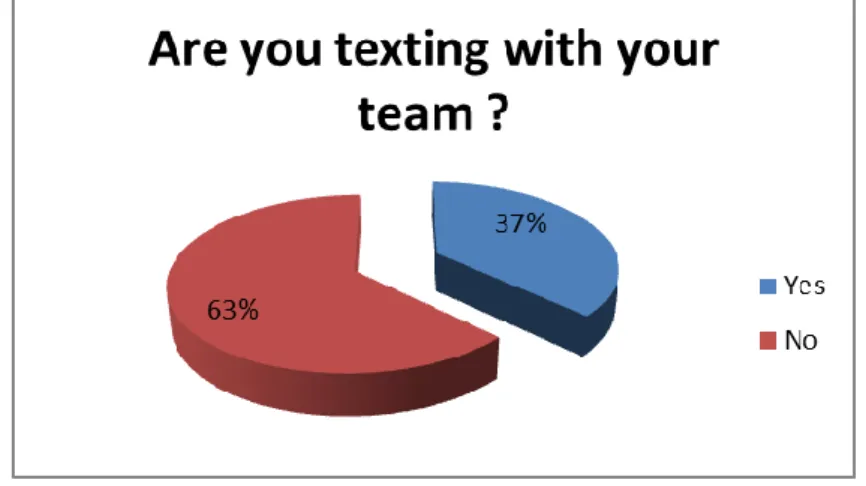
Figure 1: Are you texting with your team? (Survey November 2011)
37% are texting with their teams (figure 1) to advice on contingency (33.33%), to give appointment (22.22%), to inform on their presence or absence (18.52%), to sort out easy problems (18.52%) and to share updated information (11.11%). Business phones are used less frequently (11.11%) than personal are (14.81%). There is some indiscriminate use of mobile phones and professionals to 11.11% of responses. Finally, this mode of communication is privileged when the person is out of the facility (29.63%), it should be noted, however, an indiscriminate use between the outside and the facility to 7.41% of the responses and use in the facility but out of the office for the same response rate.
4
http://crieurspublics.blogspot.com
5 @knitandb : https://twitter.com/#!/knitandb 6
Raphaëlle Bats, février 2012
Figure 2: Are you using Facebook with your team? (Survey November 2011).
No library director or university library director uses Facebook to communicate with his team (figure 2).
Figure 3: Are you tweeting with your team? (Survey November 2011)
Only one director of university library uses Twitter to inform his/her team about the unexpected, to sort out easy problems and finally to share updated information (figure 3). However, he/she does not use it to give appointment or to give notice of his/her presence or absence. He/she uses either professional or personal tools for twittering (telephones, computers, tablets). Finally, this medium is used both inside and outside the institution.
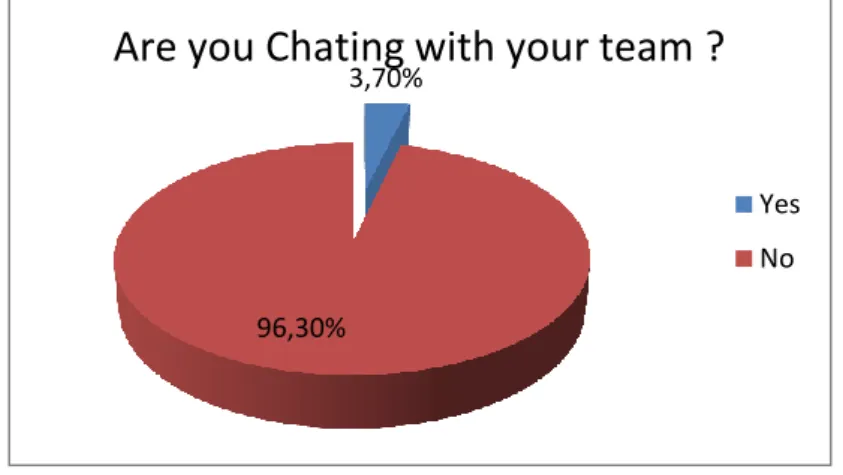
Figure 4 : Are you chatting with your team? (Survey November 2011) 0
100%
Yes No
Are you using Facebook for internal
3,70%
96,30%
Yes No
Are you Tweeting with your team ?
3,70%
96,30%
Yes No
Raphaëlle Bats, février 2012
appointments, to give notice of his/her presence or absence, sort out easy problems (figure 4). However he/she does not use it for updating. He/she uses only this chat when in the facility but outside his/her office and uses only without distinction computers or tablets either professional or personal. However, he/she does not chat via his/her phone.
IV : Discussion
Given these initial results, we conclude easily that our university libraries are far from being Organizations 2.0. The importance of using texting shows that the problem is not relying in the use of a nomadic and fast media but in the use of media that can be considered Web 2.0. These media being no longer new and getting started being easy, the know-how to use them is widespread. The reason of their low use is to be looked else- where. The rise and fall of some medias can explain a refusal to get involved. On the other hand, for some people, these tools are not that serious and are much more characterizing a trend, rather an adolescent
communication. Such a feeling is hardly compatible with the seriousness expected of an internal
communication. Finally, these media seems to require availability that the directors do not feel compatible with their responsibilities. The publicity of Medias 2.0 can also be an issue for the involvement in that kind of communication and the question of the “privassionnal” (private-professionnal) line has to be questioned. But foremost, maybe the main obstacle to these tools is their participative and collaborative aspects. In the study by Pan 2011, on the use of a blog in internal communication, the authors note how the leadership is not to be taken by the one with the official rank of director but by the one who has the skills at hand to deal with the current task. “Since they possessed equal rank and complementary roles, they created a shared leadership
environment where each librarian shifted between leader and follower based on the circumstances and required expertizes” (Pan et al. 2011, p.348). The top-down model of internal communication that emphasizes
the constructivist aspect manipulation and control of employees and in which the workplace is not a place of dialogue and exchange, must evolve (Morillon 2007). The 2.0 media could play the role of internal
communication and push micro-business communities, towards a model animated with the aim of recreating a corporate culture. “The contemporary thought considers corporate culture is built from the experience,
knowledge and ways of thinking developed and shared socially. It consists mainly of micro cultures that are strengthened within groups of employees. These are forms of social relations and informal modes of behavior which are dynamic and have unique characteristics.” (Massiera 2007, p 9)7. The Web 2.0 media gave us possibility to be internal community managers. But it is true that the management team requires taking decisions. Is there not then a risk of confusion between the direction given by an expert (leadership) and decision chosen by the official direction (management)? Maybe the solution is in a hybrid governance, part of top-down management, part of basis management. Medias 2.0 seem to offer us the opportunity of such a hybridity which the first step to a library 2.0. (CEFRIO 2011).
Conclusion
Our investigation is far from being over and we must finish processing the information on the felt about these tools, compare this with the use of these tools in external communication and finally launch the second survey of university libraries’ management team. The form will be fairly symmetrical as above but modified in some methodological points: first, the number of incomplete responses will be limited with clearer headings, then useful information to know the sample will be request: place, discipline, size of library and of the managed team and finally, some items will be distinguished to be treated more easily. In conclusion, we hope to present next year the continuation of this work and to propose the modified survey to other countries to establish a European map of our libraries as organizations 2.0 or not.
7
Raphaëlle Bats, février 2012
References
CEFRIO (2011). Livre blanc sur les nouveaux usages du Web 2.0 dans les organisations. From
http://www.cefrio.qc.ca/publications/detail-dune-publication/publication/5240/45/
Latzko-Toth, G. (2010). Le chat est-il (encore) un média interactif? tic&société, Vol. 4, n° 1. From
http://ticetsociete.revues.org/751
Massiera, B. (2007). Culture d’entreprise, l’échec d’un concept. Communication, Vol. 25/2. From
http://communication.revues.org/index885.html.
Morillon, L. (2007). Nomadisme du modèle marketing, quelle appropriation dans les recherches actions en communication organisationnelle ? Communication et organisation, 31, (pp.214-227).
Pan, D., Bradbeer, G. & Jurries, E. (2011). From communication to collaboration: blogging to troubleshoot e-resources. Electronic Library, The, 29(3), (pp.344-353).