HAL Id: dumas-00417278
https://dumas.ccsd.cnrs.fr/dumas-00417278
Submitted on 15 Sep 2009
HAL is a multi-disciplinary open access archive for the deposit and dissemination of sci-entific research documents, whether they are pub-lished or not. The documents may come from teaching and research institutions in France or
L’archive ouverte pluridisciplinaire HAL, est destinée au dépôt et à la diffusion de documents scientifiques de niveau recherche, publiés ou non, émanant des établissements d’enseignement et de recherche français ou étrangers, des laboratoires
Frédéric Breton
To cite this version:
Frédéric Breton. Optimisation de l’utilisation du personnel roulant. Gestion et management. 2005. �dumas-00417278�
I
I
N
N
T
T
E
E
R
R
N
N
S
S
H
H
I
I
P
P
R
R
E
E
P
P
O
O
R
R
T
T
O
O
p
p
t
t
i
i
m
m
i
i
z
z
a
a
t
t
i
i
o
o
n
n
o
o
f
f
t
t
h
h
e
e
P
P
a
a
s
s
s
s
e
e
n
n
g
g
e
e
r
r
C
C
r
r
e
e
w
w
U
U
t
t
i
i
l
l
i
i
z
z
a
a
t
t
i
i
o
o
n
n
M
M
a
a
s
s
s
s
a
a
c
c
h
h
u
u
s
s
e
e
t
t
t
t
s
s
B
B
a
a
y
y
C
C
o
o
m
m
m
m
u
u
t
t
e
e
r
r
R
R
a
a
i
i
l
l
r
r
o
o
a
a
d
d
C
C
o
o
m
m
p
p
a
a
n
n
y
y
Master Professionnel 2
èmeannée Transports Urbains et Régionaux
de Personnes
Universite Lumiere Lyon 2,
Faculte de Sciences Economiques et de Gestio
Université Lumière Lyon 2, Ecole Nationale
[Entitled of Diploma]
Master Degree Diploma in Urban and Regional Passenger Transport Studies
[ Supervision by authorities ]
- Université Lumière Lyon 2
- Ecole Nationale des Travaux Publics de l'Etat (ENTPE)
[ Title ]
Optimization of the Passenger Crew Utilization for MBCR
[ Subtitle ] [ Author ]
Frederic BRETON
[Members of the Jury (name and affiliation)]
Bruno FAIVRE D’ARCIER – Master TURP Patrick BONNEL – Master TURP
Elie TAMBOU – Internship advisor
[ Place of training ]
Massachussetts Bay Commuter Railroad Company
10 High Street, 3rd floor
MA 02110, Boston, USA
[ Summary ]
In 2003, the MBTA called for tenders to contract out management of the Boston suburban train network to a private company. The MCBR was chosen to manage and operate the Boston commuter rail system for 5 years. As a large railroad transportation company, MBCR constantly strives for profitability while offering superior commuter rail services its customers. In this regard, the improvement of the crew management is one of the motivations of MBCR in order to find less costly and more responsive solutions to the network’s operations. Designed to respond to this intention of optimizing the crew utilization, this report will aim on the development of a new train crew management system for the commuter rail service, and will also detail various analysis focused on the absenteeism, the vacation systems and the Extra Boards.
[ Key Words ] Crew Scheduling Crew Rostering Vehicle cycling Cost efficiency Distribution statement : - Paper : yes - Electronic : yes Declassification date : 10/01/2006 [Publication date] 10/01/2005 [Nb of pages] 90 [Bibliography] 11
[Intitulé du diplôme]
Master Professionnel Transports Urbains et Régionaux de Personnes (TURP)
[Tutelles]
- Université Lumière Lyon 2
- Ecole Nationale des Travaux Publics de l'Etat (ENTPE)
[Titre]
Optimisation de l’utilisation du personnel roulant.
[Sous-titre] [Auteur]
Frédéric BRETON
[Membres du Jury (nom et affiliation)]
Bruno FAIVRE D’ARCIER – Responsable Master TURP Patrick BONNEL – Responsable Master TURP
Elie TAMBOU – Maître de stage
[Nom et adresse du lieu du stage]
Massachussetts Bay Commuter Railroad Company
10 High Street, 3rd floor
MA 02110, Boston, USA
[Résumé]
Au terme d’un appel d’offre lancé par le MBTA, la MBCR a remporté en juillet 2003 l’exploitation du réseau de trains de banlieue de Boston pour une durée de 5 ans. L’exploitation de ce réseau, précédemment opérée par AMTRACK, n’a jamais fait l’objet d’études d’optimisation des coûts d’exploitation et d’utilisation du personnel roulant. C’est dans cette optique d’optimisation que ce stage trouve sa source, et ce à travers différentes études interconnectées. L’étude principale concerne l’optimisation de l’utilisation du personnel roulant existant et se traduit par la production d’un nouvel habillage pour toutes les catégories de personnel roulant, c’est à dire l’élaboration de nouveaux services et de nouveaux roulements. Les études secondaires se traduisent par des analyses sur l’absentéisme, les vacances et enfin les listes supplémentaires.
[Mots clés] Habillage Graphicage Optimisation des coûts d’exploitation Diffusion : - papier : oui - électronique : oui Confidentiel jusqu'au : 01/10/2006 [Date de publication] 01/10/2005 [Nombre de pages] 90 [Bibliographie (nombre)] 11
FICHE BIBLIOGRAPHIQUE
First I want to express my deep gratitude to Mr. Olivier BROUSSE, Chief Executive for CONNEX North America, for giving me this opportunity to work at the Massachusetts Bay Commuter Railroad Company. This was a very unique experience and a wonderful first step towards a career goal working in the passenger transportation industry. I especially would like to thank Ms. Lauren MANNING and Ms. Kali RECTOR from CONNEX N.A. for their help and support in all the various administrative processes prior and during my internship.
I want to deeply thank Ms. Gillian WOOD, Chief of Passenger Operations for MBCR, for her remarkable supervision of my training. Her kindness and her availability have been a great help during all my work here. I also want to sincerely thank Mr. Elie TAMBOU, who has been my internship advisor and my biggest assistance during all those months working here. I wouldn’t have been able to achieve my training goals without his availability, his precious advices, his great knowledge of the railroad operations and of course his friendship.
The achievement of the MBCR crew scheduling project has only been possible with the constant help and support of the following persons to whom I would like to express my sincere gratitude: Michael O’MALLEY, Manager of Operations Planning; William RAE, Senior Trainmaster; Harold HOFMAN, Director of Manpower Utilization; George BULLERWELL, Assistant Manager of Crew Utilization; John SANTAMARIA, Manager of Transportation. I also want to thank all the persons from MBCR that were always here to respond to my questions and to help me on occasional issues.
Finally, I want to express my thanks and my friendliness towards all the staff from the Customer Service Department and the Revenue Accounting Department for providing me with a really friendly and enjoyable working environment during all those months. This has been a really pleasant time working around those persons.
Naturally I couldn’t complete those acknowledgements without thanking Mr. Bruno FAIVRE D’ARCIER and Mr. Patrick BONNEL, the persons in charge of the Master’s degree in Urban and Regional Passenger Transportation at the University of Lyon II, for the quality of the training they provide that allows students starting in the passenger transportation industry with a solid background, but also for their availability, their support and their help not only during this internship but also all over the past year.
PUBLICATION DATA FORM ... 1
FICHE BIBLIOGRAPHIQUE ... 2
ACKNOWLEDGMENT ... 3
SUMMARY ... 4
INTRODUCTION ... 5
PART 1: CONTEXT, PROBLEMS & OBJECTIVES ... 6
PART 2: CREW SCHEDULING AND CREW ROSTERING ... 20
PART 3: ABSENTEEISM AND VACATION ANALYSIS... 57
PART 4: EXTRA BOARD ANALYSIS... 74
PART 5: LIMITS OF THE RESULTS & FURTHER WORK ... 82
CONCLUSION... 83
REFERENCES ... 84
TABLE OF CONTENTS ... 85
TABLE OF FIGURES ... 88
In 2003, for the first time in the history of the United States, the Massachusetts Bay Transportation Authority (MBTA) called for tenders to contract out management of the Boston suburban train network to a private company. The Massachusetts Bay Commuter Railroad Company (MCBR), which is 60%-owned by CONNEX North America, was chosen by the MBTA to manage and operate the Boston commuter rail system.
As a large railroad transportation company, MBCR constantly strives for profitability while offering superior commuter rail services to more than 140,000 daily customers in the Boston metropolitan area. In this regard, the improvement of the crew management is one of the motivations of MBCR in order to find less costly and more responsive solutions to the network’s operations. Indeed, an effective utilization of the staff greatly improves a railroad transit operation's reactivity and service quality, keep costs down, and can improve both customers and employees satisfaction.
Designed to respond to this intention of optimizing the crew utilization, this report will aim on the development of a new train crew management system for the commuter rail service in order to improve crew efficiencies. This study will include the development of new runs for the passenger crew, part known as the crew scheduling, as well as the development of new rosters and new equipment cycles. After a complete analyze of the current train crew management system and the identification of all the related problems, we will explain in detail the process of the crew scheduling and rostering, from the various constraints arising from operational rules and work regulations to the costs forecasting and the impact on the human resources.
In addition to the crew scheduling project, this report will also detailed two other studies, one focused on the absenteeism, and the other on the Extra Boards that are the sets of employees that cover the vacant assignments. The absenteeism analysis will consist in giving an overview of the absenteeism over a long period of time in order to allow efficient and accurate forecasting. The Extra Board analysis will investigate the current absenteeism coverage capacity, try to determine the real needs of MBCR in terms of workforce for the Extra Board and eventually perform the costs forecasting. Those two studies will be the basis of the two main parts following the crew scheduling chapter. This report can be considered in its totality both as an overview of the current network’s situation, but also as a set of proposals aiming at answering to a global problematic of optimization. It will investigate new possibilities in different issues such as train crew management and absenteeism management. Every proposition presents itself with its background, its detailed description (for which the reader will likely refer to the annex report), the analysis of its consequences on the operations and the costs forecasting.
This chapter will first introduce the Boston area and its mass transit system, with a particular effort in describing the commuter railroad network. After this part aimed at depicting the context of the study, we will focuse on the various problems in order to understand why MBCR is willing to improve the train crew efficiency. This will eventually lead us to detail the different objectives arising from this problematic.
I.
Context of the Study: the Boston area and its mass transit system.
1. Quick facts about Boston. Figure 1: Aerial view of Boston
Boston is the capital of Massachusetts and the biggest city in the state, with a population of 589,000 (census year 2000) and 2,850,000 in its greater metropolitan area (source Veolia Environnement).
Boston is one of the oldest cities in the United States and is associated with all the major liberal causes in American history: the revolution, independence, abolition of slavery and emancipation of women.
Boston was the most influential city in New England, and, more importantly, the historic capital of the United States.
At the same time, Boston is a typical city that has been rejuvenated by becoming the country's No. 2 business center, after New York. It is also a port and major university city (Boston University, Harvard, MIT and Clark). As many as half a million of the 3 million people living in the metropolitan area are students.
2. About the “T”: The Chronicle of the Boston Transit System.
While Boston is the birthplace of American liberty, it is also the birthplace of American mass transportation. The first public transportation services in Boston date back to the beginning of the 17th century and the ferry boats linking downtown Boston, which is located on a peninsula, to the mainland.
Since then, the network of services has grown steadily (the nation's first subway, the Green Line, under Boston Common between Park street and Boylston was inaugurated in 1897) and now comprises various modes of transport, including trams, trolley buses, boats, subways, trains and buses.
In the early 1960s, urban planners set up the Massachusetts Bay Transportation Authority (MBTA), a public body responsible for unifying, modernizing and operating the existing network in a bid to halt the expansion of automobile traffic. Today, the MBTA service
PART 1: CONTEXT, PROBLEMS & OBJECTIVES
district extends over almost 2,700 km2 and includes 175 cities and towns with a total of 2,600,000 inhabitants. (source Veolia Environnement)
Table 1: “T” Ridership by mode in 2004
The system contains a total of 186 routes including 4 Subways lines, 162 Bus and Trolley lines, 13 Commuter Rail lines and 4 Ferry lines. Approximately 792,600 one-way passenger trips are taken on the “T” every day. The ridership numbers below show the number of passengers boarding each of the lines on a typical weekday. Note that the total number of passengers boarding is greater than the total number of passenger trips, since many people transfer between lines to make a complete trip. The table also shows that the subway boardings represent more than 50% of the total boardings, with 30% for the bus and 12% for the rail.
Figure 2: MBTA Logo
Figure 3: Map of the subway lines
Ridership by
mode/line Daily Boardings
Red Line 210,500
Green Line 204,800
Orange Line 154,400
Blue Line 55,600
Silver Line Washington Street 14,100 Mattapan Trolley 7,800
MBTA Bus 356,400
MBTA Trackless trolleybus 11,900
Contracted bus 4,400
Commuter Rail 143,100
Water Transportation 4,700 The RIDE (paratransit) 5,300
Total Passenger Boardings 1,173,000
Figure 2: MBTA Logo
Figure 3: Map of the Subway lines Source: MBTA Table 1: “T” Ridership by mode in 2004
3. The Boston commuter railroad network.
In 2003, for the first time in the history of the United States, the MBTA called for tenders to contract out management of the Boston suburban train network to a private company. Previously the network had been operated by AMTRAK.
This was a remarkable initiative because it demonstrated the local authorities' determination to break free from Amtrak's grip in order to find less costly and more responsive solutions to their needs.
3.1. MBCR, a new company to operate the Boston railroad system.
The Massachusetts Bay Commuter Railroad Company (MCBR) is the result of a partnership among three leading transportation companies. It is 60%-owned by CONNEX North America, 20%-owned by the Canadian train manufacturer BOMBARDIER and 20%-owned by the Boston-based transportation firm ALTERNATE CONCEPT, INC. It was chosen by the MBTA to manage and operate the Boston
commuter rail system, effective July 1st, 2003.
The contract between MBCR and the MBTA, which is worth $1 billion, runs for five years. It does not require any investment by the operator. Aside from network operation, it encompasses:
• maintenance of the infrastructure, stations and rolling stock;
• creation of a dedicated passenger service centre for the suburban network;
• development of training programs for staff;
• inspection of the equipment and the development of investment programs for
network modernization;
• development of new management and payroll IT systems.
The mission of MBCR is to work in full cooperation with the MBTA to provide superior commuter rail services for the Boston metropolitan area. Its goal is to operate a safe and reliable service that exceeds expectations every day.
3.2. Key facts and figures about one of the largest suburban train network. The MBCR commuter rail network has grown over the years because of infrastructure improvements, population growth and job creation in the region. Today it has 13 lines, 125 stations and almost 700 km of track served by 466 trains per day. This is the fifth largest network in the United States behind the three New York region networks (Long Island, Metro North and New Jersey) and the Chicago network.
3.2.1. Thirteen lines that connect Boston to its metropolitan area. The Boston Commuter Rail network comprises two “independent” networks, known as Northside and Southside.
The North Side, which is the smallest one, has 5 lines heading to North Station, linking the north part of the greater metropolitan area to the north of the Boston Downtown peninsulia. The North Station is located on the green and orange subway lines, for a quick access to the business center and the financial district. Starting from North Station, those 5 lines, served by 187 trains every day, connect to 55 stations up to 80 Kilometers away from Boston.
The South Side has 8 lines heading to South Station, linking the south part of the greater metropolitan area to the south of the peninsulia, with a direct access to the financial district and the business center. South Station, which is part of the city's architectural heritage, has 13 platforms and connections to the red line, the silver line and the bus network. Starting from South Station, those 8 lines, served by 279 trains every day, connect to 68 stations up to 70 Kilometers away from Boston.
Figure 4: Map of the commuter rail lines
The transport system provides very good connections between the commuter rail lines and the subway lines (see figures 3 and 4). Actually, the red line connects with 4 stations from two different commuter lines as well as South Station. The orange line connects with 4 stations from 6 differents lines (including Back Bay station which is common to 5 South side lines), as well as North Station, so as the green line does. This allows for the rail commuters a quick transfer toward every parts of the city.
The tables below summarize the following information for each line of both North and South sides, which are going to be usefull for the next part of the study:
¾ the length of the line in kilometers;
¾ the average riding time of a trip between the two terminal stations; ¾ the departure time from the terminal station of the first inbound train; ¾ the departure time from North or South Stations for the last outbound train; ¾ the number of daily trains serving on the line.
Table 2: Northside lines characteristics in 2005
North Side Lines Line Length (Km) Time (min) Riding Inbound First Outbound Last of Trains Number Rockport 56.8 70 5:05 AM 12:10 AM 26
Newburyport 44.3 65 5:27 AM 10:40 PM 38
Haverhill 52.6 65 5:31 AM 11:59 PM 46
Lowell 40.8 45 5:35 AM 11:59 PM 42
Fitchburg 79.2 85 5:45 AM 12:10 AM 35 Table 3: Southside lines characteristics in 2005
South Side Lines Line Length (Km) Time (min) Riding Inbound First Outbound Last of Trains Number Attleboro 69.4 65 5:25 AM 11:59 PM 35 Stoughton 30.1 35 6:28 AM 11:00 PM 38 Framingham/Worcester 70.9 80 6:06 AM 11:25 PM 41 Needham 21.9 40 6:10 AM 10:30 PM 32 Franklin 49.3 60 5:15 AM 11:50 PM 37 Fairmount 14.6 20 6:00 AM 9:40 PM 40 Middleborough/Lakeville 57.0 55 5:25 AM 10:30 PM 24 Plymouth/Kingston 57.0 55 5:30 AM 10:40 PM 32
3.2.2. A significant daily ridership.
With a network extending up to 175 municipalities, the Commuter Railraod Company provides its service to more than 140,000 passengers each weekday. The main part of the ridership is using the trains on a daily basis for a job-related commute.
Based on the number of one-way passenger trips on page 7, we can estimate that the part of the “T” users riding a Commuter Rail train is 18%, which is a good result for a suburban train network.
Table 2: Northside lines characteristics in 2005 – source MBCR
Table 4: Ridership of the commuter rail lines in 2004
North Side Lines Daily Boarding
Rockport 7,800
Newburyport 10,800
Haverhill 10,900
Lowell 11,100
Fitchburg 9,000
South Side Lines Daily Boarding
Attleboro/Stoughton 28,100 Framingham/Worcester 18,800 Needham 9,200 Franklin 15,200 Fairmount 2,400 Middleborough/Lakeville 9,800 Plymouth/Kingston 10,000 Total Commuter Rail: 143,100
Clearly, the ridership is more homogeneous on the North side, whereas the ridership distribution on the South side is more disparate, with some really cohesive lines and smaller ones like the Fairmount line (AKA the Readville shuttle).
3.2.3. More than 1700 employees dedicated to the good functioning of the network.
MBCR has 1,764 employees working to provide passenger superior commuter rail
services (source HR Department, 08/25/05). We call passenger crew the employees working on board the trains. They represents less than a third of the total staff, with around 500 passenger engineers and passenger trainmen, including the conductors and the assistant conductors (or AC’s). Therefore we can deduce that the engineering, maintenance, and all other departments represent a significant part of the total human resource of MBCR.
The passenger engineers are driving the trains, while the passenger trainmen are verifying the validity of the tickets (by paying a small additional charge, passengers can buy their tickets on board) but also help to look after the safety of passengers and manage the opening and closing of train doors. We will call Road Crew the team composed of one engineer and one conductor. On average, three MBCR agents are on board each train to assist passengers.
Figure 5: MBCR passenger crew
Table 4: Ridership of the commuter rail lines in 2004
Source: www.mbta.com
The exact figures on August 25th for the passenger crew resources are 151 passenger Engineers and 319 passenger Trainmen (source Crew Dispatching Department).
3.2.4. The rolling stock and the facilities.
MBCR operates a total of 56 locomotives, primarily including F40s, GP40s and a few GP9s all running with diesel. On the South side, the passenger travel in 213 cars, many of which have two levels, hauled by 33 locomotives. On the North side, the passenger travel in 122 cars, all of which are single level, hauled by 23 locomotives. All the cars are accessible for disabled passengers, and bicycles are welcome during off-peak hours. (source MBCR)
Figure 6: MBCR locomotive
MBCR handles the maintenance of all the network's equipment at a site comprising several workshops that are able to house entire trains for major overhauls, repairs, repainting and cleaning of cars and locomotives.
The trains are stocked overnight in various facilities usually located close to each of the terminal stations. The following tables detail the location and the capacity in terms of trains’ storage of each yard and facility.
North Side Facilities Storage capacity
BET (Boston Engine Terminal) 7
Rockport Facility 4
Newburyport Facility 4
Bradford Facility 4
Fitchburg Facility 4
South Side Facilities Storage capacity
South Station + Southampton yard 10
Readville yard (day only) 8
East Junction Facility 4
Franklin Facility 3
Worcester Facility 4
Needham Heights Facility 3
Kingston Facility 4
Middleborough Facility 4
Table 5: Storage capacity of the MBCR facilities
Figure 6: MBCR locomotive
Table 5: Storage capacity of the MBCR facilities Source: MBCR
II.
A network with a heritage that limits profitability.
MBCR was chosen in July 2003 by the MBTA to manage and operate the Boston commuter rail system for five years, in a $1 billion worth contract. This network was previously operated by AMTRAK.
In its answer to the RFP (Request For Proposal), CONNEX built Crew Runs for engineers, conductors and assistant conductors of both South and North sides that have never been implemented. Those RFP crew runs were built with a management approach that would improve the productivity of the passenger crew and the cost efficiency of the network operations.
This chapter will describe in detail the different drawbacks of the current network’s operations so that we will be able to identify where the potential savings are and what can be possibly done to improve the productivity and the cost efficiency.
1. Overview of the sides of the operations that could be improved.
One of the MBTA’s motivation to call for tenders was to find less costly solutions for the network’s operation. In fact the previous operator AMTRAK have never been using any optimization tools to find a cost-effective solution that responds to the passengers, the employees and the MBTA’s needs. Today, as the RFP runs have never been implemented, MBCR is still operating the network using the previous Amtrak’s runs and rosters. The current crew runs are therefore really old and the related costs are a really important amount that MBCR is willing to reduce.
This part is meant to give an overview of the different issues related to the utilization of the old runs and rosters and aims to quantify the global cost they generate. Note that all the following tables have been built using the results of the work on the crew scheduling project detailed in the next part of this report.
¾ High overtime level: whereas the conventional daily working time is 8 hours, most of the runs actually last a lot more. Reducing the overtime is a critical issue for MBCR as the extra hours are payed at 150% of the regular rate.
Average overtime per run
Road Crew
Southside Northside
Weekdays Run 1:55 1:21
Saturday Run 1:54 1:39
Sunday Run 1:08 1:13
Weekly Scheduled Overtime 516:50 289:35
This table demonstrates that the total weekly amount of scheduled overtime over the whole network is superior to 800 hours. This figure represents the overtime of only one of the Road Crew category, which means there are more than 800 hours of weekly overtime for engineers and for conductors. The overtime associated to the assistant conductors also needs to be taken into account, as well as the unscheduled overtime resulting from any delays or problems encountered on daily service operations
The table below shows the weekly cost of the overtime for each category of employee,
based on the new rates effective July 1st 2005. The overtime hourly rates are equal to
$44.85 for the engineers, $37.74 for the conductors and $32.48 for the AC’s (source Payroll Department).
Weekly cost of overtime Southside Northside Engineers $ 23,180 $ 12,810 Conductors $ 19,505 $ 10,780 Assistant Conductors $ 8,200 $ 5,605
Total Cost of Overtime $ 50,885 $ 29,195
Table 7: Weekly cost of overtime
The total weekly cost of scheduled overtime for the whole network is superior to $80,000, which represents an extra cost of more than $6,500,000 per year. We therefore understand that reducing the overtime is critical to MBCR as this is where the main potential savings can come from.
¾ Reduced productivity-efficiency: it results from two different types of runs. The first type of non efficient run is the run shorter than 8 hours. In fact, given the labor union agreement, each working day has to be paid 8 hours, even though the run lasts less than 8 hours. This leads to pay some employees some hours during which they are actually not working.
Southside Northside Road Crew
# runs < 8 Hours Average length # runs < 8 Hours Average length
Weekdays Run 2 (4%) 6:27 2 (6%) 7:08 Saturday Run 2 (10%) 7:05 2 (12%) 7:12 Sunday Run 5 (26%) 6:48 3 (20%) 7:29
Weekly total non
productive hours 23:20 11:50
Table 8: Overview of the runs comprising non productive hours
From those figures, we can estimate the total cost that MBCR is paying for hours that are not actually worked. Summing the cost relative to the engineers and the cost relative to the conductors of both sides, the total cost for non productive hours exceeds $100,000 a year. It does not take into account the cost for AC’s non productive hours, which is
estimated at $45,000 per year. The regular hourly rates used for this cost forecasting are equal to $29.90 for the engineers, $25.16 for the conductors and $21.65 for the AC’s (source Payroll Department).
The second type of non effective run is a run comprising an extended break between two trains (typically between 1 and 2 hours), during which the employee is being paid at full rate. This phenomenon is hard to quantify, but can be reduced by modifying the trains’ arrangement within the runs, or by introducing a release between the trains when the interval is long enough.
¾ Hours of service (HOS): this term signifies that the employee is being given a rest day paid 8 hours because his previous runs actually exceeds the legal working time, consequence of a possible delay or problem during his service.
Three types of runs can lead to HOS:
- Straight runs that are too close to 12 hours in spread: given the Unions agreements, a run with a spread longer than 12 hours is supposed to include a release of 4 hours minimum. If the run happens to exceed 12 hours because of any type of delay, the employee is being given an 8 hours pay rest day.
- Split runs that are too close to 16 hours in spread: if the run happens to exceed 16 hours because of any type of delay, the employee is being given a rest paid day. Indeed this doesn’t allow the employee to have 8 hours of rest between two services, which is the minimum legal time.
- Split runs with a release too close to 4 hours: given the Union agreements, a run with a spread longer than 12 hours is supposed to include a release of 4 hours minimum. If the first part of the service experiences any delay so that the release would become shorter than 4 hours, the employee wouldn’t be able to do the second part of his service and go home early with the pay of his assignment.
The table below summarizes the average number of weekly HOS for passenger engineers and trainmen, calculated over 30 weeks from December 2004 to July 2005 (source Absenteeism analysis – see annex S23, S24, N22 and N23). The cost calculation is based on an 8 hours pay day, assuming that half of the trainmen’s HOS are associated with the conductors and the other half is due to the AC’s. The regular hourly rates used for this calculation are mentioned page 14.
Average number of HOS per week Southside Northside
Engineer 4.5 1.4
Trainmen 5.1 3.1
Annual Cost $ 105,630 $ 47,600
This table highlights that the estimated cost of Hours of Service exceeds $150,000 per year. It could be reduced by having runs less close to the legal working time limits.
¾ No standardization of the various empty moves: some differences can be noticed for the current runs regarding the time allocated to each empty moves (or passenger extra – PX) between the stations and the facilities, or also regarding the time allocated to walk between the facility and the station. Although those differences are usually small (< 5 minutes), it is important to have a standardization of the time of those moves.
¾ Insufficient number of employees for the Extra Board: the number of employees in the Extra Boards (for both sides and each category of employees) is not sufficient enough to cover all the daily absenteeism. The consequence is that
Extra Board employees can be called to make some 6th and 7th days, which are
both paid at 150% of the full rate. In the case the Extra Board employees can’t
cover all the 6th and 7th days, regular employees can be called too and will also be
paid at 150% of the full rate.
The average weekly costs relative to the 6th and 7th days are summarized in the table
below. Those costs have been calculated as the average of the weekly grand totals of
the 6th and 7th days’ costs over 31 weeks from the 1st week of January 2005 to the 1st
week of August 2005 included (source Payroll Department). Weekly cost of 6th and 7th days
Southside Northside Engineer $ 4,500 $ 3,090
Trainmen $ 7,835 $ 5,185
Total weekly cost $ 12,335 $ 8,275
Table 10: Weekly grand total of 6th and 7th days
The cost induced by the insufficiency of Extra Board employees is significant as it represents around $640,000 per year for the Southside and $430,000 per year for the Northside, that is to say more than $1,000,000 per year for the whole network. Having a more consequent Extra Board could help to significantly reduce this annual cost (the days would still have to be paid, but at a normal rate).
¾ Inadequate utilization of the Assistant Conductors: the number of Assistant Conductors in each train depends on the number of passengers in the train, and on the number of cars open to service (see page 43-44). Currently, given the last passenger counts (April 2005 for peak hours trains and September 2004 for all other trains) and the number of cars open, many trains are overstaffed, while a few are understaffed and thus are not compliant with the labor agreement and/or the MBTA agreement.
The table below summarizes the number of trains overstaffed and understaffed with AC’s for both South and North Sides on the weekday trains (see annex S14 and N13).
Overstaffing Understaffing
Southside 148 53% 5 2%
Northside 53 28% 0 0%
Table 11: Overview of the current AC’s staffing
This table proves that the number of overstaffed train is really important as more than one weekday train out of two is overstaffed on the Southside, and almost one out of three on the Northside. In comparison the understaffing is almost negligible but is nevertheless problematic as it goes against the agreements.
¾ Poor absenteeism overview: the absenteeism problem, besides the fact that the Extra Board is to short, resides in a lack of a global overview. There is a weekly overview but no follow-up to have an annual overview which would allow a better knowledge of the absences’ level and therefore allow accurate and efficient forecasting.
¾ Historical vacation system: the number of days of vacation is based on the seniority, and all the vacation weeks have to be taken within a 6 month spread. This is problematic for MBCR as a great number of employees are on vacation at the same time, therefore leading to a lack of crew and an increase of the operation costs.
2. The means of action to overcome those problems.
High overtime level, low productivity efficiency, and hours of service issues can each be attenuated by reworking the runs and the rosters for the Road Crew. This process is called crew scheduling and crew rostering, and will be the main topic of the next part. This basically consists in efficiently use the existing crew to staff trains, in compliance to various constraints from the labor union contracts to the federal regulations, but also operational rules and worker’s preferences.
We can also rework the runs and rosters for the AC’s, so as to reduce the overstaffing and to be in compliance with the labor agreement and the MBTA agreement for the trains that are currently understaffed.
We might also have to rework the equipment cycles, also called vehicle schedules, that haven’t been modified for years and may be now be a little obsolete.
Regarding the insufficiency in terms of human resource for the Extra Boards, MBCR may want to hire some new employees. A cross analysis between the absenteeism study, the vacation study and the crew scheduling study can be the opportunity to estimate the real needs and then the number of required employees.
3. Importance of an effective crew management in the railroad.
An effective management of rail crew is a core capability all railroads require. The trend of industry deregulation and restructuring is increasing the requirement for all aspects of a railroad’s operation to be more and more competitive and efficient. A railroad must have the crew management systems and processes in place that allow to:
¾ efficiently use crew to staff trains;
¾ plan crew operations quickly and efficiently; ¾ minimize crew related train disruptions;
¾ provide a fair and equitable work environment for crew; ¾ monitor and manage crew fatigue and safety;
¾ respond quickly to train and crew changes; ¾ efficiently manage rail crew.
Crew scheduling and crew rostering are two of the major tasks involved in managing large transportation networks. These important tasks are concerned with the development of duty schedules for crew to cover a given timetable in a transportation system.
Crew scheduling and rostering are complex problems. They are often large, with many staff to accommodate. Moreover, practical instances of crew scheduling and rostering applications involve many hard constraints arising from operational rules and different work regulations that need to be taken into account. Also soft constraints linked to workers’ preferences in accordance with social and family life are involved.
The main objective of the crew scheduling and rostering is to minimize the overall roster cost accrued from using the available crew while providing the required number of crew for each train trip in the schedule. This improvement of cost efficiency can be achieved while utilizing human resources more effectively, in a way that however satisfies the employees’ personal preferences.
To sum up, an effective utilization of the staff greatly improves a railroad transit operation's reactivity and service quality, keep costs down, and can improve both customers and employees satisfaction. We can therefore understand the will of MBCR to break free of Amtrak’s historic runs and rosters and to explore new possibilities for its crew scheduling.
III.
Definition of the objectives.
The main objectives of this internship will naturally come from all that have been said previously, in order to try to respond efficiently to MBCR’s expectation to provide superior commuter rail services at optimized cost, in a way that will satisfy the customers as well as the employees and the MBTA.
¾ Crew scheduling and crew rostering project:
As described previously, the crew scheduling and the crew rostering are two of the major tasks involved in a cost-effective railroad crew management. Therefore this project is the primary objective of this internship and will be the main topic of the next part of this report. This will include:
- Standardization of the different moves;
- Building new Road Crew runs for Northside and Southside, using 2003 RFP crew runs proposal as a starting point, for weekdays, Saturdays and Sundays, in compliance with all the constraints;
- Building new rosters for Engineers and Conductors of Northside and Southside, based on the new runs’ proposal;
- Reworking the equipment cycles to be compliant with the new Road Crew runs’ proposal;
- Building new runs for Assistant Conductors of Northside and Southside in compliance with the agreements based on the most recent passenger counts, for weekdays, Saturdays and Sundays;
- Building new rosters for Assistant Conductors of Northside and Southside, based on the new runs’ proposal;
- Costs forecasting, estimating the potential savings.
¾ Absenteeism and vacation analysis:
The absenteeism analysis will consist in building a working sheet that will provide an overview of the absenteeism over a long period of time (typically 1 year), in a format that will be efficient and accurate. This should obviously allow separate and accurate analysis of each type of absence, for each day of the week.
The vacation analysis will consist in investigating two different scenarios including the possibility of spreading the vacations’ weeks over one year, instead of 6 months currently.
¾ Extra Board analysis:
Synthesizing the two previous objectives’ results, we will investigate the real needs of MBCR in terms of workforce for the Extra Board. This will be done for the current network situation as well as for the hypothetical situation, should the new runs and rosters be implemented. A cost forecasting will be performed for each case.
We saw in the first part of this report that one of the main issues regarding the optimization of the utilization of the passenger crew was the crew scheduling and rostering. Obviously a suitable crew scheduling allows utilizing the manpower resources more effectively and improves cost efficiency. This part will describe in detail the whole process of building new runs and rosters for the MBCR passenger crew, from the main principles of the crew scheduling to the very results and the potential savings that can be expected from the proposals.
I.
Generalities on Crew Scheduling and Crew Rostering.
1. The process of the production of services.
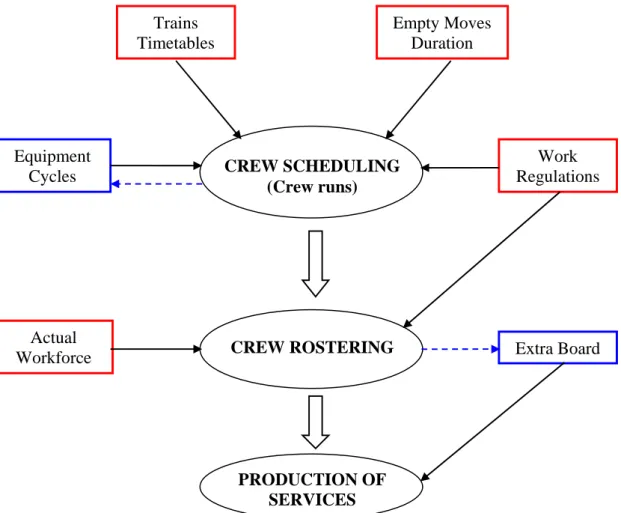
The following diagram describes the global aspects of the production of services process, identifying every parameter that have to be taken into account. We have to note that most of those parameters are actually constraints that cannot be modified (Boxes in red), whereas the boxes in blue are parameters that can eventually be modified.
Figure 7: Diagram of the production of services process
PART 2: CREW SCHEDULING AND CREW ROSTERING
Actual Workforce Trains Timetables Empty Moves Duration Equipment Cycles Work Regulations Extra Board CREW SCHEDULING (Crew runs) PRODUCTION OF SERVICES CREW ROSTERING
This diagram gives a global overview of the general process of the MBCR crew scheduling and rostering that will have to be followed. We have to emphasize the fact that we are starting from an already operating network, with existing timetables, existing equipment cycles et cetera. If we had to start from the very beginning, the regular process would be to start building the equipment cycles (also known as vehicle schedules) and the timetables given the lines’ book of specifications, and from then build the crew runs and rosters. In our specific case, the equipment cycles can be modified in consequence of new crew schedules.
This diagram highlights that there are 3 major constraints for the crew scheduling, which are the trains timetables, the empty moves duration, and the work regulations (including Federal laws and Unions agreements).
Regarding the crew rostering, the major constraint will be the work regulations (and implied “quality of life” standards), as well as the actual workforce as we will have to utilize the existing resources to cover the runs.
2. The three major aspects of a crew scheduling project.
Before going in the details of the constraints and of the methodology, it seems important to have in mind the three major aspects of a Crew Scheduling project.
Figure 8: Diagram of the crew scheduling aspects ECONOMIC
9 Minimizing the costs 9 Improving the productivity 9 Reducing the number of runs 9 Improving the crew management SOCIAL
9 Comply with the Federal labor laws 9 Comply with the Labor Union agreements 9 Being careful about the company’s traditions 9 Being careful about the employees’ well-being
9 Covering all trains to carry customers from point A to point B 9 Punctuality and Reliability
9 Comfort and Security COMMERCIAL
CREW SCHEDULING
Therefore, solving a Crew Scheduling problem will suppose to find a balance between those three aspects in order to find a solution that will satisfy the customers (commercial aspect), the employees (social aspect) and the employer (economic aspect).
II.
Road Crew scheduling: new runs and rosters for engineers and
conductors.
We will start the study of the crew scheduling project with the Road Crew scheduling (we remind that we call Road Crew the association of one passenger engineer and one passenger conductor). Precisely the Road Crew runs are the most important runs as they are the ones that have to cover all the trains with no exceptions. In this chapter we will first describe the functioning of the network’s operations, the various specific constraints, the methodology of building the runs and the rosters and finally the results and the potential savings that ensue.
1. How the network operates.
Before beginning the description of the specific constraints linked to the Road Crew, it seems important to have a global overview of how passenger operations are run on the network.
A train crew (AKA Road Crew) is composed of one passenger engineer, who is driving the train, and one passenger conductor, who verifies the validity of the tickets but also helps to look after the safety of passengers and manages the opening and closing of train doors. One or more additional conductors (the AC’s) can assist the passenger conductor in his duty. One passenger engineer’s run is strictly identical to his associated conductor’s run, meaning we will only have to build one set of runs which will be common to both of them.
In addition to the passenger services (or passenger trains), the Road Crew may have to cover some empty moves (AKA “Passenger Extra” or “PX”) between the different facilities and stations. This is especially true for the early and late runs. Indeed the Road Crew will have to move each locomotive from the facility where it was stored during the night to the station where it will make its first passenger service. Similarly, the Road Crew will have to bring the equipment to its assigned facility when the vehicle “duty” (e.g. all the passenger services than one vehicle has to do as described in the equipment cycle) is done. Whereas a Road Crew starting its duty in one location must absolutely finish its duty at the exact same location, the equipment may ends at another facility depending on the equipement cycle.
In addition to the empty moves between the facilities and the stations at the beginning and at the end of each vehicle runs, Road Crews may have to bring trainsets to the yard during off-peak hours. In fact every single equipment need to be taken to the yard for maintenance, cleaning, and especially fueling as all the locomotives run with Diesel.
There are two yards on the South side, Southampton and Readville, and one on the Northside, Boston Engine Terminal (BET), each of those comprising special tracks for maintenance, cleaning and fueling. The moves to the yards all start from North or South Station (and vice-versa the moves from the yards all head towards those two stations). They can also be operated by the so-called “House Engineers”. Operating those empty moves between the station and the yard is the only duty of the House Engineer, so that most of Road Crews can focus on operating the passenger trains.
The last thing that must be mentionned is the fact that a Road Crew can go from the yard to the station in an equipment operated by another Road Crew. This is called a deadhead move (whereas in the usual transportation language “deadhead” means any kind of empty move, deadheading for MBCR will only refer to a crew moving in a train operated by another crew) and is usefull to bring a crew to the station at a precise time when no other equipment than the one already assigned the other crew is leaving the yard.
All those specifications will have to be taken into account during the development of the runs. Except the empty moves, the runs of the Road Crew will consist in operating the passenger services, which usually go as a pair, meaning one outbound followed by one inbound. Also a run can be straight or split, with a release between the two parts of the run. A release can only takes place in North or South Station or in one of the three yards.
2. The road crew scheduling, a highly constrained problem.
The crew scheduling optimization problem is to assign crew to scheduled trains over a time period, so that the crew cost is minimum and the schedule honors many operational and contractual requirements. This problem is highly constrained due to various labor union agreements and federal labor laws, but also operational rules and workers’ preferences. This chapter will describe in details the various constraints that will have to be taken into account for the development of every single run.
2.1. Five main constraints. ¾ Covering all trains:
The addition of all the runs must cover all the trains with no exception (passenger services as well as PX moves). This can sound like a commonplace but this is however the biggest constraint.
¾ Runs start and end at the same facilities:
As said previously every run must start and end at the same facility. Here again no exception is allowed. The minimum number of runs starting from each facility depends on the capacity of the facility (see table 5).
¾ Compliance with the Federal Labor laws:
Congress enacted the Hours of Service Act in 1907 to enhance railroad safety by limiting the number of hours that railroad engineers and other railroad employees can work. Locomotive engineers and other transportation employees can work a maximum of 12 consecutive hours followed by at least 8 hours off duty.
¾ Compliance with the Union Labor agreement:
In addition to the Federal Labor laws, the Unions agreements determine the other limitation in terms of working time. The maximum spread of one run cannot exceed 16 hours, followed by at least 8 hours off duty. Any run whose spread exceeds 12 hours must comprise at least a 4 hours release. The minimum release time is assessed at 1:10 hours. A release starts 20 minutes after the last train arrival and ends 30 minutes before the next train departure, which is the time estimated in the agreement to assist the passengers in going in or out and to prepare the train.
¾ Compliance with the empty moves duration:
Every PX move is a fully part of the run and therefore the time to make this move has to be taken into account for the determination of the sign up (SU) and sign out (SO) times. The difference between SO and SU gives the working time of the run. If a crew is deadheading an empty move, it will sign up 10 minutes later than the regular SU time if the train is leaving the facility, and sign out 10 minutes earlier than the regular SO time if the train is coming back to the facility.
The five constraints above are non negotiable and therefore determine the basis to which we will have to subjugate during the development of the runs.
2.2. Finding the balance between the three aspects.
As described previously, solving a crew scheduling problem suppose to find a balance between the social, economic and commercial aspects in order to find a solution that will satisfy the customers, the employees and the employer. The following points will therefore detail the constraints that result from the choices that have been made by several MBCR’s departments of operation.
¾ Balance between economic and social aspects:
We need to find a balance between the productivity and the well-being of the employees. The runs have to be built in a way that allows each employee to have a sufficient break time to eat, have a cup of coffee or go to the restrooms for instance. We came to the conclusion that each run must comprise one break at North or South Station of at least 30 minutes. The employees’ well-being will also have a non negligible impact on the commercial aspect, as they will be in better conditions to provide customers a superior service.
Another balance has to be found between the costs’ minimization and the company’s traditions. Regarding the release, even though the minimum agreed time is 1:10 hour, the Amtrak’s runs used not to have any release shorter than 1:40 hour. We came to the conclusion that it would be better to maintain this usage so as not to get the Unions’ disapproval on this matter.
Finally, we need to find a balance between the crew management and the federal and unions labor regulations. In reality we wish that the reworked runs would prevent, or at least reduce, the Hours of Service. It has been decided that a 20 minutes security gap should be introduced to preventively absorb any potential delay that could lead to a HOS. Practically this means:
9 No straight run longer than 11:40 hours;
9 No release shorter than 4:20 hours if the spread exceeds 12 hours; 9 No split run with a spread longer than 15:40 hours.
¾ Balance between economic and commercial aspects:
One of the biggest issues in the development of the runs concerns the way how the arrangement of the trains can be made. In fact the Unions agreements don’t specify any legal time to respect between two trains. This interval must be determined as a balance between the economic point of view and the commercial point of view.
On one hand, the pursuit of productivity tends to shorten this time, whereas the commercial aspirations take advantage of a longer interval. Effectively, if it happens to be a delay and that the interval between the two trains is too short, there will be a repercussion on the next train’s departure which will eventually be delayed. This goes against the commitment of MBCR to provide its customers a punctual and reliable service. Similarly, having too shorts intervals may urge the engineers to drive too fast, decreasing both the comfort and the security of the ride.
But operation issues are also involved in the determination of this minimum interval. The main one is the brake test which is performed for every train before it leaves its originating station. For instance, before any train departs from South or North Station, the engineer must apply and release the brakes, and a car inspector at the other end of the train must insure that the brakes applied and released on the rear end of the train. Similarly, when the train gets to its final destination and is then scheduled to return to Boston, the engineer must again apply and release the brakes, and a Conductor or Assistant Conductor stationed at the rear of the train must insure that the brakes have
applied and released on the rear end of the train. Other constraints that require some
interval of time include the need for the Conductor to walk through every coach of the train to make sure that all of the passengers have exited the train, and time for the engineer and/or the conductor to contact the dispatcher to receive any messages or special instructions for the train.
As a balance between productivity and reliability, we came to the following conclusion: 9 Minimum interval of 15 minutes during peak hours;
9 Minimum interval of 12 minutes during off-peak hours.
When this is the same equipment, meaning that the crew doesn’t have to go to another track to operate another train but remains in the same train, the minimum interval is determined by the timetables and the equipment cycles and is currently 9 minutes. This hasn’t been modified.
Those various constraints are more arbitrary than the five previously mentioned, nevertheless the runs will have to be in complete compliance with them to be found workable and acceptable by the Unions.
2.3. Three additional constraints.
There are three more constraints that need to be mentioned, however those are not as restricting as the ones above as we can modify the equipment cycles in consequence of the choices we make for the runs.
¾ Runs in compliance with the Yards capacity:
This constraint is specific to the South side. There are 33 equipments that all need to go to on of the two yards during the off-peak hours. Among those 33 trains, at least 7 need to go to the yard of Readville and the rest to the yard of Southampton. Given the current House Engineer staff, at least 5 out of the 7 release trips to Readville must be operated by the Road Crew. Each of those empty moves (way-in and way-back) last 1:30 hour in average, which create important constraints as it represents more than 3 hours of PX moves within the run. While building the runs, we may need to send equipments to Readville that previously had their release in Southampton (and vice-versa), which leads to modify the equipment cycle in consequence.
¾ Runs in compliance with the House Engineers staff:
We must ensure that the new runs provide approximately the same amount of “Road Crew operated” empty moves between the Stations and the Yards (or vice-versa) than currently so as to be sure that the current House Engineer staff will still be able to operate all the others empty moves. Actually it is interesting in terms of cost efficiency to let the House Engineers take care of those operations, while giving a release to the Road Crew at North or South Station. This basically represents a gain of working time of one hour. However it is not in our interest to build runs that would require more House Engineers to operate those empty moves, so the idea is basically to have as many “Road Crew operated” empty moves than currently. We must always have this constraint in mind while building the runs, however we can still make some little modifications to the equipment cycles if we encounter any problem.
¾ Runs start and end at the same location:
This constraint is close to the one mentioned previously, however it only concerns the runs starting from Southampton for the Southside or BET for the Northside. As contrary to the runs starting from the other facilities where trains going out in the morning and coming back in the night are well established (depending mainly on the timetables), trainsets going to the yards or coming back from the yards only depend on the equipment cycles. After building the runs in terms of trains’ arrangement, we need to figure out a trainset that will bring the crew to the station at the beginning of the run and vice-versa an equipment that will bring the crew back to the yard at the end of the run. This may lead to some conflicts with the equipment cycles when no equipment is supposed to make the expected move at the expected moment. This can be solved by making very small modifications to the equipment cycles.
3. The methodological approach of building the Road Crew runs.
The first step was to determine what the field of action was. We came to the conclusion that the crew scheduling project would focus on the passenger crew only and that it was not necessary to modify the other services (House Engineers, Terminal Switchers, Wash Crew, Fuel Crew, etc.).
It was decided that the project would start with the work on the weekday runs for the Southside Road Crew so as to assimilate all the problems, constraints and specifications. This was kind of a training that would allow me to be more independent for the further steps of the work, as many people were involved to help me learn fast. This step, besides the comprehension of the problems and constraints, was also the opportunity to build some effective printout format and documents for schedules and rosters that would be used all along the project.
After this step, the process was a logical one consisting in reworking the weekend runs then the roster for the Southside; then the same work was performed on the Northside (weekday runs then weekend runs then rosters). Eventually the same process would start again for the Assistant Conductors of South and North sides.
We are going to focus on the details of the methodology for the work on the Southside, all the further work basically following the same process:
¾ Meeting and discussion with persons from different department of operations: « Director of Manpower Utilization », « Assistant Manager of Crew Utilization », « Senior Trainmaster », « Manager of Transportation », « Manager of Operations Planning ». Iterative exchange of information with all the persons above to identify the constraints and the problems, learn the functioning of the network. ¾ Study of the existing runs: empty moves duration, current intervals, usual SU and
SO times, House Engineers moves, et cetera. This important step gives a first idea of what must be done and how it can be done.
¾ Using 2003 RFP runs as a starting point, creation of effective excel working sheets for the runs description with a printout format (see annex S4 and N3). This document includes for each run: description of the trains’ arrangement (with for each train its departure and arrival time) including every PX or deadhead moves, name of the facility where the run starts and ends, SU and SO times, working time, spread time, overtime and release time.
¾ Investigating the RFP crew runs feasibility: identification of the problems (e.g. identification of every thing that do not comply with the constraints), verifying that all the trains are covered.
¾ Building by hand new weekday runs using 2003 RFP runs as a starting point that comply with all the constraints. Working in parallel on the equipment cycle to make it workable with the new runs.
¾ 1-Verification of the workability of the new runs by the different departments of operations. 2- Modifications that reflect the comments received. Succession of steps 1 and 2 until complete validation of the runs.
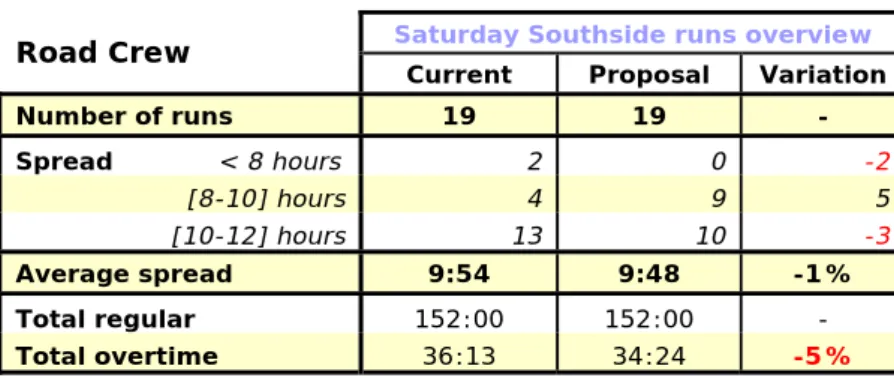
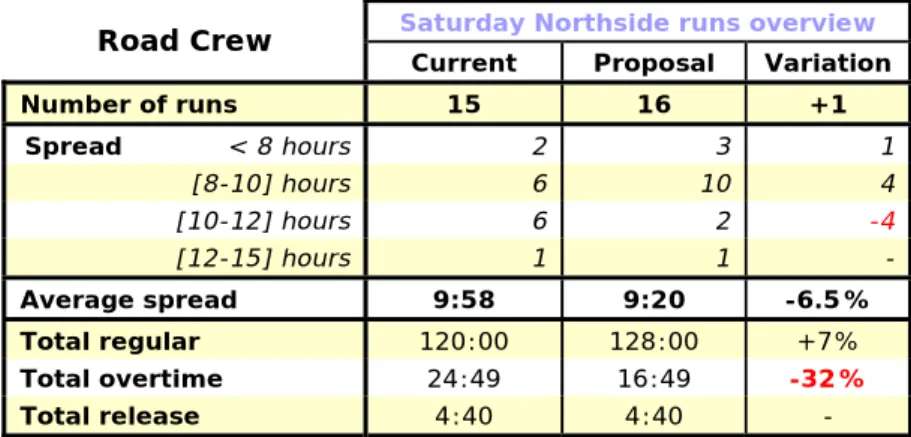
¾ Building by hand new runs for Saturdays and Sundays. There are no RFP crew runs for the weekend, so the process basically consists in building the current weekend runs on the excel document and then modify them to find a better solution. Working in parallel on the equipment cycles to make it workable with the new runs.
¾ 1-Verification of the workability of the new weekend runs by the different department of operations. 2- Modifications that reflect the comments received. Succession of steps 1 and 2 until complete validation of the runs.
¾ Creation of effective excel working sheet to build the rosters for Engineers and Conductors using the new weekday and weekend runs and perform the cost calculation at the same time. Validation of the roster by the Crew Dispatching department.
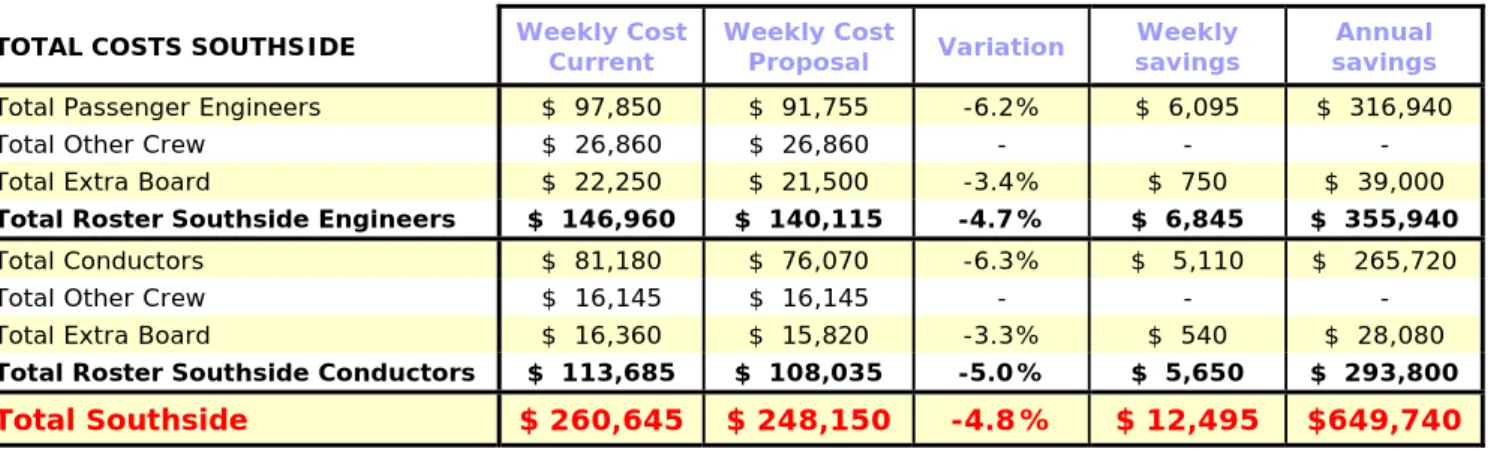
¾ Performing the costs analysis.
4. Results of the Road Crew scheduling project.
4.1. New road crew runs.
9 Generalities on the run’s construction:
In order to be in compliance with the facilities capacity, the number of runs starting from each facility and the number of runs ending in each facility must be at least equal to their capacity detailed on table 5.
For the estimation of the SU and SO times, the empty moves duration detailed in annex S3 for the Southside and N2 for the Northside will be used. They are calculated as the average of the time allocated for the same moves in the current runs. From now the SU time of each run is calculated as the first run’s train departure time minus the empty move
duration, according to the run’s starting location. Similarly the addition of the last run’s train arrival time and the empty move duration will give the SO time.
Ultimately, all the trains have to be covered by the runs in compliance with all the constraints detailed previously.
9 The RFP crew runs:
As said previously, those documents built by CONNEX in 2003 as an answer for the call for tenders will serve as a starting point of this work. Those documents include a complete set of crew runs and a complete set of equipment cycles for Southside and Northside. They were built with a management approach that would create the opportunity to either provide the existing service with fewer resources or provide more service for the same level of crewing effort.
The governing principles of the approach to managing these important service assets were the following (source 2003 MBCR Transportation Plan, section 9.2 page 10):
- Accurate scheduling and forecasting;
- Improvements in the productivity of both the crews and the trainsets; - Compliance with assignments, contract requirement and customer needs.
9 Saturday and Sunday runs:
As detailed in the methodology, the weekend’s runs must satisfy to the same criterions than the weekday’s runs, the main difference relying in the fact that there were no RFP crew runs to start from.
The Saturday’s runs and the Sunday’s runs will be built independently as the number of trains to cover may vary between those two days.
Finally, it was decided that the run type (straight or split) had to be identical to the current one, in order to avoid a possible Union’s disapproval on that matter. This means that if none of the runs of one set has a release, the proposed set must comprises only straight runs. On the other hand if some runs are currently split, we can build runs with a release.
4.1.1. New Road Crew runs for the Southside.
¾ Weekday’s runs:
The Southside weekday’s runs will have to cover every of the 279 daily passenger trains as well as one empty train for equipment’s protection purpose.
RFP feasibility investigation:
The set of RFP crew runs (see annex S4) comprises 46 runs, against 48 currently, with a potential economic saving of 6.8% (source 2003 MBCR Transportation Plan, section 9.2