HAL Id: hal-01245789
https://hal.archives-ouvertes.fr/hal-01245789
Submitted on 11 Feb 2016
HAL is a multi-disciplinary open access
archive for the deposit and dissemination of
sci-entific research documents, whether they are
pub-lished or not. The documents may come from
teaching and research institutions in France or
abroad, or from public or private research centers.
L’archive ouverte pluridisciplinaire HAL, est
destinée au dépôt et à la diffusion de documents
scientifiques de niveau recherche, publiés ou non,
émanant des établissements d’enseignement et de
recherche français ou étrangers, des laboratoires
publics ou privés.
Finely tunable 1.55 µm emitting VeCSELs for embedded
and compact optical and microwave systems
Salvatore Pes, Cyril Paranthoen, Christophe Levallois, Nicolas Chevalier,
Hervé Folliot, Mehdi Alouini
To cite this version:
Salvatore Pes, Cyril Paranthoen, Christophe Levallois, Nicolas Chevalier, Hervé Folliot, et al.. Finely
tunable 1.55 µm emitting VeCSELs for embedded and compact optical and microwave systems. 3rd
European Workshop on VeCSELs (VeCSEL 2015), IES - Institut d’Electronique et des Systèmes
(Université de Montpellier), Nov 2015, Montpellier, France. pp.23. �hal-01245789�
Finely tunable 1.55 µm emitting VeCSELs for embedded and compact optical
and microwave systems
S. Pes1,2*, C. Paranthoën1, C. Levallois1, N. Chevalier1, H. Folliot1 and M. Alouini2
1. FOTON UMR CNRS 6082, INSA de Rennes, 35708 Rennes, France
2. Institut de Physique UMR UR1-CNRS 6251, Université de Rennes 1, 35708 Rennes, France * [email protected]
Compact wavelength-tunable laser sources are important for the development of optical based system units which can be used for numerous applications, ranging from optical communications, optical sensors, and even microwave photonics and high resolution spectroscopy. In most cases, large mode-hop-free wavelength tuning is of high interests to increase system performances and versatilities. In the metrology area, a small but very accurate wavelength tuning is required to fulfill system requirements. Thanks to their long cavity, VeCSELs offer the opportunity to get small laser wavelength linewidth, and shot noise limited behavior (class-A lasers).
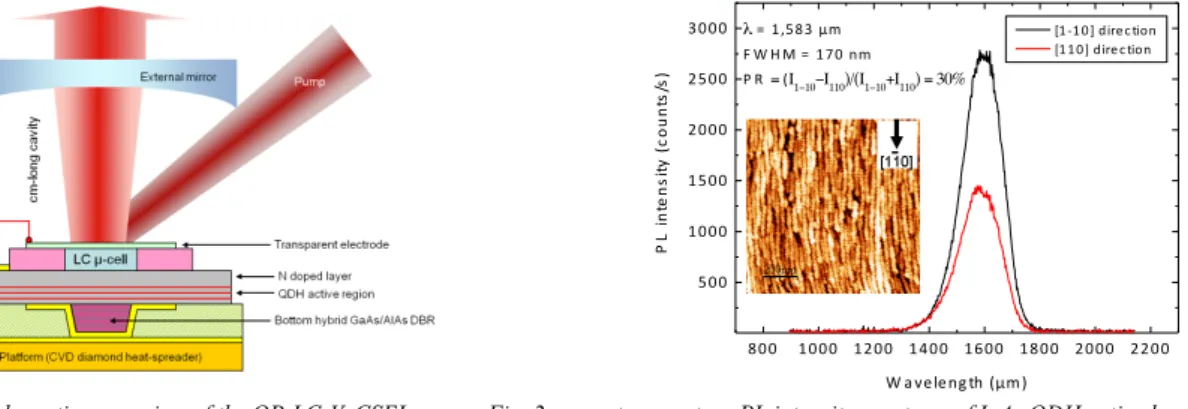
In this work we summarize the objectives and the preliminary results of the ANR Astrid HYPOCAMP project (HYbrid Polarisation controlled and mOnolithic tunable vertical Cavity surface emitting lAsers, for eMbedded and comPact optical and microwave systems), which is lead by FOTON in partnership with IPR (Rennes), CNRS-LAAS (Toulouse), CNRS-LPN (Marcoussis) and Telecom Bretagne. The project aims to develop a compact, reliable and low cost monolithic and versatile technology for the realization of tunable V(e)CSEL lasers, emitting in the 1.55 µm range (InP-based technology). In Fig.1 the optically-pumped external-cavity version of the device is presented.
Emphasis is placed on the tunability performances of the device, which is based on the insertion of a nematic liquid crystal (LC) µ-cell within the semiconductor VeCSEL cavity [1]. To efficiently exploit the wide tuning wavelength range along the extraordinary axis of the nematic LC, control and stable linear state-of-polarisation is required. It can be easily achieved by integrating InAs quantum dashes (QDH) active region on (001)-oriented InP. Thanks to the their elongated shape (inset of Fig. 2), QDH inherently present a well defined state of polarization along the [1-10] crystallographic direction with polarization ratios (PR) as high as 30% and OPSR of about 30 dB [2,3], which offers the opportunity to avoid any complex cavity design and benefit from a process-free approach. The polarization properties, in combination with the wide band gain [4] and the improved temperature behavior of QDH, can be successfully exploited to realize the final device. Such QDH nanostructured active region can be combined with a high thermally performing GaAs/AlAs hybrid bottom Distributed Bragg Reflector, and eventually integrated on a CVD-diamond heat-spreader platform to realize a 1/2-VCSEL cavity after a flip-chip bonding process. This 1/2-VCSEL chip can be placed in a cm-long external cavity for basic and advanced optical
characterizations (Pout, threshold, laser linewidth, polarization and noise behavior).
Fig. 1: Schematic cross view of the OP-LC-VeCSEL. Fig. 2: room temperature PL intensity spectrum of InAs QDH active layer (AFM
image of a QDH monolayer in inset).
Acknowledgments: This work was supported by French agencies ANR (Agence Nationale de la Recherche) and DGA (Direction Générale de l'Armement) within the ANR Astrid HYPOCAMP project (Grant n° ANR-14-ASTR-0007-01).
References:
[1] Castany et al., Applied Physics Letters, 98, 161105 (2011) [2] Lamy et al., Applied Physics Letters, 95, 011117 (2009) [3] Gauthier et al., Optics Express, 20, 16832–16837 (2012)
[4] Taleb et al., Photonics Technology Letters, vol. 25(21), 2126-2128 (2013)
800 1000 1200 1400 1600 1800 2000 2200 500 1000 1500 2000 2500 3000 λ = 1,583 µm F W H M = 170 nm P R = (Ι1−10−Ι110)/(Ι1−10+Ι110) = 30% PL in te ns ity ( co un ts /s ) W a veleng th (µm) [1-‐10] direction [110] direction