UNIVERSITY OF LIEGE LABORATORY OF ANALYTICAL CHEMISTRY
FACULTY OF MEDECINE Professor Ph. HUBERT
DEPARTMENT OF PHARMACY
CHU, Tour 4, Avenue de l’Hôpital 1, B-4000 Liège
Tel: +32(0)4 366.43.16 - Fax : +32(0)4 366.43.17 - E-mail : [email protected]
Use of tolerance intervals in the development of near infrared
spectroscopic methods: An innovative way to select the most
appropriate calibration model
E. Ziemons1, J. Mantanus1, E. Rozet1, P. Lebrun1, R. Klinkerberg2, B. Streel2, B. Evrard3, F. Moonen4, Ph. Hubert1
1 Laboratory of Analytical Chemistry, CIRM, University of Liège, Avenue de l’Hôpital 1, 4000 Liège, Belgium,
2 Galéphar Research Center M/F, Rue du Parc Industriel 39, 6900 Marche en Famenne, Belgium. 3 Laboratory of Pharmaceutical Technology, CIRM, University of Liège, Avenue de l’Hôpital 1, 4000 Liège,
Belgium.
4 Arlenda Laboratory Solution, Avenue de l’Hôpital 1, 4000 Liège, Belgium.
Keywords: Near infrared spectroscopy, calibration model, tolerance intervals, desirability index, decision rule.
1 Introduction
FDA’s Process Analytical Technology (PAT) aims at “improving the pharmaceutical development, manufacturing and quality assurance through innovation in product and process development, process analysis and process control” [1]. Regarding its non-invasive, non-destructive character and fast data acquisition, near infrared spectroscopy is more and more integrated in the PAT system. However, the implementation of NIR quantitative method is performed using an iterative heuristic approach that will ultimately build a model allowing the prediction of the compound of interest according to the product specifications [2].
In this context, an innovative approach based on the tolerance intervals and desirability indexes was developed to select the most appropriate predictive model from models plurality instead of using conventional criteria devoid of objective decision rules such as R2, RMSEC, RMSECV and RMSEP [3-4].
2 Material and methods
Pilot and industrial batches of pharmaceutical pellets were manufactured by a pharmaceutical industry. Samples were analysed by reflexion mode using a multipurpose analyzer Fourier transform near infrared spectrometer (MPA, Bruker Optics, Ettlingen, Germany). As reference method, a HPLC method was used to determine the amount of active pharmaceutical ingredient (API) in the samples.
Variability sources such as production campaigns, batches and operators were introduced in
the calibration and validation sets. Partial least square (PLS) regression on the calibration set
was performed to build calibration models of which the ability to quantify accurately was
tested with the validation set. Regarding the product specifications, the acceptance limits were
set at 5% for the API determination.
UNIVERSITY OF LIEGE LABORATORY OF ANALYTICAL CHEMISTRY
FACULTY OF MEDECINE Professor Ph. HUBERT
DEPARTMENT OF PHARMACY
CHU, Tour 4, Avenue de l’Hôpital 1, B-4000 Liège
Tel: +32(0)4 366.43.16 - Fax : +32(0)4 366.43.17 - E-mail : [email protected]
3 Results and discussion
Figure 1 – Desirability indexes of a calibration model according to the number of PLS latent variables.
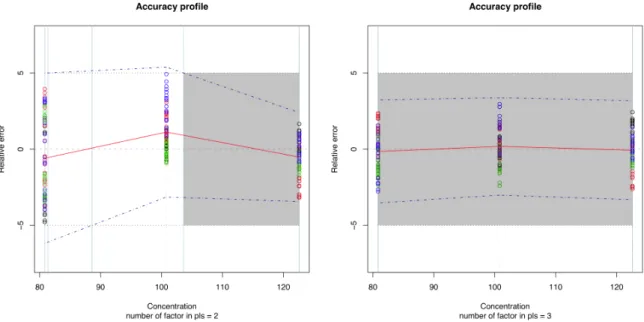
Figure 2 – Accuracy profiles of a calibration model according to the number of PLS latent variables: a) 2 PLS latent variables (left), b) 3 PLS latent variables (right).
UNIVERSITY OF LIEGE LABORATORY OF ANALYTICAL CHEMISTRY
FACULTY OF MEDECINE Professor Ph. HUBERT
DEPARTMENT OF PHARMACY
CHU, Tour 4, Avenue de l’Hôpital 1, B-4000 Liège
Tel: +32(0)4 366.43.16 - Fax : +32(0)4 366.43.17 - E-mail : [email protected]
As can be seen on Figure 1, the Fitting Model Index (FMI) reaches a plate after 3 PLS latent variables. Regarding the Figure 2, only predictive model using 3 PLS latent variables meets the product specifications.
4 Conclusion
The innovative approach can be applied on the development of a NIR quantitative method, which requires a time-consuming reference method and an iterative heuristic approach, to build a model allowing the prediction of the compound of interest according to the product specification.
This new approach, which increases significantly the objectivity of the decision process, allows to reduce dramatically the development and validation steps and thus could ease the implementation of NIR spectroscopy in pharmaceutical industry.
5 References
[1] United States Food and Drug Administration (FDA): Guidance for Industry PAT – A Framework for innovative Pharmaceutical Development, Manufacturing, and Quality Assurance, 2004.
[2] Hubert Ph., Nguyen J.-J., Boulanger B., Chapuzet E., Chiap P., Cohen N., Compagnon P.-A., Dewé W., Feinberg M., Lallier M., Laurentie M., Mercier N., Muzard G., Nivet C & Valat L. Harmonization of strategies for the validation of quantitative analytical procedures: A SFSTP proposal-part I. J. Pharm. Biomed. Anal. 36, 579-586, 2007.
[3] Rozet E., Wascotte V., Lecouturier N., Préat V., Dewé W., Boulanger B., Hubert Ph. Improvement of the decision efficiency of the accuracy profile by means of a desirability function for the analytical validation: Application to a diacetylmonoxime colorimetric assay used for the determination of urea in transdermal iontophoretic extracts. Ana. Chim. Acta 591, 239-247, 2007. [4] Ginot Y.-M., Bernard-Moulin P., Cinier R., Despagne F., Dubost J.P., Françès L., Le Bihan M., Le
Page M., Michelet A., Meunier L., Monteillet G., Quintana A., Rieutord A., Storme I., Thenevot F. & Ziemons E. Quantitative analysis using near infrared spectroscopy, Application to tablet content uniformity, I. Methodology. STP Pharm. Prat. 20, 117-135, 2010.