L I F E S C I E N C E S
Bonobos engage in joint commitment
Raphaela Heesen1*, Adrian Bangerter1, Klaus Zuberbühler2,3, Federico Rossano4, Katia Iglesias5,
Jean-Pascal Guéry6, Emilie Genty1
Joint action is central to human nature, enabling collectives to achieve goals otherwise unreachable by individuals. It is enabled by humans’ capacity to understand and engage in joint commitments. Joint commitments are evidenced when partners in interrupted joint actions reengage one another. To date, there is no clear evidence whether nonhuman animals understand joint commitment, suggesting that only humans experience it. Here, we revisit this claim by interrupting bonobos engaged in social activities. Bonobos reliably resumed the activity, and the likelihood of resumption was higher for social compared to solitary activities. Furthermore, communicative efforts deployed to suspend and resume social activities varied depending on partners’ social relationships and interactive roles. Our results suggest that bonobos, like humans, engage in joint commitment and have some awareness of the social consequences of breaking it.
INTRODUCTION
Cooperative activities are widespread in the animal kingdom. Still, only humans seem to engage in complex joint actions (1) characterized by shared intentionality, a special motivation to share experiences and mental states (2). Shared intentionality relies on advanced cog-nitive abilities like meshing beliefs and intentions with recursive mind reading, cooperative communication, perspective taking, comple-mentarity of roles, mutual help (3), and understanding of joint commitments (1, 4). Joint commitment is the “glue” that holds joint action together (5, 6), enabling collectives to achieve goals other-wise unreachable by individuals. It involves partners’ communica-tive and behavioral efforts to achieve a common goal (3), as well as their understanding of the consequences linked to breaking such commitments (7). In human children, joint commitment is mani-fested when partners whose joint action has been interrupted com-municate before moving to another activity and resume the activity after the interruption (7–10). In conversations, human adults deploy politeness when they are responsible for suspending it, and even more so when they are listeners compared to speakers (11). Suspend-ing an ongoSuspend-ing conversation (e.g., to interact with a third party) threatens the partner’s “face” (12, 13), as they are kept waiting and their time and efforts spent in the activity are being devaluated. Greater impositions (e.g., longer waiting times) and interactions with partners who are unfamiliar or of higher status (12) cause people to use more politeness when suspending or resuming.
To date, there is no clear evidence that animals experience something akin to joint commitment or even understand the consequences of breaking it, which has led to the claim that only humans are capable of shared intentionality (1, 14). This claim is based on experiments in which subjects played triadic games (involving a play object) with a human experimenter who then unexpectedly interrupted the game (15). In one study, human children (12 and 24 months) readily at-tempted to reengage the seemingly reluctant experimenter, while chimpanzees (33 and 51 months) did not (15). In other studies,
however, chimpanzees (12 to 60 months) and bonobos (all age classes) showed some resumption attempts (16, 17). Such inconsistencies across studies may be due to species differences, age effects, or game complexity, while interactions with human experimenters and their artifacts may provide additional motivational complications.
Here, we addressed this issue by testing bonobos’ understanding of joint commitment focusing on natural intraspecies interactions rather than artificial games with human experimenters. We experi-mentally interrupted naturally occurring grooming interactions among conspecifics.
We first tested whether subjects differed in their propensities to resume interrupted joint actions of social grooming (hereafter social activities) compared to solitary activities (self-grooming or solitary play). For interruptions of social activities, we targeted in-terruptions at one or both partners in two experimental conditions. This was instigated by a keeper either calling a subject’s name to provide a food reward (targeted interruption condition) or rapidly opening and closing a sliding door in the main holding area (un-targeted interruption condition). Un(un-targeted interruptions suggested the imminent occurrence of a feeding event beneficial to everyone, which usually interrupts the entire group’s ongoing activities. We designed these two conditions to manipulate the “imposition” that is being made onto one partner versus the dyad, provoking poten-tial variation in individuals’ communicative or behavioral efforts to preserve joint commitment. In the targeted interruption condition, we predicted that an imposition should be more consequential, as the responsibility of suspending the commitment is carried by just one partner, compared to the untargeted interruption condition, where the responsibility is shared. We predicted that, if bonobos have some awareness of joint commitment, they should be (i) more likely to resume an interrupted social activity than a solitary one. In addition, if only one subject is responsible for the suspension (in-stead of both), targets should appease their partners by (ii) being more likely to resume targeted interruptions compared to untarget-ed interruptions and by (iii) being more likely to communicate to suspend and resume the social activity in targeted interruptions compared to untargeted interruptions.
We further assessed whether the relationship between partners would affect their propensity to resume the social activity by inter-rupting dyads of differing social bond and rank difference. In hu-man interactions, being responsible for interrupting the interaction 1Institute of Work and Organizational Psychology, University of Neuchâtel, Neuchâtel,
Switzerland. 2School of Psychology and Neuroscience, University of St. Andrews, Scotland, UK. 3Institute of Biology, University of Neuchâtel, Neuchâtel, Switzerland. 4Cognitive Science Department, University of California, San Diego, San Diego, CA, USA. 5School of Health Sciences, HES-SO University of Applied Sciences and Arts of Western Switzerland, Fribourg, Switzerland. 6Zoological Park La Vallée des Singes, Romagne, France.
*Corresponding author. Email: [email protected]
Copyright © 2020 The Authors, some rights reserved; exclusive licensee American Association for the Advancement of Science. No claim to original U.S. Government Works. Distributed under a Creative Commons Attribution NonCommercial License 4.0 (CC BY-NC). on January 25, 2021 http://advances.sciencemag.org/ Downloaded from
increases the pressure to reduce face threats, depending on the identity of the partner. If bonobos have an understanding of their responsibility in the suspension and completion of the joint action, then we should observe patterns similar to face management in humans (11, 12) with calibration of behavior and communication to the identity of the partner. We predicted that, if bonobos are sen-sitive to something akin to human face threats, then they should be more likely to (iv) resume the activity and to (v) communicate to suspend and resume the social activity when social distance and rank difference between partners increases (12).
In addition, we explored the extent to which bonobos understand their role in the social activity. Role understanding is crucial in managing joint commitment in humans (4) where partners show awareness of who initiated and suspended a joint action and the potential imbalances in time and effort allocated to it (11, 18). To do so, we assessed whether the likelihood of resumption and communication depended on the part-ners’ responsibility in the suspension of the activity (responsible or nonresponsible), their role in initiating the interaction (initiator or receiver), and their grooming role at the moment of suspension (active or passive). We predicted that, if bonobos understand their responsibility in the joint action, then they should be more likely to communicate to suspend and resume the social activity when they are responsible for suspend-ing it (vi), when they are responsible for havsuspend-ing initiated it (vii), or when they are the passive groomee (viii). We also predicted that if partners take their role into account, then they should be more likely to resume the same grooming role they occupied before the interruption (ix).
In a first set of analyses, we compared the likelihood of resump-tion of the social activity with the same partner after interrupresump-tions. First, we compared the likelihood of resumption of interrupted so-cial activities to solitary ones (model 1). Second, we assessed the likelihood of resumption of the social activity depending on the experimental condition (targeted or untargeted interruption), taking into account social distance and rank difference between partners (mod-el 2) and the individuals’ role in the social activity (responsible or non-responsible, initiator or receiver, and active or passive) (model 3).
In a second set of analyses, we assessed the likelihood of commu-nicating to suspend and resume the social activity, depending on the experimental condition (targeted or untargeted interruption), social distance and rank difference between partners (models 4 and 5), and the individuals’ role in the social activity (responsible or nonresponsible, initiator or receiver, and active or passive) (models 6 and 7).
Last, to assess whether bonobos would resume a previous (rather than start a new) social activity, we assumed that they should meet sev-eral criteria: (i) they should resume their activities fairly rapidly, (ii) they
should frequently resume them within a 2-m2 radius of the same location,
(iii) they should engage in no other social activity with a new partner during interruption breaks, and (iv) they should continue grooming where they left off, i.e., by grooming the same body part as before the interruption. If a bonobo simply was in “grooming mood” and in the search to start a new grooming activity, we believe it is likely that they would just start grooming with the next and nearest partner and pos-sibly by grooming whichever body part is most convenient to groom. RESULTS
Likelihood of resumption of social versus solitary activities (model 1)
We conducted 88 interruptions of social activities (n = 39, targeted interruptions; n = 49, untargeted interruptions) and 26 interruptions
of solitary activities (n = 7, targeted interruptions; n = 19, untargeted interruptions). We excluded three cases in which individuals did not interrupt their social grooming activity (n = 2, targeted interruptions;
n = 1, untargeted interruptions). The mean resumption rate of social
activities (averaged across dyads) was 80% after targeted inter-ruptions and 83% after untargeted interinter-ruptions. In contrast to social activities, interruptions of solitary activities resulted in sub-stantially lower mean resumption rates in both conditions (50% versus 66% in targeted and untargeted interruptions, respectively); see Fig. 1A and fig. S3A; b = −1.57, SD = 0.49, 95% credible interval (CrI) (−2.53, −0.63); see table S4 for model details. Across solitary activity types, the average resumption rates of self-grooming (48.1%) and solitary play (52.3%) were very similar.
Likelihood of resumption by experimental condition, social bond, and rank difference (model 2)
Model 2 revealed no substantial relationships between the likelihood of resuming an activity and the experimental condition [b = −0.85, SD = 0.58, 95% CrI (−2.02, 0.26)], social bond strength [b = 0.15, SD = 0.31, 95% CrI (−0.42, 0.78)], or rank difference between partners [b = −0.01, SD = 0.29, 95% CrI (−0.59, 0.57)]; see Fig. 1 (B to D) and fig. S3B. Likelihood of resumption depending on role in social activity (responsible or nonresponsible, receiver or initiator,
and active or passive) (model 3)
In 83% of the trials, individuals responsible for suspending the social activity resumed the same role (active or passive) that they occupied before the interruption. Model 3 revealed a relationship between in-dividual roles in the social activity and resumption and initiation of the social activity and resumption (fig. S3C). Individuals were less likely to resume when they were the passive grooming partner, as compared to when they were the active grooming partner [Fig. 1E;
b = −0.98, SD = 0.45, 95% CrI (−1.91, −0.13)]. Individuals were more
likely to resume when they were initiators than when they were re-ceivers [Fig. 1G; b = 1.16, SD = 0.38, 95% CrI (0.43, 1.92)]. There was no relationship between resumption and being responsible versus nonresponsible for activity suspension [Fig. 1F; b = 0.30, SD = 0.42, 95% CrI (−0.52, 1.11)].
Likelihood of communication about suspension
and resumption by experimental condition, social bond, and rank difference (models 4 and 5)
In models 4 and 5, we compared the likelihood by which individuals who were responsible for suspending or resuming communicated depending on whether they were interrupted in the target versus untargeted interruption conditions, on the social bond they had with their social partner, and on the rank difference relative to that of their partner (table S4).
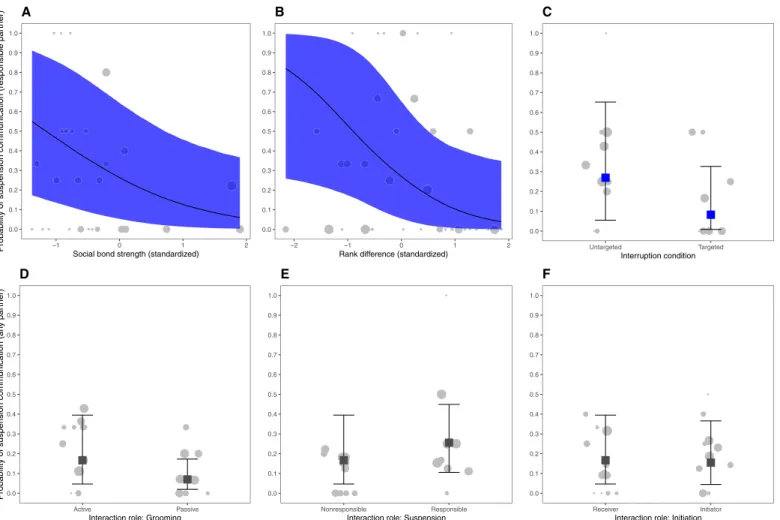
Model 4 revealed negative relationships between communication at the time of suspension and social bond strength, rank difference, and experimental condition (fig. S3D). Individuals were less likely to com-municate at the time of suspension when they were more closely bonded with their partner [Fig. 2A; b = −0.94, SD = 0.46, 95% CrI (−1.93, −0.13)]. Bonobos were also less likely to communicate at the time of suspension when they were higher ranked than their partner (Fig. 2B; b = −1.24, SD = 0.72, 95% CrI (−2.82, −0.03)] and when interrupted in the targeted interruption condition compared to the untargeted interruption condition [Fig. 2C; b = −1.46, SD = 0.72, 95% CrI (−2.99, −0.11)].
on January 25, 2021
http://advances.sciencemag.org/
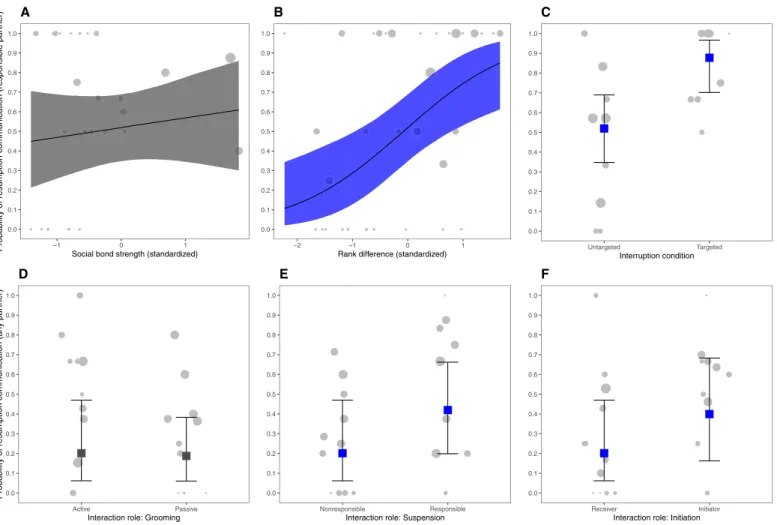
Model 5 revealed no effect of social bond on communication at the time of resumption [Fig. 3A; b = 0.21, SD = 0.31, 95% CrI (−0.39, 0.82)]. However, we found a substantial relationship between the likelihood to communicate at the time of resumption and both ex-perimental conditions and rank difference (fig. S3F). Individuals
were more likely to communicate to resume when they were higher- ranking relative to their partner [Fig. 3B; b = 1.00, SD = 0.33, 95% CrI (0.38, 1.68)] and in the target interruption condition compared to the untargeted interruption condition [Fig. 3C; b = 1.93, SD = 0.73, 95% CrI (0.59, 3.47)]. 0.0 0.1 0.2 0.3 0.4 0.5 0.6 0.7 0.8 0.9 1.0 Social Solitary Nature of activity
Probability of activity resumption
A 0.0 0.1 0.2 0.3 0.4 0.5 0.6 0.7 0.8 0.9 1.0 1 0 1 2
Social bond strength (standardized)
Probability of activity resumption (social)
B 0.0 0.1 0.2 0.3 0.4 0.5 0.6 0.7 0.8 0.9 1.0 1 0 1 2 3
Rank difference (standardized)
Probability of activity resumption (social)
C 0.0 0.1 0.2 0.3 0.4 0.5 0.6 0.7 0.8 0.9 1.0 Untargeted Targeted Interruption condition
Probability of activity resumption (social)
D 0.0 0.1 0.2 0.3 0.4 0.5 0.6 0.7 0.8 0.9 1.0 Active Passive
Interaction role: Grooming
Probability of individual taking initiativ
e to resume E 0.0 0.1 0.2 0.3 0.4 0.5 0.6 0.7 0.8 0.9 1.0 Nonresponsible Responsible Interaction role: Suspension
Probability of individual taking initiativ
e to resume F 0.0 0.1 0.2 0.3 0.4 0.5 0.6 0.7 0.8 0.9 1.0 Receiver Initiator Interaction role: Initiation
Probability of individual taking initiativ
e to resume
G
Fig. 1. Resumption. Variation of resumption probability according to nature of activity (A), social bond strength [dyadic sociality index (DSI)] (B), rank difference (C),
inter-ruption condition (D), and interaction roles (E to G). Plots depict the predicted probability of resumption for the marginal effects of the complete Bayesian models (A, model 1; B to D, model 2; E to G, model 3) and show how model predictions match the data. Upper/lower bars and ribbon edges depict 95% credible intervals (CrIs), and the mid-square or mid–ribbon lines represent estimated posterior means. Squares colored in blue represent estimated effects. Gray circles correspond to the propor-tion of resumppropor-tion per dyad [A (social); B to D] or individual [A (solitary); E to G]. Larger circles indicate more observapropor-tions.
on January 25, 2021
http://advances.sciencemag.org/
Likelihood of communication at the times of suspension and resumption depending on interactional role (responsible or nonresponsible, receiver or initiator, and active or passive) (models 6 and 7)
In these two models (models 6 and 7), we aimed at comparing the likelihood by which either partner communicated depending on their responsibility in suspending the activity (responsible or nonresponsible), on their role in initiating the activity (receive or initiator), and on their grooming role in the activity (active or passive) (table S4).
Model 6 revealed no substantial effects of any of the tested inter-actional roles on communication at the time of suspension, including responsible or nonresponsible for suspension [b = 0.54, SD = 0.54, 95% CrI (−0.51, 1.62)], initiator or receiver [b = −0.09, SD = 0.46, 95% CrI (−1.00, 0.83)], and active or passive grooming role [b = −0.98, SD = 0.55, 95% CrI (−2.10, 0.07)]; see Fig. 2 (D to F) and fig. S3E.
Model 7 revealed no substantial effect of the interactional grooming role active or passive on communication at the time of resumption [Fig. 3D and fig. S3G; b = −0.12, SD = 0.55, 95% CrI (−1.21, 0.94)]. Nonetheless, individuals were slightly more likely to communicate at the time of resumption when they were responsible for suspending
the activity compared to when they were not [Fig. 3E and fig. S3G;
b = 1.06, SD = 0.49, 95% CrI (0.11, 2.05)], and when they were initiators
compared to receivers (Fig. 3F and fig. S3G; b = 0.97, SD = 0.44, 95% CrI (0.12, 1.83)].
Assessing whether bonobos resume (versus start) a grooming activity
Bonobos resumed activities (n = 68) (i) within, on average, 86.8 s (first quartile: 26.7 s; third quartile: 105.7 s); (ii) by moving to the
same 2-m2 location radius than before the interruption in, on average,
92.6% of the time (for travel distances, see analysis S1); (iii) after having engaged with other social partners until resuming the activity again in, on average, 1.5% of cases; and (iv) by continuing to groom the same body parts than before in, on average, 40.0% of cases. DISCUSSION
Drawing on a paradigm than was previously used to assess joint commitment in human children (8, 9, 19), we investigated whether bonobos experience a sense of joint commitment when engaging in
0.0 0.1 0.2 0.3 0.4 0.5 0.6 0.7 0.8 0.9 1.0 1 0 1 2
Social bond strength (standardized)
Probability of suspension communication (responsib
le par tner) A 0.0 0.1 0.2 0.3 0.4 0.5 0.6 0.7 0.8 0.9 1.0 2 1 0 1 2
Rank difference (standardized) B 0.0 0.1 0.2 0.3 0.4 0.5 0.6 0.7 0.8 0.9 1.0 Untargeted Targeted Interruption condition C 0.0 0.1 0.2 0.3 0.4 0.5 0.6 0.7 0.8 0.9 1.0 Active Passive
Interaction role: Grooming
Probability of suspension communication (an
y pa rt ner) D 0.0 0.1 0.2 0.3 0.4 0.5 0.6 0.7 0.8 0.9 1.0 Nonresponsible Responsible
Interaction role: Suspension E 0.0 0.1 0.2 0.3 0.4 0.5 0.6 0.7 0.8 0.9 1.0 Receiver Initiator
Interaction role: Initiation F
Fig. 2. Communication for suspension. Variation of communication probability at the time of suspension according to social bond strength (DSI) (A), rank difference
(B), interruption condition (C), and interactional roles (D to F). Plots depict the predicted probability of suspension communication for the marginal effects of the complete Bayesian models (A to C, model 4; D to F, model 6) and show how model predictions fit the data. Upper/lower bars and ribbon edges depict 95% CrIs, and the mid-square or mid–ribbon lines represent estimated posterior means. Squares and ribbons colored in blue represent substantial effects. Gray circles correspond to the proportion of communication at the time of suspension per individual responsible for suspension (A to C) or any individual regardless of whether or not they were responsible for suspension (D to F). Larger circles indicate more observations.
on January 25, 2021
http://advances.sciencemag.org/
naturally occurring joint actions with conspecifics. Specifically, we assessed whether partners in an interrupted social activity would subsequently resume it and whether resumptions were driven by an individual motivation to complete an unfinished task or, as in human joint action, by an underlying sense of responsibility toward the partner—a joint commitment to a shared goal. We also assessed whether this joint commitment would vary depending on the social relationship between partners and their respective roles.
In line with our predictions, bonobos were less likely to resume a solitary than a social activity, suggesting that their motivation to resume social interactions goes beyond a mere desire to complete an unfinished task, but entails a sense of commitment toward the partner or the joint action itself. Our findings are comparable to those demonstrated for human children. Children verbally take leave after an interruption when playing together with a partner, but not when playing in parallel with that partner (8, 19). One might argue that the higher rate of resumption of social compared to solitary activities in bonobos could be explained by a more pleasant feeling of being groomed than grooming. This explanation is unlikely,
however, given that subjects were more likely to resume when they had been the active groomer, compared to when they had been the passive groomee. The high resumption rates in the social activity are thus unlikely to be merely driven by a more pleasant feeling of being groomed. It might be argued that solitary grooming rep-resents a boredom behavior that would be less likely to be resumed than a social activity. However, we also used solitary play (a usually highly enjoyable activity) as a control, and we did not find higher resumption rates for solitary play compared to solitary grooming (52% versus 48%), rendering this assumption unlikely.
When social activities were interrupted, subjects consistently re-sumed with their initial partners, regardless of experimental condi-tion or social relacondi-tionships—a behavioral pattern that was taken as evidence for joint commitment in previous studies [e.g., (7, 15, 19)]. It could nonetheless still be argued that subjects resumed social ac-tivities more because social acac-tivities serve to build relationships and, hence, are by default more rewarding than solitary activities. However, our findings support the idea that bonobos engage in joint commitment: (i) Likelihood of resumption does not differ depending on relationship
0.0 0.1 0.2 0.3 0.4 0.5 0.6 0.7 0.8 0.9 1.0 1 0 1
Social bond strength (standardized)
Probability of resumption communication (responsib
le pa rt ner) A 0.0 0.1 0.2 0.3 0.4 0.5 0.6 0.7 0.8 0.9 1.0 2 1 0 1
Rank difference (standardized) B 0.0 0.1 0.2 0.3 0.4 0.5 0.6 0.7 0.8 0.9 1.0 Untargeted Targeted Interruption condition C 0.0 0.1 0.2 0.3 0.4 0.5 0.6 0.7 0.8 0.9 1.0 Active Passive
Interaction role: Grooming
Probability of resumption communication (a
ny par tner) D 0.0 0.1 0.2 0.3 0.4 0.5 0.6 0.7 0.8 0.9 1.0 Nonresponsible Responsible
Interaction role: Suspension E 0.0 0.1 0.2 0.3 0.4 0.5 0.6 0.7 0.8 0.9 1.0 Receiver Initiator
Interaction role: Initiation F
Fig. 3. Communication for resumption. Variation of communication probability at the time of resumption according to social bond strength (DSI) (A), rank difference
(B), interruption condition (C), and interactional roles (D to F). Plots depict the predicted probability of resumption communication for the marginal effects of the com-plete Bayesian models (A to C, model 5; D to F, model 7) and show how model predictions match the data. Upper and lower bars and ribbon edges depict 95% CrIs, and the mid-square or mid–ribbon lines represent estimated posterior means. Squares and ribbons colored in blue represent substantial effects. Gray circles correspond to the proportion of communication at the time of resumption per individual responsible for resumption (A to C) or any individual regardless of whether or not they were responsible for resumption (D to F). Larger circles indicate more observations.
on January 25, 2021
http://advances.sciencemag.org/
quality or rank differences, but initiators of activities and active groomers were more likely to resume; (ii) bonobos communicate more when resuming targeted interruptions (where one individual was initially responsible for suspending the joint activity) than un-targeted interruptions; (iii) bonobos communicate more when resum-ing interactions if they themselves were responsible for suspendresum-ing or for having initiated the activity; and (iv) suspension is more fre-quently accompanied by communication when the dyad is weakly bonded (and the relationship is less secure) or individuals are lower- ranking than their partner (and the social pressure is greater).
It could also be argued that the resumption of the activity is ac-tually the start of a new interaction, which would not permit us to conclude that bonobos engage in joint commitment. However, several of our findings render this alternative explanation unlikely. Bonobos generally resumed grooming activities within a short amount of time (<1 min), moved to the same meeting point than before within
a 2-m2 radius in more than 90% of the time, engaged almost never
with any other social partner until the activity with the initial partner had been resumed, and frequently resumed both their own grooming roles as well as the grooming of the precise body part than before the interruption. We believe that these findings support the as-sumption that bonobos are somewhat aware about the permanence of their still-ongoing joint commitment with a previous partner, as they would have otherwise started grooming any other nearest part-ner and perhaps selected the body parts most convenient to them. Some other controls may nonetheless constitute a promising ave-nue for future study to further consolidate the evidence for joint commitment. For example, to further corroborate the idea that bonobos are resuming an unfinished (rather than starting a new) activity, one might compare the duration of uninterrupted ing activities versus the combined duration of an interrupted groom-ing activity before and after the interruption occurred. One might expect that the sum of the duration before and after interruption should roughly equal the total duration of an uninterrupted groom-ing activity.
Regarding the communication efforts to suspend and resume the joint activity, we found that, in line with our prediction, when groom-ing interactions were interrupted, bonobos deployed more commu-nicative efforts at the time of resumption in targeted interruptions than in untargeted interruptions. This further supports the assumption that bonobos might be aware of their responsibility toward their partner when suspending the activity. Individuals might realize that breaking a commitment due to an individual motivation (to fetch a personal food reward) is more threatening to partners than breaking a commitment due to an event relevant to the whole group (opening of holding doors). Bonobos seem to have an understanding of the social implications of their actions. When considering the communi-cation at the time of suspension, however, individuals communicated less when suspending the activity following a targeted compared to untargeted interruption. Bonobos might have had an intensified emotional response toward group-related stimuli, leading to more communication at the time of suspension in untargeted compared to targeted interruptions. Although our study could not assess this, we hope that this will be tested in future studies by measuring arousal levels via noninvasive psychophysiological techniques like thermal imaging (20) or by selecting stimuli causing comparable arousal levels across conditions. Another way to test whether arousal- based explanations are responsible for this finding would also be to compare the type of signals used to communicate suspension in the
different conditions, or equally with different partners of higher or lower rank or weak or strong bond.
It is important to note that our current analyses do not permit us to understand how bonobos communicate about joint commitment. Although we know that bonobos communicate during suspension and resumption, we cannot ascertain whether bonobos, like humans, produce specific signals to coordinate interruptions. Those signals should differ from those used to start and end an interaction. For ex-ample, humans exchange greetings and goodbyes to initiate and end an encounter (21–24) but use different phrases when communicating that they have to suspend the interaction (e.g., “Sorry, I’ll be right back”) or reinstate it (e.g., “Sorry for keeping you waiting”) (11, 18). Presuming that bonobos understand when an activity was inter-rupted prematurely, and presuming that they intend to re-establish joint commitment with their partner, an interesting avenue for future studies would be to further verify whether the signals used to commu-nicate suspension and reengagement differ from those used to com-municate about starting a new activity or to ending a previous one.
Inferences from behaviors to mental states are always debatable, so it is important to rigorously apply the principle of parsimony (25), also with human data. In humans, it is usually accepted that joint actions are the product of an underlying joint commitment that, at least in adults, is tied to higher-order mental processes that involve concerns about how others perceive them, and concerns about avoiding face-threatening acts (12). In humans, face manage-ment increases as a function of social risk, and face threats become more likely with increasing social distance and power difference between two partners, requiring more politeness (12). Moreover, social roles during joint actions matter, with beneficiaries of joint actions being more indebted to other participants. We found that social roles also matter in bonobos. For instance, bonobos were more likely to communicate to reengage a previous partner when they had been responsible for initially having suspended the activity. As predicted by politeness theory (12), bonobos increased commu-nication efforts when suspending joint actions as social distance and rank difference increased. They were more likely to communi-cate at the time of suspension when they were socially distant and subordinate in rank and more likely to communicate at the time of resumption after targeted interruptions, especially so when they were higher-ranking. The latter result did not follow the patterns predicted by politeness theory, however; we believe that this finding could be explained by the fact that higher-ranked individuals communicate to subordinates to avoid ambiguity in re-approaching—i.e., subor-dinates might generally fear approaches by dominants unless they signal benign intent. These results suggest that bonobos have some awareness of the social consequences linked to breaking joint com-mitments and adjust their communication efforts according to the identity of their partner (11, 12, 18).
Bonobos’ joint actions seem to be governed by some sense of joint commitment and seem to follow at least some patterns predicted by face management (12). Nonetheless, there is no evidence that bono-bos are concerned about how others perceive them as much as humans do. Three-year-old children resist breaking joint commitments when being offered personal rewards in about 70 to 80% of trials (9), whereas in bonobos, this is observed in merely 3% of trials. This difference demonstrates that human toddlers will forgo opportunities for personal gain to honor joint commitments. It is thus possible that humans and apes differ in how they prioritize social commit-ments relative to material personal benefits.
on January 25, 2021
http://advances.sciencemag.org/
Together, bonobos seem to have some awareness of their re-sponsibility toward their partner in joint action and of the social consequences linked to suspending a joint action. Bonobos appear to follow some patterns predicted by face management while, at the same time, prioritizing personal incentives over joint commitments, especially in situations involving highly arousing causes of inter-ruptions like food rewards. Whether these differences in behavior are due to population-specific peculiarities (e.g., wild bonobos may be more socially committed), group-specific characteristics (e.g., less egalitarian captive groups might be less flexible in communicating about joint commitment), underlying psychological differences, or differences in the importance of social norms cannot be decided with our data.
Although joint commitments usually imply mutual knowledge of partners that they are committed (3), a sense of joint commit-ment can also arise through coordination alone and must not entail the explicit communication of that knowledge by the partners (26). Our current study suggests that, at the least, bonobos engage in an implicit form of joint commitment (27), where partners get involved in a joint commitment by mutual coordination. With joint commit-ment being only one aspect of shared intentionality in humans, shared intentionality also entails other features like the ability to comple-ment roles, to help each other, to communicate cooperatively via pointing, to engage in cumulative culture, and to engage in complex forms of perspective taking (1). Although some evidence suggests that great apes might be capable of at least some of these abilities [e.g., perspective taking (28), helping (29), and cooperative commu-nication (30)], the jury is still out on the extent to which they are endowed with all the critical prerequisites necessary for shared in-tentionality. Bonobos represent an interesting model to investigate shared intentionality, as they exhibit high social tolerance (31), pro- sociality (32), and emotionality (33)—crucial features that would pave the way for successful collaboration, hence favoring the evolution of joint commitment. The close phylogenetic relationship between bonobos and chimpanzees would suggest that chimpanzees should also engage in joint commitment to some respect, but the unique socioecology of bonobos might have favored the evolution of joint commitment specifically in this species. We advocate future com-parative studies to assess joint commitment in chimpanzees using a similar methodology as in this study.
In conclusion, our findings provide evidence that bonobos are endowed with a social cognition that enables them to engage in joint commitment, although possibly in a less profound way than humans. Since joint commitment is a key prerequisite for how humans make their social worlds and taken as evidence for shared intention-ality (1, 5), our findings support the idea of a layered evolutionary continuum of primate social cognition.
MATERIALS AND METHODS Study subjects and site
This experimental study was conducted at the zoological park of La Vallée des Singes, France, from May to August 2018. The bonobo (Pan paniscus) group consisted of 17 individuals, 15 of which par-ticipated in the study (mean age = 17 years; SD = 12 years; age range, 4 to 51 years; 10 females and 5 males; see table S1 for detailed group composition). The group lives in large enclosures composed of an outdoor island enclosure with a large forest and climbing structures
in grassy areas (8000 m2) and an indoor enclosure with various
en-richment and climbing structures (600 m2). The group receives food
five to six times a day, including daily rations of primate pellets, fruits, and vegetables. Occasionally, the bonobos receive rice, nuts, meat, and eggs. Individuals can additionally forage for wild berries and herbaceous vegetation in their outdoor enclosure. In stable weather conditions (>13°C), the group is locked in their outdoor enclosure. Water is always available ad libitum from a fresh water source at the building and a stream surrounding the island. For the experiment, we selected 30 dyads on the basis of the strength of their social bond: 16 dyads with a strong bond and 14 with a weak bond (table S2) among which we selected 8 focal individuals (table S1), each of which had at least one strongly and one weakly bonded partner.
Social bond and rank difference
Data used to compute social bond strength and rank difference be-tween partners were collected at the time of the study period (May to August 2018). These consisted of 15 min of continuous focal fol-lows, 5-min scan samples, and ad libitum conflict data on selected focal individuals (defined in table S1), 1 hour per day. In total, we collected 62.3 hours of observations (7.7 hours per focal individual, SD = 0.28). We carried out analyses with the R software package (v. 3.5.0).
Social bond strengths were computed using dyadic sociality in-dexes (DSIs) using the socialindices package in R, accessed via https://github.com/gobbios/socialindices. The DSI thus serves as an inverse proxy for social distance (12). These included the count of focal individuals’ proximity to others (at arms-reach distance) re-corded during the 5-min scans, the count of approaches, and dura-tion of grooming (and play, collected previously during a 5-month observation period in 2017) recorded during the continuous 15-min focal follows. The average DSI value was 1.0 (SD = 1.9; range, 0.05 to 15.3). We classified strong bonds as those with a DSI >1 and weak bonds as those with a DSI <1.
Rank differences were computed by producing a rank hierarchy with dominance scores for each individual, on the basis of recordings of conflicts collected during a previous 5-month observation period in 2017. We computed ranks using EloRatings using the “EloRating” package in R (34). We then computed rank differences by subtracting individuals’ EloRatings. Higher values indicate stronger bonds, whereas lower values indicate weaker bonds. The average rank difference (based on original EloRatings) between partners was 416 (SD = 250; range, 46 to 1059).
Social activity type
We selected social grooming as the joint action of choice for this experiment because bonobos engage in grooming bouts very fre-quently, with various partners, over long periods of time and in a reciprocal manner; in addition, apart from its hygienic function, grooming is beneficial for managing tolerance and social bonding (35). Solitary activity types
As a control to the social activity, we investigated subjects’ motiva-tion to resume a solitary activity after interrupmotiva-tion. We selected two equivalents of social behaviors that subjects could carry out on their own—self-grooming and solitary play. We considered all individuals who engaged in either one of these activities during the experimental trials and assessed whether these individuals resumed the same soli-tary activity within 2 min after the interruption stimulus. We were able to record 26 solitary activities during the experimental trials (10 solitary play and 16 self-groomings), comprising, on average,
on January 25, 2021
http://advances.sciencemag.org/
2.4 ± 1.8 solitary behaviors per individual across conditions (n = 11 individuals; untargeted interruptions, 1.8 ± 1.5; targeted interruptions, 1.6 ± 1.3; table S2). Of the 11 individuals engaged in solitary activities during experimental trials, eight (with four focal individuals) were also subjects in different trials. Solitary activities and social activities were interrupted during the same testing period.
Experimental design and procedure
To assess whether the subjects engaged in joint commitment, we experimentally interrupted ongoing grooming interactions and ma-nipulated the partners’ individual responsibility in the interruption of the activity in two conditions. In the targeted interruption condi-tion, only one focal individual is rendered responsible for interrupting the activity while the partner is kept waiting (see movies S3 and S4). In the untargeted interruption condition, both partners are equally responsible for interrupting the activity (see movies S1 and S2). The experimental trials were conducted between 4:00 p.m. and 6:00 p.m. We waited for the subjects to be located near the indoor building or nearby tree trunks in the open space of their outdoor enclosure, as both spots were popular grooming locations at that time of day, and in full view of the experimenter (fig. S1). Experimental trials were run opportunistically, whenever focal dyads engaged in grooming, but we counterbalanced the number of targeted and untargeted in-terruptions across the study period. To avoid habituation to the stimuli and extinction of behaviors, we kept daily interruptions to a maximum of two a day. We randomized the time of interruptions in an early time slot (4:00 to 5:00 p.m.) and a late time slot (5:00 to 6:00 p.m.), maintaining a balanced number of targeted and untar-geted interruptions across time slots.
R.H. was standing in the public area and filmed the dyads of in-terest as well as the whole group, using two Panasonic HC-V770 Camcorders on tripods with externally attached directional micro-phones (Sennheiser MKE 400) placed at the two different locations (fig. S1). Grooming bouts were recorded from the beginning (one or both partners start grooming the body of the other) until the end (partners stopped grooming for at least 2 min), including in-terruption periods. R.H. timed the grooming interaction from its onset to the predetermined interruption time. R.H. called the keep-er present on that day, who was standing inside the holding area, via a walkie- talkie (Motorola GP340) 5 min before the predetermined interruption time and again 30 s before that time point. Upon cue, the keeper produced the interruption stimulus from within the building.
In the targeted interruption condition, only a focal individual was targeted by the stimulus. Upon receiving the cue by R.H., the keeper called the focal subject by its name through the holding door of the indoor enclosure. This type of stimulus is regularly used by keepers, as part of their husbandry routine, to attract one individual at a time for medical treatment or general health checks, to which individuals willingly respond by approaching. Upon arrival at the holding door, the keeper rewarded the focal subject with a desirable food item, such as carrots, juice, or raisins (keepers chose food items randomly each time to avoid habituation). If the focal individual did not ap-proach after several attempts of calling, the keeper closed the holding door and the trial was cancelled. We ran a total of 39 targeted inter-ruption trials (mean = 4.6 trials per focal individual, SD =1.4), of which we discarded 2 as the stimulus did not lead to an interruption of the grooming bout. From the 37 remaining targeted interruptions, 8 were conducted with weakly bonded dyads and 29 were conducted
with strongly bonded dyads (mean interruptions per dyad = 1.9, SD = 0.9; table S2).
In the untargeted interruption condition, we broadcasted a stimu-lus that was not directed at any individual in particular but that po-tentially affected the entire group (thus, both partners in the dyad). On cue, the keeper produced the stimulus by producing noise of a rapidly moving holding door of the indoor facility, simulating a sce-nario by which the group is usually let inside the indoor facility to receive the evening meal and rest for the night. The keeper rapidly opened and closed either the first or the second holding door (ran-domized across trials; see fig. S1 for location of holding doors). This type of noise typically interrupts the entire group’s ongoing activity and provokes the approach of all group members to the holding doors to check inside. In this condition, no bonobo received any food rewards, and the holding doors remained closed after the stim-ulus. In total, we ran 49 untargeted interruption trials (mean = 6.1 trials per focal individual, SD =2.3), of which we discarded one trial as the stimulus did not lead to an interruption of the grooming bout. From the 48 remaining untargeted interruptions, 17 were conducted with weakly bonded dyads and 31 were conducted with strongly bonded dyads (mean interruptions per dyad = 1.6, SD =1.2; table S2). Interruption times
We hypothesized that in the process of social grooming, partners may feel more committed to the grooming activity at the beginning of the bout than toward the end. They may feel less responsibility toward a potential joint commitment if interrupted at a later stage of their interaction compared to an earlier stage. For these reasons, we controlled for the time of interruption of grooming for each dyad. We determined the best interruption time for each dyad on the basis of preliminary observations during a 5-month study conducted at La Vallée des Singes from May to September 2017 (total of 330.3 hours; mean = 20.6 hours per individual; SD = 0.5 hours). The distributions of dyads’ grooming durations were estimated from at least three complete interactions per dyad (range, three to six grooming inter-actions). We then computed the average duration of grooming bouts for each dyad on the basis of these sampled interactions. We decided to determine the best period of interruption as the period between the onset of the grooming bout and the median of the dy-ad’s grooming bout duration (table S2), hereafter referred to as “in-terruption time range” (ITR). The beginning of the ITR corresponds to the start of the dyad’s grooming bouts. The end point of the range corresponds to the median duration of the dyad’s grooming bouts. We interrupted the dyads as accurately as possible in both ex-perimental conditions within this time range. For n = 10 dyads (one-third of the sample), there were either no or not enough inter-actions to be analyzed from the previous data collection, and we could therefore not predetermine an ITR for these dyads. As a compromise, we interrupted these dyads randomly within a time window of 3.0 to 18.0 min (based on the ITR of the other dyads). Solitary activities had no predetermined ITRs; individuals who engaged in solitary activi-ties (self-grooming or solitary play) at the time of a stimulus (targeted or untargeted) were interrupted, and these interruptions were analyzed whenever they occurred (i.e., the time individuals spent in solitary ac-tivities ranged from 0.2 and 5.6 min until the interruption occurred). Video coding
We coded all behaviors and communicative signals occurring during the interruption period using the computer software ELAN (Version 5.2,
on January 25, 2021
http://advances.sciencemag.org/
04 April 2018; Nijmegen: Max Planck Institute for Psycholinguistics; retrieved from https://tla.mpi.nl/tools/tla-tools/elan/). Specifically, we coded the following variables: individual IDs of the focal individ-ual and its partner; the nature of the activity that they engaged in before the interruption (social or solitary); whether the activity performed before the interruption was resumed or not within 2 min after the interruption stimulus (resumption or no resump-tion); whether the bonobos resumed their previous location with
their initial partner after the interruption within a 2-m2 radius
(yes or no); whether the bonobos would continue to groom the same body part after the interruption than they groomed before the inter-ruption (body parts divided into regions of head, face, back, shoulder, legs, hands, feet, arms, chest, stomach, and genitals); the length of the interruption break (starting with the cessation of grooming move-ments and attention paid to stimulus and ending with the restart of grooming movements on the body of the partner); whether the bonobos groomed any other partners in between the interruption breaks than the initial one (yes or no); whether communicative sig-nals (see table S3 for definitions/frequency of sigsig-nals) were exchanged during the interruption period to suspend (3 s before and 3 s after interruption stimulus) or to resume partners (3 s before resumption of grooming) (communication or no communication); the role of each partner in instigating the interaction (initiator or receiver); the role of each partner in the interaction at the time of the interruption stim-ulus and after resumption (active or passive); and the responsibility of each partner in the interruption of the activity (responsible or non-responsible for suspension or resumption). The individual respon-sible for interrupting the activity was defined as the one who stopped the activity first (i.e., “responsible for suspension”). The individual responsible for resuming the activity was defined as the one who initiated the resumption (i.e., “responsible for resumption”).
For the communicative signals, we coded any signal described in the great ape literature, which followed at least one of the previously described intentionality criteria: response waiting, audience check-ing, and persistence if the apparent goal was not met (37). Signals could be vocalizations, gestures, body signals, and facial expressions typical for bonobos (36, 38). To provide an overview of the commu-nication strategies deployed when suspending or resuming grooming activities, we present the number of times and types of signals used in our ethogram (table S3).
Statistical analysis
To test the understanding of joint commitment in our subjects, we compared the likelihood of resuming the activity after interruption of a social versus a solitary activity. In addition, we explored the likelihood of resuming the grooming activity with the same partner after interruption and the likelihood of communicating with their partner at the times of suspension and resumption, depending on the following: the experimental condition (targeted or untargeted interruptions), the nature of the relationship between partners (strong or weak bond and higher or lower ranking), and the role of partners in the interaction (initiator or receiver, responsible or nonresponsible, and active or passive).
To test our research questions, we fit Bayesian generalized mixed models (GLMMs) using the Stan computational framework (http:// mc-stan.org/), accessed through the brms package (39) in R v. 3.5.0 (40). We fit each model with random effects of IDs of individuals and their partners or dyads, where relevant (see table S4 for selected models’ specificities); for all models, we compared full models,
in-cluding respective random effects with reduced models exin-cluding random effects, to verify whether mixed modeling was justified. We ran leave-one-out cross-validations (LOO ICs) (41) and chose the model with the best expected log-predictive density (table S5) and sufficient variance across intercepts (≥0). We consistently presented the results of the more parsimonious models if random-effects model-ing was not justified; if the model fit was best without random effects, then we conducted generalized linear models (GLMs) instead. To ensure transparency, we nonetheless present all variants of non-selected models’ results in table S6. All models included four Markov Chain Monte Carlo (MCMC) chains, with 10,000 iterations per chain, of which we specified 2000 iterations as warm-up to ensure sampling calibration, leading to 40,000 posterior samples. The model diagnostics revealed that the posterior distributions reflect the distribution of the original response values appropriately; R-hat statistics <1.05, the number of effective samples >100, and the MCMC chains had no divergent transitions (tables S4 to S6 and fig. S2). For all models, we used the default priors of the brms package, which were weakly informative with a Student’s t distribution of 3 degrees of freedom and a scale param-eter of 10. For inference, we calculated 95% CrIs from the posterior distributions and checked whether 0 was comprised in this interval.
To test whether the nature of the activity affects the likelihood of resumption, we fit model 1 with the dependent variable “resumption” or “no resumption” (fitting a Bernoulli distribution with presence or absence of resumption as binary outcome). The fixed effect was the nature of the activity (social versus solitary). This dataset included 30 dyads and 11 individuals, with 111 interruptions (85 social and 26 solitary). To test whether the social bond and rank difference, as well as experimental condition, affect the likelihood of resumption, we fit model 2 with the dependent variable resumption or no re-sumption (fitting a Bernoulli distribution with presence or absence of resumption as binary outcome). The fixed effects were the DSI (as inverse proxy for social bond), absolute rank difference between partners (as proxy for rank difference), and the experimental condi-tion (untargeted versus targeted interrupcondi-tions). We z-transformed both DSI and rank difference for all individuals to mean = 0 and SD = 1. This dataset included 30 dyads and 85 interruptions. As random effects, we considered the ID of the individual/dyad.
To test whether the interaction roles affect individuals’ likelihood to resume the activity, we fit model 3 with the dependent variable resumption or no resumption (fitting a Bernoulli distribution with presence or absence of resumption as binary outcome). The fixed effects were the role in the suspension (responsible versus nonre-sponsible), the role in opening the activity (initiator versus receiver), and the role in the activity itself (active versus passive). We excluded observations where roles could not be determined, such as in the case of “mutually suspended” interruptions (n = 12 cases). The data-set thus included 10 individuals and 158 interruptions (i.e., 158 data points as we looked at each individual’s behavior, and not at the dyad’s level). As random effects, we considered individual ID, inter-action ID, and dyad ID.
To test whether the social bond and rank difference, as well as the experimental condition, affect the likelihood of communication at the time of suspension and resumption, we fit models 4 and 5 with the dependent variable “communication” or “no communication” (fitting a Bernoulli distribution with presence or absence of com-munication as binary outcome; for communicative signals used, see table S3). The dataset is composed of data points of individuals re-sponsible for suspension or resumption of the activity. The fixed
on January 25, 2021
http://advances.sciencemag.org/
effects were the social bond (DSI), the rank difference between the individual suspending or reengaging and its partner, and, as a control variable, the experimental condition (untargeted versus targeted interruptions). We z-transformed both DSI and rank difference as before. The dataset for model 4 included 10 individuals responsible for suspending (with 12 different possible partners) and 79 interruptions (i.e., of n = 85 interruptions, n = 6 interruptions were excluded as they were mutually suspended). The dataset for model 5 included nine individuals responsible for resumption and 66 interruptions (i.e., of n = 85 interruptions, n = 2 were excluded as we could not identify one individual clearly responsible for resumption, and
n = 17 interruptions were not resumed; thus, communication could
not be evaluated). As random effects, we considered the ID of the one responsible for suspension or resumption, as well as the inter-action partner.
To test whether the interaction roles affect any individuals’ ten-dency (i.e., not just the one responsible for suspension or resump-tion) to communicate at the time of suspension or resumption, we fit models 6 and 7 with the dependent variable communication or no communication (fitting a Bernoulli distribution with presence or absence of resumption as binary outcome). The fixed effects were the role in the suspension (responsible versus nonresponsible), the role in the opening of the activity (initiator versus receiver), and the role in the activity itself (active versus passive). In our dataset, each row indicates whether a partner of a dyad communicated at the time of suspension or resumption, taking each row as an independent data point of one individual acting within a dyad. We excluded ob-servations where roles could not be determined, such as in the case of mutually suspended interruptions (n = 12). The dataset used to test the communication at suspension (model 6) thus included 12 individuals and 158 interruptions. Besides data points where individ-uals responsible for suspension could not be identified, we excluded
n = 32 data points representing nonresumed interactions, reducing
the dataset used to test the communication at resumption (model 7) to 126 interruptions. As random effects, we considered individual ID, interaction ID, and dyad ID.
Controlling for stimulus habituation
Last, we implemented a control to investigate the possibility that the subjects might have become habituated to the interruption stimuli (analysis S2). To this end, we computed Bayesian GLMMs/GLMs (depending on whether random factors were modeled in selected models; see table S4) with trial number as fixed factor and the re-spective variable of the models as outcome variable. Using LOO IC, we compared the model, including trial number against a null model without any fixed effect, to inspect the possibility whether subjects’ resumption likelihood or communication likelihood decreased over time. We found no effects of trial number on any of the tested out-come variables, except a slight improvement in model accuracy for model 4. We thus re-ran the analysis with model 4 to verify whether, by inclusion of the trial number, the effects would remain stable, and found that they do. We thus conclude that trial number (i.e., stimulus habituation) had no confounding effect on the interpretation of our results.
Coding reliability
We assessed inter-rater agreement about whether (or not) the indi-vidual responsible for suspension or resumption communicated (yes or no) by using any of the signals from our ethogram (see table
S3) between R.H. and another rater (E. Doherty) who was blind to the hypothesis and entirely new to coding great ape signals. They were then told to code for the presence or absence of any of these signals at the time points of 3 s before and after the interruption occurred (suspension communication) and 3 s before the two part-ners resumed their activity (resumption communication). The test revealed substantial agreement for the communication for resump-tion (n = 20 interrupresump-tions, Cohen’s = 0.7, 85% agreement) and moderate agreement for the communication for suspension (n = 19 interruptions, Cohen’s = 0.6, 84% agreement). With a second naïve coder (Y. Kim), we also computed an inter-rater agreement about whether (or not) the subjects would resume the same location
by a 2-m2 radius after the interruption as before, would groom the
same body part as before, and would groom any other partner during the interruption break, and the length of the interruption. The tests revealed perfect agreement for the rating of location resumption
within 2 m2 (n = 24 interruptions, Cohen’s = 1.0, 100% agreement),
moderate agreement for the rating of whether the same body part region was groomed as before (n = 23 interruptions, Cohen’s = 0.6, 83% agreement), perfect agreement for the rating of whether the bonobos groomed other partners during the interruption break (n = 24 interruptions, Cohen’s = 1.0, 100% agreement), and, last, almost perfect agreement on the duration of interruption breaks [n = 24; two-way Intraclass Correlation Coefficient (ICC) = 0.91, 95% confidence interval (0.81, 0.96)].
SUPPLEMENTARY MATERIALS
Supplementary material for this article is available at http://advances.sciencemag.org/cgi/ content/full/6/51/eabd1306/DC1
REFERENCES AND NOTES
1. M. Tomasello, H. Moll, in Mind the Gap. Tracing the Origins of Human Universals, P. M. Kappeler, J. B. Silk, Eds. (Springer, 2010), pp. 331–349.
2. M. Tomasello, M. Carpenter, Shared intentionality. Dev. Sci. 10, 121–125 (2007). 3. M. Tomasello, M. Carpenter, J. Call, T. Behne, H. Moll, Understanding and sharing
intentions: The origins of cultural cognition. Behav. Brain Sci. 28, 675–691 (2005). 4. M. E. Bratman, Shared cooperative activity. Philos. Rev. 101, 327–341 (1992).
5. M. Gilbert, Joint Commitment: How We Make the Social World (Oxford Univ. Press, 2014). 6. H. H. Clark, Social actions, social commitments, in Roots of human sociality: Culture,
cognition, and human interaction, S. C. Levinson, N. J. Enfield, Eds. (Oxford: Berg Press, 2006),
pp. 126–150.
7. U. Kachel, M. Svetlova, M. Tomasello, Three- and 5-year-old children’s understanding of how to dissolve a joint commitment. J. Exp. Child Psychol. 184, 34–47 (2019). 8. M. Gräfenhain, M. Carpenter, M. Tomasello, Three-year-olds’ understanding
of the consequences of joint commitments. PLOS ONE 8, e73039 (2013).
9. U. Kachel, M. Tomasello, 3- and 5-year-old children’s adherence to explicit and implicit joint commitments. Dev. Psychol. 55, 80–88 (2019).
10. U. Kachel, M. Svetlova, M. Tomasello, Three-year-olds’ reactions to a partner’s failure to perform her role in a joint commitment. Child Dev. 89, 1691–1703 (2018). 11. A. Bangerter, E. Chevalley, S. Derouwaux, Managing third-party interruptions
in conversations: Effects of duration and conversational role. J. Lang. Soc. Psychol. 29, 235–244 (2010).
12. P. Brown, S. C. Levinson, Politeness: Some Universals in Language Usage (Cambridge Univ. Press, 1987).
13. E. Goffman, Interactional Ritual: Essays on Face-to-Face Behavior (Anchor Books, 1967). 14. M. Tomasello, A Natural History of Human Morality (Harvard Univ. Press, 2016). 15. F. Warneken, F. Chen, M. Tomasello, Cooperative activities in young children
and chimpanzees. Child Dev. 77, 640–663 (2006).
16. E. MacLean, B. Hare, Spontaneous triadic engagement in bonobos (Pan paniscus) and chimpanzees (Pan troglodytes). J. Comp. Psychol. 127, 245–255 (2013).
17. S. Pika, K. Zuberbühler, Social games between bonobos and humans: Evidence for shared intentionality? Am. J. Primatol. 70, 207–210 (2008).
18. E. Chevalley, A. Bangerter, Suspending and reinstating joint activities with dialogue.
Discourse Process. 47, 263–291 (2010).
on January 25, 2021
http://advances.sciencemag.org/
19. M. Gräfenhain, T. Behne, M. Carpenter, M. Tomasello, Young children’s understanding of joint commitments. Dev. Psychol. 45, 1430–1443 (2009).
20. G. Dezecache, K. Zuberbühler, M. Davila-Ross, C. D. Dahl, Skin temperature changes in wild chimpanzees upon hearing vocalizations of conspecifics. R. Soc. Open Sci. 4, 160816 (2017).
21. A. Kendon, Conducting Interaction: Patterns of Behavior in Focused Encounters (Cambridge Univ. Press, 1990).
22. L. Mondada, Emergent focused interactions in public places: A systematic analysis of the multimodal achievement of a common interactional space. J. Pragmat. 41, 1977–1997 (2009). 23. H. H. Clark, J. W. French, Telephone goodbyes. Lang. Soc. 10, 1–19 (1981).
24. E. A. Schegloff, H. Sacks, Opening up closings. Sem. Ther. 8, 289–327 (1973). 25. L. Morgan, Animal Life and Intelligence (Ginn, 1981).
26. J. Michael, N. Sebanz, G. Knoblich, Observing joint action: Coordination creates commitment. Cognition 157, 106–113 (2016).
27. J. Michael, N. Sebanz, G. Knoblich, The sense of commitment: A minimal approach.
Front. Psychol. 6, 1968 (2016).
28. C. Krupenye, F. Kano, S. Hirata, J. Call, M. Tomasello, Great apes anticipate that other individuals will act according to false beliefs. Science 354, 110–114 (2016). 29. F. Warneken, B. Hare, A. P. Melis, D. Hanus, M. Tomasello, Spontaneous altruism by
chimpanzees and young children. PLOS Biol. 5, e184 (2007).
30. E. Genty, K. Zuberbühler, Iconic gesturing in bonobos. Commun. Integr. Biol. 8, e992742 (2015).
31. B. Hare, A. P. Melis, V. Woods, S. Hastings, R. Wrangham, Tolerance allows bonobos to outperform chimpanzees on a cooperative task. Curr. Biol. 17, 619–623 (2007). 32. J. Tan, D. Ariely, B. Hare, Bonobos respond prosocially toward members of other groups.
Sci. Rep. 7, 14733 (2017).
33. M. E. Kret, L. Jaasma, T. Bionda, J. G. Wijnen, Bonobos (Pan paniscus) show an attentional bias toward conspecifics’ emotions. Proc. Natl. Acad. Sci. U.S.A. 113, 3761–3766 (2016). 34. C. Neumann, L. Kulik, EloRating: Animal dominance hierarchies by Elo rating. R. Packag.
Version 43, 1–26 (2014).
35. P. Fedurek, R. I. M. Dunbar; British Academy Centenary Research Project, What does mutual grooming tell us about why chimpanzees groom? Ethology 115, 566–575 (2009). 36. E. Genty, Z. Clay, C. Hobaiter, K. Zuberbühler, Multi-modal use of a socially directed call
in bonobos. PLOS ONE 9, e84738 (2014).
37. R. W. Byrne, E. Cartmill, E. Genty, K. E. Graham, C. Hobaiter, J. Tanner, Great ape gestures: Intentional communication with a rich set of innate signals. Anim. Cogn. 20, 755–769 (2017). 38. F. B. M. de Waal, The communicative repertoire of captive bonobos (Pan paniscus),
compared to that of chimpanzees. Behav. Ther. 106, 183–251 (1988).
39. P.-C. Bürkner, brms: An R package for bayesian multilevel models using stan. J. Stat. Softw.
80, 1–28 (2017).
40. R. C. Team, R: A language and environment for statistical computing (2013), available at http://citeseerx.ist.psu.edu/viewdoc/
download?doi=10.1.1.470.5851&rep=rep1&type=pdf.
41. A. Vehtari, A. Gelman, J. Gabry, Practical Bayesian model evaluation using leave-one-out cross-validation and WAIC. Stat. Comput. 27, 1413–1432 (2017).
Acknowledgments: We thank the director E. Le Grelle and the dedicated zoological staff
(F. Alexieff, C. Michelet, and L. Bertrand) for letting us conduct our observations at their site and invaluable support. We also thank E. Doherty and Y. Kim for assistance with the inter-rater coding, and A. Régnier for support with data collection. Funding: Research was funded by the Swiss National Science Foundation (grant no. CR31I3_166331 awarded to A.B. and K.Z.). Ethics statement: Received from the Commission d’Ethique de la Recherche of University of Neuchâtel (01-FS-2017) and the internal ethical committee of La Vallée des Singes. Author contributions: R.H., A.B., K.Z., F.R., and E.G. designed the study; R.H. collected the data; R.H. and K.I. analyzed the data; R.H., A.B., K.Z., F.R., and E.G. wrote the manuscript; J.-P.G. provided logistic support at the field site; R.H. and E.G. coded the videos; and E.G. coordinated the study. Competing interests: The authors declare that they have no competing interests. Data and materials availability: All data needed to evaluate the conclusions in the paper are present in the paper and/or the Supplementary Materials.
Submitted 2 June 2020 Accepted 6 November 2020 Published 18 December 2020 10.1126/sciadv.abd1306
Citation: R. Heesen, A. Bangerter, K. Zuberbühler, F. Rossano, K. Iglesias, J.-P. Guéry, E. Genty, Bonobos engage in joint commitment. Sci. Adv. 6, eabd1306 (2020).
on January 25, 2021
http://advances.sciencemag.org/
DOI: 10.1126/sciadv.abd1306 (51), eabd1306. 6
Sci Adv
ARTICLE TOOLS http://advances.sciencemag.org/content/6/51/eabd1306
MATERIALS
SUPPLEMENTARY http://advances.sciencemag.org/content/suppl/2020/12/14/6.51.eabd1306.DC1
REFERENCES
http://advances.sciencemag.org/content/6/51/eabd1306#BIBL This article cites 32 articles, 2 of which you can access for free
PERMISSIONS http://www.sciencemag.org/help/reprints-and-permissions
Terms of Service Use of this article is subject to the
is a registered trademark of AAAS.
Science Advances
York Avenue NW, Washington, DC 20005. The title
(ISSN 2375-2548) is published by the American Association for the Advancement of Science, 1200 New
Science Advances
License 4.0 (CC BY-NC).
Science. No claim to original U.S. Government Works. Distributed under a Creative Commons Attribution NonCommercial Copyright © 2020 The Authors, some rights reserved; exclusive licensee American Association for the Advancement of
on January 25, 2021
http://advances.sciencemag.org/
![Fig. 1. Resumption. Variation of resumption probability according to nature of activity (A), social bond strength [dyadic sociality index (DSI)] (B), rank difference (C), inter- inter-ruption condition (D), and interaction roles (E to G)](https://thumb-eu.123doks.com/thumbv2/123doknet/6079108.153468/3.891.74.822.83.838/resumption-variation-resumption-probability-according-sociality-difference-interaction.webp)