arXiv:1402.1482v2 [astro-ph.EP] 7 Feb 2014
Astronomy & Astrophysicsmanuscript no. WASP20-WASP28-arXiv ESO 2014c
February 10, 2014
WASP-20b and WASP-28b: a hot Saturn and a hot Jupiter in
near-aligned orbits around solar-type stars
⋆
D. R. Anderson
1, A. Collier Cameron
2, C. Hellier
1, M. Lendl
3, T. A. Lister
4, P. F. L. Maxted
1, D. Queloz
3,5,
B. Smalley
1, A. M. Smith
1,6, A. H. M. J. Triaud
3,7, D. J. A. Brown
8,9, M. Gillon
10, M. Neveu-VanMalle
3, F. Pepe
3,
D. Pollacco
8, D. S´egransan
3, S. Udry
3, R. G. West
8, and P. J. Wheatley
8 1 Astrophysics Group, Keele University, Staffordshire ST5 5BG, UKe-mail: [email protected]
2 SUPA, School of Physics and Astronomy, University of St. Andrews, North Haugh, Fife KY16 9SS, UK 3 Observatoire de Gen`eve, Universit´e de Gen`eve, 51 Chemin des Maillettes, 1290 Sauverny, Switzerland 4 Las Cumbres Observatory Global Telescope Network, 6740 Cortona Dr. Suite 102, Goleta, CA 93117, USA 5 Cavendish Laboratory, J J Thomson Avenue, Cambridge, CB3 0HE, UK
6 N. Copernicus Astronomical Centre, Polish Academy of Sciences, Bartycka 18, 00-716, Warsaw, Poland
7 Department of Physics, and Kavli Institute for Astrophysics and Space Research, MIT, Cambridge, MA 02139, USA 8 Department of Physics, University of Warwick, Coventry CV4 7AL, UK
9 Astrophysics Research Centre, School of Mathematics & Physics, Queen’s University, University Road, Belfast BT7 1NN 10 Institut d’Astrophysique et de G´eophysique, Universit´e de Li`ege, All´ee du 6 Aoˆut, 17, Bat. B5C, Li`ege 1, Belgium Received February 6, 2014 / accepted Month DD, YEAR
ABSTRACT
We report the discovery of the planets WASP-20b and WASP-28b along with measurements of their sky-projected orbital obliquities. WASP-20b is an inflated, Saturn-mass planet (0.31 MJup; 1.46 RJup) in a 4.9-day, near-aligned (λ = 8.1 ± 3.6◦) orbit around CD-24 102 (V=10.7; F9). WASP-28b is an inflated, Jupiter-mass planet (0.91 MJup; 1.21 RJup) in a 3.4-day, near-aligned (λ = 8 ± 18◦) orbit around a V=12, F8 star. As intermediate-mass planets in short orbits around aged, cool stars (7+2
−1Gyr for WASP-20 and 5 +3 −2Gyr for
WASP-28; both with Teff <6250 K), their orbital alignment is consistent with the hypothesis that close-in giant planets are scattered into eccentric orbits with random alignments, which are then circularised and aligned with their stars’ spins via tidal dissipation.
Key words.planetary systems – stars: individual: WASP-20 – stars: individual: WASP-28
1. Introduction
Planets that transit relatively bright host stars (V<13) are prov-ing a rich source of information for the nascent field of exoplan-etology. To date, the main discoverers of these systems are the ground-based transit surveys HATNet and SuperWASP and the space mission Kepler (Bakos et al. 2004; Pollacco et al. 2006; Borucki et al. 2010).
One parameter that, uniquely, we can determine for transit-ing planets is obliquity (Ψ), the angle between a star’s rotation axis and a planet’s orbital axis. We do this by taking spectra of a star during transit: as the planet obscures a portion of the rotat-ing star it causes a distortion of the observed stellar line profile, which manifests as an anomalous radial-velocity (RV) signature known as the Rossiter-McLaughlin (RM) effect (Rossiter 1924; McLaughlin 1924). The shape of the RM effect is sensitive to the path a planet takes across the disc of a star relative to the stellar spin axis. If we have a constraint on the inclination of the stellar spin axis relative to the sky plane (I∗), then we can de-⋆ Based on observations made with: the WASP-South (South Africa)
and SuperWASP-North (La Palma) photometric survey instruments; the C2 and EulerCam cameras and the CORALIE spectrograph, all mounted on the 1.2-m Euler-Swiss telescope (La Silla); the HARPS spectrograph on the ESO 3.6-m telescope (La Silla) under programs 072.C-0488, 082.C-0608, 084.C-0185 and 085.C-0393; and LCOGT’s Faulkes Telescope North (Maui) and Faulkes Telescope South (Siding Spring).
termine the true obliquity (Ψ), otherwise we can only determine the sky-projected obliquity (λ). The two are related by:
cos Ψ = cos I∗cos iP+ sin I∗sin iPcos λ
where iPis the inclination of the orbital axis to the sky plane. The obliquity of a short-period, giant planet may be indica-tive of the manner in which it arrived in its current orbit from far-ther out, where it presumably formed. As the angular momenta of a star and its planet-forming disc both derive from that of their parent molecular cloud, stellar spin and planetary orbital axes are expected to be, at least initially, aligned. Migration via tidal interaction with the gas disc is expected to preserve initial spin-orbit alignment (Lin et al. 1996; Marzari & Nelson 2009), but almost half (33 of 74) of the orbits so far measured are mis-aligned and approximately 10 of those are retrograde.1
These results are consistent with the hypothesis that some or all close-in giant planets arrive in their orbits by planet-planet and/or star-planet-planet scattering, which can drive planet-planets into eccentric, misaligned orbits, and tidal friction, which circu-larises, shortens and aligns orbits (see the following empirical-based papers: Triaud et al. 2010; Winn et al. 2010; Naoz et al. 2011; Albrecht et al. 2012; also see the following model-based papers: Fabrycky & Tremaine 2007; Nagasawa et al. 2008; Matsumura et al. 2010; Naoz et al. 2011).
1 Ren´e Heller maintains a list of measurements and references at
Systems with short tidal timescales (those with short scaled orbital major semi-axes, a/R∗, and high planet-to-star mass ra-tios) tend to be aligned (Albrecht et al. 2012 and references therein). A broad range of obliquities is observed for stars with
Teff>6250 K, for which tidal realignment processes may be in-efficient due to the absence of a substantial convective enve-lope (Winn et al. 2010; Schlaufman 2010). Limiting focus to stars more massive than 1.2 M⊙, for which age determinations are more reliable, Triaud (2011) noted that systems older than 2.5 Gyr tend to be aligned; this could be indicative of the time re-quired for orbital alignment or of the timescale over which hotter stars develop a substantial convective envelope as they evolve.
A major hurdle to overcome for any hypothesis involving re-alignment is tidal dissipation seems to cause both orbital decay and realignment on similar timescales (Barker & Ogilvie 2009). Alternative hypotheses suggest that misalignments arise via re-orientations of either the disc or the stellar spin and that migra-tion then proceeds via planet-disc interacmigra-tions (e.g. Bate et al. 2010; Lai et al. 2011; Rogers et al. 2012). However, observa-tions of debris discs well aligned with their stellar equators sug-gest that tilting of the star or the disc rarely occurs (Greaves et al. 2014).
Here we present the discovery and obliquity determinations of the two new transiting planets WASP-20b (CD-24 102) and WASP-28b (2MASS J23342787−0134482), and interpret the re-sults under the hypothesis of migration via scattering and tidal dissipation.
2. Observations
We provide a summary of observations in Table 1. The WASP (Wide Angle Search for Planets) photometric survey (Pollacco et al. 2006) monitors bright stars (V = 9.5–13.5) using two eight-camera arrays, each with a field of view of 450 deg2. Each array observes up to eight pointings per night with a cadence of 5–10 min, and each pointing is fol-lowed for around five months per season. The WASP-South station (Hellier et al. 2011) is hosted by the South African Astronomical Observatory and the SuperWASP-North station (Faedi et al. 2011) is hosted by the Isaac Newton Group at the Observatorio del Roque de Los Muchachos on La Palma. The WASP data were processed and searched for transit sig-nals as described in Collier Cameron et al. (2006) and the candidate selection process was performed as described in Collier Cameron et al. (2007). We observed periodic dimmings in the WASP lightcurves of WASP-20 and WASP-28 with peri-ods of 4.8996 d and 3.4088 d, respectively (see the top panels of Figures 1 and 2). We searched the WASP lightcurves for modu-lation as could be caused by magnetic activity and stellar rotation (Maxted et al. 2011). We did not detect any significant, repeated signals and we find that any modulation must be below the 2-mmag level.
We obtained 56 spectra of WASP-20 and 26 spectra of WASP-28 with the CORALIE spectrograph mounted on the Euler-Swiss 1.2-m telescope (Baranne et al. 1996; Queloz et al. 2000). We obtained a further 63 spectra of WASP-20 with the HARPS spectrograph mounted on the 3.6-m ESO telescope (Mayor et al. 2003), including a sequence of 43 spectra taken through the transit of the night of 2009 October 22. We ob-tained a further 33 spectra of WASP-28 with HARPS, includ-ing 30 spectra taken through the transit of the night of 2010 August 17. Radial-velocity (RV) measurements were computed by weighted cross-correlation (Baranne et al. 1996; Pepe et al.
Table 2. Radial-velocity measurements
Star Spect. BJD(UTC) RV σRV BS
−2450000 (day) (km s−1) (km s−1) (km s−1) W-20 COR 4655.88265 1.3411 0.0074 0.0613 W-20 COR 4658.86065 1.2969 0.0103 0.0490 . . . W-28 HAR 5428.71664 24.2674 0.0098 0.0021 W-28 HAR 5428.86297 24.3180 0.0094 0.0145 The uncertainties are the formal errors (i.e. with no added jitter). The uncertainties on the bisector spans (BS) are 2 σRV.
This table is available in its entirety via the CDS. Table 3. Follow-up photometry
Set Star Tel. BJD(UTC) Flux, F σF −2450000 (day) 1 W-20 FTN 4765.04209 0.99958 0.00179 1 W-20 FTN 4765.04283 1.00022 0.00163 . . . 7 W-28 Euler 5443.88762 0.9971 0.0027 7 W-28 Euler 5443.88852 1.0006 0.0027 The flux values are differential and normalised to the out-of-transit levels.
The uncertainties are the formal errors (i.e. they have not been rescaled).
This table is available in its entirety via the CDS.
tected RV variations with periods similar to those found from the WASP photometry and with semi-amplitudes consistent with planetary-mass companions. We plot the RVs, phased on the transit ephemerides, in the third panel of Figures 1 and 2 and we highlight the RM effects in Figure 3
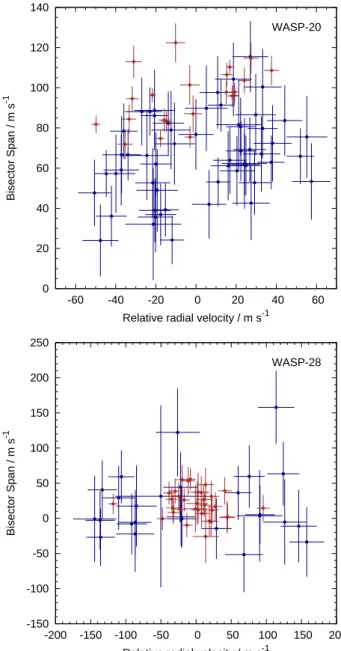
For each star, we tested the hypothesis that the RV variations are due to spectral-line distortions caused by a blended eclips-ing binary or starspots by performeclips-ing a line-bisector analysis of the cross-correlation functions (Queloz et al. 2001). The lack of any significant correlation between bisector span and RV sup-ports our conclusion that the periodic dimming and RV variation of each system are caused by a transiting planet (Figure 4). This is further supported by our observation of the RM effect of each system: the v sin I∗values from our fits to the RM effects are con-sistent with the values we obtain from spectral line broadening (see Sections 3 and 4).
We performed follow-up transit observations to refine the systems’ parameters using the 1.2-m Swiss Euler telescope (Lendl et al. 2012), and LCOGT’s 2.0-m Faulkes Telescopes North and South (Brown et al. 2013). Some transit lightcurves were affected by technical problems or poor weather, as indi-cated in Table 1.
Table 1. Summary of observations
Facility Date Nobs Texp Filter Issue
(s) WASP-20:
WASP-South 2006 May–2007 Nov 9 600 30 Broad (400–700 nm) — Euler/CORALIE 2008 Jul–2013 Oct 56 1800 Spectroscopy — ESO-3.6m/HARPS 2008 Aug–2011 Sep 20 600–1800 Spectroscopy —
FTS/Spectral 2008 Oct 25 151 40 z′ autoguider
ESO-3.6m/HARPS 2009 Oct 22 43 300–400/1200 Spectroscopy —
FTN/Merope 2011 Aug 20 70 70 z′ rotator
Euler/EulerCam 2011 Aug 29 237 20 Gunn-r cloud
Euler/EulerCam 2011 Sep 03 156 70 Gunn-r —
Euler/EulerCam 2011 Sep 08 201 30 Gunn-r —
WASP-28
WASP-South 2008 Jun–2009 Nov 10 100 30 Broad (400–700 nm) — SuperWASP-North 2008 Aug–2010 Sep 6 600 30 Broad (400–700 nm) — Euler/CORALIE 2009 Jun–2012 Dec 26 1800 Spectroscopy —
FTN/Merope 2009 Oct 21 227 40 z′ unknown
ESO-3.6m/HARPS 2010 Aug 17–19 33 600/1200 Spectroscopy —
Relative flux 0.95 1 1.05 0.4 0.6 0.8 1 1.2 1.4 1.6 Relative flux WASP FTN PS-z FTN PS-z Euler r Euler r Euler r 0.88 0.9 0.92 0.94 0.96 0.98 1 0.98 1 1.02
Relative radial velocity / m s
-1 Orbital phase -80 -60 -40 -20 0 20 40 60 80 0.4 0.6 0.8 1 1.2 1.4 1.6
Fig. 1. WASP-20b discovery data. Top panel: WASP lightcurve folded on the transit ephemeris. Middle panel: Transit lightcurves from facilities as labelled, offset for clarity and binned with a bin width of two minutes. The best-fitting tran-sit model is superimposed. Bottom panel: The radial velocities (CORALIE in blue, HARPS in brown) with the best-fitting cir-cular Keplerian orbit model and the RM effect model.
Relative flux 0.95 1 1.05 0.4 0.6 0.8 1 1.2 1.4 1.6 Relative flux WASP FTN PS-z Euler r 0.9 0.92 0.94 0.96 0.98 1 1.02 0.96 0.98 1 1.02 1.04
Relative radial velocity / m s
-1 Orbital phase -200 -150 -100 -50 0 50 100 150 200 0.4 0.6 0.8 1 1.2 1.4 1.6
-40 -20 0 20 40 0.98 0.99 1 1.01 1.02
Relative radial velocity / m s
-1 Orbital phase WASP-20 -60 -40 -20 0 20 40 60 0.96 0.97 0.98 0.99 1 1.01 1.02 1.03 1.04
Relative radial velocity / m s
-1
Orbital phase
WASP-28
Fig. 3. The Rossiter-McLaughlin effects, or spectroscopic tran-sits, of WASP-20b and WASP-28b. The CORALIE RVs are shown in blue and the HARPS RVs are shown in brown; the Keplerian orbits have been subtracted. For each planet, the ob-served apparent redshift, followed by an apparent blueshift of similar amplitude, indicate the orbit to be prograde and, proba-bly, aligned with the stellar rotation. The alignment of the orbit of WASP-28b is less certain due to its low impact parameter. The lower precision of the earlier WASP-28 RVs resulted because the sequence started at an airmass of 1.7.
3. Stellar parameters from spectra
The 9 individual HARPS spectra from 2008 of WASP-20 were co-added and a total of 18 individual CORALIE spectra were co-added to produce one spectrum per star with typical S/N of 150:1 (WASP-20) and 70:1 (WASP-28). The standard pipeline reduction products were used in the analysis.
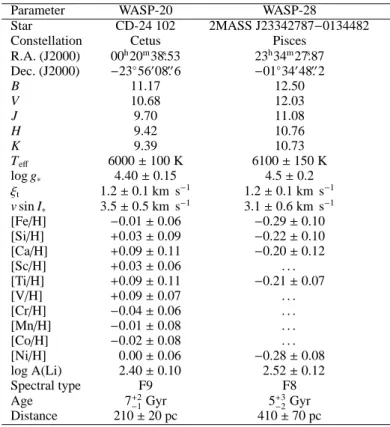
The analysis was performed using the methods given in Gillon et al. (2009). The Hα line was used to determine the ef-fective temperature (Teff), while the Na i D and Mg i b lines were used as surface gravity (log g∗) diagnostics. The parame-ters obtained from the analysis are listed in Table 4. The elemen-tal abundances were determined from equivalent width measure-ments of several clean and unblended lines. A value for micro-turbulence (ξt) was determined from Fe i using Magain’s (1984) method. The quoted error estimates include that given by the uncertainties in Teff, log g∗and ξt, as well as the scatter due to measurement and atomic data uncertainties.
We assumed values for macroturbulence (vmac) of 4.5 ± 0.3 km s−1and 4.7 ± 0.3 km s−1for WASP-20 and WASP-28, re-spectively. These were based on the tabulation by Gray (2008) and the instrumental FWHMs of 0.065Å (HARPS) and 0.11 ± 0.01 Å (CORALIE), as determined from the telluric lines around 6300Å. We determined the projected stellar rotation velocity
0 20 40 60 80 100 120 140 -60 -40 -20 0 20 40 60 Bisector Span / m s -1
Relative radial velocity / m s-1
WASP-20 -150 -100 -50 0 50 100 150 200 250 -200 -150 -100 -50 0 50 100 150 200 Bisector Span / m s -1
Relative radial velocity / m s-1
WASP-28
Fig. 4. The lack of any significant correlation between bisector span and radial velocity excludes transit mimics and supports our conclusion that each system contains a transiting planet. (v sin I∗) by fitting the profiles of several unblended Fe i lines. We determined the v sin I∗of WASP-20 from the 62 HARPS spec-tra obtained up 2010 and the v sin I∗ of WASP-28 from all 33 available HARPS spectra.
4. System parameters from the RV and transit data
We determined the parameters of each system from a simulta-neous fit to the lightcurve and radial-velocity data. The fit was performed using the current version of the Markov-chain Monte Carlo (MCMC) code described by Collier Cameron et al. (2007) and Pollacco et al. (2008).
The transit lightcurves are modelled using the formulation of Mandel & Agol (2002) with the assumption that the planet is much smaller than the star. Limb-darkening was accounted for using a four-coefficient, nonlinear limb-darkening model, using coefficients appropriate to the passbands from the tabulations of Claret (2000, 2004). The coefficients are interpolated once using
Table 4. Stellar parameters from the spectra
Parameter WASP-20 WASP-28
Star CD-24 102 2MASS J23342787−0134482 Constellation Cetus Pisces
R.A. (J2000) 00h20m38.s53 23h34m27.s87 Dec. (J2000) −23◦56′08.′′6 −01◦34′48.′′2 B 11.17 12.50 V 10.68 12.03 J 9.70 11.08 H 9.42 10.76 K 9.39 10.73 Teff 6000 ± 100 K 6100 ± 150 K log g∗ 4.40 ± 0.15 4.5 ± 0.2 ξt 1.2 ± 0.1 km s−1 1.2 ± 0.1 km s−1 v sin I∗ 3.5 ± 0.5 km s−1 3.1 ± 0.6 km s−1 [Fe/H] −0.01 ± 0.06 −0.29 ± 0.10 [Si/H] +0.03 ± 0.09 −0.22 ± 0.10 [Ca/H] +0.09 ± 0.11 −0.20 ± 0.12 [Sc/H] +0.03 ± 0.06 . . . [Ti/H] +0.09 ± 0.11 −0.21 ± 0.07 [V/H] +0.09 ± 0.07 . . . [Cr/H] −0.04 ± 0.06 . . . [Mn/H] −0.01 ± 0.08 . . . [Co/H] −0.02 ± 0.08 . . . [Ni/H] 0.00 ± 0.06 −0.28 ± 0.08 log A(Li) 2.40 ± 0.10 2.52 ± 0.12 Spectral type F9 F8 Age 7+2 −1Gyr 5 +3 −2Gyr Distance 210 ± 20 pc 410 ± 70 pc
Notes: We determined v sin I∗ from different subsets of spectra than the other parameters, as described in the text. The magnitudes are from the NOMAD catalogue (Zacharias et al. 2004). The spectral types are estimated from Teffusing Table B.1 in Gray (2008).
the values of log g∗and [Fe/H] in Table 4, but are interpolated at each MCMC step using the latest value of Teff. The coefficient values corresponding to the best-fitting value of Teff are given in Table 5. The transit lightcurve is parameterised by the epoch of mid-transit T0, the orbital period P, the planet-to-star area ra-tio (RP/R∗)2, the approximate duration of the transit from initial to final contact T14, and the impact parameter b = a cos iP/R∗ (the distance, in fractional stellar radii, of the transit chord from the star’s centre in the case of a circular orbit), where a is the semimajor axis and iPis the inclination of the orbital plane with respect to the sky plane.
The eccentric Keplerian radial-velocity orbit is parame-terised by the stellar reflex velocity semi-amplitude K1, the sys-temic velocity γ, an instrumental offset between the HARPS and CORALIE spectrographs ∆γHARPS, and √e cos ω and √e sin ω where e is orbital eccentricity and ω is the argument of perias-tron. We use √e cos ω and √e sin ω as they impose a uniform
prior on e, whereas the jump parameters we used previously,
e cos ω and e sin ω, impose a linear prior that biases e toward
higher values (Anderson et al. 2011b). The RM effect was mod-elled using the formulation of Gim´enez (2006) and, for similar reasons, is parameterised by √v sin I cos λ and √v sin I sin λ.
The linear scale of the system depends on the orbital separa-tion a which, through Kepler’s third law, depends on the stellar mass M∗. At each step in the Markov chain, the latest values of ρ∗, Teff and [Fe/H] are input in to the empirical mass cali-bration of Enoch et al. (2010) (as based upon Torres et al. 2010 and as updated by Southworth 2011) to obtain M∗. The shapes of the transit lightcurves and the radial-velocity curve constrain
bines with M∗to give the stellar radius R∗. The stellar effective temperature Teffand metallicity [Fe/H] are proposal parameters constrained by Gaussian priors with mean values and variances derived directly from the stellar spectra (see Section 3).
As the planet-to-star area ratio is determined from the mea-sured transit depth, the planet radius RP follows from R∗. The planet mass MPis calculated from the measured value of K1and the value of M∗; the planetary density ρP and surface gravity log gPthen follow. We calculate the planetary equilibrium tem-perature Teql, assuming zero albedo and efficient redistribution of heat from the planet’s presumed permanent day side to its night side. We also calculate the durations of transit ingress (T12) and egress (T34).
At each step in the MCMC procedure, model transit lightcurves and radial velocity curves are computed from the proposal parameter values, which are perturbed from the previ-ous values by a small, random amount. The χ2statistic is used to judge the goodness of fit of these models to the data and the de-cision as to whether to accept a step is made via the Metropolis-Hastings rule (Collier Cameron et al. 2007): a step is accepted if χ2is lower than for the previous step and a step with higher χ2 is accepted with a probability proportional to exp(−∆χ2/2). This gives the procedure some robustness against local minima and results in a thorough exploration of the parameter space around the best-fitting solution. To give proper weighting to each pho-tometric data set, the uncertainties were scaled at the start of the MCMC so as to obtain a photometric reduced-χ2of unity. To ob-tain a spectroscopic reduced-χ2of unity we added ‘jitter’ terms in quadrature to the formal RV errors of WASP-20: 12 m s−1for the CORALIE RVs and 7 m s−1 for the HARPS RVs; no jitter was required for WASP-28.
For both WASP-20b and WASP-28b we find, using the F-test approach of Lucy & Sweeney (1971), that the improvement in the fit to the RV data resulting from the use of an eccentric or-bit model is small and is consistent with the underlying oror-bit be-ing circular. We thus adopt circular orbits, which Anderson et al. (2012) suggest is the prudent choice for short-period,∼Jupiter-mass planets in the absence of evidence to the contrary. We find 2-σ upper limits on e of 0.11 and 0.14 for WASP-20b and WASP-28b, respectively.
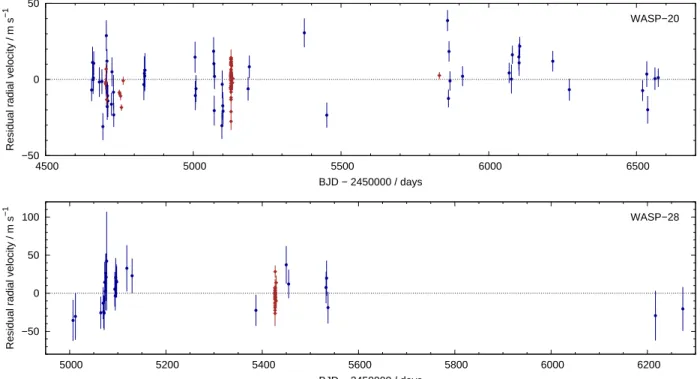
Due to the low impact parameter of WASP-28b determi-nations of v sin I∗ and λ are degenerate (Triaud et al. 2011; Albrecht et al. 2011; Anderson et al. 2011a). To ensure v sin I∗ is consistent with our spectroscopic measurement, we imposed a Gaussian prior on it by means of a Bayesian penalty on χ2, with mean and variance as determined from the HARPS spectra (see Section 3). From an MCMC run with no prior we obtained λ = −8 ± 54◦and v sin I∗= 4.1+5.9−0.9km s−1, with v sin I∗reaching values as high as 30 km s−1, which is clearly inconsitent with the spectral measurement of v sin I∗= 3.1 ± 0.6 km s−1. The de-generacy between v sin I∗and λ could be broken by line-profile tomography (Albrecht et al. 2007; Collier Cameron et al. 2010). The median values and the 1-σ limits of our MCMC parame-ters’ posterior distributions are given in Table 6 along with those of the derived parameters. The best fits to the radial velocities and the photometry are plotted in Figures 1 and 2, with the RM effects highlighted in Figure 3. There is no evidence of additional bodies in the RV residuals (Figure 5).
We checked the effect of splitting the HARPS RVs for WASP-20 into two sets: those taken around the spectroscopic transit observation, spanning 2009 Oct 20–28, and the remain-der. The fit to the RM effect was very similar to that when treat-ing the HARPS RVs as a streat-ingle dataset (λ = 11.9 ± 3.8◦; v sin I
Table 5. Limb-darkening coefficients
Planet Instrument Observation bands Claret band a1 a2 a3 a4 WASP-20 WASP / EulerCam Broad (400–700 nm) / Gunn r Cousins R 0.577 −0.042 0.484 −0.290
WASP-20 FTN / FTS Sloan z′ Sloan z′ 0.652 −0.345 0.635 −0.325
WASP-28 WASP / EulerCam Broad (400–700 nm) / Gunn r Cousins R 0.428 0.456 −0.175 −0.023
WASP-28 FTN Sloan z′ Sloan z′ 0.516 0.036 0.160 −0.135
1.2 1.4 5500 6000 6500 ( ρ* / ρO• ) -1/3 T*,eff / K 3.0 Gyr 11.0 Gyr 1.2 MO• 0.9 MO• WASP-20 1 1.2 5800 6000 6200 6400 ( ρ* / ρO• ) -1/3 T*,eff / K 1.0 Gyr 10.0 Gyr 1.0 MO• 0.8 MO• WASP-28
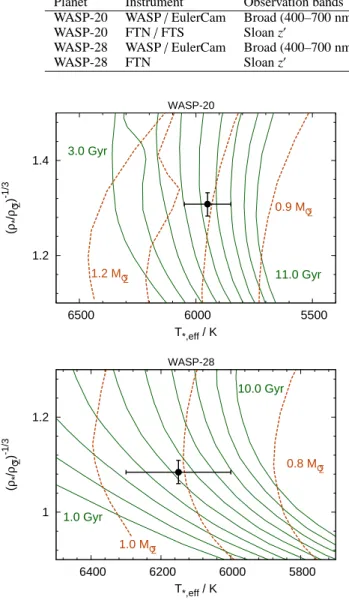
Fig. 6. Modified H–R diagrams. The isochrones, from Bressan et al. (2012), are in steps of integer Gyr with Z = 0.0152 for WASP-20 and Z = 0.0078 for WASP-28. The mass tracks, from Bertelli et al. (2008), are in steps of 0.1 M⊙with Z = 0.019 for WASP-20 and Z = 0.0097 for WASP-28.
We interpolated the mass tracks of Bertelli et al. (2008) and the isochrones of Bressan et al. (2012) using ρ∗, Teffand [Fe/H] from the MCMC analysis (Figure 6). This suggests an age of 7+2−1Gyr for WASP-20 and 5+3−2Gyr for WASP-28. The mass tracks suggest a stellar mass of 1.02+0.07−0.03M⊙for WASP-20 and 0.91 ± 0.06 M⊙for WASP-28. These are slightly lower than the masses derived from our MCMC analyses (1.20 ± 0.04 M⊙for WASP-20 and 1.02 ± 0.05 M⊙ for WASP-28), though they are consistent at the 2.3-σ (WASP-20) and 1.4-σ (WASP-28) levels.
5. Discussion
We present the discovery of WASP-20b, a Saturn-mass planet in a 4.9-day orbit around CD-24 102, and WASP-28b, a Jupiter-mass planet in a 3.4-day orbit around a V=12 star. Based on their masses, orbital distances, irradiation levels and metallicities, the radii of the planets (1.46 RJup for WASP-20b and 1.21 RJupfor
WASP-28b) are consistent with the predictions of the empiri-cal relations of Enoch et al. (2012): 1.33 RJupfor WASP-20b and 1.26 RJupfor WASP-28b.
We find both planets to be in prograde orbits and, as the
v sin I∗ values are consistent with expectations for v for such stars, it is probable that I∗ ≈ 90◦ and so Ψ ≈ λ. Assuming the spin axis of WASP-20 to be in the sky plane, the orbit of WASP-20b is aligned or near-aligned with the stellar spin (λ = 8.1 ± 3.6◦). Although our determination for WASP-28b (λ = 8 ± 18◦) is consistent with an aligned orbit, its low impact parameter results in a greater uncertainty.
Both host stars are near the posited boundary between ef-ficient and inefef-ficient aligners of Teff ≈ 6250 K (Winn et al. 2010; Schlaufman 2010). Both systems, with their low obliq-uity determinations, are consistent with the observation that sys-tems with cool host stars and short expected tidal timescales are aligned (Albrecht et al. 2012 and references therein). With
MP/M∗ = 0.00025 and a/R∗= 9.3, WASP-20b experiences rel-atively weak tidal forces. Its relative tidal dissipation timescale of τCE = 2.6 × 10¹³ yr is the longest for the cool-host group barring HD 17156 b (see section 5.3 of Albrecht et al. 2012). 2 With MP/M∗ = 0.00084 and a/R∗ = 9.5, τCE = 2.5 × 10¹² yr for WASP-28b, placing it within the main grouping of aligned, cool-host systems. Assuming the planets did not arrive in their current orbits recently, the advanced age of both systems, 7+2−1 Gyr for WASP-20 and 5+3
−2Gyr for WASP-28, mean tidal dissi-pation would have occurred over a long timescale.
The planets may have arrived in their current orbits via planet-disc migration (Lin et al. 1996; Marzari & Nelson 2009) or via the scattering and circularisation route (Fabrycky & Tremaine 2007; Nagasawa et al. 2008; Matsumura et al. 2010; Naoz et al. 2011). Assuming the latter, the planets may have scattered into aligned orbits or they may have aligned with the spins of their host stars via tidal inter-action, though how this could have occurred without the planets falling into their stars is currently a mystery (Barker & Ogilvie 2009).
Acknowledgements
WASP-South is hosted by the South African Astronomical Observatory and SuperWASP-North is hosted by the Isaac Newton Group on La Palma. We are grateful for their ongoing support and assistance. Funding for WASP comes from consor-tium universities and from the UK’s Science and Technology Facilities Council. M. Gillon is a FNRS Research Associate. A. H. M. J. Triaud is a Swiss National Science Foundation fellow under grant number PBGEP2-145594.
References
Albrecht, S., Reffert, S., Snellen, I., Quirrenbach, A., & Mitchell, D. S. 2007, A&A, 474, 565
2 Note that these timescales are relative and that Albrecht et al. (2012) plot the timescales divided by 5 × 10⁹.
−50 0 50
4500 5000 5500 6000 6500
Residual radial velocity / m s
−1 BJD − 2450000 / days WASP−20 −50 0 50 100 5000 5200 5400 5600 5800 6000 6200
Residual radial velocity / m s
−1
BJD − 2450000 / days
WASP−28
Fig. 5. The residuals about the best-fitting Keplerian orbits as a function of time (CORALIE in blue, HARPS in brown). There is no evidence of additional bodies.
Albrecht, S., Winn, J. N., Johnson, J. A., et al. 2011, ApJ, 738, 50 Albrecht, S., Winn, J. N., Johnson, J. A., et al. 2012, ApJ, 757, 18
Anderson, D. R., Collier Cameron, A., Gillon, M., et al. 2012, MNRAS, 422, 1988
Anderson, D. R., Collier Cameron, A., Gillon, M., et al. 2011a, A&A, 534, A16 Anderson, D. R., Collier Cameron, A., Hellier, C., et al. 2011b, ApJ, 726, L19 Bakos, G., Noyes, R. W., Kov´acs, G., et al. 2004, PASP, 116, 266
Baranne, A., Queloz, D., Mayor, M., et al. 1996, A&AS, 119, 373 Barker, A. J. & Ogilvie, G. I. 2009, MNRAS, 395, 2268
Bate, M. R., Lodato, G., & Pringle, J. E. 2010, MNRAS, 401, 1505 Bertelli, G., Girardi, L., Marigo, P., & Nasi, E. 2008, A&A, 484, 815 Borucki, W. J., Koch, D., Basri, G., et al. 2010, Science, 327, 977 Bressan, A., Marigo, P., Girardi, L., et al. 2012, MNRAS, 427, 127 Brown, T. M., Baliber, N., Bianco, F. B., et al. 2013, PASP, 125, 1031 Claret, A. 2000, A&A, 363, 1081
Claret, A. 2004, A&A, 428, 1001
Collier Cameron, A., Bruce, V. A., Miller, G. R. M., Triaud, A. H. M. J., & Queloz, D. 2010, MNRAS, 403, 151
Collier Cameron, A., Pollacco, D., Street, R. A., et al. 2006, MNRAS, 373, 799 Collier Cameron, A., Wilson, D. M., West, R. G., et al. 2007, MNRAS, 380,
1230
Enoch, B., Collier Cameron, A., & Horne, K. 2012, A&A, 540, A99
Enoch, B., Collier Cameron, A., Parley, N. R., & Hebb, L. 2010, A&A, 516, A33 Fabrycky, D. & Tremaine, S. 2007, ApJ, 669, 1298
Faedi, F., Barros, S. C. C., Pollacco, D., et al. 2011, Detection and Dynamics of Transiting Exoplanets, St. Michel l’Observatoire, France, Edited by F. Bouchy; R. D´ıaz; C. Moutou; EPJ Web of Conferences, Volume 11, id.01003, 11, 1003
Gim´enez, A. 2006, ApJ, 650, 408
Gray, D. F. 2008, The Observation and Analysis of Stellar Photospheres (Cambridge University Press)
Greaves, J. S., Kennedy, G. M., Thureau, N., et al. 2014, MNRAS, 438, L31 Hellier, C., Anderson, D. R., Collier Cameron, A., et al. 2011, Detection and
Dynamics of Transiting Exoplanets, St. Michel l’Observatoire, France, Edited by F. Bouchy; R. D´ıaz; C. Moutou; EPJ Web of Conferences, Volume 11, id.01004, 11, 1004
Lai, D., Foucart, F., & Lin, D. N. C. 2011, MNRAS, 412, 2790
Lendl, M., Anderson, D. R., Collier-Cameron, A., et al. 2012, A&A, 544, A72 Lin, D. N. C., Bodenheimer, P., & Richardson, D. C. 1996, Nature, 380, 606 Lucy, L. B. & Sweeney, M. A. 1971, AJ, 76, 544
Mandel, K. & Agol, E. 2002, ApJ, 580, L171 Marzari, F. & Nelson, A. F. 2009, ApJ, 705, 1575
Matsumura, S., Peale, S. J., & Rasio, F. A. 2010, ApJ, 725, 1995
Maxted, P. F. L., Anderson, D. R., Collier Cameron, A., et al. 2011, PASP, 123, 547
Mayor, M., Pepe, F., Queloz, D., et al. 2003, The Messenger, 114, 20 McLaughlin, D. B. 1924, ApJ, 60, 22
Nagasawa, M., Ida, S., & Bessho, T. 2008, ApJ, 678, 498
Naoz, S., Farr, W. M., Lithwick, Y., Rasio, F. A., & Teyssandier, J. 2011, Nature, 473, 187
Pepe, F., Mayor, M., Queloz, D., et al. 2005, The Messenger, 120, 22 Pollacco, D., Skillen, I., Collier Cameron, A., et al. 2008, MNRAS, 385, 1576 Pollacco, D. L., Skillen, I., Cameron, A. C., et al. 2006, PASP, 118, 1407 Queloz, D., Henry, G. W., Sivan, J. P., et al. 2001, A&A, 379, 279 Queloz, D., Mayor, M., Weber, L., et al. 2000, A&A, 354, 99 Rogers, T. M., Lin, D. N. C., & Lau, H. H. B. 2012, ApJ, 758, L6 Rossiter, R. A. 1924, ApJ, 60, 15
Schlaufman, K. C. 2010, ApJ, 719, 602
Seager, S. & Mall´en-Ornelas, G. 2003, ApJ, 585, 1038 Southworth, J. 2011, MNRAS, 417, 2166
Torres, G., Andersen, J., & Gim´enez, A. 2010, A&A Rev., 18, 67 Triaud, A. H. M. J. 2011, A&A, 534, L6
Triaud, A. H. M. J., Collier Cameron, A., Queloz, D., et al. 2010, A&A, 524, A25+
Triaud, A. H. M. J., Queloz, D., Hellier, C., et al. 2011, A&A, 531, A24 Winn, J. N., Fabrycky, D., Albrecht, S., & Johnson, J. A. 2010, ApJ, 718, L145 Zacharias, N., Monet, D. G., Levine, S. E., et al. 2004, in Bulletin of the
American Astronomical Society, Vol. 36, American Astronomical Society Meeting Abstracts, 1418
Table 6. System parameters from the MCMC analyses
Parameter Symbol WASP-20 WASP-28 Unit
Orbital period P 4.8996285 ± 0.0000034 3.4088300 ± 0.000006 d Epoch of mid-transit Tc 2 455 715.65562 ± 0.00028 2 455 290.40519 ± 0.00031 BJD (UTC)
Transit duration T14 0.1416 ± 0.0013 0.1349 ± 0.0010 d
Transit ingress/egress duration T12= T34 0.0263 ± 0.0016 0.01441 ± 0.00070 d Scaled orbital major semi-axis a/R∗ 9.29 ± 0.23 8.79 ± 0.19
Planet-to-star area ratio ∆F = R2 P/R
2
∗ 0.01161 ± 0.00022 0.01300 ± 0.00027
Impact parameter b 0.718 ± 0.018 0.21 ± 0.10
Orbital inclination iP 85.57 ± 0.22 88.61 ± 0.67 ◦
Stellar reflex velocity semi-amplitude K1 33.0 ± 1.7 120.5 ± 4.2 m s−1 Systemic velocity γ 1 316.222 ± 0.080 24 216.41 ± 0.43 m s−1
Offset between HARPS & CORALIE ∆γHARPS 16.10 ± 0.74 6.0 ± 1.2 m s−1 Eccentricity e 0 (adopted; <0.11 at 2 σ) 0 (adopted; <0.14 at 2 σ)
Sky-projected spin-orbit angle λ 8.1 ± 3.6 8 ± 18 ◦
Sky-projected stellar rotation velocity v sin I∗ 4.71 ± 0.50 3.25 ± 0.34 km s−1
Stellar mass M∗ 1.202 ± 0.040 1.021 ± 0.050 M⊙
Stellar radius R∗ 1.392 ± 0.044 1.094 ± 0.031 R⊙
Stellar surface gravity log g∗ 4.232 ± 0.020 4.370 ± 0.018 (cgs)
Stellar density ρ∗ 0.447 ± 0.033 0.784 ± 0.058 ρ⊙
Stellar effective temperature Teff 5950 ± 100 6150 ± 140 K Stellar metallicity [Fe/H] −0.009 ± 0.061 −0.290 ± 0.10
Planetary mass MP 0.313 ± 0.018 0.907 ± 0.043 MJup
Planetary radius RP 1.458 ± 0.057 1.213 ± 0.042 RJup
Planetary surface gravity log gP 2.527 ± 0.036 3.149 ± 0.028 (cgs) Planetary density ρP 0.1006+0.0131−0.0099 0.508 ± 0.047 ρJup Orbital major semi-axis a 0.06003 ± 0.00067 0.04469 ± 0.00076 AU Planetary equilibrium temperature Teql 1379 ± 32 1468 ± 37 K