EuroMedMig Working-Paper Series
EuroMedMig Policy Paper Series
Number 5, January 2021
When North African emigration
turns into diasporas
Migration dynamics, collective action and State responses
Prepared by
Hassan BOUSETTA
FNRS Research Professor (University of Liège,
CEDEM), Liège, Belgium
Contents
I. Introduction
II. From emigrant communities to global diasporas III. Demographic outlook of North African diasporas IV. The economic significance of North African diasporas
V. The challenge of minimising brain-drain costs and of simultaneously maximising diaspora-led transfers of knowledge and technology
VI. Collective action aimed at mobilising diasporas politically
VII. Diasporic healthcare consumption strategies before and during the COVID19 pandemics VIII. Will North African diasporic cultural identities turn into diasporic creative cultural industries?
IX. Concluding remarks and recommendations X. References
XI. National Workshop´s agenda/program
XII. List of Experts (presented in alphabetical order)
Suggested citation:
BOUSETTA, H. (prepared by) (2021) “When Western Mediterranean diasporas turn into diasporas: migration dynamics, collective action and State responses” EuroMedMig Policy Paper
Series, no. 5 (January): URL
This work is licensed under the Creative Commons Attribution-NonCommercial 4.0 International License. Click here to view a copy of this license.
The EuroMedMig Policy Papers Series aims to promote knowledge exchange and dialogue among actors working on a particular topic on Mediterranean Migration, comprising of international and Mediterranean organizations, stakeholders, civil society organizations, policymakers and politicians at all levels of government.
This Policy Paper is a summary of the National Workshop entitled “When West Mediterranean Emigration Turns into Diaspora: Migration Dynamics, Collective Action and State Responses” organized by CEDEM, University of Liège, on November 5th 2020 and held online. The agenda and list of participants of this
Workshop are in sections XI and XII.
The main objective of this Policy Paper is to summarize the premises put forward during this National Workshop with the purpose of sharing what was considered as substantial policy-relevant arguments and recommendations for the development of MedMig policies.
I. Introduction
This policy-paper is the outcome of a workshop jointly organized by the Euromedmig network and the CEDEM (University of Liège). The meeting dealt with the role of migration and diaspora-formation in the Western Mediterranean region and was held online on 5th November
2020 due to the COVID19 pandemics. The initial guiding argument of the Belgian national workshop was that processes concerned with redefining the links between home societies and so-called diasporas lie at the crossroads of new migration dynamics, new modes of collective action among emigrant communities and new State responses to these demands.
The Belgian national workshop will look at the transformations of Western Mediterranean migration from both the perspective of host and home societies. The idea was to look at how and why Western Mediterranean migrant communities are being redefined as diasporas. What does this turn mean in terms of integration dynamics and home/host countries relations? What are the issues at stake for both home and destination societies? What are, on the one hand, the implications in terms of remittances, circulation of care, brain drain for home societies, and on the other hand, the consequences in terms of “living together” in host societies?
In order to address these questions in a meaningful way, the workshop offered papers that addressed old and new migration patterns towards North West Europe. It firstly looked at conceptual issues such as the difference between diasporas and transnational migrant communities. It also looked at how gender inequalities are generated by migration and settlement patterns in destination societies. The working conditions of Mediterranean migrant women in labour intensive sectors such as agriculture was a case in point. The workshop also looked at new patterns of diaspora formation within the diaspora. The focus was placed here on how the generational experience of second-generation West-Mediterranean migrant is giving rise to new aspirations and global mobilities (Montreal, Dubai, etc.). The meeting also analysed the claims-making activity of settled migrant communities. What are their expectations in terms of integration in host countries and reintegration in home countries? Finally, the meeting looked at how State responses are formulated to migrants and diasporas’ demands.
II. From emigrant communities to global diasporas
Immigration towards North West Europe from and through the West Mediterranean is a well-established and well researched phenomenon. Colonial ties between the region, on the one hand, France and Spain, on the other hand, have set the stage for the creation of a migration corridor that has been active for more than a century. This has generated a complex web of long-distance connections and networks. Transnationalism and diaspora are two notions developed and discussed within academia to refer to these phenomena (Bauböck and Faist 2010). These distinct concepts are however sometimes used in confused, unclear or inadequate ways.
Although both diasporas and transnational collectives are social formations giving rise to shared identification, the sense of groupness associated to both should be clarified (Lacroix, 2018b). There is generally a difference to be made in terms of historical depth and geographical spread. While diasporic identities are seen as forged by long histories and, for some, by traumatic memories of dispersion, transnationalism is associated with more recent time-frames where individuals and collectives are simultaneously active in two or more different places. As Lacroix (2018b) suggests, transnationalism is about constructing and sustaining identities and social, economic, cultural and political practices across borders. He goes on arguing that the geographical outlook of diasporas is characterized by multipolar ties between an imagined homeland and a variety of places of settlement. Transnationalism is more evidently associated to the duality of the country of origin and destination. Transnational actors tend to develop multiscalar ties where translocal connections between places of departures and arrivals are central.
In recent years, the notion of diaspora has been strongly pushed forward through the rhetoric of Maghrebian State representatives. It has become commonsense to talk about a Moroccan, Algerian or Tunisian diaspora. While this is part of a broader global movement towards reshaping and renaming the nature of the relationships between international migrants and their home countries, it tends to conflate different notions leading to a form of conceptual confusion. How should we do justice to these complex understandings and nuances in practical and operational terms. While some are tempted to dismiss the use of diaspora for recent emigrant communities, others, in the footsteps of Robin Cohen (1997), are adopting and justifying the use of a modern view of diasporas that goes beyond the classical model of the forcibly dispersed diaspora.
With international institutions ranging from the World Bank to the OECD joining emigrant officials in the diaspora debate, the restrictive definition of diaspora already belongs to the past. No one can miss the increasing centrality the concept has acquired globally in policy-discussions dealing with migration and international development. This institutional push is of course no compelling reason for academics to abandon their quest for conceptual clarity. But there is also good reasons to keep using both notion of diasporas and transnationalism. Both are social formations evolving with their time. Recent scholarship tend to show this empirically so that no one can dismiss the case of transnational communities increasingly characterized by processes of diaspora-formation.
III. Demographic outlook of North African diasporas
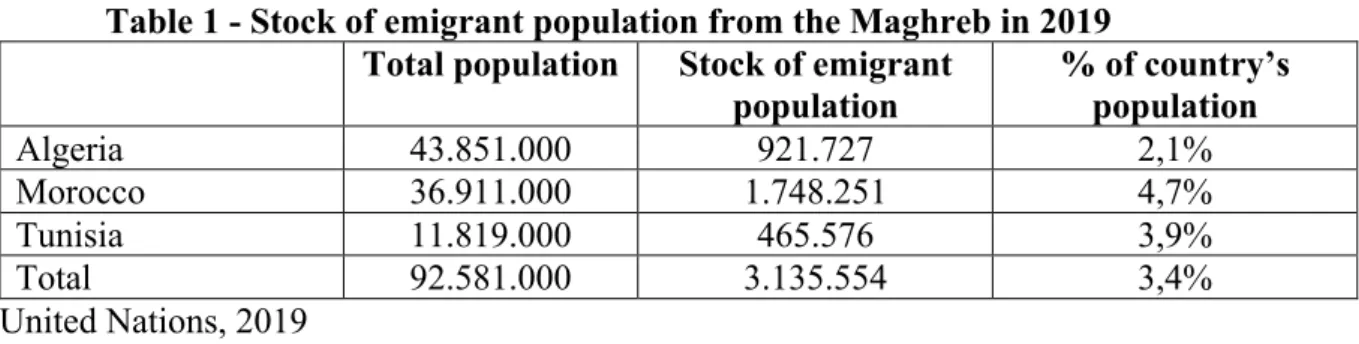
Morocco, Tunisia and Algeria have large shares of their population residing abroad. Estimating their size is methodologically uneasy. To a large extent, Maghrebian diasporas take their roots in labour migration. Recent data indicates that 3 Million Maghrebian nationals live outside their country which represent half the size of Indians, the largest group of international
migrants worldwide. As indicated in Table 1, Moroccans are the largest group of migrants from the Maghreb with 1,7M settled abroad. Algerians come second with 0,9M individuals. Tunisians represent half of the Algerian migrant population in the world with 0,4M people settled outside Tunisia.
Table 1 - Stock of emigrant population from the Maghreb in 2019
Total population Stock of emigrant
population % of country’s population Algeria 43.851.000 921.727 2,1% Morocco 36.911.000 1.748.251 4,7% Tunisia 11.819.000 465.576 3,9% Total 92.581.000 3.135.554 3,4% United Nations, 2019 https://www.un.org/en/development/desa/population/migration/data/estimates2/estimates19.asp (retrieved on 27th December 2020)
Even though they overlap to a certain extent, diasporas are distinct and potentially broader entities than migrant populations as many migrants have acquired citizenship of their country of residence and mixed with local populations over the years. This lies at the basis of the statistical discrepancies observed in social and political discourses. With more than a century of emigration towards France and other destinations, the diasporas of the Maghreb are particularly difficult to estimate. In July 2020, the Algerian President Abdelmajid Tebboune mentioned the figure of 6 Million Algerians abroad (See here). Other estimations from the academic literature points to a lower size estimated at 4 Million(Labat 2010). For Morocco, the same variations are observed. Estimations range between 3 and 5 Million residents overseas, which makes it represent the 10th
largest diaspora in the world. The Tunisians diaspora is estimated to represent more than a million people, one percent of the country’s population.
While the diaspora remains predominantly associated with the social representation of the classical economic migrant, the reality is of an increasing complexity and internal differentiation. This can be illustrated by the higher level of professional diversity and the emergence of highly-skilled categories trained in the countries of residence or brain-drain movers having left North Africa for better job opportunities. This is also reflected in the emergence of diasporas within the diasporas. As Jérémy Mandin has shown, new mobilities are currently driven by the second-generation giving rise to new mobilities towards global cities such as London, Dubai, Montreal, etc. (Mandin 2020).
IV. The economic significance of North African diasporas
The important role played by diasporas in the life of their countries of origin is illustrated by the size of the remittances sent back home. Nearly 10 billion USD have been transferred to the three countries of the Maghreb in 2020 despite the overall negative impact of the COVID19 pandemics on migrant remittances. The volume of transfers is of particular significance for Morocco and Tunisia (5,7% and 4,5% of their GDP respectively). Remittances contribute to alleviate poverty and has a positive effect on a wide range of variables including health and education.
Top recipients of remittances in the Middle East and North African Region, by total amount (Panel a) and share of GDP (Panel b), in 2020.
Maghrebian diasporas are expected to play a bigger role in the economic development of the region than they currently do. A recent study published by the OECD indicates for instance that Morocco does not take sufficient advantage of the economic potential of its diaspora. These weaknesses need to be tackled more offensively. There is a need to increase the policy coherence between diaspora policies and strategies dealing with domestic issues such as employment, education, environment, etc. (OECD. 2017). There is also a need for internal coherence at the level of policy-implementation. A better developmental impact of diasporas goes hand in hand with a better professional integration of non-migrant workers in the home country. The costs of the brain-drain for example may directly dwindle the benefits of diasporas development contribution.
V. The challenge of minimising brain-drain costs and simultaneously
maximizing diaspora-led transfers of knowledge and technology.
North African media gives on a regular basis an echo to the concerns of Maghreb leaders about the costs of the brain drain. No later than in January 2020, a debate was raised on the matter in the Moroccan Parliament on the subject. It was advocated that 10.430 Moroccan professionals had left the country in 2018, including 1.200 business men and women, 600 engineers and 630 medical doctors. During the debate, the Prime Minister Salah Eddine El Othmani has acknowledge the reality of the issue stating that Morocco is the third most impacted country in the world by the brain-drain. The Global Talent Competitiveness Index indicates that Algeria performs even more poorly in this respect. The two most populated countries of North Africa are also those most likely to waste a fraction of their educated elite.
The brain-drain is also part and parcel of the process of diaspora formation. Once abroad, highly skilled migrants tend to reconnect to the homeland in a variety of ways. This raises the challenge on how to foster the role of diaspora in supporting technology and knowledge transfer to countries of origin. North African governments have all begun a political dialogue with developed countries and within international policy circles on how to maximise the role of their diasporas. Discussions in the region are more advanced when it comes to remittances than when it is about strategies of knowledge and technology transfer. Part of the difficulty lies with an incomplete identification of the developmental projects carried out by diasporic actors. While Morocco and Tunisia have developed bilateral projects aimed at stimulating the entrepreneurship of their diaspora in partnership with development agencies of countries such as France, Belgium, Italy, Spain, the UK and Germany, to name but a few. Mapping and sorting out typologies of diasporic investors, monitoring their activities and evaluating their impact is an exercise that remains difficult for there is a lack of available data. Most often than not, transfer of knowledge and technologies towards North African countries play out below the radar of State institutions. Indians which make up one of the largest diaspora in the world are often quoted as a successful example of diaspora mobilization. The successful Indian stories of the Silicon Valley have permitted the development of offshoot projects back in India. This begs the question of whether North African countries are able to emulate the Indian model. There are important contextual differences which make it difficult to answer positively. However, the COVID19 crisis has shown the intellectual and scientific dynamism of Mediterranean diasporas. One should underline the role of people such as Moncef Slaoui, Belgian Moroccan researcher for the pharmaceutical company Moderna and the German Turkish couple, Özlem Türeci and Ugur Sahin, from BIONTech Pfizer. Their role in discovering the COVID19 vaccine is an illustration of the great potential of Mediterranean diasporas, both from the Eastern and Western sides of the
region. What their example illustrate is that diaspora have the potential to develop economic activities and sustain innovation simultaneously in different countries and continents.
VI. Collective action aimed at mobilizing diasporas politically
Understanding the logic of diasporic collective action aimed at mobilizing diasporas politically necessitate the elaboration of a periodisation linking each time-frame to the internal logic of emigration from the Maghreb, to the domestic political context in the three countries concerned and to the political situation in the countries of residence. Now, the collective action and transnational political activity of North African diasporas dates back to the colonial period. Anti-colonial Algerian, Moroccan and Tunisian liberation movements all had mobilizing activities outside the colonised territory, and often specifically in the French metropolis. There is a historical depth to the collective action of North Africans beyond borders. It is a very rich history, by and large, unwritten. It is beyond the scope of this paper to offer a historical analysis of the different generations of movements and actors who contributed to shape a sense of transnational critical political consciousness among emigrants.
In recent years, the Arab Spring protests have been carefully scrutinized by the diasporas. They have also been concerned by the other political after-effects of these protests. In 2016-17, Morocco faced the emergence of protests in a traditional emigration region in the North East, the Rif (Bousetta 2018). Since February 2020, the Algerian State is also shaken by a powerful protest movement, the Hirak, which is also carefully observed and supported from abroad. This illustrates the supportive role diaspora often play in echoing the political conflicts of the homeland.
Migration-related conflict within societies of residence are also mediated by long-distance networks. The struggle of the Strawberry Ladies (Dames de Fraise) studied by Chadia Arab offers an example of a local protest of female Moroccan migrant workers which ended up receiving wide public attention in Europe and Morocco. This was the result of the political amplification provided by Moroccan voluntary associations elsewhere in Spain and in Europe. These transnational claims-making offered a decisive strategic support to the female workers engaged in a local conflict with their abusive employers.
One should finally mention that the question of external voting for diasporas has been debated and dealt with in different terms in the three countries of the central Maghreb. Tunisians extended the right and possibility to vote from abroad after the Jasmin Revolution of 2010. Algeria, on its side, had a long practice of extending voting rights to their citizens abroad. The situation is more complex and conflictual in Morocco. While Moroccans are allowed to participate in referendums, they are not entitled to vote from abroad. All Moroccan have voting rights but only within Morocco. Voting from afar is not permitted although it has been the basis of a strong claims-making activity among diasporic associations since 2006.
VII. Diasporic healthcare consumption strategies before and during the COVID19 pandemics
Securing access to social rights and healthcare entitlements is an important preoccupation for any internationally mobile individual upon settlement in a new destination country. There is a sizeable literature documenting the various linkages between immigration and health. What is
less known is the increasing role played by healthcare-driven mobilities sometimes also called ‘medical tourism’. These are well known in North Africa but they were generally of a South North nature. What is at stake today is the reverse. New cross-borders health practices are re-shaping how medical care is accessed transnationally both within the East Mediterranean (i.e.Turkey) and West Mediterranean (ie. Tunisia). With the increasing globalization of healthcare governance, migrants are responding to these new geographies of medical care opportunities as much as non-migrants do. In the North African context, the PhD study of Carole Wenger is pioneering in this respect. Tunisia being a major destination for medical tourism in the region, her ongoing research shows how Tunisians are balancing healthcare opportunities between here and there. In contrast to non-migrants, the consumption of medical care by Tunisians in their country of origin give rise to the production of new bonds with Tunisia and to the emergence of a diasporic model of medical mobilities. In other words, pre-existing ties with Tunisia are shaping a transnational way of consuming medical care while the latter shape new affective ties which have sometimes been described as expressions of medical patriotism.
The Covi19 pandemics has temporarily disrupted the model but other practices worth of the highest interest are also emerging in parallel. Diasporic Tunisian organization have allowed a range of solidarity initiative to blossom during the crisis. They range from collecting funds for vulnerable groups to offering online medical assistance. Similar dynamics have been observed among Moroccan and Algerian diasporic organization. The transnational consumption and provision of medical care offers a promising new area for studying how diaspora position themselves in relation to healthcare. It remains however difficult to compare the Tunisian case with the Algerian and Moroccan ones as this remains an under-researched area in these countries.
VIII. Will North African diasporic cultural identities turn into diasporic creative cultural industries?
Diasporic lifestyles are a source of richness for themselves as well as for others. Diaspora are permanently in touch with cultural negotiations involved in migratory and transnational experiences. How can North African diaspora promote the role of cultures and interculturalism for leveraging increased transnational cooperation and development.
This is a broad and complex debate that is dependent on our conceptions of culture. From the vantage point of receiving societies, it is now well established that a diverse workforce is an economic asset. There is evidence of increased productivity and economic impact of companies open and welcoming cultural diversity. There is however an alternative way to look at the cultural role of diasporas, from the standpoint of the country of origin this time.
Culture can also be apprehended as an element of the creative economy rather than as a factor of distinction and identity. In France, the economy of cultural goods represents more than the car industry. With the breakthrough of digital communication, the creative sector is now worth more than 1000 billion USD worldwide. Diaspora and transnationalism have also their importance in this respect. Cultural goods have always been intensively exchanged between homelands and the destination countries. Some made an impact thanks to the support of a diasporic base and went on to succeed independently from any diasporic support. The global success of the Raï Algerian popular music is a case in point. The same holds true for the successful Moroccan music producer Red One whose biography is one of a formerly undocumented emigrant becoming a world-acclaimed popstar as well as an iconic representative of the Moroccan diaspora.
The question now facing North African countries of origin is whether they will be able to transform these diasporic successes into economically sustainable cultural industries.
IX. Concluding remarks and final recommendations
The analysis of North African emigrant communities transnationalism and processes of diaspora formation has highlighted the significance of both diaspora formation processes and the dynamism of transnational activities. Diaspora and transnationalism studies are not contradictory epistemological gazes. Both are useful resources for understanding the contemporary changes affecting, among others, North Africans abroad. By way of conclusion of this overview, we offer a number of policy recommendation.
Stimulate a multi-level approach to diaspora policies and transnationalism
- All too often, diaspora management are only dealt with at the level of national
governments in the countries of origin. In line with the principle of subsidiarity, more responsibilities should be endorsed locally by local authorities such as the Regions, Provinces Willayas and municipalities. While there is good reason to maintain the access to the territory, the regulation of the legal status of foreigners to the national level, other aspects such as diaspora return and development policies should have a strong territorial component.
- All too often, migration and diaspora management is instrumental to other policy objectives. Diasporas and transnational migrant communities shoud be dealt with as a stand-alone question.
- The role of intergovernmental cooperation whether bilateral or multilateral should be fostered and increased.
Improve the quality of policy implementation:
- Most North African States have well devised policy plans in print. The weaknesses to be observed lies at the level of policy implementation.
Improve the institutional capacities of State and non-State actors:
- The institutional capacities of State and non-State actors should be increased in order to better identify the opportunities and resources generated by diasporas and transnational activities. There is a lack of data on existing projects, among others in terms of transfer of knowledge and technologies.
- Improving the institutional capacity goes hand in hand with the need to increase participatory opportunities to the diasporas, including the right to vote from afar.
Improve the operational capacities of diasporic actors:
- North African countries have generated a range of institutions to accompany their increasing citizenry established overseas. Most governments have designated a Minister in charge of their residents abroad. Specific institutions have also been set up. While Tunisia, for instance, established an Office for Tunisians Abroad (Office des Tunisiens à l’étranger – OFE), Morocco has created a Council for Moroccan aborad (Conseil de la Communauté Marocaine à l’étranger - CCME). There is also a variety of policy initiative aimed at dealing with the issue. All these are valuable efforts that need to be amplified. - One may wonder why all the countries of the Maghreb are missing a strategy to connect
with their scientific and high-tech diaspora. What the three countries are badly missing is a specific agency betting massively on diaspora-led scientific and technological innovation. Organising an institutional interface between the national economy and the highly skilled elite abroad is a policy-gap to urgently fill.
-
X. References
Alioua, M. and al. (2017) La nouvelle politique migratoire marocaine, Rabat : Konrad-Adenauer Stiftung.
Arab, C. (2018), Dames de fraises, doigts de fée, les invisibles de la migration saisonnière
marocaine en Espagne, Casablanca : En Toutes lettres.
Bousetta, H. et Martiniello, M., (2003) "Marocains de Belgique: du travailleur immigré au citoyen transnational", Hommes et Migrations, p. 94-107.
Bousetta, (2018), « Hirak, l’âme du Rif marocain », Revue Politique, Brussels, December 2018
http://hdl.handle.net/2268/244554
Bauböck, R. and Faist, T. (2010) Diaspora and Transnationalism: Concepts, Theories and
Methods, Amsterdam: Amsterdam University Press (IMISCOE Research).
Benjelloun, S.(2020). Morocco’s new migration policy: between geostrategic interests
and incomplete implementation. The Journal of North African Studies (online first),
DOI: 10.1080/13629387.2020.1800207
Bernes, L.A, Bousetta, H and Zickgraf, C. (eds) (2017) “Migration in the Western
Mediterranean: Space, Mobility and Borders”, London: Routledge.
Labat, S. (2010), La France réinventée. Les nouveaux bi-nationaux franco-algériens, Paris : Publisud.
Lacroix, T. (2018a), Migration marocaine, régionalisation avancée et développement local, in Mohamed Berriane (coord.), Marocains de l’Extérieur 2017, Rabat, Fondation Hassan II, pp . 115-130.
Lacroix, T. (2018b) “Unravelling the conceptual link between transnationalism and diaspora”, in Routledge Handbook on Diaspora Studies, London: Routledge. Lafleur, JM. (2015) Transnational Politics and the State. The External Voting Rights of
Diasporas, London: Routldge.
Mandin, J. (2020), Aspirations and Hope Distribution in the Emigration of Maghrebi Europeans in Montreal, Journal of Immigrant & Refugee Studies, pp300-312. Natter, K. (2014) Fifty Years of Maghreb Emigration: How States Shaped Algerian,
Moroccan and Tunisian Emigration. Oxford: International Migration Institute.
OECD (2017), Interactions entre politiques publiques, migrations et développement au
Maroc, Les voies de développement, Éditions OCDE, Paris. http://dx.doi.org/10.1787/9789264279193-fr
XI. National Workshop´s agenda/program
14h – 14h10
Welcome and opening,
Prof. Marco Martiniello, Director of CEDEM, University of Liège
Prof. Ricard Zapata, Coordinator Euromedmig, Université Pompeu Fabra
14h10-14h30
Introduction and framing of the afternoon,
Dr Hassan Bousetta, FNRS, CEDEM, University of Liège
14h30-15h00
From transnational communities to diasporas: a theoretical perspective,
Dr Thomas Lacroix (CNRS, France)
Discussant: Dr Jean-Michel Lafleur, FNRS, CEDEM, MITSOPRO Team, University of Liège
15h00-15h30
Emigration and transnational social protection among Tunisians
Carole Wenger, CEDEM, MITSOPRO Team, University of Liège (Belgium)
Discussant: Prof Riadh Ben Khalifa (University of Tunis) 15h30-16h00
Leaving Europe: Emigration, aspirations and pathways of incorporation of Maghrebi French and Belgians in Montréal
Jérémy Mandin, KU Leuven
Discussant: Dr Shaima Jorio, University of Quebec in Montreal – UQAM 16h00-16h30
La diplomatie migratoire du Maroc
Dr Sarah Benjelloun, chercheure associée au laboratoire PACTE, unité mixte de
recherche du CNRS de l’Université de Grenoble et de l’IEP de Grenoble Discussant: Pierre Beaulieu, University of Liège
16h30 -17h00
Femmes marocaines : les invisibles de la migration saisonnière en Espagne,
Dr Chadia Arab, University of Angers (France)
17h00-17h30
Policy reactions, exchanges and feedbacks
Dr Sonia Gsir, Policy officer Enabel (Belgian International Development Agency) Prof. Mohamed Charef, University of Agadir, Member of the UN Commission on
migrant workers and of the Moroccan National Council for Human Rights 17h30 End of the workshop
XII. List of experts (presented in alphabetical order) • Dr. Chadia Arab, University of Angers
• Pierre Beaulieu, University of Liège
• Prof. Riadh Ben Khalifa, University of Tunis
• Dr. Sarah Benjelloun, Institut Royal des Études Stratégiques (Morocco), University of Grenoble
• Dr. Hassan Bousetta, University of Liège
• Dr. Mohamed Charef, UN commission on migrant workers
• Dr. Sonia Gsir, Enabel , Belgium International Development Agency
• Dr. Shaima Jorio, University of Quebec in Montreal – UQAM
• Dr. Thomas Lacroix, CNRS, France
• Dr. Jean-Michel Lafleur, University of Liège
• Jérémy Mandin, KULeuven
• Prof. Marco Martiniello, University of Liège
• Dr. Elsa Mescoli, University of Liège
• Carole Wenger, University of Liège