Science Arts & Métiers (SAM)
is an open access repository that collects the work of Arts et Métiers Institute of
Technology researchers and makes it freely available over the web where possible.
This is an author-deposited version published in: https://sam.ensam.eu
Handle ID: .http://hdl.handle.net/10985/10108
To cite this version :
Gérald FRANZ, Farid ABED-MERAIM, Tarak BEN ZINEB, Xavier LEMOINE, Marcel
BERVEILLER - Impact of microstructural mechanisms on ductility limits - In: Journées annuelles de la SF2M, France, 2011-07-04 - Journées annuelles de la Société Française de Métallurgie et de Matériaux - 2011
Any correspondence concerning this service should be sent to the repository Administrator : [email protected]
Impact of microstructural mechanisms on ductility limits
Gérald Franz
a, Farid Abed-Meraim
b, Tarak Ben Zineb
c, Xavier Lemoine
d,b,
Marcel Berveiller
ba
LTI, EA 3899 – IUT Amiens, Avenue des Facultés – Le Bailly, 80025 Amiens Cedex 1, France
b
LEM3, UMR CNRS 7239 – Arts et Métiers ParisTech, 4 rue Augustin Fresnel, 57078 Metz Cedex 3,
France
c
LEMTA, UMR CNRS 7563 – Nancy University, 2 rue Jean Lamour, 54500 Vandœuvre-lès-Nancy,
France
d
ArcelorMittal Global R&D, Voie Romaine, BP 30320, 57283 Maizières-lès-Metz Cedex, France
Abstract
In order to investigate the effects of microstructure and deformation mechanisms on the ductility of multiphase steels, a formability criterion based on loss of ellipticity of the boundary value problem is coupled with an advanced multiscale model accounting for intragranular microstructure development and evolution. The resulting large strain elastic–plastic single crystal constitutive law (based on crystal plasticity) is incorporated into a self-consistent scale-transition scheme. The present contribution focuses on the relationship between the intragranular microstructure of B.C.C. steels and their ductility. The model allows interesting comparisons in terms of formability limits for different dislocation networks, during monotonic loading tests applied to polycrystalline aggregates.
Introduction
The development of relevant constitutive models that are well-adapted to sheet metal forming simulations requires an accurate description of the most important sources of anisotropy, e.g., plastic slip processes, intragranular substructure changes and texture development.
During plastic deformation of thin metallic sheets, strain-path changes often occur, resulting in softening/hardening macroscopic effects that can significantly influence the strain distribution and may lead to flow localization and material failure. These effects are thought to originate during the evolution of intragranular microstructure. The main objective of the present paper is to establish the effect of microstructural mechanisms on material ductility. For the above-mentioned purpose, a material instability criterion has been coupled with a crystal plasticity-based model that includes an accurate description of the heterogeneous dislocation distribution and which has been incorporated into a self-consistent scale-transition scheme. Only the plastic instability criterion and microscopic modeling are outlined here, the overall multiscale model has been presented in Franz et al. [1]. Its ability to describe the evolution of the intragranular heterogeneous dislocation distribution and to accurately predict the macroscopic behavior of single-phase polycrystalline steels during monotonic and sequential loading paths has been shown.
A detailed qualitative strain localization analysis for a 1000-grain polycrystalline aggregate similar to a ferritic single-phase steel IF-Ti [2] is carried out, which allows us to conclude on the relationship between microstructure and ductility.
Intragranular microstructure modeling
This microscopic model, based on experimental observations on B.C.C. grains, is inspired by the works of Peeters et al. [3,4]. The hardening is described through several families of dislocation densities and their evolution.During plastic deformation, an intragranular microstructure develops, consisting of straight planar dislocation walls and of statistically stored dislocations in the cells. The spatially heterogeneous distribution of dislocations inside the grain is represented by three types of local dislocation densities (Fig. 1).
Figure 1. Schematic representation of the heterogeneous dislocation microstructure.
The dislocations stored randomly inside cells are represented by a single local dislocation density
ρ
. Two other types of dislocation densities are associated with the dense dislocation walls: the density of immobile dislocations stored in the dislocation sheetsρ
wd, and the local, directionally movable or polarized dislocation densityρ
wp. This latter is assumed to have a sign that reproduces asymmetry in slip resistance.The model will construct at most two families of dislocation sheets parallel to the {110} planes on which the highest and second highest slip activity rates occur, in agreement with experimental observations of B.C.C. crystals.
During plastic deformation, the mobile dislocations can get either trapped inside cells and in walls, or get annihilated with immobile dislocations of opposite sign or through
pencil glide. These phenomena are accounted for through the evolution equations of the three types of dislocation densities, using two different terms of hardening, which express the mechanisms of immobilization (with the model immobilization parameters I, Iwd, Iwp) and annihilation (with the model recovery parameters R, Rwd, Rwp,
ncg R , rev
R , R2).
To account for the effect of the pre-existing microstructure and thus for the strain-path history of the material, the model will necessarily have to distinguish the evolution of currently existing dislocation walls from that of previously existing dislocation sheets.
The critical resolved shear stress on each slip system s includes the contributions of isotropic hardening, latent hardening and polarity, which are related to the three above-defined dislocation densities. The resulting critical resolved shear stress is then given by
(
)
(
) ( )
(
)
0 6 1 1 sign s s c c wd s w wp s w wp i i i i i i f b f b τ τ αµ ρ αµ ρ ρ ρ = = + − +∑
m n⋅ + m n⋅where f is the volume fraction of the dislocation sheets,
α the dislocation interaction parameter, µ the shear modulus, b the magnitude of the Burgers vector, m the s unit vector assigned to the slip direction of system s, w
i
n
the unit vector perpendicular to the existing generated dense sheet i and s0
c
τ the initial critical resolved shear stress.
Modeling of formability limits
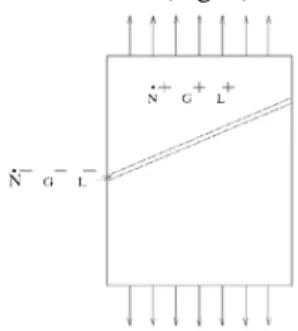
The Rudnicki–Rice criterion [5,6] corresponds to a bifurcation associated with admissible jumps for strain and stress rates across a shear band (Fig. 2).Figure 2. Localization of the deformation along a shear band.
Because field equations have to be satisfied, and because the strain rate is discontinuous across the localization band, a kinematic condition for the strain rate jump must be verified. Also, the continuity of the stress rate vector has to be verified for the forces along the localization band. The reader may refer to Ref. [7] for more details.
Numerical results – Impact of
microstructural mechanisms on
ductility
The qualitative impact of microstructural mechanisms on ductility is investigated here. In this process, the effect on ductility of the model parameters, which are associated
with elementary physical mechanisms at the microscale, will be analyzed during monotonic loading tests.
For example, as suggested by Fig. 3, an increase in the volume fraction f of the dislocation walls improves ductility. The increase of the presence of dislocation walls parallel to the crystallographic planes on which the slip activity is greatest means that fewer dislocations are likely to act as obstacles to the slippage of other dislocations.
Figure 3. Effect of the volume fraction f of the dislocation sheets on the ductility limit of polycrystalline
steel – Stress–strain behavior for plane strain tension.
Conclusion
The plastic instability criterion based on bifurcation theory first proposed by Rice has been applied to elastic–plastic tangent moduli derived from a large strain micromechanical model combined with a self-consistent scale-transition scheme. This multiscale model incorporates microscopic modeling that allows the formation and evolution of intragranular dislocation patterns on strain-paths to be precisely reproduced.
The resulting theoretical and numerical tool proves to be useful, as it allows the ductility of new grades of steel to be predicted at early stages of their design. Additional features of the tool are that it enables the formability of materials to be compared and it allows the impact of microstructural effects on ductility to be determined. Therefore, it could be used to optimize the ductility of new steels or to design materials with desired formability.
References
[1] G. Franz, F. Abed-Meraim, T. Ben Zineb, X. Lemoine, M. Berveiller, Mater. Sci. Eng. A 517(1-2), 2009, 300– 311.
[2] G. Franz, F. Abed-Meraim, T. Ben Zineb, X. Lemoine, M. Berveiller, Mater. Sci. Eng. A 528, 2011, 3777–3785. [3] B. Peeters, M. Seefeldt, C. Teodosiu, S.R. Kalidindi, P. Van Houtte, E. Aernoudt, Acta Mater. 49, 2001, 1607– 1619.
[4] B. Peeters, B. Bacroix, C. Teodosiu, P. Van Houtte, E. Aernoudt, Acta Mater. 49, 2001, 1621–1632.
[5] J.W. Rudnicki, J.R. Rice, J. Mech. Phys. Solids 23, 1975, 371–394.
[6] J.R. Rice, in: W.T. Koiter (ed.), Theoretical and Applied Mechanics, Amsterdam, 1976, pp. 207–220. [7] G. Franz, F. Abed-Meraim, J.P. Lorrain, T. Ben Zineb, X. Lemoine, M. Berveiller, Int. J. Plasticity 25, 2009, 205– 238.