HAL Id: tel-02446215
https://tel.archives-ouvertes.fr/tel-02446215
Submitted on 20 Jan 2020HAL is a multi-disciplinary open access archive for the deposit and dissemination of sci-entific research documents, whether they are pub-lished or not. The documents may come from teaching and research institutions in France or abroad, or from public or private research centers.
L’archive ouverte pluridisciplinaire HAL, est destinée au dépôt et à la diffusion de documents scientifiques de niveau recherche, publiés ou non, émanant des établissements d’enseignement et de recherche français ou étrangers, des laboratoires publics ou privés.
Anfel Selmadji
To cite this version:
Anfel Selmadji. From monolithic architectural style to microservice one : structure-based and task-based approaches. Other [cs.OH]. Université Montpellier, 2019. English. �NNT : 2019MONTS026�. �tel-02446215�
En Informatique
École doctorale : Information, Structures, Systèmes Unité de recherche LIRMM
From Monolithic Architectural Style to Microservice
one : Structure-based and Task-based Approaches
Présentée par Anfel SELMADJI
Le 3 octobre 2019
Sous la direction de Abdelhak-Djamel SERIAI
Devant le jury composé de
Flavio OQUENDO, Prof, Université de Bretagne Sud Rapporteur (président du jury) Philippe COLLET, Prof, Université de Nice Sophia Antipolis Rapporteur
Chirine GHEDIRA GUEGAN, Prof, Université Jean Moulin Lyon 3 Examinatrice Abdelhak-Djamel SERIAI, MdC, HDR, Université de Montpellier Directeur Christophe DONY, Prof, Université de Montpellier Co-directeur Hinde Lilia BOUZIANE, MdC, Université de Montpellier Co-encadrante
First and foremost, words cannot adequately express the gratitude I feel to-wards my advisor, Dr. Abdelhak-Djamel SERIAI, for all what he has done for me. The list is long. I am thankful for his continuous investment in my thesis despite the difficulties, for his patience, guidance, kindness, comprehensiveness, immense knowledge, long meeting hours even when he was exhausted,... For me, he is much more than an outstanding advisor. I am also immensely grateful to my co-advisor, Dr. Hinde Lilia BOUZIANE, for always supporting me, being extremely patient, thoughtful, and kind. My amazing co-advisor did not care how long our meetings would be, the important was that I learn how to properly tackle a problem, present things, and write them down. I am also highly thank-ful to my co-advisor, Prof. Christophe DONY, for his support, help as well as his constructive and valuable remarks. I am honored, blessed, and lucky to have Dr. Abdelhak-Djamel SERIAI, Dr. Hinde Lilia BOUZIANE, and Prof. Christophe DONY as advisors.
I would like to express my gratitude to my PhD committee members, Prof. Flavio OQUENDO, Prof. Philippe COLLET, and Prof. Chirine GHEDIRA GUE-GAN, for having accepted to evaluate my thesis. I highly appreciate the valuable time they took from their busy schedule to do that. I am also extremely grate-ful for their encouragement as well as their insightgrate-ful and inspiring comments, which have widened the scope of our perspectives, and will definitely improve our work.
Heartfelt appreciations go to every member of MaREL team for having wel-comed me, and helped me all along. Thank you for your support, motivation, enriching discussions, and constructive remarks. I am grateful that I have known you and wish you all the best.
I would like also to express my gratitude to my family members, starting with my parents to whom I am indebted and I will never ever be able to pay that debt no matter what I do. Thank you for always believing in me, for your prayers, for your support, for your unconditional love, for your sacrifices, and for all what you have done. I am also extremely appreciative to my brother, Mouaadh, my
backbone, who have been always there for me, and gave me wise advice. Thank you for never being tired of all my questions and for turning my doubt into hope. Heartfelt appreciations go to my younger brother, Oussama, and my sister, Ritedj, for lifting up my spirit with their jokes and bright smiles. Thank you for your care, heartwarming words, and beautiful drawings.
I would like to express my appreciation to my friends for the amazing, and unforgettable time we spent together. Thank you for the laughs, for all the pre-cious memories that I will treasure forever, and for being there for me despite the distance. I wish each and every one of you the best of luck and success in your future.
Special thanks to all the people in charge of my scholarship in the Algerian Ministry of Higher Education and Scientific Research, the University of Constan-tine 2, and the Algerian Consulate in Montpellier.
Finally, genuine thanks to every friend, family member, colleague, professor, and teacher who contributed to the success of this dissertation. I am lucky to have you in my life.
Les technologies logicielles ne cessent d’évoluer pour faciliter le développe-ment, le déploiement et la maintenance d’applications dans différents domaines. En parallèle, ces applications évoluent en continu pour garantir une bonne qua-lité de service et deviennent de plus en plus complexes. Cette évolution implique souvent des coûts de développement et de maintenance de plus en plus impor-tants, auxquels peut s’ajouter une augmentation des coûts de déploiement sur des infrastructures d’exécution récentes comme le cloud. Réduire ces coûts et amélio-rer la qualité de ces applications sont actuellement des objectifs centraux du do-maine du génie logiciel. Récemment, les microservices sont apparus comme un exemple de technologie ou style architectural favorisant l’atteinte de ces objectifs. Un microservice peut être vu comme un service à granularité "très" fine dé-ployable de manière indépendante et pouvant communiquer avec d’autres mi-croservices. Les microservices permettent une reconfiguration dynamique d’une application, en ajoutant, supprimant ou remplaçant des microservices pendant son exécution. Ils semblent ainsi être bien adaptés aux pratiques DevOps qui visent à réduire les coûts depuis la création d’une application jusqu’à son dé-ploiement et sa maintenance.
Alors que les microservices peuvent être utilisés pour développer de nou-velles applications, il existe des applications monolithiques (i.e., monolithes) cons-truites comme une seule unité et que les propriétaires (e.g., entreprise, etc.) sou-haitent maintenir et déployer sur le cloud. Dans ce cas, il est fréquent d’envisager de redévelopper ces applications à partir de rien ou d’envisager une migration vers de nouveaux styles architecturaux. Redévelopper une application ou réaliser une migration manuellement peut devenir rapidement une tâche longue, source d’erreurs et très coûteuse. Une migration automatique apparaît donc comme une solution évidente.
L’objectif principal de notre thèse est de contribuer à proposer des solutions pour l’automatisation du processus de migration d’applications monolithiques orientées objet vers des microservices. Cette migration implique deux étapes : l’identification de microservices et le packaging de ces microservices. Nous nous
focalisons sur d’identification en s’appuyant sur une analyse du code source. Nous proposons en particulier deux approches.
La première consiste à identifier des microservices en analysant les relations structurelles entre les classes du code source ainsi que les accès aux données per-sistantes. Dans cette approche, nous prenons aussi en compte les recommanda-tions d’un architecte logiciel. L’originalité de ce travail peut être vue sous trois as-pects. Tout d’abord, les microservices sont identifiés en se basant sur l’évaluation d’une fonction bien définie mesurant leur qualité. Cette fonction repose sur des métriques reflétant la "sémantique" du concept "microservice". Deuxièmement, les recommandations de l’architecte logiciel ne sont exploitées que lorsqu’elles sont disponibles. Enfin, deux modèles algorithmiques ont été utilisés pour par-titionner les classes d’une application orientée objet en microservices : un algo-rithme de regroupement hiérarchique et un algoalgo-rithme génétique.
La deuxième approche consiste à extraire à partir d’un code source orienté objet un workflow qui peut être utilisé en entrée de certaines approches existantes d’identification des microservices. Un workflow décrit le séquencement de tâches constituant une application suivant deux formalismes : un flot de contrôle et/ou un flot de données. L’extraction d’un workflow à partir d’un code source nécessite d’être capable de définir une correspondance entre les concepts du mon-de objet et ceux d’un workflow.
Pour valider nos deux approches, nous avons implémenté deux prototypes et mené des expérimentations sur plusieurs cas d’étude. Les microservices identifiés ont été évalués qualitativement et quantitativement. Les workflows obtenus ont été évalués manuellement sur un jeu de tests. Les résultats obtenus montrent res-pectivement la pertinence des microservices identifiés et l’exactitude des work-flows obtenus.
Mots-clés : Monolithe, orienté objet, microservice, migration logicielle,
réingénie-rie logicielle, qualité logicielle, métrique de qualité, workflow, flot de données, flot de contrôle, cloud.
Software technologies are constantly evolving to facilitate the development, deployment, and maintenance of applications in different areas. In parallel, these applications evolve continuously to guarantee an adequate quality of service, and they become more and more complex. Such evolution often involves increased development and maintenance costs, that can become even higher when these applications are deployed in recent execution infrastructures such as the cloud. Nowadays, reducing these costs and improving the quality of applications are main objectives of software engineering. Recently, microservices have emerged as an example of a technology or architectural style that helps to achieve these objectives.
A microservice can be seen as a small, independently deployable service that can communicate with other microservices. Microservices allow dynamic recon-figuration of an application by adding, removing, or replacing microservices dur-ing its execution. They also seem to be well-adapted to DevOps practices that aim to reduce costs from the creation of an application to its deployment, and main-tenance.
While microservices can be used to develop new applications, there are mono-lithic ones (i.e., monoliths) built as a single unit and their owners (e.g., companies, etc.) want to maintain and deploy them in the cloud. In this case, it is common to consider rewriting these applications from scratch or migrating them towards recent architectural styles. Rewriting an application or migrating it manually can quickly become a long, error-prone, and expensive task. An automatic migration appears as an evident solution.
The ultimate aim of our dissertation is contributing to automate the migration of monolithic Object-Oriented (OO) applications to microservices. This migration consists of two steps: microservice identification and microservice packaging. We focus on microservice identification based on source code analysis. Specifically, we propose two approaches.
OO application relying on code structure, data accesses, and software architect recommendations. The originality of our approach can be viewed from three aspects. Firstly, microservices are identified based on the evaluation of a well-defined function measuring their quality. This function relies on metrics reflect-ing the "semantics" of the concept "microservice". Secondly, software architect recommendations are exploited only when they are available. Finally, two algo-rithmic models have been used to partition the classes of an OO application into microservices: clustering and genetic algorithms.
The second approach extracts from an OO source code a workflow that can be used as an input of some existing microservice identification approaches. A workflow describes the sequencing of tasks constituting an application according to two formalisms: control flow and /or data flow. Extracting a workflow from source code requires the ability to map OO concepts into workflow ones.
To validate both approaches, we implemented two prototypes and conducted experiments on several case studies. The identified microservices have been eval-uated qualitatively and quantitatively. The extracted workflows have been man-ually evaluated relying on test suites. The obtained results show respectively the relevance of the identified microservices and the correctness of the extracted workflows.
Keywords: Monolith, object-oriented, microservice, software migration, software
reengineering, software quality, quality metrics, workflow, data flow, control flow, cloud.
Au fil des ans, les technologies évoluent pour permettre un développement et un déploiement de logiciels plus efficaces et plus faciles, ainsi que toute activité ultérieure à leur livraison, telle que la maintenance. Des exemples de technolo-gies récentes qui permettent cela et attirent l’attention des chercheurs ainsi que des industriels, sont le cloud computing, le DevOps et les microservices.
Pour suivre le rythme des avancées technologiques, les applications existantes développées en utilisant des technologies obsolètes peuvent être réécrites à partir de zéro ou migrées vers des technologies plus récentes. Notre travail contribue à la migration des applications monolithiques existantes vers des microservices afin de les adapter à la fois au cloud computing et au DevOps.
Contexte
Cloud et DevOps
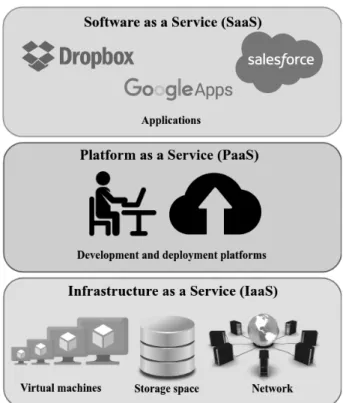
Le cloud computing est un modèle permettant l’accès réseau à un pool partagé de ressources informatiques configurables telles que l’espace de stockage, les serveurs, les applications, les services, etc. [101]. Les clients peuvent à la de-mande allouer et libérer rapidement ces ressources avec un minimum d’effort de gestion et de communication des fournisseurs de services [101]. Le cloud se car-actérise par sa haute disponibilité, son élasticité, sa scalabilité et sa flexibilité des coûts. Il fournit une variété de services qui peuvent être classés dans une hiérar-chie de termes en tant que service [127]. Une catégorisation simplifiée divise les services du cloud en trois catégories: SaaS (logiciel en tant que service), PaaS (plateforme en tant que service) et IaaS (infrastructure en tant que service). Le SaaS est un paradigme de livraison de logiciels, dans lequel les fournisseurs de services développent des logiciels et les distribuent via Internet [55]. PaaS offre des plateformes pour le développement et le déploiement d’applications dans le
cloud en utilisant des langages de programmation, des bibliothèques, des outils, etc. [57]. Les fournisseurs IaaS offrent des ressources de traitement, de stock-age, de réseau et autres ressources informatiques fondamentales permettant aux clients de déployer et d’exécuter leurs logiciels [51, 101]. Cela peut être réalisé en allouant des machines virtuelles (VM) personnalisées avec une capacité de CPU, de mémoire, de stockage et de bande passante prédéfinie [127]. Les clients peuvent allouer / libérer des machines virtuelles de manière élastique, et ils sont facturés en fonction de leur utilisation. SalesForce [5], Google App Engine [2], Amazon EC2 [3] et Microsoft Azure [4] sont parmi les principaux fournisseurs de services dans le cloud.
Grâce à ses caractéristiques, de nos jours, le cloud attire l’attention des cherch-eurs et des industriels. Certains cherchcherch-eurs le considèrent comme une plate-forme de développement et d’exécution des applications scientifiques massive-ment scalables [105]. De plus, au lieu d’investir d’avance dans une infrastructure sur-provisionnée, ils ne paient que pour ce qu’ils utilisent. Même les entreprises sont attirées par le cloud en raison de sa scalabilité et de sa flexibilité des coûts [74]. Ils le voient comme une stratégie commerciale opportuniste leur permettant de rivaliser avec d’autres entreprises et d’atteindre leurs objectifs commerciaux [34,17,16], en particulier lorsqu’il est fusionné avec DevOps efficace.
DevOps (Développement et Opérations) [26] est un ensemble de pratiques visant à améliorer la collaboration entre les équipes de développement (par ex-emple, programmation, tests, etc.) et les équipes d’opérations (par exex-emple, dé-ploiement, surveillance, etc.) pour réduire le temps de mise sur le marché. De plus, ces pratiques garantissent le maintien de la qualité du code et du mécan-isme de livraison [23]. L’intégration continue (CI) et la livraison continue (CD) font partie des pratiques clés de DevOps. Le CI permet aux membres des équipes de développement d’intégrer leur travail fréquemment, généralement plusieurs fois par jour [121, 59]. Le CD vise à garantir que des logiciels de qualité sont produits en cycles courts et qu’ils peuvent être livrés de manière fiable à tout mo-ment [41]. Le CD peut utiliser un ensemble de pratiques, telles que le CI et le déploiement automatisé [71].
Pour tirer pleinement profit de cloud et de DevOps, il est nécessaire de pren-dre en compte leurs caractéristiques et leurs exigences lors du développement d’applications. Par exemple, dans le cloud, une défaillance peut survenir à tout moment [22, 134]. Par conséquent, les applications à déployer dans cet environ-nement devraient être en mesure de gérer de telles incertitudes [22]. En outre, pour une adoption plus fluide de DevOps, il est nécessaire d’avoir un système constitué de modules qui peuvent être développés, testés et déployés de manière indépendante. Les systèmes basés sur les microservices peuvent répondre à ces contraintes.
Microservices
Récemment, les microservices [106,122,123,95] sont apparus comme un style architectural bien adapté au développement d’applications à déployer sur le cloud (architecture native pour le cloud [22]), ainsi qu’à celles qui adoptent les pratiques DevOps. En littérature, la définition la plus communément utilisée de ce style architectural est celle proposée par Lewis and Fowler [95]. Selon eux, dans ce style, une application consiste en un ensemble de petits services qui peuvent être déployés indépendamment. Chaque microservice gère ses propres données et communique avec les autres en s’appuyant sur des mécanismes légers. De plus, ils sont couramment emballés et déployés à l’aide de conteneurs [106,122,123].
Lors de l’exécution d’une application à base de microservices, ces derniers peuvent être dupliqués indépendamment ou supprimés à la volée pour réduire le temps de réponse ou parce qu’ils ne sont pas utilisés. Une telle duplication dynamique (resp., suppression) nécessite une allocation dynamique (resp., libéra-tion) des ressources fournies par le cloud. L’allocation et la libération dynamiques adaptent le coût d’utilisation des ressources aux exigences de l’application. De plus, chaque microservice peut être déployé à l’aide de ressources qui répon-dent à ses besoins (par exemple, CPU, mémoire, etc.) [52, 114]. Une telle con-sommation efficace de ressources permet aux fournisseurs de services d’offrir plus de garanties de scalabilité [56]. Enfin, les microservices facilitent la reprise de l’exécution d’une application après une défaillance du cloud, car ils peuvent être redémarrés facilement et rapidement sans qu’il soit nécessaire de redémarrer l’application entière [130].
Outre leur adaptabilité au cloud, les microservices sont bien adaptés au De-vOps. Ils permettent une livraison et un déploiement continus d’applications vo-lumineuses et complexes [114]. Cela est dû au fait qu’ils peuvent être développés, testés et déployés séparément. Par conséquent, chaque équipe peut facilement développer, tester et déployer ses microservices indépendamment des autres [130].
Problème et motivation
Ces dernières années, le style architectural microservices est devenu un élé-ment essentiel pour le développeélé-ment d’applications à déployer sur le cloud ainsi que celles qui adoptent les pratiques DevOps. Néanmoins, de nombreuses appli-cations ont été développées avant l’émergence de ce style en se basant sur un style monolithique.
Problème des Applications Monolithiques dans le Contexte de
Cloud et de DevOps
Le style architectural monolithique [128,52,114,95,112] est la façon tradition-nelle de développer des logiciels. Dans ce style, une application, appelée mono-lithique ou monolithe, est construite comme une seule unité combinant l’interface utilisateur, la logique métier et les accès aux données. Généralement, elle est au-tonome et indépendante des autres applications.
Le style monolithique est bien adapté au développement de petites applica-tions ou lorsqu’il existe de fortes dépendances entre les différentes parties d’une application, durcissant sa décomposition. Autrement, les monolithes ont des lim-itations importantes, en particulier lorsqu’ils sont déployés sur le cloud:
— Surcoût pour l’utilisation des ressources : la mise à l’échelle d’un mono-lithe nécessite simplement d’exécuter plusieurs copies de l’application en-tière derrière un équilibreur de charge [122, 95, 112]. Dans le cloud, les clients sont généralement facturés en fonction des ressources utilisées, même si certaines d’entre elles sont inutilement occupées par des parties du mono-lithe qui ne sont pas fréquemment utilisées (c’est-à-dire qui implémentent des fonctionnalités moins utilisées) [52]. C’est certainement coûteux de met-tre une application à l’échelle de telle façon. En oumet-tre, pour déployer un monolithe, les ressources nécessaires sont allouées en fonction des besoins (par exemple, CPU, mémoire, etc.) de l’ensemble du monolithe. S’il ex-iste une variation significative en terme de ces exigences lors de l’exécution du monolithe, les ressources choisies peuvent être sous-optimales ou coû-teuses.
— Temps d’arrêt considérables : pour reprendre l’exécution après une défail-lance du cloud, l’application entière peut être redémarrée. Généralement, le redémarrage d’un monolithe entraîne des temps d’arrêt considérables [52]. — Difficulté à adopter les pratiques DevOps : l’adoption des pratiques De-vOps n’est pas toujours fluide [146], en particulier lorsqu’il s’agit d’applica-tions monolithiques. L’adoption de DevOps nécessite de disposer d’un sys-tème constitué de modules qui peuvent être développés, testés et déployés de manière indépendante. Ce n’est pas le cas lors de la manipulation de monolithes.
En raison de ces limitations, les applications monolithiques ne sont bien adap-tées ni au cloud ni au DevOps. Un moyen possible d’adapter ces applications aux deux consiste à les migrer vers un style architectural capable de traiter ces limita-tions.
Migration des Applications Monolithiques vers des Microservices
Comme expliqué précédemment, les microservices peuvent être développés, testés et déployés indépendamment, ce qui leur permet de remédier aux limita-tions des applicalimita-tions monolithiques. Pour cela, les monolithes existants peuvent être réécrits à partir de zéro en utilisant des microservices ou migrés vers eux. D’une part, une réécriture complète est considérée comme une tâche risquée, coûteuse et longue. Généralement, la logique métier documentée des monolithes n’est pas à jour [93]. De plus, en raison du roulement du personnel, il devient difficile d’atteindre les experts des applications. En fait, le risque d’échec est généralement trop élevé pour que les entreprises réécrivent leurs applications à partir de zéro [30]. Par ailleurs, la migration vers le style architectural microser-vices apparaît comme une solution évidente. En effet, il est plus sûr et générale-ment mené.
Par conséquent, l’objectif ultime de notre thèse est de contribuer à automatiser la migration des applications monolithiques orientées objet vers des microser-vices afin de les adapter au cloud et au DevOps. Pour cela, nous adressons le problème de recherche qui consiste à répondre à deux questions principales:
1. Comment identifier, à partir d’une application monolithique orientée
ob-jet, l’architecture à base de microservices correspondante tout en respec-tant aurespec-tant que possible les principes de ce style architectural? Cette
ques-tion est liée à l’observaques-tion que certaines approches d’identificaques-tion de mi-croservices existantes, telles que celles proposées dans [66, 94, 25, 100, 44], présentent des limitations qui les empêchent de répondre en profondeur à cette question. Parmi les principales limitations, nous pouvons citer:
— Les critères utilisés pour identifier les microservices ne matérialisent pas toute la "sémantique" du concept "microservice". Par exemple, le critère concernant l’autonomie des données des microservices n’est pas toujours pris en compte, en particulier lorsque les entrées requises par l’approche d’identification ne sont pas de la documentation.
— Pour identifier des microservices à partir d’un monolithe, certaines in-formations nécessaires peuvent être récupérées en analysant son code source. Outre ces informations, les recommandations fournies par les experts des applications analysés peuvent être exploitées pour amé-liorer la pertinence/qualité des microservices identifiés. Cependant, les approches existantes qui nécessitent une intervention d’experts souf-frent principalement de deux limitations. D’une part, l’intervention des experts ne se limite pas à fournir des recommandations pertinentes, mais ils effectuent plutôt certaines étapes de l’approche. D’autre part, cette intervention est considérée comme toujours nécessaire, ce qui
limite l’applicabilité de ces approches.
— Le modèle algorithmique utilisé a un impact sur la pertinence/qualité de l’architecture à base de microservices identifiée. Les approches ex-istantes reposent principalement sur un nombre limité de modèles tels que le clustering.
Sur la base de ces limitations, la question ci-dessus peut être encore raffinée en trois sous-questions:
— Comment identifier des microservices à partir d’une application orien-tée objet en tenant compte de la "sémantique" du concept "microser-vice"?
— Quelles sont les recommandations pertinentes permettant de bénéficier des conseils d’experts et comment peuvent-elles être combinées avec des informations du code source?
— Quel modèle algorithmique peut être utilisé pour identifier les meill-eurs microservices possibles en fonction de l’évaluation de leur qual-ité?
2. Comment extraire à partir d’une application orientée objet un workflow
correspondant utilisé par certaines approches existantes basées sur des tâches pour identifier des microservices? Cette question est liée au constat
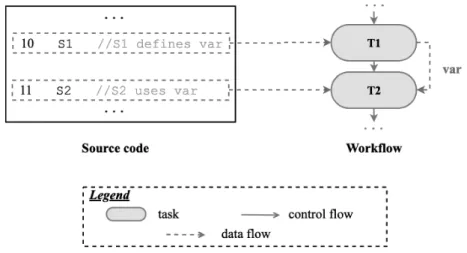
que certaines des approches existantes identifient des microservices à par-tir des workflows [15] ou leurs constituants [44]. Un workflow spécifie le mode de séquencement des tâches suivant deux formalismes: flot de con-trôle et/ou flot de données. Un flot de concon-trôle décrit l’ordre d’exécution des tâches à travers différentes constructions telles que des séquences, des branches conditionnelles (if et switch) et des boucles (for et while). Un flot de données spécifie les échanges de données entre les tâches. Si un workflow n’est pas disponible, une identification basée sur les tâches extrait d’abord celui-ci des artefacts accessibles du monolithe à migrer (par exem-ple, code source, documentation, etc.), puis l’utilise pour identifier les mi-croservices. Néanmoins, les approches existantes basées sur les tâches sup-posent soit l’existence de workflows [15], soit les experts peuvent récupérer leurs constituants [44], ce qui n’est pas toujours le cas. Pour garantir l’appli-cabilité de telles approches, un workflow peut être extrait des artefacts dis-ponibles. Plusieurs approches ont été proposées pour récupérer des work-flows. Ce-pendant, elles souffrent de deux limitations principales:
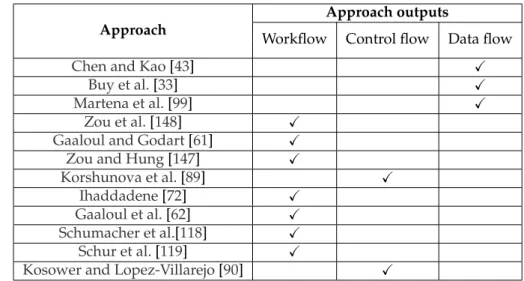
— Généralement, leur objectif n’est pas de récupérer tous les constituants du workflows. Ils extraient soit un flot de contrôle [148,147,61,89,72,
62,118,119,90] ou un flot de données [43,33,99], mais pas les deux. — Une intervention de l’expert est nécessaire pour effectuer certaines
Sur la base de ces limitations et de la définition d’un workflow, la question ci-dessus peut être encore raffinée en trois sous-questions:
— Quelles sont les tâches qui reflètent le workflow correspondant à l’app-lication orientée objet?
— Quel est le flot de contrôle à définir entre les tâches identifiées?
— Quel est le flot de données à associer aux tâches et au flot de contrôle identifiés?
Contributions
Pour aborder le problème identifié précédemment, cette thèse présente les contributions suivantes:
1. Identification des microservices à partir du code source orienté objet basée
sur la structure : notre approche identifie des microservices en se basant
sur l’analyse statique du code source orienté objet d’une application mono-lithique. Elle s’appuie sur des informations liées à la structure du code source, les accès aux données persistantes (c’est-à-dire stockées dans des bases de données) et aux recommandations de l’architecte lorsque ces der-nières sont disponibles. Son originalité se décline sous trois aspects:
— Identification de microservices basés sur l’évaluation d’une fonction
bien définie mesurant leur qualité: le but de notre approche est
d’iden-tifier des microservices en maximisant une fonction qui évalue leur qualité. Elle a été proposée en se basant sur des métriques reflétant la "sémantique" du concept "microservice". Ces métriques ont été définies en raffinant les caractéristiques des microservices. Les paramètres de la fonction de qualité sont les dépendances structurelles du code source et les liens concernant les accès aux données persistantes.
— Exploiter les recommandations de l’architecte uniquement quand
elles sont disponibles: un ensemble bien défini de recommandations,
qu’un architecte peut fournir, a été spécifié et utilisé dans notre ap-proche. Les recommandations concernent principalement l’utilisation des applications (par exemple, combien de microservices, quelle classe est le centre d’un microservice, etc.). De plus, elles sont combinées avec des informations du code source. Les recommandations, lorsqu’elles sont disponibles, sont impliquées principalement dans le partitionne-ment des applications orientées objet en microservices. Les informa-tions du code source sont utilisées pour mesurer leur qualité. Selon les recommandations disponibles, différentes identifications de microser-vices peuvent être effectuées.
— Modèles algorithmiques de regroupement et de méta-heuristiques
pour identifier des microservices en se basant sur l’évaluation de la fonction de qualité: notre approche regroupe les classes d’une
appli-cation orientée objet en fonction de leur qualité mesurée à l’aide de la fonction de qualité proposée. À cette fin, deux modèles algorithmiques ont été utilisés: un algorithme de regroupement [142] et un algorithme génétique [69, 103]. La fonction de qualité proposée est considérée comme une mesure de similarité dans l’algorithme de regroupement et comme une fonction objective dans l’autre. Il est possible d’identifier des microservices en utilisant les deux modèles algorithmiques, puis comparer les résultats obtenus et choisir les meilleurs.
2. Extraction de workflows à partir du code source orienté objet pour
per-mettre l’identification de microservices basée sur des tâches: pour
perme-ttre l’applicabilité de certaines approches d’identification existantes basées sur des tâches [15,44] lorsque seul le code source est disponible, nous pro-posons une approche visant à extraire un workflows en analysant le code source. Cette extraction nécessite la capacité de mapper les concepts orien-tés objet dans ceux du workflow. Par exemple, il est nécessaire de spécifier le mappage du concept tâche par rapport aux concepts orientés objet. Une fois qu’un tel mappage est établi, les constituants du workflow (c’est-à-dire tâches, flot de contrôle et flot de données) sont récupérés à partir du code source orienté objet en s’appuyant sur ce mappage.
1 Introduction 1
1.1 Context . . . 2
1.1.1 Cloud Computing and DevOps . . . 2
1.1.2 Microservices . . . 4
1.2 Problem and Motivation . . . 5
1.2.1 Monolithic Applications for Cloud and DevOps . . . 5
1.2.2 Migrating Monolithic Applications to Microservices for Cloud and DevOps . . . 6
1.3 Contributions . . . 9
1.4 Thesis Organization . . . 11
2 State of the Art 13 2.1 Brief Background on Migrating Monolithic OO Software Towards More Recent Technologies . . . 14
2.1.1 Software Reengineering and Migration . . . 14
2.1.2 From Object-Oriented to Components, Services and Microser-vices . . . 16
2.2 Taxonomy of Related Works . . . 19
2.2.1 Technical versus Feedback Approaches . . . 19
2.2.3 Feedbacks and Learned Lessons Approaches . . . 56
2.3 Conclusion . . . 58
3 Migration to Microservices: An Approach Based on Measuring Object-oriented and Data-Object-oriented Dependencies 59 3.1 Introduction . . . 60
3.2 Approach Principals . . . 61
3.2.1 Inputs of the Identification Process: Source Code and Ar-chitect Recommendations . . . 61
3.2.2 Measuring the Quality of Microservices . . . 63
3.2.3 Identification Process . . . 65
3.2.4 Algorithmic Foundations . . . 66
3.3 Measuring the Quality of Microservices . . . 68
3.3.1 Measuring the Quality of a Microservice Based on Struc-tural and Behavioral Dependencies . . . 68
3.3.2 Measuring the Quality of a Microservice Based on Data Au-tonomy . . . 72
3.3.3 Global Measurement of the Quality of a Microservice . . . . 78
3.4 Microservice Identification Using Clustering Algorithms . . . 78
3.4.1 Automatic Identification of Microservices Using a Hierar-chical Clustering Algorithm . . . 79
3.4.2 Semi-automatic Identification of Microservices Based on a Hierarchical Clustering Algorithm . . . 80
3.5 Microservice Identification Using Genetic Algorithms . . . 86
3.5.1 A Genetic Model for the Process of Microservice Identification 87 3.5.2 Identification of Microservices Using a Multi-objective Ge-netic Algorithm . . . 91
4 Task-based Migration To Microservices: An Approach Based on
Work-flow Extraction from Source Code 97
4.1 Introduction . . . 98 4.2 Approach Principals . . . 98
4.2.1 From Object-Oriented Architectural Style to Workflow-based one: The Mapping Model . . . 98 4.2.2 Extraction Process . . . 100 4.3 Identifying Tasks from OO Source Code . . . 103 4.3.1 Extract Method Refactoring . . . 103 4.3.2 Identifying Task Based on Analyzing the OO Application
Call Graph . . . 104 4.3.3 Identifying Tasks Inputs and Outputs . . . 108 4.4 Control Flow Recovery . . . 111 4.5 Data Flow Recovery . . . 113 4.5.1 Data Flow Graph Construction . . . 113 4.5.2 Computing Def-Use Triplets . . . 114 4.6 Conclusion . . . 116
5 Experimentations and Validations 117
5.1 Validating the Identification of Microservices from OO Applications 118 5.1.1 Research Questions . . . 118 5.1.2 Experimental Protocol . . . 119 5.1.3 Validating the Identification Based on a Clustering Algorithm124 5.1.4 Validating the Identification Based on a Genetic Algorithm . 137 5.1.5 Answering Research Questions . . . 140 5.1.6 Threats to Validity . . . 141
5.2 Experimentation and Validation of our Extraction Approach of Work-flows from OO Applications . . . 143 5.2.1 Data Collection . . . 143 5.2.2 Experimental Protocol . . . 144 5.2.3 Workflow Extraction Results and their Interpretations . . . . 145 5.2.4 Threats to Validity . . . 150 5.3 Conclusion . . . 151
6 Conclusion and Future Directions 153
6.1 Summary of Contributions . . . 153 6.2 Future Directions . . . 155 6.2.1 Addressing Limitations and New Related Aspects . . . 155 6.2.2 Experimentations and Validations . . . 156
Personal Publications 159
Appendices 163
A Call Graph Construction Algorithms Based on Static Analysis of OO
Source Code 163
1.1 Cloud computing services . . . 3 1.2 Scheme of DevOps . . . 3 1.3 Representation of microservices . . . 4 1.4 Example of a monolithic e-commerce application . . . 7 1.5 Example of the monolithic e-commerce application decomposed
into microservices . . . 7 1.6 Positioning the contributions of our dissertation within the context
of microservice identification . . . 12 2.1 Horseshoe model representing the reengineering/migration process 15 2.2 Evolution of technologies . . . 16 2.3 Taxonomy scheme of microservice identification approaches . . . . 21 2.4 Example of structure-based and task-based identifications of
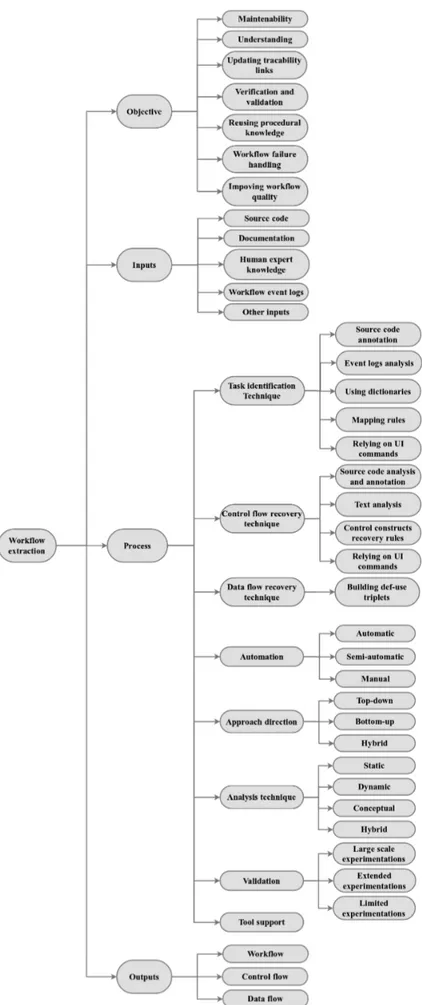
mi-croservices . . . 22 2.5 Taxonomy scheme of workflow extraction approaches . . . 39 2.6 Example of a workflow . . . 41 2.7 The extracted workflow by ProCrawl representing the peer-review
process in OpenConf [119] . . . 47 2.8 Example of data flow construction relying on def-use triplets . . . . 49 3.1 The used recommendations of software architect . . . 62
3.2 Process of identifying microservices from OO source code . . . 66 3.3 Example motivating the use of the average to compute FIntra . . . 73 3.4 Example motivating the use of the average to compute
DataDepen-dencies . . . 75 3.5 Example of the frequency of data manipulations . . . 75 3.6 Example motivating the introduction of standard deviation in the
computing of Freq . . . 76 3.7 Example used to compute FData . . . 77 3.8 Dendrogram with a set of microservices . . . 79 3.9 Identified microservices based on the entire set of gravity centers . 82 3.10 Preliminary partitioning of OO classes based on a sub-set of
grav-ity centers . . . 82 3.11 Encoding of a chromosome . . . 88 3.12 Example of the crossover operator . . . 89 3.13 Example of the mutation operator . . . 90 4.1 From OO elements to workflow ones: the mapping model. . . 99 4.2 Process of extracting workflows from OO source code . . . 101 4.3 Overview of task identification, control flow recovery, and data
flow recovery . . . 102 4.4 Example of extract method refactoring . . . 104 4.5 Schematic overview of the presented call graph construction
algo-rithms and their relationship. . . 106 4.6 Call graph built from the source code shown in Listing 4.1 . . . 107 4.7 Acyclic call graph . . . 111 4.8 The CFG of the composite task corresponding the method m of the
4.9 Example of a CFG recovered in the presence of dynamically dis-patched calls. . . 113 4.10 The DFG corresponding to the task mapped to the method m of the
class Foo shown in Listing 4.1 . . . 114 5.1 Class diagram of FindSportMates application . . . 129 5.2 Microservice identification results from FindSportMates application 130 5.3 Manually identified microservices from FindSportMates application 130 5.4 Composition and decomposition of the automatically generated
microservices to obtain the manually identified ones . . . 131 5.5 Workflow implementation model . . . 145 5.6 Class diagram of the eLib application . . . 147 5.7 Workflow extracted from eLib application . . . 148 A.1 Example of a call graph constructed using RA . . . 164 A.2 Example of a call graph constructed using CHA . . . 165 A.3 Example of a call graph constructed using RTA . . . 165 A.4 Example of a call graph constructed using XTA . . . 167 A.5 Example of a call graph constructed using VTA . . . 168
2.1 Classification of the investigated microservice identification approaches based on their objective . . . 26 2.2 Classification of the investigated microservice identification approaches
based on their required inputs . . . 28 2.3 Classification of the investigated microservice identification approaches
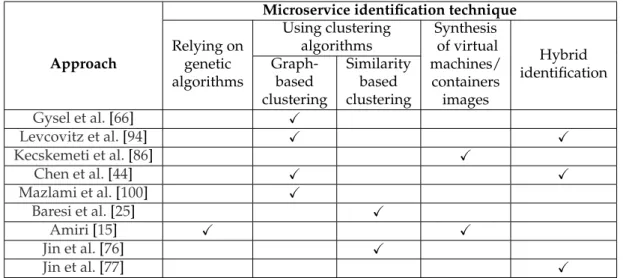
based on their identification technique . . . 31 2.4 Classification of the investigated microservice identification approaches
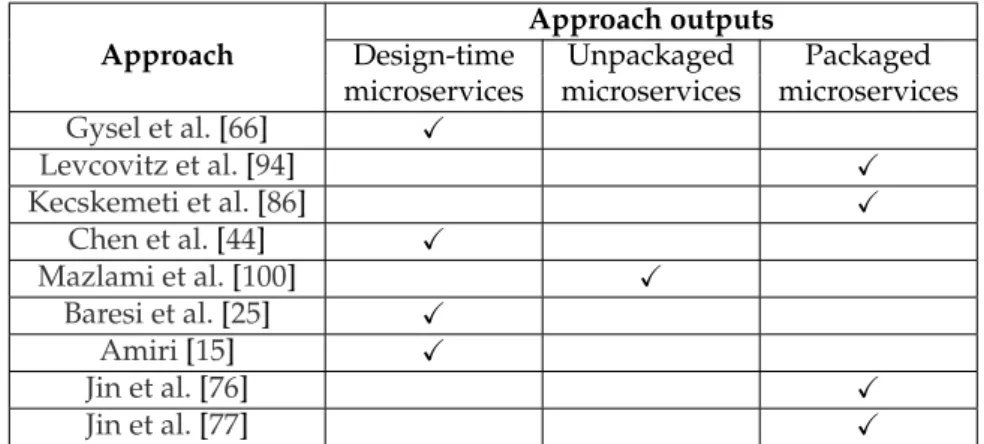
based on the remaining identification process aspects . . . 35 2.5 Classification of the investigated microservice identification approaches
based on their outputs . . . 36 2.6 Classification of the investigated workflow extraction approaches
based on their objective . . . 43 2.7 Classification of the investigated workflow extraction approaches
based on their required inputs . . . 45 2.8 Classification of the investigated workflow extraction approaches
based on their task identification, control flow, and data flow re-covery techniques . . . 51 2.9 Classification of the investigated workflow extraction approaches
based on the remaining process aspects . . . 54 2.10 Classification of the investigated workflow extraction approaches
based on their outputs . . . 55 3.1 Measurement of D between the classes of the example shown in
3.2 Measurement of Freq between the classes of the example shown in Figure 3.7 . . . 78 4.1 DEF/USE sets of the methods shown in Listing 4.1 . . . 111 4.2 VarUsed and ReachDef computed for each node of the CFG shown
in Figure 4.8 . . . 116 5.1 Applications metrics . . . 125 5.2 Number of identified microservices from FindSportMates,
Spring-Blog, and InventoryManagementSystem applications . . . 126 5.3 Measurement results of FMicro, FStructureBehavior, and FData . . . 127 5.4 Microservice classification results . . . 128 5.5 Recall measurement . . . 129 5.6 Applications metrics . . . 136 5.7 Functional independence measurement results . . . 136 5.8 Measurement results of FMicro, FStructureBehavior, and FData . . 138 5.9 Microservice classification results . . . 139 5.10 Recall measurement . . . 139 5.11 Applications metrics before applying extract method refactoring . . 144 5.12 Applications metrics after applying extract method refactoring . . . 146 5.13 Workflow extraction results . . . 146 5.14 Test cases for eLib application . . . 149
Introduction
1.1 Context . . . . 2 1.1.1 Cloud Computing and DevOps . . . 2 1.1.2 Microservices . . . 4 1.2 Problem and Motivation . . . . 5 1.2.1 Monolithic Applications for Cloud and DevOps . . . 5 1.2.2 Migrating Monolithic Applications to Microservices for
Cloud and DevOps . . . 6 1.3 Contributions . . . . 9 1.4 Thesis Organization . . . 11
Over the years, technologies evolve to enable more efficient, and easier soft-ware development, deployment, as well as any subsequent activity to softsoft-ware delivery, such as maintenance. Examples of recent technologies allowing that, and attracting the attention of both researchers as well as industrials are cloud computing, DevOps, and microservices.
To keep pace with technological advances, existing applications developed relying on outdated technologies can be rewritten from scratch or migrated to re-cent ones. Our work contributes to the migration of existing monolithic applica-tions towards microservices to adapt them to both cloud computing and DevOps.
1.1 Context
1.1.1 Cloud Computing and DevOps
Cloud computing is a model for allowing on-demand network access to a shared pool of configurable computing resources such as storage space, servers, applications, services, and so on [101]. Customers can allocate and release these resources quickly with minimum service provider communication and manage-ment effort [101]. The cloud is characterized by its high availability, elasticity, scalability, and cost flexibility (i.e., pay-as-you-go model). It provides a variety of services that can be categorized into a hierarchy of as a Service terms [127]. A sim-plified categorization (Figure 1.1) partitions cloud services into three categories: SaaS (Software as a Service), PaaS (Platform as a Service), and IaaS (Infrastruc-ture as a Service). SaaS is a software delivery paradigm, where service providers develop software and deliver it via the Internet [55]. PaaS offers platforms for the development, and deployment of applications in cloud infrastructure using pro-gramming languages, libraries, tools, and so on [57]. IaaS providers deliver pro-cessing, storage, network, and other fundamental computing resources enabling costumers to deploy and run their software [51,101]. This can be done by allocat-ing customized Virtual Machines (VMs) with predefined CPU, memory, storage, and bandwidth capacity [127]. Customers can elastically allocate/release VMs, and they are billed based on their usage. Some of the prominent cloud services providers are SalesForce [5], Google App Engine [2], Amazon EC2 [3], and Mi-crosoft Azure [4].
Due to its characteristics, nowadays, the cloud is attracting the attention of both scientific researchers, and industrials. Researchers consider it as a platform enabling them to develop and run massively scalable scientific applications [105], that are usually compute and data intensive. Moreover, instead of upfront in-vestment in an over-provisioned infrastructure, they pay only for what they use. Even companies are attracted to the cloud due to its scalability and cost flexibility [74]. They view it as an opportunistic business strategy allowing them to com-pete with other companies, and meet business goals [34,17,16], especially when merged with efficient DevOps.
DevOps (Development and Operations) [26] is a set of practices aiming to en-hance the collaboration between development (e.g., programming, testing, etc.) and operations (e.g., deployment, monitoring, etc.) teams (Figure 1.2) to reduce the time to market. Furthermore, it ensures maintaining the quality of the code and the delivery mechanism [23]. Continuous Integration (CI) and Continuous Delivery (CD) are among the key DevOps practices. CI enables members of de-velopment teams to integrate their work frequently, usually multiple times per
Figure 1.1 – Cloud computing services
day [121,59]. CD aims to ensure that valuable software is produced in short cy-cles and that it can be reliably released at any moment [41]. CD can use a set of practice, such as CI and automated deployment [71].
Figure 1.2 – Scheme of DevOps
Fully benefiting from cloud and DevOps requires taking into account their characteristics and requirements when building applications. For instance, in the cloud, a failure may occur at any moment [22, 134]. Therefore, applications to be deployed in this environment should be able to deal with such uncertainties [22]. Furthermore, smoother adoption of DevOps requires having a system con-sisting of modules that can be developed, tested, and deployed independently. Microservice-based systems can fulfill these constraints.
1.1.2 Microservices
Recently, microservices [106, 122, 123, 95] have appeared as an architectural style well-adapted for the development of applications to be deployed in the cloud (i.e., a cloud-native architecture [22]), and for those adopting DevOps prac-tices. In literature, the most commonly used definition of this architectural style is the one proposed byLewis and Fowler[95]. According to them, in this style, an application consists of a set of small services that are independently deployable and scalable. Each microservice manages its own data and communicate with others relying on lightweight mechanisms, generally HTTP resource API (Fig-ure 1.3). Moreover, they are commonly packed and deployed using containers [106,122,123].
Figure 1.3 – Representation of microservices
During the execution of a microservice-based application, microservices can independently be duplicated (i.e., scaled) or deleted on the fly to reduce the re-sponse time or because they are not used. Such dynamic duplication (resp., delete) requires a dynamic allocation (resp., release) of resources, which is pro-vided by the cloud due to its elasticity. The dynamic allocation and release adapt the usage cost of resources to the application requirements. Furthermore, each microservice can be deployed using resources that suites its requirements (e.g., CPU, memory, etc.) [52, 114]. Such effective consumption of resources allows cloud service providers to offer higher scalability guarantees [56]. Finally, mi-croservices facilitate resuming the execution of an application after a cloud fail-ure because they can easily and quickly be restarted without the need to restart the entire application [130].
Besides their well-adaptability to the cloud, microservices support DevOps. They enable continuous delivery and deployment of large and complex
applica-tions [114]. This is due to the fact that they can be developed, tested, and de-ployed separately. Therefore, each team can easily develop, test, and deploy their microservices independently from other teams [130].
1.2 Problem and Motivation
In recent years, the microservice architectural style has become an essential element for the development of applications to be deployed in the cloud and for those adopting DevOps practices. Nevertheless, many applications have been developed before the emergence of this style relying on a monolithic one. Some of these applications, such as the ones used by companies (e.g., Amazon, Netflix, eBay, etc.) afford a high business value.
1.2.1 Monolithic Applications for Cloud and DevOps
Monolithic architectural style [128, 52, 114, 95, 112] is the traditional way to develop software systems. In this style, an application, called monolithic or a monolith, is built as a single unit that combines the user interface, business logic, and data accesses. Usually, it is autonomous and independent from other appli-cations.
The monolithic style is well-adapted for the development of small applica-tions, where a single team works on the code [128], or when there are high de-pendencies between the different parts of the application hardening the decom-position. Otherwise, monoliths have significant limitations, especially when de-ployed in the cloud:
— Extra cost for resource utilization: scaling a monolith requires simply run-ning multiple copies of the entire application behind a load-balancer [122,
95, 112]. In the cloud, customers are generally billed based on the used resources, even if some of them are unnecessarily occupied by parts of the monolith that are not frequently used (i.e., implementing functionalities less utilized by users) [52]. This is definitely an expensive way to scale an ap-plication. Besides this, to deploy a monolith, the needed resources are al-located based on the requirements (e.g., CPU, memory, etc.) of the entire monolith. If there is a significant variation in term of these requirements during the execution of the monolith, the chosen resources can either be sub-optimal or expensive.
— Considerable downtimes: to resume the execution after a cloud failure, the entire application may be rebooted. Generally, considerable downtime is entailed when restarting a monolith [52].
— Difficulty to adopt DevOps practices: adopting DevOps practices is not always smooth [146], especially when dealing with monolithic applications. The adoption of DevOps requires having a system consisting of modules that can be developed, tested, and deployed independently. This is not the case when handling monoliths.
Due to these limitations, monolithic applications are not well-adapted neither to the cloud nor to DevOps. A possible way to adapt such applications to both is migrating them towards an architectural style that can tackle these limitations.
1.2.2 Migrating Monolithic Applications to Microservices for Cloud
and DevOps
As explained earlier, microservices can independently be developed, tested, deployed, and scaled, which allows them to address the mentioned limitations of monolithic applications. To illustrate the limits of these applications and the advantages of microservices, consider the example of Figure 1.4, which shows a monolithic e-commerce application running in the cloud. It takes orders from customers, verifies the availability of the ordered item in the inventory, and ships them. A user can utilize it as a mobile application or via a web browser. Sup-posing that a high number of new items that may be ordered by users during the upcoming holiday season are being added to the inventory to ensure their avail-ability. Moreover, for the current period, a limited number of orders are being placed. To reduce the response time and guarantee that items are added easily, the entire application should be scaled, even though not all its provided func-tionalities are frequently used (i.e., placing orders and shipping items). Thus, resources are unnecessarily occupied, and the cost for their usage is paid.
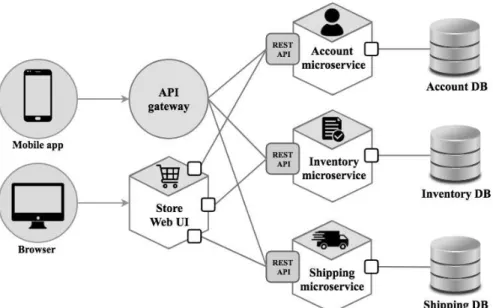
To reduce the response time without paying an extra cost, the monolithic e-commerce application can be migrated to microservices, and only the microser-vice managing the inventory should be scaled. Figure 1.5 presents a possible de-composition of the e-commerce monolith into microservices (inspired from [113]). The corresponding microservice-based application consists of several microser-vices, including the Store Web UI, which implements the user interface, and three other microservices: Account microservice, Inventory microservice, and Shipping croservice. An API Gateway routes requests from the mobile applications to mi-croservices, which collaborate via APIs.
Since microservices can address the limitations of monolithic applications, ex-isting monoliths can be rewritten from scratch relying on microservices or mi-grated towards them. On the one hand, a complete rewrite is known as a risky, costly, and time-consuming task. Generally, the documented business logic of monoliths is not up to date [93]. Moreover, due to staff turnover, reaching to ap-plications experts becomes difficult. In fact, the risk of failure is usually too high for companies to rewrite their applications from scratch [30]. On the other hand, the migration towards microservice architectural style appears as an evident so-lution. Indeed, it is safer and usually carried out.
Figure 1.4 – Example of a monolithic e-commerce application
Figure 1.5 – Example of the monolithic e-commerce application decomposed into
Therefore, the ultimate aim of our dissertation is contributing to automate the migration of monolithic OO applications towards microservices in order to adapt them to both cloud and DevOps. For that purpose, we address the research problem that consists of answering two main questions:
1. How to identify from a monolithic OO application the corresponding
microservice-based architecture while respecting as much as possible the principles of this architectural style? This question is related to the
obser-vation that existing microservice identification approaches, such as the ones presented in [66, 94, 25, 100, 44], have limitations preventing them from thoroughly answering it. Among the main limitations, we can mention:
— The used criteria to identify microservices do not materialize all the "semantics" of the concept "microservice". For example, the criterion concerning data autonomy of microservices is not always taken into account, especially when the required inputs by the identification ap-proach are not documentation.
— To identify microservices from a monolith, the needed pieces of infor-mation can be recovered from its source code by analyzing it. Addi-tionally to these pieces of information, the ones (i.e., recommendations) provided by the analyzed application experts can be used to improve the relevance/ quality of the identified microservices. However, exist-ing approaches that require experts intervention suffer primarily from two limitations. On the one hand, the experts intervention is not lim-ited to providing relevant recommendations but rather perform some steps of the approach. On the other hand, experts intervention is con-sidered as always necessary. The aforementioned constraint limits the applicability of these approaches.
— The used algorithmic model impacts the relevance/quality of the iden-tified microservice-based architecture. Existing approaches rely mainly on a limited number of models such as clustering.
Based on these limitations, the above question can be further refined into three sub-ones:
— How to identify microservices from an OO application while taking into account the "semantics" of the concept "microservice"?
— What are the relevant recommendations allowing to benefit from the guidance of experts, and how can they be combined with source code information?
— Which algorithmic model can be used to have the best possible mi-croservices based on the evaluation of their quality?
2. How to extract from an OO application its corresponding workflow to be
used by existing task-based approaches to identify microservices? This
question is related to the observation that some existing approaches identify microservices relying on workflows [15] or their constituents [44]. A work-flow specifies the sequencing mode of tasks following two formalisms: con-trol flow and/or data flow. A concon-trol flow describes the execution order of tasks through different constructs such as sequences, conditional branches (if and switch), and loops (for and while). A data flow specifies data ex-changes between tasks. If a workflow is not available, a task-based iden-tification firstly extracts it from the accessible artifacts of the monolith to be migrated (e.g., source code, event logs, etc.), and then use it to identify microservices. Nevertheless, existing task-based approaches either suppose that workflows are available [15] or experts can recover their constituents [44], which is not always the case. To ensure the applicability of such ap-proaches, a workflow can be extracted from the available artifacts. Several approaches have been proposed to recover workflows. However, they suf-fer from two main limitations:
— Usually, their aim is not to recover all the constituents of a workflow. They either extract a control flow [148, 147,61, 89,72, 62,118,119, 90] or a data flow [43,33,99], but not both.
— Expert intervention is necessary to perform some steps of the approach manually [90], which limits its applicability.
Based on these limitations and the definition of a workflow, the above ques-tion can be further refined into three sub-ones:
— What are the tasks that reflect the workflow corresponding to the OO application?
— What is the control flow to be defined between the identified tasks? — What is the data flow to be associated with the identified tasks and
control flow?
1.3 Contributions
To tackle the identified problem in Section 1.2, this dissertation presents the following contributions:
1. Structure-based identification of microservices from OO source code: our approach identifies microservices based on the static analysis of OO source code of a monolithic application. It relies on information related to source
code structure, persistent data (i.e., data stored in databases) accesses, and architect recommendations when these latter are available. Its originality can be viewed from three aspects:
— Identification of microservices based on the evaluation of a
well-defined function measuring their quality: the goal of our approach
is to identify microservices by maximizing a function which evaluates their quality. It was proposed based on metrics reflecting the "seman-tics" of the concept "microservice". These metrics were defined by re-fining conceptual characteristics of microservices. Parameters of the quality function are source code structural dependencies and accesses links to persistent data.
— Exploiting architect recommendations only when available: a well-defined set of recommendations, that an architect can provide, was specified and used in our approach. The recommendations are related, mainly, to the use of the applications (e.g., how many microservices, which class is the center of a microservice, etc.). Moreover, they are combined with source code information. Mainly, the recommenda-tions, when available, are involved in partitioning the OO applications into microservices. Source code information is used to measure their quality. Depending on the available recommendations, different mi-croservice identifications can be carried out.
— Clustering and meta-heuristics algorithmic models to identify
mi-croservices based on the evaluation of the quality function: our
ap-proach group the classes of an OO application based on their quality measured using the proposed quality function. For that purpose, two algorithmic models have been used: clustering [142] and genetic al-gorithms [69, 103]. The proposed quality function is considered as a similarity measure in the clustering algorithm and as a fitness func-tion in the genetic one. It is possible to identify microservices relying on both algorithmic models, then compare the produced results and chose the best ones.
2. Workflow extraction from OO source code to enable task-based
identifi-cation of microservices: to enable the applicability of some existing
task-based identification approaches [15,44] when only the source code is avail-able, we propose an approach aiming to extract workflows by analyzing the source code. This extraction requires the ability to map OO concepts into workflow ones. For instance, specifying what is the mapping of the concept task compared to the OO concepts is necessary. Once such a map-ping is established, workflow constituents (i.e., tasks, control flow, and data flow) are recovered from OO source code relying on it.
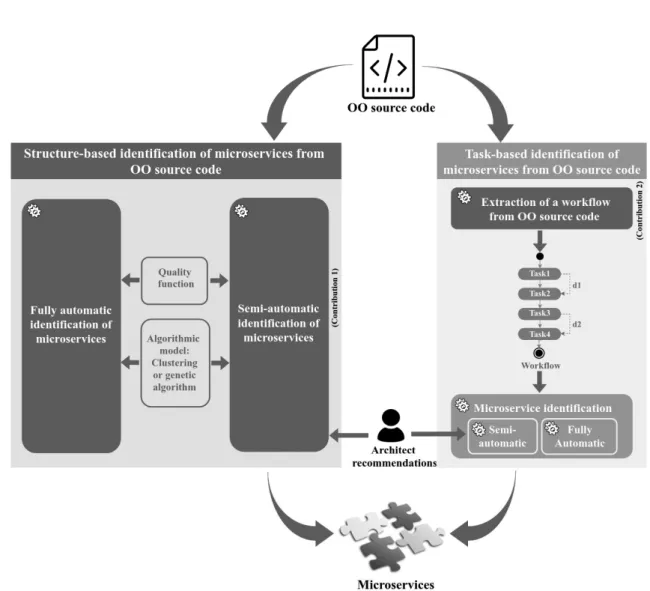
identifi-cation, as demonstrated in Figure 1.6 (contributions annotated and highlighted in blue boxes). As shown in this figure, both identification approaches (i.e., structure-based and task-structure-based) can have as input source code, and produce as output microservices. The structure-based identification recovers microservices directly, whereas the task-based one, that relies on workflows, firstly extracts them, and then carries out the identification. Moreover, both identifications can be fully automatic or semi-automatic based on whether they use software architect rec-ommendations or not.
1.4 Thesis Organization
The remainder of this dissertation is organized into five chapters as follows: — Chapter 2 discusses the state-of-the-art related to migrating monolithic
sys-tems towards microservices and extracting workflows from the available software artifacts. In this regards, a taxonomy of the related works is pre-sented to enable comparing and positioning our contributions.
— Chapter 3 presents our structure-based identification approach that parti-tions an OO source code into microservices relying on its quality measure-ment as well as software architect recommendations, when available. More-over, it uses both clustering and genetic algorithms.
— Chapter 4 presents our contribution aiming to extract a workflow from an OO application based on static analysis of its source code. The extracted workflow enables a task-based identification of microservices.
— Chapter 5 presents the conducted experiments to validate our contributions, interprets results, and discusses threats to validity. It starts by validating structure-based microservice identification qualitatively and quantitatively. Then, the workflow extraction is evaluated.
— Chapter 6 summarizes the work realized in this dissertation and gives some future directions.
Figure 1.6 – Positioning the contributions of our dissertation within the context of
State of the Art
2.1 Brief Background on Migrating Monolithic OO Software To-wards More Recent Technologies . . . 14
2.1.1 Software Reengineering and Migration . . . 14
2.1.2 From Object-Oriented to Components, Services and Mi-croservices . . . 16
2.2 Taxonomy of Related Works . . . 19
2.2.1 Technical versus Feedback Approaches . . . 19
2.2.2 Technical Approaches . . . 20
2.2.3 Feedbacks and Learned Lessons Approaches . . . 56
2.3 Conclusion . . . 58
This chapter discusses the state-of-the-art related to the migration of mono-lithic applications to microservices. Firstly, Section 2.1 positions our work com-pared to the relevant domains. Then, Section 2.2 classifies and discusses the re-lated approaches. Finlay, Section 2.3 concludes this chapter.
2.1 Brief Background on Migrating Monolithic OO
Software Towards More Recent Technologies
2.1.1 Software Reengineering and Migration
Software reengineering is defined as an engineering process seeking to gener-ate an evolvable system [120]. Generally, it includes all the subsequent activities to software delivery that aims at improving the understanding of the software as well as enhancing various quality parameters, such as system maintainability and complexity [137]. It is defined byChikofsky and Cross II[45] as:
"Software reengineering, also known as both renovation and reclamation, is the ex-amination and alteration of a subject system to reconstitute it in a new form and the subsequent implementation of the new form."
Based on this definition, the software reengineering process consists of three steps [137]. Firstly, the subject system is examined to recover relevant information (i.e., reverse engineering). The second step alters the system (i.e., transformation). Finally, the new implementation is generated (i.e., forward engineering).
When the reengineering is driven by a major technology change, it can be called migration [10], for instance, the migration of OO systems to component-based ones. In other words, software migration is a variant of software reengi-neering [10]. It is defined byBisbal et al.[29] as:
" Migration (...) allows legacy systems to be moved to new environments that allow information systems to be easily maintained and adapted to new business requirements, while retaining functionality and data of the original legacy systems without having to completely redevelop them."
The reengineering/migration process can be represented by a horseshoe model (Figure 2.1) [84], that displays the steps mentioned above. This model includes three levels of abstraction: code representation, function representation, and ar-chitecture representation.
1. Reverse engineering: reverse engineering is the process of recovering high-level abstractions, such as software architecture, by analyzing lower high-level ones, like source code [45]. Its outcome is the basis for the next steps (i.e., transformation and forward engineering). For instance, when migrating an OO application to microservices, reverse engineering can be applied to re-cover the architecture of the existing application (i.e., its classes and their relationships). In literature, many terminologies referring to reverse
engi-neering have been used, among them extraction [72], mining [62], identifi-cation [77] and recovery [148]. In our dissertation, these terms are used to refer to reverse engineering.
Figure 2.1 – Horseshoe model representing the reengineering/migration process
2. Transformation: also known as restructuring, it refers to transforming one representation form to another at the same level of abstraction (e.g., source-to-source, model-to-model, etc.) while preserving the functionalities of the system [45]. In [84], it is called architectural transformation. It aims to trans-form the reverse engineered architecture to the desired one. For instance, in this step, the recovered architecture of a monolithic OO application can be transformed into a microservice-based one. This may be done by partition-ing the classes of the OO architecture based on their relationships. Each cluster represents a microservice. It is noteworthy that the transformation is not included in the reverse engineering [10]. Nevertheless, in literature and our dissertation, the two steps have been referred to by reverse engi-neering.
During the transformation, the structure of a system can be improved. This is known as refactoring. It is defined in [58] as: "the process of changing a software system in a way that does not alter the external behavior of the code yet improves its structure. It is a disciplined way to clean the code that minimizes the
chances of introducing bugs. In essence, when you refactor, you are improving the design of the code after it has been written." The refactoring enables reworking a bad code into well-structured one by applying simple changes, such as pulling some code out of a method [58]. The cumulative effect of these simple changes can thoroughly enhance the structure of the system [58]. 3. Forward engineering: forward engineering is the traditional process of
moving from high-level conceptual abstractions to the physical implemen-tation of a system [45]. For example, when migrating an OO application to microservices, forward engineering can be applied to generate an imple-mentation of the microservice-based application relying on the recovered architecture (i.e., identified microservices) in the previous step.
2.1.2 From Object-Oriented to Components, Services and
Mi-croservices
2.1.2.1 Evolution of Technologies
Over the years, technologies evolve to ease the development of applications, their deployment, as well as any subsequent activity to their delivery. Figure 2.2 shows the evolution of technologies from Object-Oriented Programming (OOP) to microservices.
Figure 2.2 – Evolution of technologies

![Figure 2.7 – The extracted workflow by ProCrawl representing the peer-review process in OpenConf [119]](https://thumb-eu.123doks.com/thumbv2/123doknet/7714868.247846/76.892.112.745.144.346/figure-extracted-workflow-procrawl-representing-review-process-openconf.webp)