HAL Id: hal-02129171
https://hal.archives-ouvertes.fr/hal-02129171
Submitted on 9 Apr 2020
HAL is a multi-disciplinary open access
archive for the deposit and dissemination of
sci-entific research documents, whether they are
pub-lished or not. The documents may come from
teaching and research institutions in France or
abroad, or from public or private research centers.
L’archive ouverte pluridisciplinaire HAL, est
destinée au dépôt et à la diffusion de documents
scientifiques de niveau recherche, publiés ou non,
émanant des établissements d’enseignement et de
recherche français ou étrangers, des laboratoires
publics ou privés.
On intercausal interactions in probabilistic relational
models
Silja Rennoij, Linda van der Gaag, Philippe Leray
To cite this version:
Silja Rennoij, Linda van der Gaag, Philippe Leray. On intercausal interactions in probabilistic
re-lational models. The Eleventh International Symposium on Imprecise Probability: Theories and
Applications (ISIPTA ’19), 2019, Ghent, Belgium. pp.327 - 329. �hal-02129171�
Proceedings of Machine Learning Research 103:327–329, 2019 ISIPTA 2019
On Intercausal Interactions in Probabilistic Relational Models
Silja Renooij [email protected]
Linda C. van der Gaag [email protected]
Department of Information and Computing Sciences, Utrecht University, The Netherlands
Philippe Leray [email protected]
LS2N UMR CNRS 6004, DUKe research group, University of Nantes, France
Abstract
Probabilistic relational models (PRMs) extend Bayes-ian networks beyond propositional expressiveness by allowing the representation of multiple interacting classes. For a specific instance of sets of concrete objects per class, a ground Bayesian network is com-posed by replicating parts of the PRM. The interac-tions between the objects that are thereby induced, are not always obvious from the PRM. We demonstrate in this paper that the replicative structure of the ground network in fact constrains the space of possible proba-bility distributions and thereby the possible patterns of intercausal interaction.
Keywords: PRM instances, qualitative constraints on probability distributions, intercausal interaction.
1. Introduction
Real-world problem domains often have a relational struc-ture involving multiple interacting object classes, which cannot be appropriately modelled by a Bayesian network. By allowing the representation of relational information, probabilistic relational models, or PRMs, extend on the propositional expressiveness of Bayesian networks [2,3,4]. More specifically, a PRM describes the object classes from a relational schema by a graphical dependency structure and supplements this structure with probabilistic information. Inference with an instance composed of sets of concrete ob-jects per class is performed in a ground Bayesian network which is derived from the PRM by replicating parts for the concrete objects involved. The PRM thus is essentially a meta-modelcovering all possible instances.
Upon constructing a ground Bayesian network for a given instance, interactions may be induced between the random variables modelling the PRM’s feature variables, that are not always obvious from the meta-level model. In this paper, we study the possible interactions resulting for an instance from relational dependencies between the features of different classes. We focus more specifically on many-to-one dependencies: for a given instance, the value of a feature variable E of a concrete object for some class X may then depend on the values of the variable C in multiple objects for a class X0. In the PRM, the precise
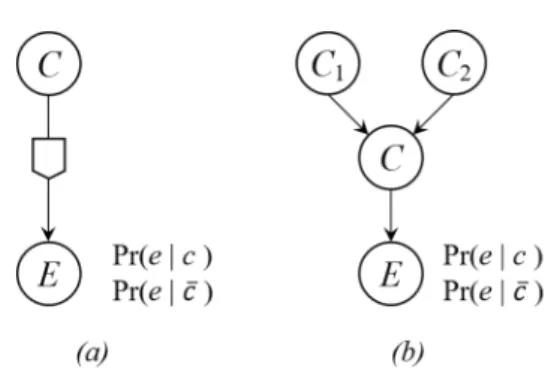
Figure 1: (a) An example PRM and (b) its ground network.
dependency involved is described by an aggregation func-tionwhich serves to summarise a multiset of values of C into a single such value [3]. Example aggregation functions are the logicalOR, theMODEand theSTOCHASTIC-MODE
[5]. In this paper, we will demonstrate that, in addition to the aggregation function used, the replicative structure of the ground network constrains the intercausal interactions induced among multiple objects. Our analysis informs the choice of aggregation function to attain the desired type of interaction in a PRM instance.
2. Running Example
As running example, we consider the small PRM shown in Figure1(a)and assume all variables to be binary-valued. The feature variables C and E belong to different classes (left implicit). The relational dependency between C and E thus extends over the class boundaries, and we assume it to be of type many-to-one, indicated by an arc associated with an aggregation function. We now consider an instance with two objects with the variable C, whose replicates are denoted C1and C2as shown in Figure1(b). For the node C,
encoding the aggregation of the two Civalues, in essence
four conditional probabilities are specified: p1= Pr(c | c1, c2) p3= Pr(c | ¯c1, c2)
p2= Pr(c | c1, ¯c2) p4= Pr(c | ¯c1, ¯c2)
INTERCAUSALINTERACTIONS INPRMS
(a) (b)
Figure 2: (a) Combinations of probability values p1, p2= p3, p4resulting in X0({C1,C2}, c) (above the surface the synergy
is positive, and it is negative below the surface), (b) the X0({C1,C2}, c)-surface restricted to combinations of
probability values p1≥ p2= p3and p2= p3≥ p4obeying S+(Ci,C).
Since the ground Bayesian network of Figure1(b)has a replicative structure, we necessarily have that p2= p3to
capture an arbitrary aggregation order.
3. Intercausal Interactions
We address the patterns of interaction between the two replicates C1and C2in our running example, that is, we
investigate how an observation for C1influences the
prob-ability distribution over C2, and vice versa, when a value
for E is known; without loss of generality, we assume in our analysis that a value is known for the aggregation node C instead. The sign of such an intercausal influence is described by the concept of product synergy [8]. More specifically, a product synergy Xδ({C
1,C2}, c) captures the
sign δ ∈ {+, −, 0} of the intercausal interaction between C1and C2that is induced by observation of C = c, where δ
is the sign of the difference p1· p4− p2· p3. If δ = 0 then
there is no interaction between the causes upon observing C= c; if δ = −, then the presence of one cause is said to explain-awaythe other.
We exploit the above and similar qualitative properties of probability to show that not all patterns of intercausal interaction can be readily attained in a ground Bayesian network. Properties of the PRM in fact dictate to a large extent the set of possible probability values pi, i = 1, 2, 3, 4,
for the aggregation node C, and thereby the patterns of interaction that can be induced. Given the constraint p2=
p3, Figure2(a)shows the surface of all picombinations
that result in a zero product synergy, and hence in a lack of interaction between C1and C2given C = c. Probability
combinations above this surface result in X+({C1,C2}, c)
and combinations below it in explaining-away. To aid in the
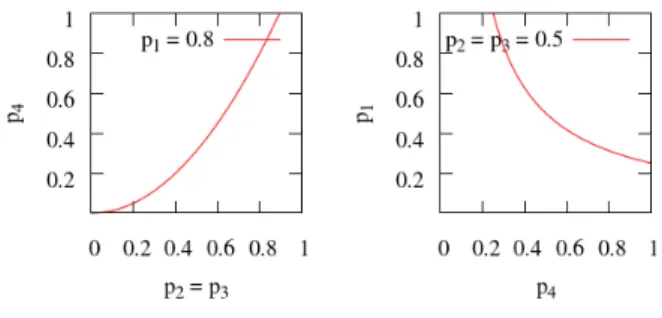
Figure 3: Slices of the X0({C
1,C2}, c)-surface for fixed
values p1= 0.8 and p2= p3= 0.5, respectively.
interpretation of Figure2(a), Figure3shows two slices of the surface: the left one is the horizontal slice for p1= 0.8,
and the right one the vertical slice at p2= p3= 0.5.
Another qualitative property of probability distributions is described by the concept of qualitative influence [7], de-noted by Sδ(C
i,C), which captures the sign of the direct
influence between two variables Ciand C. More specifically,
the influence is positive iff Pr(c | ci,Cj) ≥ Pr(c | ¯ci,Cj) for
all values of Cj, i, j = 1, 2, i 6= j; assuming c > ¯cand ci> ¯ci,
such an influence captures the idea that higher values of Ci
make higher values of C more likely, regardless of other influences on C. In the ground Bayesian network, the direct influences are constrained by S+(Ci,C), i = 1, 2 [6], that
is, the set of possible probability values pi, i = 1, 2, 3, 4, is
restricted by p1≥ {p2, p3} ≥ p4. The plane representing
the constraint p1= p2= p3is shown by dotted lines in
Figure2(b); dashed lines show the plane representing the constraint p2= p3= p4. The figure shows that these
INTERCAUSALINTERACTIONS INPRMS
straints significantly reduce the possible picombinations
that induce a zero product synergy, and leave very little room for capturing positive intercausal interactions in a PRM at hand. We further note that any deterministic aggre-gation function, encoded by a degenerate distribution for C with p1= 1 and p4= 0, will necessarily result in negative
intercausal interactions given C = c. If positive intercausal interactions or a lack of interaction are desired therefore, the use of a stochastic aggregation function is called for.
The product synergies discussed capture the intercausal interaction upon observation of C = c. The intercausal in-teractions induced by observing C = ¯care found basically by mirroring the surface across all three axes in the figures.
4. Conclusion and Future Research
Our analyses show that to induce the type of intercausal interaction desired for an application domain requires care-ful tuning of the probabilities for the observed value of aggregation node C. As the probabilities for this node in essence encode an aggregation function, studying the pos-sible probability values for C thus informs the choice of an appropriate aggregation function for the PRM.
In view of possible instantiations of the PRM we are typi-cally interested in intercausal effects due to the observation of the effect node E rather than aggregation node C. An observation for node E is essentially indirect evidence for C in the ground Bayesian network, and capturing the induced intercausal effects then involves the product synergies for both values of C [1]. For instantiations with more than two objects, we can use a generalised definition of product syn-ergy to similarly study all pair-wise interactions [1]. The concepts of product synergy and qualitative influence are not restricted to binary variables, but are in fact defined for discrete variables that allow a total order on their values. By considering all possible pairs of values ci> cjof the
variables involved, our results generalise straightforwardly beyond the binary case. A more formal underpinning of further generalisations is topic of future research.
References
[1] M.J. Druzdzel and M. Henrion. Learning probabilistic relational models. In D. Heckerman and A. Mamdani, editors, Proceedings of the 9th Conference on Uncer-tainty in Artificial Intelligence, UAI’93, pages 317–325. Morgan Kaufmann, 1993.
[2] N. Friedman, L. Getoor, D. Koller, and A. Pfeffer. Learning probabilistic relational models. In T. Dean, editor, Proceedings of the 16th International Joint Conference on Artificial Intelligence, IJCAI’99, pages 1300–1307. Morgan Kaufmann, 1999.
[3] L. Getoor. Learning Statistical Models from Relational Data. PhD thesis, Stanford, 2001.
[4] D. Koller and A. Pfeffer. Probabilistic frame-based systems. In C. Rich J. Mostov, editor, Proceedings of the 15th National Conference on Artificial Intelligence, AAAI’98, pages 580–587. AAAI Press, 1998.
[5] B. Taskar, E. Segal, and D. Koller. Probabilistic classifi-cation and clustering in relational data. In Proceedings of the 17th International Joint Conference on Artificial Intelligence, pages 870–878. Morgan Kaufmann, 2001. [6] L.C. van der Gaag and Ph. Leray. Qualitative proba-bilistic relational models. In D. Ciucci, G. Pasi, and B. Vantaggi, editors, Proceedings of the 12th Interna-tional Conference on Scalable Uncertainty Manage-ment, SUM’18, volume 6178 of Lecture Notes in Com-puter Science, pages 276–289. Springer, 2018. [7] M.P. Wellman. Fundamental concepts of qualitative
probabilistic networks. Artificial Intelligence, 44:257– 303, 1990.
[8] M.P. Wellman and M. Henrion. Qualitative intercausal relations, or explaining explaining away. In J.F. Allen, R. Fikes, and E. Sandewall, editors, KR91: Principles of Knowledge Representation and Reasoning, pages 535–546. Morgan Kaufmann, 1991.