HAL Id: hal-01545667
https://hal.archives-ouvertes.fr/hal-01545667v2
Submitted on 4 Jul 2017
HAL is a multi-disciplinary open access
archive for the deposit and dissemination of
sci-entific research documents, whether they are
pub-lished or not. The documents may come from
teaching and research institutions in France or
abroad, or from public or private research centers.
L’archive ouverte pluridisciplinaire HAL, est
destinée au dépôt et à la diffusion de documents
scientifiques de niveau recherche, publiés ou non,
émanant des établissements d’enseignement et de
recherche français ou étrangers, des laboratoires
publics ou privés.
Stochastic Bandit Models for Delayed Conversions
Claire Vernade, Olivier Cappé, Vianney Perchet
To cite this version:
Claire Vernade, Olivier Cappé, Vianney Perchet. Stochastic Bandit Models for Delayed Conversions.
Conference on Uncertainty in Artificial Intelligence, Aug 2017, Sydney, Australia. �hal-01545667v2�
Stochastic Bandit Models for Delayed Conversions
Claire Vernade
1,2, Olivier Capp´e
1,3, Vianney Perchet
1,4,51 Universit´e Paris-Saclay
2 LTCI, Telecom ParisTech,
3 LIMSI, CNRS
4 CMLA, ENS Paris-Saclay
5 Criteo Research
Abstract
Online advertising and product recommendation are important domains of applications for multi-armed bandit methods. In these fields, the reward that is immediately available is most often only a proxy for the actual outcome of interest, which we refer to as a conversion. For instance, in web advertising, clicks can be observed within a few seconds after an ad display but the corresponding sale –if any– will take hours, if not days to happen. This paper proposes and investigates a new stochas-tic multi-armed bandit model in the framework proposed by Chapelle (2014) –based on empirical studies in the field of web advertising– in which each action may trigger a future reward that will then happen with a stochastic delay. We assume that the probability of conversion associated with each action is un-known while the distribution of the conversion delay is un-known, distinguishing between the (idealized) case where the conver-sion events may be observed whatever their delay and the more realistic setting in which late conversions are censored. We provide performance lower bounds as well as two simple but efficient algorithms based on the UCB and KLUCB frame-works. The latter algorithm, which is preferable when con-version rates are low, is based on a Poissonization argument, of independent interest in other settings where aggregation of Bernoulli observations with different success probabilities is required.
1
INTRODUCTION
Characterizing the relationship between marketing actions and users’ decisions is of prime importance in advertising, product recommendation and customer relationship management. In online advertising a key aspect of the problem is that whereas marketing actions can be taken very fast –typically in less than a tenth of a second, if we think of an ad display–, user’s buy-ing decisions will happen at a much slower rate [7, 4, 18]. In the following, we refer to a user’s decision of interest under the generic term of conversion. Chapelle, in [4], while analyzing data from the real-time bidding company Criteo, observed that, on average, only 35% of the conversions occurred within the first hour. Furthermore, about 13% of the conversions could be attributed to ad display that were more than two weeks old. An-other interesting observation from this work is the fact that the delay distribution could be reasonably well fitted by an
expo-nential distribution, particularly when conditioning on context variables that are available to the advertiser.
The present work addresses the problem of sequentially learning to select relevant items in the context where the feed-back happens with long delays. By long we mean in particular that the feedback associated with a fraction of the actions taken by the learner will be practically unobserved because they will happen with an excessive delay. In the example cited above, if we were to run an online algorithm during two weeks, at least 13% of the actions would not receive an observable feedback because of delays. A related situation occurs if the online algo-rithm is run during, say, one month, but its memory is limited to a sliding window of two weeks. In Section 2 below we intro-duce models suitable for addressing these two related situations in the framework of multi-armed bandits.
Delayed feedback is a topic that has been considered before in the reinforcement learning literature and we defer the pre-cise comparison between existing approaches and the proposed framework to Section 3. In a nutshell however, the distinc-tive features of our approach is to consider potentially infinite stochastic delays, resulting in some feedback being censored (ie. not observable). Existing works on delayed bandits focus on cases where the feedback is observed after some delay, typ-ically assumed to be finite. In contrast, we assume that delays are random with a distribution that may have an unbounded support – although we require that it has finite expectation. As a result, some conversion events cannot be observed within any finite horizon and the proposed learning algorithm must take this uncertainty into account.
In Section 2, we propose discrete-time stochastic multi-armed bandit models to address the problem of long delays with possibly censored feedback. We distinguish two situa-tions that correspond to the cases mentioned informally above: In the uncensored model, conversions can be assumed to be eventually observed after some possibly arbitrarily long delay; In the censored model, it is assumed that the environment im-poses that the conversions related to actions cannot be observed anymore after a finite window of m time steps.
Assuming that the delay distribution is known, we prove problem-dependent lower bounds on the regret of any uni-formly efficient bandit algorithm for the censored and uncen-sored models in Section 4.
In Section 5, we describe efficient anytime policies relying on optimistic indices, based on the UCB [1] or KLUCB [5]
al-gorithms. The latter uses a Poissonization argument that can be of independent interest in other bandit models. In typical sce-narios where the conversion rates are less than one percent, us-ing the KLUCB variant will ensure a much faster learnus-ing and provides near-optimal perfomance on the long run (see Theo-rem 11).
These algorithms are analyzed in Section 6, showing that they reach close to optimal asymptotic performance. In Sec-tion 7 we discuss the implementaSec-tion of these methods, show-ing that it is further simplified in the case of geometrically dis-tributed delays, and we illustrate their performance on simu-lated data.
2
A
STOCHASTIC
MODEL
FOR
THE DELAYS
We now describe our bandit setting for delayed conversion events, inspired by [4]. We first consider the setting in which delays may be potentially unbounded and then consider the case where censoring occurs.
2.1
GENERAL BANDIT MODEL UNDER
DELAYED FEEDBACK
At each round t ∈ N∗, the learner chooses an arm At ∈ {1, . . . , K}. This action simultaneously triggers two indepen-dent random variables:
• Ct∈ {0, 1}, is the conversion indicator that is equal to 1 only if the action Atwill lead to a conversion;
• Dt∈ N, is the delay indicating the number of time steps needed before the conversion – if any – be disclosed to the learner.
At each round t, the agent then receives an integer-valued reward Ytwhich corresponds to the number of observed con-versions at time t: Yt= t ∑ s=1 Cs1{Ds= t− s}.
In the following, we will use the short-hand notation Xs,t = Cs1{Ds≤ t−s}, for s ≤ t to denote the possible contribution of the action taken at time s to the conversion(s) observed at a later time t. We emphasize that even if the actual reward of the learner is the sum of the conversions, we assume that the agent also observes all the individual contributions (Xs,t)1≤s≤t at
time t triggered by actions taken before time t.
The above mechanism implies that if Ct= 1, the learner will observe Dtat time t+Dt, whereas if Ct= 0, the delay will not be directly observable. In particular, if at time t, Xs,u= 0, for all s≤ u ≤ t, it is impossible to decide whether Cs = 0 or if Cs= 1 but Ds> t− s. Formally, the history of the algorithm is the σ-field generated byHt:= (Xs,u)1≤u≤t,1≤s≤u.
We consider the stochastic model under the following basic assumptions:
Ct|Ht−1∼ Bernoulli(θAt),
Dt|Ht−1 ∼ distribution with CDF τ, and Ct, Dtare conditionally independent givenHt−1.
Lemma 1. Denote by a∗ ∈ {1, . . . , K} an index such that θa∗ ≥ θk, for k∈ {1, . . . , K}, and define by r(T ) =
∑T t=1Yt the cumulated reward of the learner and by r∗(T ) the cumu-lated reward obtained by an oracle playing At = a∗ at each round. The expected regret of the learner is given by
L(T ) =E [r∗(T )− r(T )] = T ∑ s=1
E [θa∗− θAs] τT−s (1)
where by definition τT−s = P(Ds ≤ T − s). Denoting E[Nk(T )] :=∑Ts=1−11{As= k}, it holds that
L(T )≤ K ∑ k=1 (θa⋆− θk)Nk(t) and if µ =E[Ds] <∞, K ∑ k=1 (θa⋆− θk)Nk(t)− L(T ) ≤ µ K ∑ k=1 (θa⋆− θk). (2)
Proof The cumulated reward at time T satisfies
r(T ) = T ∑ t=1 Yt= T ∑ t=1 t ∑ s=1 Cs1{Ds= t− s} = T ∑ s=1 Cs1{Ds≤ T − s} = T ∑ s=1 Xs,T, where the index T stands for the time at which all past conver-sions are observed while s is the index at which the action has been taken. Hence Eq. (1) is obtained by
E [ T ∑ t=1 r(T ) ] =E [ T ∑ t=1 Yt ] = T ∑ s=1 E [Xs,T] = T ∑ s=1 θAsτT−s.
Obviously the fact that τT−s≤ 1 implies that L(T ) is upper bounded by∑Kk=1(θa⋆− θk)Nk(t), which corresponds to the
usual regret formula in the bandit model with explicit immedi-ate feedback. To upper bound the difference, note that
K ∑ k=1 (θa⋆− θk)Nk(t)− L(T ) = K ∑ k=1 (θa⋆ − θk) T ∑ s=1 1{As= k}(1 − τT−s) ≤ K ∑ k=1 (θa⋆ − θk) ∞ ∑ n=0 (1− τn) = µ K ∑ k=1 (θa⋆ − θk).
2.2
THRESHOLDED DELAYS: CENSORED
OBSERVATIONS
The model with m-thresholded delays takes into account the fact that a conversion can only be observed within m steps after
the action occurred. This basically changes the expression of the expected instantaneous reward Ytwhich becomes,
Yt= t ∑ s=t−m
Cs1{Ds= t− s}
and the future contributions of each action are capped to the next m time steps: (Xs,t)t−m≤s≤t. The history of the algo-rithm only consists ofHt = σ((Xs,u)1≤u≤t,u−m≤s≤u) and
the regret expression of Lemma 1 can be split into two terms corresponding to old pulls and the m most recent pulls:
T∑−m s=1 (θa⋆− E[θA s])τm+ T ∑ s=T−m+1 (θa⋆− E[θA s])τT−s (3)
In the remaining, for (p, q) ∈ [0, 1]2, we will denote by d(p, q) = p log(p/q) + (1− p) log((1 − p)/(1 − q)) the binary entropy between p and q, that is the Kullback-Leibler diver-gence between Bernoulli distributions with parameters p and q. Moreover, without loss of generality, we will assume that a∗ = 1 is the unique optimal arm of the considered bandit problems and denote by θ∗= θ1the optimal conversion rate.
3
RELATED WORK ON DELAYED
BANDITS
Delayed feedback recently received increasing attention in the bandit and online learning literature due to its various appli-cations ranging from online advertising [4] to distributed opti-mization [10, 3]. Indeed, delayed feedback have been exten-sively considered in the context of Markov Decision Processes (MDPs) [12, 19]. However, the present work focuses on un-bounded delays and the models considered therein would result in an infinite space MDP for which even the planning problem would be challenging. In contrast, the lack of memory in ban-dits makes it possible to propose relatively simple algorithms even in the case where the delays may be very long. For a review of previous works in online learning in the stochastic and non-stochastic settings, see [8] and references therein. The latter work tackles the more general problem of partial moni-toring under delayed feedback, with Sections 3.2 and 4 of the paper focusing on the stochastic delayed bandit problem. A key insight from this work is that, in minimax analysis, delay increases the regret in a multiplicative way in adversarial prob-lems, and in an additive way in stochastic problems.
The algorithm of [9] relies on a queuing principle termed Q-PMD that uses an optimistic bandit referred to as “BASE” to perform exploration; in [9] UCB is chosen as BASE strategy while the follow-up work [8] also considers the use of KLUCB. The idea is to store all the observations that arrive at the same time t in a FIFO buffer and to feed BASE with the information related to an arm k only when this arm is about to be cho-sen. It means that the number of draws of an arm as well as the cumulated sum of the subsequent rewards are only updated whenever the observation arrives to the learner. Meanwhile, the algorithm acts as if nothing happened.
However, in the setting considered in the present work, up-dating counts only after the observations are eventually re-ceived cannot lead to a practical algorithm: Whenever a click
is received, the associated reward is 1 by definition, otherwise the ambiguity between non-received and negative feedback re-mains. Thus, the empirical average of the rewards for each arm computed by the updating mechanism of Q-PMD sticks to 1 and does not allow to compare the arms. As a consequence, the Q-PMD policy cannot be used for the models described in Section 2, except in the specific case of the uncensored de-lay model with bounded dede-lays: Then there is no censoring anymore as one only needs to wait long enough (longer than the maximal possible delay) to reveal with certainty the exact value of the feedback.
Also, [16] notices that the empirical performances of this queuing-based heuristic are not fully satisfying because of the lack of variability in the decisions made by the policy while waiting for feedback. Their suggestion is to use random poli-cies instead of deterministic ones in order to improve the over-all exploration. Note that even though we stick to deterministic, history-based, policies, this problem is taken care of by our al-gorithm thanks to the use of the CDF of the delays that allow us to correct the confidence intervals continuously after a pull has been made.
Another possible way to handle bounded delays would be to plan ahead the sequence of pulls by batches, following the principles of Explore Then Commit, see [17]. With finite de-lays, a new un-necessary batch of exploration pulls might be started before the algorithm enters the exploitation (or commit-ment) phase. The extra cost would therefore be the maximal observable delay. Although these techniques are random and not deterministic, they have the same drawbacks as the other ones: The policy is not updated while waiting for feedback and, as a consequence, cannot handle arbitrarily large delays.
An obvious limitation of our work is that we assume that the delay distribution is known. We believe that it is a realistic assumption however as the delay distribution can be identified from historical data as reported in [4]. In addition, as we as-sume that the same delay distribution is shared by all actions, it is natural to expect that estimating the delay distribution on-line can be done at no additional cost in terms of performance. Per-haps more interestingly, it is possible to extend the model so as to include cases where the context of each action is available to the learner and determines the distribution of the correspond-ing delay, uscorrespond-ing for instance the generalized linear modelcorrespond-ing of [4]. In particular, the same algorithms can be used in this case, by considering the proper CDFs corresponding to differ-ent instances. Of course the analysis to be described below would need to be extended to cover also this contextual case.
4
LOWER BOUND ON THE
RE-GRET
The purpose of this section is to provide lower bounds on the regret of uniformly efficient algorithms in the two different set-tings of the Stochastic Delayed Bandit problem that we con-sider. This class of policies, introduced by [15], refers to algo-rithms such that for any bandit model ν, and any α ∈ (0, 1), E[R(T )]/Tα→ 0 when T → ∞.
Our results rely on changes of measure argument that are encapsulated in Lemma 1 of [13], or more recently, and more
generally, in Inequality (F) of [6]. Those results can actually be reformulated as a lower bound on the expected log-likelihood ratio of the observations under the originally considered bandit model θ and the alternative one θ′
E[ℓT] =Eθ [ pθ((Xs,t)1≤t≤T,1≤s≤t) pθ′((Xs,t)1≤t≤T,1≤s≤t) ] .
The following inequality is obtained using proof techniques from Appendix B of [13] that are detailed in Appendix B.
lim inf T→∞
E[ℓT]
log(T ) ≥ 1. (4)
To obtain explicit regret lower bounds for the models in-troduced in Section 2, we compute below the expected log-likelihood ratio corresponding to these two models.
Lemma 2. In the censored delayed feedback setting, the ex-pected log-likelihood ratio is given by
Eθ[ℓT] = T∑−m s=1 d(θAsτm, θ ′ Asτm) + T ∑ s=T−m d(θAsτT−s, θ ′ AsτT−s).
In the uncensored setting, the above sum is not split and we have Eθ[ℓT] = T ∑ s=1 d(θAsτT−s, θ ′ AsτT−s).
Proof GivenHs−1, (Xs,s, . . . , Xs,T) can be equal to • (0, . . . , 0), with proba. (1 − θAs) + θAs(1− τT−s),
• (0, . . . , 0, 1, 1, . . . , 1) with proba. θAsδu−s, for u =
s, . . . , T (u denotes the position of 1 in the vector), where δk =P(Ds≤ k). Hence, Eθ [ logpθ(Xs,s, . . . , Xs,T) pθ′(Xs,s, . . . , Xs,T Hs−1 ] = log1− θAsτT−s 1− θ′A sτT−s (1− θAsτT−s) + T ∑ u=s logθAsδu−s θA′ sδu−s θAsδu−s = log1− θAsτT−s 1− θ′A sτT−s (1− θAsτT−s) + log θAs θA′ s θAsτT−s = d(θAsτT−s, θ′AsτT−s).
The equivalent expression for the censored case is easily deduced from the same calculations.
4.1
CENSORED SETTING
Using our notations, the following theorem provides a problem-dependent lower bound on the regret.
Theorem 3. The regret of any uniformly efficient algorithm is bounded from below by
lim inf T→∞ R(T ) log(T )≥ ∑ k̸=k∗ τm(θ∗− θk) d(τmθk, τmθ∗) .
Proof The details of the proof can be found in Appendix B but we provide here a sketch of the main argument. The log-likelihood ratio is given by Lemma 2:
Eθ[ℓT] = T∑−m s=1 d(θAsτm, θ ′ Asτm) + T ∑ s=T−m d(θAsτT−s, θA′sτT−s),
which is bounded from below by Eq.(4). However, obtaining a lower bound on the regret requires to decompose this quantity into (K − 1) terms depending on the suboptimal arms. For a fixed arm k ̸= 1, we consider θ′ = (θ1, . . . , θk−1, θ1 +
ϵ, . . . , θK) for which the expected log-likelihood ratio is E[Nk(T )]d(τmθk, τm(θ1+ ϵ)) + T ∑ s=T−m d(θkτT−s, (θ1+ ϵ)τT−s)≥ Eθ[ℓT] .
Divide by log(T ) and let T to infinity, to get the result for ϵ→ 0, as the second term in the l.h.s. is bounded.
This lower bound implies that the delayed bandits problem with trespassing probability τmis as hard as solving the scaled bandit problem with expected rewards (τmθ1, . . . , τmθK). In the long run, one cannot learn faster than the heuristic approach discarding the last m observations and considerimg the ficti-tious bandit model with parameters (τmθ1, . . . , τmθK). How-ever, on horizons of the order of m time-steps, we will show empirically in Section 7 that taking delay distributions into ac-count allows for much faster learning. Note also that the con-vexity of the function τ → d(τp, τq) proved in Lemma 15 implies that the regret lower bound is a monotonically increas-ing function of τm. Hence, either reduced values of m or longer values of the expected delay µ actually make the prob-lem harder.
4.2
UNCENSORED SETTING
In the uncensored model, the same argument shows that the lower bound does not differ from the classical Lai & Robbins Lower Bound [15].
Theorem 4. The regret of any uniformly efficient algorithm in the Uncensored Delays Setting is bounded from below by
lim inf T→∞ R(T ) log(T )≥ ∑ k̸=k∗ (θ∗− θk) d(θk, θ∗) .
The full proof of this result is similar to the proof of Theo-rem 3 and can be found in Appendix B.
5
DELAY-CORRECTED
ESTIMA-TORS AND CONFIDENCE
INTER-VALS
In this section, for a fixed arm k ∈ {1, . . . , K}, we define a conditionally unbiased estimator for the conversion rate θk. Then, based on suitable concentration results we derive opti-mistic indices: a delay-corrected UCB as in [1] as well as a delay-corrected KLUCB as in [5].
5.1
PARAMETER ESTIMATOR
Define the sum of rewards up to time t as
Sk(t) = t ∑ s=1 s ∑ u=1 Xu,s1{Au= k}.
We recall that we defined the exact number of pulls of arm k up to time t as Nk(t) :=∑ts=1−11{As= k}. However, defining an estimator of θkthat is unbiased – when conditioning on the se-lections of arms – requires to consider a delay-corrected count
˜
N (t) taking into account the probability of having eventually observed the reward associated with each previous pull of k. We distinguish the expression of ˜N (t) according to whether feedback is censored or not.
Censored model. When rewards cannot be disclosed after m rounds following the action, the current available information on the pulls is split into two main groups: The ‘oldest’ pulls, censored if not observed yet, and the most recent ones. Namely, we now define ˜Nk(t) as ˜ Nk(t) = t∑−m s=1 1{As= k}τm + t−1 ∑ s=t−m+1 1{As= k}τt−s. Overall, the conversion rate estimator is defined as
ˆ θk(t) = Sk(t) ˜ Nk(t) . (5)
Remark 5. In the uncensored case, defining N˜k(t) := ∑t
s=11{As = k}τt−s. leads to an equivalent definition of ˆ
θk(t) as a conditionally unbiased estimator.
5.2
UCB INDEX
We first define a delay-corrected UCB-index for bounded re-wards.
Concentration bound. Using the self-normalized concentra-tion inequality of Proposiconcentra-tion 8 of [14], yields the following result, that we recall here for completeness.
Proposition 6. Let k be an arm in {1, ..., K}, then for any β > 0 and for all t > 0,
P ( θk > ˆθk(t) + √ Nk(t) ˜ Nk(t) √ β 2 ˜Nk(t) ) < βe log(t)e−β.
Upper-confidence Bound. Thus, an UCB index for ˆθk(t) may be defined as UUCB k (t) = ˆθk(t) + √ Nk(t) ˜ Nk(t) √ βϵ(t) 2 ˜Nk(t),
where βϵ(t) is a suitable slowly growing exploration func-tion (see below). This upper confidence interval is scaled by Nk(t)/ ˜Nk(t) when compared to the classical UCB index. This ratio gets bigger when the (τd)’s are small for large delays d, that is when the median delay is large: The longer we need to wait for observations to come, the largest our uncertainty about our current cumulated reward.
5.3
KLUCB INDEX
Concentration bound. We first state a concentration in-equality that controls the underestimation probability based on an alternative Chernoff bound for a sum of independent binary random variables (Lemma 13 proved in Appendix A).
This lemma only holds for a sequence of pulls fixed before-hand, independently of realizations, i.e., the values of Atdo not depend on the sequence of Xs. Although with a restrictive scope, it provides intuition on the construction of the algorithm. Lemma 7. Assume that the sequence of pulls is fixed before-hand and let k be an arm in{1, ..., K}. Then for any δ > 0 and for all t > 0,
P({θˆ
k(t) < θk }
∩{N˜k(t)dPois(ˆθk(t), θk) > δ})< e−δ. where dPois(p, q) = p log p/q + q− p denotes the Poisson
Kullback-Leibler divergence.
To get upper confidence bounds for θk from Lemma 7, we follow [5] and define the KL-UCB index by
UKL k (t) = max { q∈ [ˆθk(t), 1] : ˜ Nk(t)dPois(ˆθk(t), q)≤ βϵ(t) } . Using βϵ(t) = β, this KL-UCB index satisfies a result analo-gous to Proposition 6 (see Proposition 14 in Appendix A.1):
P (θk> UKL
k (t))≤ e⌈β log(t)⌉e−β.
Even though the Kullback-Leibler divergence does not have the same expression for Bernoulli and Poisson random vari-ables, the following lemma (proved in Appendix A.1) shows that for a certain range or parameters they are actually very close.
Lemma 8. For 0 < p < q < 1,
(1− q)d(p, q) ≤ dPois(p, q)≤ d(p, q).
6
ALGORITHMS
Algorithm 1 present the scheme common to both the censored and uncensored cases, which differ only by the definition of
the parameter estimator. In both cases, one may also consider either of the two UCB or KL-UCB index defined in the previ-ous section, resulting in the DelayedUCB and DelayedKLUCB algorithms. We provide a finite-time analysis of the regret of these algorithms, when using an exploration function of the form βϵ(t) = (1 + ϵ) log(t), for some positive ϵ.
Algorithm 1– DelayedUCB and DelayedKLUCB.
Require: K, CDF parameters (τd)d≥0, threshold m > 0 if feedback
is censored.
Initialization: First K rounds, play each arm once. for t > K do
Compute Sk(t) and ˜Nk(t) for all k according to the assumed
feedback model (censored or not), Compute ˆθk(t) for al k,
For a given choice of algorithmA ∈ {KLUCB,UCB},
At← arg maxkUkA(t).
Observe reward Ytand all individual feedback (Xs, t)s≤t
end for
Finite-time Analysis of DelayedUCB.
Theorem 9. In the censored setting, the regret of DelayedUCB is bounded from above by
LUCB(T )≤ (1 + ϵ) log(T ) ∑ k̸=∗ 1 2τm∆k + oϵ,m(log(T )).
Proof Outline of the proof (cf Appendix C.1):
1. First upper-bound the regret using Lemma 1 in the uncen-sored case:
R(T )≤∑ k>1
∆kE[Nk(T )],
and bounding the first m losses by 1 in the censored case:
R(T )≤ m +∑ k>1 τm∆kE [ T ∑ t>m 1{At= k} ] .
2. Then, decompose the event1{At= k} as in [1] T ∑ t>m 1{At= k} ≤ T ∑ t>m 1{U1UCB(t) < θ1 } + T ∑ t>m 1{At+1= k, UkUCB(t)≥ θ1 } .
3. Remark that the first sum is handled by Proposition 6 so it suffices to control the second sum.
E[1{At+1= k, UkUCB(t)≥ θ1 }] ≤ (1 + ϵ) log(T ) 2τ2 m∆2i + ∑ s>(1+ϵ) log(T ) 2∆2i P(UkUCB(t)≥ θi+ ∆i ) .
The last term is actually O(√log(T )), giving the desired result. Details, as well as explicit constants and dependencies can be found in Appendix C.1.
Corollary 10. In the uncensored setting, we also assume that there exists c > 0 such that 1− τm≤ mc for all m≥ 1. Then, is bounded from above by
LUCB(T )≤ 1 + ϵ 1− ϵlog(T ) ∑ k>1 1 2∆k + oϵ,m(log(T )). Proof The analysis of DelayedUCB given in Appendix C.1 (in the censored setting) shows that the performances of DelayedUCB in the uncensored setting can be upper-bounded by its performances in the censored setting, where the threshold m can be arbitrarily fixed to some value. Choosing m will only have an impact on the analysis of the algorithm. The specific choice of m satisfying τm≥ 1 − ϵ gives the claimed result. As indicated in Appendix C.1, the dependency of oϵ,m(log(T )) is actually only linear in m. As a consequence, along with the assumption on the decay of 1− τm, this yields that the overall dependency in the parameter m is reduced to 1/ϵ.
We emphasize that the assumption that 1− τm ≤ 1/m, is actually rather natural. Indeed, if 1− τm ≤ c/mγ, for some constants c, γ > 0, then the finiteness requirement on the ex-pected delay is satisfied if and only if γ > 1.
Finite-time Analysis of DelayedKLUCB.
Theorem 11. For any η > 0, the regret of DelayedKLUCB is bounded in the censored setting as
LKLUCB(T )≤(1 + η) βϵ(t) 1− θ1 ∑ k>1 τm∆k d(τmθk, τmθ1) + oϵ,m,η(log(T )). Proof Outline of the proof (cf. AppendixC.2):
1. We start by decomposing the regret according to the dif-ferent types of unfavorable events. Note that thanks to the upper bound on the regret provided by Lemma 1, we need to control on the number of suboptimal pullsE[Nk(T )] for arms k > 1. E[Nk(T )]≤ m + E [ T ∑ t=m+1 1{U1(t) < θ1} ] +E [ T ∑ t=m+1 1{A(t) = k, Uk(t)≥ θ1} ] .
2. The first sum is handled by Theorem 14 in Appendix A which shows that it is o(log(T )). For the second term, we bound the indices using the fact that ˜Nk(t)≥ τmNk(t− m) to obtain UKL k (t)≤ UKL + k (t) := arg max q∈[ˆθk,1] { q|τmdPois(ˆθk(t), q)≤ βϵ(t) Nk(t− m) } .
Notice that the UKL+
k (t) indices are well defined for t > m.
3. Then, we proceed as in the proof of Theorem 10 in Ap-pendix B.2 of [9]. For any η > 0, we define the character-istic number of pulls
Kk(T ) = (1 + η)βϵ(t) dPois(τmθk, τmθ1) , and we prove ∑ s≥Kk(T ) P(τmsdPois(ˆθk,s, θ1)≤ βϵ(t) ) = oϵ,m,η(log T ) using Fact 2 of [2] for exponential families.
Corollary 12. In the uncensored setting, under the same hy-pothesis than in Corollary 10, namely that there exists a con-stant c such that 1− τm≤ mc for all m≤ 1. Then, the regret of DelayedKLUCB is bounded from above as
LKLUCB(T )≤ βϵ(t) 1− θ1 ∑ k>1 (1 + η)(1− ϵ)∆k d((1− ϵ)θk, (1− ϵ)θ1) + oη,ϵ(log(T )).
Proof As for the proof of Corollary 10, the performance of DelayedKLUCB in the uncensored case can be bounded as in the censored case by a specific choice of m(ϵ) such that τm ≥ 1 − ϵ, namely m(ϵ) ≥ c/ϵ. As shown in the proof of Theorem 11 in the censored case, the dependency in m of the term of rest is linear, reducing to 1/ϵ.
Naive benchmark: The DISCARDING policy. An obvious benchmark algorithm in the censored setting is to use the regu-lar UCB and KLUCB policies only using the first t− m pulls and observed rewards at each time t. In that case the empirical average considered is simply ˆθmk(t) = Sk(t−m)/τmNk(t−m) and the corresponding optimistic indices are
Um(t) = ˆθmk (t) + √ βϵ(t)/2τmNk(t− m), Ukm|KL(t) = max q∈[ˆθm k,1] { q| τmdPois(ˆθmk, q)≤ βϵ(t) N (t− m) } .
These indices can only be computed after at least m rounds. The proof technique used for the analysis of our algorithms in the censored case actually shows that the DISCARDINGUCB
and DISCARDINGKLUCB policies are asymptotically opti-mal. Nonetheless, in practice it is very undesirable to have an arbitrarily long linear regret phase at the beginning of the learning until the threshold m is reached. This is especially true if the threshold m is large as compared to the horizon T . In that case, we empirically show in Section 7 that our algorithms achieve drastically improved short-horizon performance.
7
EXPERIMENTS
In this section we perform simulations in our two delayed feed-back frameworks. The algorithms described in the previous section will be denotedD-UCBandD-KLUCBin the censored setting, andUD-UCBandUD-KLUCBin the uncensored setting. As a matter of fact, the bottleneck of such policies is to com-pute ˜N (t) which is theoretically a weighted sum over all past actions and, without any assumption on the weights (τs)s≥0, it requires to store all previous rewards and recompute ˜N (t) at each iteration.
Following the conclusions of [4], we assume all along this section that the delays follow a geometric distribution with pa-rameter λ := 1/µ. This assumption allows us to implement our algorithms in a computationally, memory-efficient manner. Indeed, for each s≥ 0, we now have (1 − τs+1) = λ(1− τs) and this remark provides a sequential updating scheme of the quantity ˜Nk(t) for k ∈ [K]. In the uncensored setting, we have: ˜ Nk(t) = t ∑ s=1 (1− λt−s+1)1{As= k} = Nk(t)− Ok(t),
where Ok(t) is updated after each round as follows
Ok(t + 1)← λOk(t) +1{At= k}. (6) In the censored setting, however, one must still keep track of some of the previous pulls in order to compute
˜ Nk(t) = Nk(t− m)τm+ t−1 ∑ s=t−m+1 1{As= k}τt−s. In practice this can be done by maintaining a buffer of size m containing the last m pulls that are multiplied by the probability of observing a reward with the delay corresponding to their current position in the buffer. In addition to this buffer, we add old pulls in a separate count Nk(t− m) for which the weight will stay τm.
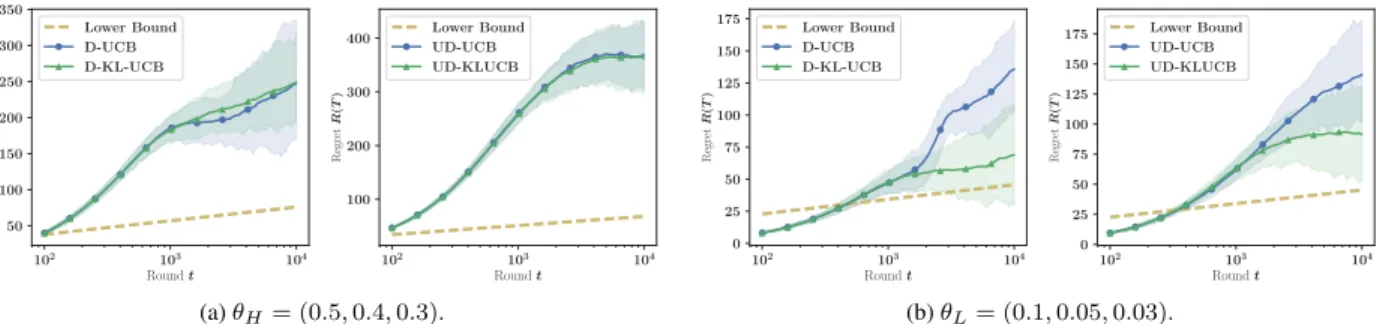
Comparing DelayedUCB and DelayedKLUCB. We com-pare the regret of both delayed bandits policies in the cen-sored and uncencen-sored setting for T = 10000, µ = 500 and m = 1000.
Simulations on Figure 1, for two problems, θH = (0.5, 0.4, 0.3) on the left, and θL = (0.1, 0.05, 0.03) on the right, display the classical pattern that while UCB-based algo-rithms perform satisfactorily for central values (close to 0.5) of the conversion rate, they are clearly sub-optimal with more re-alistic values for the conversion rate. The two right plots also confirm that, for the KLUCB-based algorithms, the loss with respect to the optimal regret growth rate due to the use of the Poisson divergence is – as expected from Theorem 11 – not significant for low values (here θ∗ = 0.1) of the conversion rates.
DelayedUCB and DelayedKLUCB vs. DISCARDING. In this section, we illustrate the good empirical initial perfor-mance of DelayedUCB and DelayedKLUCB, when compared to the heuristic DISCARDINGapproach presented in Section 6.
102 103 104 Round t 50 100 150 200 250 300 350 Regret R (T ) Lower Bound D-UCB D-KL-UCB 102 103 104 Round t 100 200 300 400 Regret R (T ) Lower Bound UD-UCB UD-KLUCB (a) θH= (0.5, 0.4, 0.3). 102 103 104 Round t 0 25 50 75 100 125 150 175 Regret R (T ) Lower Bound D-UCB D-KL-UCB 102 103 104 Round t 0 25 50 75 100 125 150 175 Regret R (T ) Lower Bound UD-UCB UD-KLUCB (b) θL= (0.1, 0.05, 0.03).
Figure 1: Expected regret of D-UCBandD-KLUCB (censored setting), and UD-UCB andUD-KLUCB (uncensored setting) for two bandit problems: θH = (0.5, 0.4, 0.3), θL = (0.1, 0.05, 0.03). For all experiments, T = 10000, µ = 500, m = 1000 (if censored) and the results are averaged over 100 runs.
102 103 104 Round t 0 25 50 75 100 125 150 Regret R (T ) Lower Bound D-KL-UCB D-KL-UCB-discard 102 103 104 Round t 0 50 100 150 200 250 Regret R (T ) Lower Bound D-UCB D-UCB-discard
Figure 2: Expected regret of D-UCB and D-KLUCB in the censored setting vs the equivalent discarding policies when µ = 500 and m = 1000. Results are averaged over 200 in-dependent runs.
Figure 2 compares results for both DelayedUCB and DelayedKLUCB with θ = (0.1, 0.05, 0.03), T = 10000, µ = 500 and m = 1000 in the censored setting. We ob-serve that discarding policies incur a linear regret phase at the beginning of the learning and happen to catch up with the ex-pected regret growth rate only after a large number of rounds. These figures reveal a non-negligible gap in performance be-tween the naive DISCARDINGapproach and our delay-adapted quasi-optimal algorithms.
8
CONCLUSION
The stochastic delayed bandit setting introduced in this work addresses an important problem in many applications where the feedback associated to each action is delayed and censored, due to the ambiguity between conversions that will never hap-pen and conversions that will occur at some later – perhaps unobservable– time. Under the hypothesis that the distribution of the delay is known, we provided a complete analysis of this model as well as simple and efficient algorithms. An interest-ing generalization of the present work would be to relax the model hypothesis and estimate the delay distribution on-the-go, possibly using context-dependent delay distributions.
References
[1] Peter Auer, Nicolo Cesa-Bianchi, and Paul Fischer. Finite-time analysis of the multiarmed bandit problem. Machine learning, 47(2-3):235–256, 2002.
[2] Olivier Capp´e, Aur´elien Garivier, Odalric-Ambrym Mail-lard, R´emi Munos, Gilles Stoltz, et al. Kullback–leibler upper confidence bounds for optimal sequential alloca-tion. The Annals of Statistics, 41(3):1516–1541, 2013. [3] Nicolo Cesa-Bianchi, Claudio Gentile, Yishay Mansour,
and Alberto Minora. Delay and cooperation in non-stochastic bandits. In 29th Annual Conference on Learn-ing Theory, pages 605–622, 2016.
[4] Olivier Chapelle. Modeling delayed feedback in display advertising. In Proceedings of the 20th ACM SIGKDD in-ternational conference on Knowledge discovery and data mining, pages 1097–1105. ACM, 2014.
[5] Aur´elien Garivier and Olivier Capp´e. The KL-UCB al-gorithm for bounded stochastic bandits and beyond. In COLT, pages 359–376, 2011.
[6] Aur´elien Garivier, Pierre Menard, and Gilles Stoltz. Ex-plore first, exploit next: The true shape of regret in bandit problems (to appear). Mathematics of Operations Re-search, 2017.
[7] Wendi Ji, Xiaoling Wang, and Dell Zhang. A probabilis-tic multi-touch attribution model for online advertising. In Proceedings of the 25th ACM International on Confer-ence on Information and Knowledge Management, pages 1373–1382. ACM, 2016.
[8] Pooria Joulani, Andr´as Gy¨orgy, and Csaba Szepesv´ari. Online learning under delayed feedback. CoRR, abs/1306.0686, 2013.
[9] Pooria Joulani, Andras Gyorgy, and Csaba Szepesvari. Online learning under delayed feedback. In Proceedings of The 30th International Conference on Machine Learn-ing, pages 1453–1461, 2013.
[10] Kwang-Sung Jun, Kevin Jamieson, Robert Nowak, and Xiaojin Zhu. Top arm identification in multi-armed ban-dits with batch arm pulls. In The 19th International
Conference on Artificial Intelligence and Statistics (AIS-TATS), 2016.
[11] Sumeet Katariya, Branislav Kveton, Csaba Szepesvari, Claire Vernade, and Zheng Wen. Stochastic rank-1 ban-dits. arXiv preprint arXiv:1608.03023, 2016.
[12] Konstantinos V Katsikopoulos and Sascha E Engelbrecht. Markov decision processes with delays and asynchronous cost collection. IEEE transactions on automatic control, 48(4):568–574, 2003.
[13] Emilie Kaufmann, Olivier Capp´e, and Aur´elien Garivier. On the complexity of best arm identification in multi-armed bandit models. The Journal of Machine Learning Research, 2015.
[14] Paul Lagr´ee, Claire Vernade, and Olivier Capp´e. Multiple-play bandits in the position-based model. In Ad-vances in Neural Information Processing Systems, 2016. [15] Tze Leung Lai and Herbert Robbins. Asymptotically
effi-cient adaptive allocation rules. Advances in applied math-ematics, 6(1):4–22, 1985.
[16] Travis Mandel, Yun-En Liu, Emma Brunskill, and Zo-ran Popovi´c. The queue method: Handling delay, heuris-tics, prior data, and evaluation in bandits. In Twenty-Ninth AAAI Conference on Artificial Intelligence, 2015. [17] Vianney Perchet, Philippe Rigollet, Sylvain Chassang,
and Eric Snowberg. Batched bandit problems. The Annals of Statistics, 44(2):660–681, 2016.
[18] R´omer Rosales, Haibin Cheng, and Eren Manavoglu. Post-click conversion modeling and analysis for non-guaranteed delivery display advertising. In Proceedings of the fifth ACM international conference on Web search and data mining, pages 293–302. ACM, 2012.
[19] Thomas J Walsh, Ali Nouri, Lihong Li, and Michael L Littman. Learning and planning in environments with delayed feedback. Autonomous Agents and Multi-Agent Systems, 18(1):83–105, 2009.
A
Concentration results
A.1
Poissonization of the KL indices
We require variants of Lemma 9 and Theorem 10 in [5] adapted to our setting.
Lemma 13. For θ ∈ [0, 1], (τi)1≤i≤L ∈ [0, 1], let (Xi,j)1≤i≤L,j≥1be a collection of independent Bernoulli random variables
such thatE(Xi,j) = τiθ and (ϵi,j) ∈ {0, 1} associated deterministic indicators. For 1 ≤ i ≤ L, denote by ni =
∑∞
j=1ϵi,j and whe shall assume that all ni are finite an that at least one of them is non-zero. Let X =
∑L i=1
∑∞
j=1ϵi,jXi,j and denote by ϕ(λ) = logE [exp(λX)] its log-Laplace transform and by ϕ∗(x) = supλxλ− ϕ(λ) the associated convex conjugate (Fenchel– Legendre transform).
Then, for all λ∈ R,
ϕ(λ)≤ ( L ∑ i=1 τini ) θ(eλ− 1), (7)
and, for all x≥ 0,
ϕ∗(x)≥ ( L ∑ i=1 τini ) dPois ( x ∑L i=1τini , θ ) , (8)
where dPois(p, q) = p log p/q + q− p denotes the Poisson Kullback-Leibler divergence.
Proof By direct calculation,
ϕ(λ) = L ∑ i=1 nilog ( 1− τiθ + τiθeλ ) . The function τi→ log(1− τiθ + τiθeλ
)
is a strictly concave function on [0, 1] and we upper bound it by its tangent in 0, that is, log(1− τiθ + τiθeλ
)
≤ τiθ(eλ− 1), which yields (7) upon summing on i.
The r.h.s. of (7) is easilly recognized as the log-Laplace transform of the Poisson distribution with expectation(∑Li=1τini )
θ. To obtain (8), we use the observations that xλ− a(eλ− 1)is maximized for λ = log(x/a) where it is equal to d
Pois(x, a) as well as
the fact that dPois(τ x, τ a) = τ dPois(x, a).
Lemma 13 bounds the log-Laplace transform of the Bernoulli distribution with that of the Poisson distribution with the same mean and uses the stability of the Poisson distribution. Using dPois(p, q) instead of d(p, q) –where d(p, q) = p log p/q + (1− p) log[1 −
p)/(1− q) denotes the Bernoulli Kullback-Leibler divergence– will of course induce a performance gap, which is however not significant for low values of the probabilities as shown by the Lemma 8, which we recall below.
Lemma 8. For 0 < p < q < 1,
(1− q)d(p, q) ≤ dPois(p, q)≤ d(p, q).
Proof For the upper bound,
d(p, q)− dPois(p, q) = (1− p) log 1− p 1− q − (q − p) = −(1 − p) log(1 + p− q 1− p) + (p− q) ≥ 0, using− log(1 + x) ≥ −x.
For the lower bound,
dPois(p, q)− (1 − q)d(p, q) = qp log p q+ q− p − (1 − q)(1 − p) log ( 1− p 1− q ) . (9)
One has dPois(q, q) = d(q, q) = 0 and the derivative of (9) wrt. p is equal to
q logp q + (1− q) log ( 1− p 1− q ) =−d(q, p) ≤ 0. Hence, dPois(p, q)− (1 − q)d(p, q) is positive when p ≤ q.
Lemma 7. Assume that the sequence of pulls is fixed beforehand and let k be an arm in{1, ..., K}. Then for any δ > 0 and for all t > 0, P({θˆ k(t) < θk } ∩{N˜k(t)dPois(ˆθk(t), θk) > δ})< e−δ. where dPois(p, q) = p log p/q + q− p denotes the Poisson Kullback-Leibler divergence.
Proof To boundP(ˆθk(t) < x) =P(Sk(t) < ˜Nk(t)x), for 0 < x < θk, apply Chernoff’s method using the result of Lemma 13 to obtain
P(ˆθk(t) < x)≤ e− ˜Nk(t)dPois(x,θk).
Using that x7→ dPois(x, θk) is decreasing on [0, θk], we can apply it on both side of the inequality on the left-hand side to obtain
P({θˆ k(t) < θk } ∩{N˜ k(t)dPois(ˆθk(t), θk) > ˜Nk(t)dPois(x, θk) }) ≤ e− ˜Nk(t)dPois(x,θk).
Denoting δ = ˜Nk(t)dPois(x, θk) yields the desired result.
Theorem 14. Consider (τi)1≤i≤L ∈ [0, 1], θ ∈ (0, 1), and independent sequences (Xi(s))s≥1 of independent Bernoulli
ran-dom variables such that EXi(s) = τiθ. Let Ft denote an increasing sequence of sigma-fields, such that for each t and all i, σ(Xi(1), . . . , Xi(t)) ⊂ Ft. Also consider a predictable sequence of indicator variables ϵi(s) ∈ {0, 1}, that is, such that σ(ϵ1(t + 1), . . . , ϵL(t + 1))⊂ Ft. Define Si(t) = t ∑ s=1 ϵi(s)Xi(s), Ni(t) = t ∑ s=1 ϵi(s);
and the pooled quantities
S(t) = L ∑ i=1 Si(t), N (t) = L ∑ i=1 Ni(t), N (t) =˜ L ∑ i=1 τiNi(t), θ(t) =ˆ S(t) ˜ N (t). The KLUCB index, defined as,
UKL(n) = max{q∈[θ(n), θˆ M ] : ˜N (n)dPois(ˆθ(n), q)≤ δ } . satisfies
P (U(n) ≤ θ) ≤ e⌈δ log(n)⌉e−δ.
Proof The proof is analogous to that of Theorem 10 of [5] and we only detail the step that differs, namely, the identification of the supermartingale Wλ t. Define, Wλ 0 = 1 and, for t≥ 1, Wtλ= exp ( λS(t)− ˜N (t)θ(eλ− 1)). E [exp(λ(S(t + 1) − S(t))) |Ft] =E [ exp ( λ L ∑ i=1 ϵi(t + 1)Xi(t + 1) ) Ft ] ≤ exp (( L ∑ i=1 τiϵi(t + 1) ) θ(eλ− 1) ) = exp (( ˜ N (t + 1)− ˜N (t) ) θ(θeλ− 1)),
where we have used (7) and the definition of ˜N (t). Multiplying both sides of the inequality by exp (
λS(t)− ˜N (t + 1)θ(eλ− 1)) show thatEWλ
t+1≤ EWtλand hence that Wtλis a supermartingale.
B
Details on the Lower Bound Results
We provide here the details of the proof of Theorems 4 and 3. The key result that we use is a lower bound on the log-likelihood ratio under two alternative bandit models θ and θ′that do not have the same best arm. Namely, according to Lemma 1 of [13], we have
lim inf T→∞
E[ℓT] log(T ) ≥ 1.
Now, considering specific changes of measures θ′ that only modify the distribution of one single suboptimal arm, we are going to obtain lower bounds on each expected number of pullsE[Nk(T )] for k̸= 1 as in Appendix B of [13].
Uncensored Setting: As argued in Section 4, in the uncensored setting the likelihood of the observations is
Eθ[ℓT] = T ∑ s=1
d(θAsτT−s, θA′sτT−s).
Now, fix arm k ̸= 1 and for ϵ > 0, consider θ′ = (θ1, . . . , θk−1, θ1 + ϵ, . . . , θK). For this change of measure, the expected
log-likelihood only contains the terms involving arm k:
Eθ[ℓT] = T ∑ s=1
1{As= k}d(θkτT−s, (θ1+ ϵ)τT−s).
Now, in order to obtain an expression that involves E[Nk(T )], we need to bound from above this sum using Lemma 5 of the Appendix B of [11], which we recall here for completeness.
Lemma 15. Let p, q be any fixed real numbers in (0, 1). The function f : α7→ d(αp, αq) is convex and increasing on (0, 1). As a consequence, for any α < 1, d(αp, αq) < d(p, q).
Thus, for each s≥ 1 we have τT−s≤ 1 and according to the above result,
d(θk, (θ1+ ϵ))≥ d(θkτT−s, (θ1+ ϵ)τT−s) and E[Nk(T )]d(θk, θ1+ ϵ)≥ T ∑ s=1 1{As= k}d(θkτT−s, (θ1+ ϵ)τT−s). We obtain lim inf T→∞ E[Nk(T )]d(θk, θ1+ ϵ)
log(T ) ≥ lim infT→∞ E[ℓT] log(T )≥ 1. Letting ϵ→ 0 yields lim inf T→∞ E[Nk(T )] log(T ) ≥ 1 d(θk, θ1) . In order to bound the expected regret LT, we use the inequality (2) from Lemma 1:
LT ≥ K ∑ k=2
(θ1− θk) (E[Nk(t)]− µ) ,
where µ = E[Ds]. We now lower bound each E[Nk(t)] and under the assumption that E[Ds] < ∞ and we use that lim infT→∞µ/ log(T ) = 0 to obtain
lim inf T→∞
LT
log(T )≥ lim infT→∞ ∑K k=2(θ1− θk) (E[Nk(t)]− µ) log(T ) ≥ K ∑ k=2 (θ1− θk) d(θk, θ1) .
Censored Setting: The proof in the Censored Setting follows the same step as the proof above expect for the fact that we do not require Lemma 5 of [11] in order to bound the log-likelihood ratio. We directly have
Eθ[ℓT] = T∑−m s=1 d(θAsτm, θA′sτm) + T ∑ s=T−m d(θAsτT−s, θA′sτT−s).
Proceeding as above and considering the adequate change of measure involving only one suboptimal arm k and taking ϵ→ 0, we obtain lim inf T→∞ E[Nk(T )]d(τmθk, τmθ1) + ∑T s=T−md(θkτT−s, θ1τT−s)
log(T ) = lim infT→∞
E[Nk(T )]d(τmθk, τmθ1)
log(T ) ≥ 1,
where we used the fact that the second term of the sum in the left-hand side is finite. The end of the proof is similar to the uncensored setting case treated above where we can simply bound the regret according to Eq. (3) as
LT ≥ k ∑ k=2 τm(θ1− θk)E[Nk(T− m)] + T ∑ s=T−m+1 τT−s(θ1− θAs)
in order to obtain the asymptotic lower bound.
C
Analysis of DelayedUCB and DelayedKLUCB
In order to control the empirical averages of the rewards of each arm for different values of Nk(t), we introduce the notation ˆ
θk,s:= ∑s
u=1Xk,u/s for the mean over the first s pulls of k.
C.1
DelayedUCB
In this section, we provide the complete proof of Theorem 9.
We decompose the regret after bounding by 1 the first m losses of the policy :
LUCB(T )≤ m + ∑ k>1 τm∆kE [ T ∑ t>m 1{At= k} ] .
Hence we only need to bound the number of suboptimal pulls, as in the seminal proof by [1]. For any suboptimal k > 1, we have:
E[Nk(T )]≤ 1 + T ∑ t=K+1 P(U1UCB(t) < θ1 ) + T ∑ t=K+1 P(At+1= k, UkUCB(t)≥ θ1 ) .
While the first term is simply handled by Proposition 6 and is O(1/ϵ3) = o(log(T ), the second one must be controlled as in the original proof of UCB1 by [1] using the fact that for all t > m,
Nk(t) ˜ Nk(t) ≤ Nk(t− m) + m ˜ Nk(t) ≤ 1 τm + m τmNk(t− m) that allows us to upper-bound the optimistic indices as
ˆ θk(t) + ( 1 τm + m τmNk(t− m) ) √ βϵ(t) 2Nk(t) ≥ UUCB k (t). Then, we use this upper bound on the indices in order to bound the relevant sum of probabilities.
T ∑ t=m+1 P(At+1= k, UkUCB(t)≥ θ1 ) ≤ E ∑ s≥1 1 { ˆ θi,s+ ( 1 τm + m τms ) √ βϵ(t) 2s ≥ θi+ ∆i } . In order to upper-bound this expectation, we first introduce the quantity si> 0 defined by
( 1 τm + m τmsi ) √ βϵ(t) 2si = ∆i,
that we rewrite, with the introduction of γi> 0, as si= βϵ(t)
2τ2
m∆2i
(1 + γi)2 so that we get ( 1 + m si ) 1 1 + γi = 1. Simple computations finally leads to, if γi≤ 1,
2mτ2
m∆2i
βϵ(t) = γi(1 + γi)
2≤ 4γ
i.
As a consequence, if T is big enough (so that the left hand side is smaller than 4), we get that si≤ (1 + ε) log(T ) 2τ2 m∆2i (1 + γi)2≤ (1 + ε) log(T ) 2τ2 m∆2i (1 + 3γi)≤(1 + ε) log(T ) 2τ2 m∆2i + m. We now focus on the sum to upper-bound:
E ∑ s≥1 1 { ˆ θi,s+ ( 1 τm + m τms ) √ βϵ(t) 2s ≥ θi+ ∆i } ≤ ⌈si⌉ + 1 + ∑ s>⌈si⌉ e−2s ( ∆i−(τm1 +τmsm ) √ βϵ(t) 2s )2 ≤ si+ 2 + ∑ s>⌈si⌉ e−2 (√ s∆i− ( 1+m si )√ βϵ(t) 2τ 2m )2 ,
where we used the Chernoff’s inequality for bounded random variables.
Standard computations (comparisons between sums and integrals) give the following ∑ s>⌈si⌉ e−2 (√ s∆i− ( 1+m si )√ βϵ(t) 2τ 2m )2 ≤ ∫ ∞ si e−2 (√ s∆i− ( 1+m si )√ βϵ(t) 2τ 2m )2 ds ≤ 1 2∆2 i ( 1 + √ 2π 4 ( 1 + m si ) √ βϵ(t) 2τ2 m ) ≤ 1 2∆2 i ( 1 + √ 2π 4 √ si∆i ) ≤ 1 2∆2i ( 1 + √ π 4 √ (1 + ϵ) log(T ) τ2 m + √ π 4 √ m ) .
As a consequence, we have just proved that T ∑ t=m+1 P(At+1= k, UkUCB(t)≥ θ1 ) ≤ (1 + ϵ) log(T ) 2τ2 m∆2i + o(log(T )) .
More precisely, combining all our claims yields that
LUCB(T )≤ (1 + ϵ) log(T ) 2τ2 m∆i + O ( 1 ∆i √ (1 + ϵ) log(T ) 2τ2 m ) + O ( 1 ∆i 1 ϵ3 ) + O (√m ∆i + m ) ,
and the result follows.
C.2
DelayedKLUCB
We follow the steps of [5] and decompose the regret as E[Nk(T )]≤1 + m − K T ∑ t=m+1 P (UKL 1 (t) < θ1) + T ∑ t=m+1 P(At+1= k, UkKL(t)≥ θ1 ) ≤ 1 + m − K + T ∑ t=m+1 P(U1KL(t) < θ1 ) + T ∑ t=m+1 P (At+1= k, UKL k (t)≥ θ1) .
The first term of the above sum is handled by Theorem 14 that shows that it is o(log(T )). We must now bound the second sum corresponding to the cases when suboptimal indices reach the optimal mean θ1. To proceed, we simply notice that for all t,
˜
Nk(t)≥ τmNk(t− m). We define an alternative optimistic index that upper bounds UkKL(t) for t > m: UKL
k (t)≤ arg max q∈[ˆθk,1]
{q|τmNk(t− m)dPois(ˆθk(t), q)≤ βϵ(t)} := UkKL+(t). Now we can finish the proof following the steps of the proof of Theorem 2 in [5]. First, we denote
Kk(T ) =
(1 + η)βϵ(t) d(τmθk, τmθ1)
and we decompose the second sum after bounding the first Kk(T ) terms by 1 and bounding the remaining terms in a similar way as in Lemma 11 of [9]: T ∑ t=m+1 P(At+1= k, UkKL+(t)≥ θ1 ) ≤ Kk(T ) + ∑ t≥Kk(T )+m+1 P(At+1= k, UkKL+(t)≥ θ1 ) ≤ Kk(T ) +E ∑ t≥Kk(T )+m+1 t ∑ s=1 1{At+1= k, Nk(t− m) = s, τmsdPois(ˆθk,s, θ1)≤ βϵ(t) } ≤ Kk(T ) +E ∑T s=Kk(T ) 1{τmsdPois(ˆθk,s, θ1)≤ βϵ(t) }∑T t=s 1 {At+1= k, Nk(t− m) = s} ≤ Kk(T ) + m ∑ s≥Kk(T ) P(τmsdPois(ˆθk,s, θ1)≤ βϵ(t) ) ≤ Kk(T ) + mC2(η) Tf (η) ,
where the last inequality comes from the fact that for all s∈ {1, . . . , T },∑Tt=11 {At+1= k, Nk(t− m) = s} ≤ m and from the proof of Fact 2 for exponential family bandits in [2] that proves the existence of the constants C2(η) and f (η) that achieve the bound.
We can now upper bound the regret thanks to the decomposition provided by equation 3:
LKLUCB(T )≤ m + ∑ k>1 τm∆kE [Nk(T )]≤ (1 + η)βϵ(t) K ∑ k=2 τm∆k dPois(τmθk, τmθ1) + o(log(T )).
To obtain the final result, we use Lemma 8 that shows that for θk< θ1, dPois(τmθk, τmθ1) > (1− τmθ1)d(τmθk, τmθ1). Thus,
LKLUCB(T )≤ m + (1 + η) βϵ(t) 1− τmθ1 K ∑ k=2 τm∆k d(τmθk, τmθ1) + o(log(T )).
D
Additionnal experiments on delay agnostic policies
As a last additional contribution to this work, we suggest a distribution-agnostic heuristic that estimates the CDF parameters (τd)d≥0 in an online fashion. Indeed, as the delay distribution is assumed to be shared between actions, each observed reward provides an information on the delays that can be exploited to estimate the CDF without having to deal with the exploration-exploitation dilemma.
Uncensored setting. In the Uncensored setting and under the geometric assumption on the distribution of the delays, the entire CDF can be retrieved using an estimate of the unique parameter λ = 1/µ. To this aim, we build an estimate the expected delay at round t, ˆµ(t), using a stochastic approximation process with decreasing weights αt= 1/tγ for 1≥ γ ≥ 0.5. When an observation Dtarrives we update
ˆ
µ(t)← (1 − αt)ˆµ(t) + αtDt. Then we use this estimator as a plug-in quantity to compute Ok(t) defined in (6) for all k.
Censored setting. In the Censored setting however, no observation comes after the threshold m and this does not allow us to directly estimate the expected delay µ as the longest observations are censored. To circumvent this problem, we choose to estimate biased parameters for τ1, . . . , τm. Concretely, we initialize counts for the observed delay values δ0= (0, . . . , 0)∈ Nm+1(delay can
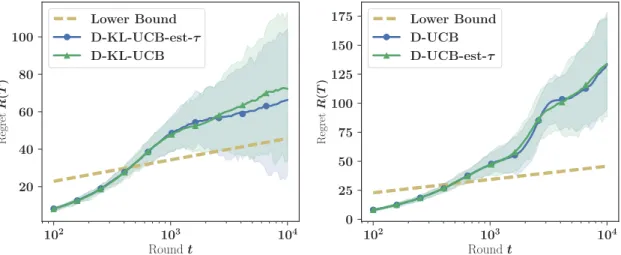
be null). Then, after each observation Dt, we increment all the counts δsfor s≥ Dt. Then, the biased empirical CDF is obtained by normalizing those counts by the total number of observations received up to time t, nd(t). We emphasize that the obtained estimators are biased: For each s∈ {0, . . . , m}, E[δs(t)/nd(t)] = τs/τmas all observed delays are smaller or equal to m. Thus, plugging those estimates in ˜Nk(t) actually allows to have an estimate of ˜Nk(t)/τminstead of ˜Nk(t) and consequently an estimate of τmθk instead of θk. 102 103 104 Round t 20 40 60 80 100 Regret R (T ) Lower Bound D-KL-UCB-est-τ D-KL-UCB 102 103 104 Round t 0 25 50 75 100 125 150 175 Regret R (T ) Lower Bound D-UCB D-UCB-est-τ
Figure 3: Expected regret of DelayedKLUCB with and without online estimation of the CDF in both the censored and uncensored setting. Results are averaged over 100 independent runs.
Figure 3 compares both our policies to its equivalent, delay-agnostic heuristic using the same confidence intervals with plug-in estimates of the (τd)d≥0. It is clear from these experiments that using delay parameters estimated on-the-go does not hurt the cumulated regret overall.