HAL Id: hal-01138189
https://hal.archives-ouvertes.fr/hal-01138189
Submitted on 2 Apr 2015
HAL is a multi-disciplinary open access
archive for the deposit and dissemination of
sci-entific research documents, whether they are
pub-lished or not. The documents may come from
teaching and research institutions in France or
abroad, or from public or private research centers.
L’archive ouverte pluridisciplinaire HAL, est
destinée au dépôt et à la diffusion de documents
scientifiques de niveau recherche, publiés ou non,
émanant des établissements d’enseignement et de
recherche français ou étrangers, des laboratoires
publics ou privés.
Continuously-tunable, from MHz to GHz range, short
pulse train generation and its dynamic properties
X You, Grethell Perez-Sanchez, C Gosset
To cite this version:
X You, Grethell Perez-Sanchez, C Gosset. Continuously-tunable, from MHz to GHz range, short
pulse train generation and its dynamic properties. SPIE PHOTONICS WEST 2014, Feb 2014, san
francisco, United States. �10.1117/12.2040106�. �hal-01138189�
Continuously-tunable, from MHz to GHz range, short pulse train
generation and its dynamic properties
X. You
a, G.G. Perez-Sanchez
b, cand C. Gosset
aaTélécom ParisTech (Ecole Nationale Supérieure des Télécommunications) et Centre National de la recherche
Scientifique (LTCI, UMR 5141), 46 rue Barrault, 75013 Paris, France
bCentro de Investigación e Innovación Tecnológica del IPN, Cerrada Cecati S/N. Col. Santa Catarina, C.P. 02250,
México D. F. México
cNow with Tecnológico de Estudios Superiores de Coacalco, Av. 16 de septiembre No. 54, C.P. 55700, Col. Cabecera
municipal, Coacalco de Berriozábal, Estado de México, México
Abstract
We propose a new method to generate a continuously tunable repetition rate pulse train. It is based on the filtering of the negative nonlinear phase shift induced by the amplification of a rectangular optical signal in a semiconductor optical amplifier (SOA). A constant pulse width of about 40 ps with a huge continuous tunability of the repetition rate, ranging from 1 MHz to 5 GHz, was experimentally demonstrated. The dynamic properties of the proposed versatile pulse source are studied.
Keywords: short pulse train generation, large tunability, SOA nonlinear amplification, duty cycle tailoring 1. INTRODUCTION
In the field of instrumentation and characterization techniques, narrow pulse sources play an important role. For instance, the asynchronous sampling pulsed coherent detection provides a blind and asynchronous characterization method of optical signal and data flows, with THz bandwidth potentiality [1,2]. In the field of optical communication, it allows extracting the intrinsic statistical properties as constellation, eye diagram, BER and SNR. This technique requires a local oscillator as a train of brief optical pulse (typically in the 1 ps range or below) with repetition rate typically in the 500 MHz - 1 GHz range corresponding to a trade-off between phase noise impairments and cost effective solution. On another hand, application such as pump-probe experiment requires repetition rate in the 10 MHz range to allow relaxation of high-speed phenomena in materials.
Passive Mode-locked lasers are interesting candidates to generate short optical pulse train signal. Fiber laser are adapted to the generation of low repetition rate signal, typically bellow 100 MHz, thanks to long cavities. For higher frequency range, semiconductor laser exhibits impressing performances in term of repetition rate, typically above 10 GHz [3,4]. In the range 100 MHz-10 GHz, it doesn’t exist solution based on mode-locking process, due to not suited particle lifetime of the active medium. Furthermore, mode-locked lasers, whatever technology used, suffer from a lack of tunability of the repetition rate, and semiconductor based lasers also exhibits high phase noise of spectral components that can appear as a bottleneck for application such as asynchronous coherent sampling.
Cavity-less pulse sources allow the generation of high repetition rate signal with very good phase noise properties. But the proposed techniques don’t allow the generation of periodic signal below 1 GHz [5,6].
In this paper, we present a simple setup for the generation of versatile pulse train based on the nonlinear amplification of a square signal with a semiconductor optical amplifier. It allows a large continuous tunability of the repetition rate, from 1 MHz to 5 GHz, with a constant pulse width around 40 ps. Furthermore, by using a tunable continuous wave (CW) laser, we obtain also a continuous wavelength tunability. This simple setup is a preliminary step toward a sub-ps versatile pulse train source by combining additional compression stages based on fiber nonlinearities. In the next section, we will first describe the principle of operation of the proposed scheme. Then, in section III, the pulse source is characterized by evaluating it over the characteristics of the driven electrical signal, as the repetition rate and the duty cycles, and of the bias point of the Mach-Zehnder Modulator (MZM). In the last section, the experimental results will be discussed before to conclude.
2. PRINCIPLE OF OPERATION AND EXPERIMENTAL SETUP
The proposed pulse source is based on the nonlinear amplification using a semiconductor optical amplifier (SOA) of a square waveform signal. SOA non-linearities lead to the front edge distortion, such that the output signal can be seen as the superposition of the linearly amplified signal, and a pulse located at the front edge. Due to the non-zero phase-amplitude coupling factor, the SOA induces optical chirp during the transient amplification, leading to a dissymmetric optical spectrum. As the SOA induces a strictly negative nonlinear phase shift during the dynamic process of signal amplification, the part of the spectrum located toward short wavelength is a replica of the input spectrum, while the one located toward long wavelength is related to the transient regime occurring during the amplification of the front edge. Hence, by filtering out the long wavelength spectrum, the transient signal of the induced-distortion signal train is isolated from the rectangular wave.
Figure 1 shows the experimental setup. The intensity of a tunable CW laser is modulated with a MZM by a pulse pattern generator (PPG). The role of the PPG is to easily generate a periodic rectangular waveform driven signal, with tunable repetition rate and duty cycle. An attenuator at the output of the MZM is used to adjust the power of the modulated signal at the input of the SOA, in order to control the nonlinear phase shift induced by the amplification of the SOA. Due to the polarization dependence of the SOA, a polarization controller (PC) is used at the input of the SOA to maximize the amplification, and thus the induced nonlinear phase shift of the amplified signal. The carrier frequency of the tunable laser is set to 1540.162 nm, and injection current of the SOA 200 mA. The centre wavelength of the flat top optical filter is set at 1540.52 nm (bandwidth: 650 pm).
Figure 1. Experimental setup and the symbolic pulse train at different measurement points
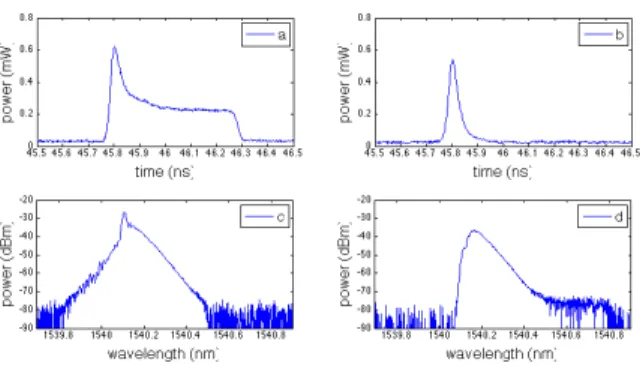
In the lower right of figure 1, the schematic intensity of the optical waveform is depicted. Figure 2 shows measured temporal waveforms at point b (fig. 2a), and point c (fig. 2b) after filtering out the transient regime. The repetition rate is set to 1 GHz with a 50% duty cycle. Figure 2c and 2d show the related optical spectrum.
Figure 2. a) Temporal waveform of the amplified signal at the output of the SOA. b) Temporal waveform after filtering with a square flat top optical filter. c) Spectrum of a). d) Spectrum of b).
3. RESULTS AND ANALYSIS
In this section, we investigate the influence of the driven electrical signal and the bias point of the SOA. We will show their strong influence on the amplification dynamic, and thus on the characteristic of the generated pulses after filtering out the single-sideband (SSB) signal corresponding to the transient amplified signal.
3.1 Influence of the repetition rate of the driven electrical signal
As an illustration, we show on figure 3 the spectra of a square signal at the output of the SOA for several repetition rates and a 50% duty cyle. The shapes of the long wavelength spectra for 1GHz and 100 MHz repetition rate signal are identical, with a power ratio of 10 dB. The power ratio corresponds to the repetition rate ratio. It means that for both repetition rates, the energy contains in the transient signal is identical. For the 10 GHz repetition rate, the shape of the long wavelength signal is different. Actually, the energy contains in the transient signal is smaller than for 1GHz and 100 MHz repetition rates. This is due to the dynamic of the SOA. For 1 GHz and 100 MHz repetition rate of the input square signal, the time between two square pulses is long enough (respectively 500 ps and 5 ns) to obtain a complete gain recovery. This is not the case for 10 GHz repetition rate of the input signal. As a consequence, the front edge distortion is reduced and thus, for the latter case, the SPM effect is reduced, leading to a narrower spectrum compared to the 1 GHz and 100 MHz repetition rate. Hence, the chirp is reduced in this configuration.
Figure 3. Spectra of 100 MHz, 1 GHz and 10 GHz signals amplified by the SOA
The repetition rate tunability is evaluated for 1 MHz, 10 MHz, 100 MHz, 500 MHz and 5 GHz. The different pulse profiles are measured with a 30 GHz bandwidth sampling oscilloscope and depicted in figure 4. We observe a constant amplitude for repetition rates up to 1 GHz, corresponding to a constant energy in the transient regime. A constant pulse width of 40 ps is obtained. At 5 GHz, we observe a strong diminution of the amplitude of the front edge distortion, correlated with an increase of the pulse width, due to the impact of the SOA dynamics. Hence, it induces a decrease of the efficiency conversion.
Figure 4. Pulse profiles for several repetition rate
1539.2 1539.4 1539.6 1539.8 −70 −60 −50 −40 −30 −20 −10 0 Wavelength (nm) Power (dBm) 10 GHz 1 GHz 100 MHz
3.2 Influence of the duty cycle of the driven electrical signal
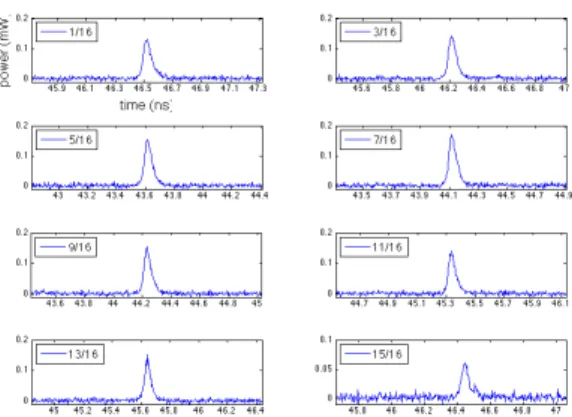
For a given repetition rate, the duty cycle of the driven electrical signal plays an important role in the pulse train generation. To control the period of the signal, we set the length of the sequence generated by the PPG to obtain sequence duration equal to the required period. The PPG is clocked with a 10 GHz clock signal. The duty cycle is then fixed with the number of consecutive marks running within the sequence, while other bits are set to zero. The generated electrical signal is then applied to the driver of the MZM. The rise time of the front edge of the optical signal is measured to be 25 ps. The sequence length is set to 16 bits with a bit duration of 100 ps, leading to a repetition rate of the signal of 625 MHz. The influence of the duty cycles on the pulse generation process is investigated from 1/16 to 15/16 for 8 values totally.
We show in figure 5 the amplified signal at the output of the SOA. The peak intensity of the transient signal is constant for duty cycle lower than 9/16, measured to be 0.6 mW. The duration of the off part of the input signal (number of consecutive zeros) is large enough to allow the full recovery of the gain. For larger duty cycle, the peak intensity decreases, down to 0.2 mW for 15/16 duty cycle due to the lack of recovery time of the gain. As a consequence, the saturated gain is reduced, and the power of the amplified mark decrease with respect to the duty cycle.
For low duty cycle, below 3/16, we observe that the time required to reach the saturation is not enough. Hence, the energy contains in the transient part of the signal is reduced, and thus the energy in the pulse after filtering.
Figure 5. Pulse profiles for several duty cycles from 1/16 to 15/16
We show on figure 6 the impact of the duty cycle on the optical spectrum. The nonlinear part of the spectra, corresponding to the long wavelength, is almost similar for duty cycle between 3/16 and 9/16. As told above, it indicates that the dynamics of the SOA is fast enough to allow a complete gain recovery before the next front edge amplification. For duty cycle from 11/16 to 15/16, we measure a decreasing of the optical power related to long wavelength spectrum, telling us the lack of gain recovery time of the SOA. We observe also that the spectrum related to the 1/16 duty cycle is reduced due to the too short duration of the input signal. Finally, thanks to Parseval theorem, we observe on figure 7 that the energy contains in the pulse after filtering is reduced for 1/16 and 11/16 to 15/16 duty cycles.
Figure 7. Signal after filtering for several duty cycles
To confirm the dynamic behaviour of the proposed pulse source illustrated on figures 5 to 7, we measure the mean power of the signal after filtering for several duty cycle, shown on Figure 8. Measurements were done with 100 MHz repetition rate in order to obtain a better resolution. We observe the constant behaviour for intermediate duty cycle range, between 6% and 90%. For duty cycle upper than 90%, the dynamics of the SOA limits the pulse conversion efficiency. For duty cycle lower than 6%, the efficiency is limited by the duration of the input signal.
Figure 8. Pulse power (a.u.) for several duty cycles
4. CONCLUSION
We proposed a new method to generate optical pulse train at several repetition rates, from 1MHz to 5 GHz, with constant pulse width measured to be 40 ps. The dynamical properties of the pulse generator have been studied. They indicate the potentiality of the method to generate pulse train with very low repetition rate, up to a few GHz. The repetition rate upper limitation is induced by the gain recovery time of the SOA, while no limitation exists for very low repetition rate. It is even possible to generate a single pulse with this technique. The use of faster SOA based on quantum dots materials could be interesting to increase further the repetition rate. Nevertheless, the SOA needs to have a highly nonlinear behaviour to not decrease the pulse conversion efficiency. Hence a trade-off between dynamic and conversion efficiency has to be considered for the design of the SOA. This technique is a well promising technique to generate short optical pulses with versatile repetition rate, as it could be associated with compression stage.
REFERENCES
[1] M. Westlund, H. Sunnerud, M. Karlsson, P.A. Andrekson, “Software-synchronized all-optical sampling for fiber communication systems”, J. Lightwave Technol., vol. 23, 1088-1099 (2005).
[2] Gallion, P., You, X., Gosset, C., Grillot, F., “Bandwidth and dynamic range of a pulsed local oscillator coherent optical detection. Application to linear optical sampling,” SPIE OPTO, (2014).
[3] C. Gosset, K. Merghem, A. Martinez, G. Moreau, F. Lelarge, G. Aubin, J.-L. Oudar and A. Ramdane, "Phase-amplitude characterization of a high repetition rate laser quantum dash passively mode-locked laser", Optics Lett., vol. 31, 12, p. 1848 (2006).
[4] A. Akrout, K/ Merghem, J.P. Tourrenc, A. Martinez, A. Shen, F. Lelarge, G.-H. Duan, A. Ramdane, “Generation of 10 GHz optical pulses with very low timing jitter using one section passively mode locked quantum dash based lasers operating at 1.55 µm”, paper JThA30, Proc. of OFC (2009).
[5] A. Wiberg, C.-S. Brès, B. Kuo, A. Myslivets, S. Radic, “Cavity-Less 40 GHz Pulse Source Tunable Over 95 nm”, paper 5.2.3, Proc. of ECOC, Vienna, Austria (2009).
[6] A. Wiberg, L. Liu, E. Myslivets, V. Ataie, B. Kuo, N. Alic, S. Radic, “Photonics processor for anlog-to-digital converter using a cavity-less pulse source”, Optics Express, vol. 20, no 26, p. B419 (2012).