HAL Id: hal-01372766
https://hal.inria.fr/hal-01372766
Submitted on 27 Sep 2016
HAL is a multi-disciplinary open access
archive for the deposit and dissemination of
sci-entific research documents, whether they are
pub-lished or not. The documents may come from
teaching and research institutions in France or
abroad, or from public or private research centers.
L’archive ouverte pluridisciplinaire HAL, est
destinée au dépôt et à la diffusion de documents
scientifiques de niveau recherche, publiés ou non,
émanant des établissements d’enseignement et de
recherche français ou étrangers, des laboratoires
publics ou privés.
Group Modeling: A Unified Velocity-Based Approach
Z Ren, Panayiotis Charalambous, Julien Bruneau, Qunsheng Peng, Julien
Pettré
To cite this version:
Z Ren, Panayiotis Charalambous, Julien Bruneau, Qunsheng Peng, Julien Pettré. Group
Model-ing: A Unified Velocity-Based Approach. Computer Graphics Forum, Wiley, 2017, 36 (8), pp.45-56.
�10.1111/cgf.12993�. �hal-01372766�
Group Modeling: a Unified Velocity-based Approach
Z. Ren1†P. Charalambous2‡J. Bruneau3§Q. Peng1and J. Pettré2¶
1Zhejiang University, Hangzhou, China 2Inria Rennes, France 3IRISA, University Rennes 1, France
(a) Performance (b) Pedestrians (c) Tourists/Guide (d) Teachers/Students
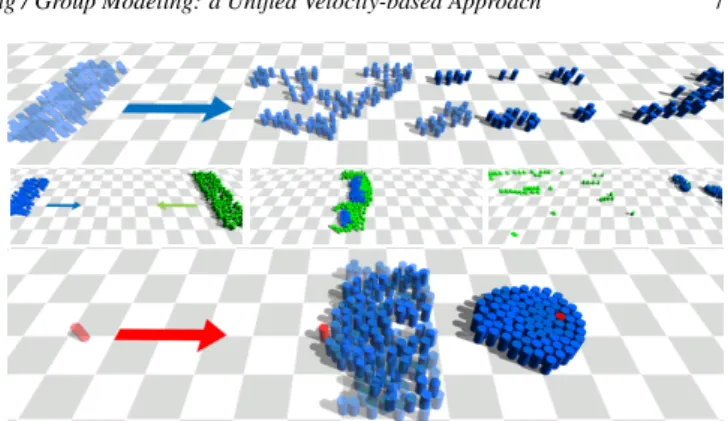
Figure 1: Our simulation algorithm is capable of generating different group behavior using a small set of intuitive parameters. Abstract
Crowd simulators are commonly used to populate movie or game scenes in the entertainment industry. Even though it is crucial to consider the presence of groups for the believability of a virtual crowd, most crowd simulations only take into account individual characters or a limited set of group behaviors. We introduce a unified solution that allows for simulations of crowds that have diverse group properties such as social groups, marches, tourists and guides, etc. We extend the Velocity Obstacle approach for agent based crowd simulations by introducing Velocity Connection; the set of velocities that keep agents moving together whilst avoiding collisions and achieving goals. We demonstrate our approach to be robust, controllable, and able to cover a large set of group behaviors.
Categories and Subject Descriptors(according to ACM CCS): I.3.7 [Computer Graphics]: Three-Dimensional Graphics and Realism—Animation; I.6.8 [Simulation and Modeling]: Types of Simulation—Animation
1. Introduction
Real crowds are not only made of isolated individuals but also structured by the presence of groups, such as families, bands of friends, larger groups of schoolmates or tourists during a field-trip. Groups result into visually strong patterns: aggregations, specific spatial distributions, cohesive motions, etc. In many places, crowds are mainly composed of groups compared to individual walkers (e.g., 70% in the example of a shopping street according to Mous-saïd et al. [MPG∗10]). When aiming to improve crowd simulator quality, it is crucial to consider groups, especially in the context of entertainment applications which are in demand for high visual
† e-mail: [email protected] ‡ e-mail: [email protected] § e-mail: [email protected]
¶ e-mail: [email protected]
quality. The general objective of our work is to simulate crowds that may contain groups.
While several techniques that simulate groups in crowds are re-ported in the literature, the problem has only received partial an-swers: solutions are limited to specific situations, group types or behaviors. We first address the problem of providing a general def-inition of groups in crowds which may exist under many forms. Groups are of different sizes: a family of four, ten friends, fifty tourists, one thousand in a march, etc. Groups are structured by different internal relations: followers with a leader, tourists made of families with a guide, schoolmates with a set of teachers, etc. Groups are guided by different goals and constraints: armies have specific formations, parents keep contact with their kids, friends chat together, etc. It is still a challenge to model groups in all these dimensions. Previous solutions do not generalize to a large vari-ety of groups. We also address the problem of implementing groups in a crowd simulator. Previous approaches added an upper
simula-tion behavioral layer to play on agents’ goals and force grouping. This a limited solution, we believe that the notion of groups should be expressed at the core of microscopic simulation algorithms, as a new mode of local interactions between agents. This requires to mathematically define those local interactions and to deal with the problem of combining several, often conflicting, local interactions (e.g., avoiding collisions while staying close to other agents).
In this paper, we propose a unified and opened definition of groups in crowds: a group is a subset of agents which desire to move together. This means that agents of the same group should move so that they maintain a bounded distance. Setting both up-per and lower bounds allows agents to simultaneously group and avoid collisions respectively. We implement this definition based on the velocity-obstacle formalism. One agent in a group constantly moves with velocities that enable: a) not colliding with other neigh-bor agents, and b) staying at a bounded distance to some other agents belonging in the same group. On the technical point of view, we extend the RVO algorithm by adding an upper bound on the future distance of closest approach to make agents group together. Obviously, in most cases, an agent cannot stay at a bounded dis-tance from all the other members of its group especially when that group is large. Therefore, one important component of our solu-tion is the way each agent selects a subset of neighbors to stay close to (the connection-agents). Playing on the few parameters of our algorithm (the number of connection agents, their selection, the bound distance value with connection agents, etc.) we demonstrate the remarkable ability of our algorithm to generate a large variety of emerging group behaviors as well as to deal with complex sim-ulation scenarios.
Our contribution is multi-faceted:
1. We introduce a new model of local interaction for grouping, based on a velocity-based formulation.
2. We propose a unified group simulation algorithm which is capa-ble of covering a large set of existing situations. By only playing on few parameters’ value, we are able to configure our algorithm to consider small and large groups, uniform or leader/followers groups, cohesive groups or sparse ones, etc.
3. Our method enables emergent group behaviors based on the lo-cal expression of grouping interactions. We demonstrate the va-riety of emergent behaviors at the same time we map them with the simulation parameters values.
The remaining of the paper is organized as follows. In Section2, we overview existing solutions to simulate groups and outline the lack of a general solution to simulate them. Section3is dedicated to the technical description of our approach. In Section4we demon-strate our approach in two different ways. We first demondemon-strate the variety of group behaviors emerging from different parameter sets. Secondly, we demonstrate our method over typical situations of real usage. We discuss our results and the limitations of our approach before concluding and opening perspectives for future research.
2. Related Work
This section overviews the literature on crowd simulation and fo-cuses on group modeling; we do not report the sociological aspects of the topic.
Microscopic crowd simulation Modeling local interactions is an essential task in the design of microscopic crowd simula-tors. Many approaches addressed the problem of collision avoid-ance [Rey99,HM95,POO∗09,GCC∗10,OPOD10], respectively based on steering rules, social forces, experimental analysis, veloc-ity space optimization and vision perception. Our method is built on the velocity obstacle (VO) concept [FS98]. Van den Berg et al. [VdBLM08] proposed the Reciprocal Velocity Obstacle (RVO) to handle oscillations present in the initial VO method, and later derived a linear programming solution [VDBGLM11]. Guy et al. [GKLM11] mapped RVO parameters with personality descrip-tors. Kim et al. [KGL∗13] learned simulation parameters from video. These only consider the collision avoidance between in-dividuals, other techniques enable individuals to avoid a group. Schuerman et al. [SSKF10] represented the whole group as a new type of agent. Lemercier and Auberlet [LA15] introduced behav-ioral laws to simulate group avoidance. Bruneau et al. [BOP15] used Virtual Reality to study how real humans behave when avoid-ing groups.
Group simulation The seminal work by Reynolds [Rey87] demonstrated impressive flocking simulation. Musse and Thal-mann [MT97] considered the relationship between groups of in-dividuals and the emergent group behavior originating from it. The same authors presented a hierarchical model which can con-trol groups with different degrees of autonomy [MT01]. Helbing’s social forces model [HM95] was extended to simulate groups by adding several attractive forces [PV08,BMdOB03]. The leader-follower group structure has been widely considered. Loscos et al. [LMM03] presented a model in which the leader decides about the motion of the entire group, guided by local rules. Qiu et al. [QH10] algebraically modeled inter-group and intra-group re-lations. Villamil et al. [VMdO03] discussed relations between agents’ internal states and the ability of grouping.
Small-group simulation has attracted more interest: some empir-ical studies regarding the spatial organization of pedestrian groups [PE09,MPG∗10] have been conducted. Based on observations, Moussaïd et al. employed a social force model-based approach to organize group formations, while Peters and Ennis used discrete formation templates, as Karamouzas and Overmars [KO12]. Yeh et al. [YCP∗08] placed different types of composite agents to con-strain agents in groups. Rojas and Yang [RY13] introduced a group agent consisting of several hinge-connected slots which each mem-ber follows. Alonso-Mora et al. [AMBR∗12] enabled a large num-ber of robots to transform among a set of formations by computing their goal positions in each formation assignment. In the robotics community, Kimmel et al. [KDB12] maintain cohesion for a group of robots based on the VO approach. Besides the microscopic simu-lation methods mentioned above, macroscopic simusimu-lations can dis-play macroscopic behavior of the whole crowd based on contin-uum or fluid dynamics [TCP06,NGCL09]. The computer anima-tion community also values the user interacanima-tion of the group control in order to design a required movement [KLLT08,TYK∗09]. Re-cently, example-based and data-driven approaches have also been used to construct groups according to data from videos of real crowds [LCL07,CC14,JCP∗10,LCHL07].
many different models have been proposed to simulate them; most of them are designed to first consider crowds made of individual agents. It is only in a second step that they are then extended to con-sider moving groups [SSKF10,LA15,BOP15]. However, those ex-tensions generally focus on one specific aspect of group behaviors, like flocking, leading and following, moving in formations, etc. No simulation methods have given the general formulation of what is a group. As a result, methods that suit small group simulation will not suit larger groups, or flocking algorithms won’t handle leader-followers situations. Although rule-based and force-based methods can intuitively model group interactions, the quality of the simu-lated result has a high dependence on the complexity of rules and the definition of force components.
In comparison to previous work, we attempt to generate a group in a general bottom-up way; i.e., the group and its pattern are emerged and evolved due to the interactions between individuals and different behaviors can be achieved by tuning parameters of individuals without the need of group-level rules.
Our interaction algorithm is based on the concept of VO, which can easily be implemented and is computational efficient so that it is suitable for real-time applications. We extend the concept of VO, so that the grouping phenomenon can be reproduced directly through the interactions between individuals. This approach is in contrast with previous attempts also based on VO, such as Kimmel et al. [KDB12]. In this latter approach, group structure is fixed, agents have the same speed and velocity is defined by direction and it cannot handle various situations like a leader-follower group. In comparison, our neighbor selection mechanism enables emergent group splitting and merging under external constraints, and the way we define internal relations between members enables handling a larger set of group behaviors and situations.
3. Velocity-based group simulation algorithm 3.1. Overview
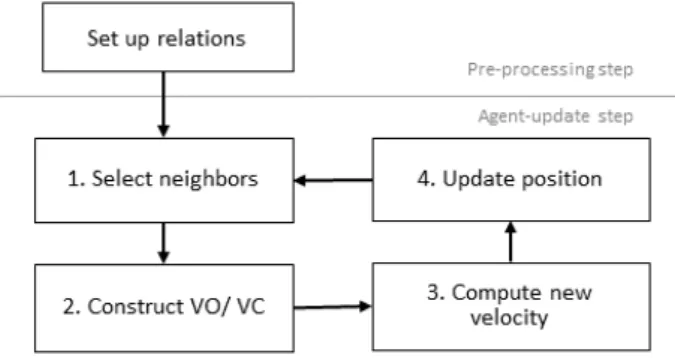
Our solution simulates crowds made of both individuals and groups based on a velocity-obstacle approach. Individual agents are agents that navigate with no desire to stay close to another agent and are steered exactly like in the existing RVO algorithm [VdBLM08]: their velocity is so that their (short term) future distance of closest approach with any other agent is always above a collision thresh-old. Group agents have a desire to stay near specific agents (the group members); these agents combine local avoidance with group-ing. Grouping is performed by selecting at simulation time a sub-set of agents belonging to the same group, called the connection neighbors. A group agent’s velocity is then computed so that its short term future distance of closest approach with its connection neighbors is below a maximum distance threshold. More precisely, our method is based on the run loop illustrated in Figure2. During preliminary initialization, a user sets relationships between agents (Section3.2). Then, during simulation, each agent: 1) selects a sub-set of connection-neighbors from its group (Section3.3); 2) com-putes the set of velocities that allow it to move towards its des-tination while avoiding collisions and staying near its connection neighbors (Section3.4); 3) selects a new velocity from this set (Sec-tion3.5) and finally 4) applies the selected velocity and moves.
Figure 2: Overview of Simulation workflow.
3.2. Setting up Relations
Users initialize a simulation by setting relation influences between agents and thus creating group of agents that are related. This step is performed through a relation matrix that encodes group relation-ships between agents. Entry ei j∈ [0, 1] of the matrix represents the relation influence, i.e., the preference of agent Ai to stay close to Aj: high values indicate high desire whereas a value of 0 indi-cates no grouping relationship. Conceptually, the relation matrix is a weighted directed graph describing logical (often asymmetric) relationships between agents. We can see a simple illustrative ex-ample of a relation matrix in Table1: a crowd of 5 agents consisting of 2 groups: {A1, A2, A3} and {A4, A5}. In the first group, A1has a stronger desire to stay near A3than to A2(e13> e12).
A1 A2 A3 A4 A5 A1 - .7 1 0 0 A2 .7 - 1 0 0 A3 1 1 - 0 0 A4 0 0 0 - 1 A5 0 0 0 1
-Table 1: Example of a relation matrix for two groups.
3.3. Selecting Connection-Neighbors
At runtime, each agent belonging in a group moves to stay close to some of its influencing agents (according to the relation ma-trix).The number of followed agents is limited, because maintain-ing close distance to all can be infeasible. As demonstrated in Sec-tion4, the limit number of connection-neighbors ncis a main pa-rameter of our method that affects emergent group behavior. This section describes how we select for each group agent a subset of connection agents, among all its influencing agents.
Selection Criteria We define a relation distance di jrel between agents Aiand Ajthat takes into account both the euclidean distance di jeucand relation influence ei j:
di jrel= deuci j · f (ei j), (1) where f (.) is a monotonically decreasing function; i.e., f (0) ≥
(a) (b) (c) (d)
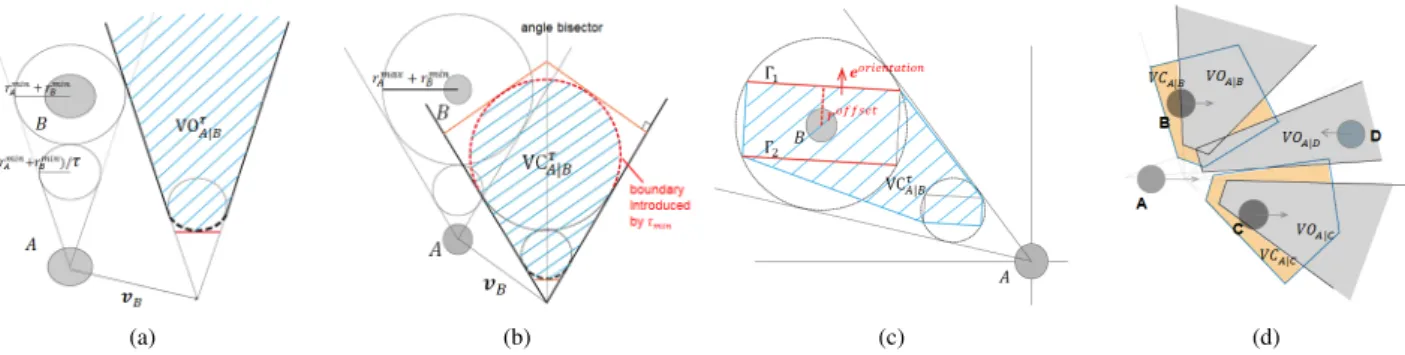
Figure 3: (a) The velocity obstacle V Oτ
A|Bof a agent B to agent A is a truncated cone in the velocity space. (b) The velocity connection VCτ
A|Bof an agent B to agent A contains the velocities that result in grouping A and B together for at least τminseconds before time τ. Here τmin= 1. (c) VCA|Bτ for a rectangular constraint. (d) A situation where not all velocity constraints can be satisfied since VCτ
A|B∩ VCA|Cτ = ∅ (group neighbors B and C are not close to each other). In this case, agent A tries to stay close to both B and C.
f(ei j) ≥ f (1), ∀ei j∈ [0, 1]†. Neighbors having the lowest nc rela-tion distances will be selected as the connecrela-tion neighbors. Com-bining euclidean distance and relation influence ensures that nearby low influencing agents will not overshadow further away high in-fluencing agents.
During simulation, when several agents are influencing each other they form a spatially distributed group. As all group agents are selecting a limited number of connection-neighbors (potentially smaller than the total number of agents in the group), a group can split into several subgroups. This happens in an emergent man-ner, depending on the group constraints. As an example, consider a school trip where all the members of the school are initially to-gether and might split into several subgroups due to navigation pur-poses or because they have different goals. This emergent behavior is studied in Section4.1and discussed in Section5.
3.4. Velocity Connection
Having the set of connection neighbors for all agents, we need to compute a velocity for each to perform both collision avoidance and grouping. Technically speaking, we build on the principle of reciprocal velocity obstacles (RVO [VdBLM08]). RVO allows per-forming collision avoidance by always selecting a walking velocity so that the distance of closest approach over a future time window is above a collision distance threshold rmin. To make an agent move near another agent, we add an upper bound rmaxto the distance of closest approach. The velocity of the agent will combine two local interactions: collision avoidance and staying close. In other words, it keeps distances with both a minimum and maximum boundary.
Velocity Obstacle We first remind how the velocity obstacle V O set is computed in an agent’s reachable velocity space. Let D(p, r) denote an open disc of radius r centered at p. Given two agents A and B, the velocity obstacle for A induced by B is the set of all velocities of A that will cause a collision between A and B at some moment before time τ. Formally:
† We use an exponentially decreasing function.
V OτA|B= {v|∃t ∈ [0, τ] :
t(v + vB) ∈ D(pB− pA, rminA + r min B )}. (2) In the velocity space, VO is a truncated cone and τ determines its truncated boundary, as shown in Figure3a. Velocities outside VO are guaranteed to be collision free, which leads to the definition of the set of collision avoiding (CA) velocities for A:
CAτA|B= {v|v /∈ V OτA|B}. (3) Velocity Connection We define the velocity connection VC as the set of velocities that make the agent’s distance to another agent within an upper bound in at latest time τ. For an agent A, the ve-locity connection for A with respect to B can be formulated in a similar way as VO:
VCτ
A|B= {v|∃t ∈ [τmin, τ] :
t(v + vB) ∈ D(pB− pA, rmaxA + r min B )}, (4) where τminis the minimum time spent to group together, which should be more than the update period to prevent excessive dis-placements in one time step. As shown in Figure3b, τminadds an-other boundary to the VC as compared to VO. In our implementa-tion, each of the curved boundaries of VC and VO are replaced by a tangent line for efficiency.
When A succeeds in approaching B at a distance less than rAmax, A should preserve that distance at all times. Thus, the relative ve-locity should stay in a circle centered at pB− pAwith radius rmaxA and thus the velocity connection becomes:
VCA|B= {v|τmin(v + vB) ∈ D(pB− pA, rAmax+ rBmin)}. (5) Formation Constraints The rmaxA boundary means that agents
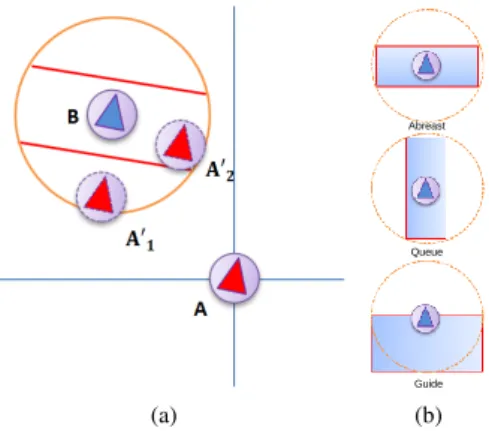
tend to stay in an arbitrary position within a circle around neigh-bors. However, groups often move according to a specific forma-tion, e.g., members of small groups prefer to walk side by side. Considering this, users can create additional formation constraints. For some situations, we employ rectangular constraints by placing boundaries Γ1and Γ2as shown in Figure3c. Placement is deter-mined by an offset ro f f set and a direction eorientationdepending on requested formations. The VC in then obtained by considering the vertices of the rectangle at the current timestep and after τ seconds. As an example, consider agent A with group neighbor B (Fig-ure4a). By setting eorientationto the moving direction B, A aims in staying in an “abreast” formation with B. In the current implemen-tation, we have three types of rectangular constraints, which can give queuing, abreast and guide-follower patterns (Figure4b). As we show in Figure5, agents keep their abreast formation even after interacting in constrained environments. Generally speaking, the constraint area can be any polygonal shape in the velocity space. If the polygon is convex, the grouping velocity set can be obtained by computing the convex hull of the vertices of the constraint polygon and the polygon scaled by τ.
(a)
Abreast
Queue
Guide
(b)
Figure 4: Anisotropic Constraints. (a) A01 and A02 are possible future positions for agent A. Both of them are acceptable in the isotropic constraint whereas only A02 is acceptable when having a rectangular abreast constraint. (b) The currently implemented anisotropic constraints.
(a) Isotropic ( [KDB12]) (b) Abreast Formation
Figure 5: (a) Using an isotropic constraint, agents will keep their distances but not initial angles, whereas (b) using an abreast con-straint forces agents to adapt as requested.
Multiple VCs and VOs In multi-agent scenes, collision free
ve-locities can be chosen from the intersection of CA’s of multiple nearby agents. Velocities keeping agents together to multiple con-nection neighbors would be in the intersection of VCs. Therefore velocities lying in both of the two intersections satisfy both group-ing constraints and collision avoidance. However, as shown in Fig-ure3d, there are situations that either of the intersections becomes empty. In these cases, rather than selecting a velocity strictly from the intersection set, we consider the preference of all reachable ve-locities and the most preferred velocity is selected.
3.5. Velocity Preference
During simulation, a group agent has to move towards a target while avoiding collisions and staying close to influencing agents. Therefore, an agent has to select a velocity that balances between these three, often conflicting criteria. We define m(v), as the pref-erence value of selecting velocity v:
m(v) = mV O(v) + wgmVC(v) + wvmdes(v). (6)
Here, mV O, mVCand mdesindicate preferences for avoiding col-lisions, staying with influencing agents (group cohesiveness) and following desired velocity respectively. Each one of these compo-nents is weighted by 1, wgand wvrespectively (wg, wv≤ 1); i.e., velocities that avoid collisions are typically preferred. High values of m(v) indicate high preference of selecting velocity v. Having a set of candidate velocities V = {v : |v| ∈ D(0, |v|max)}, we set the agent’s new velocity vnewas the one with the maximal preference value:
vnew= arg max v∈V
m(v). (7)
|v|max is the maximum speed the agent can reach and is deter-mined by the agent’s kinematic limitations and D(0, |v|max) con-tains all the reachable velocities of an agent. The candidate veloc-ity set V is constructed by sampling a number of velocities dis-tributed over D(0, |v|max). In the following paragraphs, we describe the three components of Equation6.
Grouping For an agent Aihaving a set of connection neighbors CNi, preference to the velocity connection mVC is dependant on how far away the candidate velocity is from all velocity connections {VCi| j: Aj∈ CNi}. We set:
mVC(v) = − 1 |CNi|Aj∈CN
∑
iei jλVCj (v), (8)
where |CNi| is the number of connections neighbors of agent Ai. ei jis the relation influence of agent Ajto agent Ai(Section3.2); large values of ei jincrease the attraction of Ajto Aiso that the
pre-ferred velocity is closer to VCi| j. Finally λVCj (v) weighs velocities based on distance to the boundary of velocity connections:
λVCj (v) = (
dVCj if v /∈ VCi| j
0 if v ∈ VCi| j. (9) dVCj is the nearest distance from v to the boundary of VCi| j. Collision avoidance Differently to mVC, mV Oconsiders the dis-tance from v to V Oi| j. Let λV Oj (v) be:
λV Oj (v) = (
dV Oj if v ∈ V Oi| j
0 if v /∈ V Oi| j (10) Here dV Oj is the nearest distance from v to the boundary of V Oi| j. The maximum λV Oj (v) measures how much that agent violates the constraints. Thus, we use it to penalize choosing v; mV O(v) is de-fined as the negative of this penalty:
mV O(v) = −max(λV Oj (v)) (11) Desired velocity Finally, to define a preference to desired veloc-ity mdes, we set λdes(v) to be the distance between v and the desired velocity. Thus mdesis defined as:
mdes(v) = −λdes(v) (12) In Section4.1(and to a greater extend in the Appendix), we give an analysis of the effect of weights wgand wvon group behavior.
3.6. Merging
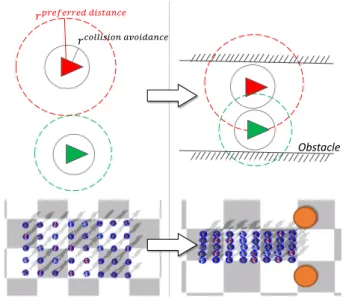
Figure 6: Splitting/Merging Agents of the green group split to avoid the agents of the red group. Setting nic= 1, an extended connection is made between agents of the two subgroups allowing them to merge back together directly after the end of the avoidance. As introduced in Section 3.3 and demonstrated later in Sec-tion4.1, group splitting can emerge. In some types of groups, such as families or small groups of friends, there is a high preference in members of groups to be attracted together. Though it is common to observe these types of groups split into subgroups for avoidance purposes, most of the time they merge back together as soon as
they can; i.e., they aim in staying close to both nearby and far away group members. A similar constraint can be added to the model (Figure6): in addition to selecting ncconnection neighbors, agents can select a limited number of “extended” connections nicfrom other subgroups (typically nic∈ [1, 2]). This allows agents to be at-tracted to both high influencing agents and to at least an agent from another subgroup and therefore guiding subgroups back together. By default, nic= 0 which means that subgroups will not seek to merge as soon as possible; rather they will be grouped after some time assuming they have the same goal. An example demonstrating this behavior can be seen in Section4.2.
3.7. Preferred distance
In Equation6we have set three main constraints on speed to get the general group behaviors. The first constraint, mdes(v) models the desire of an agent to move toward its goal. Adding the con-straint mV O(v) results in extending the model with collision avoid-ance behavior. Similarly by adding mVC(v) grouping behavior is added. Following the same motif, by adding additional constraints an agent’s behavior can become more complex. In this section we demonstrate such an application; we add a constraint on the mini-mum preferred distance agents want to keep from each other.
Obstacle
𝑟𝑝𝑟𝑒𝑓𝑒𝑟𝑟𝑒𝑑 𝑑𝑖𝑠𝑡𝑎𝑛𝑐𝑒
𝑟𝑐𝑜𝑙𝑙𝑖𝑠𝑖𝑜𝑛 𝑎𝑣𝑜𝑖𝑑𝑎𝑛𝑐𝑒
Figure 7: Preferred distance Agents have a new minimum dis-tance constraint that is more flexible than collision avoidance, al-lowing them to keep some empty space around them whenever it is possible.
Keeping a minimum preferred distance is a behavior quite simi-lar to collision avoidance. In both cases, a minimum distance with other agents is kept. The main difference is that in the case of col-lision avoidance, the minimum distance is strictly kept with others whereas the minimum preferred distance is a preference and can be ignored in specific situations, mainly when there is not enough space to satisfy it. In order to incorporate this behavior, we extend Equation6by adding a new constraint constraint mV I(v) using the
Table 2: Tested Parameters Parameters used in the sensitivity analysis; these affect the generated groups.
Eqn. Range Value Description
rmax 4,5 [1 − 4] 1.2m Max. distance
wg 6 [0 − .5] .5 Group weight
wv 6 [0 − .5] .2 Des. velocity weight
nc 8 [1 − 45] 3 Max. # of neighbors
|vi| 12 [.5 − 1.5] 1.33m/s Pref. Speed of agent Ai
ei j 1 [0 − 1] 1 Influence of Ajto Ai
same formulation as mV O(v) (Equation11) and increasing the ra-dius. Additionally, to make this a more flexible constraint, we as-sociate a very small weight wi≈ 0.1 ∗ wgto mV I(v). By doing this, agents will try to keep their distance from others but only if this is possible (see Figure7). Therefore, Equation6can be replaced with the following:
m(v) = mV O(v) + wgmVC(v) + wvmdes(v) + wimV I(v). (13)
4. Results
To evaluate the performance and quality of our system, we (a) test the effect of parameters on the results (Section4.1) and (b) demon-strate example scenes with various types of groups (Section4.2).
4.1. Parameter Analysis
The purpose of the sensitivity analysis is twofold; (a) to demon-strate that our framework is capable of generating a varying num-ber of groups of different properties and (b) to demonstrate sets of parameters that can be used to generate desired group behaviors (such as the ones demonstrated in Section4.2). To do so, we per-formed extensive tests on the effect of our system’s parameters on different quantitative and qualitative characteristics of crowds for different scenarios. We identify four parameters that affect group behavior the most; the number of connection neighbors nc, weights wg and wvfor group and desired velocity preference respectively and finally the presence of leaders. We studied the effect of these parameters on various group properties such as cohesion, density, velocity, collisions and goal completion (see the Appendix for def-initions).
4.1.1. Scenarios
The analysis is performed by simulating different scenarios that have the same basis, a group of agents where all agents have the same goal and equal weights in the relation matrix. During sim-ulations, different kinds of internal or outside influences were in-troduced aiming to introduce perturbations to the group’s behavior. Simulation were run multiple times (10 for each different case) for each different set of parameters with random initial positions for all agents. All of the simulations run long enough to capture the full effect of the perturbation. For all of the examined scenarios, all pa-rameters except the ones being tested have default values (Table2). We define three main scenarios for our experiments (Figure8):
Figure 8: Scenarios The scenarios being used for the analysis. Blue indicates the agents being analyzed, green opposing agents and red leaders.(top) SimSpeed (center) SimCFlow (bottom) SimLeader.
1. SimSpeed: We initialize a group of 90 agents with different pre-ferred velocities v : |v| ∼ U (.5, 1.5)m/s.
2. SimCFlow: The outside influence is a set of 135 individual agents that move on the opposite flow of the group of 90 agents. Additionally, all agents have the same preferred speed |v| = 1.33m/s.
3. SimLeader: We set the group size to 80 members, initially standing still without any goal (i.e., |v| = 0m/s) and introduce a leader that aims in passing though them and attracting them to its own goal. To design a leader, we initialize the relation matrix such that the leader has a higher influence on other agents; in our experiments ei j= 1 if Ajis a leader and ei j= .5 otherwise. For the first two scenarios we set the group to move from left to right whereas on the 3rd, agents start standing still.
4.1.2. Parameters Analysis
In this section we discuss the effect of some important parame-ters on observed group behaviors. A more thorough analysis can be found in the supplied Appendix.
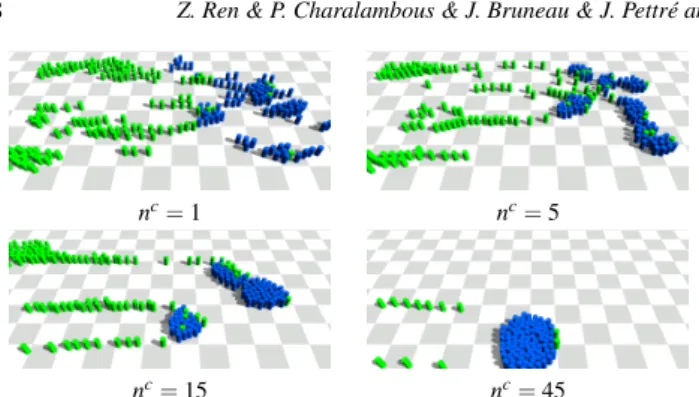
Connection Neighbors The number of connection neighbors nc has a big impact on group cohesion. As an example, consider how varying ncaffects group behavior for the SimCFlow scenario (Fig-ure9). Having a small ncresults in the splitting of the group into several small subgroups whereas progressively increasing ncresults in fewer and larger more cohesive groups. Setting nc= 45 that cor-responds to half the agents of the group, we get a very cohesive group where all group members stay together no matter the na-ture of the perturbation (different speeds or counter-flow of agents). Additionally, as expected and noticed in real life situations, having higher cohesion has a negative impact on speed or goal completion; agents need to slow down or temporary change directions so that they stay together. In the SimSpeed scenario for example, where agents are initialized with different desired speeds, having a small nc ([2 : 5]) results in clusters of agents that move with different speeds whereas higher values (nc> 5) result in larger, slower and more cohesive groups.
Weights Weights wgand wv(Equation6) play an important role in emergent group behaviors; they aim in balancing between
stay-nc= 1 nc= 5
nc= 15 nc= 45
Figure 9: Number of connections Increasing the number of con-nections increases cohesion forcing clusters to stay together when interacting with a flow of agents (SimCFlow).
ing with group members and satisfying desired velocity respec-tively (Figure10). Additionally, collision avoidance is affected in-directly; both wgand wvare always kept below 1 so that collision avoidance is always the most important criteria in selecting veloc-ities. As expected, low values of wglead to poor group behavior whereas high values give good group behavior but also agents that move less efficiently towards their goals. Similarly, low values for wvlead to agents that do not move efficiently towards their goals whereas high values forces them to prefer moving towards their targets in the most efficient way neglecting group behaviors. We found that a good balance between group and velocity preferences for most group behaviors is to set wg= 0.5 and wv= 0.2; here wgis bigger than wvand high enough to guide agents in staying together while still moving towards their goals.
wg= 0, wv= 0 wg= 0, wv= .2
wg= .2, wv= .2 wg= .5, wv= .2 Figure 10: Weights When group weight wg is large enough, the group does not break into clusters even in large interactions with other groups (SimCFlow).
Leaders/Followers In the leader-follower situation (Sim-Leader), some parameters have significant importance since they influence the leader’s capacity to lead other agents. The most im-portant parameter is the number of connections nc. As we can see on the example in Figure11, if ncis close to zero, the leader agent will not be able to attract all of the agents since not all of them can perceive it. If on the other hand nc is large, the leader will not have enough influence on the other agents to attract them; the group prefers to stay still. We found that an intermediate value of nc around 4 optimizes the leader’s capacity to lead other agents; this is the only situation in Figure11where the leader is able to lead all
the other agents. On the other hand, weights wgand wvhave simi-lar influence to the other scenarios; followers have no goals which practically means wvdoes not play any role in their behavior con-trary to the leader. If the leader agent favors group behavior (wg), then it will be attracted by the “no goal” heavy group and will fail to achieve its goal. If the leader favors velocity preference, then it will lose the majority of the group members whilst moving as efficiently as possible towards its goal.
nc= 1 nc= 4
nc= 10 nc= 15
nc= 20 nc= 45
Figure 11: Leader/Followers Resulting groups for different nc. In-creasing the number of connections neighbors makes the standing group more rigid and difficult to move using a single leader.
4.2. Example Cases
Based on the results of the previous paragraphs, we designed some scenes consisting of multiple types of groups; these include tours with guides, small social groups, big cohesive groups, etc. Please consult Figure1for an overview of some of the group behaviors we discuss here and the supplemented video for group animations (and implementation details) in various environments. Here we discuss the parameters used to achieve these behaviors. For all cases, de-fault values are the ones shown in Table2unless specified. In both example scenes, we can see some or all of the following types of groups at the same time.
Pedestrians We introduce groups of 2-4 agents walking together in streets as in typical real life environments. To achieve small cohesive groups we set rmax = 1 and nc= 1 for groups of 2-3 agents and nc= 2 for 4 agents (Figure1b); i.e., each character only considers friends for group navigation. Additionally, we used the abreast line constrained (as described in Section3.4) so that agents maintain side-by-side walking behavior even when interact-ing with other agents. In Figure5we show a comparison between using isotropic and anisotropic constraints.
Artist Performance Our system makes it easy to design a street performance (Figure1a); people gather around a performer and stop to watch her performance. To achieve this, we set the per-former as a leader but increase its rminto 4 and set rmax= 5. This enforces a personal space around the performer where other agents in the group cannot enter. Additionally we set nc= 2 for all agents so that agents in the same groups stay together.
Guided Tourists Guiding a group of tourists using a guide (Fig-ure1c) can be achieved by setting low ncfor the tourists so that they
stay with their closest friends whilst keeping the group intact. As discussed in Section4.1and the Appendix, setting nc∈ [3−7] gives the optimal results; here we set nc= 3. Additionally, the guide has influence ei j= 1 to all other members of the group and the tourists have an influence of .5 to all other members including the guide. Finally, when constructing the VC with the respect to the guide, a guide constraint is used (Figure4b) to keep the tourists staying behind the guide.
Students/Teachers Similarly to the guided tourist example, we set a higher influence of the teachers to the students (1 to .5 of the students) and set the relation matrix as seen in the video (Fig-ure1d). Students have no goal, i.e. their velocity will be zero if there are no teachers nearby, and are led by the teacher. By em-ploying the queue constraint between students and a abreast con-straint between student and teacher, students will walk in a queue formation with the teacher being on the side.
Crosswalk We also demonstrate two different types of groups crossing a crosswalk (Figure12); two big rigid groups (left) with a queue constraint and two groups consisting of multiple small groups of 2-3 agents (right) using a circular constraint. In both cases, nc= 1. In the first case, groups naturally form lanes to avoid each other more efficiently whereas on the second case the groups mix together but do not split from their groups.
Figure 12: Demo: Crossing
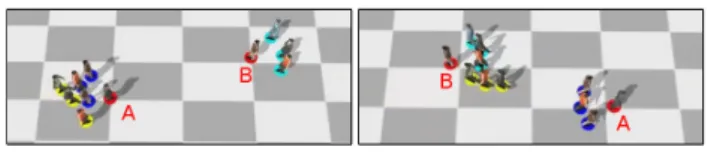
Switching between groups We are also able to simulate follow-ers that switch between different leadfollow-ers. These kind of situations can be observed in tourist attractions where tourists might switch to groups that they consider more interesting (interest is the influence of each leader). Another interesting application could be a hero unit in a game which when it acquires more experience/influence, can attract units from another hero unit. This phenomenon can natu-rally emerge with our approach by setting a relation matrix where multiple leaders have non zero influences on the same follower. We show an example of this behavior in Figure13; the yellow agents following leader A at the beginning switch to following leader B, since B has higher influence to them than A does.
Figure 13: Demo: Switching Groups
Dynamically Switching Parameters As described in Section3, a user defines the relation matrix and relevant parameters at a pre-processing step. This does not imply that parameters cannot change at runtime; parameters can be switched during simulation time to
change group behavior. We demonstrate such a scenario here (Fig-ure14) where a group in a square formation changes at runtime to a line formation to pass through a corridor more efficiently and then changes back to the original parameters (and therefore the square formation). The square formation is setup using nc= 3 and rmax= 1; the front agents use the abreast constraint whereas the others use the line constraint (the relation matrix can be seen in the supplied video). To switch to the queue formation, we set rmax= 2 and set the queue constraint to the front agents.
Figure 14: Demo: Dynamically Switching Parameters Inter-group interaction During group interactions, groups can bypass each other or one can split spatially into subgroups. Assum-ing a small number of connection neighbors nc, these subgroups might not merge back again soon. If desired, group re-merging can be enforced as presented in Section3.6. In Figure15we demon-strate that our approach is able to reproduce these different behav-iors with the right set of parameters. Setting nc= 3 to the group on the left, results to a big cohesive group that bypasses the small one. Decreasing ncto 2, makes the group split to avoid the small one. If the large group does not consider agents from both subgroups, it will remain split for a long time. To encourage re-merging, we force each agent to consider at least another agent from the other sub-group by setting nic= 1. For all cases, the small group had nc= 3.
Initial Setup Bypassing
Splitting Merging
Figure 15: Group Interactions Different interaction behaviors can emerge depending on parameters.
5. Discussion and Limitations
We propose a crowd simulation algorithm suitable for both indi-viduals and groups by extending a velocity-based approach with new kinds of interactions between agents. These local interactions enable two or more agents to move while trying to stay below a bounded distance from each other. Agents select other agents to stay close to based on a relation matrix that is easily set up by a designer. This bottom-up way to generate group behaviors gives us
a very flexible solution introducing significant progress beyond the state of the art in group simulation.
It is a unified solution to group simulation, since we can simulate a large number of different group situations just by setting appro-priate parameters. This approach can simulate such diverse groups as couples of walkers, lanes, formations and tourists with complex structure (e.g., group guide with different families in the group, etc). We demonstrate crowds made of mixtures of groups of differ-ent types as well as individual agdiffer-ents; all using the same algorithm. We show some intuitive correlations between the parameters space and the visual aspect of moving groups; this allows a designer to setup a simulation for a given desired scenario by selecting appro-priate parameters. Finally, the flexibility of the solution produces interesting patterns and emergent behaviors. From the simple be-haviors of staying together and avoiding collision, simulated agents demonstrate the ability to reproduce real groups behaviors such as group splitting, flow smoothing, group switching, fast agents slow-ing down to wait for slower group members, etc.
Our approach however has some limitations. First, our definition of local interactions in a group is a unique one: stay within a dis-tance (or polygonal area). We would like to consider some other types of interactions such as holding hand that add a very strong navigational constraint or more complex positioning with preferred position instead of hard constrained one. Moreover, we would like to add some higher level behaviors such as members of a group that meet and gather somewhere. As we show with the formation con-straint (Section3.4) and the merging (Section3.6), constraints can easily be added to the velocity computation or neighbors selection to handle more complex behaviors.
We would also like to evaluate the level of realism that can be achieved by the proposed system. This is a very difficult task since reference and observations data on groups are limited. The de-sign of relevant evaluation metrics for groups moving in crowds needs addressing as well. This by itself is an entire problem, cer-tainly out of the scope of this paper, and which requires a large effort in performing relevant evaluation. Finally, given the propor-tion of groups in real crowds (> 70% move in groups in typical crowds [MPG∗10]), it is certainly a promising research path for considering other type of applications, like architecture design and safety.
6. Conclusions and Future Work
We have presented a new microscopic algorithm to simulate diverse types of groups in crowds using a set of intuitive parameters. We have three main contributions. Firstly, we formulate a new model of local interactions between agents so that they form groups of agents moving together. We have demonstrated the ability of this local model to handle different kind of groups (couples to very large groups, leader(s)/followers groups, formation walking groups, ...) as well as a wide variety of behaviors (various levels of cohesion, group splitting and merging, group switching, ...). Secondly, we proposed a general, unified, crowd simulation algorithm which con-siders mixtures of groups and individual agents moving in the same scene. A simple relation matrix and few parameters determine the whole crowd in an intuitive way. Finally, we present an empirical
mapping between the parameter space of our solution and emer-gent group behaviors: this makes the parameter tuning stage easy with respect to the desired simulation scenario. Our results section demonstrates that complex scenarios can be achieved with relative ease.
Our results open promising future research paths. Our priority is to extend our solution with other new types of interactions be-tween agents of the same group and new types of groups. In re-ality, groups are places of possibly complex relations and interac-tion between members and also group composiinterac-tions can evolve in time. We demonstrated that we can switch parameters in simulation time, resulting in different group behaviors; by introducing mor-phing abilities we could have more control on group transitions. Additionally, by introducing complex interactions we would again extend the validity domain of our solution. Finally, an interesting avenue would be to introduce models of local interactions between 2 groups (or more) or between groups and individuals. Many inter-esting situations involve these kinds of interaction, like groups of teammates from opposing teams, or specific behaviors of individu-als with groups [BOP15].
Finally, our more long term objective is to evaluate our model from real crowd data. Some recent tracking techniques [PEVG10] or motion analysis techniques [CKGC14] are able to detect groups in crowd motions. These techniques could be put into practice to create a database on group behaviors and their influence on traffic. This would certainly serve as a basis to address the problem of evaluating the level of realism of our solution.
Acknowledgements
Work for this work has been funded by ANR JCJC PERCOLA-TION project, fund number ANR-13-JS02-0008.
References
[AMBR∗12] ALONSO-MORA J., BREITENMOSER A., RUFLI M., SIEGWARTR., BEARDSLEYP.: Image and animation display with mul-tiple mobile robots. The International Journal of Robotics Research 31, 6 (2012), 753–773.2
[BMdOB03] BRAUNA., MUSSES. R.,DEOLIVEIRAL. P. L., BOD -MANNB. E.: Modeling individual behaviors in crowd simulation. In Computer Animation and Social Agents, 2003. 16th International Con-ference on(2003), IEEE, pp. 143–148.2
[BOP15] BRUNEAUJ., OLIVIERA.-H., PETTRÉJ.: Going through, go-ing around: A study on individual avoidance of groups. Visualization and Computer Graphics, IEEE Transactions on 21, 4 (2015), 520–528. 2,3,10
[CC14] CHARALAMBOUS P., CHRYSANTHOUY.: The PAG Crowd: A Graph Based Approach for Efficient Data-Driven Crowd Simulation. Computer Graphics Forum 33, 8 (2014), 95–108.2
[CKGC14] CHARALAMBOUS P., KARAMOUZAS I., GUY S. J., CHRYSANTHOUY.: A Data-Driven Framework for Visual Crowd Anal-ysis. Computer Graphics Forum 33, 7 (2014), 41–50.10
[FS98] FIORINIP., SHILLERZ.: Motion planning in dynamic environ-ments using velocity obstacles. The International Journal of Robotics Research 17, 7 (1998), 760–772.2
[GCC∗10] GUYS. J., CHHUGANIJ., CURTISS., DUBEYP., LINM., MANOCHAD.: PLEdestrians: a least-effort approach to crowd sim-ulation. In Proceedings of the 2010 ACM SIGGRAPH/Eurographics
Symposium on Computer Animation(2010), Eurographics Association, pp. 119–128.2
[GKLM11] GUYS. J., KIMS., LINM. C., MANOCHAD.: Simulat-ing heterogeneous crowd behaviors usSimulat-ing personality trait theory. In Proceedings of the 2011 ACM SIGGRAPH/Eurographics Symposium on Computer Animation(2011), ACM, pp. 43–52.2
[HM95] HELBINGD., MOLNARP.: Social force model for pedestrian dynamics. Physical review E 51, 5 (1995), 4282.2
[JCP∗10] JUE., CHOIM. G., PARK M., LEEJ., LEEK. H., TAKA -HASHIS.: Morphable crowds. In ACM Transactions on Graphics (TOG) (2010), vol. 29, ACM, p. 140.2
[KDB12] KIMMELA., DOBSONA., BEKRISK.: Maintaining team co-herence under the velocity obstacle framework. In Proceedings of the 11th International Conference on Autonomous Agents and Multiagent Systems-Volume 1 (2012), International Foundation for Autonomous Agents and Multiagent Systems, pp. 247–256.2,3,5
[KGL∗13] KIM S., GUY S. J., LIU W., LAU R. W., LIN M. C., MANOCHAD.: Predicting pedestrian trajectories using velocity-space reasoning. In Algorithmic Foundations of Robotics X. Springer, 2013, pp. 609–623.2
[KLLT08] KWONT., LEEK. H., LEEJ., TAKAHASHIS.: Group motion editing. In ACM Transactions on Graphics (TOG) (2008), vol. 27, ACM, p. 80.2
[KO12] KARAMOUZASI., OVERMARSM.: Simulating and evaluating the local behavior of small pedestrian groups. Visualization and Com-puter Graphics, IEEE Transactions on 18, 3 (2012), 394–406.2 [LA15] LEMERCIERS., AUBERLETJ.-M.: Towards more behaviours in
crowd simulation. Computer Animation and Virtual Worlds (2015).2,3 [LCHL07] LEEK. H., CHOIM. G., HONGQ., LEEJ.: Group behavior from video: A data-driven approach to crowd simulation. In Proceed-ings of the 2007 ACM SIGGRAPH/Eurographics Symposium on Com-puter Animation(Aire-la-Ville, Switzerland, Switzerland, 2007), SCA ’07, Eurographics Association, pp. 109–118.2
[LCL07] LERNERA., CHRYSANTHOUY., LISCHINSKID.: Crowds by example. In Computer Graphics Forum (2007), vol. 26, Wiley Online Library, pp. 655–664.2
[LMM03] LOSCOS C., MARCHAL D., MEYER A.: Intuitive crowd behavior in dense urban environments using local laws. In Theory and Practice of Computer Graphics, 2003. Proceedings(2003), IEEE, pp. 122–129.2
[MPG∗10] MOUSSAÏDM., PEROZON., GARNIERS., HELBING D., THERAULAZG.: The walking behaviour of pedestrian social groups and its impact on crowd dynamics. PloS one 5, 4 (2010), e10047.1,2, 10
[MT97] MUSSES. R., THALMANND.: A model of human crowd behav-ior: Group inter-relationship and collision detection analysis. Springer, 1997.2
[MT01] MUSSES. R., THALMANND.: Hierarchical model for real time simulation of virtual human crowds. Visualization and Computer Graph-ics, IEEE Transactions on 7, 2 (2001), 152–164.2
[NGCL09] NARAINR., GOLASA., CURTISS., LINM. C.: Aggregate dynamics for dense crowd simulation. In ACM Transactions on Graphics (TOG)(2009), vol. 28, ACM, p. 122.2
[OPOD10] OND ˇREJJ., PETTRÉJ., OLIVIERA.-H., DONIKIANS.: A synthetic-vision based steering approach for crowd simulation. In ACM Transactions on Graphics (TOG)(2010), vol. 29, ACM, p. 123.2 [PE09] PETERS C., ENNIS C.: Modeling groups of plausible virtual
pedestrians. IEEE Computer Graphics and Applications, 4 (2009), 54– 63.2
[PEVG10] PELLEGRINI S., ESSA., VAN GOOLL.: Improving data association by joint modeling of pedestrian trajectories and groupings. In Computer Vision–ECCV 2010. Springer, 2010, pp. 452–465.10
[POO∗09] PETTRÉ J., OND ˇREJ J., OLIVIER A.-H., CRETUAL A., DONIKIANS.: Experiment-based modeling, simulation and validation of interactions between virtual walkers. In Proceedings of the 2009 ACM SIGGRAPH/Eurographics Symposium on Computer Animation(2009), ACM, pp. 189–198.2
[PV08] PEDICAC., VILHJÁLMSSONH.: Social perception and steer-ing for online avatars. In Intelligent Virtual Agents (2008), Sprsteer-inger, pp. 104–116.2
[QH10] QIUF., HUX.: Modeling group structures in pedestrian crowd simulation. Simulation Modelling Practice and Theory 18, 2 (2010), 190–205.2
[Rey87] REYNOLDS C. W.: Flocks, herds and schools: A distributed behavioral model. ACM Siggraph Computer Graphics 21, 4 (1987), 25– 34.2
[Rey99] REYNOLDSC. W.: Steering behaviors for autonomous charac-ters. In Game developers conference (1999), vol. 1999, pp. 763–782. 2
[RY13] ROJASF. A., YANGH. S.: Immersive human-in-the-loop hmd evaluation of dynamic group behavior in a pedestrian crowd simulation that uses group agent-based steering. In Proceedings of the 12th ACM SIGGRAPH International Conference on Virtual-Reality Continuum and Its Applications in Industry(2013), ACM, pp. 31–40.2
[SSKF10] SCHUERMANM., SINGHS., KAPADIAM., FALOUTSOSP.: Situation agents: agent-based externalized steering logic. Computer An-imation and Virtual Worlds 21, 3-4 (2010), 267–276.2,3
[TCP06] TREUILLEA., COOPERS., POPOVI ´CZ.: Continuum crowds. ACM Transactions on Graphics (TOG) 25, 3 (2006), 1160–1168.2 [TYK∗09] TAKAHASHIS., YOSHIDAK., KWONT., LEEK. H., LEE
J., SHINS. Y.: Spectral-based group formation control. In Computer Graphics Forum(2009), vol. 28, Wiley Online Library, pp. 639–648.2 [VDBGLM11] VANDENBERGJ., GUYS. J., LINM., MANOCHAD.:
Reciprocal n-body collision avoidance. In Robotics research. Springer, 2011, pp. 3–19.2
[VdBLM08] VAN DENBERGJ., LINM., MANOCHAD.: Reciprocal ve-locity obstacles for real-time multi-agent navigation. In Robotics and Au-tomation, 2008. ICRA 2008. IEEE International Conference on(2008), IEEE, pp. 1928–1935.2,3,4
[VMdO03] VILLAMILM. B., MUSSES. R.,DEOLIVEIRAL. P. L.: A model for generating and animating groups of virtual agents. In Intelli-gent Virtual AIntelli-gents(2003), Springer, pp. 164–169.2
[YCP∗08] YEH H., CURTIS S., PATIL S., VAN DEN BERG J., MANOCHAD., LINM.: Composite agents. In Proceedings of the 2008 ACM SIGGRAPH/Eurographics Symposium on Computer Anima-tion(2008), Eurographics Association, pp. 39–47.2